Archive | July, 2014

“This Wealth of Mr. Gertenrich has cost the Game an A-1 Player”

7 Jul

Sportswriter William A. Phelon said Louis Wilhelm “Lou” Gertenrich “is not a ball player because he has to be, but because he wants to be.”

The son of a successful candy maker, Gertenrich was rumored to be one of Chicago’s wealthiest young men.  He was also an excellent ballplayer and sprinter, but spent a great deal of time focused on business rather than sports.  Phelon said:

“Gertenrich hasn’t played ball, even when he desired to play the game, because his business interests would not allow him the leisure time.  In other words, Mr. Gertenrich, being a man of income and financial substance, cannot dally with the ball and bat as he would like, and this wealth of Mr. Gertenrich has cost the game an A-1 player.”

Lou Gertenrich
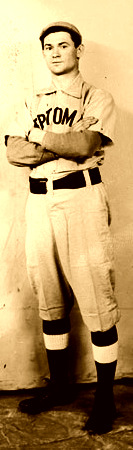
Lou Gertenrich

He began to be noticed as a ballplayer in 1891 as a 16-year-old pitcher with a team called the American Boys (later called the Mystics), the following year he joined the Clybourn Juniors.

At 19, in 1894 he joined Chicago’s City League, first with the Brands and then the Garden Cities, pitching and playing shortstop and outfield.  As local clubs found they could do better as independents than as members of a league the City League went from an eight, to six to finally a four-team league before disbanding at the close of the 1895 season.

Gertenrich remained a popular figure in semi-professional circles in Chicago, playing primarily for the Maroons and the Auburn Parks.

In 1898 The Sporting Life said Hank O’Day thought Gertenrich “is a sure comer.”

On September 15, 1901 the last place Milwaukee Brewers were in Chicago for a doubleheader, the final two home games for the first place White Sox.  Brewers Outfielder/Manager Hugh Duffy, and another outfielder, Irv Waldron, were injured.  As a result, The Chicago Daily News said:

“Manager Duffy gave Louis Gertenrich, a city league star, a trial.”

Starting the first game in right field, Gertenrich singled in his first big league at bat and scored a run on a home run hit by another player making his debut; Leftfielder Davy Jones.  Gertenrich was 1 for 2 before being removed in the fifth inning of a 5 to 4 loss.

In the second game he pinch hit for pitcher Ned Garvin and grounded out in the bottom of the ninth of a 9 to 4 loss to Chicago.

Gertenrich returned to the Auburn Parks with a .333 major league batting average.

He got a big league call again in 1903.  On July 21 the first place Pittsburgh Pirates were in Chicago to playing the Cubs.  Pirates Manager Fred Clarke, who was injured, had allowed outfielder Jimmy Sebring three days off to return to Williamsport, Pennsylvania for his wedding.

Gertenrich was brought in to play right field; he went 0 for 3 with a sacrifice bunt and handled two fly balls.  He returned to the Auburn Parks’ lineup the following day.

He spent most of the next decade playing in the re-formed Chicago City League—spending time with the Logan Squares, Gunthers, the Roger Parks, the West Ends, the Riverviews and Anson’s Colts.  He also coached baseball  at the Morgan Park Academy on Chicago’s South Side.

The Daily News said:

“Gertenrich is recognized as one of the heaviest hitters in local semi-pro ranks, and there is no batter more feared by the pitchers than this speedy fielder.”
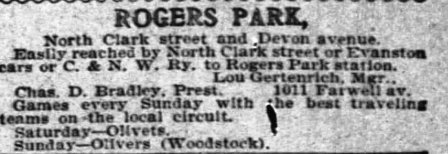
1906 advertisement for the Rogers Parks, when Gertenrich played for and managed the team

1906 advertisement for the Rogers Parks, when Gertenrich played for and managed the team

William A. Phelon wrote for The Chicago Journal when Gertenrich left Chicago briefly in 1905, at age 30,  to join the Springfield Babes in the Central League and the Decatur Commodores in the Three-I League.  Phelon told a story about Gertenrich’s stay in Springfield:

“Mr. Gertenrich was able to arrange his affairs for a lay-off of three months (in order to play for Springfield, and) the rich man negotiated with (Manager Jack) Hendricks for a position…The very next afternoon beheld Mr. Gertenrich, free from business care and happy as a proverbial lark, capering in the Springfield pasture and slamming that old ball like seven Cobbs and a Lajoie thrown in for luck.

“On his first day out he got three singles.  Next day he amassed two triples and a double.  The third day he whacked a home run and a single.  On his fourth day he drew three passes and connected for a triple.  On the morning of the fifth day Mr. Hendricks summoned him to headquarters.

“’Mr. Gertenrich,’ said Mr. Hendricks, pausing to wipe away a tear ‘you are a great batsman and a good fellow.  You are setting this league afire.  You are the wonder of the Twentieth Century.  But you are breaking the hearts of my younger players.  They cannot bat like you.  They are losing their ambition.  A few more games with you among them and they will pine away and die…Moreover Mr. Gertenrich, you have money.  You do not need this job.  The boys whom you are shoving into obscurity have little families and need the coin.  I hate to say it Mr. Gertenrich,’—and the manager again wiped away a tear—‘but you and I must part.  Here is your release.  Goodbye, Mr. Gertenrich, and good luck be with you.  Please go away, for I weep every time I look at you.”

Gertenrich also appeared in several games for Decatur after his release from the Springfield Babes, against Springfield’s other team, the Senators, and the Peoria Distillers.

For the next four seasons, Gertenrich remained one of Chicago’s best local athletes.  At 33-years-old in 1908 he was still a good enough runner to win the City League Field Day title of fastest player; The Daily News said he rounded the bases in 14 and 1/5 seconds.

The Chicago Eagle called him:

“(O)ne of the best known and most popular players in Chicago.”

In 1909 he hit .318 (5th in the league) and The Sporting Life said the Brooklyn Superbas were trying to sign Gertenrich and made an offer “which he has taken under consideration.”  The deal was never completed.

Gertenrich hit .350 in 1910 (3rd in the league), playing for Rogers Park.

In 1912 he returned to professional baseball as a member of the Chicago Green Sox in the United States League.  William C. “Billy” Niesen, a long-time City League operator had initially been one of the organizers of another proposed outlaw organizations, the Colombian League, but when then venture failed, and after one of the proposed New York team dropped out of the United States League in late March Niesen was awarded a Chicago franchise; Niesen was a good fit for the fledgling league because already had a ballpark on the North Side of Chicago at the corner of Clark Street and Leland Avenue–called Gunther Park, also referred to frequently in the Chicago press as Niesen’s Park.

The Sporting Life said “Base ball men are still betting that the new league doesn’t open the season,” but Niesen had high hopes.  He hired Burt Keeley, a long-time City League figure who had pitched in 30 games for the Washington Senators in 1908 and 1909.

He also signed Gertenrich, who had played for Niesen’s Gunthers in the City League the year before, and according to The Chicago Examiner had hit a home run off of Bill Lindsay of the Chicago American Giants that was “the longest hit ever seen at Niesen’s Park.”
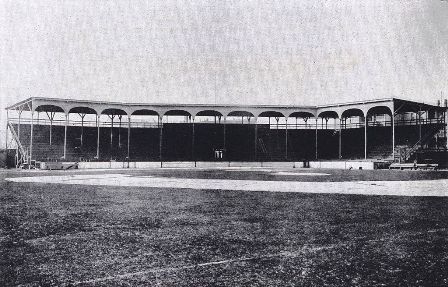
gunther

Gunther Park, where The Examiner said Gertenrich was responsible for “the longest hit ever seen at Niesen’s Park.”

An ambitious 126-game schedule was announced, but the upstart league was under-capitalized and low attendance doomed it to failure.  The league folded after just more than a month of play.  The Green Sox were 10-12.  Gertenrich returned to the candy business and semi-pro ball.

On March 8 of 1913 the Federal League rose out of the ashes of the United States League and was incorporated in Indianapolis.  Keeley was named manager, and many of the same players, including Gertenrich, who played for the Green Sox signed with the new club.

The Chicago Inter Ocean said:

“Gertenrich will be the mainstay of the outfield and is a heavy hitter.  He has made final arrangements for joining the club by procuring a competent manager for his candy business.  He will devote his time to the interests of the club.”

The team won their opener on May 6 against the St. Louis Terriers, and got off to a 7-1 start.  Chicago led the league until the middle of June when they were overtaken by Indianapolis.  They faded quickly after that; at the same time the team’s front office was in chaos, the team’s president was removed  and a new set of directors were elected in July.

On August 16 The Chicago Tribune said the team, hopelessly out of the pennant race, ten games behind Indianapolis, released Gertenrich “on the ground of cutting down expenses.”

Individual records are scare, but the 38-year-old Gertenrich was called “one of the classiest outfielders” in the league by The Associated Press.  In March of 1914 The Daily News said Gertenrich “was batting .413” at the time of his release, but had not received an offer from one the Federal League teams for 1914.

While Gertenrich relinquished some of the responsibilities of his company during 1912 and 1913 he had time to receive two United States patents for inventions for his candy company, including one described as a “corn confection” called the “Ball Tosser.”

Gertenrich was finished with professional baseball after his release in 1913, but continued playing semi-pro ball for several teams in and near Chicago, and formed a team called the Gertenrich Stars which played in Chicago through 1917.

He was a regular sponsor and attendee of alumni events for semi-pro and professional ballplayers in Chicago and played on the German Club of Chicago’s baseball team until his death from a cerebral hemorrhage in 1933.

As a candy maker he had one more connection with professional baseball.  An advertisement for his company appears on the back of a baseball card set.  The 120 card set–the more common version advertises American Caramel on the back (E121)—was issued in 1922.  The Gertenrich variations are extremely rare.
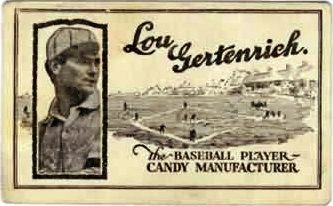
The Gertenrich back variation of an E-121

The Gertenrich back variation of an E-121 card
Independence Day 1918

4 Jul

In June of 1918 it was announced that King George V would be attending, and throwing out the first pitch, at the July 4 baseball game between the United States army and navy teams.

The Associated Press (AP) said the King was looking for help to prepare for the Independence Day game:

“At the request of the king, Arlie Latham, a former big league player, who will umpire the Fourth of July game, sent the King a regulation baseball a few days ago.  The next day Latham called at the Palace and gave the King a brief lesson as to how the baseball should be handled.

“The proper form in pitching was rather hard for the King to get, as he is used to a different type of throw, as in cricket, but the royal student finally began to get something approaching the right swing.  Since then the King has been practicing in his spare moments on a blank wall in the garden.

“The King has expressed hope that he will be able to throw out the ball in a manner to win the approval of the American Rooters.”

Whether he actually practiced is unknown, but the plan to have the King throw out the first ball was scrapped, and he instead walked the ball out to Umpire Latham and handed it to him.

Regardless of how the ball was delivered, the press in London understood the gravity of the gesture.

The London Daily Telegraph said:

“Nothing will give greater pleasure across the Atlantic than the appearance of the King and Queen at the baseball match at Chelsea.  That mark of understanding and attention will appeal to the heart of America far more than any military pageant or review, and the handing out of the ball by the king to the players—an act which will seem trivial and incomprehensible to the German mind—is likely to do more toward the removal of century-old prejudice in America against the name ‘King George’ than the ablest diplomacy or the most persuasive rhetoric.”

The London Daily Sketch memorialized the event in verse:

“King George III with cannon balls

Did try our brothers to dispatch.

King George V the country calls

To watch with him their baseball match.”

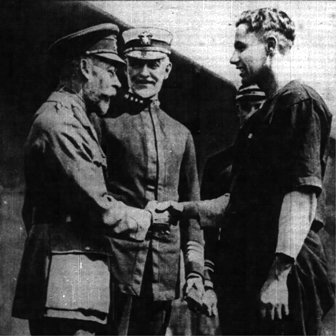
King George shakes hand with Lt. Mims, captain of the army team.  Admiral Sims looks on.

King George shakes hand with Lt. Mims, captain of the army team. Admiral William  Sims looks on.

On July 4 The AP reported:

“King George saw the American Army defeated in a hard-fought baseball game today.  The opponent of the army team was one picked from the American navy, which won by a score of 2 to 1.  Every one of the nine innings had its thrills for the more than 18,000 spectators.

“King George followed the game closely and enjoyed it thoroughly.  At the close he turned to Admiral (William) Sims and General (John) Biddle and expressed the hope that he might be able to see many more games before the summer was over.

“Few sporting events since the war began have aroused so much interest and discussion in London as yesterday’s game.  Independence Day was on everybody’s lips…For several days the newspapers have been explaining baseball and the people of London have been pouring over the mysteries of the American national game, instinctively trying to find in it some parallel to their own cricket.  Many persons went to the game armed with clippings and drawings of a diamond showing the position of the players.

“American soldiers and sailors on their way to the game were heartily cheered.  Outside the entrance to the Chelsea football grounds, where the game was played, the people lined the streets for several blocks and crowded the windows in their homes to watch the crowds.”

Hall of Famer Herb Pennock pitched for the navy team which was captained by his Red Sox teammate Mike McNally.

Most sources reported the the attendance as 18,000.  McNally, in a letter to Red Sox Secretary Larry Graver said in a letter reprinted by The AP:

“There were some 50,000 people present.  King George, Admiral Sims, and a lot of other ‘big guys.'”

The wire service summed up the importance of the day:

“No Country ever celebrated the national anniversary of another country as the people of Great Britain today celebrated the Fourth of July.”

“No Exhibition was ever Received in this City with more Enthusiasm”

2 Jul

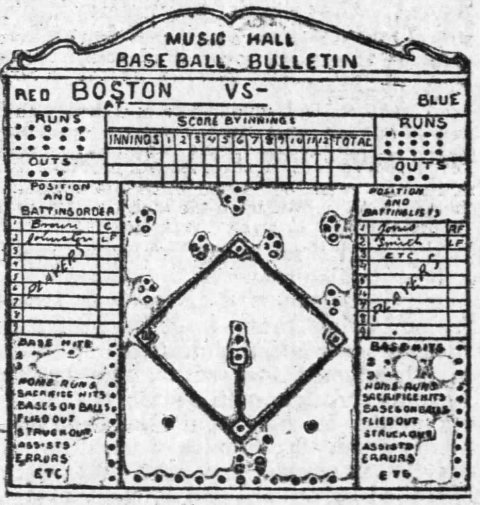
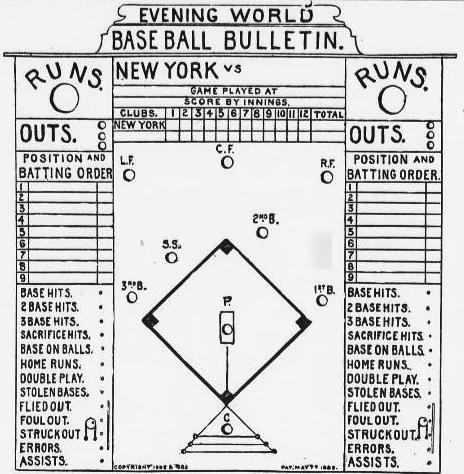
The New York World unveiled a newly updated attraction for baseball fans on August 6, 1889; the “Baseball Bulletin,” a version of which had also been introduced at the Boston Music Hall earlier that summer.

The Boston Music Hall "Bulletin Board."

The Boston Music Hall “Bulletin Board.”

The Associated Press said some fans thought the board was “an advantage over the actual game, in that it not only reproduces the plays graphically and simultaneously, but it keeps at the same time a simple and conspicuous record of the contest.”

The New York World's "Bulletin Board."

The New York World’s “Bulletin Board.”

The Boston Herald said their board measured “fifteen feet square.”  New York’s board was an improved version of one that had been used the previous October for the Giants six game to four World Series victory over the American Association’s St. Louis Browns.

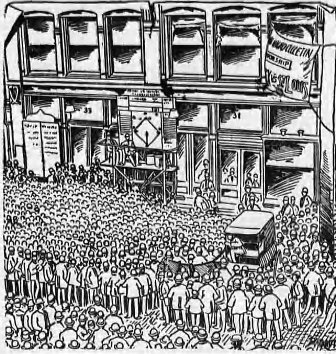
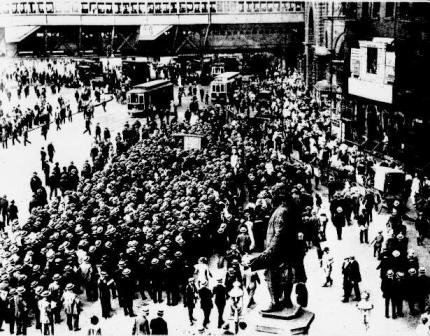
The crowd on Park Row for the 1888 World Series

The crowd on Park Row for the 1888 World Series

The board was the creation of  reporter Edward Van Zile of The World; Van Zile received a patent for the invention, although it was another member of the paper’s staff, Publisher Joseph Pulitzer’s secretary Edwin A Grozier, who turned it into a profitable enterprise. After purchasing the original rights from Van Zile, Grozier improved the design and received his own patent.

The World said the new version was a bigger sensation than the one introduced the previous October:

“’Perfection’ is the word which expressed the verdict of the baseball public who had the good fortune to witness the game between the New York Giants and Baby Anson’s team on The  World’s Baseball Bulletin Board yesterday afternoon…it is safe to say that no exhibition was ever received in this city with more enthusiasm than was the baseball bulletin.

“And the crowd too!  What a vast number!  There must have been fully 10,000 people in the audience, and the way they cheered when the Giants made a run was a sound that would have made Baby Anson sick.”

The presentation of the game took place on New York’s “Newspaper Row” (Park Row), with a crowd on the east side of the street

“(E)xtending from above The World Building to far below it (and) on the west side of the street the crowd was much larger.  There was a long line of people from Mail Street almost down to the other end of the big Federal Building.

“No point from which the game could be witnessed was left vacant.  The boys climbed up and lodged themselves in among the pillars of the Post Office…Even the lamp post was monopolized by the urchins, and when our boys made a good play they generally led the cheering.”

The “expert board operator placed the Chicago men in the field,” for the first inning, and leadoff hitter George Gore at the plate:

“When (Gore) slid down to first base the crowd were just ready to cheer, but they saw him put out and they reserved their applause for another occasion.

“They did not have long to wait, however, for (Mike) Tiernan and (Buck) Ewing  each succeeded in gaining bases, and then big Roger Connor was placed over home plate

“The crowd held its breath in anticipation of what was to come.  Their enthusiasm was drawn up to a high pitch, and was just waiting for a chance to break its bonds.  And they got it!  The little red disk representing Connor slid up to first and Tiernan slid across home plate.  Then there was a volley of cheers.  It broke forth clear and strong, and the sound could be heard blocks away.

“Up on the tops of the tall buildings in the neighborhood the cheers of the crowd could be heard resounding forth as a victorious army returning from battle.

“And it was all the same through the game. A great many people were attracted to the spot by the cries of the crowd, and when they saw the baseball bulletin they all united in declaring it to be the greatest thing they had ever seen.”

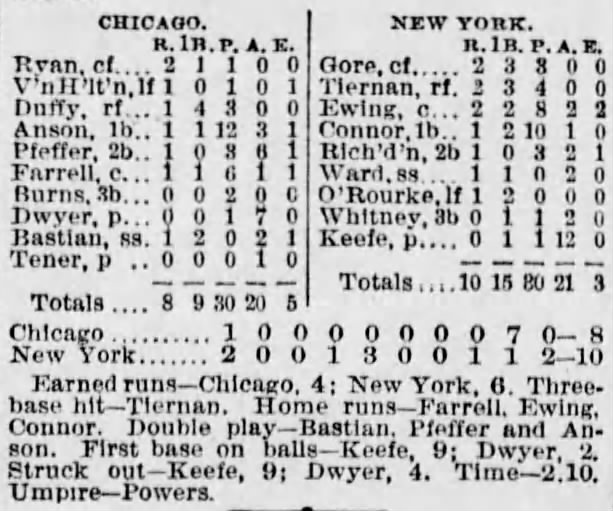
Chicago scored seven runs off Tim Keefe in the ninth to tie the score at 8.  The crowd’s “disapproval resolved itself into a continued groan.”

The Giants scored two runs in the tenth, and when the white Stockings came to bat in the last half of the inning:

“(T)he crowd watched more intently than at any time before.As each Chicago man went out there was a yell, and when they all went out without having made a run it was impossible to say a word that could be heard.”

The Box Score

The Box Score

The paper commemorated their innovation with a poem:

A boy was passing down the street,

Another lad he chanced to meet;

‘I’ll bet,’ he said, ‘we’re licked once more.

What is the score?’

A merchant coming down that way,

Lifted his bearded head so gray;

And ceased o’er book and cash to pore—

‘What is the score?’

A preacher wrestled with his text,

And wondered what he’d best say next;

Then called out through his study door;

What is the score?’

The Mayor in his office sat

And pondered over this and that,

The said: ‘I’m sure the game is o’er.

What is the score?’

If they had only chanced to go

Into the middle of Park Row,

And see the bulletin of The World,

And the glorious pennant there unfurled,

They’d never ask the question more

‘What is the score?’

The  World predicted the initial crowd was just the beginning:

“Today’s game between the Chicagos and the New Yorks will be duly recorded on the board.  There is room for everybody to see, and it is expected that the crowd will be twice as large as yesterday.”

The following day the paper did not say the crowd had doubled—to 20,000—but claimed it was “The largest crowd that had ever been on Park Row,” for the Giants 4 to 2 victory over the White Stockings.

Crowds continued to come to Park Row as the Giants battled the Boston Beaneaters and won the pennant on the final day of the season.

Baseball Bulletin Boards, and other versions of the concept, remained a popular feature well into the 20th Century. More often than not they were sponsored and presented by local newspapers.

The New York Sun presented their own "Baseball Bulletin Board"  on New York's Park Row in 1914

The New York Sun presented their own “Baseball Bulletin Board” on New York’s Park Row in 1914