Named after the nation’s first black governor, Pinckney Benton Stewart Pinchback of Louisiana, the Pinchbacks were the best black baseball team in New Orleans–and the entire South– during the 1880s.
In August of 1888 The Chicago Tribune said the Pinchbacks were coming to town:
“This is the first time a colored club from the South has visited Chicago.”
The team scheduled games with the Chicago Unions for August 21 and 22, then were traveling to St. Louis.
The paper said:
“The Pinchbacks are composed of the best colored players, and will certainly give the Chicago and St. Louis boys some trouble.”
The Tribune claimed Pinchbacks’ pitcher George Hopkins:
“(P)ossesses wonderful control over the ball, and in no game so far this season has he struck out less than ten men.”
There were wildly different estimates of the crowd. The Chicago Herald said 300 fans saw the game, The Chicago Inter Ocean said 1500 turned out.
Despite the low estimate of the crowd, The Herald said there was great interest in the game
“No less than 150 boys or ‘kids’ surrounded the ball grounds as early as 2 o’clock (the game was scheduled for 3:45) and importuned every adult who approached with, ‘Say, Mister, won’t yer take me ter th game?’ For four or five innings those ‘kids’ took in the game through the knotholes and cracks in the fence, crouching or straining two or three deep…Finally they found an unguarded hole through which they slipped inside, and soon a policeman’s services had to be invoked to keep them from clustering on first base.”
The paper said another 50 or more fans viewed the game, “(F)rom the top of a Rock Island freight car a block distant.”
Among the fans, according to The Herald were “(A) score of colored ladies, 12 or 15 (Chinese) and 20 or 30 whites.”
The Tribune also provided as much coverage of the atmosphere surrounding the contest as the “Wildly exciting game,” at Chicago’s South Side Park, located at 33rd Street and Portland Avenue.
“Both organizations enjoy an unrivaled reputation in the world of colored sport, and the Pinchbacks are so highly esteemed in Louisiana that five carloads of gentlemen of their race came with them from the South. The betting on the contest was unprecedentedly heavy, a colored saloonkeeper, whose probity is held beyond question, having in his pockets 124 dollars and 45 cents cash, a ring with a stone popularly believed to be an amethyst, two pencil cases, a watch chain, and a promissory note, being the stakes in various wagers made upon the result, together with a bundle of gold-topped umbrellas, and canes with silver heads and elaborate monograms.”
Fans of each team sat on opposite sides of the grandstand:
“The New Orleans contingent sat to the right of the stand, and the Chicago men to the left. There was not much cordiality between them as hospitality demanded. A notice board separated them. It said: ‘Please do not throw cushions.’
“The Southerners, being men of means, had all provided themselves with cushions. The Chicago men, being comparatively indigent, had to sit on the hard boards.”
One New Orleans fan threatened the umpire, who the paper described as “A gentleman of mild disposition.”
Unions’ manager and catcher Abe Jones admonished the fan:
“’You won’t use any profane language on these grounds,’ cried Mr. Jones.
“’Go along,’ retorted the man…’you can’t hit the ball with a shovel.’
“On this, a partisan of the home team raised a cushion, which her purloined in the excitement from a Southerner, and brought it down with a resounding thwack on the head of the enthusiast, who was heard to exclaim as he sunk to rise no more, ‘Can’t hit the ball with a shovel.’”
Early in the game, the umpire caused another controversy when a Pinchback batter was called out on strikes:
“’Get a new umpire,’ cried the excursionists from New Orleans. ‘The umpire’s all right,’ returned the Chicago men.”
The Pinchbacks persisted and:
“Two umpires were selected in place of the weakling whose infirmity of purpose had precipitated the crisis.”
With the new umpires in place, the paper said:
“And now the game became exciting.”
The Herald said the umpire, named John Nelson, was much more of a factor. The paper claimed:
“He made several very bad decisions, every one favorable to the home nine.”
Entering the sixth inning the score was tied at one when a Chicago player doubled off of Hopkins. The Tribune said:
“In an instant, the grandstand went mad. One gentleman stood upon his head, his legs being supported by two friends, who held him in this uncomfortable position until somebody bowled him over with a cushion. Another gentleman transformed himself into a windmill and swung his arms at incredible speed. A third turned a succession of somersaults, landing at length in the midst of the New Orleans contingent, which, chafing at the prospect of defeat lifted him bodily and dropped him over the stand.”
The Union Giants scored three runs in their half of the sixth:
“The Southerners never recovered from the disaster. One of their supporters, whose face was so freckled that it looked like fly-paper in a confectioner’s window, announced despairingly that all was over but the shouting. The saloonkeeper began his distribution of silver-headed canes and gold-tipped umbrellas.”
The Union Giants won 4 to 1:
“Then the cushions flew.
“The women pressed around the Unions, even going to the length of embracing them. Cigars were pressed upon the winners by their happy supporters.
“’It’s the pootiest game we’ve played for months,’ said one of them.
“And it was.”
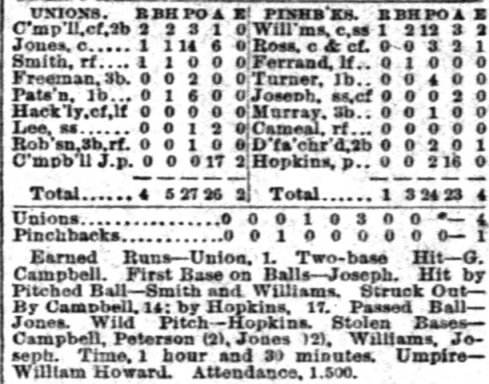
Game 1 Box Score
The Pinchback came back the next day, beating the Unions 6-5. The Inter Ocean said 1800 were in attendance and credited Hopkins, who pitched complete games in each game, with 37 strikeouts over 18 innings—a claim Abe Jones of the Unions disputed in a letter to the paper:
“There were ten strikeouts and the manager of the Pinchbacks (Walter L. Cohen) made a great mistake in his report of the game. Hoping that he will be more truthful in his next.”
Two days later the paper published Cohen’s response:
“Jones (denied) the accuracy of the published score…I beg leave to state in justice to myself that the gentleman who scored the game was employed by Mr. Jones, and if there is a mistake it is him who is responsible and not me, for I had nothing to do with either the scoring or compiling of the score.”
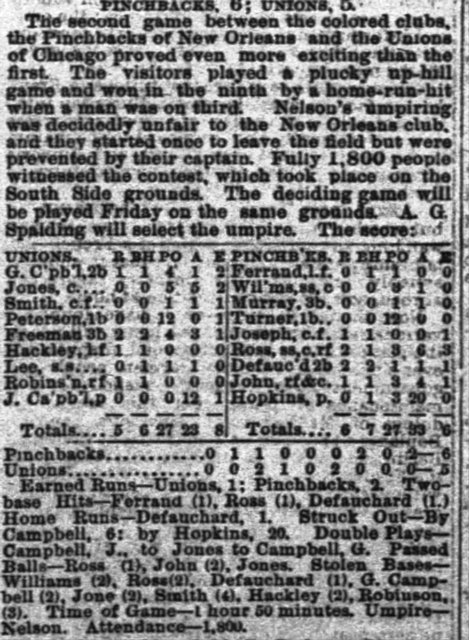
Game 2 Box Score
The bad blood between the teams might explain why rather than playing a deciding game, The Tribune and The Herald reported that the Pinchbacks chose instead to play against a “picked nine” at Southwest Park on at the corner of Rockwell and Ogden, on their third day in Chicago. They won 14-7. Hopkins completed his third complete game in three days. It was reported that he struck out 14.
The Pinchbacks swept a three-game series with the St. Louis West Ends at Sportsman’s Park before returning home. The New Orleans Times-Picayune said:
“The famous colored baseball club, the Pinchbacks, arrived home last evening after a successful sojourn in Chicago and St. Louis, where they bore away most of the honors.”
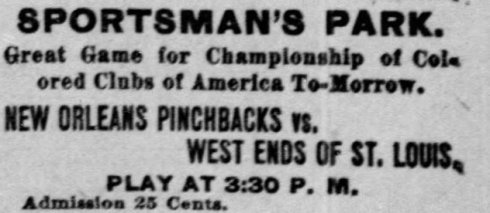
Advertisement for the Pinchbacks vs West Ends
The Pinchbacks returned to Chicago the following year, and in 1890, Hopkins left New Orleans and joined the Unions, which brought about the end of the team’s prominence in Southern black baseball.
Tags: Abe Jones, Chicago Unions, George Hopkins, New Orleans Pinchbacks, Sportsman's Park, St. Lous West Ends
 Baseball History Daily