Archive | January, 2021

“A New Era in the Sport”

6 Jan

“The baseball world is beginning to roll itself into its usual spring prominence, and while managers are busy signing the players assigned to them, the public is awaiting patiently the beginning of what is predicted will be a new era in the sport.”

O.P. Caylor’s prediction in The New York Herald was made before the National League began the 1892 season as 12-team league playing a split season after the collapse of the American Association, and Caylor sought out the opinions of several players, managers, and executives about the coming season; they shared their “sanguine feeling on their part in the success,” of the game.
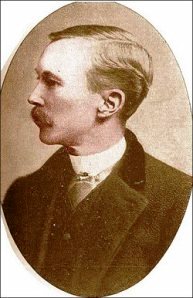
O.P. Caylor

Brooklyn’s Dave Foutz said:

“I don’t believe it will be necessary to make any changes in the rules. We have got our hands pretty full with testing the policy of a twelve-club league and a double season without trying any new rules to perplex the public.”

Foutz said the league was now composed of “the twelve best cities in the country to play in, and the best players will be put in the field.”

Chris von der Ahe, owner of the St. Louis Browns said:

“While I opposed the twelve-club league when the idea was first broached, I feel now that the interests of baseball are best subserved by the new agreement.”

He said the dissolution of the Association benefitted his team:

“The St. Louis club is stronger than it ever was, and we will show the patrons of baseball all over the country a championship form.”

Harry Wright, manager of the Philadelphia Phillies said:

“Never in the history of baseball has the prospect for a successful season been brighter; never has there been such a perfect harmony among the baseball powers in this country. This fact, in my opinion, leads to the hope that the game of baseball will be revived to all its pristine glory.”

Harry Wright

Wright said he felt the distribution of American Association refuges had been “fair and equitable” and said:

“As far as the two-season idea is concerned I believe it will be a success, and I think that the public generally will watch the finish each time with the same intense interest that has marked the great and close finishes of the past.”

New York Giants manager Pat Powers said:

“This twelve-club league, it strikes me, will be a decided success. Coming, as it does, in a presidential year is very fortunate.”

His rationale was that during every other presidential year “interest in baseball would decrease” as the election drew closer, and the new league format would mitigate that loss of interest.

Powers said the “twelve most representative cities “ were included and “the different clubs are composed of the very best players of the baseball profession.”

Powers said the split season would “keep the public interested,’ the larger league would be successful, and “the game will boom.”

Charles Byrne, the President of the Brooklyn club said the split season would allow fans to “witness the most exciting finish es baseball has yet known.”

The Boston Beaneaters won the first half, the Cleveland Spiders the second; Boston beat Cleveland five games to none for the championship.

Foutz and Byrnes’ Brooklyn Grooms finished third, Wrights’ Philadelphia Phillies fourth, Powers’ New York Giants eighth, and von der Ahe’s Browns 11th.

The split season was dropped before the 1893 season.
“When Baseball was in Swaddling Clothes”

4 Jan

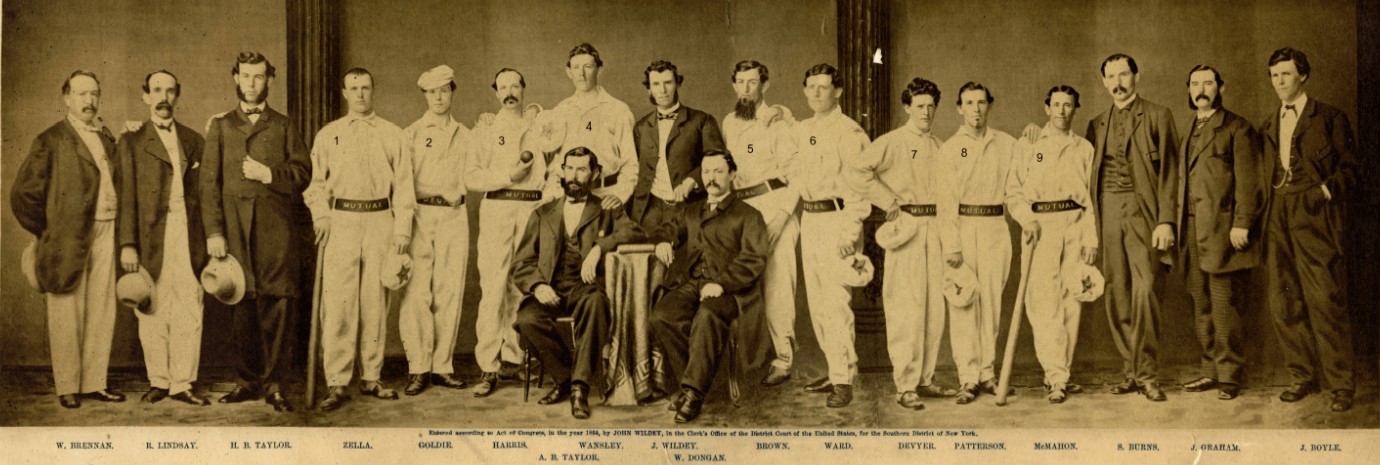
William “Billy” McMahon was a member—and for a time captain—of the Mutual Club of New York from 1859 to 1870, he later became a successful businessman, owning a “Concert saloon” called the Haymarket in at the corner of Sixth Avenue and Thirtieth Streets in Manhattan’s Tenderloin District. McMahon’s establishment was so popular that his obituary estimated his net worth at $500,000.

1864 Mutuals–McMahon is fours from the right.

McMahon was also a volunteer firefighter, and in that capacity, in 1887, joined the New York Veteran Fireman’s Association on a cross country trip, which stopped in Chicago in September–a reporter for The Chicago Daily News, hearing of McMahon’s baseball past, sought him out.

“’What’s that? Baseball! Bless me, I’ve almost forgotten the game. Who told you I knew anything about baseball? Listen to this young fellow, boys.”

The reporter had been tipped off about McMahon by Tom Foley; Foley played with the 1871 Chicago White Stockings and lived in the Chicago suburbs:

“Tom Foley told you! Where in the name of all that’s sacred is Tom? Tom Foley! Why great thunder! I thought he had gone under.”

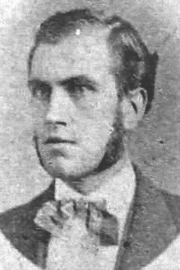
Foley

McMahon was 58 years old and described as “a smooth-faced, gray-haired, pleasant, jovial old gentleman.”

He said:

“Well, well, who’d a thought it! To come way out here to Chicago to be asked about baseball! But I can tell you something about the old days and the players, that’s a fact. Let’s see—it was in ’52 when I first got to be some pumpkins as a ballplayer. That was the time when baseball was in swaddling clothes and needed a nurse.

“The only two clubs then in existence were the Knickerbockers and New Yorks, afterward called Gothams. You know—but of course you don’t know, young man—but I’ll tell you. There were no (set number of) innings in those days. No, sir…Twenty-one aces counted a game, and the club which made them first won.”

McMahon said when he began playing in 1852 for the Gothams, he was working as a “butcher boy, stout, strong and active, and oh, how I could run and chase a ball, and the old man rubbed his legs most tenderly as a spell of deep thought came over him and the old days passed in review before his fancy.”

He said he played shortstop in one of the 1852 games against the Knickerbocker’s at Red House Grounds—the teams played two games that year at the Harlem location which also was the sight of a racetrack. His recollection of the result differs from the available information about the game(s).

“Well, the Knickerbockers won the toss, and, unlike the practice now-a-days, took the bat. They made five runs and we followed with three. The next time we skunked ‘em, and in two more ties at bat we made 21 aces and won the game.”

McMahon claimed after that single game in 1852, until he joined the Mutuals in 1857.

He recalled coming to Chicago with the team in 1870 to play the White Stockings on July 23; by that year, according to The Chicago Tribune McMahon was “business manager, and substitute in case of need.”

He did not play in the game but recalled “(we) made the great and first record of scoring 9 to 0, and from this game came the expression “Chicagoed,” which I understand, is used to this day when a whitewash is affected.”

And McMahon, like so many to come, decried the decline in the quality of the game from his time:

“(B)ut the baseball today ain’t a marker of that of twenty-five years ago. Why, what catcher could have stood behind Johnny Hartfield [sic, Hatfield]…whose throwing record at Hartford has never been beaten,”

Hatfield threw a ball 382 feet six inches on July 10, 1868—but it happened in Cincinnati, not Hartford as McMahon recalled.

The current pitchers, he said:

“(F)ire in the ball overhand as though they meant to commit murder. No, no; gimme the good old underhand throw, lots of hitting and lots of pretty fielding. That’s your game for fun. I stand now ready now to gamble $500 to $1000 that the clubs of today, using the same lively, half rubber ball we used, cannot excel the good score we made in the old days.”

McMahon sent his “regards to the white Stockings,” then the “fireman moved away with his comrades.”

McMahon continued to operate the Haymarket until selling it in 1890, The New York Journal said, “He never interfered with the crooks, but it was distinctly understood that there must be no crookedness carried on within his walls.” The New York Times was less charitable and said, “some of the worst characters in police annuls had the run of the place.”

“He died in 1898.