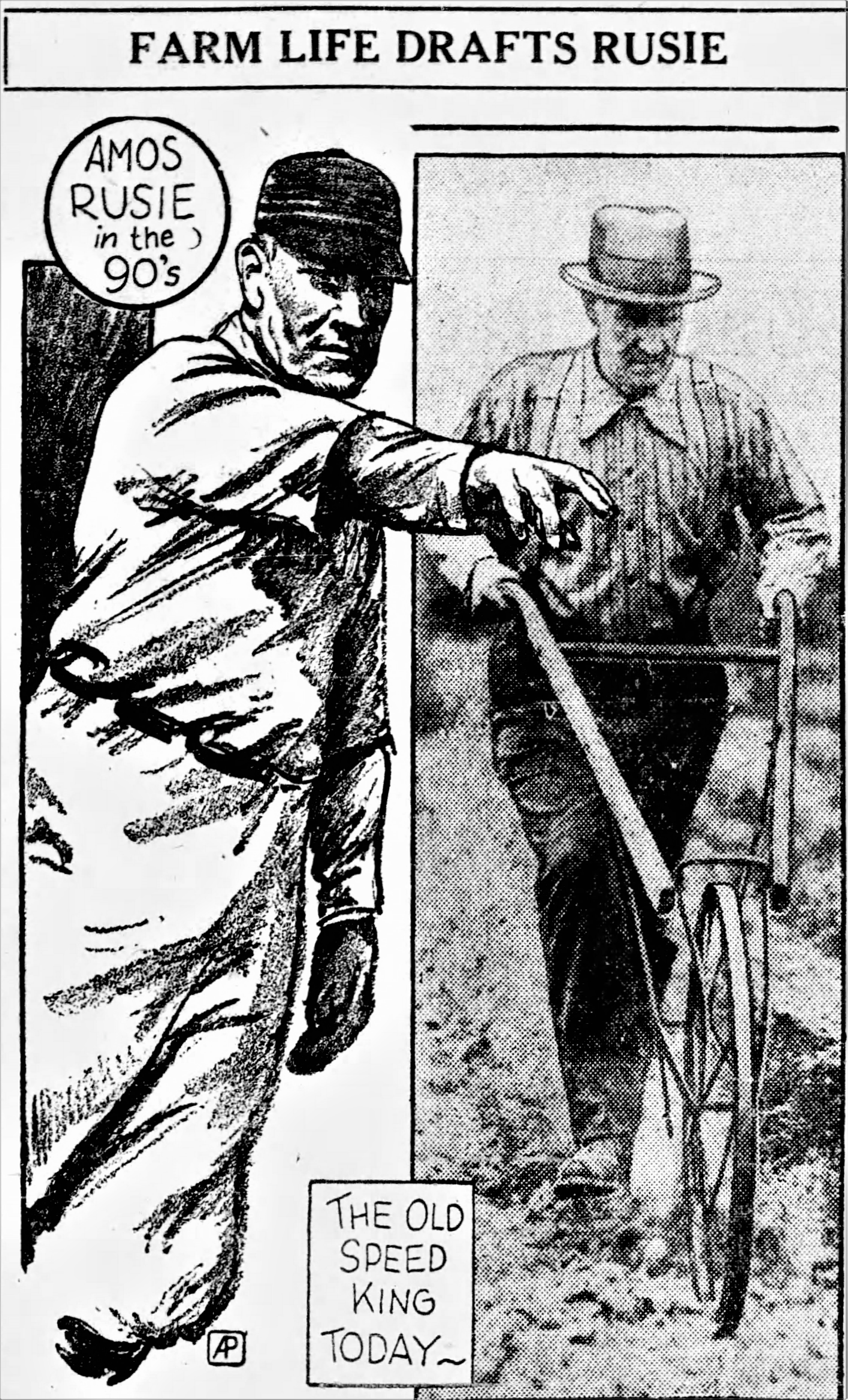
Amos Rusie’s return to the Seattle area to purchase a farm in 1929 made his briefly as interesting to West Coast baseball writers and his arrival at the Polo Grounds eight years earlier had briefly made his reminiscences of great interest to the New York scribes.
There is some disagreement about whether Rusie enjoyed his time in New York. What’s certain is his eight years caused him to retract his opinion from 1921 that the game had not substantially changed.
Rusie
When he arrived in Washington, The Associated Press asked the former pitcher/ballpark superintendent turned farmer for his views on the game and to select his all-time team.
Rusie said he couldn’t understand how modern pitchers “don’t pitch to sluggers,” enough:
“None of the pitchers in my day were afraid to pitch to the best of them. You didn’t find us walking the slugger almost every time he came to bat, as they do nowadays. We figured we would either make him hit the ball or sit down. That’s what he was up there for.”
Rusie said “brain counts more than slugging,” and selected an all-time team that included just one (barely) active player:
Pitchers: Christy Mathewson, Kid Nichols, Cy Young
Catchers: Buck Ewing, Roger Bresnahan, John Kling
First base: Dan Brouthers, Fred Tenney
Second base: Napoleon Lajoie, Eddie Collins
Third base: Jimmy Collins, John McGraw
Shortstop: Honus Wagner, Hughie Jennings
Left field: Ed Delahanty, Joe Kelley
Center field: Ty Cobb, Tris Speaker
Right Field: Willie Keeler, Fred Clarke
Eddie Collins appeared in just nine games in 1929 and three in 1930 while coaching for the Athletics. Babe Ruth, who made such an impression on Rusie when eight years earlier he watched major league baseball for the first time in two decades, didn’t make the cut.
After taking in three Yankees games upon his arrival in New York—the first major league games he had seen in 20 years—New assistant Polo Grounds superintendent, Amos Rusie talked to Robert Boyd from The New York World, who asked “What impressed you the most,” after twenty years away.
“Babe Ruth.
“We had great hitters in my time, Napoleon Lajoie, (Honus) Wagner, and Ed Delahanty. But they didn’t hit the ball near as hard as this boy.”
Rusie, having seen the current baseball for three games, conceded it was livelier, and said, “I suppose the fans want hitting, and it looks like their getting it.”
Rusie
The Hoosier Thunderbolt also refused to say if pitchers of his era were better, telling Boyd he wanted to see a few more games before weighing in. He did share his general philosophy:
“I don’t approve of being too severe with pitchers. Do not curb their development. In my time we were not allowed to soil the ball. There were no freak deliveries. The spitter and shine were not heard of. We had to depend on speed and fast breaking curves, and we had a great advantage over the batsman. But today the batter has the edge. The livelier ball and the rules imposed on the pitcher are the cause of it.”
Rusie said he was pleased to see the large crowds at the Polo Grounds:
“Baseball has grown into a great national institution.”
He also said he felt the Black Sox scandal, “did not hurt the game much,’” and lauded the selection of Kennesaw Mountain Landis as commissioner, saying his presence would make the game “grow infinitely more powerful.”
Three weeks into his return to New York, the city’s baseball writers had not tired of talking baseball with Rusie.
John B. Foster of The Daily News walked the ground of Manhattan Field—the former Brotherhood Park built for the Players League in 1890 and the Giants home park beginning the following season, Rusie’s second with the Giants—with the former pitcher, who said
“Remember the old wooden stand after you got in, and the little old lake in left field and center field after every heavy rain and high tide?
“Sometimes there’d be a lake in right field too. Remember that old two-story shed for the visiting club, and how the players used to cuss (Giants owner Andrew) Freedman because he didn’t build a better place.
“The old wooden stand wasn’t an old wooden stand when it was built. We used to think it was some theater. It was four times bigger’n the stands out West. The first time I saw it I didn’t think there’s ever’d be enough people to fill it.”
He stood firm on the question of whether the game had changed substantially:
“Nope, not as I’ve been able to see.”
Rusie talked more about his “gone” arm:
“I was sent from New York to Cincinnati. I pitched a little there (he appeared in three games and pitched 22 innings) but after a game I lay awake all-night suffering from the pain in my shoulder. I made up my mind to quit…if I couldn’t pitch the kind of ball that I had been accustomed to pitch when I was good, I wasn’t going to pitch. No bush league for me.”
At that point, New York pitcher Fred Toney—having eavesdropped on the conversation—said:
“’We are going to have him in a game before the season is over.’
“Rusie grinned and shook his head negatively
“’My old wing might break off if I took such a chance,’ replied Amos laughing.”
Despite his response, Rusie did wish he could face one more batter:
Fred Toney
“Sometimes, I’ve thought that I’d like to pitch just once against Ruth if I was up to my speed. Just for an experiment. I ‘don’t say that I could fool him anymore’n pitchers fool him now, but I’m like the kid and the buzz saw. I want to monkey with it just once.”
Rusie worked at the Polo Grounds until June of 1929—he picked a poor time to return to Washington and buy a farm—just months before the stock market crashed. His views about the modern game had also changed during his eight years back at the ballpark.
In 1921, John McGraw secured employment for Amos Rusie at the Polo Grounds; most current biographies of the “Hoosier Thunderbolt” say he first served as a night watchman and later became the superintendent of grounds at the ballpark—contemporaneous accounts said he was hired as assistant to superintendent Arthur Bell.
The suggestion that the job was an act of charity by McGraw was questioned by some of Rusie’s friends. John Crusinberry of The Chicago Tribune said when rumors had circulated in late 1920 that the former pitcher was destitute in Seattle, his former teammate Jack Doyle, then scouting for the Chicago Cubs, sought out his former teammate on a West Coast trip:
“But it wasn’t a tired and worn laborer who called. It was Mr. Amos Rusie, prominent in the business, social, and political life of Seattle.”
Crusinberry told his readers, Rusie owned a car and a home and was not simply a gas fitter, but rather the “superintendent of the municipal gas works of the city.”
His first day on the job in New York was the first time he had seen a major league game since 1900—the Yankees beat the Tigers 7 to 3. William Blythe Hanna of The New York Herald talked to the man with, “speed like Walter Johnson’s and the fastest curve ball extent,” a couple of days later.
Ruse at Polo Grounds, 1921
Miller Huggins, the manager of the Yankees said he handed Rusie a baseball when the former pitcher arrived that first day:
“’So, that’s the lively ball?’ Said Amos. ‘Well, it feels to me exactly like the ball I used to pitch in the nineties. If it’s any livelier I have no means of telling it, so I’ll have to take you work for it.”
Rusie grips the “lively” ball
Rusie said even the ball in the 1890s made it “hard enough then to keep the other fellows from making hits,” and as for his legendary speed:
“My speed?’ added the big fellow, diffidently, ‘Oh, I dunno. They said I had a lot of it.’
“’They also say nobody ever had as fast a curve ball as you.’
“’Yes, they said that when I was pitching, but it isn’t for me to say.”
Back to the difference, or lack thereof from his perspective—between the current ball and ball of the nineties, the 50-year-old said he wouldn’t be able to tell by trying to throw one:
“I couldn’t do anything with a baseball now. It’s been a good while since I could. Arm’s gone.”
Rusie was a rarity among veterans of his era—he didn’t insist that the players and the game of his era was superior:
“I can’t see much difference in the game now and then, either. They’re doing what we did, the hit and run and the bunt and all that. Maybe outfielders play back farther now. You know we didn’t have the foul strike rule, and that made it harder on the pitchers. They had to pitch more balls.”
To a reporter from The Associated Press, Rusie conceded some things had changed:
“In the old days the Polo Ground’s stands were wooden affairs, not nearly so large as the steal ones now. The ‘L’ trains were drawn by steam engines then, and there weren’t any subways. Instead, if taxicabs, the sports used Hansom cabs. But—it’s the same old game.”




 Baseball History Daily