Archive | Uncategorized RSS feed for this section

“Bill James’ Arm is Gone”

5 Jun

Christy Mathewson briefly “wrote” a column for the Wheeler newspaper syndicate in 1916 on the fate of two star pitchers:
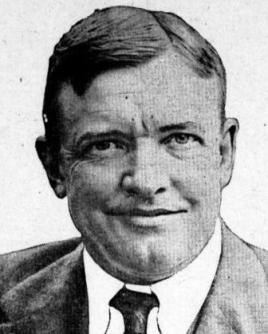
matty22

Mathewson

“If there is one thing I hate to see in baseball, it is a young pitcher, who has done grand work, have to quit in his prime because his arm has suddenly gone dead.  This has happened often in the past.  And it two stars would be missing this year looks like as if two stars will be missing this year, and, strangely enough, each one from a Boston baseball club.

“I hear that Bill James’ arm is practically gone, and James had as much to do with the Braves winning the world’s championship when no one expected (Braves Manager George) Stallings to do it in 1914 as any pitcher on his staff.”

Mathewson said he had heard from James’ teammate Johnny Evers:

“’Bill James’ arm is gone—for good I am afraid. Everybody on the club, from Stallings down knows it, including Bill James, himself.’

“The big Boston pitcher is only a kid in years and in service, too, for that matter when you compare him to old campaigners like Eddie Plank, Mordecai Brown and me who come from an aged vintage.  But James hurt his arm through foolishness, I believe, for the greatest folly of a pitcher is not to rest regularly his salary soup bone at least four or five months every year.”

Mathewson said James “a big, strong fellow,” ruined his arm by pitching on the West Coast every off-season:

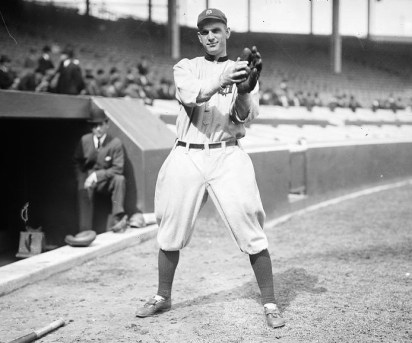
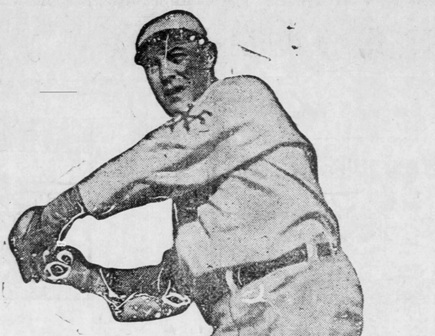
billjames

Bill James

“He did a lot of pitching the winter after the Braves had closed in on and taken the world’s championship.  This undoubtedly hurt him for he has never been good since.”

Mathewson said of the other Boston pitcher:

“Joe Wood, once called ‘smoky Joe’ of the Red Sox, is another grand pitcher likely to be somewhere else, perhaps in the scrap heap, when the roll is called this spring.  And I may be myself too, I admit that.  I have heard that Wood’s wing is in bad shape, and he probably will never work again.”

Mathewson said a New York doctor was treating Wood, but:

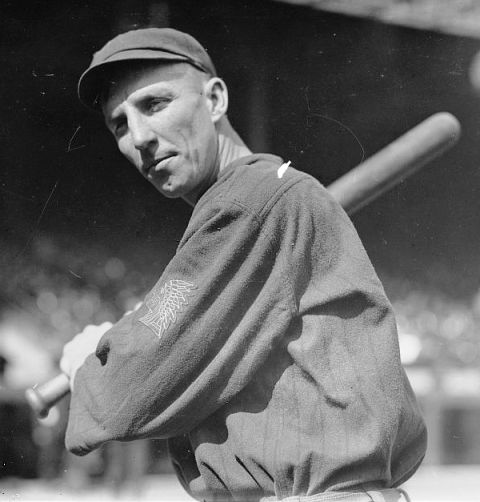
smokyjoewood

Smoky Joe Wood

“I have never found any pitcher with a bad wing who got much benefit from the advice of a ‘doc.’”

Unlike James, Mathewson said he felt wood might come back:

“(F)or some club if his arm comes around because he is naturally one of the greatest players ever in the Big League.”

Mathewson, who was 8-14 the previous season, after 12 straight 20-plus win seasons, said of his own future:

“(Giants Manager John McGraw) is a little worried over his pitching outlook.  He doesn’t know whether I am going to be able to deliver anything or whether I will spend the summer playing golf…I will know pretty soon whether I will put my pitching wing in the mothballs for good or whether it will be fit to run another season.  And believe me, I am anxious to find out.”

Mathewson did not put his “pitching wing in the moth balls.”  In 12 appearances with the Giants was 3 and 4 before being traded to the Cincinnati Reds in July.

Bill James didn’t pitch at all in 1916.  He only appeared in one more major league game—with the Braves in 1919.

Joe Wood appeared in just seven more games as a pitcher between 1917 and 1920 with the Cleveland Indians but played five seasons in the outfield for the Indians from 1918-1922.
More Superstitions, 1884

2 Jun

Superstitious ballplayers are as old as baseball.

When the Philadelphia Athletics visited Harrisburg, Pennsylvania for an exhibition game 1884, a reporter from The Harrisburg Telegraph talked to “an old base baller” who was attending the game.

The reporter asked:

“’Are base ball players superstitious?’

“’You betcher life,’ said the veteran; ‘why there is Harry Wright (who) always carries a black cat in the bat bag, just for luck.  Al Spalding  of the Chicago carries a buckeye in his pocket for luck, and Bob Ferguson begins to hedge in his bets if he meets a cross-eyed man while on his way to the grounds.’”

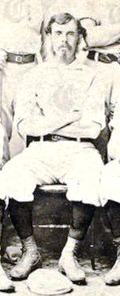
harrywright

Harry Wright

The “old base baller” also told the reporter:

Bobby Matthews will never pitch unless he has an old copper cent in his pocket, and Monte Ward, of the New Yorks, carries a mascot around his neck in the shape of a gold coin.  (Jim) Whitney, of Boston, loses heart if he forgets to put his bunch of keys in his pocket before pitching.  Just before the Athletics-St. Louis game last year to decide the championship, (Bill) Gleason, of the St. Louis, got as pale as a sheet when he saw a red-headed boy carry in the bat bag.  He said it was bad luck, and, sure enough, it was.”

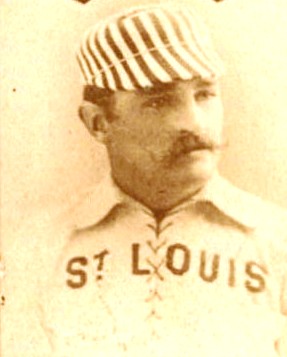
gleason

Bill Gleason

Philadelphia won the September 23 game 9-2, giving them a 3 ½ game lead in the American Association race, and held on to win the pennant by 1 game.

And the old player told the paper:

“Big (Dan) Brouthers, of the Buffalos, carries a barlow knife for luck.  Oh, yes, base ball players are superstitious, an’ don’t ye forgit it.”

Bed Check, 1887

31 May

In 1887, The St. Louis Post-Dispatch set out to find out “How managers watch their players on the road.”


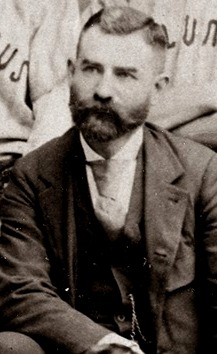
schmelz

Gus Schmelz


The paper spoke to Gus Schmelz, manager of the Cincinnati Red Stockings of the American Association; the previous season, Schmelz managed the National League St. Louis Maroons:

“He thinks, of course, that all good ball-players should retire early, and regards plenty of sleep as conducive to good condition.  Most managers agree with him on this head and some of them have difficult tasks in seeing that their men are under the cover at the proper hour. This is particularly true when the club is on the road and when the aggregation is anxious to have a good time with their friends in the city.”

The paper said Jim Mutrie of the New York Giants had what he thought was a great plan to ensure his players were in bed early:

“(H)e keeps a book which he leaves with the hotel clerk who checks off the players’ names with the hour of their application for the key and late comers may expect free lectures the morning following.  This plan is an excellent one, but it may be news to Mutrie to know that some of his pets return as early as 10 o’clock for their keys, are checked off in regular order and after ascending in the elevator to their rooms, as it were, return by the stairway when all is quiet, and come back in the small hours.”

As for John “Kick” Kelly, the new manager of the Louisville Colonels:

“Kelly says his plan is to wait up for the boys, and hammer at their doors until the whole club is housed, but even this plan is easily circumvented by the ingenious players who rack their brains for schemes to outwit their keepers.”


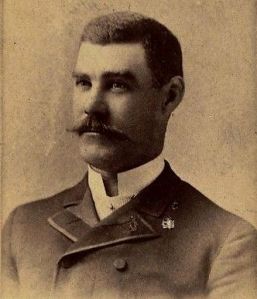
kickkelly

Kick Kelly


The only manager who had a plan that was working well, according to the paper, was:

“One of the most prominent and best-known managers in the country, whose name it is unnecessary to mention, has recently adopted a new plan for keeping track of his men, and from which there seems no loop-hole of escape. His orders to his men are that everyone should be asleep by 11 o’clock, thus giving them ample time for repose.  When traveling, this rigorous manager waits at the hotel desk until the hands of the clock point to 10:30, and then every key in the rack which opens his rooms is turned over to him.  These he carries with him to his own, and the tardy player must rouse him up and obtain his key or else stay away during the whole night.  In either case, the unfortunate man has a sure guarantee of a sound tongue-threshing, if not a comfortable fine.  The plan has operated with immense success thus far, but whether it will continue to do so remains to be seen.”

To Hank Gowdy

29 May

gowdy

George Moriarty became an American League umpire after his playing career ended—he also wrote a nationally syndicated column which often included elegies for deceased players and poems.

moriarty

George Moriarty

In 1919, he wrote a tribute to the first major league player to enlist in WWI—Hank Gowdy:

“They’re waiting, Hank, to pay respects because you went away to help make Prussians into wrecks for this U.S.A.  They’re waiting, Hank, to clap their hands, to yell and everything; the countless mobs of baseball fans acknowledge you are king.  When Uncle Sammy gave the call for valor, pep and vim, you dropped your glove, your bat and ball, and said, ‘I’ll sign with him!’  When handing out the credit, Hank, no mite to you we toss; we can’t name one more willing Yank who bore the U.S. cross.  They missed you, Hank, for many months; the way you caught—your whip. And when they talked of hero stunts, your name fell from each lip. They’re eager, Hank, to see your face, reflecting courage strong.  They want to see you swing the mace back here where you belong.  And if you throw not on a line, the fans won’t say a word, for Hank, old kid, you crossed the Rhine, and that makes you some bird.  They’re eager, Hank, to see you score again the winning run; for in your form they’ll see the swarm of Yanks that whipped the Hun.  What greater record in the guide, as future years advance?  A record strong as time and tide—Hank Gowdy, First to France.”


Stealing Bats, 1889

26 May

In 1889, The Cincinnati Enquirer said of the quest the average ballplayer made to secure a bat to his liking:

“The average ball-player has trouble in securing a bat of the size and weight to suit his fancy.  He will run over the stock of bats in sporting goods stores, buy pieces of wood and have them turned, and go miles to secure the article, but the season may be half over before he will find one that suits him exactly.  When he does find one to his fancy he will have trouble in keeping it, as opposing players will try to steal it.”

The paper said theft was so common:

“A bat is looked at as common property, and there is no crime in base-ball to swipe a bat providing you do it without getting caught.”

The Enquirer said John Reilly of the Red Stockings was a “Bat crank,” and “(H)as a mania for hunting good sticks.’”   Reilly was asked if he ever had a bat stolen:

“’I should say I did,’ was John’s reply.  ‘There are ball-players who make a business of stealing good bats.  I never knew Pete Browning to ‘swipe’ a bat, but you can get a trade out of the Gladiator at any stage of the game.  He has always got a stick or two to trade, and about the first thing he does when he strikes a lot is to size up the opposing club’s pile of bats and tries to drive a bargain.”


reilly

John Reilly


Reilly said there was a problem with Browning’s trades:

“Some of the Louisville players complain that Pete never trades his own bats, but grabs the first one he runs across in the Louisville pile.”

As for Browning’s use of heavy bats, Reilly said:

“Pete uses the heaviest bat of any man in the business…he had one here once that must have weighed twelve pounds.  It felt like it had an iron sash weight in the end of it.  Once, when I was in Louisville, I saw a bat floating around in a bath tub in the clubhouse.  ‘Whose bat is that? I inquired.  ‘it belongs to me,’ replied Pete:  ‘I put it in there so it will get heavy.”

petebrowning

Pete Browning

Reilly also told the story of “a splendid stick,” that had been stolen from his team in 1888.  Hick Carpenter had acquired the bat in a trade with John Sneed of the New Orleans Pelicans:

“(N)early all the players were using it.  We had it until sometime in May when it disappeared.  That was the last we saw of it until the Clevelands came around late in the summer.  One of our players saw the bat in the Cleveland club’s pile, and at once claimed It.  The Clevelands stopped the game and would not play until the bat was returned.  (Charles “Pop”) Snyder said it might belong to us, but he didn’t know anything about it.  He claimed that Tip O’Neill, of the St. Louis Browns brought it to Cleveland and forgot it, and that (Ed) McKean took it.  We had to give it up”

Reilly said another bat had been stolen from him in 1888:

“I cut the letter ‘R’ in the knob of the handle…I did not run across it again until late in the season in Brooklyn.  The bat had been painted and the knob sawed half in two to get rid of the little ‘R.’ I claimed the bat but did not get it”

Reilly said the New York Metropolitans, the American Association franchise that folded in 1887, were:

“(T)he best bat swipers in the business. They would leave New York on a trip with an empty bat bag and after they had played on a few lots they would have bats to sell.”

Another Rube Waddell Story

19 May

John Ganzel played seven seasons in the major leagues for five teams, and he claimed he only had one beer his entire life.


While managing the Rochester Red Wings in 1912, Ganzel told a reporter about the circumstances.  The story appeared in numerous newspapers—including The Rochester Democrat and Chronicle.

Ganzel, a teetotaler, went into a bar with a friend in Marlin, Texas in 1907.  Ganzel and the Cincinnati Reds were training there, as were the Philadelphia Athletics—and pitcher Rube Waddell:

rube

Rube Waddell

Ganzel ordered a ginger ale.

“A moment later in walked Waddell and ordered a glass of beer.  The drinks were untouched when Connie Mack, also a teetotaler, stepped into the barroom to use the telephone.

mack

Connie Mack

“Connie spied the Rube.  But the Rube had seen him first in the mirror behind the bar.  Quick as a flash he switched the drinks then held the ginger ale aloft in a conspicuous way and hailed Mack.

“’Hello, Connie, come over and have a ginger ale with me,’ he said.  Mack joined him and they drank ginger ale together.

“In order to spare the Rube embarrassment and a possible fine, I had to drink the Rube’s beer, the first and only alcoholic indulgences of my life.”

Bugs Finds the “Plate”

17 May

John McGraw called the erratic, talented, and tragic Arthur “Bugs” Raymond, one of the best pitchers he ever managed.  Raymond might be the best pitcher to finish his career with a record 12 games under .500 (45-56); he drank himself out of organized ball by age 29, and he was dead the following year.

bugs pix

Bugs

When Raymond was traded to the New York Giants after the 1908 season, Hugh Fullerton of The Chicago Herald told a story about how St. Louis Cardinals infielder Billy Gilbert helped cure Raymond of a bout with wildness the previous year.

hughf

“Bugs sometimes lacks control, and during one period early last season in St. Louis, he got so wild that (Manager John) McCloskey was in despair.  ‘Bugs’ couldn’t get one over the plate, let alone cutting the corners, and McCloskey began to believe he never would.  One afternoon just before a game, Mack, who is a born worrier, was sitting on the bench and turning to Gilbert, said: ‘Gil, what’s the matter with the Bug? Isn’t there any way he can get control?’

‘Let me catch him for awhile and I’ll fix him,’ said Gilbert.

‘All right.  Take him back of the stand and work with him.’”

billyg

Billy Gilbert

Fullerton said before taking Raymond “back of the stand,’ Gilbert went in search of something.

“(S)ecuring a big beer mug (he) placed it on the ground and standing behind it, ordered Raymond to proceed.

“’Here’s where you get control, Bugs,’ said Gil.  ‘You can hit this every time.’”

Said Fullerton:

“And whether faith, confidence, or luck did it, he got perfect control pitching over the stein, and it was a week before Gilbert dared tell McCloskey how he did it.”

Making Baseballs, 1890

15 May

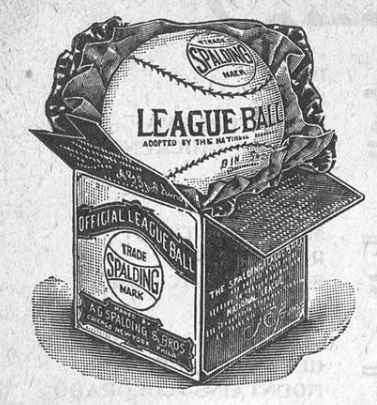
In 1890, The New York Commercial Advertiser told their readers about a modern marvel—the mass production of baseballs:


1890sball

Ball from the 1890s


“Automatic machines for making baseballs have been so successfully contrived that their introduction is likely to constitute a practical industry.  Each machine winds two balls at one time, in the following way:

“A little para-rubber ball, weighing three-quarters of an ounce, around which one turn has been made with the end of a skein of an old-fashioned gray stocking yarn, is slipped into the machine, then another, after which the boy in charge touches a lever, the machine starts and the winding begins.  The rubber ball is thus hidden in a few seconds, and in its place appears a little gray yarn ball that rapidly grows larger and larger.

“When it appears to be about half the size  of the regulation base-ball there is a click, the machine stops, the yarn is cut, the boy picks out the ball and tosses it into the basket.  When this basket is full it is passed along to another boy, who runs a similar machine, where a half-ounce layer of worsted yarn is put on.

“The next machine adds a strong white cotton thread; a coating of rubber cement is next applied and a half ounce layer of the very best fine worsted completes the ball with the exception of the cover.”

Lost Pictures–Frank Chance by Oscar Cesare

12 May

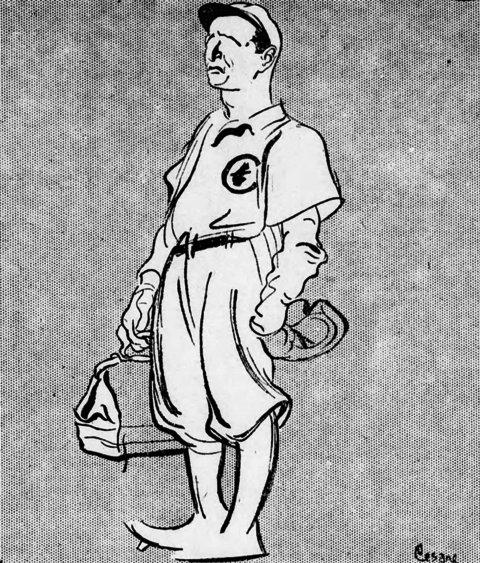
chancecesare

Frank Chance, as seen through the eyes of Oscar Cesare, cartoonist for The New York Evening Post; the sketch appeared along with a 1911 feature article by Homer Croy of the International Press Bureau:

“Frank Chance is the “Peerless Leader” to all America with W.J.B. (William Jennings Bryan) just coming in sight around the bend.  W.J. may be the last syllable when it comes to a crown of thorns, but what does  he know about first base?  When it gets down to real peerlessness, Chance of Cook County has got the Lincoln leader lashed so tightly to the mast that he can’t move an eyebrow.”

Croy noted Chance’s fear of the “hoodoo:”

“He is one of the most superstitious men in baseball, but having 13 for his lucky number.  When on a Pullman it would take a straightjacket and a new cable to make him sleep anywhere except in lower 13;  if the club gets a car with only twelve berths he writes 13 on the door and doubles up in the stateroom.  He refuses to change his shirt as long as the Cubs are winning; he’s very firm about this and cannot be won over with either pleading or powder.”

Submarine Gheen

10 May

Born August 13, 1899, Thomas Whistler Gheen made a name for himself pitching for the amateur team in his hometown of Lincolnton, North Carolina in 1919 and 1920. The Charlotte Observer said Gheen was:

“(B)elieved by many to be the best pitching prospect in the Carolinas.”

He was called “Submarine” Gheen, for what The Charlotte News called his “Far-famed underhand delivery.”


gheen1919

Tom Gheen, 1919


Late in the 1920 season, Gheen was signed by the Charleston Palmettos of the South Atlantic League.  Gheen appeared in six games and posted a 2-4 record with a 2.06 ERA for the last-place (54-71) Palmettos.

He began the 1921 season in Lincolnton but was signed by the Charlotte Hornets after he pitched a perfect game against the Loray Mills team in Gastonia, North Carolina.  He struck out 21 batters.  The Charlotte Observer said:

“Not a Loray man reached first.  Persons who saw the game say it was the most remarkable bit of hurling ever seen in Gaston County.”

In June, The Observer said he was:

“(F)ast developing into one of the best twirlers on the staff.”

Despite his promise, Gheen seemed to be troubled.  When he was playing amateur ball for Lincolnton, The Observer noted after he had been used as a pinch hitter:

“Most of Gheen’s hitting is done in the clubhouse.”

The High Point Enterprise said of Gheen:

“The blond-haired boxman never had a serious thought in his life and is dizzy as a southpaw off the field.”

With a 5-9 record and 3.22 ERA in late July, Gheen jumped the team.  According to The Durham Morning Herald:

“His excuse was that the fans razzed him to excess.  He declared that the razzing so affected his pitching it was impossible to win.”

The Charlotte Observer suggested he jumped for another reason:

“(He) quit the club following rumors circulated by gamblers that he had ‘thrown’ a ball game.”

The Morning Herald called him a “Wonderful pitcher,” and said he was “almost unbeatable when his underhanded ball in breaking properly.”

Charlotte catcher Pat Carroll came to Gheen’s defense, telling The Observer that the other catchers on the club did not encourage the pitcher to use his submarine delivery often enough:

“They can’t hit that ball to save their lives.  I ordered it every time Gheen got in the hole and it was pitiful to see the batter try to connect.  It didn’t help them a bit to know what was coming.  They couldn’t hit the ball; that’s all there was to it.”

The Hornets, according to The Charlotte News granted the “recalcitrant hurler” his wish and sold the “erratic heaver” to the Winston-Salem Twins of the Piedmont League.


gheen2

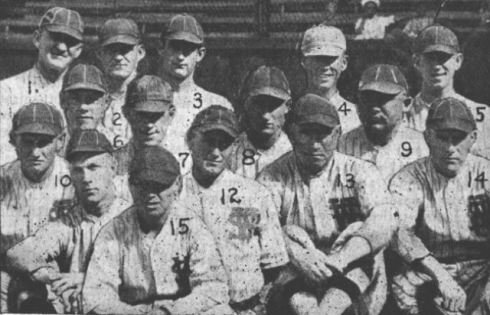
Gheen (5 top right) with the Winston-Salem Twins, 1921


Gheen was 11-3 in 15 games for the 62-58 Twins, and big things were expected of him in 1922.

He rose to the occasion on Opening Day, April 26.

The Observer buried the lede:

“Submarine Gheen made himself famous in the opening game of the Piedmont League season…his opponents being the Greensboro Patriots, who were defeated 5 to 0.

“Only 27 men faced the Twin moundsman who did not yield a hit nor issue a free pass.”

It was his only victory for Winston-Salem.  Less than a month after his perfect game Gheen was suspended indefinitely by manager Charles Clancy for “insubordination.”

Gheen was reinstated 10 days later but was sold to the Houston Buffaloes of the Texas League less than a week later. He was 1-5 for the Twins.

Gheen was plagued by wildness in Texas, posting a 6-11 record with a 4.06 ERA.

He was traded to Galveston Sandcrabs at the end of the Texas League season but was sold the following spring to the Rocky Mount Tar Heels in the Virginia League.  The 1923 season appears to have been controversy free for Gheen; he was 13-11 with a 3.43 ERA.

Back in the Piedmont League in 1924, Gheen was on his way to a 14-10 season for the High Point Pointers, when, on September 12, he made headlines off the field after he killed a man.

Gheen was riding in a car with friends near New Bern, North Carolina when they came upon a man lying in the road.  The High Point Enterprise said, the car, driven by Gheen’s friend:

“(S)werved to avoid hitting a negro lying prone across the road.  The driver of the car…backed up to see what was the trouble.

“As the car was being backed up one of the party yelled, ‘look out, he’s got a gun.’  Gheen, riding in the front seat, reached in the side pocket of the car and secured a revolver.  As the Negro came running alongside the car, revolver in hand, Gheen yelled, ‘Throw up your hands.’ This the Negro refused to do and Gheen fired three shots penetrating the upper part of the Negro’s body.  He died almost instantly.”

Gheen and his friends were cleared of any wrongdoing the following day.

The paper did not identify the dead man and said:

“He was said to have been a desperate character and to have had a police record.”

Gheen played two more seasons of professional baseball; he was 9-8 for the Columbia Comers in the South Atlantic League in 1925.

He joined the Jacksonville Tars of the Southeastern League in 1926—he won eight of his first 10 decisions with the club but was also arrested for the alleged assault of a woman when playing the Albany (GA) Nuts.  He appears to have avoided prosecution gheen1919but went 3-6 the rest of the season and his career as a professional ballplayer was over at age 28.

The following year, while back in his hometown of Lincolnton, “Submarine” Gheen, was killed when the Ford Touring car he was driving turned over on July 3.  The man who was considered the “best pitching prospect in the Carolinas” six years earlier died at the age of 29 on July 4, 1927.