Archive | Uncategorized RSS feed for this section

“(He) Should Remain an Outcast Forever”

8 May

Thomas Stevens Rice was an attorney, a criminologist, and covered baseball for The Brooklyn Eagle for nearly 20 years.  In 1921, he related a story that he said showed:

“That the mills of the gods may grind rapidly, as well as grind exceedingly fine.”


thomasstevensrice

Thomas Stevens Rice


The story was told to him by George A. Putnam, the business manager of the San Francisco Seals of the Pacific Coast League.

“Outside of San Francisco in the small towns is the Mission League, composed of semi-pro clubs and containing many old professional ballplayers, who turn an honest penny on the side in the sport now that they have passed from the big show and are regularly engaged in their occupations.

“Among the towns in the Mission League is San Jose. And San Jose has a semi-pro park that would delight Ring Lardner.  Far out in center is an ambitious scoreboard, liberally decorated with the advertising sign of the town’s leading hardware merchant and a strong supporter of the team.

“About a month ago San Jose was playing at home and a ball was hit to center it was diligently pursued by two outfielders, both formerly in organized baseball, one of them a major leaguer in his day.  They chased the ball up to the scoreboard and tried to retrieve it before carried out of sight of the umpire, but failed.

“As the two veterans whipped around the corner of the board they surprised a man peeping at the game through the planking.  He was seedy in apparel, had a beard of several days growth, and a general air of utter forlornness. Both outfielders were at first indifferent to the stranger, but a second glance identified him.

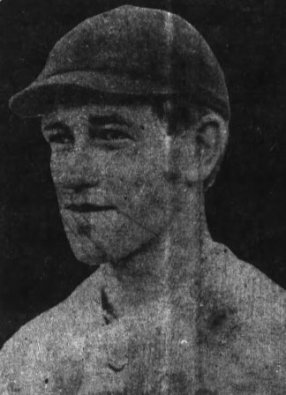
“The utterly forlorn stranger was Hal Chase, who two years ago was a member of the New York Giants, at a salary that was probably beyond that which until war times was paid a United States Senator.  It was the same Hal Chase who had been tried by the National League on the charge of throwing games when a member of the Cincinnati Reds and acquitted for lack of definite evidence; the same Hal Chase who had been given another chance by the New York National League club; the same Hal Chase who had been fired by the New York National League club on charges which were never fully explained, but were clearly understood to be based upon alleged crookedness; it was the same Hal Chase who had left New York, returned to his home state of California, and had been barred from the ball parks of that state on the ground of being involved in betting.”

halchasepix

Hal Chase

Rice had no complaints about the “forlornness,” or fate, of Chase:

“Chase, who stands before the world bearing unrefuted charges of having crooked the game which brought him fame and fortune, and which is an institution of which his country has been vastly proud, should remain an outcast forever he would be no more than bearing part of the penalty he deserved.  If every man who had a hand in the crooking of the national game should die an outcast in the gutter, despised by the potter’s field men who bury him.  It would be no more than they deserved.”

Rice also said there were fans who deserved the same fate as Chase:

“The baseball fan who patronizes semi-pro or other games openly participated in by men who have brought the national sport into disrepute and cast a cloud over its honesty merits the fate of a Chase for helping to encourage crookedness.”

He said his statements were in no way exaggerating his position—one he said was critical to protect the integrity of the game:

“The effective penalty imposed upon (Bill) Craver, (George) Hill [sic Hall], (Jim) Devlin, and (Al) Nichols in the 1870s (all were banned for accepting money to lose games in 1877), was not their being dropped from baseball and forced to turn to other means of making a living.  It was the ostracism that followed them their graves and made them anathema even in the society of professional thieves.”

And, he said, all penalties related to gambling should remain in effect forever:

“To impose a definite penalty on baseball crooks and then have the public forgive and forget when it is worked out, would be nothing less than an incentive to a repetition of the crime.  Let the possible throwers of games and the pawns of gamblers know they will be sneered at on the street by every pickpocket and dog-stealer who recognizes them, and that a bartender at a black and tan speakeasy will refuse to serve them.”

Lost Pictures–Ty Cobb by Oscar Cesare

5 May

ty

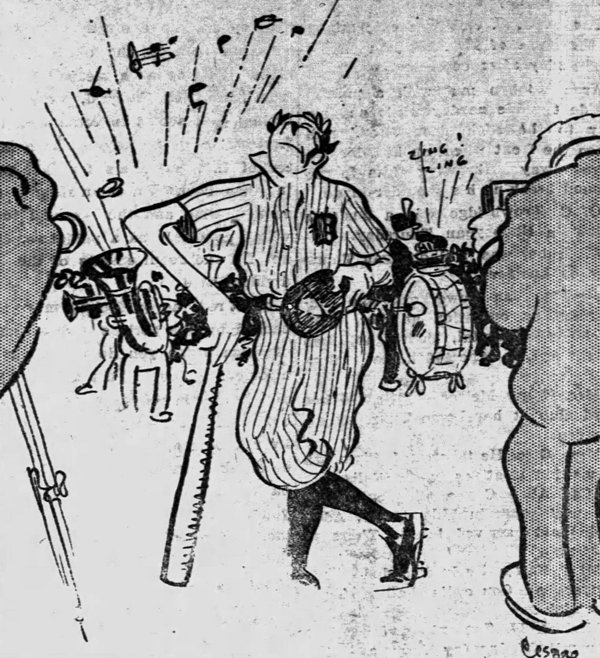
A sketch of Ty Cobb by Oscar Cesare of The New York Evening Post.

The picture accompanied a feature story by Homer Croy, of the International Press Bureau about Ty Cobb published in the Winter of 1911.  Croy would later become a well-known novelist and screenwriter, best known for writing “They had to See Paris,” Will Rogers’ first sound film.

“Residents of Royston, Georgia say this world has produced three great men: Shakespeare, Napoleon–and Ty Cobb.  The bearded bard of Avon may have written a few plays that now give employment to Julia Marlowe and E.H. Sothern, but what did he know about the fall-away slide?  The bow-legged little man who always wore his hat crossways may have won a war or two, but what sort of batting average did he have.

But speaking of real men whose names will go resounding, reverberating and re-echoing down the corridors of time, there is Mr. Tyrus R. Cobb who was born right in this town, sir!”

______

“He is the master of the slide, being able to coast in between the ankles of a knock-kneed man and never gets touched…He never gets hurt.  If he went into the aviation business or become an auto racer he would still live to be as old as Shem, who carpentered on the ark for Noah at a hundred and twenty years.  Ty needing only a package of court plaster or so every decade.  In coming down in an aeroplane he would always hop out at the fourth floor, come in on the hook slide on his hip, and then get up as sound as a simoleon to see if the umpire had called him safe.

“In the time the Empire state Express of baseball lives in Augusta, sells automobiles and talk about the new baseball phenom he has discovered—Tyrus Jr.”  (Cobb’s son—Tyrus Raymond Cobb Jr. was born the previous year.”

“Yet, not one of them can Play Ball like Wallace”

3 May

Jack O’Connor needed to vent.  The St. Louis Browns manager had just led his club to one of the worst seasons in major league history—a 47-107 record.


oconnorcoke

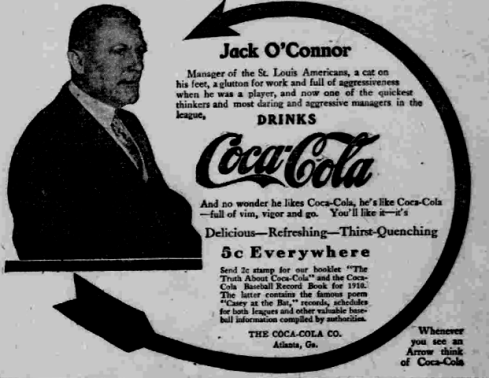
1910 Coca-Cola ad featuring O’Connor


Having just piloted a team that batted .218—the leading hitter was 36-year-old Bobby Wallace, who hit .258, and whose best pitcher, Joe Lake, posted an 11-17 record, O’Connor had reached a few conclusions about the game.  He told a reporter for The St. Louis Republic:

“The only thing every free-born American, with a constitution and public schools, thinks he can do is to play ball and manage a ball club.  Yet playing ball and managing ball clubs are two of the most highly specialized professions in the world.”

O’Connor said of the second-guessers:

“Of some 10,000 boys and men who are playing ball one way or another not 50 can play one position well enough to be called first-class ballplayers.

“One million young Americans see (Ty) Cobb play ball every year; yet not one of them can even imitate him.

“All that Walter Johnson, the greatest of pitchers, has is speed.  Now any strong-armed young man has speed.  Yet in 10,000,000 strong-armed young men not one has speed like Johnson has.

“How do you figure it?

“I guess that 10,000,000 young men and at least 100,000 professional ballplayers have seen Wallace perform in the 17 years he has been playing. Yet, not one of them can play ball like Wallace. Not one can even throw like him.”

And, no doubt, with the Browns’ .218 team batting average on his mind, O’Connor said:

“Batting is simple.  How many boys and men have seen Lajoie in the past 15 years—yet why can’t some one of them bat like Larry?

wallace

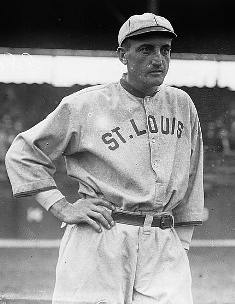
Bobby Wallace

And with a 47-win season on his mind, O’Connor concluded:

“I have always held that ballplayers are born, not made…so many smart fellows who have good heads and the ball instinct think that they can take good-looking athletes with legs and arms and eyes and make ballplayers of them.  The smart fellows make the mistake of imaging that the object of their solicitude has the head and instinct that they—the instructors—have…Many boys have everything but instinct.  That is the quality that is hardest to find.”

Despite the Browns’ horrible record, it was O’Connor’s role in trying to assist Lajoie, his former teammate, to win the batting title over Cobb on the final day of the season—ordering third baseman Red Corriden to play so far back that Lajoie bunted in five straight at-bats—that led to his firing.

“Both Organizations enjoy an Unrivaled Reputation in the World of Colored Sport”

1 May

Named after the nation’s first black governor, Pinckney Benton Stewart Pinchback of Louisiana, the Pinchbacks were the best black baseball team in New Orleans–and the entire South– during the 1880s.

In August of 1888 The Chicago Tribune said the Pinchbacks were coming to town:

“This is the first time a colored club from the South has visited Chicago.”

The team scheduled games with the Chicago Unions for August 21 and 22, then were traveling to St. Louis.

The paper said:

“The Pinchbacks are composed of the best colored players, and will certainly give the Chicago and St. Louis boys some trouble.”

The Tribune claimed Pinchbacks’ pitcher George Hopkins:

“(P)ossesses wonderful control over the ball, and in no game so far this season has he struck out less than ten men.”

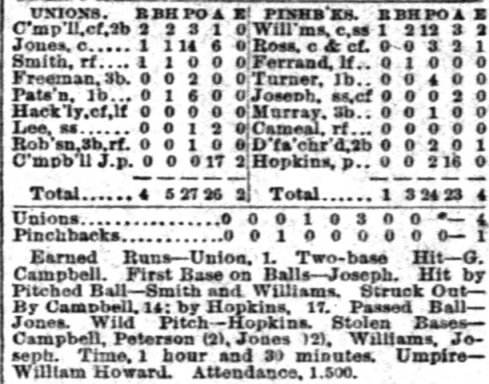
There were wildly different estimates of the crowd.  The Chicago Herald said 300 fans saw the game, The Chicago Inter Ocean said 1500 turned out.

Despite the low estimate of the crowd, The Herald said there was great interest in the game

“No less than 150 boys or ‘kids’ surrounded the ball grounds as early as 2 o’clock (the game was scheduled for 3:45) and importuned every adult who approached with, ‘Say, Mister, won’t yer take me ter th game?’ For four or five innings those ‘kids’ took in the game through the knotholes and cracks in the fence, crouching or straining two or three deep…Finally they found an unguarded hole through which they slipped inside, and soon a policeman’s services had to be invoked to keep them from clustering on first base.”

The paper said another 50 or more fans viewed the game, “(F)rom the top of a Rock Island freight car a block distant.”

Among the fans, according to The Herald were “(A) score of colored ladies, 12 or 15 (Chinese) and 20 or 30 whites.”

The Tribune also provided as much coverage of the atmosphere surrounding the contest as the “Wildly exciting game,” at Chicago’s South Side Park, located at 33rd Street and Portland Avenue.

“Both organizations enjoy an unrivaled reputation in the world of colored sport, and the Pinchbacks are so highly esteemed in Louisiana that five carloads of gentlemen of their race came with them from the South.  The betting on the contest was unprecedentedly heavy, a colored saloonkeeper, whose probity is held beyond question, having in his pockets 124 dollars and 45 cents cash, a ring with a stone popularly believed to be an amethyst, two pencil cases, a watch chain, and a promissory note, being the stakes in various wagers made upon the result, together with a bundle of gold-topped umbrellas, and canes with silver heads and elaborate monograms.”

Fans of each team sat on opposite sides of the grandstand:

“The New Orleans contingent sat to the right of the stand, and the Chicago men to the left.  There was not much cordiality between them as hospitality demanded.  A notice board separated them.  It said: ‘Please do not throw cushions.’

“The Southerners, being men of means, had all provided themselves with cushions.  The Chicago men, being comparatively indigent, had to sit on the hard boards.”

One New Orleans fan threatened the umpire, who the paper described as “A gentleman of mild disposition.”

Unions’ manager and catcher Abe Jones admonished the fan:

 “’You won’t use any profane language on these grounds,’ cried Mr. Jones.

“’Go along,’ retorted the man…’you can’t hit the ball with a shovel.’

“On this, a partisan of the home team raised a cushion, which her purloined in the excitement from a Southerner, and brought it down with a resounding thwack on the head of the enthusiast, who was heard to exclaim as he sunk to rise no more, ‘Can’t hit the ball with a shovel.’”

Early in the game, the umpire caused another controversy when a Pinchback batter was called out on strikes:

“’Get a new umpire,’ cried the excursionists from New Orleans.  ‘The umpire’s all right,’ returned the Chicago men.”

The Pinchbacks persisted and:

“Two umpires were selected in place of the weakling whose infirmity of purpose had precipitated the crisis.”

With the new umpires in place, the paper said:

“And now the game became exciting.”

The Herald said the umpire, named John Nelson, was much more of a factor.  The paper claimed:

“He made several very bad decisions, every one favorable to the home nine.”

Entering the sixth inning the score was tied at one when a Chicago player doubled off of Hopkins.  The Tribune said:

“In an instant, the grandstand went mad.  One gentleman stood upon his head, his legs being supported by two friends, who held him in this uncomfortable position until somebody bowled him over with a cushion.  Another gentleman transformed himself into a windmill and swung his arms at incredible speed.  A third turned a succession of somersaults, landing at length in the midst of the New Orleans contingent, which, chafing at the prospect of defeat lifted him bodily and dropped him over the stand.”

The Union Giants scored three runs in their half of the sixth:

“The Southerners never recovered from the disaster.  One of their supporters, whose face was so freckled that it looked like fly-paper in a confectioner’s window, announced despairingly that all was over but the shouting.  The saloonkeeper began his distribution of silver-headed canes and gold-tipped umbrellas.”

The Union Giants won 4 to 1:

“Then the cushions flew.

“The women pressed around the Unions, even going to the length of embracing them.  Cigars were pressed upon the winners by their happy supporters.

“’It’s the pootiest game we’ve played for months,’ said one of them.

“And it was.”


pinchg1

Game 1 Box Score


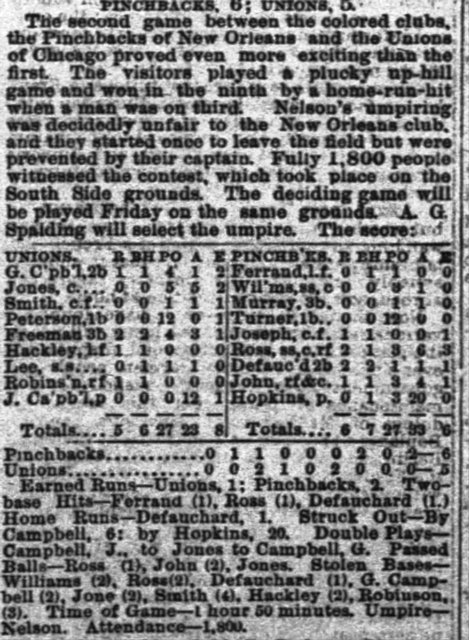
The Pinchback came back the next day, beating the Unions 6-5. The Inter Ocean said 1800 were in attendance and  credited Hopkins, who pitched complete games in each game, with 37 strikeouts over 18 innings—a claim Abe Jones of the Unions disputed in a letter to the paper:

“There were ten strikeouts and the manager of the Pinchbacks (Walter L. Cohen) made a great mistake in his report of the game.  Hoping that he will be more truthful in his next.”

Two days later the paper published Cohen’s response:

“Jones (denied) the accuracy of the published score…I beg leave to state in justice to myself that the gentleman who scored the game was employed by Mr. Jones, and if there is a mistake it is him who is responsible and not me, for I had nothing to do with either the scoring or compiling of the score.”


pinchg2

Game 2 Box Score


The bad blood between the teams might explain why rather than playing a deciding game, The Tribune and The Herald reported that the Pinchbacks chose instead to play against a “picked nine” at Southwest Park on at the corner of Rockwell and Ogden, on their third day in Chicago.  They won 14-7.  Hopkins completed his third complete game in three days.  It was reported that he struck out 14.

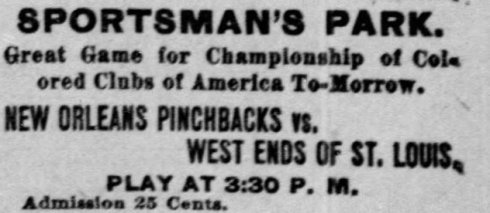
The Pinchbacks swept a three-game series with the St. Louis West Ends at Sportsman’s Park before returning home. The New Orleans Times-Picayune said:

“The famous colored baseball club, the Pinchbacks, arrived home last evening after a successful sojourn in Chicago and St. Louis, where they bore away most of the honors.”


pinchbacksstl

Advertisement for the Pinchbacks vs West Ends


The Pinchbacks returned to Chicago the following year, and in 1890, Hopkins left New Orleans and joined the Unions, which brought about the end of the team’s prominence in Southern black baseball.

Lost Pictures–1924 House of David

26 Apr

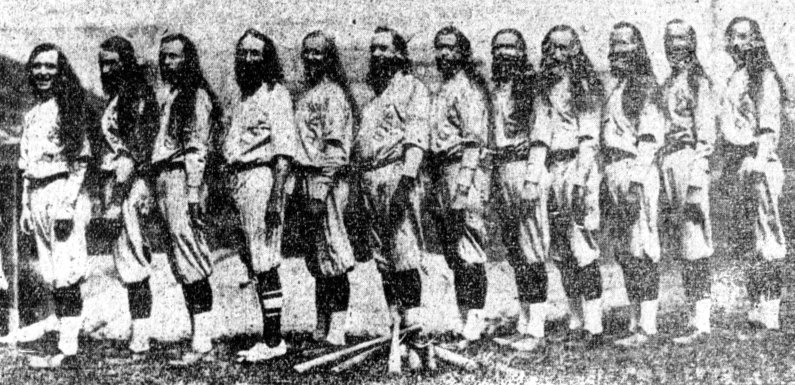
hod

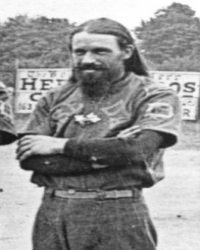
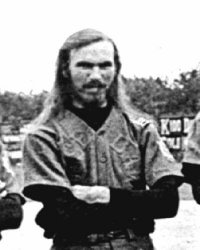
A 1924 promotional photo of the House of David baseball team, from the Israelite House of David, the Adventist sect based in Benton Harbor, Michigan. The photo was distributed to Midwest newspapers during the barnstorming team’s tour that season.

Promotional materials promised, “Some wonderful baseball players are on the House of David team,” including Jess Tally, “The bearded Babe Ruth.” And “Cookie Hannaford the phenomenal first sacker.” The team claimed Tally had hit 34 home runs in 132 games in 1923, and 11 through the team’s first 31 games of 1924.

tally

Tally

ezra

Hannaford

The team always claimed that several members of the club, “Rejected major league jobs, refusing to clip their whiskers.”

Dick Jess, who had managed Babe Ruth’s 1921 barnstorming tour, was the promoter for the House of David tour, and described the team as:

“Bewhiskered, barberless, shaveless baseballists, and foes of the barber trust.”

“I Haven’t Heard of any Club Owners Refusing to accept the Patronage of Colored People”

24 Apr

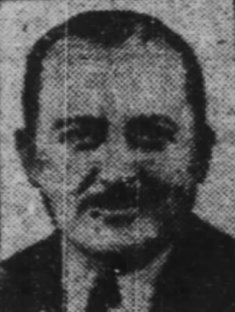
Damon Runyon called Dan Parker, “The most consistency brilliant of all sportswriters.”

Parker wrote a column and was sports editor of The New York Daily Mirror from 1926 until the paper folded in 1963.


danparker

Dan Parker


Parker often used his column, “Broadway Bugle” to agitate for change in sports.  He crusaded against fixed wrestling matches, disreputable “Racetrack touts,” and the influence of organized crime in boxing—these columns led to several investigations, the disbanding of the corrupt International Boxing Club, and several criminal convictions, including Frankie Carbo, a member of the Lucchese crime family.

Parker was also an early crusader for the integration of professional baseball.  In 1933, Parker lent his name and influence to The Pittsburgh Courier’s “Crusade for comments from baseball celebrities” who supported integration.

Parker wrote to Chester Washington, The Courier’s sports editor:

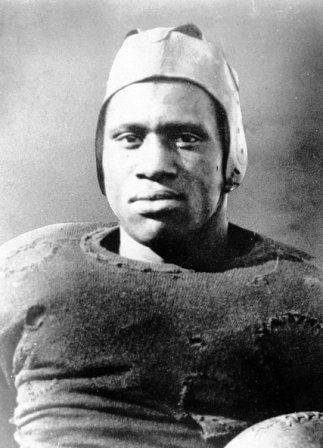
“I don’t see why the mere accident of birth should prove a bar to the Negro baseball players who aspire to places in organized baseball.  I haven’t heard of any club owners refusing to accept the patronage of colored people. Rutgers didn’t draw any color line when Paul Robeson proved himself the best man for the place he was fighting for on the football team.  The All-American selectors didn’t go into a huddle about Paul’s complexion when they picked him for a place on the mythical eleven, football’s highest honor.


robeson

Paul Robeson


“The U.S. Olympic Committee didn’t consider Eddie Tolan’s or Ralph Metcalfe’s lineage when they were picking the strongest sprinting team possible for last summer’s games.  If the Negro athlete is accepted without question in college football and amateur track and field events, which are among the higher types of sports, I fail to see why baseball, which is as much a business as it is a sport, should draw the line.

“In my career as a sports writer, I have never encountered a colored athlete who didn’t conduct himself in a gentlemanly manner and who didn’t have a better idea of sportsmanship than many of his white brethren.  By all means, let the Negro ballplayer play in organized baseball.  As a kid, I saw a half dozen Cuban players break into organized baseball in the old Connecticut League.  I refer to players like (Armando) Marsans, (Rafael) Alameda, (Al) Cabrera and others (Almeida, Marsans, and Cabrera played with the New Britain Perfectos in the Connecticut State League in 1910). I recall the storm of protest from the One Hundred Per Centers at that time but I also recall that all the Cubans conducted themselves in such a manner that they reflected nothing but credit on themselves and those who favored admitting them to baseball’s select circle.

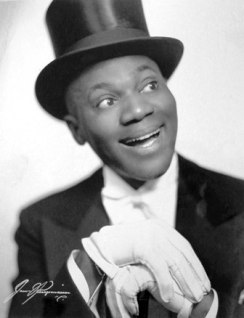
“The only possible objection I can find to lifting the color line in baseball is that the Yankees might then lose their great mascot.  I refer to my good friend, (Bill) “Bojangles” Robinson, who chased away the Yankee jinx last season with his famous salt-shaker. The Yanks didn’t draw the color line on their World Series special to Chicago for Bill accompanied us on the trip.  On the way back, at every town where we stopped for a few minutes, the crowd hollered for Babe Ruth. Babe would make an appearance and then introduce Bojangles who would tell a few stories, go into his dance and make the fans forget about baseball as he ‘shuffled off to Buffalo.’


bojangles

Bill “Bojangles” Robinson


“I read your paper every week and find your sports pages well edited and thoroughly enjoyable.”

Parker’s letter was released shortly after Heywood Broun of The New York World-Telegram made waves at the 1933 Baseball Writers Association dinner when he said:

“I can see no reason why Negroes should not come into the National and American Leagues.”

Broun and Parker were joined by another prominent sports writer, Gordon Mackay, who had been sports editor at three Philadelphia papers—The Enquirer, The Press and The Public Ledger—who wrote to The Courier:

“I believe that there are scores of Negroes who would make good in the big minors and in the majors.  Take some of the men I used to know—John Henry Lloyd, Rube Foster, Big (Louis) SantopPhil Cockrell, Biz Mackey and others—why, Connie Mack or the Phillies would have been strengthened with any of them on the best teams they ever had.”

The Courier’s Washington was hopeful that the sentiments of three powerful sportswriters would have some impact:

“Fair-minded and impartial writers like Broun, Mackey, and Parker can do much towards breaking down the barricaded doors of opportunity to capable colored ballplayers which lead into the greatest American game’s charmed circle.  And we doff our derby to ‘em.”

“I Saw this Same Proud Bird of Freedom, the American Eagle, Soaring Aloft”

21 Apr

“Land and Water” was a British magazine that existed in various incarnations from the early 1860s until 1920.

In 1874, the magazine opined on the Boston Red Stockings and Athletics of Philadelphia crossed the Atlantic to play baseball in England:

“The Yankees have come over to show Englishmen what baseball really is in its pure, unadulterated state.  America swears by baseball, and when America swears the earth totters.  You want, I admit, to see the Yankees at work before you can understand the science and niceties of the sport.  They are wonderful in all reality when they are stripped and ready for the fray.  Baseball encourages fielding more than anything, and the Yankees are perfect marvels in the matter of fielding.  Kittens are dull and apathetic by comparison if you estimate their playfulness.”

The British were impressed with the way the Americans practiced:

“You see them all over the ground before the real business begins in different groups, all at exercise of some sort.  The first thing that strikes you will be their skill in catching, and their extraordinary aptitude for fielding and returning the ball smartly, in whatever position they may be placed, or in whatever fashion it comes.  You see no respect for persons, for the ball is thrown as hard as ever it can be hurled, and yet, though the distance is only a few yards, it is caught like lightening, and there is the action for return as the game were in progress and one of the bases empty.”

The magazine asked Cricketer Tom Brown his opinion of the American game:

“Cricket is more than a game, it is an institution, and baseball will never supersede or do the slightest injury to our own natural sport in any way.”

In spite of Brown’s assessment, the magazine conceded that baseball would “prove a pleasant relief after some of our own British amusements.”


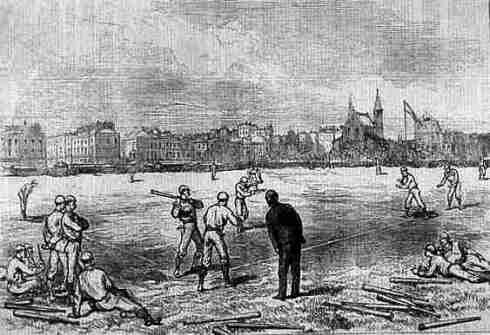
woodcut

A “Harper’s Weekly” woodcut from the 1874 tour.


And, the magazine said, the relative speed of a baseball game might appeal to some British fans:

“It is not everyone that can afford to spare three days or one whole day for sport, however much his inclinations may lead him. It is this drawback alone prevents the acclimatization of cricket in America, and it is by a parity of reasoning the absence of all the waste of time that makes baseball such an enthusiasm over the Atlantic.  You will have to see a game before you can appreciate its advantage.  You may come to scoff, but in all probability, you will go away to pray.  A game at baseball rarely, if ever, exceeds two hours in duration.”

But, watching the exhibition would be nothing close to experiencing a game in Boston or Philadelphia, the magazine said:

“A contest between Yorkshire and Nottinghamshire at cricket is perhaps the nearest approach in an English way, but the roar that proceeds from every Yorkshire throat when a Nottingham wicket falls at Sheffield, is a mere whisper compared with the hubbub that attends a baseball game of interest from the first ball pitched to until the last strike.”

The game was explained to readers by comparing it to cricket:

“The positions of pitcher and catcher are closely akin to those of our bowler and wicket-keeper, though the latter is more of a combination of wicket-keeper and long-stop. Much of the success of the nine depends on the manner in which these two posts are filled, as to succeed they should thoroughly understand each other, and be well acquainted with each other’s movements…A fieldsman at baseball must have good nerves, and not be easily disconcerted.  He is especially to be perfect, or else every mistake is registered to his disadvantage.  It is without s doubt an excellent plan, but the records of the game are pitiless, and every error is registered by the scorer with the same merciless severity and strict impartiality.”

As for the game itself, the magazine’s correspondent said:

It was on Thursday afternoon last (July 30) that I saw this same proud bird of freedom, the American Eagle, soaring aloft. It was the first appearance of the American champions on English soil; and for one, I was curious to see the Yankees disport themselves in England at their own pastime…(the teams) were wonderfully well matched, too, in every way the competing nines; and the wonderful aptitude and agility shown by the catcher, the unerring accuracy displayed by all fieldsmen, and the general dash and briskness of the play all around, elicited frequent applause.”

The Athletics won the game 14-11 in 10 innings, in front of a crowd of just 500.  The magazine’s correspondent was too polite to mention the small crowd:

“Towards the end, we had got thoroughly excited, and the interest was universal.  It may be that we should have enjoyed it more throughout had we only understood, some of us, the state of the game…Nevertheless, there was but one feeling amongst us, that the Americans had shown us some excellent sport, and taught us, unintentionally perhaps, more than one useful lesson.  There was such backing up, as one would like to see in every cricket match if there was only a chance.  There was an amount of discipline, too, among the players that would have gratified the most inveterate martinet, and an air of unselfishness among the players that was devoid of anything like the taint of personal gratification.  It may be that baseball will show up conspicuously some of the faults of our English game. If so the American invasion will not have been in vain.”


“It’s a Nice Game for a Poet or Orator”

18 Apr

Marcus C. “Brick” Pomeroy, publisher and editor of The La Crosse (WI) Democrat was no fan of President Abraham Lincoln—a Copperhead, who opposed the Civil War and desired an immediate peace settlement with the Confederacy—he called the president “fungus from the corrupt womb of bigotry and fanaticism.”


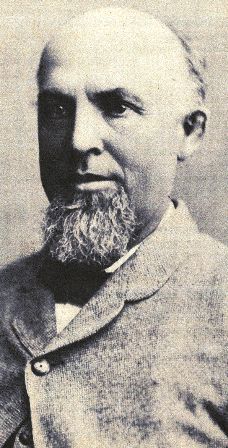
brickpix

Brick Pomeroy


After the Civil War, he briefly turned his attention to baseball.  In 1867, he wrote in The Democrat about his experience with the game:

“The doctor said we need exercise.  Doctors know.  He told us to join base ball, we joined.  Bought a book of instructions, and for five days studied it wisely, if not too well.  Then we bought a sugar scoop cap, a red belt, a green shirt, yellow trousers, pumpkin colored shoes, a paper collar and a purple necktie, and with a lot of other delegates, moved gently to the ground.

“There were two nines.  These nines were antagonists.  The ball is a pretty little drop of softness, the size of a goose egg, and five degrees harder than a brick.  The two nines play against each other.  It is a quiet game, much like chess, only a little more chase than chess.

“There was an umpire.  His position is a hard one.  He sits on a box and yells ‘fowl.’ His duty is severe

“I took the bat.  It is a murderous plaything, descended from Pocahontas to the head of John Smith.  The man in front of me was a pitcher.  He was a nice pitcher, but he sent the balls hot.  The man behind me was a catcher.  He caught it too!

“The umpire said ‘play.’ It is the most radical play I know of, this base ball—Sawing cord wood in moonlight rambles beside base ball.  So the pitcher sent a ball towards me.  It looked pretty coming, so I let it come.  Then he sent another.  I hit it with the club and hove it gently upward.  Then I started to walk to the first base.  The ball lit in the pitcher, or his hands, and somebody said he caught a fly.  Alas, poor fly! I walked leisurely toward the base.  Another man took the bat.  I turned to see how he was making it, and a mule kicked me in the cheek.  The man said it was the ball.  It felt like a mule, and I reposed on the grass.  The ball went on!

“Pretty soon there were two more flies, and three of us flew out.  The other nine came in, and us nine went out.—This was better.  Just as I was standing on my dignity in the left field, a hot ball as they called it, came skyrocketing toward me.  My captain yelled ‘take it.’

“I hastened gently forward to where the ball was aiming to descend. I have a good eye to measure distances and saw at a glance where the little aerolite was to light.  I put up my hands.  How sweetly the ball descended. Everybody looked—I felt something warm in my eye!  ‘Muffin!’ yelled ninety fellers, ‘muffin be damned! It’s a canon ball!’  For three days I had two pounds of raw beef on that eye, and yet I paineth!

“Then I wanted to go home, but my gentle captain said ‘nay.’  So I stayed and stayed.  Pretty soon it was my strike.  ‘Brick to the bat!’ yelled the umpire.  I went, but not all serene as my wont.  The pitcher sent in one hip high.  I missed it.  He sent in another neck high. It struck me in the gullet.  ‘Fowl,’ yelled the umpire.  He sent in the ball again.  This time I took it square and sent it down the right field, through a parlor window—a kerosene lamp, and rip up against the head of an infant who was quietly taking it’s nap in his mother’s arms  Then I slung the bat and meandered forth to the first base.  I heard high words and looked.  When I slung the bat I had with it broken the jaw of the umpire and was fined 10 cents.”


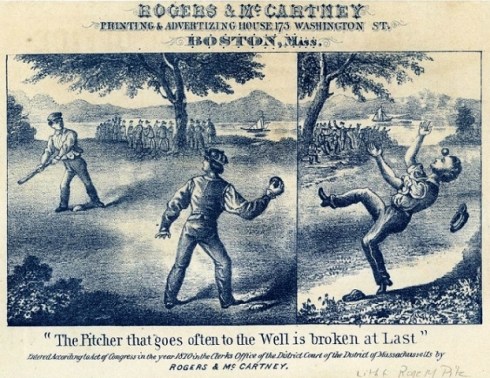
1870

An 1870 Woodcut by Rogers and McCartney of Boston, which would have been an appropriate illustration for Pomeroy’s article


Pomeroy said the game was as dangerous to spectators as players:

“The game went on.  I liked it.  It is so much fun to run from base to base  just in time to be put out, or to chase a ball three-fourths of a mile down hill, while all the spectators yell ‘muffin!’ or ‘go round a dozen times!’ Base ball is a sweet little game. When it came my turn to bat again, I noticed everybody moved back about ten rods!  The umpire retreated twelve rods.  He was timid.  The pitcher sent ‘em in hot. Hot balls in time of war are good; but I don’t like ‘em too hot for fun.  After a while I got a fair clip at it., and you bet it went, cutting the daisies down the right field.  A fat man with his dog sat in the shade of an oak enjoying the game. The ball broke one leg of the dog and landed like a runaway engine in the corporosity of the fat man.  He was taken home to die.”

Back on defense, Pomeroy said:

“Then I went on a double quick to the field and tried to stop a hot ball.  It came toward me from the bat at the rate of nine miles a minute. I put up my hands, the ball went sweetly singing on its way with all of the skin from my palms with it.

“More raw beef!”

Pomeroy summed up his experience playing ball:

“That was an eventful chap who first invented baseball.  It’s such fun.  I’ve played five games, and this is the glowing result:

Twenty-seven dollars paid out for things.

One bunged eye, badly bunged

One broken little finger

One bump on the head.

A sore jaw.

One thumb dislocated.

Two sprained ankles

One dislocated shoulder, from trying to throw a ball a thousand yards

Two hands raw from trying to stop hot balls

A lump the size of a hornet’s nest on my left hip, well back.

A nose sweetly jammed, and five uniforms spoiled from rolling in the dirt at the bases.

“I have played two weeks, and don’t think I like the game.  There is not a square inch on, in or under me but aches.  I sleep nights dreaming of hot balls, ‘flys, and ‘fouls,’ and descending skyrockets.’  I never worked so hard since Ruth stole wheat, and never was so lame since the burning of Luther.

“I am proud of my proficiency in the game. It’s fine exercise—a little easier than running through a thrashing machine, and not much either.  It’s a nice game for a poet or orator—‘twill make one sore beyond all accounts.

“I’ve looked over the scorer’s book, and find that in two weeks I’ve broken seven bats, made one tally, broken one umpire’s jaw, broken ten windows in adjoining houses, killed a baby, broke the leg of a dog, and mortally injured the bread basket of a spectator, knocked five other players out of time by slinging my bat, and knocked the waterfall from a school marm who was standing twenty rods from the field, a quiet looker on.

“I’ve used up fifteen bottles of arnica liniment, five bottles of lotions, half a raw beef, and am so full of pain that it seems as if my bones were but broken bats, and my legs the limbs of a dead horse chestnut, instead of the once elegant trotters.

“P.S.  All ladies in favor of ‘universal suffering’ are invited to join our club”

After his brief interest in baseball, Pomeroy moved from Wisconsin to New York, to Chicago, and back to New York where he published various newspapers.  In 1880 he was president of a company that proposed to dig a tunnel through the Rocky Mountains; the company sold $7 million worth of stock, but eventually went bankrupt before and work on the project was begun.

He died in 1896.

Glory Thieves

6 Apr

In 1958, two men, one who had just died in a Detroit rooming house, and another, who was living in Dayton, Ohio, claimed to be former major league pitcher Jack Rowan. Rowan played for the Cincinnati Reds, Chicago Cubs, Detroit Tigers and Philadelphia Phillies over parts of seven seasons from 1906-1914.

Each man had supporters who claimed he was the “real” Rowan.

The Dayton Rowan died in 1966—the question of who was the “real” Rowan died with him.
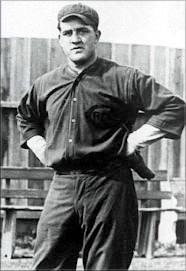
rowan2

Jack Rowan

In the end, one man had his greatest achievement stolen from him, and the other was the vilest of thieves; stealing an achievement and a legacy from someone who had earned it.

When someone erroneously claims military service it is called stolen valor. Given the role of baseball in the American fabric, for one to claim to have been a professional ballplayer when they did not achieve that status makes that person a glory thief.

In “Shoeless Joe,” W.P. Kinsella introduced fiction’s best known glory thief. Eddie “Kid” Sissions claims to be “The oldest living Chicago Cub,” while he actually had only an obscure minor league career. The book’s hero, Ray Kinsella, gives Scissions a pass when his lie is discovered:

“I imagine Eddie Scissons has decided, ‘If I can’t have what I want most in life, then I’ll pretend I had it in the past, and talk about and live it and relive it until it is real and solid and I can hold it in my heart like a precious child. Once I’ve experienced it so completely, no one can ever take it away from me.’”

Kinsella and his protagonist were too forgiving.

Countless are the number of times I have had someone who never came closer than a seat in the stands at a professional game tell me they played pro ball.  More incredibly, the phenomenon persists during a time when claims of a pro career can be verified within seconds.

Over many years in Chicago I ran into dozens of claimants to a professional baseball career; mostly barstool jockeys operating during a period when everyone didn’t have easy access to the internet in their purse or pocket. There were also many imposters–for some reason utility infielders were particularly popular–I met a fake Sammy Esposito, Craig Grebeck, Paul Popovich, Alan Bannister, and Mick Kelleher among others.
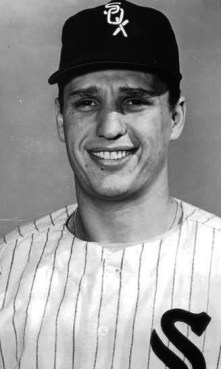
ce2a4bffa153a67b275606664c5e5ef6.jpg.cf

The real Sammy Esposito

When I was living in Las Vegas, the old men who sat together drinking at one of the local’s casinos told me I had to meet their friend who, they said, had a cup of coffee with the Red Sox in the mid 1960s—even said he roomed with Rico Petrocelli on the road. Their hero never seemed to be able to come over when I was around—and of course, a quick search of Baseball Reference confirmed he never played professional baseball at any level. But he has regaled two generations of credulous Las Vegans with stories of his time with the Red Sox.

And there was the contractor who told me he had played in the Royals organization in the 1980s; two basic questions about the club’s affiliates during those seasons revealed him to be a glory thief—he hadn’t bothered to do the most basic research to make his claim credible. If his ball playing ability was commensurate with the quality of his work, it is likely he never played at a level higher than Little League.

It is also very possible the middle-aged guy with a gut and a story about his professional career at your softball game is a glory thief as well. If you are playing with a former professional, you know it.

I worked at a television station in Chicago during the late 90s and played 12” softball with the morning anchorman—Mike Pomeranz. Pomeranz pitched four seasons in the minors, was once traded for Lloyd McClendon, and is now a studio host and announcer for the Padres on Fox Sports San Diego.

My one vivid memory of softball with Pomeranz was playing first base—Mike, a southpaw was playing third—he fielded a ground ball and effortlessly and flat-footed put the ball in the pocket of my glove. I walked around with a handful of ice for the rest of the day. He didn’t need to tell anyone he played pro ball.
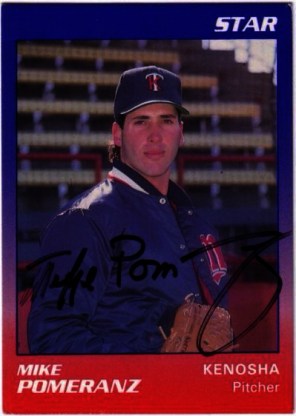
pomeranz_mike.jpg.cf

Mike Pomeranz

I asked John Thorn, Official Historian of Major League Baseball for his take on what kind of person pretends to have had a professional baseball career:

“Calling Dr. Freud. Self-aggrandizement always reflects an undersized ego and uncertain sense of self, as if life were to be lived from the outside.”

Dr. Freud was not available for a second opinion but Dr. Rachel Annunziato was. Annunziato, associate professor of Psychology at Fordham University said:

“I would say given how easily such claims could be debunked these days, there might be concerns about significant mental illness—delusions–and perhaps antisocial personality characteristics which can include lying and manipulating.”

Dr. Annunziato allows that for a thief like Kinsella’s “Kid” Scissions, a professional, but one who didn’t make it to the big leagues the misrepresentation is mainly tied to ego:

“I suspect too that many were ‘close’ and perhaps have modified their story over time to protect (and) bolster self-esteem.”

And, finally, because my experience with glory thieves has been limited to bar stools and social situations, I asked someone who has dealt with them professionally to tell me about his experiences with them.

Bill Deane was Senior Research Associate for the Baseball Hall of Fame from 1986-1994, and shared several great stories:

“I’d often be asked to verify that someone played minor league baseball—typically a family member or friend of the questioner. As often as not, I’d find there was no evidence of Grandpa having played professional baseball at any level, and have to come up with a tactful way of telling them so.”

Deane heard many stories about another would-be former Boston player while at the Hall of Fame:

“I frequently got calls about a Sal Rizzo, who claimed to have played for the Red Sox and set some sort of record for triple plays. The calls came from people who were considering a business venture with Rizzo. He must have been a smooth talker, because when I told them there was no such person who played major or even minor league ball, they were sure I was mistaken.”

Another of Deane’s encounters seems to fit Dr. Annunziato’s assessment that some glory thieves might be delusional:

“Another ‘former major leaguer,’ James Durler, wrote frequently, requesting copies of his big league records so he could apply for a pension. The man said he had played in the majors between 1967 and 1970, and listed his birth date (December 3, 1954), teams, positions, and other details of his career. After checking fruitlessly for any evidence that he played in the majors or even the minors, it dawned on me that the guy would have had to be 12 years old when he began his career. I wrote him back with my findings, but he continued to write every month or so, each time listing different teams with which he played and different details about his career, but always the same birth date and same range of playing years. My responses got more and more sarcastic over the years, before I finally let go of my need to answer every letter.”

More recently Keane met someone else claiming to be a former Red Sox; in this case, even the man’s wife wasn’t quite sure of the truth:

“I had a face-to-face experience with an impostor. A man moved into the Cooperstown area in 2003, and told the Town Clerk (who happened to be my wife, Pam) that he was Chuck Schilling, who played for the Red Sox from 1961-65. He said he had been Carl Yastrzemski’s roommate and told all kinds of stories about his career. Pam told me about the encounter, and I thought an interview with Schilling would make a great story for the local newspapers. I researched his career thoroughly so I would be prepared, and then I happened into him when I visited the Town building and he was there again. Pam introduced us.

“Chuck seemed older than he ought to have been, and didn’t look much like the guy I researched, but of course he’d aged 40 years since then. He went into a self-deprecating routine about his career, and how he was such good friends with Yaz. I got suspicious when I asked him a couple of questions he should have known the answer to, but didn’t, such as if he remembered his first home run. When your first big league homer is a grand slam off the best curveball pitcher–Camilo Pascual–of your generation, and part of a six-RBI day, I think you’d remember it. So, I figured either the guy is a fraud, or he has no memory, either way making for a bad interview.

“I phoned him to set one up anyway, and got his wife. He was outside, but she asked me ‘Are you sure you’ve got the right guy?’ She said that he sometimes claims he played for the Red Sox, other times is tight-lipped about it. But she also said her husband was born in 1927 (the ballplayer was born in ’37), and spells his name ‘Schelling.’ I guess he knew the jig was up by the time he got to the phone. ‘Listen,’ he said, ‘I’m not the Chuck Schilling who played ball, I was just kidding.’”

Whichever one of the two Jack Rowan’s was the real deal, he probably would not have gotten the joke.

A Hot Stove Hiatus

14 Nov

hotstove

A  cartoon from The Chicago Inter Ocean on the eve of the 1913 American League meeting.

As the Hot Stove League commences, Baseball History Daily will be taking a brief hiatus while I relocate.  I hope to be back posting by Black Friday.  In the meantime, please follow me on Twitter @BBHistoryDaily, I will continue to Tweet while on the road over the next couple of weeks.

Thanks to everyone who reads, comments and contacts.  See you in a few weeks.