Tag Archives: American Association

Brother Joe Comes Back

30 Nov

Twenty-three-year-old Joe Corbett, brother of heavyweight champ “Gentleman Jim” Corbett announced his retirement before the 1899 season.  Corbett had written a column for The San Francisco Call during his 1898 hold out, and announced he was quitting that job too:

“I have (also) quit writing baseball news now, and take little or no interest in the game. I wouldn’t cross the street to see one.”

Corbett ran the livery stable his father had started in San Francisco, helped operate the family bar on Ellis Street, and within weeks had apparently regained his interest in the game and was back writing for The Call.  His responsibilities in the family businesses increased after his parent’s deaths in August of 1898 (Patrick Corbett shot and killed his wife then committed suicide).
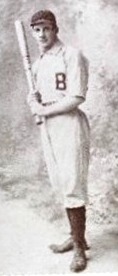
Joe Corbett

There remained significant interest in Corbett’s services; unfortunately for Joe he remained under the control of Ned Hanlon.  Hanlon had moved to the Brooklyn Superbas in 1899 as part of a stock swap between the Brooklyn and Baltimore franchises—he took several players with him, including “Wee Willie” Keeler, Hughie Jennings and Joe Kelley—he also kept Corbett’s rights.
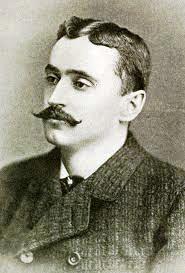
Ned Hanlon

Hanlon offered Corbett $2400 to play for Brooklyn and turned down offers to trade his rights.

According to California newspapers Corbett occasionally pitched in semi-pro games in 1899, but in 1900 The Sporting Life reported that Corbett was “dangerously ill,” and would probably never pitch again as a result of sciatic rheumatism.

Less than a year later The Sporting Life said Corbett was pitching for a team in Oakland, and the next year he appeared in five games for the Minneapolis Millers in the American Association—the retirement appeared to be over.

A successful January 1903 appearance on the mound in an exhibition game featuring barnstorming Major Leaguers renewed interest in Corbett again.  The Los Angeles Angels of The Pacific Coast League offered Joe a contract he couldn’t refuse, one that allowed him to tend to the family business interests in San Francisco during the season.

Newspaper reports said Corbett earned $5000 for the 1903 season, Angels manager Jim Morley said he wouldn’t say how much Joe earned but said that he had:

“Figured it out that Corbett will get 4.99 a curve.”

After going 23-16 for the Angels, the Major leagues again came calling.   Early reports had Corbett signing with the Pittsburgh Pirates, who offered $5000, but Joe eventually signed with the Saint Louis Cardinals.  While the Cardinals assured Joe that Ned Hanlon had relinquished Brooklyn’s claim, the Corbett family was not ready to end the feud with Hanlon.

Gentleman Jim, when asked if Joe would ever consider playing for his former manager again, told reporters:

“Hanlon couldn’t get Joe to twirl for him if he offers him a million dollars a year.”

Things didn’t go well in Saint Louis.  Joe Corbett was 5-8 when the Cardinals released him August 1.

Jim was, as always, Joe’s biggest defender:

“My brother Joe was getting $7000 for the season from the St. Louis club, but his heart was not in his work, simply because he was separated from his wife and little ones who were out in California.  Thinking of his family all the time impaired his effectiveness as a pitcher.”

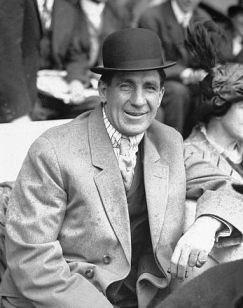
Gentleman Jim
Joe returned to San Francisco where he added a hat store to growing stable of businesses; his rights returned to Hanlon and Brooklyn.

The final chapter of the Corbett story on Monday.
“A Vain and Foolish Kick”

23 Nov

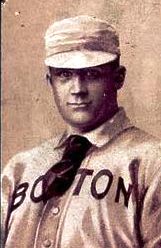
The Brooklyn Bridegrooms won the 1890 National League Championship by 6 ½ games over the Chicago Colts behind pitcher Tom Lovett who posted a 30-11 record.

Just three years earlier there was speculation that Lovett’s career might be over due to overwork.

Tom Lovett, 1890

Born in Providence, Rhode Island in 1863, Lovett began his professional career with Waterbury in the Connecticut State League in 1884.  He appeared in 16 games for Philadelphia Athletics in the American Association in 1885 and was in the New England League with the Lynn/Newburyport Clamdiggers.

In 1887 he signed with the Bridgeport Giants in the Eastern League and dominated the league in May and early June.  Despite getting off to a fast start (the team was 20-5 in May), Bridgeport was suffering a decline in attendance and the franchise was in trouble.

At the same time community leaders in Oshkosh, Wisconsin were determined to win the Northwest League championship, and they put enough money together to offer to purchase Lovett who was 21-3, as well as Tug Wilson, Bridgeport’s catcher and leading hitter, and shortstop Dan Shannon, the Eastern League’s leading base stealer.

Lovett was 20-2 for Oshkosh (40-7 for the season) and they easily won the championship, but he did not pitch during the season’s closing days; The Sporting Life reported that “Lovett is said to be lame in the arm.”

Despite speculation well into the next spring that his arm was permanently “lamed,” Lovett recovered and posted a 30-14 season in 1888 with Omaha in the Western Association.   In the fall of 1888 he was purchased by Brooklyn, then in the American Association.

Lovett was 17-10 in his first season with Brooklyn, and followed that with his pennant-winning performance in 1890.  He then dropped to 23-19 in 1891 as the team fell to 6th place; Lovett threw a 4-0 no-hitter in June against the New York Giants.

After the 1891 season Brooklyn attempted to cut his salary to $2800 (various sources say he either earned $3000 or $3500 in 1891).  Lovett demanded $3500 and turned down a compromise offer of $3200.

He said he could earn more money operating his tavern in Providence and chose to sit out the 1892 season.

The Sporting Life called it, “A vain and foolish kick against salary reduction.”

In this case the critics might have been correct.  The Lovett-less Grooms improved from 61-76 in 1891 to 95-59 in 1892.

Hat in hand, he returned to Brooklyn for the 1893 season signing for $2400.

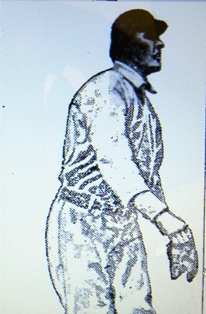
Lovett pitched in only 14 games and had a 3-5 record before hurting his arm again.  The following season he pitched for the Boston Beaneaters until he was released in July.  His Major League career over, Lovett finished 1894 in the Eastern League with the Providence Clamdiggers and spent 1895 with the renamed Providence Grays in the same league.

Lovett, with Boston 1894

Lovett, most likely baseball’s first true hold out, spent the rest of his life in Providence and died in 1928.

“The Man who Ate Himself out of the American League”

20 Nov

Frank Frederick Schneiberg was born in Milwaukee in 1882 (Baseball Reference lists his year of birth as 1880, but all available documents say 1882).

He began playing baseball for amateur teams in the Milwaukee city league, and after playing for the Pabst Brewery team in 1903 signed with the Springfield Hustlers in the Three-I League.  No records survive, but according to The Milwaukee Journal Schneiberg “won 19 out of 21 starts.”  He played with the Freeport Pretzels in the Wisconsin State League in 1905 and according to the Journal “won 12 straight.”

Frank Schneiberg

He won 22 games the following season with the La Crosse Pinks, which earned him a shot with the Detroit Tigers.

It didn’t go well.

Schneiberg was released to the Milwaukee Brewers before the beginning of the season.

The Associated Press said:

“He has the earmarks of a great pitcher…speed, curves, control and a pretty good collection of baseball brains…but Schneiberg was lazy…He wasn’t eager to pitch.”

The story quoted Tigers manager Hugh Jennings:

“He knows how (to pitch) but he won’t exert himself, I don’t want anybody who will not hustle.”

The Toledo News-Bee blamed his release on something else:

“He is known all over the country as the man who ate himself out of the American League.”

It is unknown whether either or both versions of his time with the Tigers is accurate, in either case, Detroit did try to claim that Schneiberg was still their property later that season when he was pitching well for the Brewers.  The claim was denied and he remained in Milwaukee.

Schneiberg pitched for the Brewers for three seasons compiling a 40-48 record.

While a fan favorite in Milwaukee, Schneiberg appears not to have been popular in at least one other American Association city.  The Toledo News-Bee accused him of being a head hunter in 1908:

“Schneiberg has the reputation of threatening to ‘bean’ batters.”

The following season The News-Bee claimed the Brewers were trying to trade the pitcher and said the team was:

“(V)ery anxious to trade the German, who does not work with any spirit, but the player is not highly regarded around the circuit.”

Regardless of the opinion in Toledo, The Brooklyn Superbas thought highly enough of Schneiberg to draft him from the Brewers at the end of the 1909 season.

He appeared in his only Major League game. On June 8, 1910, with Brooklyn trailing the Cincinnati Reds 4-0, Schneiberg relieved Nap Rucker in the top of seventh inning.  He walked four, gave up five hits and allowed 7 runs (Baseball Reference shows Schneiberg giving up eight runs, with seven earned—the box score from the game shows 7 total).

Schneiberg was lifted for a pinch-hitter in the bottom of the seventh.  Within days, he was traded to the Des Moines Boosters in the Western League.

He retired after the 1910 season, but in February of 1913 signed with the Memphis Chickasaws of the Southern Association.  He appeared in two games and was released, and in June signed with the Springfield Watchmakers in the Three-I League.  It’s unclear whether he appeared in any games with Springfield.

Frank Schneiberg 1932

Schneiberg retired to Milwaukee after the 1913 season, he became an asbestos worker and an official in the Asbestos Workers Union.  He passed away in Milwaukee in 1948.

A Few Veteran’s Day Remembrances

9 Nov

Lester Wirkkala

PFC Lester Rudolph Wirkkala, pitcher for seven seasons in the Northern League, Nebraska State League, Ohio State League and American Association; killed in action near Gravelotte, France, September 7, 1944.

Roman Wantuck

PFC Roman Wantuck, 34-13 record in two seasons with the Sheboygan Indians in the Wisconsin State League; killed in action on Biak Island, New Guinea, June 16, 1944.

James Whitfield

Staff Sergeant James J. Whitfield, outfielder for the Albany Cardinals in the Georgia-Florida League in 1941; killed in action Angaur, Palau, September 22, 1944.


Support Homes For Our Troops.


Alonzo Hedges and the Hunting Dog

31 Oct

In 1903 Alonzo Hedges briefly became a baseball sensation.

“Pongo” Joe Cantillon, manager of the pitching strapped Milwaukee Brewers in the American Association acquired fellow Kentuckian Hedges in August from the Paducah Chiefs in the Kitty League (no roster exists for the team, but Hedges is listed in multiple box scores in Kentucky newspapers).

Said to be a 19-year-old, Hedges started his first game for Milwaukee the day after his arrival and shut down the Columbus Senators–he took a no-hitter into the ninth inning, giving up a single with two outs.

After another shutout in his second game, Hedges, “The Boy Pitcher of Milwaukee,” appeared headed for stardom.  He wasn’t.

Alonzo Hedges

First, The Chicago Tribune revealed in mid August that “The ‘boy pitcher’, whom a number of clubs are after, is really 23-years-old.”   Then Hedges faltered.  While posting a 5-4 record he was hit hard in last 11 games with Milwaukee, after being nearly unhittable in the first two.

Back in the Kitty League with the Springfield Hustlers in 1904, Hedges was effective and helped lead the team to the league championship (again, no statistics survive), but he was no longer mentioned seriously as prospect.

Newspaper accounts indicate he was the “Hedges” who appeared in four games for the Webb City Goldbugs in the Missouri Valley League in 1905—although an arm injury ended his career early in the season.   Hedges signed with the Springfield Senators of the Three-I League in 1906, but it appears that he never played for the team.

How Hedges ended up with Springfield after his brief time in Milwaukee is the real story.

One of the stories that has been told and retold about the colorful Joe Cantillon is that in 1915, while part owner and manager of the Minneapolis Millers, he traded a player, “outfielder Bruce Hopper,” to the Chicago Cubs for a hunting dog.

There are two problems with the oft-repeated story:  “outfielder Bruce Hopper”  is actually pitcher Bill “Bird Dog” Hopper, and contemporaneous accounts mentioning that Hopper was once traded for a dog provide no details of the transaction and predate Hopper’s tenure playing for Cantillon.

Joe Cantillon

However, such a trade might have taken place, but it happened more than ten years earlier and the player traded was Alonzo Hedges.

A 1910 article in The Milwaukee Sentinel mentions that Milwaukee Brewers owner Charles Sheldon Havenor kept a photo of Cantillon on his desk, along with a letter.  The letter read:

“The mother of the dog in the picture is the one I received in exchange for Alonzo Hedges, the pitcher.”

The story went on to tell the story of the trade:

“Cantillon went to Springfield, IL, to see a friend of his who owned the Springfield club and ran a cafe on the side.  During the course of the afternoon the friend showed Joe a couple of dandy setter puppies.”

Later in the discussion when the Springfield owner mentioned his need for pitching, Cantillon offered to sell him Hedges, and Cantillon said “I’ll let you have the fellow for one of those dogs.”

The Sentinel concluded:

“Mr. Hedges may not have been much of a bear cat as a pitcher, but he probably has the distinction of being the only ball player in captivity ever traded for a dog.”

One more note on Hedges.  The Chicago Tribune might have been wrong, the 23-year-old “Boy Pitcher,” might have actually been 26-years-old.  While Hedges grave lists his birth date as 1880, all extant records, including Hedges’ death certificate and census data, indicate he was born on 1877.

Hedges passed away January 12, 1928 in Paducah, Kentucky.

Fall from Grace

24 Oct

Grayson S. “Gracie” Pierce played parts of three seasons in the major leagues and was a National League umpire selected to preside over the final game of the 1886 championship series.  It went downhill from there.

Pierce was born in New York City in 1860.  Nearly every contemporaneous newspaper account referred to him as “Grace,” not “Gracie.”

Grayson Pierce

Pierce hit .186 playing for five different teams in the American Association and National League during his brief big league career; he was only slightly more successful during his single minor league season playing with the Hartford Babies and Binghamton Bingoes in 1885.

During his playing career there are references to Pierce occasionally serving as an umpire in college and professional games, and according to The Cincinnati Commercial he worked as a longshoreman in New Orleans each winter; he became a National League umpire in 1886,

In October of 1886, The Chicago White Stockings of the National League met the St. Louis Browns in the 1886 World Series.  Pierce was selected to serve as umpire in game 5, but according to The St. Louis Globe- Democrat, “(H)e was not on the grounds, as a long search revealed.”

Pierce got his chance the following day—with St. Louis leading the series 3-2, he was again selected to serve as umpire.  It didn’t go well for the White Stockings or Pierce.

Chicago blew a 3-0 lead in the eighth inning and lost the game in the tenth.  Pierce’s performance was universally panned.  The Globe-Democrat said:

 “For Umpire Grace Pierce of the League staff had been selected.  His judgment was weak and his decisions throughout the game gave rather poor satisfaction.”

The Globe-Democrat’s assessment was echoed elsewhere as well.  The Chicago Inter Ocean said that among the crowd:

“There was much loud talking and opinions of Pierce were quite freely expressed.”

Pierce was not a member of the National League staff the following year and instead worked in the International Association.  In September, a variety of charges were made against Pierce by the owner of the Syracuse Stars.  The complaint, filed with the league, said Pierce was drunk at games in Syracuse and Newark, and also claimed as reported by The Rochester Post-Express:

 “(Pierce) had forced Con. Murphy (Cornelius Murphy) to drink against the latter’s will and that he took (Tom) Lynch out of bed at 10 o’clock at night and started out ‘to do the town’  both returning in the morning ‘boiling drunk.’”

Pierce denied the charges saying Murphy concocted the story after Pierce had ejected him from a game and fined him $3 in Newark.  The Post-Express sided with Pierce and said:

“Grace is not a total abstainer, but in his long career on the ball field he has never been charged with drunkenness.  So far as Con. Murphy is concerned it has never been known before that he would have to be forced to take a drink.”

As for the charges regarding the drinking binge with Lynch, Pierce said:

“I was going home I found Lynch drunk in the street, I took him home and put him to bed.”

There is no record of what became of the charges, but Pierce did continue working as an umpire on the East Coast through the 1891 season.

The Sporting Life reported that Pierce did not have a position with a league for the 1892 season.

He disappeared for two years and  was not heard from again until July of 1894 when The New York Times reported:

“(Pierce) formerly a baseball player and umpire, was arraigned before Justice Burke in the Harlem Police Court yesterday morning charged by Barney Brogan a liquor saloon keeper…with stealing $35 from his cash drawer after the saloon was closed.”

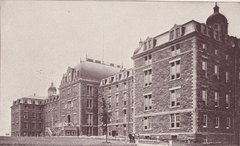
Pierce, who The Brooklyn Daily Eagle described as being “in a half-dazed condition” in court,   denied the charges but was unable to post the $1000 bond.  He was sent to Blackwell’s Island (the prison located on what is now Roosevelt Island). He became ill and died at City Hospital on Blackwell’s Island six weeks after his arrest.

City Hospital, Blackwell’s Island

Rooney Sweeney

18 Oct

John “Rooney” Sweeney was better known for his unpredictability and for making  good copy for the 19th Century press than for anything he did on the baseball field.  He remains one of the few Major League players for which a date of death is unknown.

Born in New York City in 1858, Sweeney’s first professional experience was in 1881 in the Eastern Championship Association, a league which only lasted one season.  Like many of the short-lived leagues of baseball’s first 30 years, the ECA had no fixed schedules and no control over player movement making it impossible to keep full rosters.  Sweeney played with four teams in the league: The Brooklyn Atlantics, New York Mets, New York Quick Steps and New York New Yorks.

There’s no record of where Sweeney played the following season, but in 1883 he played for Camden Merritts in the Interstate Association and made his Major League debut with the Baltimore Orioles in the American Association.

Although there is no other source for the claim, a 1910 article on the origin of catcher’s equipment in The Freeman claims that Sweeney was playing on the West Coast in Oakland for part of 1883 and was one of the first catchers to wear a mask, “The day he placed it on his head and went up behind the bat he was ‘Booed’ until he took it off in disgust.  Later the fans began to see the benefits of the wire covering.”

John “Rooney” Sweeney”

Sweeney then played with the Baltimore Monumentals in the Union Association in 1884.  He appeared in three games for the St. Louis Maroons in the National League in 1885 before being released.

According to The Sporting Life:

“When Rooney Sweeney was recently released by (Maroons owner Henry) Lucas he had quite a roll. So before leaving St. Louis, just to blow in a dollar or two, Rooney… hired a fine team of grays and a park wagon from a livery stable.  This was at ten o’clock Thursday morning.  At three o’clock Friday morning, eleven hours behind time, a messenger boy drove the team into the stable. Both the grays looked ready for the bone-yard and the owner at that moment would have sold them for a song. Their whole appearance showed that they had been driven nearly to death.

“Several men in the stable armed themselves with clubs and horsewhips and started out in search of Rooney. He must have been told of their coming, however, for before daybreak he took a train. It was lucky for him that the train started out before the livery men caught him.”

Rooney’s never again appeared in the Majors, but was said to have joined a team in Troy, New York after leaving St. Louis.  In 1887 and ’88 he played in the New England League, and then dropped out of sight, and apparently out of baseball, again.

In 1890, Sweeney signed with the London Tecumsehs in the International Association.

Official records indicate that he only appeared in one game—The Chicago Tribune, on May 12 reported on his debut:

 “Rooney Sweeney’s return to the diamond was not a success.  In his opening game nine bases were stolen on him and he had three errors.”

Things went downhill from there.  Sweeney was released in mid-May but apparently remained in London.  In June, it was reported that he had been arrested for stealing $40 from London pitcher James Maguire.

He received four months in jail and as the judge handed down the sentence The Sporting Life said, “Sweeney wept copiously.”

It was reported that Sweeney spent his time in jail writing letters to friends, one of which found its way into several newspapers.  Regarding the crime he was convicted of, Sweeney wrote:

 “We were all playing poker in a room up here and there was a big pot on the table.   Just then somebody flung a big black cat square on the table.  Of course the cat was scared and in her hurry to get away scattered the chips every which way and knocked down the stacks that were standing in front of the players.   Well, I just grabbed what I thought was my share, the same as any man would do, and it got me into jail, that’s all.”

After his release from jail, there are no records that indicate he ever again played in a professional game, but nearly every article written about him mentions that “He is not averse to playing baseball again.”

In 1892, Sweeney became involved in boxing, claiming he was going to manage fighters.  Just weeks later he was reported he was through with boxing and said:

 “I thought ballplayers was (sic) the ungreatfullest (sic) lot on earth, but they ain’t in it with fighters.”

And of course, the articles said, “Rooney is going to try his hand again at catching.”

Within a year of Sweeney’s foray into the boxing world both of his parents and his brother, New York City police officer Jeremiah Sweeney, died, and it was reported that he had inherited a great deal of property in New York and New Jersey, but of course in between collecting rents he said he’d like to play baseball again.

Sweeney was next heard from in September of 1897 when The Sporting Life said:

 “John Sweeney, a once famous base ball player, more popularly known as “Rooney” Sweeney  is dying in the Hudson Street Hospital as the result of injuries sustained by a fall in Battery Park last night.

“For some past Sweeney has been assisting the boatmen at the Battery…last night, while seated on the excursion pier, he was seized with an epileptic fit, and fell heavily to the ground, sustaining a concussion of the brain. An ambulance was rung up, and he was hurried to the hospital.  Sweeney has played with many of the principal base ball clubs both in the East and West, being at one time a member of the famous Metropolitan nine. He was also identified during his career with the St. Louis and Indianapolis.”

But that might not have been the end for Sweeney.  Three years later it was reported that he was working as a “Fireman on a tug boat.”

Sadly, that’s the last bit of information about the enigmatic Sweeney.  Whether he had succumbed to his illness in 1897 or he recovered and ended up aboard that tug boat we may never know.  No records of his death are available.

A Really Complete Chronology, and Quite a Reason to End up on the Disabled List

10 Oct

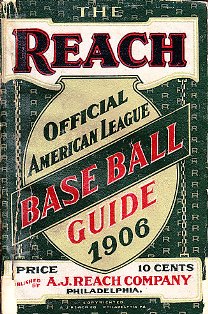
The Reach Guide, founded by Major Leaguer turned sporting goods magnet Alfred Reach in 1883, along with the Spalding Guide, founded by Major Leaguer turned sporting good magnet Albert Spalding in 1878, were the annual bibles of baseball.

Both publications prided themselves on providing the most complete chronology of the previous season.

An example of just how complete the Reach Guide could be is found in the 1906 edition.

The entry is about a young pitcher named Gus Bonno.

Bonno was born November 27, 1882 (Baseball reference incorrectly lists his birth year as 1881) in Ohio.  Records for his career are spotty.  After playing for a semi-pro team in Urbana Ohio in 1901 and part of ’02, late that season Bonno appeared in two games with the Toledo Mud Hens in the American Association.  Bonno returned to semi-pro the following season and played for the Paducah Indians in the Kitty League in 1904.

Bonno pitched for the Newark Sailors in the Eastern League and Norwich Reds in the Connecticut State League in 1905.

The Kentucky New Era referred to the Bonno as: “The handsome black haired, black-eyed debonair Italian twirler.”  In fact, nearly every contemporaneous newspaper article about Bonno referred to his ethnicity, which underscores the domination of players of Irish and German heritage in 19th and early 20th Century baseball.

Back to the Reach Guide.

On page 160, for the date September 23, 1905:

“Pitcher Gus Bonno at Cincinnati broke his ankle jumping from a second story window of a young woman’s home to avoid being shot by a jealous rival suitor.”

1906 Reach Guide

Bonno recovered enough to join the Augusta Tourists in the South Atlantic in the spring of 1906, but was sold to the Norfolk Tars of the Virginia League at the beginning of season.  He continued to pitch until 1911 with stops in the Western League and Bluegrass League.

He passed away in Cincinnati in 1964.

Ty Lober

27 Sep

Elmer “Ty” Lober was a long-time minor league player, manager in the Wisconsin State League, served in the Army in WWI and was a central figure in a scandal that briefly rocked the Pacific Coast League in 1914.

In September of 1914 police in Portland, Oregon announced the arrest of four men, and issued a warrant for a fifth.  The men were charged with “Wholesale traffic in school girls between the age of 14 and 16.”

Two of the men arrested were Portland outfielder Lober and third baseman Bobby Davis.  Also arrested were a local jeweler and an actor named Bert Roach (Roach would go on to appear in more than 300 films).  The warrant was issued for Mission Wolves and former Major League pitcher Frank Arellanes.

Early reports indicated that the players had confessed and that there would be several more arrests.  But the “open and shut case” described by West Coast newspapers seemed to quickly fall apart, and concerns about wide spread human trafficking among Pacific Coast League players quickly faded.

Just three weeks after the arrests the grand jury came back with indictments for only two of those arrested; Davis and Arellanes.  The cases against these two quickly fell apart also and all three players were in uniform at the beginning of 1915, Lober and Davis with Portland and Arellanes with Denver in the Western League.

Lober went on to play with Lincoln in the Western League before entering the service in 1918.  He spent 1920 with an independent team in Zanesville, Ohio and was signed to play with the Milwaukee Brewers in the American Association in 1921.  He finished his career with the Little Rock Travelers of the Southern Association in 1925 (he’s misidentified as “Lobar” on Baseball Reference).

Elmer “Ty” Lober

Lober managed and occasionally played for Two Rivers in the Wisconsin State League into the early 30s

He passed away on November 6, 1946 in Two Rivers.

Reports of His Death Were Greatly Exaggerated

18 Sep

Harry “Rube Allemang’s career was on the upswing at the close of the 1902 season; after a disappointing 4-15 record in his first season in pro ball with the Youngstown/Marion franchise in the Interstate League, Allemang had turned it around at Little Rock in the Southern League posting 20-4 and 19-11 season in 1901 and ’02.  (Contemporaneous newspaper accounts say he also played for Fort Wayne in the Interstate League in 1899, but there are not available records)

The Cincinnati Reds had just purchased Allemang’s contract and he was out celebrating with friends on the Evening on November 8.  Walking home at around 3 am, Allemang stumbled upon the lookout for a robbery in progress in the Mason City, West Virginia post office.  The lookout told Allemang to stop; when the pitcher kept walking he was shot, robbed and left for dead.

News of the shooting appeared in papers the following day:

Chicago Tribune: “Ball Player in Murdered”

New York Times: “Harry Allemang, Ballplayer, is Dying”

Fort Wayne Gazette: “Harry Allemang Mortally Wounded”

Arizona Republican: “Shot and Mortally Wounded”

The reports were premature.

Despite being shot just above the heart, with the bullet passing through his right lung, Allemang was out of the hospital in less than a month.  The Associated Press said “His case puzzles leading physicians.”

While still in the hospital he sent a letter to Reds owner August Herrmann to “Let you know I am still alive and expect to report in the spring.”

Allemang, with the bullet still lodged in his upper back, got ready for the 1903 season by doing ten mile runs while being pursued by blood hounds borrowed from the Mason County Sheriff.  But Allemang was never the same pitcher after the shooting.

He struggled that spring with the Reds and was sent to St.Paul in the American Association.   He was 12-11 in St. Paul in ’03 and 10-23 with Indianapolis in the same league in 1904.  After just two games with Sioux City in Western League in 1905, Allemang signed with the Niles Crowites in the Ohio-Pennsylvania League in May, and then jumped to an outlaw league team in Coatsville, Pennsylvania in July.  He came back to Southern League with Nashville in 1906, but lasted just six games, posting a 2-4 record.

Allemang passed away in Linton, Indiana in March of 1938—more than 35 years after the newspapers pronounced him dead.