Tag Archives: American Association

“Wilmington is in to the Finish”

10 Dec

When first-year manager Edgar Bear’s 1-9 Wilmington Sailors took the field on May 17, 1902 against the Durham Bulls, George Dudley Proud was, contrary to speculation in the press, assigned to work as umpire.

With the season just 10-games old Proud’s abilities as an umpire had been called into question by Bear, by Greensboro Farmers manager George “King” Kelly, and the press in Greensboro and Wilmington.

The game remained a scoreless tie into the bottom of the seventh inning.  The Wilmington Messenger said:

“Up to that stage it was a clean game, and there were many brilliant plays.  Neither side had scored.  Wilmington took her seventh inning and retired without any chance at the home plate.  Durham came up and (Otis) Stocksdale reached first on a clean hit and stole second. “

The next batter, John Curran, hit a ground ball to first baseman William “Germany” Dommel.  Proud ruled that Dommel did not touch first base and called Curran safe:

“This caused the trouble that resulted in Wilmington’s leaving the field.”

The team left the field and refused to return; Proud awarded the game to Durham by forfeit.  Bear’s role during the incident that led to the forfeit is unclear.   The Wilmington papers said he was present and in the stands, The Durham Herald said he was not at the ballpark when the incident took place.

What happened next is not in dispute.

The Durham Herald said:

“Umpire G. D. Proud, of the State Base Ball League, was assaulted last evening by Mr. E. J. Bear, manager of the Wilmington club.  The assault was the outcome of the kicks made by the Wilmington players in the game yesterday.”

According to the paper, Bear, accompanied by five Wilmington players, went to Durham’s Central Hotel and confronted the umpire.

“(Bear) knocked on the door of Proud’s room and being told to enter; he did so and started off by using insulting language.  This was followed by an attempt to strike the umpire.”

Bear was restrained by two hotel guests and arrested for assault.  Proud was fined $25 and released from jail the following morning.

The Messenger said:

“(Proud’s) conduct in Durham was such to make him many enemies, he told (a reporter) this morning that Durham had tried to ruin him and now he intended to break the state league if possible.  It is learned he telegraphed (North Carolina League) President (Perrin) Busbee this afternoon telling him either Durham or Wilmington had to get out of the league.”

On May 20 The Charlotte Observer published a letter from Bear, which read in part:

“I do most earnestly declare that in my opinion Mr. Proud is totally incompetent as an umpire, and the earlier he is relieved of his job the better it is for the league, and I desire to deny most emphatically that I ever made the statement that Wilmington was going to try to break up the league, or that either Durham or Wilmington had to get out of the league.”

Bear claimed he had not been in contact with the league president and said:

“I am manager of the Wilmington club at a great financial loss, but I have only the good of the league at heart, and intend that Wilmington shall remain a member of the league as long as any other club is in it, whether the Wilmington club wins another game or not.  And further that my best efforts will be given to make the league a success, financially and otherwise.  Wilmington is in to the finish.”

Wilmington was in to the finish—Bear was not.

The New Bern Daily Journal said:

“Manager Edgar Bear rather unceremoniously relinquished the management of the Wilmington baseball club (on May 25) by failing to provide transportation for the team to leave for the game at New Bern.”

Bear had disappeared.  His career as a professional baseball manager was over in less than a month.  He was replaced Harry Mace, who was an umpire in the league and a former professional player who had pitched in three games for the Washington Statesmen in the American Association in 1891.  Wilmington was 10-40 at the beginning of July when the team disbanded and the league was reconstituted with four teams.  Mace rejoined the league’s umpire staff.

Proud did not last much longer.  The day The New Bern Daily Journal reported on Bear’s exit, another article said:

“The New Bern team (the Truckers) arrived here (May 25), after its tempestuous three games at Raleigh…The team felt no discouragement from the loss of those games, which were under the complete control of Umpire Proud, who never gave new Bern a chance to win.”

Proud would resign before the end of May.  The Wilmington Messenger said he was “Honest, but not up to the requirements of the position.”

Proud became an umpire in the Tri-State League a month later.  He was also involved in automobile racing on East Coast, and created road maps.

Bear made the papers one last time.  On September 18 1905, Bear, going by the name of Eddie Merode and working as an acrobat in vaudeville performances in Utah.  The Charlotte Observer said police were called to “an opium joint” in Salt Lake City’s Chinatown were they found him “apparently dying of opium poisoning.”  He died later that day.
“The Great Baseball Question has been what will Capt. Comiskey do next Season”

3 Dec

In January of 1890 The St. Louis Globe-Democrat said what was on the minds of every baseball executive, writer, and fan:  “The great baseball question has been what will Capt. Comiskey do next Season”

For weeks there was speculation about whether Charles Comiskey, captain and manager of the St. Louis Browns, would remain in the American Association or join the Players’ National League of Professional Baseball Clubs (Players League), the league borne out of baseball’s first union the Brotherhood of Professional Base-Ball Players.

Charles Comiskey, against slang in baseball stories.

Charles Comiskey

On January 15, in a letter to The Sporting News, Comiskey announced his decision:

“During the past few weeks many interviews have appeared with me in different newspapers of the country relative to my having signed a contract with the St. Louis and Chicago Brotherhood clubs.  Up to this writing I am mind and fancy free.  But before Saturday night, January 18, I will have signed a contract to play at first base for the Chicago Brotherhood team.  I take this step for the reason that I am in sympathy with the Brotherhood.

“I believe its aims are for the best welfare and interest of the professional players.  I believe that if the players do not this time stand true to their colors and maintain their organization they will from this day forward be at the mercy of the corporations who have been running the game, who drafted the reserve rule and give birth to the obnoxious classification system.

“I have taken all the chances of success and failure into consideration, and I believe that if the players stand true to themselves they will score the grandest success ever achieved in the baseball world.

“But besides having the welfare of the players at heart I have other reasons for wanting to play in Chicago.  My parents and all my relatives reside there, and the all the property I own is located in the city.  I was raised there and have a natural liking for the place.  But, outside of all these reasons, my relations with the management of the St. Louis club have, during the past year been so unpleasant I do not care to renew them.  I have many friends in St. Louis, and for their sake I hate to leave here, but the other reasons out-balance this friendship, so I will cast my lines with the Chicago club.

“This is the first letter I have written on the subject which seems to have interested the baseball world throughout the whole of the present winter.

“Yours respectfully, Chas. Comiskey”

A week before the season began The Chicago Tribune said Comiskey’s new club “on paper, is the greatest team ever organized.”   Despite the hype, Comiskey’s Chicago Pirates finished in fourth place.  The Players League lasted only one season and dissolved in November of 1890.

Comiskey’s backing of the Brotherhood against “the corporations who have been running the game” would probably have come as a surprise to many of those who played for him when he owned the Chicago White Sox.  Arnold “Chick” Gandil, banned from baseball for his role in the 1919 Black Sox scandal said of Comiskey in a 1956 article in “Sports Illustrated:”

“ He was a sarcastic, belittling man who was the tightest owner in baseball. If a player objected to his miserly terms, Comiskey told him: “You can take it or leave it.” Under baseball’s slave laws, what could a fellow do but take it? I recall only one act of generosity on Comiskey’s part. After we won the World Series in 1917, he splurged with a case of champagne.”

Chick Gandil

Chick Gandil

Morrie Rath

25 Nov

In August of 1913, the Chicago White Sox sold second baseman Morris “Morrie” Rath to the Kansas City Blues of the American Association.

Morrie Rath

Morrie Rath

The Chicago Eagle said the sale wasn’t the result of Rath’s .200 batting average, or 16 errors, but because of his performance coaching first base during a game in Philadelphia earlier in the month:

“Morris was coaching at first base and (Manager Nixey) Callahan was at third.  (Harry) Lord was at bat.  He hit a bounder to one of the infielders and as it was a slow hit he figured he could beat it out.  He ran with every ounce of speed and strength that he possessed.  The play was mighty close.

Harry Lord

Harry Lord

“’Out,’ cried the umpire.

“Lord figuratively hit the ceiling.  He threw his cap down and jumped upon it.  He picked it up and threw it down again.  He howled and he scowled.  He allowed that if there ever was a blind umpire that he was working on the bases that day.  He assured the ump that in all his experience as a ball player it was the worst decision he ever saw.  Then up spoke Rath.  His voice was as gentle as could be:

“’Yes, you were out Harry.’

“And Lord collapsed.  That beat the other thing.  Never in his experience as a ball player had he heard another player agree with the umpire when it meant that one of his pals was out instead of safe.  That was beyond the comprehension of Lord.  He just wilted and staggered to the bench.

“By this time Callahan was over there.  There was fire in his eye, and he was fighting mad.  ‘Of all the—‘ he started in and then stopped.  For the umpire was laughing.

‘What’s the matter?’ howled Cal.

‘Why Rath here agrees that he was out,’ laughed the ump.

“What did Cal do?  What could he do?  He also was dazed.  It was a new one on him.  He had been around ball fields for many years, but never before had a member of his team taken sides with the ump against a teammate.”

It was a long road back to the big leagues for Rath.  He played for Kansas City until June of 1915 when he was sold to the Toronto Maple Leafs.  In 1916, He joined the Salt Lake City Bees in the Pacific Coast League, after hitting .300 and .341 he was drafted by the Cincinnati Reds after the 1917 season in the Rule 5 Draft.

After spending 1918 in the United States Navy where he was captain of the baseball team at the Philadelphia Navy Yard, Rath finally joined the Reds for the 1919 season.  He was Cincinnati’s regular third baseman in 1919 and 1920 and appeared in all eight games of the 1919 World Series against his former team.

Rath finished his career with the San Francisco Seals in the Pacific Coast League in 1921.

After his career, he operated a sporting goods store in Upper Darby, Pennsylvania.  In 1945, suffering from ill-health, he committed suicide.

“I Consider him a Weak, Foolish Talker”

13 Nov

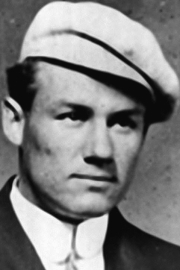
Bill Phyle was a no-show.  He failed to appear before Southern Association President William Kavanaugh at the league’s hearing regarding his charges that the end of the 1903 season was fixed.  After the league suspended him he failed to appear in St. Louis to defend his charges in front of the National Association of Professional Baseball Leagues (NAPBL).  He claimed he was too ill to attend either meeting.

As a result he was expelled from organized baseball in October of 1903.  His appeal was denied in December.

Phyle had very few supporters by the time his fate was settled by the NAPBL, but he still had at least one—kind of:  Milwaukee Brewers Manager “Pongo” Joe Cantillon, the man who sold Phyle’s contract to the Memphis Egyptians.

Joe Cantillon

Joe Cantillon

Cantillon told William A. Phelon of The Chicago Daily News that his former player wasn’t too bright, but that he also wasn’t wrong:

“I consider him a weak, foolish talker, who opened his head when it did not do him any good.  Just the same, Billy Phyle had cause for the charges which he made, and I got it good and straight that there was work done in the Southern league last season which was on the scandalous pattern.”

Cantillon stopped short of saying the season was fixed—but not very far short:

“Understand I do not say, neither does Phyle charge, that any games were sold, or that either manager or club owners were in on any such deals.   Even though there are thousands who say—apparently with mighty good reason—that the league is crooked, always has been crooked since it started, and always will be crooked—I do not accuse anyone of selling out.”

Cantillon then came pretty close to accusing Atlanta of selling out:

“This is the way the thing was done—and if anybody wants to howl I’ll show the goods and produce the names.  When Memphis was playing Atlanta it was a case of anything to beat out Little Rock.  The Atlanta players, knowing that their only chances had gone glimmering, were anxious to help their friend’s to beat Mike Finn’s gang (Little Rock).  There was no sell out and there were no intentional errors—nothing so gross and coarse as that.  But a couple of the best regulars on the Atlanta team were laid off; a couple of substitutes were put in their places; a raw, unseasoned amateur was sent in to pitch, and then, to make assurances doubly sure, the Atlanta catcher told each Memphis batsman just what to expect as he came to the plate.”

Cantillon also said the Birmingham Barons were “trying to help (Little Rock) along,” and:

“Every player in the league was dead wise to the whole situation, but Billy Phyle was the only man who was foolish enough to open his face, and he got soaked proper.”

Cantillon claimed to “positively know” that Phyle had been sick, and that was the only reason he failed to appear to substantiate his claims in front the league and the NAPBL.  Regardless, he said Phyle would have had a difficult time:

“Even if he had been able to attend, what show would he have had, with every manager determined to clear his own skirts and swat Bill for the squeal he made?”

Cantillon challenged anyone in the Southern Association to refute his allegations.

In February of 1904 Cantillon cancelled a scheduled spring tour of the South and Phelon said in The Daily News that Southern Association teams had refused to play against Brewers.

The following month Clark Griffith, who was in the South with the New York Highlanders, told The Atlanta Constitution that Cantillon was “ a nice fellow,” who “had been misquoted and had not authorized the interview, and in fact knew nothing of it until it appeared in the press.”

Cantillon himself never directly denied his statement, but The Constitution, content to keep the focus of Southern wrath on Phyle was happy to give the Milwaukee manager a pass:

“(Griffith’s claim) puts a new light on the question and it is very probable that he has been judged too harshly in the south…Phyle as a baseball issue is now dead.  Any effort to revive him and bring him forward on the stage either as a hero suffering persecution or a sick man worrying his life out by the blacklist hanging over him, will meet with the opposition of every paper in the south.”

Phyle went to Toledo and spent the spring and summer wiring Southern Association President Kavanaugh asking for reinstatement so his contract could be assigned to the Mud Hens.  After his application was rejected in May, and again in July, Phyle joined the independent Youngstown Ohio Works team.  The team played exhibition games that summer with the Brooklyn Superbas and Pittsburgh Pirates—both National League clubs were fined $100 for playing against the blacklisted Phyle.

(Some sources list Phyle as a member of the 1904 Johnstown Johnnies in the independent Pennsylvania League, but several Pennsylvania newspapers, including The Williamsport Gazette and The Scranton  Republican said in August “Phyle turned down a $225 per month offer from Johnstown.”)

Phyle became part of another scandal in 1905.

Bill Phyle

Bill Phyle

Youngstown joined the newly formed Ohio-Pennsylvania League, and needed to submit a roster to the NAPBL for approval.  Phyle’s name did not appear on the submitted list, but he played third base for the club all season, including an exhibition with the Cincinnati Reds on August 31. Youngstown was fined $500 in mid September and ordered to release Phyle.  Cincinnati was fined $100.

Phyle was finally reinstated in February of 1906, after he submitted a letter to the directors of the Southern Association retracting all of his 1903 allegations.

His contract was assigned to the Nashville Volunteers who sold him to the Kansas City Blues in the American Association.  After hitting .295 in 72 games, Phyle got one last trip to the National League.  He was traded to the St. Louis; he hit just .178 for the Cardinals.  He retired after playing three years in the Eastern League with the Toronto Maple Leafs from 1907-1909.

More than twenty years later Joe Cantillon was apparently forgiven in the South.  He managed the Little Rock Travelers to back-to-back eighth place finishes in 1926 and 1927.

The rest of Bill Phyle’s story next week.

“The Montgomery Team Threw to us Three Games by Arrangement”

12 Nov

The Southern Association kicked off their 1903 season assuming things couldn’t help but go better than the previous year.  The actions of Memphis Egyptians owner/manager Charlie Frank—who continued to put players in the Memphis line up who had been blacklisted by the league—had thrown the season into chaos.  The situation became so contentious that the headline in The Atlanta Constitution said after the final day of the season:

  To The Relief of All the Season is Now Over

A post season agreement restored the league—and made Frank even a greater power in the league.

As part of the settlement Frank received an estimated $5000 which he immediately put towards building a contender for 1903.

Frank built a good team and continued to improve it; as the team battled for the pennant in the final month the roster included veterans Perry Werden, Joe Delehanty, and Charles “Dusty” Miller.

In July he paid a reported $2500 to the Milwaukee Brewers in the American Association for outfielder Sam Dungan, pitcher Ray “Dad” Hale and third baseman Bill Phyle; Frank named Phyle team captain.

Bill Phyle

Bill Phyle

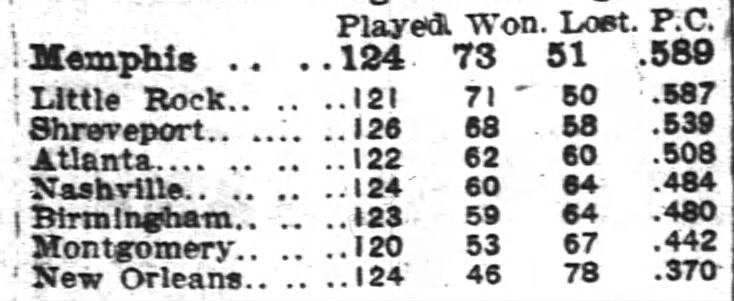
Frank’s team finished strong and edged out the second place Little Rock Travelers on the final day of the season; Memphis beat the Atlanta Crackers 9 to 5 in front of 7500 fans—the then largest ever crowd at Atlanta’s Red Elm Park.

The final standings

The final standings

The following week Little Rock defeated Memphis 3 games to 2 in a best of five series; the Southern Association season appeared to have come to peaceful close on September 28, 1903.

That changed two days later.

Newspapers across the South reported on serious charges that were being made in Memphis.  The Associated Press said:

“According to statements made by William Phyle, former National League player and this year a captain of the pennant-winning Memphis team…the Memphis club won first honors by inducing players on the opposing team to ‘throw’ the final (series).”

Phyle told reporters the scheme began earlier in September:

“The Montgomery team (Black Sox) threw to us three games by arrangement, but Little Rock kept on winning and kept it close on out heals.  I knew that Birmingham (Barons) threw to Little Rock too.  Then the deciding and final game of the season between Memphis and Atlanta arrived, and we had to win the last two games to keep the lead.  Two of the Atlanta pitchers were given $25 each to allow Memphis to win…and another player was also bought.  We won one game by (George) Winters misjudging a fly that allowed (Ted) Breitenstein a three-bagger and the deciding run.”

Winters error came in the second to last game; he was absent from the final game of the season.

Phyle later told an Atlanta reporter that the pitchers who were paid off were Frank “Zeke” Wilson and John Ely.  Charlie Frank, who had just announced he was leaving Memphis to take control of the New Orleans Pelicans, denied the charges and claimed Phyle was simply angry over a “dispute involving money.”

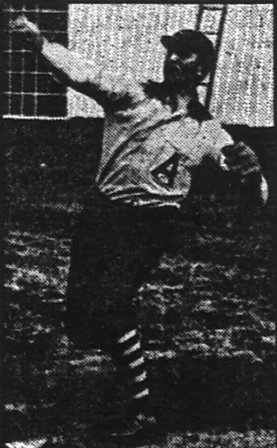
Zeke Wilson

Zeke Wilson

Phyle also said the five-game post season series was “prearranged, so that the deciding game was played in Memphis before a Sunday crowd.”

League President William Kavanaugh scheduled a meeting in Memphis for October 17 to investigate the charges, and Phyle went to West Baden, Indiana.

Phyle demanded travel expenses to return to Memphis for the meeting, he initially claimed that the money the league wired came too late. Then Kavanaugh ordered him, by telegram, to “catch the first train for Memphis,” Phyle refused, now claiming he was ill.

The meeting was held without Phyle.  Zeke Wilson testified that he had received $50 from Charlie Frank, but that it was given to him after the season in order to secure his release from Atlanta.  He said he intended to sign with Frank in New Orleans (he ended up signing with Montgomery in 1905, but joined Frank in New Orleans in 1905).

As for Winters, who made the error that allowed Memphis to win the second to last game and was absent for the final game, The Sporting Life said that charge was “very easily explained.” It was claimed he failed to appear in the final game because of a dispute with Atlanta management over transportation money.

Managers Lew Whistler of Montgomery and Michael “Duke” Finn of Little Rock denied that either club was involved in “anything crooked.”  John Ely did not appear but sent a letter denying all charges.

Without Phyle in attendance to provide his evidence the league “exonerated all clubs and players mentioned in his charges,” and suspended Phyle indefinitely.

Next Phyle was ordered to St. Louis to defend his charges before the National Association of Professional Baseball Leagues.  He again failed to appear.

On October 25 Bill Phyle was expelled indefinitely from professional baseball.

The following week he appealed the decision; claiming his illness was the only reason he failed to appear and that if allowed “he will appear and substantiate the charges which he has made.”

He was never given another opportunity to present his case.  His appeal was denied in December.

Tomorrow: More on Bill Phyle.

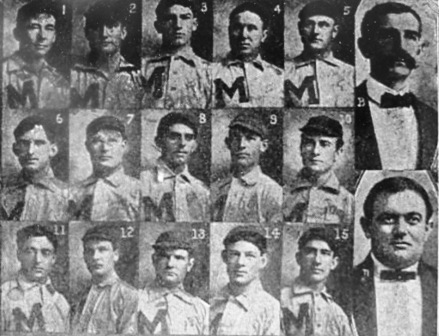
The 1903 Memphis Egyptians--

The 1903 Memphis Egyptians–Bill Phyle is number 11, Joe Delehanty 2, Perry Werden 4, “Dusty” Miller 12, Ted Breitenstein 13, Charlie Frank, bottom left with bow tie

Sam Barkley and the Mobster

29 Oct

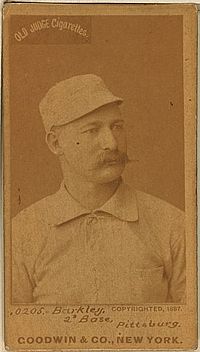
Samuel W. Barkley’s brief career on the diamond was highlighted by two legal disputes over his services; his life off the field was more complicated and interesting.

Barkley rose from amateur and semi-pro teams around Wheeling, West Virginia, to a solid season (.306, league-leading 39 doubles) as a 26-year-old rookie with the Toledo Blue Stockings in the American Association in 1884. Among his teammates in Toledo were Fleetwood and Welday Walker.

Toledo was only a major league franchise in 1884—The Toledo Blade said the team had lost “nearly $10,000–and disbanded,” selling five players, including Barkley, to the St. Louis Browns—the sale included pitcher Tony Mullane, who attempted to sign with Cincinnati after agreeing to sign with St. Louis, leading to his year-long suspension. By the time all the legal wrangling was done, only Barkley and Curt Welch reported to the Browns.

After a .268 season in St. Louis, owner Chris Von der Ahe sold him to the Pittsburgh Alleghenys, but Barkley had already signed a contract with the Baltimore Orioles. The American Association suspended and fined Barkley; Barkley sued. The dispute was settled with Barkley being reinstated and Pittsburgh paying the fine on his behalf.

Sam Barkley

Sam Barkley

After two years in Pittsburgh, he was purchased by the Kansas City Cowboys, and that’s when his life got more interesting.

In Chicago, he met an 18-year-old woman named Dora Feldman, who followed him to Kansas City, where as The Toledo News-Bee said, “most of his money was thrown at the feet of the young woman.”

The Chicago Inter Ocean said Barkley claimed, that the day before he married Dora, “she went to her room in a Kansas City hotel and took poison, fearing he would not marry her.”

Despite the suicide attempt, the two married.

He hit just .216 in 1888 but was hitting .284 the following year when he was sold to the Toledo Black Pirates in the International League. After just 50 games there his career was over. At some point during the 1888 season he suffered a knee injury he said ended his career:

“I knocked a safe one to left field, and was dancing around between first and second bags when (Mike) Mattimore, the Philadelphia (Athletics) pitcher attempted to catch me napping. He ran to the base line, and as I attempted to slide back to the first bag he unintentionally gave me the ‘knee’ and it injured severely the knee cap on my left leg.”

With his playing days behind him, Barkley, who was reported to have made as much as $1,800 a season with the Alleghenys, returned to Pittsburgh with a young wife who had aspirations to be an actress and opened a cigar store.

It didn’t end well.

After just more than a year in business, The Pittsburgh Press said Barkley’s store on Smithfield Street closed by order of the sheriff, due to “claims aggregating $3,600.”

The couple moved to Chicago.

Initially, things went better there.

Barkley opened a tavern at 292 West Madison Street, and he and Dora had a son who was born around 1895.

Shortly after they returned to Chicago Dora met Chicago’s first crime boss Michael Cassius “Mike” McDonald.

Richard Henry Little of The Chicago Tribune said McDonald, “never held office but ruled the city with an iron hand.”

McDonald built a gambling and protection syndicate, controlled the Garfield Park racetrack, and solidified his control of the city as leader of the local Democratic Party. He was also heavily involved in legitimate businesses—he owned The Chicago Globe newspaper and financed the building of Chicago’s first elevated rail line.

Mike McDonald

Mike McDonald

Years later Barkley told The Inter Ocean about his wife’s first meeting with McDonald:

“She was introduced to him at a box party in McVicker’s Theater shortly after the close of the big fair (World’s Columbia Exposition), in 1893…I remember the night distinctly. Dora came home to our place at 319 Washington Boulevard and told me that she had met a very fascinating old man (McDonald was 44), who was reputed to have a lot of money.

“’Watch me get a piece of that money,’ Dora said to me, jestingly, and fool that I was I laughed at the supposed joke.”

Dora Feldman Barkley McDonald

Dora Feldman Barkley McDonald

There are several versions of what happened next. One involves an elaborate (seemingly too elaborate) story that suggested Barkley was lured by a friend of McDonald into a compromising position involving women and drugs—only to be “caught” by his wife. The more likely version was that he was simply paid off—The Inter Ocean said he received $30,000 to divorce Dora.

Barkley never acknowledged receiving the money and only said:

“(Dora and McDonald) had planned between them to oust me, and no matter what I might have done, it would have been all the same in the long run. With his money and his influence, McDonald could put it over me any time he wanted.”

Dora eventually became McDonald’s second wife in 1898, (his first wife, who once shot a police officer—she was acquitted—had eloped to Europe with a soon to be former priest).

By 1897, Barkley had opened a new tavern at 15 North Clark Street, which was frequently in the news.

Sam Barkley

Sam Barkley

The Chicago Tribune called it a “notorious saloon,” and The Chicago Daily News reported on several occasions that the bar had its license revoked temporarily for various criminal activities and violations; in 1900 The Inter Ocean said a grand jury report was “almost an indictment of the city administration for its toleration of the dives, all-night saloons, and resorts for thieves and the depraved.” Of Barkley’s location the grand jury said:

“Men and women drinking, swearing and carousing, with music; open after midnight in the past. Several murders have been committed in front of this door.”

As with all such “clean-up” drives during that era in Chicago, nothing came of the grand jury report.

Dora again made headlines in 1907—and as a result so did her ex-husband.

The Inter Ocean said:

‘Mike ‘ M’Donald’s Wife Kills Artist in His Studio

“Dora McDonald, wife of Michael C. McDonald, millionaire, politician, traction man, and ex-gambler, shot and killed Webster S. Guerin, an artist, behind the locked doors of his studio in the Omaha Building, LaSalle and Van Buren Streets yesterday.”

Barkley was quickly contacted by reporters and told his sad story of how Dora had left him. The paper said:

“The story that Sam Barkley slowly grieved his life away over the loss of his pretty wife is disproved by the discovery of Sam Barkley alive and prosperous in Chicago today.”

Dora McDonald was eventually acquitted, but Mike McDonald did not live to see it, he died during her trial.

Barkley fell on hard times in Chicago soon after the killing. In August of 1908 a six-inning benefit baseball game was played at Comiskey Park between two Chicago City League teams–“Nixey” Callahan‘s Logan Squares and the Rogers Parks–“to raise enough money to start him in the cigar business.”

The Chicago Examiner said, “A fair-sized crowd turned out.”

Fred Pfeffer played first base for the Rogers Parks and “was the hero of the game with two hits besides fielding in grand style,” another former big leaguer, Emil Gross, served as umpire.

Shortly after that Barkley was operating a cigar store in his hometown, Wheeling, West Virginia.

There was one last chapter in the Barkley story. Soon after he returned to West Virginia he was living in poverty and became ill, and died on April 20, 1912. The Chicago Daily News said several days before his death a former baseball acquaintance was summoned to his side:

Billy Sunday called on him. He talked baseball for a while and then religion. At the end Sam liked both equally well.”

Billy Sunday

Billy Sunday

Dora McDonald was contacted for a comment:

“It is a closed incident—it’s so long ago that I knew him. But I’m sorry.”

She eventually married a doctor, moved to California and died in 1930.

“Johnson can Hit the Ball as far as Anybody”

14 Oct

After Hal Chase replaced George Stallings as manager of the New York Highlanders, Otis “Ote” Johnson was given another opportunity to play for the team.

Highlanders’ second baseman Frank LaPorte and third baseman Jimmy Austin were traded to the St. Louis Browns for third baseman Roy Hartzell.  Chase said he’d move shortstop John Knight to second and playing Johnson at shortstop.

The Sporting Life quoted Chase saying he planned to play Johnson at short “for his batting,” but noted that Johnson “only batted .223 in the fast Eastern League last season.”

Otis "Ote" Johnson

Otis “Ote” Johnson

New York scout Arthur Irwin agreed with Chase that the team needed Johnson’s bat in the lineup, and told The New York Globe:

“Johnson can hit the ball as far as anybody, and what is more he can hit often.”

The New York Herald said:

“Johnson is a beautiful fielder as well as a good hitter, and it is Chase’s intention to have him take the shortstop job.”

That’s where Johnson was on Opening Day, a 2 to 1 victory over the defending World Champion Philadelphia Athletics; Johnson batted seventh, went 0 for two with a walk and a sacrifice, and scored a run.

After sweeping Philadelphia in three games, New York split a four game series with the Washington Senators.

The Washington Herald said New York’s new shortstop “sure looked good, he fielded his position in fine shape,” and “keeps the infield alive with his funny remarks.”

A month after the season began The Indianapolis News said Johnson was “called home (to Muncie, Indiana) by the serious illness of his mother.”  Three days later the paper said he returned to New York “his mother’s condition having considerably improved.”  Within a week of his return the New York papers reported that Johnson had filed for divorce from his wife.

Less than two weeks later Johnson lost his starting job; Knight moved to short and Earle Gardner played second base.

Ote Johnson

Ote Johnson 1911

The San Francisco Chronicle said of the former Pacific Coast League star:

“Ote Johnson has been benched for his weak hitting.  He put up a star game in the field…but Ote did not respond with the hitting which featured his work when he was with Portland.”

Three days after he was benched Johnson left the team again to finalize his divorce.  After returning Johnson became New York’s primary utility infielder until he fell out of favor with Hal Chase.  The manager had been criticised as the team slumped for, as The Globe said “utterly lacking in the qualities for successful management.”

By August the team was fourteen games out of first place and The Herald said:

“Hal Chase, who has been very lenient with his players, is drawing the string tighter.”

The paper said Johnson “has been suspended without pay for violating the club’s rule of discipline.”  It was never revealed what rule was violated, but Johnson was suspended for about a week.  Johnson also hurt his throwing arm in August, further limiting his playing time.

Many in the New York press questioned Chase’s ability as a manager; Wilton Simpson Farnsworth of The New York Evening Journal was the exception.  Farnsworth said of Chase, when the team was 13 games back in August:

“Hal Chase, the game’s greatest first baseman, has made good as manager of the new York Yankees…Knockers claim that poor management is keeping the Yanks down, but forget it! A bad break in luck plus innumerable injuries is the cause.”

Hal Chase

Hal Chase

Regardless of the reasons, 1910’s second place team was limping to a sixth place finish. Chase resigned as manager in November.  Johnson hit just .234 and committed 31 errors in just 65 games.  He was released to the Rochester Hustlers in the International league in December.

Johnson spent just one season in Rochester; he hit .268 and got married; after the season his contract was sold to the Binghamton Bingoes in the New York State League (NYSL).  Johnson protested the pay cut his Binghamton contract called for, and initially threatened to jump to the PCL, he eventually signed a contract and became popular with fans.  He hit the Bingoes first home run of the 1913 season and was awarded with a free daily shave from a local barber and fan named Billy McCann.

He played most of the next three seasons in the NYSL—with the exception of 45-games with the St. Paul Apostles in the American Association at the beginning of the 1914 season.

After playing for the Elmira Colonels in 1915 Johnson recommended two players to his friend Walter “Judge” McCredie on the Portland Beavers—his teammate, pitcher Frank Caporal, and Syracuse Stars first baseman Owen Quinn—and it appeared the 31-year-old Johnson might be heading back to Portland where he remained very popular.

On November 9 Johnson went hunting with friend in Binghamton.  The (Portland) Oregonian said:

“Ote Johnson, famous ‘Home Run’ Ote of the Portland Pacific Coast team of 1907, 1908 and 1909, is dead…It seems Johnson, in company with a party of friends, went forth in search of game and while chasing a wounded fox stumbled and fell, both barrels of the shotgun he was carrying discharged into his abdomen.

“To the older generation of Portland fans Johnson will be remembered for his prowess in poling out long bingles.  He was one of the longest hitters that ever wore the livery of a Coast League club.  Some are prone to argue that he eclipsed the performances of (Frank) Ping Bodie and Harry Heilman, who are now the long-swat stars of the circuit.  Johnson also had a peculiar throw from third that will be remembered–He had a perfect underhand throw and was a wonder at handling bunts.”

He was buried in Johnson City, New York–his pallbearers included several players: Mike Roach, Charles Hartman, Mike Konnick, and William Fischer,

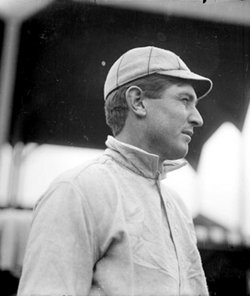
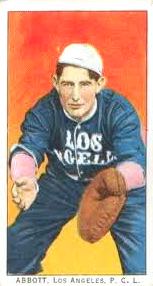
Fred Abbott

9 Oct

Fred Abbott (born Harry Frederick Winbigler) spent more than a decade in the minor leagues before the Cleveland Naps purchased his contract from the New Orleans Pelicans prior to the 1903 season.  The 28-year-old rookie appeared in 77 games for the Naps.

Fred Abbott

Fred Abbott

After his first big league season he told The Cleveland Press about his most embarrassing moment with the Naps:

“I was behind the bat in a game at Washington one day last summer when the batter hit a ball straight up over my head.  I should judge it went nine miles high.  As I tore off my mask a bleacherites flashed the sun’s rays in my eyes by aid of a looking-glass.  It nearly blinded me.

“’I can’t see it,’ I shouted, expecting either (Earl) Moore, who was pitching or Hick (“Cheerful” Charlie Hickman), who was at first, to take the ball.  But neither man stirred.  Instead Cheerful took my latitude and Earl my longitude.

“’Go toward first two steps,’ yelled Moore.  I did.

“’Go back about three feet,’ shouted Hick.  I did.

“Now put your hands straight over your head,’ howled both men in chorus when they had got me placed.  I did.

“And although my eyes were shut tight, the ball dropped straight into my hands.”

Abbott played one more season in Cleveland, and played for the Philadelphia Phillies in 1905.  The Phillies sold his contract to the Toledo Mud Hens in the American Association (AA).

Abbott laid down roots in Toledo.  He played five seasons there and operated a bowling alley and pool hall on Euclid Avenue with his teammate Harry Hinchman; until Hinchman took over as Mud Hens manager.

The Pittsburgh Press said:

“Rather tough on a baseball player when your own business partner releases you and sells your ability to play to a club on the other side of the country? “

Hinchman had succeeded James “Ducky” Holmes as manager late in the 1910 season; Abbott was sold to the Los Angeles Angels in the Pacific Coast League shortly after the season ended:

“One of Hinchman’s first managerial duties was to sell his partner to the Los Angeles club, Hinchman believing that Fred had been connected to the Toledo club too long and that both he and the club would be benefited by the change.”

Abbott wasn’t thrilled, but took the news in stride:

“Gee, I had been in Toledo so long that I had about made up my mind that I was going to die in the harness there…It’s a good move sending me to Los Angeles, but I will have to put in a longer season there than in the AA, and the pay offered is just the same.  I didn’t like that angle to the case very well, but they have got us ballplayers where they want us and I suppose it is up to Fred to run along and play.”

Fred Abbott with Los Angeles Angels 1911

Fred Abbott with Los Angeles Angels 1911

Los Angeles apparently grew on Abbott; he only spent one season with the Angels before retiring, but remained in L.A. until his death in 1935.

“Krug Seemingly Lost his Head”

25 Sep

The 1902 Southern Association season was so contentious that a headline in The Atlanta Constitution said the day after it ended:

To the Relief of All the Season is Now Over

In addition to the months-long battle between Charlie Frank and the league, there was an on-field incident that The Columbus (GA) Daily Enquirer called “an exhibition as was never before seen on an Atlanta Diamond.”  Henry “Heine” Krug was at the center of it.

Henry Krug

Henry Krug, 1902

In February of 1902, Ed Peters, new owner and president of the Atlanta Firemen signed Ed Pabst to manage the team.  Pabst had played the previous season with the San Francisco Wasps in the California League and brought with him to Atlanta his friend Krug, a 25-year-old shortstop who had been playing for West Coast professional teams since he was 17.

When Krug was signed The Constitution said he was “beyond doubt the star of the Pacific Coast,”

The Sporting Life said Krug had already signed a contract with the Philadelphia Phillies, but jumped the Phillies to join Atlanta.

Krug’s average never dipped below .300, and was very popular with fans and the press.  The Constitution called him “The best all-around professional of the Southern Association” in June.

On July 15 the paper noted his “dashing, errorless work that has been classed as phenomenal.”

Two days later the tone changed dramatically.

The fourth place Firemen were playing Charlie Frank’s Memphis Egyptians and Krug was having a rough day.  Early in the game a throw from first baseman George Winters hit Krug “and gave him a severe blow in the mouth.”  Krug had walked off the field, intending to leave the game, but came back.  He probably shouldn’t have.

Krug went on to make three errors, two of which The Constitution said “in the opinion of the crowd might have been avoided.”

The crowd began to taunt Krug and “Instead of taking the roast the bleachers proceeded to give him as any sensible player would take it, Krug seemingly lost his head and with all the vicious intent imaginable, he secured the ball and threw it with all his strength into the bleachers.”

The Constitution said Krug, “phenomenal” just two days earlier, now said the shortstop’s “conduct on former occasions has been offensive to the patrons of the game.”  Although Krug was ejected from a game earlier in the week, there didn’t appear from newspaper reports to be any pattern of “offensive conduct.”

Atlanta bleacher fans “dodged the sphere” and no one was hurt.  Team president Peters immediately approached Ed Pabst and “instructed him to order Krug out of the game.”  Pabst refused:

“He did not like what he considered an infringement on his prerogative, and at once tendered his resignation as manager of the Atlanta team.  President Peters was just as ready to accept as Manager Pabst was to tender, and within the space of a few seconds the ball player who has been managing the Atlanta team since the playing season of 1902 opened found himself deposed.”

Ed Pabst

Ed Pabst

Peters took over as manager and remained in the position for the rest of the season.  His first act as manager was to remove Krug from the game and suspend him.  The Constitution said:

“Krug’s baby act was witnessed by Sergeant Martin and policemen Norman and Hollingsworth.  They placed him under arrest.”

Some reports said a bottle and rock were thrown at Krug, but the player said he didn’t see that and was reacting only to the verbal taunts.  He appeared in court the following day and was fined $10.75; The Daily Chronicle said, “Krug appeared very penitent.”

Peters sold Krug’s contact to the New Orleans Pelicans the following day, but Krug refused to report sending a wire to Peters and Pelicans owner Abner Powell saying “that if he could not play in Atlanta he would not play,” in the league.

Despite the incident, there was no shortage of interest in Krug’s services.  In addition to New Orleans, the Phillies, who he jumped to join Atlanta and the San Francisco franchise in the California League offered him contracts.

Krug signed with Philadelphia and made his debut with the Phillies on July 26; the day after Atlanta management petitioned the National Association of Baseball Leagues (NAPBL) to blacklist Krug.

No action was taken and Krug played out the season in Philadelphia, hitting .227 in 53 games.  He spent 1903 with the San Francisco Seals in the Pacific Coast League (PCL).  Peters sold his interest in Atlanta in 1903.

Before the 1904 season, the PCL and the NAPBL reached an agreement that made the league part of the National Association and no more an “outlaw league.”  As part of the deal, PCL players who were under contract with other teams were returned.  As a result, Krug returned to Atlanta.

The Constitution assured their readers:

“He has promised to be good and to do his best to help the team win.  It is the belief of many fans in this city that he wishes to redeem the past.”

Krug played two incident-free, if unspectacular seasons in Atlanta, then played in the New York State League with the Scranton Miners and the American Association with the Indianapolis Indians.

krug1

Henry Krug,1907

The 31-year-old returned to San Francisco, where he was “negotiating for a place with the California State League,” and had accepted a position coaching the baseball team at Cogswell College.  Krug underwent surgery for “an abscess upon his throat” on January 12, 1908, and died from complications from the operation two days later.

Two months after his death all had been forgiven in Atlanta.  The Constitution named him to the paper’s “All-Atlanta Ball Team,” the best professional players to have played in the city.  Krug “was a power with the stick.  No better man ever played on the Atlanta team when it came to breaking up a game.”

“Pitchers Should be Taught how to Sleep”

24 Sep

Edward Tilden Siever had a theory about one of the greatest dangers facing pitchers:  how they sleep.

Edward Siever

Edward Siever

The Kansas native did not begin playing professionally until he was 24-years-old in 1899, and was 18-14 as a rookie with the Detroit Tigers two years later.  He injured his arm that season, had a sub .500 record the next three seasons with the Tigers and St. Louis Browns, and went to the American Association with the Minneapolis Millers in 1905. 

Siever’s arm recovered sufficiently to post a 23-11 record with the Millers and was purchased by the Tigers the following spring; he was 14-11 in 1906.

He was having the best season of his career in 1907; finishing with an 18-11 record and a 2.16 ERA for the American League Champion Tigers.  It was during that season that he told The Detroit Times about his theory:

“Pitchers should be taught how to sleep.  Don’t laugh, I mean that More than one good pitcher has lost his arm because he did not know how to sleep correctly.”

Siever claimed that fellow Kansan, St. Louis Cardinal pitcher Charlie “Dusty” Rhodes, missed much of 1906 with a bad arm brought on by the manner in which he slept:

“(Rhodes) used to rest his head on it when he was sleeping.  It deadened the muscles…No ballplayer should ever rest his head on his arms when he is sleeping.  It’s more dangerous than the average young man imagines.  Many a ball player loses his whip and doesn’t know how to account for it.  I’ll bet that’s the real reason in many a case.”

Charlie "Dusty" Rhodes

Charlie “Dusty” Rhodes

The Chicago Cubs defeated Siever in his only World Series appearance in 1907, and after a 2-6 start in 1908 he was sold to the Indianapolis Indians in the American Association; he pitched three more seasons in the minor leagues. 

He remained a popular figure in Detroit and worked for the city’s public works department until he died of a heart attack in 1920.