Tag Archives: Arlie Latham

Independence Day 1918

4 Jul

In June of 1918 it was announced that King George V would be attending, and throwing out the first pitch, at the July 4 baseball game between the United States army and navy teams.

The Associated Press (AP) said the King was looking for help to prepare for the Independence Day game:

“At the request of the king, Arlie Latham, a former big league player, who will umpire the Fourth of July game, sent the King a regulation baseball a few days ago.  The next day Latham called at the Palace and gave the King a brief lesson as to how the baseball should be handled.

“The proper form in pitching was rather hard for the King to get, as he is used to a different type of throw, as in cricket, but the royal student finally began to get something approaching the right swing.  Since then the King has been practicing in his spare moments on a blank wall in the garden.

“The King has expressed hope that he will be able to throw out the ball in a manner to win the approval of the American Rooters.”

Whether he actually practiced is unknown, but the plan to have the King throw out the first ball was scrapped, and he instead walked the ball out to Umpire Latham and handed it to him.

Regardless of how the ball was delivered, the press in London understood the gravity of the gesture.

The London Daily Telegraph said:

“Nothing will give greater pleasure across the Atlantic than the appearance of the King and Queen at the baseball match at Chelsea.  That mark of understanding and attention will appeal to the heart of America far more than any military pageant or review, and the handing out of the ball by the king to the players—an act which will seem trivial and incomprehensible to the German mind—is likely to do more toward the removal of century-old prejudice in America against the name ‘King George’ than the ablest diplomacy or the most persuasive rhetoric.”

The London Daily Sketch memorialized the event in verse:

“King George III with cannon balls

Did try our brothers to dispatch.

King George V the country calls

To watch with him their baseball match.”

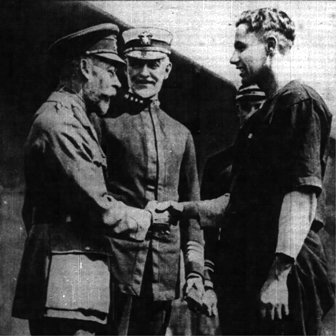
King George shakes hand with Lt. Mims, captain of the army team.  Admiral Sims looks on.

King George shakes hand with Lt. Mims, captain of the army team. Admiral William  Sims looks on.
On July 4 The AP reported:

“King George saw the American Army defeated in a hard-fought baseball game today.  The opponent of the army team was one picked from the American navy, which won by a score of 2 to 1.  Every one of the nine innings had its thrills for the more than 18,000 spectators.

“King George followed the game closely and enjoyed it thoroughly.  At the close he turned to Admiral (William) Sims and General (John) Biddle and expressed the hope that he might be able to see many more games before the summer was over.

“Few sporting events since the war began have aroused so much interest and discussion in London as yesterday’s game.  Independence Day was on everybody’s lips…For several days the newspapers have been explaining baseball and the people of London have been pouring over the mysteries of the American national game, instinctively trying to find in it some parallel to their own cricket.  Many persons went to the game armed with clippings and drawings of a diamond showing the position of the players.

“American soldiers and sailors on their way to the game were heartily cheered.  Outside the entrance to the Chelsea football grounds, where the game was played, the people lined the streets for several blocks and crowded the windows in their homes to watch the crowds.”

Hall of Famer Herb Pennock pitched for the navy team which was captained by his Red Sox teammate Mike McNally.

Most sources reported the the attendance as 18,000.  McNally, in a letter to Red Sox Secretary Larry Graver said in a letter reprinted by The AP:

“There were some 50,000 people present.  King George, Admiral Sims, and a lot of other ‘big guys.'”

The wire service summed up the importance of the day:

“No Country ever celebrated the national anniversary of another country as the people of Great Britain today celebrated the Fourth of July.”
“I Remember Well the First Day Latham Coached”

11 Jun

Arlie Latham “The Freshest Man on Earth” is generally credited as the first full-time third base coach.  Even before John McGraw hired him to coach third for the New York Giants in 1909, Latham’s antics as a “coacher” were already legendary—in 1907 Ted Sullivan, one of baseball’s pioneers and Latham’s manager with the St. Louis Browns, told The Washington Evening Star about Latham’s first time.

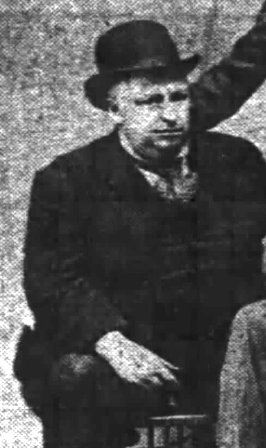
Ted Sullivan

Ted Sullivan

“’I remember well the first day Latham coached,’ said Sullivan.  ‘It was in Cincinnati in 1883.  I must confess I never had much use for a ‘fresh’ player, and soon after Latham reported I was not backward in telling him he was too d— fresh, but  I later discovered that he was a wonderful player, and that his freshness was of a most harmless and hilarious nature.  But after I gave him the reprimand I noticed he was a little timid about saying anything, but was still of good cheer.

“One day in Cincinnati Will White had the Browns on his staff with his little stingy rise ball.  My best men were on the bases and there was no one on the line.  I asked the men on the bench, ‘Is there no one here able to coach a little?’ Latham speaks up and says, ‘I will coach if you want me.’”

Never one for understatement, Sullivan said what happened next:

“Well, if Gabriel had entered a graveyard and blown his trumpet, and the tombstones had loosened their grip on the dead, it would not have created more of a sensation.  Latham walked out to the home plate and to the consternation of umpire, players and myself, delivered this talk to pitcher White:

‘My Dear Mr. White, we have been very courteous to you during the game, but as the Browns need a few runs we will have to be rude to you for awhile,’ and then stalking off to third base went through those gyrations that afterward made him famous all over America.  White was dumbstruck at the flow of words that afterward fell from Latham, and he became so rattled that the Browns batted him out of the box and won the game.”

Will White

Will White

No Browns game in Cincinnati that season matches well with Sullivan’s initial account—he continued to tell the story to reporters for more than a decade and sometimes said instead the game was “against Cincinnati—the game that best fits Sullivan’s description was a 9 to 5 Browns win over the Reds on May 16. But, contemporary accounts attribute White’s faltering, which led to the Browns come from behind victory, to a knee injury rather than any “flow of words” from Latham.

“Latham was the original funny man in the coacher’s box, and he stood in a class entirely by himself.  He has had many imitators, but they have never reached the position that Latham occupied, for he was a genius in the work and never used language that would offend the ears of the most prudish.

“Many years ago it used to be Latham’s great aim to get out on the coaching line here in Washington in the games that local pet—Win Mercer—was to do the pitching.  It will be recalled that Mercer was an extremely handsome fellow, and often it fell to his lot to pitch on Ladies’ Day.  Latham took the greatest delight in endeavoring to disconcert Mercer, the large number of ladies being mad enough to pull his hair, while at the same time they were convulsed with laughter at his sayings and antics.  He and Mercer were great chums, and when Latham was secured by the Wagners (J. Earl and George) to travel with the Washingtons (in 1899) for coaching purposes alone the two were inseparable, thus showing that though a thorough minstrel and actor, his chaff never broke into bitter personalities  or severed friendships.

“We have our Hughey Jennings and others of today, but in the history of baseball there has only been one ideal coacher from the line—Arlie Latham.”

Latham with the New York Giants

Latham with the New York Giants

When McGraw hired Latham two years later, Bozeman Bulger, sports writer for The New York Evening World said the Giants’ new third base coach had just as much fun as a minor league umpire as he did when coaching—Bulger was a writer for The Birmingham Age-Herald while Latham was working in the Southern Association:

“I had the fun one time of traveling with Latham while he was an umpire in the Southern (Association).  On one of those days the Birmingham club was playing at Little Rock, and Pat Wright was playing first for Little Rock, and Pat Millerick, of Birmingham was at the bat.  He hit a little grounder toward short, and for a moment it was fumbled.  Pat went lumbering down to first.  Seeing that he couldn’t quite make it on the run, he slid for the bag.  Pat Wright at the same time got the ball a little wide and slid for the bag himself, so as to beat the runner.  The feet of both hit the bag at about the same time.”

Latham made no call on the play.

“’Judgment!’ yelled Millerick, as he threw up his hand.

“Everybody waited for Latham to make a decision.

“’Wait a minute,’ said Arlie, ‘I want to do this thing right.’  He then rushed into the clubhouse and came out with a tape measure.  While the crowd sat in suspense Latham deliberately measured the feet of the two Pats—Millerick and Wright.  It was shown that Wright’s foot was one inch longer, and Millerick was promptly declared ‘Out!’  Nobody had the nerve to question the decision.”

“Why don’t you make Latham keep still?”

2 May

After winning the first three games of the 1894 season, the Cincinnati Reds dropped six of their next seven.  The Cincinnati Enquirer’s Harry Weldon said most of the players weren’t “fighters.”

“To be a ‘fighter’ in the sense that this term is applied in baseball does not necessarily mean that you must be a leg breaker, a rib crusher or indulge in billingsgate or profanity to your opponent.  It simply means that your mind must be on the game every minute and every second while it is in progress.  It means that you must watch every movement and point and be alert for any opening, however small.

“The Reds are as gentlemanly a team as there is in the league, and it is to their credit that they are so; but there is such a thing as carrying the matter too far.  There is an old adage about ‘fighting the devil with fire’ that some of our local players would do well to follow.  This advice is apparent.  There are times when ‘Excuse me please,’ and ‘I beg your pardon,’ won’t do.  The men to whom they are addressed don’t know what that sort of language means.  In other words, when you are in Rome do as Romans do.”

Weldon said some players were critical of the behavior of Reds third baseman Arlie Latham.  Latham was a Weldon favorite; the two had been friends since Weldon served as secretary for St. Browns President Chris Von der Ahe while Latham played there:

Arlie Latham

Arlie Latham

“There are a few growlers and soreheads who find fault with Latham for talking too much.  I cannot sympathize with such criticism.  Latham does not coach because he likes it or to be ‘funny’ and ‘work the grand stand,’ as many of his detractors would have people believe it.  I once heard one of the soreheads say to Captain (Charlie) Comiskey: ‘Why don’t you make Latham keep still?’

“’Do you want me to put him out of the game?’ replied the Reds’ captain.

“’No, I only want you to make him stop talking.’

“’Well, if I did that, he might as well be out of the game, for he would lose his interest.’

“Every word of this is true.  Latham is too much interested to keep still.  Hardly a ball is pitched in the game by the Reds’ pitchers that Latham from third base doesn’t have something to say.  Scarcely a movement is made at the bat, on the bases or the coaching lines that Latham doesn’t deliver some wordy instructions.

“He is in the game from start to finish.  He couldn’t be funny ‘to order’ to save his life.  The ludicrous and witty sallies he makes from the coaching lines just bubble out of him.  He doesn’t ‘day dream’ or ‘build air castles’ while a play is in progress as some players do.

“His mind is right on the business on hand.  He is a fighter all over.  There are others on the Cincinnati team who would do well to follow his example.  The Pittsburghs and Clevelands are examples of what fighters can do.  Every member of those teams was in the game all the way through when they were here.  Not a play occurred that they were not on their feet hustling and shouting.  The Reds should fall in beside (Latham) from now on and back him up with spirit and noise.

“Nothing pleases a crowd of local enthusiasts more than a scrappy game.  If you have got to go down, boys, do it with all your banners flying.  Fight it to the last-ditch, and then if you are whipped you’ll know how it occurred.”

Harry Weldon

Harry Weldon

The Reds never started fighting in 1894, and finished in tenth place with a 55-75 record; it was Comiskey’s final season as a major league manager, and his least successful.  The following year he purchased the Sioux City franchise in the Western league, and moved the team to St. Paul.

Latham, who hit .313 in 1894, had his final productive season the following year, hitting .313 for an improved Reds club (66-64) managed by William “Buck” Ewing.

Weldon was sports editor of The Enquirer until he suffered a stroke in February of 1900 at age 45, he died two years later.  Ren Mulford Jr., who succeeded Weldon as editor said:

“No more forceful writer on sports topics ever played upon the keys of a typewriter.”

“Figures of your kind are Pathetic”

13 Aug

John McGraw made news for an “innovation” in 1909.  The Associated Press said:

“McGraw has adopted an innovation in baseball which will appeal to fandom throughout the National league circuit and probably prevent (Fred) Merkle and others from running to the clubhouse before they ‘touch second.’ The innovation is the signing of the once famous player Arlie Latham as coach for the base runners.”

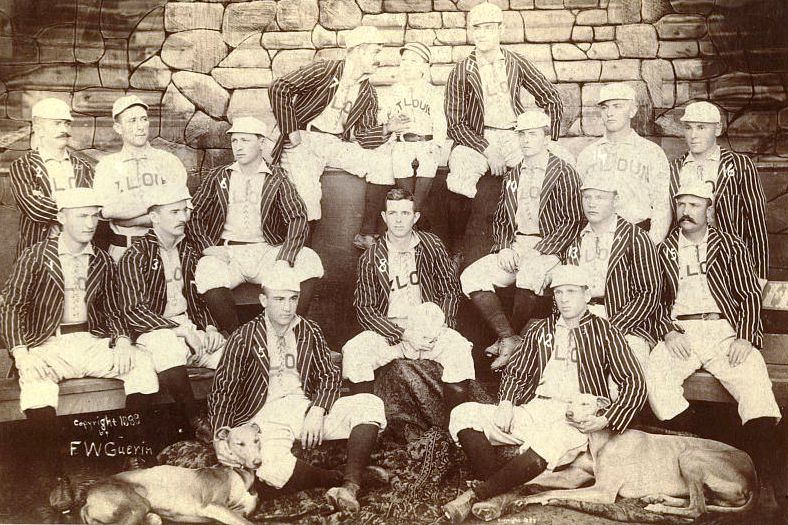
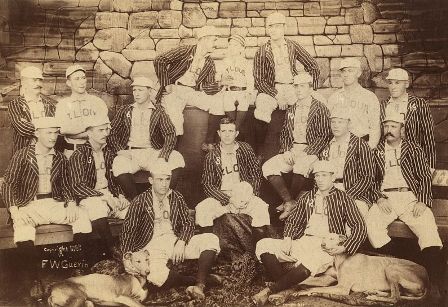
Arlie Latham, top center, facing team mascot, with 1888 American Association champion St. Louis Browns

Arlie Latham, top center, facing team mascot, with 1888 American Association champion St. Louis Browns

Walter Arlington “Arlie” Latham, was “particularly known for his humor” in the 1880s and 90s.  Primarily a third baseman with the St. Louis Browns in the American Association, the Chicago Pirates in the Players League and the Cincinnati Reds in the National League, Latham was nicknamed “The Freshest Man on Earth.”

The Associated Press said Latham:

“(B)rought much enjoyment to spectators of the Cincinnati club’s games and the Reds kept Latham a long while after he deteriorated as a player because of his drawing power as a comedian and humorist.

“Latham will don the uniform of the Giants and take his place in the coacher’s box while the Giants are at bat and between coaching the baserunner and batsmen and ‘getting the goat’ of the opposing pitchers will furnish an interesting sidelight to the New York games.”

Things did not go smoothly when Latham joined the team.  During spring training in Marlin, Texas Latham and McGraw were returning to their rooms at the Arlington Hotel when Giants outfielder James “Cy” Seymour, according to The St. Louis Post Dispatch, “knocked him down, and then bit him on the cheek.”  The article said McGraw and Latham did not know the “reason (Latham) was attacked,” but McGraw announced that Seymour was given his unconditional release.  McGraw said:

“Seymour is done with the New York club, and that goes.  It was the worst thing I ever saw pulled off.  Nothing like that can go on the New York club.”

Despite what he said McGraw did not release Seymour; the outfielder was suspended for the first week of the regular season, and The Dallas Morning News said McGraw made Seymour pay “his own expenses in Texas after the unpleasant episode.”

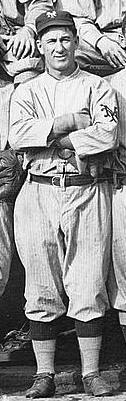
Arlie Latham, New York Giants coach

Arlie Latham, New York Giants coach

Latham was often criticized for his antics and even more often for the quality of his work as a coach, which became such a running joke that The New York Times said after the Giants had beaten the Cardinals in a September 1910 game:

“Arlie Latham’s team won it with their eyes shut, 11 to 3.  Latham’s coaching was invaluable yesterday.  He advised the players to touch every base and this tip won the game for them.”

The Sporting Life said:

“(Latham) undoubtedly lost a lot of games by bad coaching.  He got so unreliable that in a tight pinch McGraw would shift him from third to first and take the third line himself.”

The Sporting Life also said that Latham served as McGraw’s spy;  a position that would later be filled by another colorful McGraw coach, Dick Kinsella.

Giants outfielder Fred Snodgrass told Lawrence Ritter in “The Glory of their Times,” that Latham “was probably the worst third base coach who ever lived.”

It looked like the end of the line for baseball’s first full-time coach after the 1910 season.  The New York Herald said Latham “will not wear a Giant uniform next season,” and:

“He may amuse old timers, who remember him as a great ball player with (Charlie) Comiskey’s St. Louis Browns, but the new generation of fans seems to regard his efforts with disfavor.”

Despite the criticisms and predictions of his impending firing, Latham was back with Giants in 1911.  After the Giants pennant winning season Latham again joined the Giants for spring training in Texas in 1912, but in March, according to The Associated Press:

“(Latham) was carried as one of the twenty-five men permitted on the payroll.  McGraw did not want to let Latham go, but needed the place on the payroll for a real player.”

While McGraw didn’t want to lose his coach, most of baseball thought the end of Latham’s coaching career was a good thing; but even the New York press was not as harsh in their assessment of Latham as was Ed Remley, the baseball writer for The Fort Worth Star-Telegram:

“Arlie Latham has passed.

“May he rest in peace, for he is truly dead…Arlie has been called the fool of baseball and with much justice.  He was not the fool in any modern sense but more like the professional jesters who were kept in the courts of kings in the middle ages.

“Today, reading descriptions of the position of the court jesters, their crude horseplay jokes, we are not filled with laughter but with pity…The crude vassals of a former generation thought the brutal jokes of the court fool were funny; the bleacherites of today laugh at Arlie Latham pretending an engrossing interest in a game which he cannot even play himself…Vale, Latham—You have our sympathy, but we are not really sorry you are gone.  Figures of your kind are pathetic and pathos has nothing to do with baseball.”

Latham was next heard from when he accepted a coaching position with Patrick “Patsy” Flaherty’s Lynn Fighters in the New England League; that job only lasted until June.  Latham managed to run afoul of the entire Lynn team.  The Associated Press said he was forced to resign because “Players thought he was after manager Flaherty’s job and threatened to go on strike unless he was dismissed.”

Latham finished the 1914 season as an umpire in the Massachusetts and Rhode Island based Colonial League.  He did not return the following season, and in May of 1915 The Pittsburgh Press reported under the headline “Arlie Latham Has Quit The Diamond for All Time Now,” that he had found a new line of work; operating a deli in the Washington Heights neighborhood in Manhattan:

“He declares that as a delicatessener he is batting only .106 at present, but that when he gets properly warmed up and learns how to shave 15 ½ ounces of ham for a pound he will hit with the best of them in the delicatessen league.”

By 1917 Latham was in Europe, for the last act of his baseball career.  From 1917 to 1923 he lived in London and organized baseball leagues for military personnel.  The highlight of his stay was the July 4, 1918 game between the Army and Navy teams.  Latham served as umpire and greeted the most important dignitary at the game, King George V.  The Associated Press said:

“It had been planned to have the king throw out the first ball, but this was abandoned because of the netting in front of the royal box, so the king brought the ball out on the field and handed it to the umpire.  One of the balls used was autographed by the king with an American fountain pen and mailed tonight to President Wilson as a souvenir. “

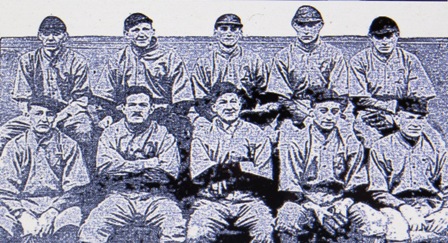
Arlie Latham, front row center, with army team in London, 1918

Arlie Latham, front row center, with army team in London, 1918

After returning to the States, Latham first returned to the deli, then later was hired to work in the press box at the Polo Grounds, he remained a fixture at the New York ballpark until his death at age 92 in 1952.

As a result of outliving his critics and becoming one of the last surviving links to the 19th Century game by the time of his death, memories had faded about the “pathetic” figure of Latham, and only the image as  “baseball’s clown prince” remained.

“The Greatest Team Ever Organized”

24 Apr

Hopes were high for The Players League, and for Chicago’s franchise, the Pirates, in the newly formed baseball brotherhood.

Rumors had been reported for more than two months, but finally on January 18 The Chicago Daily News said that Charlie Comiskey “came to town yesterday morning, and at 4 o’clock signed…for three years,” to serve as captain and manager; the contract was said to be worth “$5,000 per annum.”

President Charles A. Weidenfelder had built a strong ballclub, with major assists from Fred Pfeffer, Chicago White Stockings second baseman, who encouraged most of that team to jump to the new league, and Frank Brunell, a former Chicago newspaper man who was secretary of the new league, and traveled to St. Louis to encourage Comiskey to jump to the brotherhood.

There was an embarrassing moment in March when Chicago newspapers reported that the carpenters union was complaining that non-union labor was being used to build the team’s ballpark at Thirty-Eighth Street and Wentworth Avenue.    The secretary of the union was quoted in The Chicago Tribune saying  Brunell had “promised to make it right.  But he didn’t.”

Despite the  irony of a league borne out of the game’s first labor movement betraying organized labor (there were similar difficulties in Boston and Philadelphia), enthusiasm for the new league was high; in Chicago the expectations were higher.  A week before the season opened The Chicago Tribune said:

“The elements which go to make up a great team are united in the Chicago Brotherhood Club, which, on paper, is the greatest team ever organized.”

Comiskey’s club opened the season on April 19 in Pittsburgh.  According to The Chicago Inter Ocean:

“It was a great day for the Players League…There were 9,000 people by the turnstiles’ count to see the fun…It was by all odds the biggest crowd that had ever turned out to witness an opening game of ball in Pittsburgh.”

The pregame festivities included a parade through the streets of Pittsburgh featuring both teams, league officials and a Grand Army of the Republic brass band.

“(Pittsburgh) Manager (Ned) Hanlon was presented with an immense floral horseshoe, Comiskey with a big floral ball on a stand of floral bats, Pfeffer with a basket of roses…(Chicago’s Arlie) Latham ‘stood on his head, with a smile well-bred, and bowed three times’ to the ladies.  (He had) the legend ‘We are the people’ in great black letters on (his) broad back.”

After the fanfare, “Pfeffer and the boys played a particularly brilliant game,” as Chicago defeated Pittsburgh 10-2.

Box Score--Chicago Pirates/Pittsburgh Burghers, Opening Day, 1890.

Box Score–Chicago Pirates/Pittsburgh Burghers, Opening Day, 1890.

Opening Day was the high point for Chicago. The league as a whole struggled financially and attendance dropped sharply after the initial excitement wore off.  Only eight games into the season, barely 500 people attended Chicago’s game in Cleveland on May 1.

Comiskey’s “greatest team ever organized,” was never able to keep pace with the league champion Boston Reds and finished fourth in the eight team league, 10 games back.

The Chicago Times lamented the team’s poor showing and blamed it on a “lack of discipline,” (the article appeared in slightly different form in several newspapers):

“The outside world cannot fully realize the bitter disappointment felt here over the poor showing made by Comiskey’s team during the season just closed.  Surely it was strongest aggregation of players ever collected in one club, but its lack of success was mainly from two causes—lack of discipline and the miserable condition of certain members of the club.

“There has been absolutely no discipline in the team, and some of the men paid as much attention to Comiskey’s orders as they would to a call from some church congregation.  An order to sacrifice was met with a smile of scorn, and the ball was hammered down to an infielder, who made an easy double play.”

The Times said “(Tip) O’Neill, Latham, Pfeffer, (Jimmy) Ryan and others utterly ignored Comiskey’s mandates, and in consequence there was continual disorder.”

The paper’s primary target was shortstop Ned Williamson.  The criticisms might have been unjustified: the former White Stockings favorite had struggled with the knee injury he sustained on the 1888-89 world tour, and might have already been ill as his health would decline rapidly, and he’d be dead by 1894; the victim of tuberculosis:

“Williamson played a game of which an amateur should have been ashamed, and was thirty pounds overweight throughout the season.”

The paper promised “there will be numerous, changes in the club, provided the players League is still in existence,” in 1891.

It was not to be.  By November league secretary Brunell told The Chicago Herald:

“The jig is up.  We are beaten and the Brotherhood is no more.”

Brunell attempted to put a positive spin on the news, telling the paper it was mistaken to infer the “Brotherhood has weakened.”  Rather “we began to see that the interest in baseball was on the wane, and in order to prevent it from dying out entirely…we finally concluded that a consolidation of forces (with the National League and American Association) would be better for all concerned.”

The Herald wasn’t buying Brunell’s statement:

Brunell’s talk has finally let in the light on a subject previously enveloped in darkness.  It appears now that the Players League folks actually courted a knockout, and bankrupted themselves from pure patriotic motives.  The ex-secretary is a funny little man.”

Brunell would go on to found The Daily Racing Form in 1894.

Comiskey returned to the St. Louis Browns in the American Association.  Tip O’Neill, who also jumped the Browns to join the Players League, returned to St, Louis with his manager.

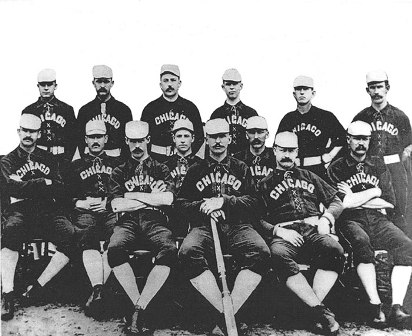
Comiskey (8) was joined in Chicago by three members of his American Association championship teams in St. Louis.  Arlie Latham (7), Tip O'Neill (11), and pitcher Silver King (14) who posted a 30-22 record.

Comiskey (8) was joined in Chicago by three members of his American Association championship teams in St. Louis. Arlie Latham (7), Tip O’Neill (11), and pitcher Silver King (14) who posted a 30-22 record.

Fred Pfeffer stayed in Chicago, spending one more turbulent season with Cap Anson, before being traded to the Louisville Colonels.

Arlie Latham, “The Freshest Man on Earth” went to the Cincinnati Reds in the National League.

Ned Williamson never played again.