Tag Archives: Baltimore Orioles

Burns “Put the Punishment on Phyle”

20 Nov

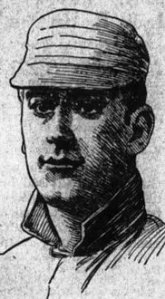
After holding out over a temperance clause the Chicago Orphans added to his contract, Bill Phyle finally signed in late March of 1899.  He reported to spring training in New Mexico anywhere from 10 to 30 pounds overweight (depending on the source) and struggled all season to regain the form he showed the previous season.

On April 17 he was beaten 8-0 by the Louisville Colonels in first start.

On April 25 he lost 3-2 to the St. Louis Perfectos.  The Chicago Tribune said “Phyle gave away the game by distributing bases on balls in just the spots where timely hits followed and transformed the favors into tallies that gave the victory.”

William Phelon, The Chicago Daily News baseball writer, disagreed.  He said Phyle’s “work was of sterling quality.”

Regardless, Chicago Manager Tom Burns didn’t give Phyle another opportunity to pitch for more than a month.

Phelon said it was a mistake for Burns to not use Phyle.  The Chicago Inter Ocean said after the team lost seven of nine games in May “it is passing strange that young Phyle is not given a chance.  On last year’s form Phyle is as good as, if not better than (Jack) Taylor.  The paper called Phyle’s performance in the St. Louis game “gilt-edged” and blamed the loss on “comrades that gave the victory to the enemy.”

Finally, on May 28 Phyle pitched again.   He lost 4 to 3 to the Washington Senators; he gave up three runs on five straight hits with two outs in the ninth.

He lost again on June 1, 7-1 to the Philadelphia Phillies.  Phelon’s opinion of the pitcher was unchanged, and said the losses were simply bad luck:

“Phyle has now lost four straight games.  It is Phyle’s luck to be stuck in whenever the other pitchers have won about three straight, and the team is just about unavoidably due to lose.”

On June 5 Phyle did his best pitching of the season–a victory he is not credited with in the record books.

With the Orphans trailing the Baltimore Orioles 3 to 2 in the third inning, pitcher Clark Griffith was ejected for arguing a called ball.  The Chicago Tribune said:

“It was a queer game.  Phyle pitched after Griffith had been benched…holding the Orioles helpless.”

Chicago won 9 to 4.  And while the Chicago newspapers credited the victory to Phyle, the record books do not.
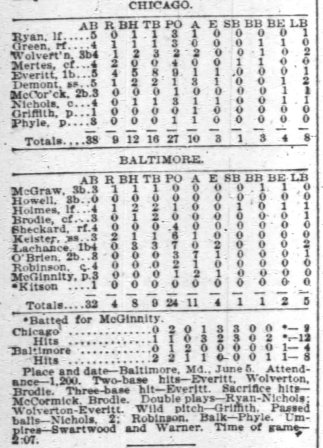
Box score for June 5 game.  Phyle relieved Clark Griffith in the 3rd inning.

Box score for June 5 game. Phyle relieved Clark Griffith in the 3rd inning.

Phyle became ill later the same week, (some sources said it was recurring malaria), a week later he fell off a bicycle and missed two more weeks.  When he returned to the team on June 22, the Boston Beaneaters beat him 5 to 1.

He was credited with his first “official” win on July 1—a game The Inter Ocean called “a comedy of errors,” and a “depressing exhibition.”   He beat the New York Giants 10 to 9, allowing 10 hits and giving up seven runs in the first two innings.  Each team committed seven errors.
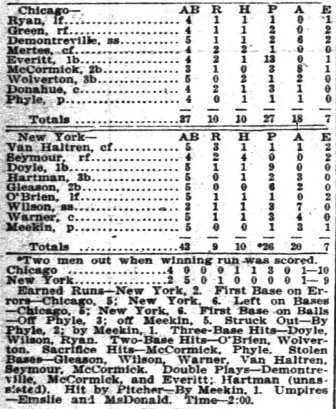
Box score of Bill Phyle's only "official" victory of 1899.

Box score of Bill Phyle’s only “official” victory of 1899.

Chicago went into a slump that would last for the rest of the season; after Phyle’s July 1 win the team was 38-24, in third place, and went 37-49 the rest of the way finishing eighth.

Phyle lost again on July 9 and July 24, and rumors began to circulate that he would be released or traded back to Charlie Comiskey’s St. Paul Saints.

On August 6 Phyle lost 10 to 9 to the Cleveland Spiders.  One week later while the team was on the road, The Inter Ocean reported that he “was sent home by manager Burns.”

The Tribune called Phyle “the scapegoat” and said he and three unnamed teammates  “celebrated after beating a horse race at Washington and Manager Burns, to call a halt, put the punishment on Phyle.

Phelon wrote in The Daily News:

“When the club started for Philadelphia he was told to go home ‘You are through young man, go back to Chicago,’ said Burns, and Phyle went back.  He went back in a rage too, and says he will tell (team president) Jim Hart a lot of things. He says that he has been held up to public derision as a drunkard, all season, and that Burns plays favorites, allowing his friends to jag up as much as they wish and turning all the trouble on others.”

Phelon remained supportive of the pitcher in The Daily News, but in The Sporting Life he reported that Phyle, a former boxer, had deserted the team in early August to go to “St. Louis to see a prize fight, and was not on hand when sorely needed.”

While the relationship between Hart and Burns was strained, and Burns would be replaced at season’s end, Phyle’s complaints went nowhere with the team president and he was suspended without pay.

Ten days after Phyle was suspended Phelon reported that the Baltimore Orioles had offered to trade for or buy Phyle,” (John) McGraw has taken quite a fancy to the young pitcher.”  Hart refused to make a deal.

Phyle never pitched for Chicago again, he is credited with a 1-8 record and 4.20 ERA.

The last Bill Phyle chapter—tomorrow.
Sam Barkley and the Mobster

29 Oct

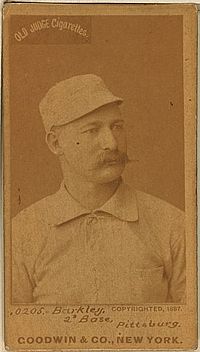
Samuel W. Barkley’s brief career on the diamond was highlighted by two legal disputes over his services; his life off the field was more complicated and interesting.

Barkley rose from amateur and semi-pro teams around Wheeling, West Virginia, to a solid season (.306, league-leading 39 doubles) as a 26-year-old rookie with the Toledo Blue Stockings in the American Association in 1884. Among his teammates in Toledo were Fleetwood and Welday Walker.

Toledo was only a major league franchise in 1884—The Toledo Blade said the team had lost “nearly $10,000–and disbanded,” selling five players, including Barkley, to the St. Louis Browns—the sale included pitcher Tony Mullane, who attempted to sign with Cincinnati after agreeing to sign with St. Louis, leading to his year-long suspension. By the time all the legal wrangling was done, only Barkley and Curt Welch reported to the Browns.

After a .268 season in St. Louis, owner Chris Von der Ahe sold him to the Pittsburgh Alleghenys, but Barkley had already signed a contract with the Baltimore Orioles. The American Association suspended and fined Barkley; Barkley sued. The dispute was settled with Barkley being reinstated and Pittsburgh paying the fine on his behalf.

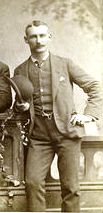
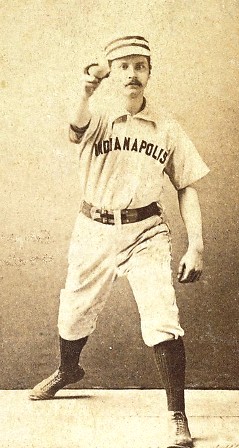
Sam Barkley

Sam Barkley

After two years in Pittsburgh, he was purchased by the Kansas City Cowboys, and that’s when his life got more interesting.

In Chicago, he met an 18-year-old woman named Dora Feldman, who followed him to Kansas City, where as The Toledo News-Bee said, “most of his money was thrown at the feet of the young woman.”

The Chicago Inter Ocean said Barkley claimed, that the day before he married Dora, “she went to her room in a Kansas City hotel and took poison, fearing he would not marry her.”

Despite the suicide attempt, the two married.

He hit just .216 in 1888 but was hitting .284 the following year when he was sold to the Toledo Black Pirates in the International League. After just 50 games there his career was over. At some point during the 1888 season he suffered a knee injury he said ended his career:

“I knocked a safe one to left field, and was dancing around between first and second bags when (Mike) Mattimore, the Philadelphia (Athletics) pitcher attempted to catch me napping. He ran to the base line, and as I attempted to slide back to the first bag he unintentionally gave me the ‘knee’ and it injured severely the knee cap on my left leg.”

With his playing days behind him, Barkley, who was reported to have made as much as $1,800 a season with the Alleghenys, returned to Pittsburgh with a young wife who had aspirations to be an actress and opened a cigar store.

It didn’t end well.

After just more than a year in business, The Pittsburgh Press said Barkley’s store on Smithfield Street closed by order of the sheriff, due to “claims aggregating $3,600.”

The couple moved to Chicago.

Initially, things went better there.

Barkley opened a tavern at 292 West Madison Street, and he and Dora had a son who was born around 1895.

Shortly after they returned to Chicago Dora met Chicago’s first crime boss Michael Cassius “Mike” McDonald.

Richard Henry Little of The Chicago Tribune said McDonald, “never held office but ruled the city with an iron hand.”

McDonald built a gambling and protection syndicate, controlled the Garfield Park racetrack, and solidified his control of the city as leader of the local Democratic Party. He was also heavily involved in legitimate businesses—he owned The Chicago Globe newspaper and financed the building of Chicago’s first elevated rail line.

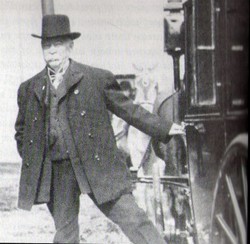
Mike McDonald

Mike McDonald

Years later Barkley told The Inter Ocean about his wife’s first meeting with McDonald:

“She was introduced to him at a box party in McVicker’s Theater shortly after the close of the big fair (World’s Columbia Exposition), in 1893…I remember the night distinctly. Dora came home to our place at 319 Washington Boulevard and told me that she had met a very fascinating old man (McDonald was 44), who was reputed to have a lot of money.

“’Watch me get a piece of that money,’ Dora said to me, jestingly, and fool that I was I laughed at the supposed joke.”

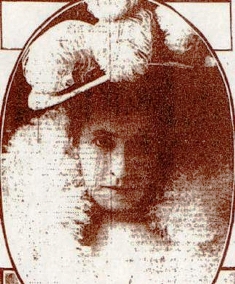
Dora Feldman Barkley McDonald

Dora Feldman Barkley McDonald

There are several versions of what happened next. One involves an elaborate (seemingly too elaborate) story that suggested Barkley was lured by a friend of McDonald into a compromising position involving women and drugs—only to be “caught” by his wife. The more likely version was that he was simply paid off—The Inter Ocean said he received $30,000 to divorce Dora.

Barkley never acknowledged receiving the money and only said:

“(Dora and McDonald) had planned between them to oust me, and no matter what I might have done, it would have been all the same in the long run. With his money and his influence, McDonald could put it over me any time he wanted.”

Dora eventually became McDonald’s second wife in 1898, (his first wife, who once shot a police officer—she was acquitted—had eloped to Europe with a soon to be former priest).

By 1897, Barkley had opened a new tavern at 15 North Clark Street, which was frequently in the news.

Sam Barkley

Sam Barkley

The Chicago Tribune called it a “notorious saloon,” and The Chicago Daily News reported on several occasions that the bar had its license revoked temporarily for various criminal activities and violations; in 1900 The Inter Ocean said a grand jury report was “almost an indictment of the city administration for its toleration of the dives, all-night saloons, and resorts for thieves and the depraved.” Of Barkley’s location the grand jury said:

“Men and women drinking, swearing and carousing, with music; open after midnight in the past. Several murders have been committed in front of this door.”

As with all such “clean-up” drives during that era in Chicago, nothing came of the grand jury report.

Dora again made headlines in 1907—and as a result so did her ex-husband.

The Inter Ocean said:

‘Mike ‘ M’Donald’s Wife Kills Artist in His Studio

“Dora McDonald, wife of Michael C. McDonald, millionaire, politician, traction man, and ex-gambler, shot and killed Webster S. Guerin, an artist, behind the locked doors of his studio in the Omaha Building, LaSalle and Van Buren Streets yesterday.”

Barkley was quickly contacted by reporters and told his sad story of how Dora had left him. The paper said:

“The story that Sam Barkley slowly grieved his life away over the loss of his pretty wife is disproved by the discovery of Sam Barkley alive and prosperous in Chicago today.”

Dora McDonald was eventually acquitted, but Mike McDonald did not live to see it, he died during her trial.

Barkley fell on hard times in Chicago soon after the killing. In August of 1908 a six-inning benefit baseball game was played at Comiskey Park between two Chicago City League teams–“Nixey” Callahan‘s Logan Squares and the Rogers Parks–“to raise enough money to start him in the cigar business.”

The Chicago Examiner said, “A fair-sized crowd turned out.”

Fred Pfeffer played first base for the Rogers Parks and “was the hero of the game with two hits besides fielding in grand style,” another former big leaguer, Emil Gross, served as umpire.

Shortly after that Barkley was operating a cigar store in his hometown, Wheeling, West Virginia.

There was one last chapter in the Barkley story. Soon after he returned to West Virginia he was living in poverty and became ill, and died on April 20, 1912. The Chicago Daily News said several days before his death a former baseball acquaintance was summoned to his side:

Billy Sunday called on him. He talked baseball for a while and then religion. At the end Sam liked both equally well.”

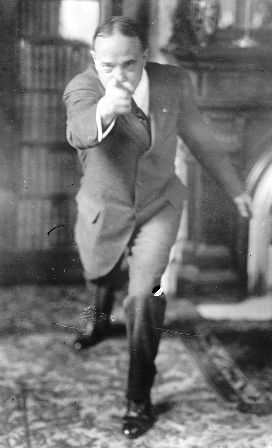
Billy Sunday

Billy Sunday

Dora McDonald was contacted for a comment:

“It is a closed incident—it’s so long ago that I knew him. But I’m sorry.”

She eventually married a doctor, moved to California and died in 1930.

“You can try to Refine and Civilize Baseball all you want”

21 Oct

In 1912, Joe Kelley, former player and manager (and future Hall of Famer) told William A. Phelon, sports editor of The Cincinnati Times-Star, a story about the lack of civility in baseball and a game Kelley claimed took place when he was with the Baltimore Orioles in the 1890s:

“You can try to refine and civilize baseball all you want and you can make a parlor game out of it by giving the umpires power of life and death, but you can’t kill off the players’ tongues unless you stun ‘em with an ax.

“Years and years ago, I well remember, two ball clubs tried to pull a polite and courteous ballgame, just to see how things would work.  The old Baltimores and the old Bostons (Beaneaters)—which were real ball clubs both of them—held a conference one afternoon.  There had been a lot of talk and newspaper criticism about rough house work and bad language—and we wanted to show the press and public that we could be good, decent people after all.  We agreed to try out the polished conversation and Golden Rule stuff for this one occasion, and Tim Hurst, who was slated to umpire, agreed to help the good work along.”

——

Joe Kelley

Joe Kelley

“The first half inning went by something lovely.  Even when Tim called a strike on Tom McCarthy that was a foot over his head, there was no outbreak.  Say Tom, very gently, ‘Wasn’t that ball a trifle high, Mr. Umpire?’  And says Tim, all courtesy, ‘I fear I may have erred in judgment, Mr. McCarthy.  Kindly overlook it, if you will.’ And in our half, when Jack Doyle went down to second in a cloud of dust, and Tim said ‘Out,’ Jack jumped up, and red in the face, yelled ‘What the —-‘ and caught himself in time.  ‘Pardon me,’ says Jack, ‘but I honestly thought that Mr. Long failed to touch me.’  And says Herman Long, equally polite, ‘I am under the impression that I did touch Mr. Doyle.

“And in the very next inning the blow-off came.  Three on and two gone with Hughey Jennings batting.  (Heinie) Reitz made a dash for home on what he thought was a passed ball.  The Boston catcher (Charlie Ganzel) recovered it, but as he dove for the putout, Jennings wandered against him and knocked him 10 feet away.  ‘Out fer interference,’ yelped Hurst—and then everybody arrived at the plate all in a bunch.

Tim Hurst

Tim Hurst

Kelley said there was a chaotic scene at home plate.  Reitz was screaming at Hurst while Jennings and Ganzel nearly came to blows:

“’Fer Moses sakes remember,’ I interposed, ‘that this is supposed to be a polite courteous game, just to show how well we can behave—‘ and somebody hit me across the map with a catching glove.

“’I can lick every wan av yez,’ howled Tim Hurst, and I’ll do it, too, if you’re not back in your places inside a half-minute.’

“’You’re a cheap crook,’ said John McGraw.

“’You’re all a bunch of yellow dogs,’ said Herman Long, addressing the whole Baltimore team, sort of impersonally.

“and when the police arrived the rules of etiquette had been fractured so badly I never heard of their being reinstated.  That was, I think, the first, last and only time that a courteous ball game was staged in big league company.”


Things I Learned on the Way to Looking up Other Things #5

8 Aug

Johnny Evers “Ardent Worshipper of Hoodoo Lore”

Edward Lyell Fox was a war correspondent in World War I; after the war he was accused of taking money to write stories favorable to the German government.  Before that he wrote extensively about baseball for several American magazines.

In 1910, writing for “The Columbian Magazine”, Fox interviewed Johnny Evers of the Chicago Cubs about the “almost unbelievable efforts made by ballplayers to offset what they firmly believe to be ‘hoodoos.’”

Evers was one of the most superstitious players in the game, “an ardent worshipper of voodoo lore,” according to Fox, and Evers said the Cubs “are more superstitious than any team in the big leagues,” and that manager Frank Chance “is one of the most ardent respecters of diamond ‘hoodoos.’”

It’s not certain that Evers’ claim that “most players firmly believe in,” the superstitious he listed for Fox, but it’s clear he believed them:

 “If any inning is favorable to a player, he will try to lay his glove down on the same spot where he had placed it the inning before.

“While going to different parks in cars, the sight of a funeral cortege is always regarded as an ill omen.”

Evers also said the sight of a handicapped person was also an “ill omen…unless you toss him a coin.”

On the other hand Evers said a wagon load of empty barrels was a sign of good luck.

Johnny Evers,

Johnny Evers,


“Too much of a Good Thing”

Even in baseball’s infancy that were critics that said the popularity of the game was “too much of a good thing.”

In September of 1865 The Philadelphia Inquirer editorialized:

 “Let us take, for instance, the base ball (sic) pastime, which is now assuming the proportions of a violent and widespread mania.”

The culprit, according to the editorial, was the athletic club teams that were growing in popularity and  no longer “satisfied with a game or two a week.”

 “(S)ome of these associations devote, three, four or five days at a time to their games; that they are not satisfied with playing on their own grounds for their own benefit and amusement, but that they thirst for popular applause, and are rapidly transforming their members into professional athletes…They issue their challenges, and hotly contend for mastery with clubs belonging to other cities.”

 The Inquirer did predict one aspect of baseball’s new popularity:

 “It can be easily seen that this spirit must soon lead on to gambling. So far the only prize of the base ball and cricket matches has been a ball or some implement of the game, but private wagers have undoubtedly been laid upon the playing of certain clubs, and money has changed hands upon results.”

The Enquirer was also concerned that the game defied “common sense” because “during the heats of summer violent bodily exercise should be avoided; but upon this subject common sense and the base ball mania seem to be sadly at variance.”

The editorial concluded that “the young men,” make sure “they do not depreciate themselves to the level of prize fighters or jockeys, who expend their vim on horse races and matches made for money.”

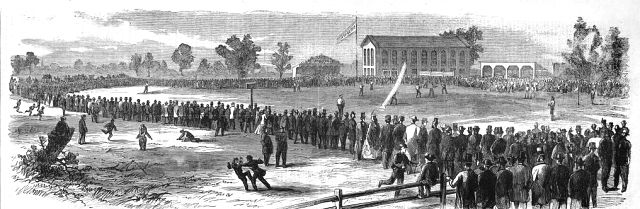
Athletic of Philadelphia versus Atlantic of Brooklyn, in Philadelphia October 30, 1865--"a violent and widespread mania."

Athletic of Philadelphia versus Atlantic of Brooklyn, in Philadelphia October 30, 1865–“a violent and widespread mania.”


Odds, 1896

Early in 1896 The New York Sun reported on “an early development of interest.”  A local bookmaker had issued odds on the 1896 National League race:

“He lays odds of 3 to 1 against Baltimore finishing first; 7 to 2 against Cleveland and Boston;  4 to 1 Philadelphia and New York; 7 to 1 Chicago; 8 to 1 Brooklyn and Pittsburgh; 15 to 1 Cincinnati; 40 to 1 Louisville; 100 to 1 Washington, while (Christian Friedrich “Chris”) von der Ahe’s outfit (St. Louis) is the extreme outsider on the list.  Any lover of the German band can wager any amount and “write his own ticket.”

The final standings:

1. Baltimore Orioles

2. Cleveland Spiders

3. Cincinnati Reds

4. Boston Beaneaters

5. Chicago Colts

6. Pittsburgh Pirates

7. New York Giants

8. Philadelphia Phillies

9. Washington Senators

10. Brooklyn Bridegrooms

11. St. Louis Browns

12.  Louisville Colonels

1896 Orioles, 3 to 1 favorites, won the National League Championship.

1896 Orioles, 3 to 1 favorites, won the National League Championship.

“The Disappearing Oakland Infielder”

7 Aug

James Ernest “Jimmy” Frick began his career with the Iola Gasbags in the Missouri Valley League in 1904, hitting .331 in 106 games.  While Frick began the 1905 season with the Oklahoma City Mets in the Western Association, a “C” level league, press reports said he could have played at a higher level and The Sporting Life said St. Louis Cardinals, Hall of Famer pitcher Charles “Kid” Nichols “cannot understand why Jimmy Frick of Oklahoma City persists in hiding out it the bushes when he can make good in fast company.”

Frick was hitting above .300 in July when he was sold to the Seattle Siwashes in the Pacific Coast League; he hit .252 in 18 games until August 18 when The Associated Press said Frick “disappeared mysteriously.”

Four days later The Seattle Star said Frick who “was very popular” with local fans had jumped the Siwashes and rejoined Oklahoma City having been promised “$1000 and a chance to manage the team next year.”

Whether the reported deal was actually promised to Frick is unknown.  While he returned to Oklahoma City he never joined the Mets and finished the season with the Wichita Jobbers.

At the end of the 1905 season multiple teams laid claim to him.  The Associated Press said:

“The case of J. Frick who was claimed by Indianapolis, Wichita, Seattle and Oklahoma City was referred to Secretary (John) Farrell (of the National Association).”

In February of 1906 Frick was awarded to Wichita then immediately traded to the Toronto Maple Leafs in the Eastern League.  He spent the next five and a half years in the Eastern League with Toronto, the Baltimore Orioles and the Newark Indians.

On July 16, 1910, while with Baltimore, Frick was hit in the head with a pitch.  In August The Sporting Life said he had not yet returned to the lineup:

 “(Frick) is in a bad way in this city, as the result of being hit on the head by a pitched ball during the last home series of the Birds. Although the accident happened at least three weeks ago, Frick’s head is still in bad condition, his face is swollen and dizziness seizes him on the slightest provocation. It is doubtful if Frick will play again this season.”

He did return at the tail end of the season, but only appeared in a few games.  In 1911 he was sold to Newark, and after hitting just .200 in 28 games he was sold to the Troy Trojans in the New York State League.

Jimmy Frick

Jimmy Frick

Before the 1912 season, Harry Wolverton, third baseman and manager of the Oakland Oaks in the Pacific Coast League, was named manager of the New York Highlanders in the American League.  Oakland hired Bayard “Bud” Sharpe to manage the team; one of his first moves was to purchase Frick from Troy to fill the void Wolverton left at third.

By March 7 The Associated Press said Sharpe was “somewhat exercised about infielder Frick.”  The new third baseman had arrived in Oakland by train several days earlier, but had not arrived at the Oaks training camp in Livermore, California and had not been heard from him.  Sharpe showed up the following day, but it was reported he had spent several days in an Oakland hospital—it was not reported why he was hospitalized.

Frick began the season as the Oaks starting third baseman, but after hurting his foot in April, August “Gus” Hetling filled in and Frick never returned to the regular lineup.

On September 17, with Oakland in a battle for the pennant with the Vernon Tigers, the team was in Los Angeles when Frick, according to The Associated Press left his room at the Hotel Rosslyn and “dropped from sight.”

The Los Angeles Examiner said the Oakland team and the Los Angeles Police Department had looked for Frick for more than a week and found no sign of the infielder.  The Associated Press said “all of Frick’s haunts have been searched,” and that the disappearance “may hurt Oakland in their fight for the pennant, as he is considered the best utility infielder on the team.”

Herb McFarlin, Secretary of the Oaks, said:

“Frick has always been a steady player, not inclined to drink or run around.  He always has been absolutely dependable.”

On October 4 The Associated Press said “the disappearing Oakland infielder” had been found by his wife:

“He had been ill in a Los Angeles Hospital, assuming an alias so that he would not be bothered.”

As with his spring disappearance there was no mention as to why Frick was in the hospital.

On October 5 he was with the Oaks in Portland for a game with the Beavers, he did not play, but was “out on the coaching line rooting for his team.”

Frick was with the team on October 27 when they took both games of a double-header in Los Angeles; Vernon won both games of a doubleheader from Portland, and Oakland took the pennant with a winning percentage of .591 to Vernon’s .587.

Frick saw little action in the final weeks of the season, his replacement Hetling hit .297 and was awarded a Chalmers Automobile as the league’s most valuable player.

Gus Hetling, Frick's replacement at third

Gus Hetling, Frick’s replacement at third

Frick and his wife went to Portland at the end of the season, and in late November planned to leave for Oklahoma City where they owned a farm.  On November 20 Mrs. Frick went to pick up tickets for the trip, when she returned home, she found Jimmy Frick dead.  He committed suicide by drinking carbolic acid. (Baseball Reference incorrectly lists his date of death as November 18),

The Portland Oregonian said Frick had been “ill and despondent,” and said he was suffering from “brain fever.”  (Brain fever is an antiquated and vague term used for inflammation of the brain).

None of the stories about Frick’s suicide and “brain fever” mentioned the severe injury he had received when he was hit in the head in 1910, so  it’s impossible to determine whether it contributed to the erratic behavior that year, hospital stays, or death of the disappearing Oakland infielder.”

Butcher Boy Schmidt

25 Jul

Charles John “Butch” “Butcher Boy” Schmidt was credited by Connie Mack with being the catalyst for the Boston Braves World Series upset of Mack’s Philadelphia Athletics in 1914; one year later Schmidt walked away from baseball in his prime.

Butch Schmidt

Butch Schmidt

He was born in Baltimore in 1886, and played amateur ball while working in the family meat market, which earned him his nickname.

Schmidt signed as a pitcher with the Baltimore Orioles  in the Eastern League and assigned to the Holyoke Papermakers in the Connecticut State League, where he posted a 10-9 record.  In late August the Orioles recalled him, and he went 5-1 in 11 games with Baltimore.

The New York Highlanders drafted Schmidt and the 22-year-old pitcher started the 1909 season in New York.  He appeared in only one game, on May 11, giving up 10 hits and eight runs, four earned, in five innings.  Early in June he was returned to the Orioles.

After appearing in eight games on the mound with the Orioles, Schmidt was moved to first base.  After hitting .244 for the remainder of ’09, he hit .292, .291, and .274 the next three seasons, and was sold to the Rochester Hustlers in the International League, where he hit .321; he was purchased by the Boston Braves on August 22, and hit .308 in 22 games playing in place of Ralph “Hap” Myers.

At the end of the 1913 season Boston sold Myers’ contract to Rochester; The Boston Post reported that Braves manager George Stallings simply didn’t like Myers.  (Myers had a different theory for his release—that story next week)

Schmidt was installed as the Braves first baseman in 1914, and as Boston made their improbable run to the National league pennant Schmidt   hit .285 with 71 RBI and .990 fielding percentage, and finished 16th in the voting for the Chalmers Award, for the most valuable player in the National League; teammates Johnny Evers and Rabbit Maranville finished first and second in the voting.

Grantland Rice said in The New York Tribune:

“There are few greater first basemen in baseball and none who is steadier or a better fighter.  For Schmidt is also of the aggressive type and a hustler every second.”

The New York Times didn’t think quite as highly of Schmidt and on the eve of the World Series said the “advantage favors the Athletics” at first base:

(John “Stuffy”) McInnis makes exceptionally brilliant plays…has been through Worlds Series fire and proved just as cool as if he were playing an exhibition game in the springtime.  Schmidt has yet to face the strain and tension of the big baseball classic…While Schmidt is not a scientific batsman, he is a free swinger and hits the ball hard, but he doesn’t hit it often.”

The pressure of the series didn’t seem to bother Schmidt, the Braves first baseman hit .294 with five hits, two runs and two RBIs in the four game sweep of the Athletics; McInnis hit just .143.

In game one he made a play in the first inning that Connie Mack said set the tone for the series and “sparked the Braves.”  With runners on first and second with one out, Athletics third baseman Frank “Home Run” Baker hit a foul pop-up into short right field.  Athletics outfielder Eddie Murphy tagged up and attempted to go to third; The Associated Press said Schmidt made a “great throw…from a difficult angle,” to third baseman Charlie Deal to retire Murphy.

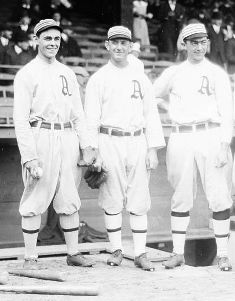
Stuffy McInnis, Eddie Murphy and "Home Run" Baker,

Stuffy McInnis, Eddie Murphy and “Home Run” Baker,

Early in the 1915 season Braves manager George Stallings called Schmidt “The best first baseman in the game,” but his performance at the plate slipped.  Schmidt hit just .251 with 60 RBIs.  The Braves again found themselves in 8th place in July, and while they made another strong run, finished 2nd, seven games behind the Philadelphia Phillies.

Despite the mediocre season at the plate, it was assumed the 28-year-old Schmidt would remain the Braves first baseman.  Schmidt shocked Stallings, Boston fans, and all of baseball when he announced in January of 1916 that he was retiring from baseball.

Butch Schmidt at bat

Butch Schmidt at bat

The Associated Press said Schmidt was leaving “to devote his entire time to his private business.”

Grantland Rice said Schmidt’s business included “six meat markets in Baltimore,” and that he earned $8000 a year from his stores.

The Sporting Life said it was just as likely that Schmidt, listed at 200 pounds, retired because:

Hard work in that old rubber shirt to get down to weight, especially when the extra weight comes off slowly, more slowly each succeeding season, is a trial that anyone would like to sidestep if he could. “

Boston manager George Stallings filled the void left by Schmidt by purchasing Ed Konetchy from the Pittsburgh Rebels from the newly defunct Federal League.

The Boston Post said the change at first base would not hurt the Braves:

“Konetchy, a heavier hitter than Schmidt, is just about as capable in other ways.”

Despite the confidence of The Post, Stallings was not convinced and continued to try to induce Schmidt to return; his efforts were unsuccessful.

After Konetchy hit .260 for the third place Braves in 1916 it was reported that Schmidt would return to the team.  After several weeks of speculation, Schmidt told The Boston Globe “no offer” could induce him to return to Boston.

Konetchy hit .272 and .236 the next two seasons, and each off season it was rumored Schmidt would return, and every year he stayed home where he continued to run his business and play semi-pro ball in Baltimore’s Inter-City League.

Before the 1919 season Konetchy was traded to the Brooklyn Robins and the Braves acquired Walter Holke from the Cincinnati Reds.  Holke hit .292 for the Braves in 1919, but rumors continued that Schmidt, out of organized baseball for four years, would be returning to Boston.  The Associated Press said:

“George Stallings of the Boston Braves is trying to get Charlie “Butch” Schmidt, the Baltimore butcher boy who played first base for the world’s champions of 1914, to return to the Boston Braves.  Schmidt is reported to be in wonderful condition as he has kept in practice since his retirement.”

Schmidt never returned to professional ball, and was finally removed from Boston’s reserve list in 1922.

Butch Schmidt walked away from professional baseball and never looked back; he died in 1952 of a heart attack while inspecting cattle at the Baltimore Union Stock Yards.

“There was probably none so Unique as Shreve”

24 Jul

Leven Lawrence “Lev” Shreve II came from a prominent family in Louisville, Kentucky.  His great-uncle, and namesake, had been president of the Louisville Gas and Water Company, and the Louisville & Nashville Railroad.

The 19-year-old made his professional debut in 1886, playing with Savannah, then Chattanooga; he was a combined 12-9 with 1.52 ERA.  Shreve was signed by Billy Barnie to join his young pitching staff with the Baltimore Orioles in the American Association.  He came to Baltimore with great expectations.

Lev Shreve

Lev Shreve

The Baltimore Daily News called him “Barnie’s phenom.”  In wasn’t the first time a relatively unknown pitcher was given that name by the Baltimore press.

Shreve had trouble getting as Barnie primarily relied on 21-year-old Matt Kilroy and 22-year-old Phenomenal Smith; Shreve, and fellow 20-year-old Ed Knouff saw limited action in the first two months of the season.

The Sporting Life said he wasn’t happy:

 “Shreve, the Louisville boy…complains that he does not get a fair deal.  He affirms that his arm is in fine trim, but that he is not allowed to pitch. Shreve is an ambitious ball player, and desires to show what is in him.  He says he will quit if Barnie does not play him.”

The Baltimore Sun said

“People are asking why Shreve isn’t given a chance.”

The Sporting Life, perhaps, provided an explanation for the lack of work later that month:

“Cigarette smoking is said to be impairing the efficiency of two Baltimore pitchers, Shreve and Knouff”

It would not be the last mention of cigarettes and Shreve in The Sporting Life;  the pitcher was also said to be “a cigarette fiend,” and “as noted for his cigarette habit” as his pitching.

Neither Shreve, who was sold to the Indianapolis Hoosiers in the National League, nor Knouff, who was sold to the St. Louis Browns, would finish the season with Baltimore; it’s unknown whether smoking was the cause.

Shreve was 3-1 with a 3.79 ERA in five games in Baltimore.

The sale to Indianapolis didn’t seem to hurt Shreve’s confidence according to George Myers, his catcher with the Hoosiers.  Meyers, two decades after playing with Shreve, said the pitcher was talented, cocky and erratic, and described Shreve’s first National League game; a 4-1 10-inning victory over the first place Detroit Wolverines on August 19:

“There was probably none so unique as Shreve…My, but he was a fresh youth…He had awful speed and good curves and perfect control of the ball.  His confidence and egotism were astounding.  I remember one day we were to play against Detroit (Wolverines).  It was when the big four, (Jack) Rowe, (Deacon) White, (Hardy) Richardson and (Dan) Brouthers were on the team.

“Mr. Shreve, who had been assigned to pitch, strutted to the box with the swagger that would have made John L. Sullivan look cheap when John L. was monarch of all in the fistic business.  ‘Just watch me fellows, and see what I do to those swell-headed guys from Michigan,’ said the smiling Shreve.  ‘I am going to make ‘em look like a lot of suckers.’

“Richardson was the first batter up…’So you are the great invincible Hardy Richardson, eh?’ drawled Mr. Shreve.  ‘Well Hardy, old chap, I’m going to show you that you are easy for a good pitcher…Shreve let go the first ball and it went around Hardy’s neck like a shot.  He struck at it after I had it in my hands.  Bang goes the second, also a strike, and the third a wide, slow, outshoot, fooled the great batter completely and Shreve said mockingly: ‘Back to the bench Hardy, I told you that you were easy.

“Big Dan Brouthers, who was always a terror to pitchers, came next and he had blood in his eye…’so this is the terrible Mr. Dan Brouthers,’ grinned the fresh pitcher.  ‘Hate to tell you Dan, how soft a mark you are’…Dan missed the first two, which went close to his chin, and the next he hit like a shot at the pitcher.  Shreve caught it in easy style and gave Brouthers the ‘ha ha’ in most tantalizing fashion as Dan ambled to the bench.

“Deacon White came next and Shreve kidded him unmercifully.  ‘Deacon who told you that you could hit anything?’ was the greeting white was given.  The Deacon scowled and muttered ominous.  ’Duck soup is what you are for me.’ Sand Shreve, as White missed the first ball by several inches.  ‘Oh, how easy,’ was the next rejoinder, and Deacon smashed blindly at an outshoot, a moment later striking out on one of those speedy ones such as had sent Richardson to the bench.

“The Big Four could do absolutely nothing with Shreve’s delivery, and the other members of their team were just as helpless…This fellow Shreve was one of the best pitchers I ever met, but he was an erratic chap, and dreadfully hard to handle.”

George Myers

George Myers

After beating the eventual National League champions in his first start, Shreve ended up a disappointing 5-9 with a 4.72 ERA for Indianapolis.

Myers said on another occasion Shreve approached him before pitching against the Chicago White Stockings, who had won the National League championship in 1886:

“’Say, George, what team is this we are up against today?’

“I immediately began to read him a lecture, telling him that a young man just starting in on his career as a professional ballplayer shouldn’t deport himself in such a manner. ‘The idea of you coming on to the grounds when the champion Chicagos are here, and not knowing it, why—‘  ‘The champion Chicagos,’ interrupted Shreve, ‘Never mind, George, just watch me.  Oh just wait and see what I will do to that bunch.”

Myer s said Shreve shutout the White Stockings.  (This story appears to be either apocryphal or conflated with another incident as Shreve did not shutout Chicago that season).

Shreve was 11-24 in 1888 and 0-3 in 1889 when he was released by the Hoosiers.  He played three minor league seasons and was out of professional baseball by the age of 24.

Myers said his former teammate was “erratic as Rube Waddell,” and:

“I could tell story after story about this man Shreve.  If he had taken care of himself he would have been the greatest pitcher in baseball history.”

“He was Not Crazy as Reported”

18 Jul

Ervin Thomas “Erve” “Dutch” Beck hit the first home run in the American League; on April 25, 1901, the second day of the season, as a member of the Cleveland Blues; Beck homered off White Sox pitcher John Skopec at Chicago’s South Side Park.

It was a highlight in a short, promising career, like many at the turn of the 20th Century, destroyed by alcoholism.

Beck was considered the best young player in Toledo, Ohio when he joined the Adrian Reformers in the Michigan State League as a 16-year-old in 1895, then for the next five seasons, he was the star of his hometown Toledo Mud Hens in the Interstate League.  For the two seasons in Toledo for which complete records survive, Beck hit .298 in 1898 with 11 home runs and, a league-leading .360 with 15 home runs in 1900.

Erve Beck

Erve Beck

Earning the Nickname “Home run Dutch” in the Toledo papers, Beck was credited with 67  during his five seasons with the Mud Hens;  he would remain the team’s all-time career home run leader until 2007 when Mike Hessman (currently with the Louisville Bats in the International League) hit his 68th as a Mud Hen.

Beck also had a brief trial with the Brooklyn Superbas in the National League in 1899, hitting .167 in eight September games.

It’s unclear exactly when Beck’s problems with alcohol began, but according to fellow Ohioan Ed Ashenbach (alternately spelled Ashenback by several contemporary sources), a minor league contemporary who wrote a book in 1911 called “Humor among the Minors”,  it was well-known during Beck’s career that he was “addicted to strong drink,” and as a result suffered from “hallucinations.”

Ed Ashenbach

Ed Ashenbach (Ashenback)

Before the 1901 season, Beck, whose rights were held by the Cincinnati Reds, jumped to the Cleveland Blues in the newly formed American League; the twenty-two-year-old hit .289 and accounted for six of Cleveland’s twelve home runs.

Beck jumped back to the Reds before the 1902 season and received rave reviews early in the season.  The Cincinnati Tribune seemed to like him more at second base than veteran Heine Peitz:

“Erve Beck looks more like a second baseman than anyone who has filled the position since (Bid) McPhee went into retirement (in 1899).  He covers the ground, seems to know where to play and is capable of swinging the bat with some effect.”

His teammate, pitcher Frank “Noodles” Hahn claimed Beck hit the ball “harder than (Napoleon) Lajoie.”

Beck hit better than .300 playing second base in May but went to the bench when Peitz, who was filling in behind the plate for an injured Bill Bergen returned to second.

In June first baseman Jake Beckley missed a week with an injury and Beck filled in there; The Cincinnati Enquirer’s Ren Mulford said:

“(Beck) played the bag in splendid style…In handling ground balls Beck is as good as Beckley, and he is a better thrower… Beck gave another display of his versatility by plugging up a hole in right field.  He made one catch that was a lollapalooza…Most players would have lost heart when benched as Beck was, but he remained as chipper as a skunk during his term of inactivity, and gladly accepted the opportunity to get back into the swim. Beck is a phlegmatic soul, who takes life, as he finds it without a growl.”

In spite of a .305 batting average in 48 games and the great press he received, Beck was released by the Reds in July.  Whether the release was simply because he was the odd man out with Peitz, Beckley and right fielder Sam Crawford healthy or as a result of drinking is unknown.

Beck was signed almost immediately by the Detroit Tigers where he took over at first base after Frank “Pop” Dillon was sent to the Baltimore Orioles.  He hit .296 in 41 games but was again released at the end of the season.

Beck would never return to the big leagues.

In 1903 he .331 for the Shreveport Giants in the Southern Association, he jumped Shreveport the following season and played for the Portland Browns in the Pacific Coast League.   He returned to the Southern Association with the New Orleans Pelicans in 1905.  After starting the 1906 season in New Orleans, he was released in July and signed by the Nashville Volunteers; his combined average with both Southern Association teams was .211.

Beck’s drinking was, according to Ashenback and contemporary newspaper accounts, common knowledge by the time he wore out his welcome in Nashville in August and was sold to the Augusta Tourists in the South Atlantic League.

That stop would last for only one game.

The 27-year-old, four years removed from the American League, played first base for the Tourists on August 6.  Augusta second baseman Ed McKernan said, “It was evident when he reported there was something amiss with him,” and claimed Beck chased “an imaginary flock of geese away from first base” during the game.

The following day, according to The Augusta Chronicle, Beck “created a sensation in the clubhouse…causing all but two of the players to leave the house.”  As a result, Augusta released him.

The following day The Chronicle said:

“(Beck) ran amuck this morning and created great excitement on the street.

“While in a room on the third floor of the Chelsea hotel the big infielder suddenly began to see things and sprang from the third story window to the ground below.  Only two intervening telephone wires and a rose bush saved his life.

“He then darted down an alley and hid himself in a store.  He was finally captured and came quietly back to his room with a policeman and (Tourists outfielder Frank) Norcum.”

The Sporting Life assured their readers that Beck “was not crazy, as reported, but only suffering from the effects of a (drunken) spree.”

McKernan said “During his convalescence…Beck would smilingly avow his determination to abstain from strong drink.”

There were varying reports regarding the extent of his injuries, and it’s unknown whether he was physically able to play after the fall, but Beck would never play professionally again.

He returned to Toledo where he operated a tavern and appears to have been unable “to abstain from strong drink;” he died in 1916 of Articular Rheumatism complicated by Hepatic Cirrhosis.

“The Ty Cobb of Trapshooters”

15 Jul

Lester Stanley “Les” German broke into professional baseball with a bang in 1890.  The 21-year-old played for Billy Barnie’s Baltimore Orioles, a team that had dropped out of the American Association and after the 1889 season and joined the Atlantic Association, a minor league.

German was 35-9 in August when the American Association’s Brooklyn Gladiators folded in August, the Orioles returned to the association, and German returned to Earth; posting a 5-11 record for the big league Orioles.

German was a minor league workhorse for the next two and a half seasons.  He was 35-11 for the Eastern Association champion Buffalo Bisons in 1891; he appeared in 77 games and pitched 655 innings for the Oakland Colonels in the California League in 1892, and was 22-11 for the Augusta Electricians in the Southern Association in July of 1893 when his contract was purchased by the New York Giants.

Les German, 1894

Les German, 1894

German would never win in double figures again; In five seasons in the National League he was 29-52, including a 2-20 mark with the 1896 Washington Senators.

It was German’s next career that earned him the most notoriety.  A crack shot, German became one of the most famous trapshooters in the country for the next thirty years.  He won numerous championships and was often featured in Buffalo Bill’s Wild West Show with Annie Oakley.

A National Sports Syndicate article in 1918 said “Lester German is the Ty Cobb of trapshooters.”  The article said that beginning in 1908, when official records were first kept, German had maintained a “remarkable average,” shooting a t a better percentage than any other professional marksman.

Les German, 1918

Les German, 1918

As German’s reputation as a shooter grew, his legacy as a pitcher became inflated.

A mention of his baseball career in a 1916 issue of “The Sportsmen’s Review”, credited German, and his 9-8 record,  with “leading the Giants,” to their 1894 Temple Cup series victory over the Baltimore Orioles, there was no mention of Amos Rusie’s two shutouts .  A 1915 article in The Idaho Statesman inexplicably said German “headed the National League in both pitching and fielding” in 1895—German was 7-11 with a 5.54 ERA and committed 2 errors in 45 chances on the mound; he also made eight errors in 11 games he filled in for the injured George Davis at third base.

German operated a gun shop and continued to organize and participate in shooting tournaments until his death in Maryland in 1934.

“Baseball by Electricity”

11 Jul

In 1886, The Electrical Review told the story of the first attempts at “reproducing almost instantly a vivid view of the exact situations and plays in a game of baseball.”

The original plan was hatched by three telegraph operators in Nashville, Tennessee who “turned their enthusiasm for baseball to good account.”   J. U Rust, E.W. Morgan, and A.H Stewart made the first attempt to transmit a game between Chattanooga and Nashville in 1884:

“To do this they leased a wire from Nashville to Chattanooga, one end of which was on the ball field, with an expert operator, who was accurately informed in baseball playing, seated watching the game and immediately telegraphing each play as it progressed.  At the Nashville end of the wire were two other telegraphic and baseball experts.  As they received the record from their partner, one man reproduced it verbally to the audience, while the other man manipulated cards bearing the names of the players, around a painted view of the ball field which was placed in full view of the audience.”

The following season Southern League games were transmitted to opera houses in several of the league cities by Morgan & Co. “the ingenious firm” created by the three telegraph operators.

On July 9, 1886 Morgan & Co. transmitted the game between the Detroit Wolverines and the Chicago White Stockings from Chicago’s West Side Park to the Detroit Opera House. The “unique entertainment before a crowd of 600 persons,” was described by The Electrical Review:

“On the stage was a huge landscape—it would have done well as a drop curtain—having a well-painted perspective view of a baseball diamond and outfield.  At the points on the picture representing the positions of batsman, pitcher catcher and basemen, are openings into which may be shoved cards bearing the names of the players, and into which these names are placed as the telegraph operator seated at his instrument reads to the audience the progress of the game, even to the smallest details.”

The crowd at the Opera House “was wrought up to a very high pitch of enthusiasm.  For instance, when the operator read—with (Abner) Dalrymple’s name appearing as batsman—“foul fly to left,” the audience fairly held its breath, and when the next instant the operator called out, ‘and out to (James “Deacon”) White,’ there came a storm of applause, just such as heard on a veritable ball field…the excitement was intense.”

The Chicago White Stockings defeated the Detroit Wolverines 8-2 on July 9, on there way to the 1886 National League championship

The Chicago White Stockings defeated the Detroit Wolverines 8-2 on July 9, on their way to the 1886 National League championship

By the end of the 1886 season, games were presented in opera houses in Chicago, Boston, New York and Cincinnati.  By the end of the decade the practice would become commonplace in all big league cities.

By the mid 1890s the system for presenting games to the public had become much more advanced.

The Baltimore Morning Herald said in September of 1894:

“The ball game today between the Baltimore (Orioles) and Louisville (Colonels) clubs will be given as usual from the stage at Ford’s Grand Opera House at 4 o’clock by electricity.  The system utilized for the first game in the city is ‘The Compton Electric Baseball Game Impersonator.’   It has been used in New York and elsewhere with unbounded success.  It is a contrivance so ingenious that the slightest move of the players is visible, and the anxiety and interest of those present is just as great as though they had been occupying the grandstand.  Every strike is recorded and illustrated, and, whether at the bat, running the bases or in the field, all the players are known and watched…a visible reproduction of the game is given to the minutest detail.”

By the end of that season the Compton system was used to transmit games to fans in New York, Chicago, Philadelphia and Washington, and it, and numerous systems developed by competitors would become commonplace over the next four decades.

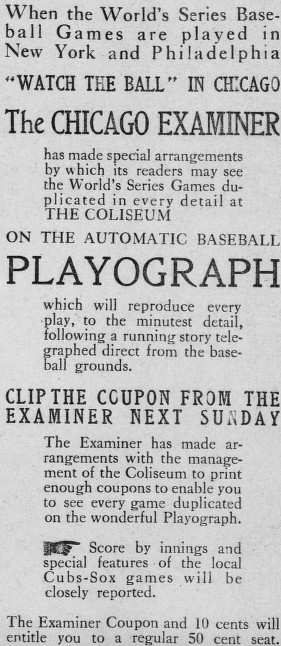
The Chicago Examiner sponsored the "automatic Baseball Playograph" exhibition of the 1913 World Series between the New York Giants and Philadelphia Athletics.

The Chicago Examiner sponsored the “automatic Baseball Playograph” exhibition of the 1913 World Series between the New York Giants and Philadelphia Athletics.

Usually sponsored by local newspapers, the exhibitions were an especially popular method for following the World Series in real-time.   It was not until 1938 (when the New York Yankees, New York Giants, and Brooklyn Dodgers became the last teams to have their games broadcast on radio) that the technological descendants of Morgan & Co. became completely obsolete.