Tag Archives: Baltimore Orioles

“Remarkable Baseball Stunt”

15 Jan

In the 1890s, there was a “baseball puzzle” that was said to have confounded Baltimore Orioles catcher Wilbert Robinson for days.  How could a team hit two triples and four singles in an inning and not score a run?

His confusion probably says more about Robinson than the complexity of the puzzle.  The answer was the first two hitters tripled and were out trying to stretch them into home runs.  Three players hit singles to load the bases.  The fourth hitter singles, but the ball strikes a runner ending the inning.

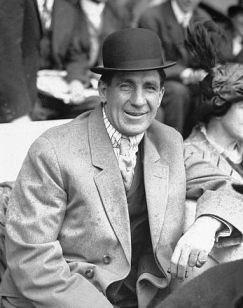
Wilbert robinson

Wilbert Robinson

In 1912, a sportswriter in The Toronto Globe claimed that a similar inning had actually occurred in a minor league game in 1890.

The Pittsburgh Gazette-Times called it a “Remarkable baseball stunt.”

While there’s no proof the story isn’t apocryphal, both papers said it took place on May 30, 1890, in an Indiana League game and the members of the Anderson, Indiana team mentioned in the articles all did play for Anderson in 1890. (Although Baseball Reference doesn’t list statistics or rosters for the 1890 Indiana League, all the named players are confirmed as having played for that team in a variety of contemporaneous sources.)

According to the story Benjamin Ireland led off the inning with a triple.  With Ed Wiswell at the plate, the ball got away from the catcher, Ireland was out trying to score.  Wiswell tripled, but was tagged out trying to stretch the triple.  Rush Shumway followed with the third triple of the inning.

With Shumway on third Gene Derby bunted down the third base line that the third baseman waited to roll foul, “It stayed (fair) and (Derby) pulled up at second.  (Shumway) did not try to score.”

The fifth batter, Charles Faatz, also bunted.  The runners held as Faatz beat out the bunt.  Frank Fear was the next batter and “hit a vicious liner to right, but the ball struck Faatz on the arm.”

Three triples, two singles, no runs.

A remarkable inning.

“Hanlon Springs a Surprise on the Baseball Public”

14 Jan

Albert Joseph “Smiling Al” Maul’s best days seemed well behind him by 1898.  The 32-year-old Maul had posted a 16-12 record for the Pittsburgh Burghers in the Players League in 1890, but after returning to the National League the following season he had gone 39-44 through 1897.

Baltimore Orioles manager Ned Hanlon signed Maul after he was released by the Washington Senators in 1897.  The results were not good; in two games Maul gave up 9 hits and walked 8, posting a 7.04 ERA.  Baltimore released him at the end of the season and there were no takers for Maul at the beginning of 1898.

Ned Hanlon

Ned Hanlon

By June of 1898 The Baltimore Morning Herald said:

“For some time (Hanlon) has been hinting to his friends that he had something up his sleeve in the way of twirling talent that would surprise the natives, but when he let fall Al Maul’s name he was met with a chorus of merry ha-has.”

But by June Hanlon’s “surprise” was no longer met with laughter.

On June 5, The Sunday Herald headline said:

“Hanlon springs a surprise on the baseball world.”

Maul had shut out the Saint Louis Browns on three hits in his first start for Baltimore.

Al Maul

Al Maul

The Herald cautioned that “it’s too early to say that Maul is all right,” but all season he successfully filled the gap in Baltimore’s rotation caused by Joe Corbett’s holdout.

The New York World said Maul was:

“The most remarkable case on record of a restored glass arm.”

Maul’s comeback season became a sensation.  John Clarkson, who had not appeared in a game since 1894, told The Bay City (MI) Tribune he was serious about making his own comeback:

“I might be a second Al Maul, who can tell?”

Clarkson’s comeback never materialized, but Maul’s success continued all summer.

The Sporting Life credited Hanlon for his pitcher’s success:

“Al Maul’s experience this season is only another confirmation of the claim that Ned Hanlon can take any old thing and get good results from, it for a year or so.”

Maul finished the season with a 20-7 record and a 2.10 ERA, and Hanlon had high hopes for his pitcher the next season.  Maul, along with “Wee Willie” Keeler, Hughie Jennings and Joe Kelley moved to the Brooklyn Superbas as part of the stock swap between the Baltimore and Brooklyn franchises that led to Hanlon’s move to Brooklyn.

But the pitcher who won 20 games two years after his career was “over” was out of surprises.  After four games with Brooklyn in 1898, Hanlon released Maul.  Brief stints with the Philadelphia Phillies and New York Giants failed to rekindle the magic and Maul’s career came to an end after his release by the Giants in September of 1901.

Maul went on to coach baseball at Lehigh University and scouted for several years for the Philadelphia Athletics.  He died in 1958 at age 92.

Brother Joe Comes Back

30 Nov

Twenty-three-year-old Joe Corbett, brother of heavyweight champ “Gentleman Jim” Corbett announced his retirement before the 1899 season.  Corbett had written a column for The San Francisco Call during his 1898 hold out, and announced he was quitting that job too:

“I have (also) quit writing baseball news now, and take little or no interest in the game. I wouldn’t cross the street to see one.”

Corbett ran the livery stable his father had started in San Francisco, helped operate the family bar on Ellis Street, and within weeks had apparently regained his interest in the game and was back writing for The Call.  His responsibilities in the family businesses increased after his parent’s deaths in August of 1898 (Patrick Corbett shot and killed his wife then committed suicide).

Joe Corbett

There remained significant interest in Corbett’s services; unfortunately for Joe he remained under the control of Ned Hanlon.  Hanlon had moved to the Brooklyn Superbas in 1899 as part of a stock swap between the Brooklyn and Baltimore franchises—he took several players with him, including “Wee Willie” Keeler, Hughie Jennings and Joe Kelley—he also kept Corbett’s rights.

Ned Hanlon

Hanlon offered Corbett $2400 to play for Brooklyn and turned down offers to trade his rights.

According to California newspapers Corbett occasionally pitched in semi-pro games in 1899, but in 1900 The Sporting Life reported that Corbett was “dangerously ill,” and would probably never pitch again as a result of sciatic rheumatism.

Less than a year later The Sporting Life said Corbett was pitching for a team in Oakland, and the next year he appeared in five games for the Minneapolis Millers in the American Association—the retirement appeared to be over.

A successful January 1903 appearance on the mound in an exhibition game featuring barnstorming Major Leaguers renewed interest in Corbett again.  The Los Angeles Angels of The Pacific Coast League offered Joe a contract he couldn’t refuse, one that allowed him to tend to the family business interests in San Francisco during the season.

Newspaper reports said Corbett earned $5000 for the 1903 season, Angels manager Jim Morley said he wouldn’t say how much Joe earned but said that he had:

“Figured it out that Corbett will get 4.99 a curve.”

After going 23-16 for the Angels, the Major leagues again came calling.   Early reports had Corbett signing with the Pittsburgh Pirates, who offered $5000, but Joe eventually signed with the Saint Louis Cardinals.  While the Cardinals assured Joe that Ned Hanlon had relinquished Brooklyn’s claim, the Corbett family was not ready to end the feud with Hanlon.

Gentleman Jim, when asked if Joe would ever consider playing for his former manager again, told reporters:

“Hanlon couldn’t get Joe to twirl for him if he offers him a million dollars a year.”

Things didn’t go well in Saint Louis.  Joe Corbett was 5-8 when the Cardinals released him August 1.

Jim was, as always, Joe’s biggest defender:

“My brother Joe was getting $7000 for the season from the St. Louis club, but his heart was not in his work, simply because he was separated from his wife and little ones who were out in California.  Thinking of his family all the time impaired his effectiveness as a pitcher.”

Gentleman Jim

Joe returned to San Francisco where he added a hat store to growing stable of businesses; his rights returned to Hanlon and Brooklyn.

The final chapter of the Corbett story on Monday.

Brother Joe’s Holdout

29 Nov

Joseph Aloysius “Brother Joe” Corbett got his nickname because lived in the shadow of his older sibling—“Gentleman Jim” Corbett, World Heavyweight Champion.

Baseball was Jim’s first love, and he aspired to pro career, but his time in professional baseball was limited to about three dozen games for a variety of minor league teams from 1897-1900 when his boxing fame made him a drawing card.

Jim was very protective of Joe, and contemporaneous newspaper accounts indicate that he served as something of an agent for his younger brother.

Joe, at 19-years-old and with limited experience in college and two California-based minor leagues, was given a trial with the Washington Senators in 1895—said to be a result of Jim’s friendship with Senators manager Gus Schmelz.  Joe went 0-2 for Washington and was released.

After pitching for the Norfolk Braves in the Virginia League and Scranton Miners in the Eastern League in 1896, Corbett earned another trip to the Big Leagues with Ned Hanlon’s great Baltimore Orioles team, the O’s were 90-39, 9.5 games ahead of the second place Cleveland Spiders.

Joe Corbett

Corbett was 3-0, and won two games against Cleveland in the Temple Cup, the National League post season 7-game series between the first and second place teams.

At the close of the Temple Cup series, while Jim was in New York, Hanlon got Joe to sign a $1400 contract in Baltimore for the 1897 season.

The 1897 Orioles finished in second place, but Corbett established himself as a rising star, posting a 24-8 record.  The Orioles sent Joe a contract for $2100.  Joe returned it unsigned and demanded $3000, and according to some reports, $300 in travel expenses.

The Orioles offered to split the difference.  Joe refused.

Ultimately the parties ended up either $100 apart, or with the Orioles relenting (depending on the source).  Joe still refused, and sat out the entire season.

Some sources, like the book “Baseball Hall of Shame 4,” claim Corbett’s holdout was over Hanlon’s failure to keep a promise to buy Joe a suit for winning 20 games.  The articles from that period and the quotes from the principles would make the suit story appear apocryphal and of later vintage.

Jim Corbett blamed the dispute on Hanlon, who he felt took advantage of his brother with the $1400 contract for 1897. “Gentleman Jim” said:

“Hanlon, as you know, is the cheapest magnate in baseball…he knows very well that I would not allow Joe to sign for such a measly salary and he took advantage of my absence. “

Jim said he told his brother to “Quit Hanlon for all time.”

Joe sat out 1898.  Before the 1899 season Joe told reporters:

“I have gone out of the baseball business for good.”

Like his brother, who retired from the ring on numerous occasions, Joe would be back.

More tomorrow.

Gentleman Jim

“A Star of the First Magnitude”

8 Nov

Huyler Westervelt was going to be the next big thing.

By January of 1894 the New York Giants had been trying to sign the 24-year-old Westervelt for more than two years.   Considered the best amateur pitcher on the East Coast, he pitched for a number of top teams including the Englewood Field Club, New Jersey Athletic Club, and Orange Athletic Club. Westervelt came from a prominent family in Tenafly, New Jersey and said repeatedly that he’d never play professionally.

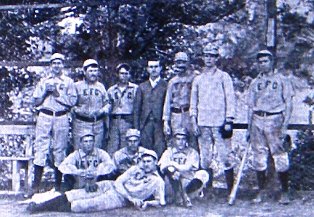
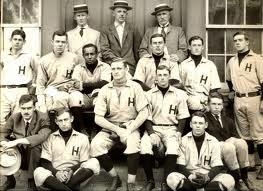
Huyler Westervelt, standing second from right, with the Englewood Field Club team circa 1893

When Giants owner E.B. Talcott finally convinced Westervelt to play professionally he simply signed a piece of paper which said:

“I hereby agree to play with the New York Base Ball Club for the season of 1894 at a salary of $1800.”

Westervelt made his debut for the Giants on April 21, losing 4-3 to the Baltimore Orioles; but beat the Boston Beaneaters 5-2 on May 5, holding the defending champions to three hits and earning the fawning praise of New York Sporting Times columnist O.P. Caylor who said Westervelt was:

 “(A) newly discovered jewel who has flashed out in the baseball firmament as a star of the first magnitude.

“(On May 5) young Westervelt became famous, and his name flashed over thousands of miles of wires that night, while next day the whole country was reading about his triumph.”

Westervelt struggled for the remainder of the season; prone to wildness he finished with a 7-10 record and 5.04 ERA, but still figured into the Giants future plans.  He refused to sign a contract for 1895 which reduced his salary to $1500—Westervelt was added to Giants’ reserve list, where he would remain for several years.

Westervelt continued playing for amateur teams in New York and New Jersey, while working for the Overman Bicycle Company, and attempted to get the Giants to trade or release him.  He filed an appeal contending that he never signed a National League contract, only the piece of paper he signed with Talcott, and therefore the Giants had no right to put him on the reserve list.  He lost the appeal.

Huyler Westervelt

There were reports in early 1896 that Baltimore Orioles manager Ned Hanlon was trying to acquire the pitcher, they never panned out.  In April The Sporting Life said Westervelt was done with professional baseball, but later in the year he joined the Derby-Shelton Angels in the Naugatuck Valley League; no statistics survive other than a brief mention of a seemingly less than successful August game against the Torrington Tornadoes, “(Westervelt) received the warm reception of 16 hits.”

Westervelt returned to the amateur leagues, playing well into the first decade of the 20th Century, and went to work as a broker on Wall Street.  He remained on the reserve list of the New York Giants through the 1901 season, prompting The Sporting Life to say:

 “By the way, did you notice that New York still reserves Huyler Westervelt?  That is one of the standing jokes of each season.”

Westervelt made one more appearance in professional baseball; according to Baseball Reference he played 17 games for the Bradford Drillers in the Interstate League in 1905; while he is not listed on the roster of the Utica Pent-Ups in the New York-Penn League in 1905, he appeared in at least one game for that team, losing a 5-4 decision to the Troy Trojans on June 23.

While Westervelt never achieved the stardom Caylor predicted for him, he remained an important figure in amateur baseball circles until his death in 1949 at the age of 80.

Sammy Strang

5 Nov

Samuel Strang Nicklin, “The Dixie Thrush,” was one of baseball’s great renaissance men.

Born in Tennessee in 1876, he was the scion of one of Chattanooga’s most prominent families.  His father John Bailey Nicklin served in the Union Army during the Civil War, moved to Chattanooga in 1866, and served as mayor from 1887-1889.

Sammy Strang

Samuel Nicklin spent one year at the University of Tennessee where he starred on the football and baseball teams. He also had two short stints in professional baseball 1893 and 1896, which included 14 games with the Louisville Colonels in the National League when he was 19.  Late in 1896, he enlisted as a private in the Tennessee Volunteers, served in Spanish-American War and rose to the rank of captain.

After leaving the service, Nicklin signed a contract with Cedar Rapids Bunnies in the Western Association and dropped his last name; he was known as Sammy Strang for the rest of his career.

The Milwaukee Journal said of the name change:

“(Strang) came of a rich southern family with deep prejudices against professional ball.”

This “prejudice” likely had nothing to do with it given that in addition to serving as Chattanooga mayor, the elder Nicklin was active in professional baseball, serving as president of the Southern Association in the 1890s.

A career .269 hitter, Strang was best known for being one of baseball’s first regular pinch-hitters while playing for John McGraw’s New York Giants from 1905 until June of 1908.  According to The Associated Press:

“McGraw noted the regularity with which he hit in pinches.  So he called him a ‘pinch hitter’—and the term stuck.”

During the 1909 season, Strang began coaching the baseball team at West Point.  He retired from baseball after playing from 1908-1910 with the Baltimore Orioles in the Eastern League, to study opera.

Sammy Strang

During his baseball career, Strang was known for writing songs and singing but decided to seriously pursue a music career in 1910.  He traveled to Paris where he trained under Jean De Reszke, one of the greatest male opera stars of the 1890s.

Upon returning from Paris, he chose not to accept an offer to join an opera company and instead returned to West Point, where he continued as coach until 1917.

Strang returned Tennessee shortly before his father’s death in 1919 to manage and take over ownership of the struggling Chattanooga Lookouts in the Southern League.  While the Lookouts did not win a league championship during Strang’s tenure, he was credited with turning the franchise around and sold the team, for which he paid nothing 1919, for a reported $75,000 in 1927, while retaining ownership of the stadium, Andrews Field.

Unfortunately, Strang’s most ambitious plan–to sign Satchel Paige in 1926–never materialized.

According to Larry Tye’s book “Satchel Paige: The Life and Times of an American Legend,”   Strang failed in an attempt to sign Paige for $500 to pitch a game against the Atlanta Crackers. Paige said of the deal:

“I just had to let him paint me white.”

Samuel Strang Nicklin died in Chattanooga in 1932.

Tom Colcolough

26 Oct

Thomas Bernard “Coke” Colcolough (his name was pronounced “Cokely”) posted a 14-11 record in parts of four seasons in the National League with the Pittsburgh Pirates and News York Giants.

His greatest baseball achievement has been lost to history.

Before the 1893 season, professional baseball eliminated the five and a half by four-foot pitcher’s box and replaced it with the rubber, while moving the distance to the current 60 feet, six inches.  Intended to increase offense the change had the desired effect increasing batting averages throughout baseball.

Not everyone immediately took to the new rule.  The Boston Globe and Cleveland Plain Dealer predicted the rule would be eliminated.  They were wrong, it was there to stay.

One consequence of the new rule was the sharp decline in no-hitters.  In the National League seven no-hitters were thrown between 1890 and 1892.  From the beginning of the 1893 season until Cy Young’s in September of 1897, there was but one:  On August 16, 1893, Bill Hawke of the Baltimore Orioles no-hit the Washington Senators.

Hawke’s was not the first professional no-hitter after the change.  That belonged to Charleston Seagulls pitcher Tom Colcolough on June 23 against the Montgomery Colts in the Southern Association.  The Sporting Life said:

“Colcolough, the rising young pitcher of the Charleston Club, has the honor of being the first pitcher under the new rules to dispose of an opposing team without a safe hit in a full game.  He accomplished the feat against the hard-hitting Montgomerys.”

Colcolough was 16-11 for Charleston and earned his first trip to the Major Leagues.   Prone to wildness (166 walks in 319 1/3 Major League innings), Colcolough was returned to the minor Leagues in 1895, pitching for the Wilkes-Barre Coal Barons in the Eastern League from 1895 through 1898.

Tom Colcolough

Colcolough earned one more shot in the National League with the Giants in 1899 posting a 4-5 record.  He was sent to Jim O’Rourke’s Bridgeport Orators in the Connecticut League in July and was released at the end of the season.

Colcolough returned to Charleston, South Carolina and served as a city councilman.  He passed away there in 1919.

A Really Bad Idea II

23 Oct

Last week I told you about Chicago Colts President Al Hart’s connection with the proposed rule to change the shape of the diamond.  He wasn’t the only baseball pioneer who considered adopting rule changes which would have completely changed the game.

William Henry “Harry” Wright, called by many “The Father of Baseball,” was among the most respected figures of baseball’s first two decades.  The Philadelphia Record described his importance:

 “Harry Wright has done more than any other man to bring baseball to its present high standing.”

Wright’s story has been told many times and in many places.  This lesser known story focuses on two rules changes he championed.

Harry Wright

After the 1893 season Wright’s contract was not renewed as manager of the Philadelphia Phillies he accepted the position of “Chief of Umpires” of the National League.  The Philadelphia Record reported on a number of rule changes he advocated, including this:

 “Harry Wright thinks that players should not be allowed to question an umpire’s decision during the progress of a game, or to speak to him while the ball is in play, and that he should have the power of taking out of the contest any player (or manager) who breaks the rule.”

While not necessarily a bad idea, if adopted Wright’s idea would have drastically changed the game for several generations of famous umpire baiters.

One other rule change Wright promoted, as reported by The Sporting Life, would certainly have been a bad idea:

 “(A)llowing a base runner to run on a fly ball instead of returning and registering at the base.”

While Wright’s idea never was seriously considered for incorporation into the rule book, it had advocates as late as 1899, four years after his death.

Washington Senators Manager Arthur Irwin endorsed the rule with this colorful description:

 “Uncertainty is the life of the game, and the more uncertain the uncertainty the higher does the interest key itself…for instance (John) McGraw, one of the most daring base runners in the league Is on first base with two men out, and a run needed to win the game (Wilbert) Robinson follows with a fly to center field, and at the stroke of the bat away scuds Mac. His get-away is the cue that brings the spectators to their feet.  ‘Will he score?  Can (Joe) Kelley field that ball home to cut him off at the plate?’ Around the runway fly the twinkling feet of the little Napoleon of the Orioles.   It’s a chase of life and death between Mac and the ball. Kelley swings the sphere on two bounds to Duke Farrell at the plate.  Mac slides into the rubber, and beats the throw by an abbreviated whisker.

“Can you imagine a more intense climax to a game of ball? Why, the game would be full of such play if the idea of running on a fly ball became a rule.  It would increase the base running, produce more plays in the field, and keep the outfielders almost as busy as the inner circle, when the bases were occupied.”

Of course Irwin failed to consider the scenario where the winning run is on third base and scores on a routine fly ball with two outs.

Arthur Irwin

Rooney Sweeney

18 Oct

John “Rooney” Sweeney was better known for his unpredictability and for making  good copy for the 19th Century press than for anything he did on the baseball field.  He remains one of the few Major League players for which a date of death is unknown.

Born in New York City in 1858, Sweeney’s first professional experience was in 1881 in the Eastern Championship Association, a league which only lasted one season.  Like many of the short-lived leagues of baseball’s first 30 years, the ECA had no fixed schedules and no control over player movement making it impossible to keep full rosters.  Sweeney played with four teams in the league: The Brooklyn Atlantics, New York Mets, New York Quick Steps and New York New Yorks.

There’s no record of where Sweeney played the following season, but in 1883 he played for Camden Merritts in the Interstate Association and made his Major League debut with the Baltimore Orioles in the American Association.

Although there is no other source for the claim, a 1910 article on the origin of catcher’s equipment in The Freeman claims that Sweeney was playing on the West Coast in Oakland for part of 1883 and was one of the first catchers to wear a mask, “The day he placed it on his head and went up behind the bat he was ‘Booed’ until he took it off in disgust.  Later the fans began to see the benefits of the wire covering.”
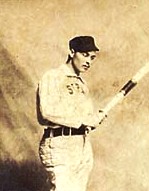
John “Rooney” Sweeney”

Sweeney then played with the Baltimore Monumentals in the Union Association in 1884.  He appeared in three games for the St. Louis Maroons in the National League in 1885 before being released.

According to The Sporting Life:

“When Rooney Sweeney was recently released by (Maroons owner Henry) Lucas he had quite a roll. So before leaving St. Louis, just to blow in a dollar or two, Rooney… hired a fine team of grays and a park wagon from a livery stable.  This was at ten o’clock Thursday morning.  At three o’clock Friday morning, eleven hours behind time, a messenger boy drove the team into the stable. Both the grays looked ready for the bone-yard and the owner at that moment would have sold them for a song. Their whole appearance showed that they had been driven nearly to death.

“Several men in the stable armed themselves with clubs and horsewhips and started out in search of Rooney. He must have been told of their coming, however, for before daybreak he took a train. It was lucky for him that the train started out before the livery men caught him.”

Rooney’s never again appeared in the Majors, but was said to have joined a team in Troy, New York after leaving St. Louis.  In 1887 and ’88 he played in the New England League, and then dropped out of sight, and apparently out of baseball, again.

In 1890, Sweeney signed with the London Tecumsehs in the International Association.

Official records indicate that he only appeared in one game—The Chicago Tribune, on May 12 reported on his debut:

 “Rooney Sweeney’s return to the diamond was not a success.  In his opening game nine bases were stolen on him and he had three errors.”

Things went downhill from there.  Sweeney was released in mid-May but apparently remained in London.  In June, it was reported that he had been arrested for stealing $40 from London pitcher James Maguire.

He received four months in jail and as the judge handed down the sentence The Sporting Life said, “Sweeney wept copiously.”

It was reported that Sweeney spent his time in jail writing letters to friends, one of which found its way into several newspapers.  Regarding the crime he was convicted of, Sweeney wrote:

 “We were all playing poker in a room up here and there was a big pot on the table.   Just then somebody flung a big black cat square on the table.  Of course the cat was scared and in her hurry to get away scattered the chips every which way and knocked down the stacks that were standing in front of the players.   Well, I just grabbed what I thought was my share, the same as any man would do, and it got me into jail, that’s all.”

After his release from jail, there are no records that indicate he ever again played in a professional game, but nearly every article written about him mentions that “He is not averse to playing baseball again.”

In 1892, Sweeney became involved in boxing, claiming he was going to manage fighters.  Just weeks later he was reported he was through with boxing and said:

 “I thought ballplayers was (sic) the ungreatfullest (sic) lot on earth, but they ain’t in it with fighters.”

And of course, the articles said, “Rooney is going to try his hand again at catching.”

Within a year of Sweeney’s foray into the boxing world both of his parents and his brother, New York City police officer Jeremiah Sweeney, died, and it was reported that he had inherited a great deal of property in New York and New Jersey, but of course in between collecting rents he said he’d like to play baseball again.

Sweeney was next heard from in September of 1897 when The Sporting Life said:

 “John Sweeney, a once famous base ball player, more popularly known as “Rooney” Sweeney  is dying in the Hudson Street Hospital as the result of injuries sustained by a fall in Battery Park last night.

“For some past Sweeney has been assisting the boatmen at the Battery…last night, while seated on the excursion pier, he was seized with an epileptic fit, and fell heavily to the ground, sustaining a concussion of the brain. An ambulance was rung up, and he was hurried to the hospital.  Sweeney has played with many of the principal base ball clubs both in the East and West, being at one time a member of the famous Metropolitan nine. He was also identified during his career with the St. Louis and Indianapolis.”

But that might not have been the end for Sweeney.  Three years later it was reported that he was working as a “Fireman on a tug boat.”

Sadly, that’s the last bit of information about the enigmatic Sweeney.  Whether he had succumbed to his illness in 1897 or he recovered and ended up aboard that tug boat we may never know.  No records of his death are available.

George Treadway

16 Oct

A small item in the Louisville Courier-Journal near the end of the 1893 season created a major stir.  And while the story was almost immediately shown to be untrue, several books and articles over the years have tried to imply that it’s still an open question.

The story about George Treadway was written by Courier-Journal Baseball Editor Sam McKee who was traveling with the Baltimore Orioles of the National League:

“There can be little doubt that Treadway, Baltimore’s right fielder is a Negro…all the players say he is.”

Treadway attributed the story to a former teammate he refused to name, and told The Baltimore News:

“The story is the result of a piece of spite work on the part of a former member of the Baltimore team, and knowing the man as I do, I am not surprised that such a thing could emanate from him.”

Treadway went on to say that he had information about the player which would “Kill him eternally, as far as the baseball profession is concerned, but I prefer not to act in that underhanded way.”

Treadway said the story about him came out of an incident when he was playing with Denver in the Western Association when an opposing player had directed a racist epitaph at Treadway.

George Treadway

Both The Baltimore Afro-American and baseball columnist O.P. Taylor reported that the story was investigated and was untrue.  At the same time it came to light that Baltimore owner Harry Vonderhorst and manager Ned Hanlon had heard similar rumors and conducted an investigation before signing Treadway, The Sporting Life said:

“Manager Hanlon felt satisfied the report was without truth and Treadway was made a member of the team.”

The story quickly went away, but in recent years has been revived, and mostly in the absence of the facts.  For example:

“. . . the writers . . . compared Joe (Jackson) to Treadway . . . but they did not mention that Treadway had been driven out of baseball by opposing players and fans who bombarded him with taunts and slurs about his alleged or real Negro blood.” – From Say It Ain’t So, Joe!: The True Story of Shoeless Joe Jackson

This reference to Treadway, like most, ignores critical facts.  The taunts and slurs must not have been very effective—Treadway remained in the Major Leagues for two full seasons, and part of a third after the story broke, and he was “driven out of baseball” a full 11 years later at the age of 37.

Had there been any evidence that Treadway was African-American his tenure in professional baseball would have been similar in length to that of William Clarence Matthews a decade later.

As the starting shortstop for Harvard University, Matthews faced four years of racial tension and boycotts—when the Crimson faced Georgetown in 1903 Georgetown’s manager,  and the team’s catcher, Samuel H. Apperious (Baseball Reference lists him as “William”) refused to participate in the game.

After graduating Matthews attempted to play professional baseball, signing with the Burlington team in the Vermont-based “outlaw” Northern League.  Upon arriving in Burlington Matthews was faced with another player boycott led by the same Sam Apperious, who was playing for the Montpelier-Barre team in the lead.  While there were rumors that Matthews might play Major League ball it never rose beyond speculation.

Matthews was, in effect,  “driven out of baseball.”

William Clarence Matthews with Harvard Baseball Team

George Treadway was in and out of professional baseball until 1904, but his absences were about the economics of early baseball and not questions about his race: from 1899-1901 Treadway played baseball for various teams in the Chicago area, including the White Rocks in the Chicago City League, while working for the Pullman Palace Car Company.

After leaving Chicago, Treadway played in the Pacific Northwest League and Pacific Coast League.  He stayed on the West Coast and settled in California until his death in 1928.

Matthews became an attorney, was actively involved in politics and served as legal counsel for Black Nationalist leader Marcus Garvey.  He also passed away in 1928.