At 6’ 5” John Bannerman “Larry” McLean is still the tallest catcher to have played in the Major Leagues nearly a century after his final game. Born in New Brunswick, Canada, McLean’s ability was mostly overshadowed by his frequent off-field troubles during his career.
McLean bounced between the minor leagues, semi-pro teams, and trials with the Boston Americans, Chicago Cubs and Saint Louis Cardinals from 1901-1904. McLean joined the Portland Beavers in the Pacific Coast League in 1905 and it was here that he developed into a good ballplayer and a first-rate baseball character.

Larry McLean
McLean hit .285 in 182 games with Portland in 1905, but also started to show signs of the troubles that would plague him for the remainder of his career; Portland added a “temperance clause” to his contract and McLean, who had originally planned on a boxing career, loved to fight.
In 1906, while hitting .355 for Portland, and catching the eye of the Cincinnati Reds who would purchase his contract in August; McLean announced that he was going to become a professional fighter.
The wire report which ran in The Bakersfield Daily Californian said:
“McLean the giant catcher of the Portland team…He is so big that umpires walk out behind the pitcher so they judge balls and strikes…announces that he will fight any man in the world, Big Jeff (Jim Jeffries) not barred.”
The story said McLean was training with Tom Corbett (older brother of “Gentleman Jim” Corbett) and Corbett said he “has a ‘sure ‘nuff’ champion in the big catcher.”
Talk of a ring career temporarily ended when McLean joined the Reds, but McLean’s legend grew. In November of 1906, he caught a murderer while in a subway station with his wife. The Boston Post said the suspect:
“Was seen to pull a gun and pump five bullets (into the victim)…Larry started after him and collard him just outside the entrance. (McLean had the suspect) pinioned so he could not move. The police soon arrived and took charge of McLean’s prisoner.”
McLean was a huge hit with Havana fans the following winter when the Reds touring Cuba; The Sporting Life said:
“Larry McLean was the favorite and every time he caught a ball the crowd applauded. McLean has been dubbed by the baseball fans ‘Chiquito.’”
McLean and Chicago White Sox pitcher Frank Smith were mentioned at various times as possible opponents for heavyweight champion Jack Johnson; boxing writer Tommy Clark said in 1910 that McLean “Thinks he has a good chance of lowering Johnson’s colors.”
But while McLean was a fan favorite he regularly ran afoul of Cincinnati management and none of the managers he played for was able to keep him out of trouble.
While with the Reds McLean was arrested at least four times–for disorderly conduct, passing a bad check and two assaults. In one case, at the Savoy Hotel in Cincinnati, McLean knocked a newspaper man from Toledo unconscious after the man “Reproved McLean for using a vile name.”
While serving a suspension for breaking team rules in 1910 McLean Said:
“When I get back to Cincinnati there will be 25,000 fans at the depot waiting to shake hands with me.”
Frank Bancroft, Reds secretary and former manager said in response:
“Twenty-five thousand, why, they’ve not that many barkeepers in Cincinnati”
McLean had worn out his welcome by 1910, but Cincinnati was not able to find any takers for the catcher. Pittsburgh Pirates owner Barney Dreyfuss said, “I wouldn’t give 30 cents for Larry McLean.”
McLean stayed with the Reds for two more seasons, but when Joe Tinker took over the team one of his first moves was to sell McLean to the Saint Louis Cardinals in January of 1913. McLean said he had finally learned his lesson and promised to behave with the Cardinals:
“They didn’t want me around because they said I was a bum. Now I’m going to fool Tinker.”
McLean did behave himself in Saint Louis and seemed to appreciate the opportunity he was given by his former Reds teammate, manager Miller Huggins, even earning a “good behavior” incentive in his contract, and was hitting .270 for the Cardinals, but the cash-strapped team went with the younger, cheaper Ivey Wingo behind the plate and traded McLean to the New York Giants for Pitcher Doc Crandall.
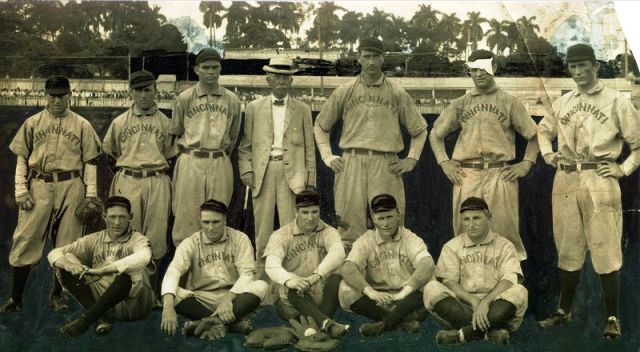
Larry McLean, standing 5th from left, Miller Huggins, standing end left, and Frank Bancroft, standing middle (in suit) on the 1908 Cuban tour.
The rest of the McLean story tomorrow.
 Baseball History Daily