Tag Archives: Boston Beaneaters

“Fear of the Black List has Stopped Many a Crooked Player from Jumping”

9 Sep

For a brief period in the mid1890s, George Jouett Meekin was considered among the top pitchers in the game; he might never have had the opportunity, but for what The Sporting Life called “The disastrous effects of Chairman Young’s somersault.”
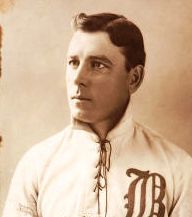
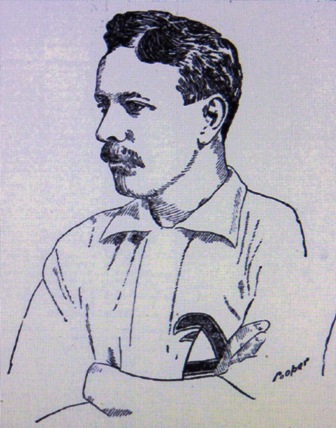
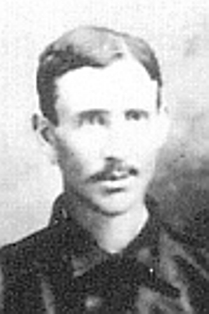
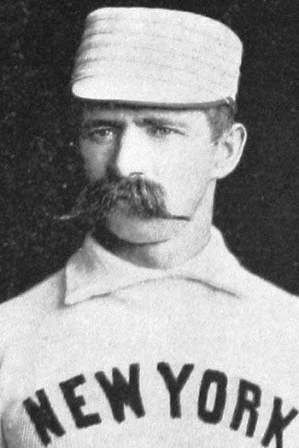
Jouett Meekin

Jouett Meekin

 John Montgomery Ward, Meekin’s manager with the New York Giants, said he was, along with Amos Rusie, Tim Keefe, John Clarkson and Kid Nichols, the “most marvelous pitchers as ever lived.”

Charles “Duke” Farrell, who caught Meekin and Rusie with the Giants, said:

“Sometime, it seemed to me that (Meekin) was actually faster…Rusie’s speed struck the glove with a bruising deadening, heavy shock, and Meekin’s fastest gave a sharp, sudden sting.”

But in 1891 Meekin was a 24-year-old pitcher in his third season with the St. Paul Apostles in the Western Association. The New Albany, Indiana native became a well-known amateur player across the Ohio River in Louisville before signing his first professional contract with the Apostles in 1889.  His sub .500 winning percentage was not enough to keep the American Association’s eighth place Louisville Colonels, from inducing Meekin to jump his contract with St. Paul.

In June Meekin jumped; at the same time third baseman Harry Raymond jumped to Colonels from the Western League’s Lincoln Rustlers.

The National Board of Control, created after the 1890 season as part of the “peace agreement” between the National League and The American Association after the collapse of the Players League, to arbitrate contract disputes, acted quickly.  Board Chairman (and National League President) Nick Young announced that Meekin and Raymond would be “forever ineligible to play with or against a National Agreement club.”  The statement, signed by Young, also said:

“This order or any other that may hereafter be made for the same cause, will never be modified or revoked during the existence of the present board, whose term of office will not expire for five years.”

The move was applauded by the press and no less a figure than “the father of baseball,” Henry Chadwick, who called Raymond and Meekin part of a “venal cabal” of jumping players.

Despite the promise that the order would “never be modified or revoked,” Young did just that.  Within weeks of issuing the order, both players were reinstated.

The backlash was swift.

The Cleveland Plain Dealer called the reversal “nauseating.”  The Cincinnati Times-Star said it was “one of the greatest mistakes ever made.”  The Milwaukee Evening Wisconsin said Young and the board chose to “toss the National Agreement into the fire.”
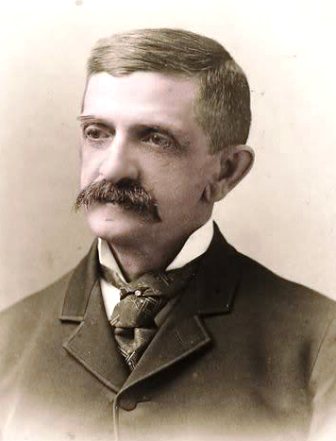
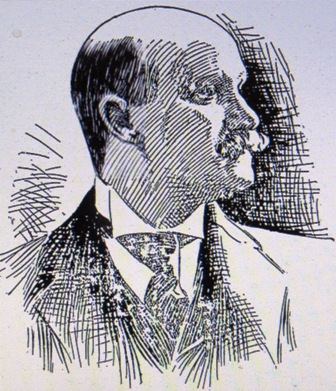
nickyoungpix

Nick Young

James Edward Sullivan, founder of the Amateur Athletic Union (AAU) said the reinstatement of the “arch-culprits” Meekin and Raymond “was the worst in the history.”  He predicted dire consequences as a result:

“Heretofore the fear of the black list has stopped many a crooked player from jumping or doing dishonest work.  But from now on it will be different.  A precedent has been formed.”

Raymond jumped back to Lincoln, taking Colonels’ pitcher Phillip “Red” Ehret with him to the Rustlers.  Meekin remained with Louisville and moved to the National League with the Colonels the following season.

Meekin had a 10-year big league career as a result of Young’s reversal.

From 1891-93, Meekin was 29-51 with Louisville and the Washington Senators and was traded to the Giants (along with Duke Farrell) before the 1894 season.  He was 33-9, and fellow Indiana native Amos Rusie was 36-13, for the 2nd place Giants.  Meekin had two complete game victories in the Giants four game sweep of the first-place Baltimore Orioles in the Temple Cup series (Rusie won the other two games).

The New York Evening Journal called Meekin “Old Reliable,” and said, “He can push ‘em up to the plate in any old style, and is factor with the stick.”  The pitcher hit .276 with 29 RBI in 183 at bats in 1894 (including hitting 3 triples in a game on July 4) and was a career .243 hitter.

Meekin won 102 more games (including 26, and 20 win seasons in 1896 and ’97), but as O. P. Caylor said in The New York Herald he suffered from “a lack of control.”  Meekin walked 1056 batters and struck out only 901 in more than 2600 innings, he also hit 89 batters; in 1898, he broke Hughie Jennings nose with a pitch.

After posting a 16-18 record for the seventh place Giants in 1898, Meekin, along with Rusie, and second baseman William “Kid” Gleason, were blamed by New York owner Andrew Freeman for the team’s disappointing finish.  Freeman told reporters:

“Meekin, Rusie and Gleason will be either sold or traded.  We do not want them.  I’m going to break up cliques in the team even if I have to get rid of every man.  There must be harmony.  Without it we can’t win games.  We have too many men who are simply playing for their salaries and do not seem to care whether they win or not.”

Rusie had injured his arm late in the season and sat out the next two years.  Meekin and Gleason, despite Freedman’s promise, returned to the Giants for the 1899 season.  The team finished in tenth place, and Meekin struggled with a 5-11 record.

He was sold to the Boston Beaneaters in August for a reported $5000, although it was commonly assumed that the Giants received much less, or simply “loaned” Meekin to Boston for the stretch run; a charge made by Brooklyn Superbas manager Ned Hanlon.  Although Hanlon’s charges have become “fact” in countless books and articles over the years, several newspapers, including The Pittsburgh Press refuted Hanlon’s story:

“All that talk and fuss about Freedman giving Jouett Meekin to Boston in order to help that team win the pennant and thus get even with Brooklyn is nonsense.  The truth of the matter is that Freedman thought Meekin’s days as a pitcher were over, and he offered him to the Pittsburgh club, but President (William) Kerr thought the same way and did not take him.  At the time Boston’s pitching corps was in bad shape and manager (Frank) Selee took a chance on the big fellow.  There was no underhand dealing in the matter at all.”

Meekin was 7-6 with a 2.83 ERA for Boston, but the team finished second to Brooklyn.  He was released by Boston before the 1900 season and pitched just two games with the Pittsburgh Pirates before being released again in July.  He finished the season with the Grand Rapids Furniture Makers in the Western Association and spent 1902 in the Southern Association with the Memphis Egyptians.

Meekin returned home to New Albany, Indiana, where, in 1910, according to The Trenton True American “his earnings from baseball are well invested in real estate.”

Meekin slipped into relative obscurity by the time he died in 1944.

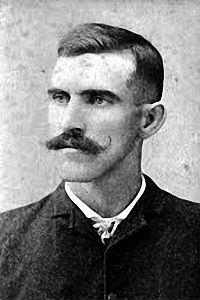
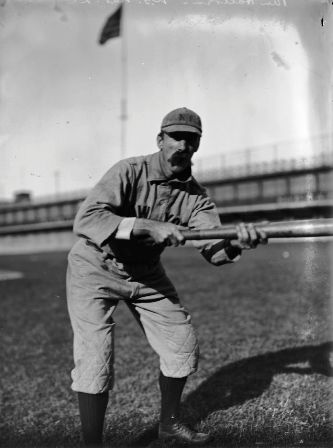
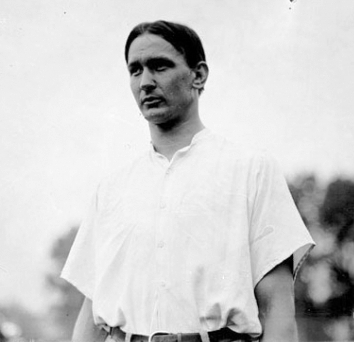
The original picture that appeared with this post–now below–was misidentified as Jouett Meekin in this blog and by The Louisville courier-Journal in 1897.  According to Mark Fimoff co-chair SABR Pictorial History Committee, the picture was actually Lave Cross.  
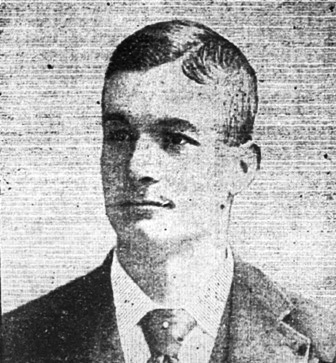
Lave Cross--picture earlier misidentified as Jouett Meekin.

Lave Cross–picture earlier misidentified as Jouett Meekin.
Things I Learned on the Way to Looking up Other Things #5

8 Aug

Johnny Evers “Ardent Worshipper of Hoodoo Lore”

Edward Lyell Fox was a war correspondent in World War I; after the war he was accused of taking money to write stories favorable to the German government.  Before that he wrote extensively about baseball for several American magazines.

In 1910, writing for “The Columbian Magazine”, Fox interviewed Johnny Evers of the Chicago Cubs about the “almost unbelievable efforts made by ballplayers to offset what they firmly believe to be ‘hoodoos.’”

Evers was one of the most superstitious players in the game, “an ardent worshipper of voodoo lore,” according to Fox, and Evers said the Cubs “are more superstitious than any team in the big leagues,” and that manager Frank Chance “is one of the most ardent respecters of diamond ‘hoodoos.’”

It’s not certain that Evers’ claim that “most players firmly believe in,” the superstitious he listed for Fox, but it’s clear he believed them:

 “If any inning is favorable to a player, he will try to lay his glove down on the same spot where he had placed it the inning before.

“While going to different parks in cars, the sight of a funeral cortege is always regarded as an ill omen.”

Evers also said the sight of a handicapped person was also an “ill omen…unless you toss him a coin.”

On the other hand Evers said a wagon load of empty barrels was a sign of good luck.

Johnny Evers,

Johnny Evers,


“Too much of a Good Thing”

Even in baseball’s infancy that were critics that said the popularity of the game was “too much of a good thing.”

In September of 1865 The Philadelphia Inquirer editorialized:

 “Let us take, for instance, the base ball (sic) pastime, which is now assuming the proportions of a violent and widespread mania.”

The culprit, according to the editorial, was the athletic club teams that were growing in popularity and  no longer “satisfied with a game or two a week.”

 “(S)ome of these associations devote, three, four or five days at a time to their games; that they are not satisfied with playing on their own grounds for their own benefit and amusement, but that they thirst for popular applause, and are rapidly transforming their members into professional athletes…They issue their challenges, and hotly contend for mastery with clubs belonging to other cities.”

 The Inquirer did predict one aspect of baseball’s new popularity:

 “It can be easily seen that this spirit must soon lead on to gambling. So far the only prize of the base ball and cricket matches has been a ball or some implement of the game, but private wagers have undoubtedly been laid upon the playing of certain clubs, and money has changed hands upon results.”

The Enquirer was also concerned that the game defied “common sense” because “during the heats of summer violent bodily exercise should be avoided; but upon this subject common sense and the base ball mania seem to be sadly at variance.”

The editorial concluded that “the young men,” make sure “they do not depreciate themselves to the level of prize fighters or jockeys, who expend their vim on horse races and matches made for money.”

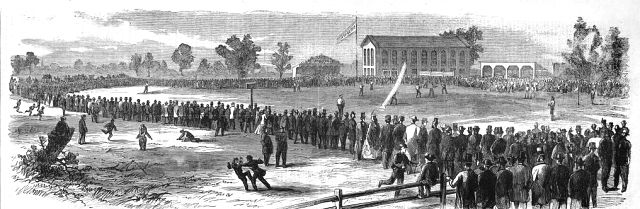
Athletic of Philadelphia versus Atlantic of Brooklyn, in Philadelphia October 30, 1865--"a violent and widespread mania."

Athletic of Philadelphia versus Atlantic of Brooklyn, in Philadelphia October 30, 1865–“a violent and widespread mania.”


Odds, 1896

Early in 1896 The New York Sun reported on “an early development of interest.”  A local bookmaker had issued odds on the 1896 National League race:

“He lays odds of 3 to 1 against Baltimore finishing first; 7 to 2 against Cleveland and Boston;  4 to 1 Philadelphia and New York; 7 to 1 Chicago; 8 to 1 Brooklyn and Pittsburgh; 15 to 1 Cincinnati; 40 to 1 Louisville; 100 to 1 Washington, while (Christian Friedrich “Chris”) von der Ahe’s outfit (St. Louis) is the extreme outsider on the list.  Any lover of the German band can wager any amount and “write his own ticket.”

The final standings:

1. Baltimore Orioles

2. Cleveland Spiders

3. Cincinnati Reds

4. Boston Beaneaters

5. Chicago Colts

6. Pittsburgh Pirates

7. New York Giants

8. Philadelphia Phillies

9. Washington Senators

10. Brooklyn Bridegrooms

11. St. Louis Browns

12.  Louisville Colonels

1896 Orioles, 3 to 1 favorites, won the National League Championship.

1896 Orioles, 3 to 1 favorites, won the National League Championship.

Another Rube Waddell Story

31 Jul

There are probably as many stories about George Edward “Rube” Waddell as any player in the history of baseball; and some of them might be true,

This one was told by Hugh Fullerton in The Chicago Tribune, and is about the contract Waddell signed to join the Chicago Orphans in 1901.

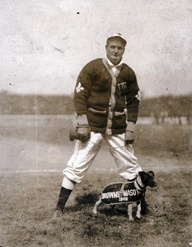
Waddell with St. Louis Browns Mascot

Rube Waddell

Despite the erroneous story, told through the decades, that the Pirates were so anxious to rid themselves of Waddell that they let him go for a cigar (or a box of cigars in some versions), there was actually a great deal of interest in Waddell and while the sale price was never disclosed, The Chicago Daily News said Chicago paid “good money” for the pitcher.

In addition to Chicago, other contemporaneous reports said the Boston Beaneaters were very interested in obtaining Waddell.

Fullerton told a good story, maybe just as erroneous as the cigar story, of how Chicago manager Tom Loftus was able to sign Waddell and thus beat Boston to the punch of purchasing his release from Pittsburgh:

“(Rube) was threatening to annihilate several members of the team and he was on one of his periodical rampages.  Boston wanted him badly—and so did Chicago.  Boston offered to give him $3,500 for the remainder of the season, and Chicago was willing to pay him only $2,400 and Loftus was delegated to sign Rube and make him be glad to knock off $1,000 from his earnings from the end of May to the middle of October.  Loftus cornered George Edward and commenced jollying him.

“’I’ll tell you, Tom,’ said Eddie, ‘I’d rather play with you than with Boston, but they offer me $1,100 more.

“’That’s all right,’ said Tom.  ‘Don’t let a little thing like that stop you from joining a good ball club with a lot of good fellows.”

Fullerton said the two discussed the pros and cons of Waddell accepting Chicago’s offer when Loftus finally said:

 “’I’ll tell you, Eddie, what I’ll do.  You sign that contract, and when we get to New York I’ll buy you the best Panama hat in town.

’“’All right,’ said George Edward.  ‘Just put that in the contract.’”

Fullerton said the deal was made and “When they got to New York Loftus bought him the $1,000 Panama hat—for $28.”

Tom Loftus

Tom Loftus

Waddell’s time in Chicago was brief, and typically bizarre.  After posting a 14-14 record and a 2.81 ERA for Loftus and the Orphans, Rube received an offer he couldn’t refuse in September.

The Tribune told the “pitiable little story, this tale of ‘Rube’ Waddell and his love of nature.”  Waddell had deserted the team to play for an amateur club in the town of Grayslake, Illinois, about 40 miles north of Chicago.  The Tribune said Waddell was induced to go north with the promise of being able to fish six days a week, if he pitched on the seventh.

The Orphans suspended Waddell for the remainder of the season.  In December he jumped Chicago to join Los Angeles in the California League.

“Atlanta’s Baseball Bullies”

17 Jun

During the 1885 season, Lewis Henke of the Southern League’s Atlanta Atlantas was killed during a game; the death was attributed to on-field rowdyism by the Southern press who hoped the death of the popular player would help end brawling behavior in the league.

In January of 1886, the Atlantas hired a new manager, William Aloysius “Blondie” “Billy” Purcell.   Purcell had split the 1885 season between the Philadelphia Athletics in the American Association and the Boston Beaneaters in the National League, hitting .279 in 87 games.  The Sporting Life said:

 “Billy will make a good manager, and is capable of securing a team—even at this late date—to win the championship. “

William "Blondie" Purcell

William “Blondie” Purcell

Purcell came to Atlanta with an excellent reputation, The Philadelphia Inquirer described him as being “Of a genial, happy disposition,” who was very popular when playing for the Athletics, and in 1883 and ’84 as a member of the Quakers.

That changed quickly, just two weeks into the season The Macon Telegraph said under the headline “An Alleged Conspiracy against Purcell,” that the new manager had incurred the wrath of his players by “ruling the team with an iron hand.”

After the rough start, the team appears to have turned their wrath towards their opponents and became the most hated team in the league.

Over the course of the next four months, Southern papers chronicled the bad behavior of the Atlanta squad.

It started with a game against the Charleston Seagulls when Purcell was accused of cheating, The Charleston News and Courier said:

“Manager Purcell was playing in the left field and the Charleston team was at the bat.  During the inning one of the Charleston team batted a ball to left field.  It went over the fielder’s head and, after striking the fence, rebounded and then went into the ditch.  The fielder started for it, but after running only a short distance took a ball from his shirt pocket and through it to the diamond.  The remarkable rapidity with which the ball was fielded was loudly applauded at the time…The fielder subsequently went to the ditch, picked up the ball and tossed it in the diamond…The incident was witnessed by several people, and the statement can be substantiated if the proof is demanded.”

Cheating turned to “bullying” as the season progressed.

The Savannah Times dubbed the team “Purcell’s Plug-Uglies,” and said of them after a July game:

“From the start of the game yesterday the Atlantas began their rowdyism, (Tom) Lynch was running to first in the first inning, the ball got there just ahead of him, Lynch deliberately struck (Jim) Field with his fist…from then on the whole team began to kick and try to hack the umpire.  In this Purcell was ably assisted by (John “Monk”) Cline and (John “Cub”) Stricker, two of the rowdiest  ball players that have been seen on our field…The conduct of the Atlanta club was most reprehensible, and has placed them in an exceedingly unenviable light.”

Tom Lynch, one of Atlanta's bullies

Tom Lynch, one of Atlanta’s bullies

Earlier that month after a couple of close wins over the Seagulls, The News and Courier again criticized the Atlantas saying the team “ought to be kicked out of the league,” and said:

“(T)here was an immense crowd present to witness the game, but their afternoon’s pleasure was completely spoiled by the disgusting behavior of the visitors, whose kicking and sharp practices are sufficient to drive any respectable audience from a ball field.”

After another game in Charleston, The News and Courier said Purcell’s team used “blasphemous and obscene language,” and:

“Those who attended the game this afternoon are outspoken in their condemnation of the disgraceful behavior of the Atlanta team, and declare that either they should not be allowed to continue in the league, or that they should be made to behave themselves at least decently in the presence of the communities where they have to play.”

The Macon Telegraph called the team “Atlanta’s Baseball Bullies,” and said after a game in which Purcell was fined $10 “for his ungentlemanly remarks,” that Atlanta played “good ball,” but that it was “marred” by their conduct.  The paper also said:

“The Atlanta team is evidently akin to the bulldozing idea.  The bullies and braggarts who compose the team have evidently been taught that an umpire is a very insignificant personage and to be influenced by blackguardism.”

Similar charges of “rowdyism” and “bullying” were made throughout the season.

The Atlanta Constitution saw nothing wrong with the team and blamed the criticisms from the papers in other Southern Association on “jealousy” over the team’s success.

With Atlanta holding on to a small lead for the league championship, the most serious charges would wait until the final weeks of the season, and include two of Atlanta’s most prominent citizens …tomorrow.

Gus Dorner’s Spitball

7 Jun

dorner1 dorner2

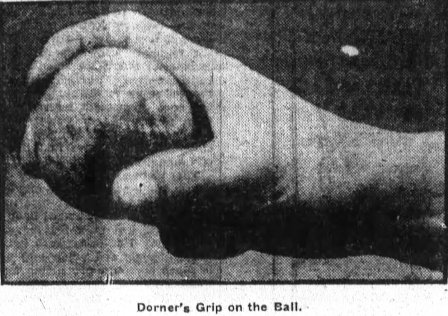
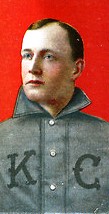
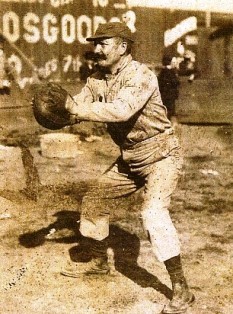
Augustus “Gus” Dorner suddenly became a successful pitcher in 1904.  He had brief trials with Cleveland in the American League in 1902 and ’03, he was 6-6 and control was a problem; on May 23, 1903, walked 11 batters in a game against the Philadelphia Athletics.  He finished the 1903 season with the Columbus Senators in the American Association posting a 7-7 record.

The next two seasons in Columbus Dorner was 18-10, and 29-8.  The Fort Wayne Daily News said:

“The big German attributes his success to condition, control, study of the batsman and mastery of the spitball.”

Dorner said, “I use the spitball a great deal.”  As a result of his new pitch he said:

“(I) have not had the slightest trouble with my arm this year.  I have worked hard to get control and perfect the spit ball.”

The magic was short-lived.  Dorner earned a return to the big leagues in 1906 but was a combined 8-26 with the Cincinnati Reds and Boston Beaneaters.  Overall he was 29-62 in parts of four seasons with Boston.

Gus Dorner

Gus Dorner

He didn’t fare much better in the minor leagues, going 25-29 his last three seasons as a professional.  After his release from Boston in May of 1909, he finished the season with the American Association’s Kansas City Blues with a 9-18 record.  The last two years of his career were spent with the Wilkes-Barre Barons in the New York State League and the Harrisburg Senators in the Tri-State League.

“California Wonder”

30 Apr

Two West Coast ballplayers dubbed “California Wonder” by the press made their Major League debuts less than a week apart in 1887.  One went on to be one of the best leadoff hitters of his era; the other remains almost completely unknown.

George Van Haltren was a 21-year-old left-handed pitcher, outfielder and first baseman who had played two seasons with the Oakland franchise in the California and California State Leagues.

James McMullin, birth date unknown, had pitched for Mike Finn’s San Francisco Pioneers in 1886.

Mike Finn, manager, San Francisco Pioneers

Mike Finn, manager, San Francisco Pioneers

Van Haltren’s rights were acquired by the Pittsburgh Alleghenys, but because of his mother’s illness he said he would instead play for the San Francisco Haverlys.  The Chicago White Stockings traded for Van Haltren in April, but he still refused.  The Sporting Life said “the California Wonder will not come east,” quoted him saying:

“No, I will not play with Chicago this season; but if my left arm holds out and my parents are blessed with good health I will be open to Eastern engagements next season.”

The White Stockings threatened to have him blacklisted for not reporting but Van Haltren dug his heels in; only changing his mind after his mother passed away in May.

The Chicago Inter Ocean announced that he had arrived in town on June 25 and would be making his debut for the White Stockings on the two days later:

“(Van Haltren) at one time retired the Pioneer Club of San Francisco with a hit, and struck out seventeen men.  If he can continue this record here the Chicagos will come out of the race this season with another set of figures to put on the big flag at the park.”

Van Haltren’s debut was not good.  He walked 16 Boston Beaneaters and lost 17 to 11.  He finished the season 11-7, and would spend one more season as a full-time pitcher; going 13-13 in 1888 (he was 15-10, splitting time between the mound and outfield with the Brooklyn Ward’s Wonders in the Players league in 1890).  Van Haltren would distinguish himself as one of the game’s best leadoff men, hitting better than .300 every year from 1889-1901, except for 1892 when he hit .293.

Van Haltren ended his career in 1903 with 2544 hits.

George Van Haltren

George Van Haltren

McMullin’s debut was no better than Van Haltren’s.

He began the 1887 season with the Pioneers, but was acquired in June by the new York Mutuals of the American Association.

When McMullin joined the club The Sporting Life said:

“The Mets have got their new California pitcher and like him well in practice.  He has plenty of speed.”

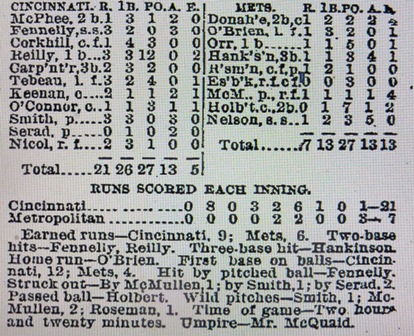
McMullin made his debut on July 2 against the Cincinnati Red Stockings.  The New York Times said of his performance, under the headline, “A ‘Wonder’ Exploded.  The Mets’ California Pitcher A Failure:”

“The debut of McMullen, the ‘California Wonder,’ was made (in Cincinnati) today in the presence of nearly 7,000 people, who went into hysterics from laughing at the awful exhibition given by the Wonder and his support.  He was utterly unable to get the ball over the plate and was miserably supported in the field.  After the third inning he retired to right field and there made a couple of errors.”

He gave up eight runs, made four errors and had two wild pitches in a 21-7 drubbing.

The box score from McMullin's debut.

The box score from McMullin’s debut.

McMullin only made two more appearances for the Metropolitans, and while he was credited with wins in both games his performance was no better; in his eight-day, three-game career he pitched 21 innings, gave up  25 runs (18 earned),  25 hits, walked 19, and struck out 2.  He made a total of five errors, and had one hit in 12 at bats.  The Mets released him on July 10.

And with that McMullin disappeared—there is no record of him having pitched anywhere after he left New York, there’s no record of whether he  threw and batted left-handed or right-handed, no pictures survive, and no record of when or where he died.  Another enigmatic figure of professional baseball’s early years.

“Phil Powers Seems to be Dead to the World”

15 Apr

Phillip J. Powers again left the National League umpire staff at the close of the 1888 season.  In 1889 he returned to London, Ontario to manage the Tecumseh’s, quit in May to become an umpire in the International Association, and then resigned from that job to return to the National League as an umpire in July.

Phil Powers

Phil Powers

The Detroit Free Press said the former and current National League arbiter “would never be a success as an umpire.”

Within weeks he was again at the center of controversy.

After the Boston Beaneaters beat the Philadelphia Quakers on July 25, The Philadelphia Inquirer placed the blame for the home team’s loss squarely on the shoulders of one man:

“Anyone who saw Phil Powers umpire yesterday would set him down as incompetent or dishonest.  While he is neither of these he gave a combination of glaring decisions which robbed the Philadelphia club of the game…It was a hard game to lose and it was no wonder that nearly every one of the 6,7000 spectators joined in hooting at Powers.”

The Inquirer would continue to criticize Powers for the remainder of his career; a few sample quotes.

From 1890:

“Umpire Phil Powers seems to be dead to the world.”

From 1891:

“The rank work of umpire Powers.”

From 1892:

“Umpire Phil Powers has been unanimously elected a member of the Society for the Promotion of Riots.”

The Sporting Life joined the chorus and derided as a “decided detriment to the game,” his work in the Giants-White Stockings series in early August:

“Mr. Powers is not a competent umpire…He does not know the rules, and judging from his decisions on the bases his eyesight is certainly impaired.”

 The Chicago Daily News quoted “Cap” Anson saying Powers “ didn’t know his business.”

Powers did have one defender.  “Orator” Jim O’Rourke, of the New York Giants, wrote a long letter that was reprinted in The Sporting Life, and other papers, making the case for the “High opinion in which Mr. Powers is held by the majority of professionals”, and using the opportunity to heap scorn on Anson:

“No man ever filled the position to better advantage and with more honor and credit to himself.   Mr. Powers is conscientious, faithful and absolutely fearless in voicing his convictions; neither can there be any doubt of his intentions to discharge impartially the irksome duties which the office entail upon him.

“Anson’s hate of such a man is only limited by the capacity of his nature for hate. Now why is this so? Because this cross-grain brow-beater, with the swaggering air of a Mexican bandit, who is so susceptible to becoming red-headed In the presence of umpires and spectators, is forced by this honest referee to have the result of a game settled by the contesting clubs upon its merits and not by his disgusting methods, which have made him the laughing-stock of all players, not even excepting his own.”

Jim O'Rourke--Defender of Powers

Jim O’Rourke–Defender of Powers

Despite O’Rourke’s defense, the criticisms of Powers continued, but he managed to stay on the National League staff in 1890 and ’91.

The Sporting Life updated readers about the umpire through the 1891 season:

“(Powers) has been catching it along the Western line from spectators, players and reporters.”

“(The Pirates) ready to meet Anson’s team to the call of Umpire Phil Powers, who has never pleased Pittsburgh’s audiences”

“Western critics are unanimously of the opinion that Phil Powers argues too much with the players.”

“(Cleveland papers) roasted Phil Powers to their hearts’ content.”

In August of 1891 Powers was released as an umpire by the National League.  He died in New York City in 1914.

A postscript:

A story that has appeared in several books and articles (all citing previous secondary sources) claims Powers pulled a gun on enraged fans in either 1888 or ’89.  While similar stories have been attributed to other umpires (for example umpire Joe Ellick, in 1886, was escorted off the field in Philadelphia by police who drew their weapons to protect him from an angry mob) and there are numerous contemporaneous references to irate fans at games, some with Powers as umpire,  none mention the gun incident.

It is probably a conflation of stories such as Ellick’s and a wire service article that appeared in several newspapers in 1906, shortly after “Buck” Ewing’s death, and described another incident involving Powers and Ewing.

“It was in 1889 that one of the worst rows in the history of baseball was precipitated at Cleveland by “Buck” Ewing.  Phil Powers was umpiring and his weakness whenever a critical decision came up was so apparent that the crowd was on pins and needles as to which way the cat would jump.

“(Jimmy) McAleer hit for two bases.  After he had got (sic) to second, Ewing said something to Powers, and the umpire hesitated a moment and then declared McAleer out for not touching first base…(Powers) was not looking at first when McAleer passed, having turned his head as somebody yelled at him from the opposite side of the field.  This was plainly evident to the crowd, and the moment that the spectators understood why McAleer was out they bolted from the stands and made a rush for the umpire.

“(Powers) took one look at the approaching mob and fled to the players’ clubhouse.  The police cleared the field after a while and Powers was induced to come forth and finish the game, but with police protection on either side of him.”

According to the story (which makes no mention of a gun), Powers later admitted that he had no idea whether McAleer had touched first base and simply took “Ewing’s word for it.”

Jimmy McAleer, called out on Ewing's word

Jimmy McAleer, called out on Ewing’s word

“Barnie’s Phenom”

10 Apr

The Baltimore Orioles needed pitching in 1889; Billy Barnie’s team had finished in 5th place in the American Association with a 57-80 record, and a 5.69 team ERA.

The Baltimore papers thought he had found a solution in April of 1889, The Sun said:

“Yesterday a big six-footer strolled up to the ball grounds while the Baltimore boys were at play.  He put on a suit and went in to pitch.  The ball-players laughed at first, but soon found that they could not hit the stranger.  He placed the ball in every conceivable position, and his curves and in-and-out shoots were remarkable.  When he picked up the bat he made the ball and the centre-field fence come together.  Mr. J.M. Ritter, a traveling salesman, had seen the young pitcher at play in Virginia and brought him to Baltimore.”

The Baltimore American was also enthusiastic:

“Great things are expected of Goetz, the Greencastle giant.”

His full name was George Burt Goetz, a 24-year-old house painter from Greencastle, Pennsylvania, who had played semi-pro ball in Virginia and Pennsylvania.

His first outing was against Pennsylvania University at Oriole Park; The Sun said Goetz “delighted 1,000 persons yesterday afternoon by his work in the box.” He pitched five shutout innings, giving up just two hits in a 20-1 victory; he also hit four singles, The Sun raved “He gives promise of becoming a great pitcher, batter and runner.”

The Sun said Goetz’ arrival was almost biblical:

“(He) has apparently created almost as much of a sensation among the local ball enthusiasts as David did when he strolled in among the embattled hosts of the Hebrews and offered to take the Philistine champion down a peg or two. ..Let us hope for the honor of the Baltimore Club that Mr. Goetz will prove a Baltimore David, and that the big champions of opposing teams may fall before his lightning delivery and Heaven-inspired curves.”

Within a week Goetz had been brought back to earth when he was pounded in an exhibition game against the National League’s Boston Beaneaters in Baltimore, he gave up 15 hits, 12 runs (6 earned), and committed three errors in a 12-5 loss.

The Sun conceded that “David met Goliath and came out second best this time,” but remained hopeful:

“(T)here’s life in him yet, which the season may develop into full growth.”

As quickly as he had arrived, it was reported that Goetz had returned to Pennsylvania to recover from an unknown illness; The Sporting Life simply said “Barnie’s Phenom Goetz is sick and recuperating in Greencastle.”

Oriole Manager Billy Barnie

Orioles Manager Billy Barnie

Goetz made it back to Baltimore and pitched in a June 6 game “Between two nines composed of Baltimore club players…for the benefit of the Johnstown (flood) sufferers.”  The Sun said “Goetz was too much for them,” allowing only four hits.

That outing appears to have earned him a shot for his professional debut; eleven days later Goetz started the first game of a double-header against the last place Louisville Colonels.  The Sun said:

“With a hard, steady work and a display of intelligence he may become a success.  At times he would fire the ball over the plate with a speed like a rifle shot, but when men were on bases he was nervous.  He was twelve times safely with a total of seventeen bases.”

Goetz gave up six runs (four earned); Baltimore tied the game with a three-run ninth inning, and won it with four in the tenth, earning Goetz the victory, Bert Cunningham pitched the tenth inning for the Orioles.

It would be his only appearance.

On July 4 the Orioles released Goetz. With little fanfare or explanation Barnie’s phenom was through.

Goetz signed with the York franchise in the Middle States League later in 1889.

He dropped out of sight until 1892 when The Sun reported that Goetz was “the sensation of the Wisconsin-Minnesota League,” pitching for Hayward, Wisconsin, and had recently struck out 19 in a game with the West Superior team.  The paper facetiously noted “It was reported Goetz had drowned in the Johnstown flood, but seems to have turned up again.”

Goetz’ catcher in Wisconsin was a Baltimore native named Milton K. Osborn; the two would play again the following season with a team in Little Falls, Minnesota and both joined the Lynchburg Hill Climbers of the Virginia League in 1894.  No statistics survive for any of Goetz’ post-Baltimore stops.

His trail goes cold after 1894.  There are many listings in city directories for George B. Goetz’ throughout the country for the next several decades, and there are reports that he was in California as late as 1912—but nothing else is known about “Barnie’s phenom”

Ernie Diehl

18 Mar

Ernest Guy “Ernie” Diehl’s entire professional career consisted of less than 60 games.

Every year from 1900 to 1911 he was offered contracts by professional teams and despite his time with two National League teams and two minor league teams he never earned a penny as a ballplayer.

By the time the 25-year-old Diehl made his first professional appearance with the Pittsburgh Pirates in May of 1903, he was already a well-known player. Diehl was the star of the perennial powerhouse Avondale team in Cincinnati’s semi-pro Saturday League, which The Sporting Life called “a fast, clean league.”

diehl

Ernie Diehl

Diehl was born in Cincinnati in 1877, the scion of a Cincinnati distillery empire; His father Adam G. Diehl had made a fortune in the whiskey business with his brother-in-law; together they founded The Edgewood Distilling Company.

He attended the University of Cincinnati and established a reputation as one of the area’s best athletes.  Perhaps even better at tennis than baseball, Diehl was a prominent amateur tennis player during the first decade of the 20th Century.

In May of 1903 when the Pirates arrived in Cincinnati for a series, the team was decimated with injuries and Diehl joined the team for one game, playing left field on May 31, he went 1 for three in a 3-2 pirate victory.

Despite being offered a contract with Pittsburgh, Diehl chose to return to the distilling business and the Saturday Baseball League.

In 1904, with several Pirate players hurt, Diehl was again asked to join the team; this time for 12 games.  The Pittsburgh Gazette said Diehl also spent time with the Pirates in Hot Springs, Arkansas that spring.

The Baltimore American ran a story before the Pirates arrived in New York in August:

“New Yorkers who attend the games between the Brooklyn and Pittsburgh teams will be treated to an opportunity of seeing the work in the field of a millionaire ballplayer.”

While he hit just .162 for the Pirates in 1904, that did not diminish Pirate owner Barney Dreyfuss’ desire to sign Diehl.

Before the 1905 season Dreyfuss told The Pittsburgh Press:

“The one player I would like to get on the team is beyond my reach… His name is Ernest Diehl…He is one of the best baseball players I ever saw.”

Dreyfuss also called Diehl “One of the best all-around athletes,” he had seen.  The Press said that although Diehl was required to sign a contract for his time with the Pirates in 1903 and ’04:

“Diehl never received a penny of salary from President Dreyfuss.”

Barney Dreyfuss

Barney Dreyfuss

Dreyfuss, and every other owner who offered Diehl a contract was unsuccessful in securing him for the 1905 season; Diehl spent the season playing in the Saturday League and in several tennis tournaments across the country.

He again played tennis and semi-pro ball in 1906, until August when the Boston Beaneaters came to Cincinnati. Shortstop Al Bridwell was injured, and Diehl was signed (again for no salary) to play for Boston in the three-game series.

The Associated Press reported:

“’Ernie’ Diehl, a wealthy young distiller of this city, an enthusiastic athlete, long known as a brilliant baseball player on local amateur teams, distinguished himself in the series just played…He played three games in the Boston ranks…He made five hits in eleven times at bat…Diehl could not afford to enter professional ball if he desired, at the highest salary paid in the organization, on account of his business, but is delighted and satisfied with his experience…Besides his heavy batting, his fielding was strictly up to the professional standard.”

Just as he had in Pittsburgh, Diehl turned down an offer to stay with Boston for the remainder of the 1906 season.

In 1907, Diehl appeared in 21 games for the Toledo Mud Hens in the American Association, hitting .405.  The Toledo News-Bee said Diehl was spending “His vacation…helping out the Toledo club.”  The Associated Press said that as in the past, “Diehl is wealthy and refused to accept pay for his services.”

In addition to his business interests, amateur tennis and baseball career, and professional baseball “vacations,” Diehl also served on Cincinnati’s city council from, roughly, 1906-1910.

In 1909 Diehl played in one game of a doubleheader for the Boston Doves on August 12 against the Reds, he was 2 for 4 with a double—it would be his last in the National League

Diehl then joined the eventual American Association champion Louisville Colonels, at the request of his friend and fellow Cincinnatian, manager Heinie Peitz.  (Baseball Reference lists a player as “Diehl,” with no first name on the 1909 Louisville roster, with a .226 average in 20 games).

The Sporting Life said Diehl “figured very prominently in Louisville’s winning the championship of the A.A. will again be in Colonel garb,” in 1910; Diehl did not play for Louisville, or any other professional team again.

In 1911 The Associated Press and Cincinnati newspapers said the 33-year-old Diehl had a deal in place with Reds manager Clark Griffith to join the team at some point during the season; as with Louisville, that deal never materialized either.

Diehl was briefly mentioned as a candidate to replace Griffith as Reds manager in 1912, the job eventually went to Hank O’Day.

Diehl’s career was summed up well in a 1914 Baseball Magazine article by William A.  Phelon:

“For ten years it has been a tacitly accepted fact, around the big leagues and whenever players or managers assembled, that Ernie Diehl was not only of major league quality, but what might be called super-quality—the Wagner-Lajoie-Cobb variety.  He could hit, run, and break up a defense with anybody, and was a versatile artist in five or six positions.  Business held him; there never was a chance for him to spend a full season in the game; year after year, in short vacation frolics, he showed the professionals what he could do—and now, getting on in years, with business still gripping him, he sadly gives it up, and lays aside the bat and glove he never had a fair chance to use.”

Diehl’s Edgewood Distilling Company seems to have been dissolved sometime around 1918, and he eventually settled in Miami where he died in 1958.

“The Money in Baseball” 1884

14 Mar

In 1884, under the headline “The Money in Baseball,” The Boston Globe expressed their antipathy about the “enormous salaries which the ‘kings of the profession’ demand.”

The Globe observed that “The best pitchers get as much money for working a few hours each day during seven months as many college professors receive for the entire year’s service.”

George Wright, Hall of Famer, and brother and teammate of Harry Wright with the 1869 Cincinnati Red Stockings, told the paper

“The money paid the entire team would put a poor team on the field today.  My brother Harry was the most expensive man on the team, and he got $2000 for being captain and playing center field.  I was in my regular position at short and drew $1800.”

Wright said several players on the Red Stockings were paid less than $1000.

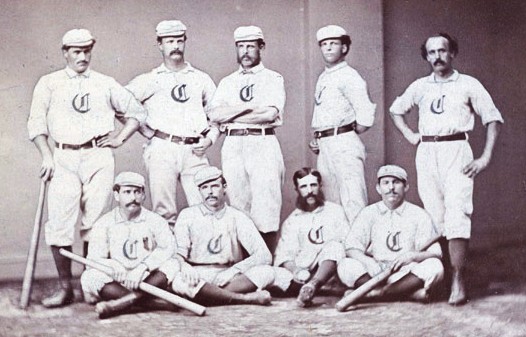
1869 Red Stockings, Harry Wright, standing third from left, George Wright standing to the right of him.

1869 Red Stockings, Harry Wright, standing third from left, George Wright standing to the right of him.

By comparison The Globe said:

“The salary list of the Boston League club amounts to $25,000 in round numbers…It is impossible to estimate how much has been paid in salaries to ballplayers throughout the country.  The eight League clubs will certainly average as much as Boston’s total…In the Union Association are eight more clubs…there is not much doubt that the eight clubs pay at least $125,000 in salaries.  The American Association has twelve clubs…the salary list of these three largest baseball associations in the country aggregate between $500,000 and $600,000.”