Tag Archives: California League

Road Trip High Jinks, 1891

1 Oct

The Sacramento Daily Record-Union described the 50-mile road trip the California League’s Sacramento Senators and San Francisco Metropolitans took to play a game in Stockton, on the box car of a freight train:

 “(The players) commenced to playing craps…The San Francisco players and also umpire (John) Sheridan were on the train, and everyone was betting his ‘chicken feed.”  Big (Edward “Jumbo”) Cartwright borrowed ten cents to start on, and came out (with) over $7…Sheridan won about the same amount, but did not stop playing and dropped $3 of what he had won.  Red (Frank) Armstrong was intensely interested in the game, except for an intermission of about five minutes, when he poked a drunk’s hand through a window in the caboose.

“At Stockton both clubs were accorded a royal reception; but the heat was sweltering and everyone was in a half-way stupor.  Just about then ‘Rube’ (Reuben) Levy and ‘Bony’ (James Peck) Sharp and a couple of others came running up the middle of the street with their coats off yelling ‘Fire!’   They ran about four blocks and when they stopped the population was running at a lively rate.  But there was no fire, except in the air”

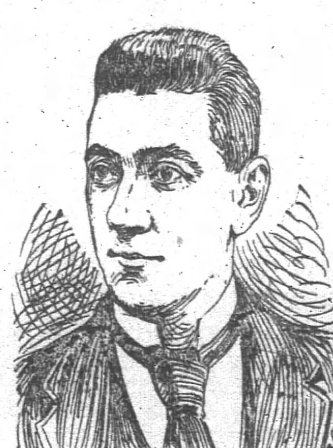
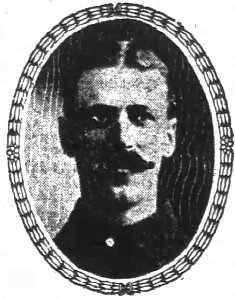
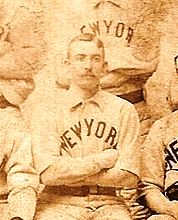
Reuben "Rube" Levy

Reuben “Rube” Levy

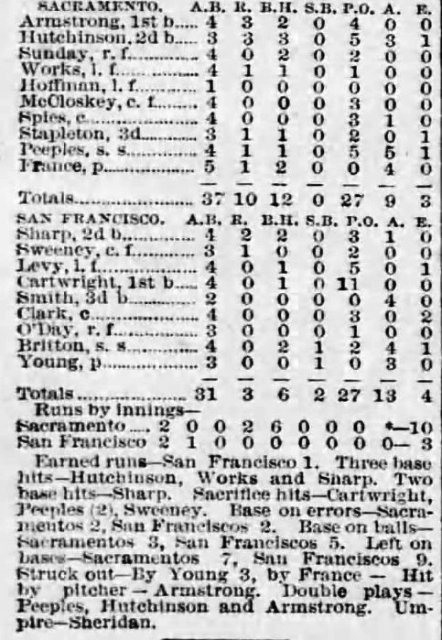
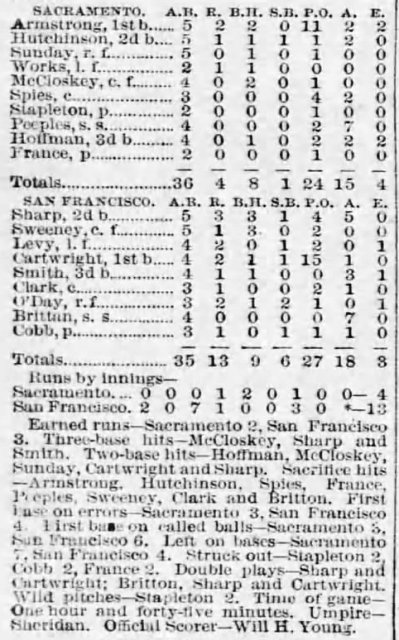
The teams played that morning in Stockton, Sacramento winning 10 to 3.  Immediately after the game, the teams re-boarded the freight train (there was no description of the return trip) and played an afternoon game in Sacramento.  San Francisco won that game 13-4.

Game 1 Box Score

Game 1 Box Score–played in Stockton

Game 2 Box Score

Game 2 Box Score–played in Sacremento

“Krug Seemingly Lost his Head”

25 Sep

The 1902 Southern Association season was so contentious that a headline in The Atlanta Constitution said the day after it ended:

To the Relief of All the Season is Now Over

In addition to the months-long battle between Charlie Frank and the league, there was an on-field incident that The Columbus (GA) Daily Enquirer called “an exhibition as was never before seen on an Atlanta Diamond.”  Henry “Heine” Krug was at the center of it.

Henry Krug

Henry Krug, 1902

In February of 1902, Ed Peters, new owner and president of the Atlanta Firemen signed Ed Pabst to manage the team.  Pabst had played the previous season with the San Francisco Wasps in the California League and brought with him to Atlanta his friend Krug, a 25-year-old shortstop who had been playing for West Coast professional teams since he was 17.

When Krug was signed The Constitution said he was “beyond doubt the star of the Pacific Coast,”

The Sporting Life said Krug had already signed a contract with the Philadelphia Phillies, but jumped the Phillies to join Atlanta.

Krug’s average never dipped below .300, and was very popular with fans and the press.  The Constitution called him “The best all-around professional of the Southern Association” in June.

On July 15 the paper noted his “dashing, errorless work that has been classed as phenomenal.”

Two days later the tone changed dramatically.

The fourth place Firemen were playing Charlie Frank’s Memphis Egyptians and Krug was having a rough day.  Early in the game a throw from first baseman George Winters hit Krug “and gave him a severe blow in the mouth.”  Krug had walked off the field, intending to leave the game, but came back.  He probably shouldn’t have.

Krug went on to make three errors, two of which The Constitution said “in the opinion of the crowd might have been avoided.”

The crowd began to taunt Krug and “Instead of taking the roast the bleachers proceeded to give him as any sensible player would take it, Krug seemingly lost his head and with all the vicious intent imaginable, he secured the ball and threw it with all his strength into the bleachers.”

The Constitution said Krug, “phenomenal” just two days earlier, now said the shortstop’s “conduct on former occasions has been offensive to the patrons of the game.”  Although Krug was ejected from a game earlier in the week, there didn’t appear from newspaper reports to be any pattern of “offensive conduct.”

Atlanta bleacher fans “dodged the sphere” and no one was hurt.  Team president Peters immediately approached Ed Pabst and “instructed him to order Krug out of the game.”  Pabst refused:

“He did not like what he considered an infringement on his prerogative, and at once tendered his resignation as manager of the Atlanta team.  President Peters was just as ready to accept as Manager Pabst was to tender, and within the space of a few seconds the ball player who has been managing the Atlanta team since the playing season of 1902 opened found himself deposed.”

Ed Pabst

Ed Pabst

Peters took over as manager and remained in the position for the rest of the season.  His first act as manager was to remove Krug from the game and suspend him.  The Constitution said:

“Krug’s baby act was witnessed by Sergeant Martin and policemen Norman and Hollingsworth.  They placed him under arrest.”

Some reports said a bottle and rock were thrown at Krug, but the player said he didn’t see that and was reacting only to the verbal taunts.  He appeared in court the following day and was fined $10.75; The Daily Chronicle said, “Krug appeared very penitent.”

Peters sold Krug’s contact to the New Orleans Pelicans the following day, but Krug refused to report sending a wire to Peters and Pelicans owner Abner Powell saying “that if he could not play in Atlanta he would not play,” in the league.

Despite the incident, there was no shortage of interest in Krug’s services.  In addition to New Orleans, the Phillies, who he jumped to join Atlanta and the San Francisco franchise in the California League offered him contracts.

Krug signed with Philadelphia and made his debut with the Phillies on July 26; the day after Atlanta management petitioned the National Association of Baseball Leagues (NAPBL) to blacklist Krug.

No action was taken and Krug played out the season in Philadelphia, hitting .227 in 53 games.  He spent 1903 with the San Francisco Seals in the Pacific Coast League (PCL).  Peters sold his interest in Atlanta in 1903.

Before the 1904 season, the PCL and the NAPBL reached an agreement that made the league part of the National Association and no more an “outlaw league.”  As part of the deal, PCL players who were under contract with other teams were returned.  As a result, Krug returned to Atlanta.

The Constitution assured their readers:

“He has promised to be good and to do his best to help the team win.  It is the belief of many fans in this city that he wishes to redeem the past.”

Krug played two incident-free, if unspectacular seasons in Atlanta, then played in the New York State League with the Scranton Miners and the American Association with the Indianapolis Indians.

krug1

Henry Krug,1907

The 31-year-old returned to San Francisco, where he was “negotiating for a place with the California State League,” and had accepted a position coaching the baseball team at Cogswell College.  Krug underwent surgery for “an abscess upon his throat” on January 12, 1908, and died from complications from the operation two days later.

Two months after his death all had been forgiven in Atlanta.  The Constitution named him to the paper’s “All-Atlanta Ball Team,” the best professional players to have played in the city.  Krug “was a power with the stick.  No better man ever played on the Atlanta team when it came to breaking up a game.”

The First Triple Play in the West

12 Sep

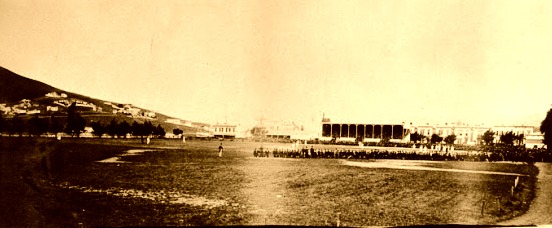
On April 4 of 1880, the California League San Franciscos and Athletics met at the Recreation Grounds (the park was located at 25th and Folsom).

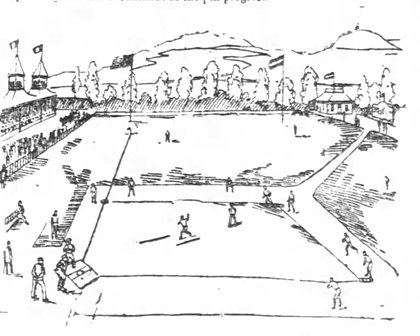
San Francisco's Recreation Grounds

San Francisco’s Recreation Grounds

Two newspapers in town treated the key play of the game very differently.

The San Francisco Bulletin’s coverage of the game was headlined:

Extraordinary Base-Ball Play

The San Francisco Chronicle headline:

An Uninteresting Game with a Score of 4 to 1—Very Poor Playing on the Part of the San Franciscos

In the eighth inning, the San Franciscos’ Al Mast was on second and Andy Piercy was on first.  George “Live Oak” Taylor was at the plate.

Hall of Famer James “Pud” Galvin was pitching for the Athletics; Galvin, in a contract dispute with the  Buffalo Bisons, played several months in California before jumping the Athletics to return to Buffalo in May.

Pud Galvin

Pud Galvin

The second baseman was Jim McDonald, a 19-year-old San Francisco native.

The Bulletin’s first paragraph referred to “The feature of the game” and said:

“(Taylor) struck a powerful ‘liner’ to second base, which was neatly captured by McDonald, and placing his foot on second forced Mast out, and then threw the ball to first in time to cut Piercy off.  The play was vociferously applauded.  There is but one other instance in the history of the national game where this play has been made.”

(The article was referring to Providence Grays center fielder Paul Hines’ disputed unassisted triple play, turned two years earlier versus the Boston Red Caps)

The Chronicle, while mentioning McDonald’s play was less impressed, mentioning the play deep into its much longer recap of the game.  The paper noted that McDonald made three errors earlier, and “in a measure he redeemed himself by an effective pay in the eighth inning,” the paper described the play and noted that McDonald “was deservedly applauded for it.”

Despite the triple play The Chronicle questioned the wisdom of McDonald being in the lineup:

“(McDonald) is a player of some promise, but the policy of putting him in the important position he fills is a questionable one.  In his practice games his playing in brilliant, but in a match contest he appears to lack the necessary confidence, and in baseball vernacular he falls all to pieces.”

Jim McDonald

Jim McDonald

McDonald played primarily on the West Coast, but had a brief career in the East, spending time in all three major leagues in 1884 and 1885.  He played two games for the Washington Nationals in the Union Association, 38 with the Pittsburgh Alleghenys in the American Association and five with the Buffalo Bisons in the National League.

After his playing career ended in 1894, McDonald was an umpire in the National League and California League, and a West Coast boxing referee; he officiated many fights including Jim Jeffries 1898 victory over Peter Jackson and Abe Attell’s 1903 20 round draw with Eddie Hanlon.

His active career came to an end in 1904 when he was diagnosed with Tuberculosis; he died in 1914 in San Francisco.

Another Rube Waddell Story

31 Jul

There are probably as many stories about George Edward “Rube” Waddell as any player in the history of baseball; and some of them might be true,

This one was told by Hugh Fullerton in The Chicago Tribune, and is about the contract Waddell signed to join the Chicago Orphans in 1901.

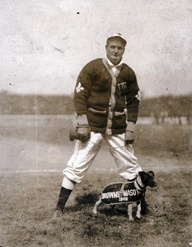
Waddell with St. Louis Browns Mascot

Rube Waddell

Despite the erroneous story, told through the decades, that the Pirates were so anxious to rid themselves of Waddell that they let him go for a cigar (or a box of cigars in some versions), there was actually a great deal of interest in Waddell and while the sale price was never disclosed, The Chicago Daily News said Chicago paid “good money” for the pitcher.

In addition to Chicago, other contemporaneous reports said the Boston Beaneaters were very interested in obtaining Waddell.

Fullerton told a good story, maybe just as erroneous as the cigar story, of how Chicago manager Tom Loftus was able to sign Waddell and thus beat Boston to the punch of purchasing his release from Pittsburgh:

“(Rube) was threatening to annihilate several members of the team and he was on one of his periodical rampages.  Boston wanted him badly—and so did Chicago.  Boston offered to give him $3,500 for the remainder of the season, and Chicago was willing to pay him only $2,400 and Loftus was delegated to sign Rube and make him be glad to knock off $1,000 from his earnings from the end of May to the middle of October.  Loftus cornered George Edward and commenced jollying him.

“’I’ll tell you, Tom,’ said Eddie, ‘I’d rather play with you than with Boston, but they offer me $1,100 more.

“’That’s all right,’ said Tom.  ‘Don’t let a little thing like that stop you from joining a good ball club with a lot of good fellows.”

Fullerton said the two discussed the pros and cons of Waddell accepting Chicago’s offer when Loftus finally said:

 “’I’ll tell you, Eddie, what I’ll do.  You sign that contract, and when we get to New York I’ll buy you the best Panama hat in town.

’“’All right,’ said George Edward.  ‘Just put that in the contract.’”

Fullerton said the deal was made and “When they got to New York Loftus bought him the $1,000 Panama hat—for $28.”

Tom Loftus

Tom Loftus

Waddell’s time in Chicago was brief, and typically bizarre.  After posting a 14-14 record and a 2.81 ERA for Loftus and the Orphans, Rube received an offer he couldn’t refuse in September.

The Tribune told the “pitiable little story, this tale of ‘Rube’ Waddell and his love of nature.”  Waddell had deserted the team to play for an amateur club in the town of Grayslake, Illinois, about 40 miles north of Chicago.  The Tribune said Waddell was induced to go north with the promise of being able to fish six days a week, if he pitched on the seventh.

The Orphans suspended Waddell for the remainder of the season.  In December he jumped Chicago to join Los Angeles in the California League.

Hap Myers

29 Jul

When the 6’ 3” 175 pound Ralph Edward “Hap” Myers was let go by the Boston Braves after the 1913 season a reporter told Braves shortstop Rabbit Maranville he was sorry to see Myers go.  Maranville joked:

“Well, you might be, but I’m not.  Do you know that guy is so thin that every time I picked up a grounder I had to shade my eyes with my gloved hand to locate him before throwing the ball.”

Myers began his professional career after graduating from University of California, Berkeley in 1909, where he also played baseball.  The San Francisco native hit a combined .311 playing for the Sacramento Sacts in the Pacific Coast League, and the San Jose Prune Pickers and Santa Cruz Sand Crabs in the California League.

Myers went east in 1910 after being purchased by the Boston Red Sox, but became ill, with scarlet fever, and as a result appeared in only six games in Boston before being  sent first to the Toronto Maple leafs in the Eastern league, then the Louisville Colonels in the American Association.

Despite hitting just .240 with Louisville, Myers was selected by the St. Louis Browns in the Rule 5 draft.  The Red Sox claimed Myers still belonged to them and his contract was awarded to Boston, where he began the season, was sold to the St. Louis Browns, who quickly released him despite hitting .297 in 11 games, then back to the Red Sox where he hit .368 in twelve games before being sent to the Jersey City Skeeters in the Eastern League.

It was never clear why, in spite of hitting .333 in 81 at bats in 1910-1911, Myers couldn’t stick in the American League.

In 1912 he returned to the West Coast to play for the Spokane Indians in the Northwestern League where he led the league in hits, and runs, hit .328, and led all of professional baseball with 116 stolen bases.  The Portland Oregonian said:

“Myers base stealing smashes any previous performance in Northwestern League history.  You have to go back 20 years in official guide books to find any record to compare…and that includes every league in organized baseball.”

Spokane owner Joe Cohn went overboard in his praise of Myers in The Spokane Spokesman-Review:

“Best ballplayer in the Northwestern League by a long shot.  He is the greatest ballplayer I ever saw.  Boy I tell you this Myers is a wonder.  Ty Cobb, Hans Wagner, Tris Speaker and all of them have nothing on Myers…I think Myers has it on Cobb, Wagner, Lajoie, Jackson and the whole bunch.”

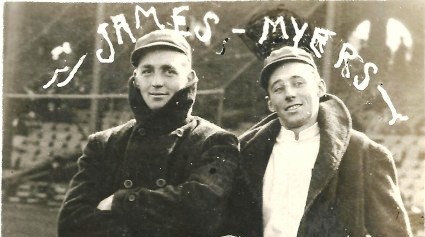
Myers, and Portland catcher Rex DeVogt were purchased by the Braves from Portland, Devogt would only last for three games, and six hitless at-bats in April of 1913.  Myers would become the Braves starting first baseman.  Another Pacific Coast League player, pitcher “Seattle Bill” James also joined the Braves.

hap3

“Seattle Bill” James and “Hap” Myers

Myers got off to a slow start; he was hitting just .224 in early July, but was leading the National League in steals.  An article in The Tacoma Times said:

“When Hap Myers, recruit first baseman of the Boston Braves is in full stride stealing bases, he covers nine feet…the average stride of a sprinter is six feet. “

The article said the average player took 13 steps, roughly seven feet per step, between bases but Myers took only ten steps:

“Myers is something of a baseball curiosity, and his work is watched with interest by the fans.  If the time comes that the big fellow climbs into the .300 class as a batter, he is apt to become a veritable terror of the paths.”

He was also said to use “a bat of unusual length,” but the size was never mentioned.

After the slow start, Myers hit well in the second half of the season, ending with a .273 average and 57 stolen bases (second to Max Carey of the Pittsburgh Pirates who stole 61).  Despite his strong finish, Myers was replaced at first base for 22 games in August and September by Butch Schmidt, who was purchased from the Rochester Hustlers in the International League.

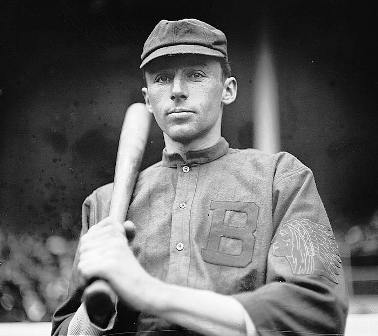
"Hap" Myers

“Hap” Myers

At the end of the season Myers was sold to the Hustlers, the deal was, in effect, a trade for Schmidt.  The Boston press simply said Myers did not get along with manager George Stallings; Myers told a reporter in San Francisco that there was another reason; baseball’s labor unrest:

  “I was assigned by the fraternity to get as many Braves as possible into the fraternity, and succeeded in enrolling nearly the entire team.  The powers that be evidently didn’t relish my actions for soon my every move began to bring calldowns and I was not surprised to read in the newspapers a little later that I had been sent to Rochester.”

Myers jumped Rochester to join the Federal League; his signing was reported months before he actually signed.  The Associated Press said in March of 1914:

“Although it has been generally understood that Hap Myers, last season’s first baseman of the Boston National has been under a Federal League contract for some time, the elongated first sacker did not put his name to a contract until yesterday afternoon.  Myers originally expected to play with Larry Schlafly on the Buffalo Federals, but was transferred to Brooklyn, and seemed altogether pleased with the move.”

Myers got off to a strong start, and The Sporting Life said:

“Brooklyn fans cannot understand why Hap was passed out of the National League. They have had a chance already to give his successor at first base on the Boston team (Butch Schmidt) the once over, and the general opinion is that- Hap Myers “lays all over.”

His success in Brooklyn didn’t last; in 92 games Myers hit just .220.

Hap’s story continued tomorrow.

“The Ty Cobb of Trapshooters”

15 Jul

Lester Stanley “Les” German broke into professional baseball with a bang in 1890.  The 21-year-old played for Billy Barnie’s Baltimore Orioles, a team that had dropped out of the American Association and after the 1889 season and joined the Atlantic Association, a minor league.

German was 35-9 in August when the American Association’s Brooklyn Gladiators folded in August, the Orioles returned to the association, and German returned to Earth; posting a 5-11 record for the big league Orioles.

German was a minor league workhorse for the next two and a half seasons.  He was 35-11 for the Eastern Association champion Buffalo Bisons in 1891; he appeared in 77 games and pitched 655 innings for the Oakland Colonels in the California League in 1892, and was 22-11 for the Augusta Electricians in the Southern Association in July of 1893 when his contract was purchased by the New York Giants.

Les German, 1894

Les German, 1894

German would never win in double figures again; In five seasons in the National League he was 29-52, including a 2-20 mark with the 1896 Washington Senators.

It was German’s next career that earned him the most notoriety.  A crack shot, German became one of the most famous trapshooters in the country for the next thirty years.  He won numerous championships and was often featured in Buffalo Bill’s Wild West Show with Annie Oakley.

A National Sports Syndicate article in 1918 said “Lester German is the Ty Cobb of trapshooters.”  The article said that beginning in 1908, when official records were first kept, German had maintained a “remarkable average,” shooting a t a better percentage than any other professional marksman.

Les German, 1918

Les German, 1918

As German’s reputation as a shooter grew, his legacy as a pitcher became inflated.

A mention of his baseball career in a 1916 issue of “The Sportsmen’s Review”, credited German, and his 9-8 record,  with “leading the Giants,” to their 1894 Temple Cup series victory over the Baltimore Orioles, there was no mention of Amos Rusie’s two shutouts .  A 1915 article in The Idaho Statesman inexplicably said German “headed the National League in both pitching and fielding” in 1895—German was 7-11 with a 5.54 ERA and committed 2 errors in 45 chances on the mound; he also made eight errors in 11 games he filled in for the injured George Davis at third base.

German operated a gun shop and continued to organize and participate in shooting tournaments until his death in Maryland in 1934.

“All Men were his Friends”

12 Jun

Among the reasons Rube Levy remained one of the most popular figures in West Coast baseball was his refusal to accept offers to play for teams outside of California.  The San Francisco Chronicle said:

“With all his vast experience on the baseball diamond, the young man has never ventured beyond the confines of the state in which he was born…Time and time again Rube has received princely offers from Eastern magnates bidding against each other, but he always declined their advances.  He knew that California needed him, and he said he never would desert the state.  This sacrifice on his part is what has endeared Reuben in the hearts of the populace and why he is always greeted with plaudits.”

Reuben "Rube" Levy

Reuben “Rube” Levy

Levy disappeared from professional rosters after the 1896 season, but appears to have remained active as a player and umpire in semi-pro baseball in San Francisco.

Levy, along with his brother David who also played professional ball on the West Coast in the 1880s and 90s, also worked for the San Francisco Fire Department.  A  city report from 1898 shows the brothers working out of Engine Company 14 on McAllister Street.  Reuben, badge number 187, was an assistant foreman, David, number 184, a hoseman.

In 1899 he became an umpire in the California League.  Early in the season The Sporting Life said “he is not altogether conversant with the playing rules,” and later said he “is umpiring in style, but is a little off on balls and strikes.”

The following season Levy returned as a player with the San Francisco Brewers in the California League.   On April 2, 1900 The Chronicle, which incorrectly said he had been away from professional ball for seven years, said of the crowd:

“It applauded every move made by Rube Levy, who played out in the western prairie for San Francisco, and made one hit and four putouts and otherwise distinguished himself before rooters who used to yell for him years ago.  Old timers referred to the epoch when Rube used to be the darling of the kindergarten bleachers at the old Haight Street Grounds, when 2000 shrill-voiced youngsters, at 10 cents a voice used to go into ecstasies over Rube.”

The article said of the 37-year-old, “(He) chased flies and caught them as cleverly as though he were Rube’s grandson.”

Levy appeared in 87 games in 1900, hitting .205, and returned to umpiring the following season.

In 1903 he joined the newly formed Pacific Coast League.  It’s more likely he acquired the position because of his brother-in-law, rather than based on his reputation as an umpire.  Levy’s wife was the former Rebecca Fisher, sister of Mike “Mique” Fisher one of the league’s founders and owner/manager of the Sacramento Senators.

"Mique" Fisher, Levy's brother-in-law.

“Mique” Fisher, Levy’s brother-in-law.

The reviews of his work as an umpire never improved, The San Francisco Call said about one game: “He did not give either nine the worst of it, He was just impartially rank.”   The Los Angeles Times was especially critical of his work, calling him “notoriously incompetent.”

He managed to remain on the league umpire staff through the 1904 season.

The Spokane Daily Chronicle summed up his career as an arbiter:

“He was anything but a success as an umpire, but he had the reputation of being one of the few men in the business who refused to get mad.  The players started in time and again to bait him and get him mad, but Rube always preserved his abundant good humor.”

After the 1904 season Levy opened a cigar store on Fillmore Street in San Francisco.  On February 8, 1907 the 42-year-old Levy died after a brief illness, his death was attributed to a brain tumor.

The Sporting Life said of his death:

“(T)here was never a more popular ball player in San Francisco, and of whom it can be truly said that all men were his friends.”

“The Idol of the Haight Street Grounds”

11 Jun

Reuben “Rube” Levy was one of the first Jewish professional players, and one of the biggest stars in the early days of West Coast baseball.

Born in 1862 to Prussian-Polish immigrants, Levy worked as a shoe cutter and began his professional career as a teenager, playing left field for the San Francisco Californias in the New California League in 1881.

A good fielder, but not particularly fast, The San Francisco Morning Call once described him chasing a ball: “Reuben Levy, following the ball as it sped gleefully along, looked like a cow chasing a coyote across a pasture.”

Reuben "Rube" Levy, 1888

Reuben “Rube” Levy, 1888

Levy quickly became a fan favorite.

The Morning Call, and The San Francisco Chronicle called him “the hero of the kindergarten” during the years he played at Haight Street Grounds; the title referred to the section of the grandstand adjacent to left field occupied mostly by young fans.  The Sporting Life said “there never was a more popular player in San Francisco,” and called him “The idol of the Haight Street Grounds.”

Years later, The South of Market Journal recalled that the “kindergarten” fans “applauded the genial Rube for any kind of play.”  The paper said one reason why Levy was the most popular West Coast player with children was because in the days when baseballs were a valuable commodity he would:

“Get hold of a ball that he would bide and save till the game was over, when the kids would swarm down the field and gather around their idol. He would take a ball from his pocket; toss it high in the air with hundreds of healthy youngsters, among them future greats, in a big drive to capture it. Believe us, many a spunky kid emerged from this huddle with something other than a smile, yes, more like a blue forget- me-not under the eye in the struggle for the possession of the prize. Then away Rube, the idol of the Kindergarten would gallop lo the clubhouse joyful in the thought that his juvenile admirers were
made happy for the day.”

In 1890 The Sporting Life said Levy had won a contest for the most popular player in the California League, beating out popular Oakland Colonels infielder, and fellow San Francisco native, Jim McDonald:

 “(A)t the eleventh hour the friends of Rube Levy executed a grand coup by unloading three thousand votes into the ballot box, thereby flooring McDonald and other favorites ‘out of sight.’  Sixth Street and the Kindergarten by a straight stroke had outwitted Mac’s friends and landed their boy first under the wire, and distanced all others. Well, Levy deserves it, as he is a quiet, unobtrusive gentleman and first-class ball player, and Jim would rather have been beaten in the race by his old neighbor than by any other player.”

San Francisco's Haight Street Grounds

San Francisco’s Haight Street Grounds

Levy was said to have a good arm, and while with the San Francisco Metropolitans in 1892 manager Henry Harris decided to use the left-hander on the mound in an early season game.  The Chronicle said:

“The Los Angeles (Seraphs) team has a majority of left-handed batters in its make-up, and they generally hit the ball on the seam for bases. Harris is a firm believer in the theory that a southpaw is particularly effective against this class of hitters.”

The experiment failed.  The Chronicle said Levy “with the speed of a (Amos) Rusie, but without control…entered the box against (Bob) Glenalvin‘s men (and) gave them the game in the first few Innings.”

Harris used Levy three more times on the mound, but the results were no better.  He ended up 0-2, giving up 12 hits, three walks and 14 runs (although only 2 earned) in six innings.

Levy pitched at least one more game each during the 1893 and ’94 season.  The Chronicle said of his 1894 effort pitching for the San Francisco Hot Peanuts against the Californias of San Francisco:

“Rube Levy was elected to do the twirling yesterday and in consequence of the arrangement the San Francisco team was defeated.  Throughout the afternoon Reuben’s opponents at the bat straightened out his curves for long-distance jolts, and stole bases on him unawares.  Levy’s work in the box was so ineffective that the crowd was continually provoked to offering him words of cheer and comfort.”

Levy pitched a complete game, losing 18-10, the Californias had 17 hits, stole seven bases, and the Peanuts committed 11 errors behind him.

Levy was generally described as a clutch hitter, but almost no statistics survive.   Baseball Reference lists his 1892 and ‘93 averages at .237 and .283.

Levy, unlike other pioneering Jewish players seems to have been spared  of anti-Semitism and Insensitivity, perhaps owing to San Francisco’s large Jewish population (second only to New York during his career).

While the San Francisco based Breeder and Sportsman referee to his “little Hebraic curve,” in an article about one of his pitching appearances, nothing seems to have risen to the level of what Zeke Ferrias faced when pitching in the Three-I and other Midwest leagues during the first decade of the 20th Century.   It was not unusual for newspapers, like The Dubuque Telegraph-Herald to attribute a victory to Ferrias’  “Jew luck,” and conversely, when he began to fade as a pitcher to mention that “his Jew luck had quit him.”

The first part of Rube Levy’s career came to a close when he retired after the 1896 season; the second part tomorrow.

“Mique” Fisher and the PCL

6 May

Michael Angelo “Mique” Fisher is one of the forgotten pioneers of the Pacific Coast League (PCL).  Fisher had no given middle name, but adopted the name Angelo “after the famed painter he admired.”

Born in New York City in 1862, Fisher’s family relocated to Sacramento, California shortly after the end of the Civil War.  Fisher was a semi-pro outfielder with teams in San Francisco, Oakland and Sacramento, and in 1884-85 played for the San Francisco Haverlys in the California League.  Sometime later in the decade he joined the Sacramento police force.

Fisher’s only connection with baseball from 1885 until he was nearly 40-tears-old was as a fan and as a friend of a young catcher named Charlie Graham who had played at Santa Clara University and in the California League.

In 1902 Detective Captain Fisher made a career change.

The Sacramento Gilt Edges in the California League were owned by a local businessman named Arthur Beebe.  Beebe, according to The Sporting Life “incurred the displeasure of his associates in the league owing to his continual kicking against the umpires appointed by President (James T.) Moran.”

At a league meeting in February the franchise was taken away from Beebe and awarded to Fisher.  The San Francisco Call said Beebe blamed the move on San Francisco owner Henry Harris, who he said “is backing Mike Fisher.”
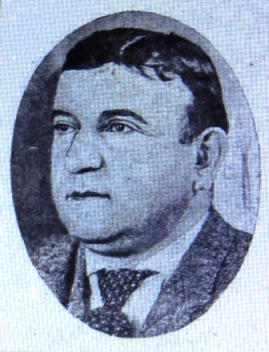
Michael Angelo “Mique” Fisher, circa 1905

Michael Angelo “Mique” Fisher, circa 1905

There’s no contemporary reference to why Harris preferred Fisher to Beebe, but within a year Harris would spearhead the effort to expand the California League to the Pacific Northwest—forming the PCL, and might simply have wished to pack the league with allies for the planned expansion.

The new Sacramento owner’s first move was to sign Charlie Graham, who played for Harris in San Francisco in 1901; Graham was named captain.  The Gilt Edges got off to a horrible start, but according to The Sporting Life “managed to replace the weak ones with men that worried other clubs at all stages, and finally crawled up into the .400 class.”

In December of 1902 The Seattle Times reported that Harris’ scheme was official:

“The California League will be known next year as the Pacific Coast League.  It will expand and take in Seattle and Portland.”

The Los Angeles Angels won the first PCL championship, but it was another Los Angeles team that caused the most excitement for Fisher and Sacramento in 1903.

In March three of Fisher’s players, Win Cutter, Charles Doyle and George Hildebrand jumped to the Los Angeles team, in the newly formed Pacific National League—they were said to have been recruited by former teammate Elmer Stricklett.  Hildebrand agreed to return, but Fisher took action as the other two prepared to board a train for L.A.  The San Francisco Call said:

“There was a sensational scene at the railway depot this afternoon, when Michael Fisher, manager of the Sacramento baseball nine, appeared with a police officer armed with warrants and caused Cutter and Doyle, two of the start players, to be placed under arrest on charges of obtaining money under false pretenses.”

The players were held in jail until they agreed to return to Fisher’s club, and the charges were dropped.

After the 1903 season Fisher relocated the franchise to Tacoma, Washington; the move brought better geographical balance to the league, and gave the PCL a foothold in a city that had just been vacated by the rival Pacific National League.

Charlie Graham remained team captain and the pitching staff was improved with the addition of Jim St. Vrain and Orval Overall.  Fisher’s Tacoma Tigers took the pennant, winning both halves of the split season schedule.
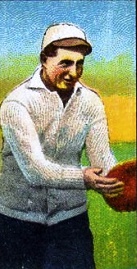
Charlie Graham

Charlie Graham

it was Graham, not Fisher, who was generally given credit for the success of the team.  As The Portland Oregonian later said:

“Mique Fisher in the strict sense of the term never was a great manager.  In a general way he knew baseball, but as a master of the fine points of the game as it should be played he was not up to the big thing…It was Graham who taught the players how to play the game.”

The paper did concede that Fisher was a good players’ manager:

“His players liked him and worked hard for him and that always helped a whole lot.”

Other tended to dismiss Fisher, The Spokane Daily Chronicle called him:

“The man who has acted as the original blast furnace for the hot air factory.”

Fisher not only had his baseball acumen questioned, but the move to Tacoma turned out to be disastrous from a business standpoint. The Oregonian said the Tigers won in 1904 despite “little enthusiasm,” from the city of Tacoma.  Fisher also began to run afoul of his investors, according to The Daily Chronicle:

“It is no secret  the stockholders have been losing money and blame for that is laid on the manager.”

The 1905 Tigers started strong, winning the first half—again playing to small, indifferent crowds, then fell apart in the second half, finishing last.  The Tigers were badly beaten five games to one in a postseason series by the Los Angeles Angels.

In September of 1905, Fisher announced that a six-game series with the Oakland Oaks would be played in Spokane, Washington, giving rise to rumors that the team would relocate there the following season.  The rumor also stirred up a conflict with the Northwestern League, who laid claim to Spokane and took their case to the National Commission.

Fisher initially denied that the team had designs on Spokane, but in October he this telegram to The Spokane Chronicle:

“To Sporting Editor…Spokane has been awarded to the Coast League by the National Commission.”

The San Francisco Bulletin said the league needed to abandon Tacoma and:

“It certainly seems that the admission of Spokane is the only logical course for the league to pursue.”

Logic did not win out.  By November Fisher had negotiated a deal to move the team to Fresno, California, a town with roughly one-third the population of Spokane—the PCL made it official in January of 1906 that the Tacoma Tigers would become the Fresno Raisin Eaters.

Fisher had owned a half interest in the team in Tacoma, he gave up his ownership stake in Fresno and signed a three-year contract with the club.

It turned out to be another bad decision.

Fisher, for the first time, managed a team without Charlie Graham by his side.  The catcher started the season with the Boston Americans (his only big league season), but left the team in May to return to San Francisco a month after the 1906 earthquake—various sources attributed his departure to being homesick, wanting to be near family, or to attend to his wife who was ill; in any case he never returned east and signed with the Sacramento Cordovas in the California League in August.

Fresno was a last place team from wire-to-wire, finishing with a winning percentage well below .400.

The new ownership fired Fisher, who eventually sued the team to recover $500 he said he was promised if terminated before his three-year contract expired.  He never collected the $500 and told reporters:

I was gypped out of the franchise.”

Wallace “Happy Hogan” Bray was named to succeed Fisher as manager, but Fresno was dropped from the PCL after the Seattle Siwashes withdrew from the league, in order to maintain an even number of teams.

Fisher’s managerial career was over, but his baseball career was not; more on that tomorrow.

“California Wonder”

30 Apr

Two West Coast ballplayers dubbed “California Wonder” by the press made their Major League debuts less than a week apart in 1887.  One went on to be one of the best leadoff hitters of his era; the other remains almost completely unknown.

George Van Haltren was a 21-year-old left-handed pitcher, outfielder and first baseman who had played two seasons with the Oakland franchise in the California and California State Leagues.

James McMullin, birth date unknown, had pitched for Mike Finn’s San Francisco Pioneers in 1886.

Mike Finn, manager, San Francisco Pioneers

Mike Finn, manager, San Francisco Pioneers

Van Haltren’s rights were acquired by the Pittsburgh Alleghenys, but because of his mother’s illness he said he would instead play for the San Francisco Haverlys.  The Chicago White Stockings traded for Van Haltren in April, but he still refused.  The Sporting Life said “the California Wonder will not come east,” quoted him saying:

“No, I will not play with Chicago this season; but if my left arm holds out and my parents are blessed with good health I will be open to Eastern engagements next season.”

The White Stockings threatened to have him blacklisted for not reporting but Van Haltren dug his heels in; only changing his mind after his mother passed away in May.

The Chicago Inter Ocean announced that he had arrived in town on June 25 and would be making his debut for the White Stockings on the two days later:

“(Van Haltren) at one time retired the Pioneer Club of San Francisco with a hit, and struck out seventeen men.  If he can continue this record here the Chicagos will come out of the race this season with another set of figures to put on the big flag at the park.”

Van Haltren’s debut was not good.  He walked 16 Boston Beaneaters and lost 17 to 11.  He finished the season 11-7, and would spend one more season as a full-time pitcher; going 13-13 in 1888 (he was 15-10, splitting time between the mound and outfield with the Brooklyn Ward’s Wonders in the Players league in 1890).  Van Haltren would distinguish himself as one of the game’s best leadoff men, hitting better than .300 every year from 1889-1901, except for 1892 when he hit .293.

Van Haltren ended his career in 1903 with 2544 hits.

George Van Haltren

George Van Haltren

McMullin’s debut was no better than Van Haltren’s.

He began the 1887 season with the Pioneers, but was acquired in June by the new York Mutuals of the American Association.

When McMullin joined the club The Sporting Life said:

“The Mets have got their new California pitcher and like him well in practice.  He has plenty of speed.”

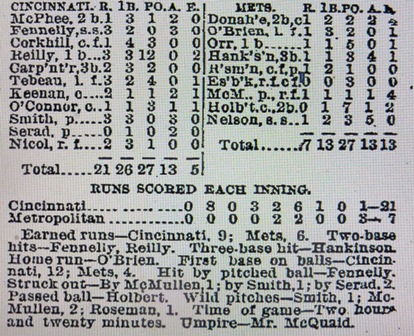
McMullin made his debut on July 2 against the Cincinnati Red Stockings.  The New York Times said of his performance, under the headline, “A ‘Wonder’ Exploded.  The Mets’ California Pitcher A Failure:”

“The debut of McMullen, the ‘California Wonder,’ was made (in Cincinnati) today in the presence of nearly 7,000 people, who went into hysterics from laughing at the awful exhibition given by the Wonder and his support.  He was utterly unable to get the ball over the plate and was miserably supported in the field.  After the third inning he retired to right field and there made a couple of errors.”

He gave up eight runs, made four errors and had two wild pitches in a 21-7 drubbing.

The box score from McMullin's debut.

The box score from McMullin’s debut.

McMullin only made two more appearances for the Metropolitans, and while he was credited with wins in both games his performance was no better; in his eight-day, three-game career he pitched 21 innings, gave up  25 runs (18 earned),  25 hits, walked 19, and struck out 2.  He made a total of five errors, and had one hit in 12 at bats.  The Mets released him on July 10.

And with that McMullin disappeared—there is no record of him having pitched anywhere after he left New York, there’s no record of whether he  threw and batted left-handed or right-handed, no pictures survive, and no record of when or where he died.  Another enigmatic figure of professional baseball’s early years.