Tag Archives: Charles Comiskey

Burns “Put the Punishment on Phyle”

20 Nov

After holding out over a temperance clause the Chicago Orphans added to his contract, Bill Phyle finally signed in late March of 1899.  He reported to spring training in New Mexico anywhere from 10 to 30 pounds overweight (depending on the source) and struggled all season to regain the form he showed the previous season.

On April 17 he was beaten 8-0 by the Louisville Colonels in first start.

On April 25 he lost 3-2 to the St. Louis Perfectos.  The Chicago Tribune said “Phyle gave away the game by distributing bases on balls in just the spots where timely hits followed and transformed the favors into tallies that gave the victory.”

William Phelon, The Chicago Daily News baseball writer, disagreed.  He said Phyle’s “work was of sterling quality.”

Regardless, Chicago Manager Tom Burns didn’t give Phyle another opportunity to pitch for more than a month.

Phelon said it was a mistake for Burns to not use Phyle.  The Chicago Inter Ocean said after the team lost seven of nine games in May “it is passing strange that young Phyle is not given a chance.  On last year’s form Phyle is as good as, if not better than (Jack) Taylor.  The paper called Phyle’s performance in the St. Louis game “gilt-edged” and blamed the loss on “comrades that gave the victory to the enemy.”

Finally, on May 28 Phyle pitched again.   He lost 4 to 3 to the Washington Senators; he gave up three runs on five straight hits with two outs in the ninth.

He lost again on June 1, 7-1 to the Philadelphia Phillies.  Phelon’s opinion of the pitcher was unchanged, and said the losses were simply bad luck:

“Phyle has now lost four straight games.  It is Phyle’s luck to be stuck in whenever the other pitchers have won about three straight, and the team is just about unavoidably due to lose.”

On June 5 Phyle did his best pitching of the season–a victory he is not credited with in the record books.

With the Orphans trailing the Baltimore Orioles 3 to 2 in the third inning, pitcher Clark Griffith was ejected for arguing a called ball.  The Chicago Tribune said:

“It was a queer game.  Phyle pitched after Griffith had been benched…holding the Orioles helpless.”

Chicago won 9 to 4.  And while the Chicago newspapers credited the victory to Phyle, the record books do not.
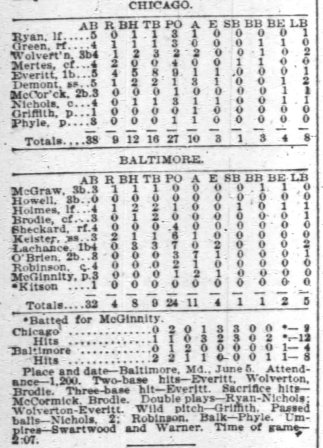
Box score for June 5 game.  Phyle relieved Clark Griffith in the 3rd inning.

Box score for June 5 game. Phyle relieved Clark Griffith in the 3rd inning.

Phyle became ill later the same week, (some sources said it was recurring malaria), a week later he fell off a bicycle and missed two more weeks.  When he returned to the team on June 22, the Boston Beaneaters beat him 5 to 1.

He was credited with his first “official” win on July 1—a game The Inter Ocean called “a comedy of errors,” and a “depressing exhibition.”   He beat the New York Giants 10 to 9, allowing 10 hits and giving up seven runs in the first two innings.  Each team committed seven errors.
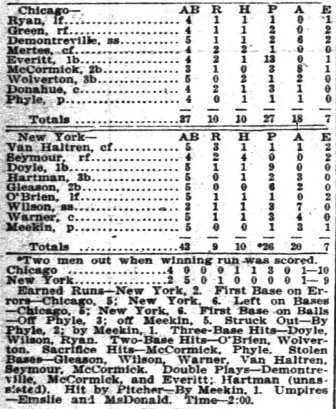
Box score of Bill Phyle's only "official" victory of 1899.

Box score of Bill Phyle’s only “official” victory of 1899.

Chicago went into a slump that would last for the rest of the season; after Phyle’s July 1 win the team was 38-24, in third place, and went 37-49 the rest of the way finishing eighth.

Phyle lost again on July 9 and July 24, and rumors began to circulate that he would be released or traded back to Charlie Comiskey’s St. Paul Saints.

On August 6 Phyle lost 10 to 9 to the Cleveland Spiders.  One week later while the team was on the road, The Inter Ocean reported that he “was sent home by manager Burns.”

The Tribune called Phyle “the scapegoat” and said he and three unnamed teammates  “celebrated after beating a horse race at Washington and Manager Burns, to call a halt, put the punishment on Phyle.

Phelon wrote in The Daily News:

“When the club started for Philadelphia he was told to go home ‘You are through young man, go back to Chicago,’ said Burns, and Phyle went back.  He went back in a rage too, and says he will tell (team president) Jim Hart a lot of things. He says that he has been held up to public derision as a drunkard, all season, and that Burns plays favorites, allowing his friends to jag up as much as they wish and turning all the trouble on others.”

Phelon remained supportive of the pitcher in The Daily News, but in The Sporting Life he reported that Phyle, a former boxer, had deserted the team in early August to go to “St. Louis to see a prize fight, and was not on hand when sorely needed.”

While the relationship between Hart and Burns was strained, and Burns would be replaced at season’s end, Phyle’s complaints went nowhere with the team president and he was suspended without pay.

Ten days after Phyle was suspended Phelon reported that the Baltimore Orioles had offered to trade for or buy Phyle,” (John) McGraw has taken quite a fancy to the young pitcher.”  Hart refused to make a deal.

Phyle never pitched for Chicago again, he is credited with a 1-8 record and 4.20 ERA.

The last Bill Phyle chapter—tomorrow.
“Gallant Larry Lajoie and his Bludgeon Knouted and Lashed the Mackmen”

22 Jul

In the summer of 1913 the editors at The Chicago Record-Herald said they were tired of the “vernacular slang” that accompanied most baseball stories, and proposed that their readers vote about whether they would prefer “the use of correct English” in baseball stories.

As the example of the overuse of slang, clichés and “baseballese” The Record-Herald presented this “horrible example” from Gordon J. MacKay of The Cleveland Leader:

“Gallant Larry Lajoie and his bludgeon knouted and lashed the Mackmen into submission this afternoon at Shibe Park, and in the swirl of the attack by the Gallic Goliath the myrmidons of the lean leader were tumbled in a gulch of whitewash.”

Napoleon Lajoie

Napoleon Lajoie

While the paper’s readers were sending in their votes the newspaper was polling baseball men and college professors, who according to The Philadelphia Inquirer were “going at one another hammer and tongs,” over the issue.

Chicago White Sox owner Charles Comiskey was on the side of “plain English,” telling the paper:

“What readers want to know is who won the game and how it was won.  When the facts are covered up with a lot of useless words the reader is apt to grow tired.”

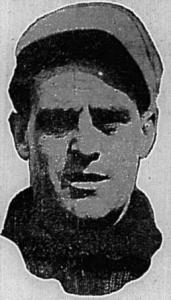
Charles Comiskey, against slang in baseball stories.

Charles Comiskey, against slang in baseball stories.

Most of the players, managers and executives polled by the paper were in agreement with Comiskey.

The professors were nearly unanimously on the side of slang.  Nathaniel Butler of the University of Chicago said:

“I think it would be pretty tame to report baseball in plain, ordinary English.  There is a species of humor on the sporting page which is enjoyable. “

After a month of opinions from baseball and academia, and newspapers across the country, the result of The Record-Herald’s balloting were made public.  The New York Times said:

“Slang as a means of the proper description of baseball games in the newspapers came out a little behind straightforward English, according to the verdict of several thousand readers in a test vote taken in a Chicago newspaper.”

By a close margin of 2004 to 1926, readers voted for “the English proscribed by the dictionaries,” but The Times said the results were:

 “(Q)ualified by several thousand voters who expressed themselves in favor of the use of a moderate amount of snappy, descriptive phrases, not limited necessarily to dictionary words, however.  Many voted in favor of slang, but advocated the elimination of nicknames.”

Vaudeville comedian and songwriter Junie McCree, writing for “Baseball Magazine” presented his version of how all baseball stories should be presented as a result of the vote:

The first athlete of the opposing aggregation was unable to locate the exact proximity of the ball and smote thrice in vain.

The next member was more fortunate in his endeavor and expelled the ball with such force that its destination was problematical to the guardian of latitude left, so the runner with some exertion and much rapidity voyaged to the third station without being molested.

At this point an urchin in one of the open stands requested vehemently that the home pitcher should be escorted to the suburbs of the enclosure and someone of animation be installed in his stead. His request was unheeded, much to his chagrin.

The third station being occupied by an invader caused the infielders to become more intimate with the domestic china to prevent foreign registration.

At this moment an attempt was made to execute the famous “Caress Play,” and in the unbiased opinion of the populace was frustrated by the marvelous dexterity of the “receiving teller” of the home team, but the magistrate of strikes and balls decided to the contrary, thus bringing on himself much verbal abuse. Among the ensuing verbiage one individual intimated in stentorian tones that the umpire was a facsimile of the principal ingredient in lemonade.

The contest from here on was uneventful until the seventh inning, at which time it becomes the duty of the resident assemblage to arise en masse and exercise the elasticity of limb and body.

While the home aggregation were at bat the visiting hurler became excited and ascended into nature’s oxygen.  A florid-faced individual in the grandstand arose and shouted all sorts of adjectives until someone volunteered the recommendation that he “lease or engage an auditorium.”

The various stations were congested before a single demise had occurred. A huge gentleman of pure American birth, reservation, extraction and much muscular appurtenances approached the plate and poised himself in a very hostile attitude; he attacked the sphere with a savagery known only to the ancient Romans, and with one blow the leathered globule wandered forth into undiscovered regions of remotest territory, thereby cleansing the stations of its human debris, and totaling a quartet of tallies to the frantic delight of those present.

This gave the Hosts an advantage which their guests were unable to overcome, and the contest was decided in favor of the natives. Score, 4 to 1.

P. S.—The same gentlemen participate in another exhibition on the morrow.

“A Historical Account of a Great Game of Ball”

5 Mar

The headline above appeared in 1907 above an article written by Frederick North Shorey in The Freeman regarding a series between Andrew “Rube” Foster’s Leland Giants and Mike Donlin’s All-Stars “an aggregation composed of such noted players as Mike Donlin, Jake Stahl, Jimmie Ryan and Jimmy Callahan, probably the best semi-professional team in the country.”

Shorey said the series at South Side Park “exceeded in interest to the people it attracted anything that took place between the White Sox and Cubs last fall (1906 World Series).”

Rube Foster beat the Donlin All-Stars 3-1 in the first game, allowing only three hits:

“Rube Foster is the pitcher of the Leland Giants, and he has all the speed of (Amos) Rusie, the tricks of a Radbourne, and the heady coolness and deliberation of a Cy Young. What does that make him? Why, the greatest baseball pitcher in the country; that is what the best ballplayers of the white persuasion that have gone up against him say.”

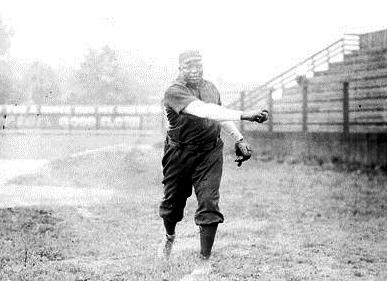
Rube Foster

Rube Foster

Foster was so important to his fans, Shorey said:

“If it were in the power of the colored people to honor him politically or to raise him to the station to which they believe he is entitled, Booker T. Washington would have to be content with second place.”

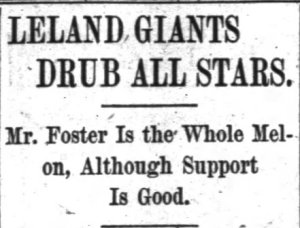
The Chicago Tribune said of Foster’s domination of the All-Stars:

lelandsvsdonlins

Back to the series, and back to Shorey:

“While the all-stars were confident in their ability to win, several of the old players, including Mr. Donlin himself, who have known of the prowess of Mr. Foster…knew that it was by no means a certainty…but they had hopes that the colored team behind him might do something to undo the efforts of the twirler.

Mike Donlin

Mike Donlin

Shorey said the all-stars were over matched:

“The colored men set a new pace for base running, while foster’s cool, deliberate pitching was too much for the old-time players on Donlin’s team. Both teams put up brilliant fielding games.”

Foster pitched in four games in the series; he won all four.

David Wyatt–who had been a teammate of Foster’s with the Chicago Union Giants in 1902, and who in 1920 was asked by Foster to help draft the constitution of the Negro National League—also wrote about the series in The Freeman:

“All the baseball critics in the city were out to look the Lelands over, many under the impression that they were overrated. The most interested of the number was Mr. Comiskey, owner of the white Sox…After witnessing the first game the white sox boss said if it were possible he would have annexed the signature of at least three of the boys to contracts, and he was so enthused over the fast, snappy work of the Lelands that he had his world’s champions to lay over one day in Chicago to watch the boys play.”

Wyatt had higher hopes for “Baseball as the common leveler” in general and the series specifically:

“There was no color line drawn anywhere; our white brethren outnumbered us by a few hundred, and all bumped elbows in the grand stand, the box seats and bleachers; women and men alike, all whetted freely with one another on the possible outcome of the series, the effect it would have upon the future of the negro in baseball, the merits of the different players etc…”

Foster’s heroics, Wyatt’s hopefulness, Comiskey’s words and Chicago’s enthusiasm were, of course, not enough to change the status quo; regardless of the “Great game of ball,” played at South Side Park in that 1907 series, the color line would remain intact for four more decades.

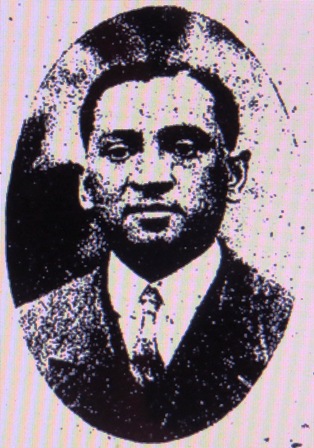
David Wyatt

David Wyatt

Fielder Jones and the Chehalis Gophers

11 Feb

Most biographies of Fielder Jones—player-manager of the 1906 World Champion Chicago White Sox, the Hitless Wonders—mention that he managed the Chehalis Gophers, a team in the Washington State League, in 1910;  they never mention that he ended up there because of a near-fatal assault before he arrived.

The 36-year-old Jones left the White Sox after the 1908 season to settle in the Portland, Oregon and tend to his many business holdings in the area.  In 1909, he was named president of the Northwestern League, and served for one season.  According to West Coast newspaper reports, Jones was in the running to named president of the Pacific Coast League in 1910, before Thomas Graham was elected as a compromise candidate.

In the spring of 1910, Jones coached the Oregon Agricultural College (now Oregon State) baseball team to the school’s first conference championship.

At the same time, Jones was coaching at OAC, the Washington State League was getting underway—the league had been operating for at least three seasons, but 1910 was the first year it was recognized under baseball’s national agreement as an “official” minor league.

The Chehalis Gophers were led by 27-year-old Fred Nehring; he had previously played on the Pacific Coast, Northwestern and Connecticut State Leagues.  Nehring, who was born in Pueblo, Colorado in 1883, but grew up in Chehalis, had been playing on and off with the local team since leaving the Tacoma Tigers in 1908

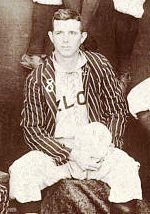
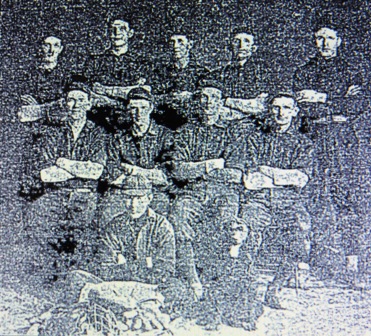
1908 Chehalis team. Fred Nehring standing 2nd from left, Tamp Osburn, standing 4th from left.

1908 Chehalis team. Fred Nehring standing 2nd from left, Tamp Osburn, standing 4th from left.

Another player who had spent time with Chehalis since 1908 was a pitcher known variously as “Tamp” Osburn, Osborn or Osborne (for the purpose of this story we’ll call him Osburn—most common usage by contemporaneous sources).  Tamp Osburn has, at least, two separate, partial listings on Baseball Reference.

Osburn was considered a talented pitcher, but an erratic character.  While pitching for the Spokane Indians in Northwestern League in 1907, he quit the team in June.  According to The Spokane Daily Chronicle:

“The whole trouble yesterday started when a couple of misplays in the eighth inning put a losing aspect on the game…Tamp blames the whole trouble on (William ‘Terry’) McKune, who he says ‘threw’ the game on him.”

Osburn had additional problems with teammates and developed a reputation as an eccentric, and like all eccentric pitchers of the era there was one he was often compared; The Daily Chronicle called him “The Rube Waddell of the Northwestern League.”

After playing together for Chehalis in 1908, both Nehring and Osburn played in the short-lived Inter-Mountain League in 1909; both returned to Chehalis after that league folded in July.

???????????????????????????????

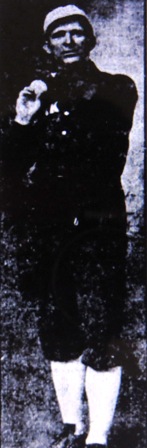
“Tamp” Osburn, 1908 with Spokane Indians

On May 20, just after the 1910 season opened, the Chehalis team boarded a train.  According to The Chehalis Bee-Nugget:

“(Osburn) who had been drinking before the train left Chehalis became so unruly on the train that the train crew called on Fred Nehring, captain of the Chehalis team to quiet him.  Tamp resented Nehring’s efforts to keep him from cursing in the presence of ladies, and pulled a knife and began to slash Nehring…Two severe cuts…in the left arm, and the other was in the breast.  If the latter had been an inch farther over, it would have penetrated the lungs.”

Nehring had the wounds dressed, left the hospital against doctor’s advice and managed the Chehalis team “from the bench.”  Despite the seemingly quick recovery, Nehring only appeared in a few games the rest of the season.  Osburn was arrested.

The Chehalis team floundered for the next several weeks.  In late June, it was announced that Fielder Jones would join the team as manager and centerfielder.

Under Jones, who was still property of the White Sox and needed Charles Comiskey’s approval to play, Chehalis easily won the league championship; Jones hit .358 in 37 games.

Jones had agreed to play for the team for no salary and was only reimbursed for his expenses.  This arrangement nearly cost Chehalis the league championship.  According to The (Portland) Oregonian, the second place Raymond Cougars protested to the league and the National Commission that all wins under Jones should be forfeited because Jones “was not under contract.”  The protest was denied and Chehalis was declared league champion.

Osburn was sent to the Lewis County Jail while awaiting trial, and according to The Oregonian was involved in an attempted escape along with other prisoners who occupied the jail’s first floor, a week after his arrest.  The paper said of Osburn “the baseball player, and one other man were taken to the cells on the second floor and locked up securely.”

There is no record of whether Osburn was convicted; in any case, he was free by July of 1911 and was pitching for the Missoula, Montana franchise in the Union Association when The Helena Daily Independent reported that Osburn:

“The Missoula pitcher, who started a rough house in a Missoula cafe and pulled a knife on a stranger, drew a severe panning from the judge, who, after fining him $25, -said: ‘There are some good men on your team, who behave themselves, but there is a lot of you whose conduct is a disgrace to the city and the national game. We don’t want that kind of men in Missoula uniforms, and you fellows have got to stop such actions.”

Contemporaneous newspaper accounts say he was a native of Utah, but given the inconsistent spelling of his last name, and a full first name never being listed, the trail for Osburn ends after this 1911 incident.

Nehring remained in Chehalis where he died on February 19, 1936.

Jones returned briefly to baseball in 1914 and 1915 as manager of the Saint Louis Terriers in the Federal League.  He died in Portland in 1934.

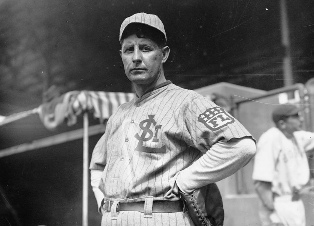
Fielder Jones, 1914

Fielder Jones, 1914

“King of the Natural Hitters”

25 Jan

Percival Wheritt “Perry” “Moose” Werden began his baseball career as a pitcher for the semi-professional team of his employer; the Ira Perry Pie Company in Saint Louis.  He was discovered by the St. Louis Browns who offered him a contract but ultimately signed with the Saint Louis Maroons in the Union Association.

(An oft-repeated story that Werden’s discovery involved him leaving a pie wagon unattended to join a game, resulting in the wagon being destroyed is almost certainly apocryphal, although it has been repeated as fact with little or no support by several writers)

In 1884 the 22-year-old was 12-1 with a 1.97 for the Maroons who at 94-19 won the Union Association pennant by 21 games; despite the strong start, Werden would never pitch in the Major Leagues again.

The Maroons joined the National League the following season and Werden ended up with the Memphis Reds in the Southern League.  He was primarily a catcher a first baseman, and his career as a pitcher pretty much ended; he appeared on the mound in only three games that season and had only 14 more minor league appearances over the next 10 years because of arm trouble.

Perry Werden, 1908

Perry Werden, 1908

From 1886-88, Werden played with five minor league teams and played three games in the National League with Washington in 1888.  In 1889, Werden joined the Toledo Black Pirates in the International League, where he became a great hitter.

Werden hit .394 for Toledo; in 424 at-bats, he had 167 hits, which was the hit record for the franchise for nearly 100 years, finally broken by Greg “Boomer” Wells in 1982 (Wells had 182 hits in 541 at-bats).

Toledo became a Major League franchise the following season, joining the American Association as the Maumees, Werden was the their starting first baseman, hit .295 and led the team in hits, runs, triples, and RBIs.  The Maumees finished 68-64 in their only season.

Werden was sold by Toledo to the Baltimore Orioles in 1891 and had another solid season, leading the team in hits, triples and RBI’s.  The following season he was signed by the Saint Louis Browns to replace Charles Comiskey at first base; Comiskey had jumped the Browns to join the Cincinnati Reds.

Werden hit .256 and .290 in two seasons with the Browns.  In 1894, he returned to the minor leagues with the Minneapolis Minnies in the Western League.  That’s where he became a legend.

In 1894, Werden exploded.  He hit .417 with 43 home runs.  In 1895, he improved to .428 with 45 home runs.

The Western League was no doubt a hitter’s league; eight players with at least 100 at-bats hit .400 or better in 1894 and 11 did so in 1895.  And the Minnies home field, Athletic Park, where Werden hit most of his home runs, was by all estimates a hitter’s paradise with a short (some sources say 250 feet) fence.

Regardless, 45 home runs would remain a professional baseball record until 1920. The Duluth News-Tribune said several years later that Werden hit seven home runs in a double-header in 1895; under the headline “Perry Werden was King of the Natural Hitters:”

“It was one of the greatest batting feats ever seen on a baseball lot anywhere.”

Werden had one last season in the Major Leagues.  At 35-years-old in 1897, he hit .301 for the Louisville Colonels, then returned to the minor leagues where he continued to hit well; .330 for his minor league career.

Werden became an umpire in the American Association in 1907, and became a baseball pioneer in 1908 when he joined the Indianapolis Indians in the same league; he was one of the first full-time coaches in professional baseball.  The Associated Press said:

“Perry Werden will go to Indianapolis to act as assistant manager, coach and advisor in general of the Indianapolis baseball club this year.”

In October The Indianapolis News declared Werden a success in the new role:

“Werden was one of the biggest factors in bringing Indianapolis her first pennant since 1902.  Without his services it’s highly probable the flag would have flown elsewhere”

The Indianapolis Star predicted that Werden’s “novel position,” would become the norm with the Indians, and throughout baseball.

Werden eventually returned to umpiring, working in the western, Dakota, South Dakota and Northern leagues.

His 43 home run season became news again in 1920 as Babe Ruth was closing in on Werden’s professional record.  Werden said there was one player in his era who was Ruth’s equal as a hitter.  Who was it?

Read about it on Monday.