Tag Archives: Charles Murphy

The National League versus Horace Fogel

8 Jul

In 1912 Horace Fogel, president and owner of the Philadelphia Phillies and umpire William Thomas “Bill” Brennan were at the center of baseball’s biggest controversy: Fogel  accused Brennan and others with favoring the pennant winning New York Giants.

Fogel first suggested that St. Louis manager Roger Bresnahan was “pulling for” New York after the Giants won two of three games from the sixth place Cardinals in August.

Less than a month later Fogel would turn his attention to the umpires, and National League President Thomas Lynch.  Fogel was not a fan of the league president to begin with; the previous December The New York Times said that Fogel had been coerced by Cincinnati Reds owner August Herrmann into supporting Lynch’s reelection at the league meeting in New York:

“It was reported about the Waldorf yesterday that… (Chicago Cubs President Charles) Murphy and Fogel would not vote against Mr. Lynch because President Herrmann had in his possession a letter which was sent to him by mistake from Fogel, when it should have been sent to Murphy.  Mr. Fogel, it seems, put Mr. Murphy’s letter in the envelope addressed to Mr. Herrmann.  It is said to contain something important about the relations of the Philadelphia and Chicago clubs.”

Horace Fogel
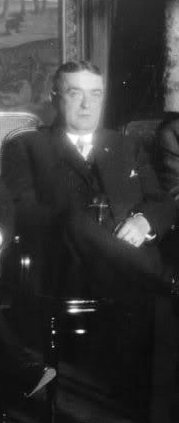
Horace Fogel

On September 7 Fogel wrote a letter to Lynch attacking the league’s umpires in general and Brennan specifically, and  according to The Philadelphia Inquirer “hinting that Lynch had some influence in their poor officiating.”

A week later an article, said to be authored by Fogel, appeared in The Chicago Evening Post that repeated the charges made in the letter to Lynch.  Fogel also sent Herrmann a telegram telling the Reds owner he felt the National League pennant race was “crooked.”

Brennan was the first umpire to respond.  He sent a letter to the National Baseball Commission on September 30 demanding an apology from Fogel for impugning “the impartiality of National League umpires.”

Fogel repeated his accusations again in letters sent the following week to the seven other National League team presidents, and promised to “make startling disclosures.”

On October 17 The Associated Press said his counterparts voted to “formally draw up charges against President Fogel of the Philadelphia club for his remarks reflecting on the integrity of National League umpires.”

Brennan told reporters that he would be filing a libel suit against the Phillies owner.
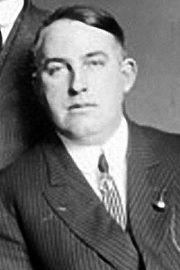
William "Bill" Brennan

William “Bill” Brennan

A hearing was scheduled for November 26.  President Lynch said:

“If the charges can be proved, then the umpires in question should be blacklisted and the president of the league should step down in disgrace.  If the charges are not true, some step should be taken to see that this man no longer represents a club in the National League.”

Fogel responded:

“I probably will begin an action for criminal libel against (Lynch) at an early date.  I have retained Hughey Jennings (the Tiger manager was also an attorney in Scranton, PA) as one of my lawyers, and I intend to have several of the best men in Philadelphia.”

As the members of the National League executive committee gathered at New York’s Waldorf Astoria Hotel to determine whether he should be expelled from the league, the Philadelphia magnate attempted and end run; he announced that he had relinquished day-to-day operations of the team VP Albert D. Wiler.  By doing so Fogel’s attorney (Jennings did not represent him at the hearing) claimed the league “had no right to try Fogel, as he was no longer an officer of the National League.”

The proceedings went forward with Fogel facing seven specific charges:

  1.  The accusation against Bresnahan

  2. An allegation that he told reporters on September 5 that the pennant race was fixed.

  3. The letter to Lynch attacking the umpires and hinting that Lynch was influencing their decisions.

  4. The article in The Chicago Evening Post repeating the charges made in the letter to Lynch.

  5. The telegram to Herrmann.

  6. The letters to the other seven club presidents.

  7. The allegations Fogel made both publicly and privately, about Brennan.

The Philadelphia Inquirer said:

“Fogel denied charges one and two and maintains that charge three was a privileged letter and not for publication.  While he did not actually deny writing the article that appeared in The Chicago Evening Post, he declared that the statement was not authorized and said it must have been misinterpreted.  He said he simply wanted to see reforms made and was not attacking anybody or anything in connection with baseball.  He denied outright the charges that he had said anything derogatory to umpire Brennan and claims privilege of the letters and telegrams.”

Besides Fogel,  three New York reporters testified that Fogel made the statements attributed to him in the press, while “Fogel had a flock of Philadelphia scribes who politely but forcibly insisted the New York men were romancing.”

After a six-hour hearing over two days the committee unanimously found Fogel guilty of five of the charges (the letter to Lynch and telegram to Herrmann were deemed privileged and those counts were dismissed).  The League ruled that Fogel was “forever excluded from participation,” in the National League.

The Inquirer said:

“Mr. Fogel had no sooner read the decision than he countered it with a defiant statement.  Before the meetings began he had expected such a decision, he declared.  ‘The jury was packed against us, ‘he asserted, and he practically told the magnates who had expelled him from their councils that he would pay no attention to their findings.”

Fogel did have his defenders, author, and Heart Newspaper correspondent,  Damon Runyon said:

“As we understand the matter, Horace Fogel has been found guilty of  conversation in the first degree.”

Damon Runyon, supported Fogel

Damon Runyon, supported Fogel

Fogel’s defiance and threats against Lynch, the league, and the magnates who had ousted him.  The Chicago Evening Post reported in February of 1913 that Fogel “has accepted an offer of $10,000 to write a series of articles in which he will later attempt to prove that baseball is a crooked game.”

Instead he launched a magazine, rumored to be funded by Charles Phelps Taft, brother of the President, who had bankrolled Fogel’s initial purchase of the Phillies. “Baseball Weekly” began publication in  March, 1913, and over the course of the next several months set out to discredit the game, focusing on two points, which had been and would continue to be the major criticisms of organized baseball.

Fogel railed against the reserve clause, calling it “virtual baseball slavery,” and argued that organized baseball violated the Sherman Antitrust Act,  earning him the June 1913 cover of rival  “Baseball Magazine,” and the title, “The Man who is Trying to Wreck Baseball.”

Fogel would remain a baseball gadfly for the next decade.  Took ill in the early 20s and died in Philadelphia in 1928.
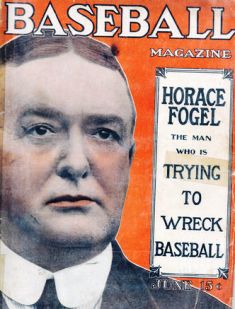
June 1913 edition of "Baseball Magazine"

June 1913 edition of “Baseball Magazine”

His interest in the team was purchased by a group led by William H. Locke, former secretary of the Pittsburgh Pirates.  When Locke died in October of 1913, his uncle, former New York Police Commissioner William Baker took control of the Phillies, leading the team until his death in 1930.

Brennan announced after Fogel was banned that he would drop his proposed $10,000 libel suit, telling The Associated Press:

“I am satisfied, I immediately demanded a hearing before the National League heads and Fogel’s trial was brought about as a result of my demands.”

Later this week; an allegation that Fogel was a patsy, and umpire Brennan’s other battle in the City of Brotherly Love.
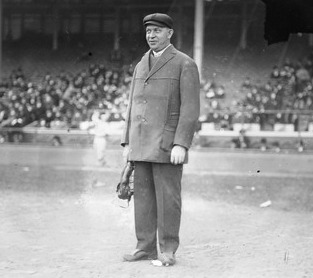
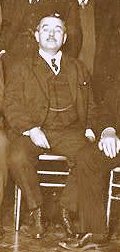
Murphy Calls Out an Umpire

12 Oct

Three years before Chicago Cubs President Charles Murphy ousted legendary manager Frank Chance, he picked a fight with the most powerful and respected umpire in baseball.

In September of 1909 the second place Cubs had just taken three of five games from the league-leading Pirates in Pittsburgh.

On September 9 Murphy filed a formal protest with the league over the fourth game of the series (won by the Pirates 6-2) charging that umpire Bill Klem “(D)eliberately acted as a conspirator, robbing the Cubs of any reasonable chance for victory.”

The Cubs had argued several calls by Klem during the game and Manager Frank Chance and Cubs’ infielders Joe Tinker and Harry Steinfeldt were fined for comments made to the umpire.

Murphy questioned Klem’s honesty and demanded that he not be allowed to serve as umpire in any games played by his team and that the game be replayed.

Klem was an unlikely person to have his integrity questioned.  Generally credited with professionalizing umpiring, he had come forward with fellow umpire Jim Johnstone the previous season to report they had been offered a bribe to help determine the outcome of the October 8 Cubs game with the New York Giants to decide the pennant (the make-up game for the September 23 “Merkle’s Boner” game).

While the league never released specific details of the bribe attempt, the allegations made by the umpires were found to be true and barred the “unnamed conspirators” from any Major League ballpark. Both umpires were commended by the league for demonstrating to the “American public the honesty and integrity of our national game.”

League President John Heydler (appointed after the suicide of Harry Pulliam) immediately announced his support for Klem in the dispute.  Murphy responded by announcing he would ensure Heydler would not be reappointed president of the league that winter—Murphy would be successful spearheading the effort to replace Heydler.

Murphy was never able to cite any specific reasons for his charges and was pressured to drop the protest, which he eventually did, but Klem remained indignant and asked to have his name cleared.  According to newspaper reports:

“The umpire does not propose to let the matter rest.  He considers that his reputation has been attacked, and he therefore will ask the league to investigate him.”

There’s no record that the investigation was ever conducted.

Klem attended that year’s winter meetings in order to be on hand when Murphy was pressured to make a formal, public apology.

Chicago Cubs President Charles Murphy

More on Murphy and his feuds in the coming weeks.

Demon Rum–or Demon Rum as an Excuse to Replace a Popular Manager

8 Oct

The 2011 Boston Red Sox were only the latest in a long history of alcohol taking the blame for a team’s poor performance.

As the Chicago Cubs faded into third place during the waning days of the 1912 season, team president Charles Murphy issued an order for “total abstinence” and all players would have a temperance calls in future contracts.

The move was not unprecedented—since 1909 Barney Dreyfus of the Pittsburgh Pirates had required his players to sign a temperance pledge.  What made Murphy’s order so newsworthy was that over the course of several days he issued numerous, often contradictory, “clarifications” and because it quickly became apparent the move was a intended to wrest control of his ballclub from Manager Frank Chance.

Murphy’s original statement said that “loose living and training methods” led to the team’s poor finish. At the same time he provided cover for popular Cub outfielder Frank Schulte who had been suspended by Chance in September his nighttime activities during a crucial August road trip in Cincinnati.  The Cubs lost three of four games to the Reds and fell out of contention.    Murphy’s statement presented Schulte as a man incapable of any personal responsibility:

“I desire to say that in my judgment Schulte has been more sinned against than sinner…from what I could gather he was a victim of too many so-called friends…if we had a rule similar to that in vogue in Pittsburgh this player could not have been led into temptation.”

Chicago Cubs President Charles Murphy

The implication being that Chance had perhaps overreacted by suspending “the more sinned against” Schulte.  This statement was further complicated by Murphy’s several “clarifications,” some of which seemed to support Chance’s decision while some did not.

Chance quickly defended his players and his reaction to Murphy revealed just how bad the relationship was between the team president and his manager:

“Murphy only thinks of the team when it’s winning…his statement reflects upon me personally, and I have been in the business too long to allow Murphy or anyone else to insult me.”

Making matters worse, and calling Murphy’s motives into question was that Chance issued his response from a hospital bed in New York.  As a result of being hit in the head by numerous pitches throughout his career, Chance had developed a blood clot near his brain and had undergone surgery just a few days earlier.

Murphy didn’t hesitate to use Chance’s health issues against him.

A month earlier, plagued by doubts about his condition and suffering from severe headaches, Chance had suggested to Murphy that he might not be able to manage the Cubs in 1913.  At the time Murphy told his manager to wait until after the surgery to make a decision about his future.  Now he was using that conversation to assert that Chance had issued his resignation.

Once Murphy began claiming Chance had, in effect, quit in August the Chicago media which had almost universally supported the “abstinence pledge” called foul.  The Chicago Tribune and Chicago Examiner both said Murphy was using the conversation and the pledge as cover to run the legendary Chance—who led the Cubs to four pennants and two World Championships—out of town.

Chance went.  But he didn’t go quietly.

The manager had acquired 10 percent of the Cubs, shares Murphy had been trying to purchase for more than a year.  Chance sold the shares to Harry Ackerland a Pittsburgh investor who President Murphy did want owning part of his team.  Despite Murphy’s efforts to block the sale, it went through.

Chance was claimed on waivers by Cincinnati, but after the Reds acquired Joe Tinker from the Cubs and named him manager, Chance was waived to New York, where he became manager of the Yankees.

Chance led the Yankees for two losing seasons, managed the Los Angeles Angels in the Pacific Coast League in 1916 and ’17, and closed out his career with one dismal season in Boston; the Red Sox finished 61-91 under Chance.

Frank Chance

Johnny Evers was named Cubs manager for the 1913 season—the Cubs again finished third.

From the day Murphy issued his initial statement until Chance died in 1924, “The Peerless Leader” never missed an opportunity to take a shot at Murphy.

When the Cubs were sold to Cincinnati publishing magnate Charles Phelps Taft (President William Howard Taft’s half-brother) before the 1914 season Murphy claimed that he had made more than a half million dollars on the deal.  Chance and former Cubs pitcher Mordecai Brown (who had his own feud who Murphy who released him after the 1912 season, allegedly without giving Brown money he was owed for playing in that year’s “City Series” with the Chicago White Sox) quickly responded.  Both players confirmed what had long been rumored—that Murphy had been bankrolled by Taft who retained a majority of the shares.   Murphy, said Chance, “Never owned more than fifteen or twenty percent of the club stock.”

Both players also charged that Murphy’s treatment of his players was a primary reason for the formation of the upstart Federal League—at best an oversimplification of the conditions which led to Major League Baseball’s last “third league.”

Another Charles Murphy feud later this week.

.