Tag Archives: Chicago White Stockings

“As a Trickster he was a Marvel”

12 Jun

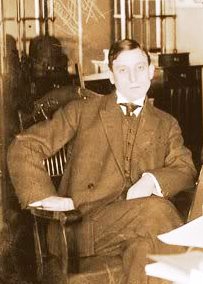
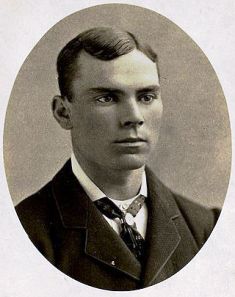
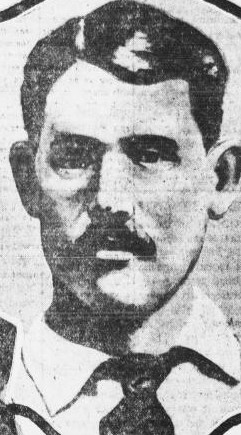
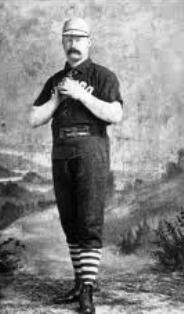
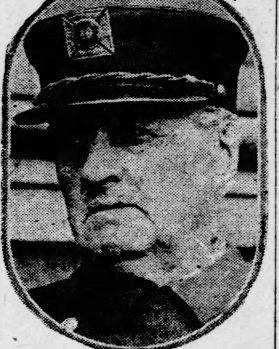
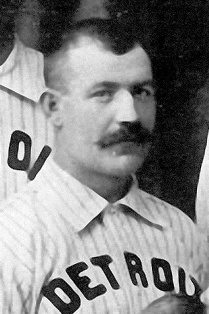
Dan Brouthers was working at the Polo Grounds in 1917—after John McGraw got Brouthers hired, he held a variety of jobs there according to contemporary news accounts, including night watchman, custodian, and operating the gate at the press entrance to the ballpark—when The New York World asked him to reminisce about some of the his experiences as a player.
brouthers

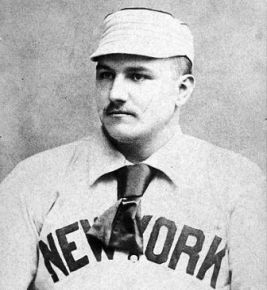
Dan Brouthers

Brouthers said he was told by McGraw when he had earlier scouted for the Giants, “brains and speed are what you are to look for.”

Brouthers said:

“If you get hold of a good, speedy man, with something more than a bone above the ears, you probably have the makings of a good ball player.”

He said players with the combination of brains and a willingness to flout the rules had won many games when he was playing:

”It may be that the poorer team had a fox on it somewhere, and every time the umps are asleep or looking the other way, he pulls one over…There are of course, some people who believe in playing baseball on the level. But a good many other birds realize that it is played on a diamond, and so take advantage of all corners.”

One player stood out in that category for Brouthers:

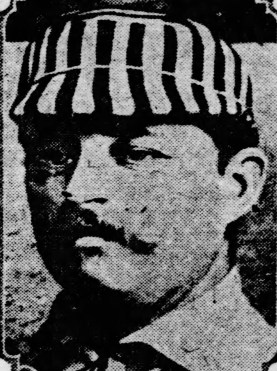
“Mike (King) Kelly was a shark for that sort of thing. He could have sold earmuffs in the Philippines or palm-leaf fans in Alaska. He was a wonder as a baseball player, but as a trickster he was a marvel. Whenever he was on the field the umpires spent half their time combing the wool away from their eyes.”

Brouthers described The King:

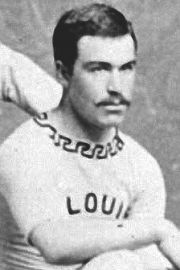
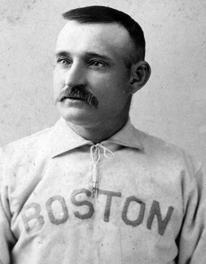
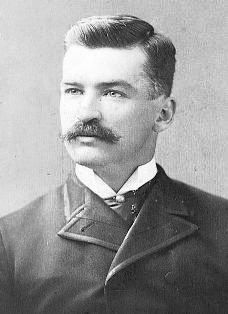
“He was very little short of six feet tall, weighed in the neighborhood of 180 pounds, had a fine, full mustache which was the fashion in those days and a bluff, genial manner that disarmed suspicion and made you like him from the first.”
kingkelly

Kelly

He said:

“Mike was the idol of the fanatics, and anything he did was right…He was so popular that he had three nicknames—The King of the Diamond, The Only Kel, and the $10,000 Beauty…Kelly was as full of tricks as a monkey, and couldn’t stand to lose a game if he could win it—by any means at all.”

Brouthers provided his version of the most famous story about Kelly, which he said happened when they were both with the Boston Reds in the Players League in 1890:

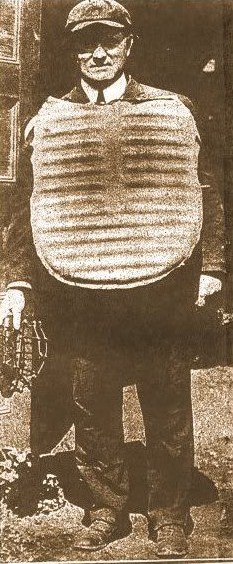
“One afternoon Kel was sitting on the bench, while (Charlie) Bennett was catching.”

Brouthers is confusing his former teammate with the Detroit Wolverines—Bennett–with Morgan Murphy and William “Pop” Swett who were the other two catchers in addition to Kelly on the club.

“The game was close, but Kel had made up his mind we had to win it and had his peepers skinned for a chance to put one over. Suddenly the man at bat knocked a high foul that Kelly saw (the catcher) could not catch. It is hardly likely that what Kelly did would have occurred to any other manager. What Kel did was jump up and run for the foul ball at the top of his speed. And while running for it he kept shouting to the umpire that he had taken (the catcher) out of the game and had substituted himself. Then he caught the foul ball.

“According to Mike’s way of doping it out, it was strictly according to Hoyle.”

Brouthers said Kelly then walked over to the catcher and took his mask and glove:

“Then the astonished umpire and the spectators came out of their trance at the same time and there was a yell from both of them. Kel insisted everything was O.K. In fact, he didn’t even concede there was room for an argument. There was nearly a riot over the affair, but it ended by Kelly being shooed back to the bench, and the batter being called safe. That one was a little too raw for the ump. But Kel wore an injured air all the rest of the game, and although the crowd knew he was wrong, they all sympathized with him.”
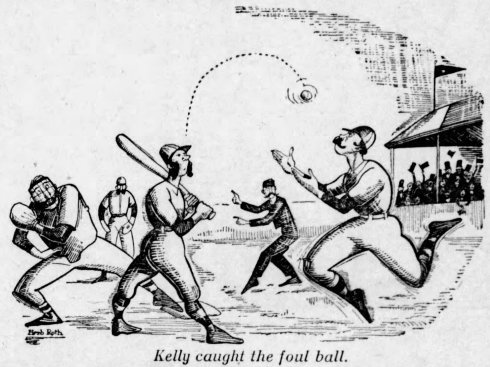
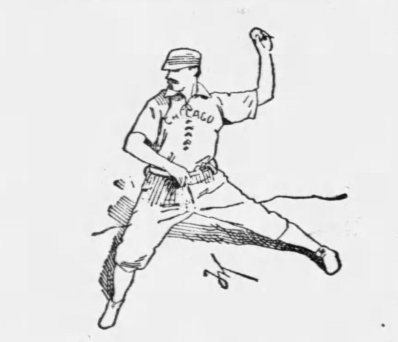
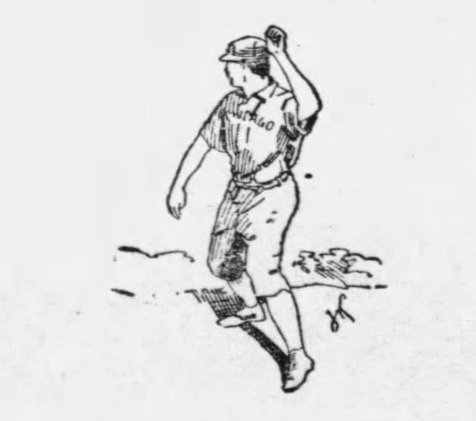
kellycartoon.jpg

Cartoon by Herb Roth of The New York World which accompanied the article

Brouthers said Kelly had more success with other stunts:

“When I was with Detroit Kel was playing with Anson’s Chicago club. At a game in Detroit, when I came to bat in the ninth inning, there were two out and three on base. Moments like that are big ones in a batter’s life, and I got a toe hold and made my mind to tear the cover off the first good one that came across. I believe we needed three runs too. Kel was playing in the field that day. I picked out one that I liked and hit it hard enough to drive it out of the lot. I was sure the ball was going over the fence, because Kelly was running in that direction like a mountain goat. Just as he got near the fence, he made a wonderful jump and got the ball. That made three out; the game was over, and Kel kept running into the clubhouse, taking the ball with him. We lost the game, of course.

“Some time later Kel confessed to me that the ball he apparently caught he had never even touched. It had cleared the fence by 10 feet!”

Brouthers said Kelly often hid a ball in the outfield, “opposing teams didn’t know this at the time. If they had, Kel probably would have died a violent death.”

“One foggy afternoon in Philadelphia, with Phil Powers umpiring, Philadelphia had a man on base when Sam Thomson came to bat. Sam picked out one he liked, and, as we found out later, poled it clear over the right field fence. But because of the fog the umpire couldn’t follow the flight of the ball.

“Now Kelly had a ball hidden in the long grass near the fence, and when Thompson made his hit, Kelly never looked at the ball in play at all, but dived for the extra ball. He fumbled around a bit as though he were looking for it and then picked it up and made an accurate throw to home, putting out the man who had been on first when the ball was hit.”

Brouthers said Thompson was sure the ball had cleared the fence and, “roared like a lion and called down the vengeance of high heaven” on Powers.

“And while he was ranting and roaring, Kelly, with an injured and innocent air, was calmly proving that the ball never went near the fence at all. Powers believed Kelly and his own eyesight, and Thompson, almost crying with rage, was fined for kicking.”

Brouthers said Kelly showed of his “foxiness” coaching third base as well.

“If a ball had been fouled by the man at bat and hit the grandstand, Kelly would demand that the pitcher throw it to him, in order that Kelly might be sure it was not cut or ripped. He only pulled this stunt when there was a man on base. Then the pitcher, if he were not wise, would throw the ball to Kelly. Kelly, instead of catching it, would dodge it, and allow it to roll past him, and the man on base would streak for home. And probably get there before the ball could be returned. Of course, this only worked once on the same man, but it sometimes helped to win a game.”

Brouthers also said Kelly attempted to use a potato as a ball in the 1880s:

“I can remember one time he took a potato to right field with him, and when a hit ball bounded past him, he made believe he had caught it, and then turning whipped the potato to the second baseman. The second baseman relayed the potato to third in order to get the man trying for that base. And he might have got him but for the fact that the potato was not a solid one and burst when the third baseman caught it.”

Brouthers said Kelly “was the most genial fellow in the world off the diamond,” but considered umpires “an eyesore.” He said “he would stand as close to him as he could and jaw him until the ump would run up a $100 fine on him in $5 and $10 clips. But that didn’t work the King any, because someone else always paid his fines.”
Things I Learned on the way to Looking up Other Things #34

6 Jun

Trash Talk, 1887

In June of 1887 the Cincinnati Red Stockings dropped to sixth place in the American Association pennant race; Ren Mulford of The Cincinnati Enquirer assured his readers the team would not remain in the basement. The St. Louis Post Dispatch responded:

“Ren Mulford Jr., of Cincinnati, whoever he is, is quite a chatty baseball writer, and his apologies for the Cincinnati club are a mark of rare ability. Mr. Mulford, whoever he is, thinks the Reds will not be at the sixth place when the season ends, but Mr. Mulford, whoever he is, will probably find out his mistake later on.”

ren-mulford

Ren Mulford

Mulford was correct, the Red Stockings went 61-33 the rest of the way, finishing second—but it was not enough to catch the St. Louis Browns who won the pennant by 14 games.

Burns on Anson, 1898

Tom Burns, in the process of leading the Chicago Orphans to a fourth-place finish in 1898, told Henry Zuber of The Cincinnati Times-Star that Cap Anson was not primarily responsible for the reputation he built as a great manager in the 1880s:

tomburns

Tom Burns

“Anson had a team that could think for itself. It was not necessary for him to direct the play of the team on the field, for the reason that the players were far above the average in baseball intelligence, and worked and studied together without the aid or suggestions of the manager. The late Mike Kelly carried the leading brainery of the team, and it was he, with the aid of the other baseball-intelligent men of the team, that invented and carried out any plans and tricks that proved such an improvement to the game and made the White Stockings the famous team they were.”

Anson’s teams finished first or second nine times from 1880-1891, from 1892 until he left the team in 1898 his teams finished no better than fourth.

Louisville Patriotism, 1898

At the outset of the Spanish-American War in April of 1888, The Cincinnati Post said of Harry Pulliam’s Louisville Colonels:

pulliam

Harry Pulliam

“Patriotism is running amuck among the Colonels. They purchased gaudy red, white, and blue stockings for yesterday’s game, and each player wore a tiny United States flag in his cap band. President Pulliam is thinking of raising a regiment. ‘The governor of Kentucky,’ said the happy executive, ‘is having all sorts of trouble. You know everybody worth mentioning in our state is a colonel, or considers he is of that rank. All wish to enlist, but no one is ready to accept a commission below that of colonel.”

Comiskey on “ungrateful” players, 1894

By 1894, Charles Comiskey, in his last year as a major league player and manager and leading the Reds to a 55-75 tenth place finish, told The Cincinnati Post his opinion of players had changed:

Charles Comiskey

Comiskey

“Ball players are often accused of being and ungrateful lot of men. I used to defend them on this charge, but I must confess that recently I have come to the conclusion that the average player is inclined to throw down his best friend. It’s a broad assertion, but my experience has been a severe one. There are some true men playing the game, but you can quickly pick them out of every team.”

“The Hardest Loser the Game Ever Knew”

3 Apr

During the same week Billy Sunday appeared at one of his largest revivals—preaching in front of an estimated 10,000 people in Spokane, Washington—Cap Anson was telling a judge in Chicago that he was “Busted,” unable to pay a $111 debt.

billysunday

Billy Sunday

Sunday told a reporter for the Associated Press in Spokane that he would be happy to raise money for his former teammate and manager—an offer Anson refused.  He also talked about his admiration for Anson and his impact on the game:

“Anson gave Chicago four pennant winners. He developed some of the greatest baseball players the game ever knew right in Chicago—made stars of raw kids. Look at Bill Lange, in my judgment the greatest outfielder the game ever produced. Anson made him.”

Sunday said:

“No other man gave so much of his best efforts for so long a time for any city since the game of baseball became popular…He took his job seriously. He was the hardest loser the game ever knew. I tell you, it used to be blue smoke in that old dressing room after those games that we lost by carelessness or dumb playing. He was fighting every minute for every game, no matter how big a lead the other fellows had.”

Sunday, who had been invited to Spokane originally by temperance advocates, claimed his former manager inspired him in that belief:

“Anson was a credit to the game of baseball. He was a model for the other players to follow, at least while I was under him. He had been a hard drinker until one day in 1876—the boys told me about this-he got into a fight at Philadelphia in a crowd after a hard game. It took eight policemen to handle him.

“The papers made a big muss about it, called him a rowdy, drunken bum—or something in the slang of those days that meant the same thing.”

Sunday said the incident “straightened Anson up,” and:

“He saw where whiskey was leading him to and he cut it out—right then and there—for all time. He never drinks, so far as I know, and while he tolerated it among other Chicago players, it was only because in those days a captain almost had to, and he counseled the boys against it, continually and repeatedly.”

And he said his former manager knew how to handle his players:

“Cap used to give me a jacking up for some ‘bonehead’ play, but he always knew just how to make me feel ashamed of myself without making me mad. He never violated a fellow’s inner instincts of manliness, and after I was converted I enjoyed playing under Anson just as much as I did before.”

In the end, Sunday said Anson was alone among his peers:

“I have followed baseball for nearly 30 years, and I believe that Anson stands as an absolutely unique character in the history of the game. There never was anybody like him before; there never has been anybody like him since.”

anson

Anson

Three years later, when Anson was trying to dig out of another financial hole, traveling the small theater circuit in the Midwest, he “lost himself in reflection” talking about Sunday to The Decatur (IL) Herald:

“If Billy Sunday chases the devil as fast as he used to circle the bases, he’ll have the old boy nailed at the plate.”

Anson contradicted the story he and Sunday would later tell about his aunt being responsible for the discovery of Sunday in Anson’s native Marshalltown, Iowa.

He told the paper his father and brother played with Sunday and “tipped him off as a mighty fast man.”

He said:

“Sunday was playing on the home team, running with the hose cart and driving a hearse, I believe, for a furniture store. He wasn’t making more than $12 a week. I asked him if he waned to play professional ball. ‘Sure,’ he said.”

Anson also told the not quite fully accurate and slightly different version of the story—which first appeared in his 1900 autobiography– about Sunday’s initial days with the White Stockings:

“Funny thing about Billy’s first appearance in the game. He was at bat 12 straight times without ever touching the ball. The 13th time he fouled it. I suppose any other manager would have released him, but I liked the fighting qualities of the fellow and held on to him.”

Anson also said Sunday took “more desperate chances in a game” than any other player:

“Some of the chances he took scared me. He didn’t get away with all of them, but he won out the percentage, just the same as he is doing today.”

As for Sunday’s conversion:

“Sunday was always religiously inclined. From the very start he refused to play baseball on Sunday. I always looked on him as a Christian young man.”

“Spalding Should Never Permit a Chicago Audience to be so Insulted Again”

20 Mar

George Van Haltren didn’t instantly live up to his billing.

The 21-year-old, then pitcher, had finally decided to leave California in June, after the death of his mother—he had refused to come East for more than a year while his mother was ill. His refusal to come to Chicago had resulted in threats of being blacklisted from White Stockings’ owner A. G. Spaulding.

The Oakland Tribune said Van Haltren’s current club, the Greenhood and Morans had offered him $300 a month to stay in California.

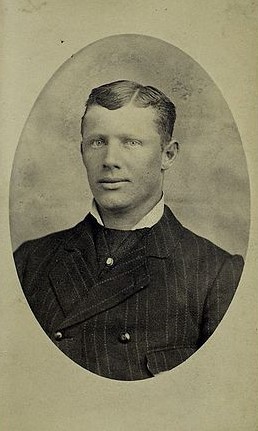
vanh.jpg

Van Haltren

The impending arrival of Van Haltren was big new in the Chicago papers.  With the team struggling in fourth place, The Chicago Daily Journal said Van Haltren was “depended upon to help (John) Clarkson and (Mark) Baldwin boost the club.’ The paper left readers with high expectations:

“Two years ago he commenced playing ball as a catcher, but after a year at the receiving end of the battery, he decided it was better to give than to receive…In his first four games he struck out 55 men; in a game a little later he struck out three consecutive batters on nine pitched balls, and in another game he made a record of 19 strike outs in a nine inning game.”

Van Haltren’s arrival for his start, against Boston, was greeted with fanfare and received as much coverage in West Coast newspapers as in Chicago.  The scene, described by The Oakland Tribune:

“Eight thousand people witnessed the game.  The Chicagos marched on the diamond with Van Haltren and Captain Anson in the lead, then followed by the band and th other players of the club.  When they arrived at the home plate Anson and Van Haltren took off their caps, and the latter was loudly cheered.”

The Chicago Tribune said Van Haltren was sharp for four innings, striking out the first batter he faced:

“(He) retired Joe Hornung on strikes and the crowd manifested its pleasure.”

The Beaneaters scored two unearned runs in the first, but the White Stockings responded with five in the first and scored two more runs in the third.  Through four innings Van Haltren allowed just one hit.

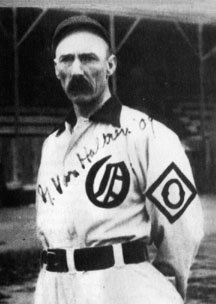
vanh2.jpg

Van Haltren

The Boston Globe said what came next:

“Spalding’s wonder, the famous left-handed pitcher Van Haltren, the terror of the Pacific slope, made his debut as a league pitcher and for four innings he was a king with the crowd. After that he lost all control of the ball and all the Bostons had to do to get to first was to wait for five balls.”

Beginning in the fifth, Van Haltren “sent 14 men to first on balls, besides hitting four with the ball, and (Tom) Daly, who caught him for the first time, saved him about 10 wild pitches.”

The Chicago and California papers saw Van Haltren’s implosion differently—they blamed umpire Herm Doscher.  The Chicago Tribune said:

“Not only was his judgment on balls and strikes miserable, but he lacks a knowledge of the rules of the game.”

The Chicago Inter Ocean (which estimated the crowd at 7,000, not 8,000) said fans “witnessed the rankest case of robbery by an umpire that has ever taken place in the city. President Spalding should never permit a Chicago audience to be so insulted again.”

doscher2

Doescher

The Oakland Tribune called Doscher “Incredibly unfair and incorrect,” and The San Francisco Examiner claimed Doscher was confused by Van Haltern’s curve ball:

“Doescher’s [sic] decisions of balls were drawn from the direction of the ball when at least three feet away from the plate, losing all sight of the ultimate course of the curves at the vital spot.”

Even The Boston Post agreed that Doscher’s umpiring was “erratic” and that he participated in “bad discrimination against Van Haltren.”

Despite his meltdown—or Doscher’s incompetence—Van Haltren entered the ninth with the game tied at 11.

The Beaneaters scored six runs in the ninth after three walks—The Chicago Daily News said, “fully one-half the balls called on Van Haltren should have been strikes.”  Van Haltren was also rattled by second baseman Fred Pfeffer’s second error of the game and two hits—or as The Chicago Tribune put it:

“(Edward ‘Pop’) Tate got his base on balls after Van Haltren had struck him out fairly; (Michael ‘Kid’) Madden was hit by the ball and given his base; Pfeffer’s error gave (King) Kelly first and filled the bases.  Then (Bobby) Wheelock was given his base on balls after about six strikes.”

Having given up the lead, Van Haltren then gave up a triple to Boston’s Bill Nash, Nash scored on a single by Ezra Sutton and the Chicago went down in order in the ninth.

The phenom left-hander from California lost his first game 17-11, walked 16 and hit three batters.

The Oakland Tribune said:

“A correspondent saw Captain Anson and was informed the management of the White Stockings were perfectly satisfied with the new pitcher, who, considering all circumstances, made a good showing as a National League player.”

Anson started Van Haltren in right field the following day and thought enough of him to use him in relief of John Clarkson in the seventh inning, The Chicago Daily News said of his second stint on the mound:

“(He) did remarkably well, staking out such batsmen as Hornung, Nash and Johnson.  The general opinion here is that when he becomes used to Eastern ways, he will prove the best pitcher of the year.”

Van Haltren did not prove to be “pitcher of the year,” he finished 11-7 with a 3.86 ERA, but walked just 50 batters in 152 innings after walking 16 in his first nine.

But he was treated like the “pitcher of the year” when he returned home.

vanhaltren15683011790852769907.jpg

Van Haltren

The San Francisco Examiner said:

“George Van Haltren is, beyond all question entitles to rank as the premier pitcher of California, and the most invidious of our Eastern friends will not begrudge us the right to boast a little about the stalwart young fellow who has done so much in the East to puzzle the crack batsmen beyond the Rockies, and at the same time prove to the older but not more progressive East what kind of products we raise here in California…It is believed that The Examiner’s readers will agree that a finer specimen of young America, of Californian or any other growth, than George Van Haltren would be hard to find.”

Van Haltren never excelled as a pitcher but became one of the best leadoff men of the 19th Century.

Things I Learned on the way to Looking up Other Things: Lost Quotes

11 Feb

Hughie Jennings on Ossie Vitt, 1915

Hughey Jennings told The Detroit News in 1915:

“Vitt is the most valuable player in the American League.  He is the most valuable because he can play three positions in the infield.  He is also an excellent outfielder and can field with the best of them.  Vitt lacks the class to gain a regular position because he cannot hit.”

vitt

Ossie Vitt

Over ten seasons with the Tigers and Red Sox, Vitt hit just .238

A White Stockings Player on George Washington Bradley, 1876

After winning their first four games of the National League’s inaugural season—and scoring 40 runs–the Chicago White Stockings were shut out by St. Louis pitcher George Washington Bradley on May 5, 1876; Bradley yielded just two hits in the 1-0 win.  An unnamed Chicago player was quoted by The St. Louis Post-Dispatch:

gwbradley

Bradley

 “A man might just as well try to successfully strike his mother-in-law as one of his balls.”

Bill Terry on John McGraw, 1934

Despite their often-strained relationship—they once went two years without speaking, Bill Terry, speaking to The Associated Press, said of John McGraw after the man who managed him and whom he replaced as manager, died in 1934:

“I don’t think there ever will be another manager as great as McGraw.  I had my little arguments with him but there was always a soft spot in my heart.  He was the only man I ever played big league ball for, and to hear that a man who has spent his whole life in baseball has gone makes me feel humble.  We will call off practice on the day of his funeral.”

Hal Schumacher on John McGraw, 1934

Hal Schumacher played for John McGraw as a 20-year-old rookie in 1931, and for part of 1932 before McGraw was replaced by Bill Terry.  When McGraw died in 1934, Schumacher told The Associated Press:

mcgraw2

McGraw

“I never could understand his reputation as an iron-fisted ruler.  I never heard him bawl out a rookie.”

Harry Wright on fans and winning, 1888

Harry Wright, told The Pittsburgh Press about the difference between how fans treated winning clubs in 1888 versus his time with the Red Stockings in the 1870s:

harrywright

 Wright

“I won the championship six times, and the most we ever got was an oyster supper.  Now the whole town turns out to meet the boys when they return from a fairly successful trip.  They are learning how to appreciate pennant winners nowadays.”

Dick Hoblitzel on his “X-Ray Eye,” 1911

Dick Hoblitzel told The Cincinnati Times-Star in the spring of 1911 he was “training his batting eye,” and:

“(B)elieves he will soon be able to count the stitches on a ball before it leaves the pitcher’s hand.  ‘It’s the X-ray eye that does this,’ he avers, and he has made a bet of a suit of clothes that he will finish in the .275 class or better.”

Hoblitzel, perhaps as a result of his “X-ray eye,” hit.289 in 1911.

Tommy Corcoran on Umpiring, 1897

Tommy Corcoran told a Sporting Life correspondent in 1897:

corcoran

Corcoran

I believe I’d rather carry scrap iron for the same money than umpire a ball game.  There is no vocation in which there is less sympathy or charity than in baseball.  It must be awful for an old player to listen to the abuse he has to stand from those he once chummed with.  There is an illustration of the heartlessness of some players.  That umpire’s playing days are over, or he wouldn’t be an umpire.  He is trying to earn a living and his old comrades won’t let him.”

“The Boys Began to Cast Threatening Looks”

4 Feb

The effect of “hoodoos” were the frequent subject of baseball stories in the 19th Century—but rarely was one chronicled from beginning to end during a single game. On August 26, 1885, on an unseasonably cold day and in front of a crowd of just 1200, the first place Chicago White Stockings were hosting the last place Detroit Wolverines. The Chicago Tribune marked the moment when the “Hoodoo” arrived:

“When (The White Stockings’) players took their positions on the diamond with (Ned) Hanlon at the bat for the visitors; a half-starved, miserable-looking little dog with a coat of hair like that of a hyena and the air of a coyote, shambled out from among the carriage wheels and took up his position close to (George) Gore. The centerfielder evidently looked upon the wretched animal as a ‘Hoodoo,’ for he threw a clod of dirt at it, and the forsaken little brute weakly trotted off to the shelter of the brick wall.”

gore

Gore

The dog made its way to the Chicago bench, where:

“(Ned) Williamson and (John) Clarkson tried in vain to make friends with him, but he would have none of it, and trotted off to the grass plot near the grandstand railing, where seated on his haunches he watched the game.”

The White Stockings scored two runs in the first inning when Anson and Fred Pfeffer scored on a Williamson double, and, according to the paper “Anson whispered to Gore that the dog was a ‘mascot.’”

The dog remained near the Chicago bench and when the team failed to score through the sixth inning, and the score remained 2 to 0:

“(T)he boys began to cast threatening looks in the direction of the miserable-looking canine mutter something about a ‘hoodoo.”

Each team added a run in seventh. In the eighth, Chicago allowed a run when Hanlon was attempting to steal second and scored after a wild throw by catcher Silver Flint and a poor throw by Gore.

“Hanlon had crossed the home plate. The coyote uttered a plaintive howl a Hanlon scored, and deliberately trotted over to the Detroit players’ bench, where he took his seat.”

The dog having switched sides, “(Chicago) knew they could not make another run and they did not, but fortunately for the prospective pennant-winners, (Detroit’s Charlie) Bennett’s two-bagger in the ninth inning was productive of no good,” when Jim McCormick retired the next three Detroit batters to end the game.

jimmccormick1

Jim McCormick

The Chicago Inter Ocean noted:

“The dog then left the field in disgust and saved the game for Chicago.”

The White Stockings went on to win the pennant by two games. The dog was not heard from again.

Things I Learned on the Way to Looking up other Things: Quotes

28 Dec

Jack Clements, Phillies catcher in 1896 to The Chicago Daily News about umpire Tim Hurst:

“The reason Tim Hurst is so successful as an umpire is not only because he will break the face of any man who insults him, but because he joins in the talk behind the rubber and jollies the basemen into believing that almost everything je says is all right and that they shouldn’t kick about it.”

timhurst

Tim Hurst

Ed McKean, Cleveland shortstop from 1887-1898, to The Cleveland News, 1917

“’Walter Johnson smoke—Huh! Old Amos Rusie had just as much speed and a curve ball that Johnson or no other living pitcher ever had, why that curve came over the plate with just as much speed as did his fast one.’ Thus Ed McKean settled the much mooted question as to the speediest pitcher who ever wore a glove…’I know that many will take exception to my statement that Rusie had more speed than Johnson, but I am giving you my honest opinion.  I’ll admit I have never batted against Johnson, but I’ve watched him closely ever since he broke in.  I have batted against Rusie when Amos was at his best, and of the two, Rusie, to my way of thinking, had more speed.”’

amosrusie

Amos Rusie

Dan Brouthers, while telling The Detroit Free Press in September of 1894 that the Baltimore Orioles would hold on to win the pennant, declared that teammate Kid Gleason:

“’(I)s the best pitcher I ever saw.  He can pitch every day in the week and be just as good at the end as at the beginning.  He is a hitter and a base runner, and an all-around player.  Why, if one of the players makes an error and lets in a run, Gleason says, ‘Never mind, old man, I’ll beat those ducks myself,’ and he is more than likely to do it…They talk about Rusie and (Jack) Stivetts.  They were great pitchers under the old rules, and they are very good now, but they’re not in it with this man Gleason.”

Gleason was purchased from the St. Louis Browns in June and was 15-5 in 21 games and hit .349 in 97 at bats.  The Orioles won the pennant by three games.

Kid_Gleason

Gleason

The St. Louis Post-Dispatch said, in 1889, a reporter asked pitcher Toad Ramsey:

“’What would you suggest would be the best way to increase batting, Mr. Ramsey?’ was asked the ‘phenom’ the other day in Louisville.  The great left-hander winked his left eye in an off-hand way, but jovially declined to answer the question.  ‘It ain’t my business to give points on batting.’”

Ramsey was then asked who the best hitter in baseball was:

“’Tip O’Neill,’ he replied unhesitatingly.  ‘He’s the best hitter I ever saw, and he’s got the most judgement.  He can’t hit harder than Browning, if Pete would take care of himself, but nobody ever saw Pete doing that,’ concluded Mr. Ramsey, as a feeling of regret for Pete’s weakness displayed itself on his face.  Then he walked away with an acquaintance.”

toad.jpeg

Ramsey

George Gore told The Chicago Daily News about one of his former teammates:

“Ed Williamson of the Chicago champions was the greatest shortstop of them all.  He was a wonderful thrower, probably the hardest in the business.  Anson used to play first base without gloves in those days, and Ed took delight in lacing over hot ones to the old man.  When anybody hit a grounder to Williamson, he would pick it up, wait until the runner was a few yards from the bag, and then line the ball to Anson like a cannon shot.  The old man was nearly knocked down on several occasions.”

williamson2

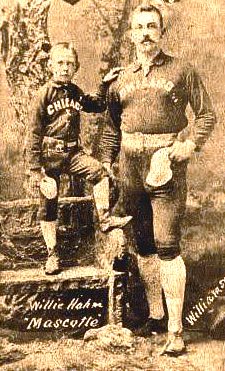
 Williamson with mascot Willie Hahn


“Baseball is a lot Faster now”

18 Oct

Bill Gleason was the shortstop for three of the four straight American Association champion St. Louis Browns team—he was with the 1885-1887 teams—and, apparently, very superstitious.  After his baseball career ended in 1891, the St. Louis native returned home and became a fire fighter.

Unlike many of his contemporaries, he didn’t spend his later years complaining about how the game wasn’t as good as when he played.

In 1926, the captain of the city’s Engine Company Number 38, sat in the Sportsman’s Park press box for game three of the World Series, and spoke to a reporter from The Post-Dispatch:

gleason26

Bill Gleason Fire Captain

“’It’s a fast team, a fast team,’ Gleason repeated again and again as the Cardinals infield worked.  ‘And baseball is a lot faster now than it was when we played it back in the old days.’”

And Gleason was aware of how most of his contemporaries felt:

“’I’m not one of these old codgers who’d tell you there are no times like the old times.  These boys out there are faster than we were, I think, and the game’s gone a long way ahead.  And I wouldn’t like to say we had any players quite up to the big fellow out there,’ waving a hand toward ‘Babe’ Ruth who was emerging from the Yankee dugout.”

Gleason noted that while his three Browns teams “were champions of the world,” he said they were not as great as the current Cardinals:

“’This man (Jesse) Haines who pitched today is a wonder.  He had everything, speed, curves, and absolute control (Haines shut the Yankees out on five hits in a game delayed by rain for 30 minutes during the fourth inning)…Sometimes it seems to me that we don’t have the pitching now that we used to, but Haines certainly furnished it for us today.  He puts me in mind of old Tim Keefe of the New York team.  He was a great pitcher in my day.”

But Gleason was even more impressed with the Cardinals infield:

“’Then there’s that double play combination.  (Tommy) Thevenow to (Rogers) Hornsby to (Jim) Bottomley.  Thevenow is lightening fast, Hornsby’s play is as smooth as silk, and Bottomley is just a beauty.”

gleason88.jpg

Gleason, 1886

Gleason said Hornsby’s play at second reminded him of his Browns teammate Yank Robinson:

“’(He) handled himself a lot like Hornsby.  You didn’t realize how fast he was moving. He worked so easily.’”

Gleason said the Cardinals had better hitting than his Browns and said of outfielder Billy Southworth:

“’He’s like Curt Welch, the center fielder of the Browns.  Goes back on a fly ball and gets set for it just like old Curt did.  And (catcher Bob) O’Farrell is a lot like Doc Bushong of the Browns—steady and dependable.’”

Gleason also talked about how the 1926 incarnation of Sportsman’s Park differed from the first version which hosted the 1886 world’s championship against the Chicago White Stockings:

“’In those days,’ he said, ‘the grounds were laid out so that we batted from Grand Avenue, and what is now home plate was then left field. “

Gleason said the following season, when the Browns again played the White Stockings in a post series, that the decision to make the series a “winner take all” for the gate money was Albert G. Spalding’s idea:

“’(Browns owner) Chris von der Ahe (wanted to) split the gate.  (Spalding) said he would play only on the basis of winner take all and we played on that agreement.  The Browns won the series four games to two.  We won the last three games here, and I think it’s likely the Cardinals will do the same thing.”

His prognostication was off—the Cardinals dropped the next two games to the Yankees, but did come back to win the final two to take the World Series in seven games.

Gleason remained with the St. Louis fire department until his death at age 73 in 1932—there was general confusion about Gleason’s age at the time of his death, The Post-Dispatch said “Records vary to his age but he was about 70,” The St. Louis Star and Times and The Associated Press said he was 66.

The Post-Dispatch said he was recovering from an infection he got from stepping on a nail at a fire, when “he insisted on going down to the corner drug store.  On the way home he collapsed from the heat and never left his bed again.”

“The Brown Stockings, A Gloomy Title”

14 Sep

Shortly before the 1875 National Association season, the St. Louis Brown Stockings visited Louisville to play an exhibition against the semi-pro Olympics.

The Louisville Courier-Journal wrote with admiration about the building of a professional club in St. Louis:

“The signs of the times indicate a far livelier season of base ball than has ever been enjoyed in America by lovers of the great national pastime.  Especially will this be the case in the west, to which part of our country the great baseball wave has been slowly moving for several years.”

The paper said St. Louis was acting to eclipse Chicago as the “capital” of baseball in the west:

“In order to be honorably represented in the base ball arena, the Mound City folks formed a stock company; gathered in $20,000 from wealthy merchants and millionaires, procured twelve experts in the national game, and now the city smiles while she thinks how her club will walk forward to the pinnacle of fame this year.”

Recruited from “Eastern states,” The Courier-Journal said of the St. Louis team:

“The Brown Stockings, a gloomy title for so gay a set of fellows, though it is rather the fault of St. Louis papers than the base ballists, that they are forced to wear it.  All in all, the St. Louis club is composed of as handsome a set of fellows as ever handled the willow or tossed the ball.  We refer to face as well as form.  Since their engagement by a St. Louis stock company the base-ballists have been under gymnastic training…The members have perfect understanding of each other’s movements, and act accordingly.”

Noting that many of the players had spent the previous season in Brooklyn, the paper said they chose to “come west, like all good people ought to do.”

The Courier-Journal reporter interviewed outfielder Jack “Death to Flying Things” Chapman, who offered a wealth of information on the 19th Century ballplayer:

chapman

Jack Chapman

“(He) is six feet high, and splendidly built, being a ‘man as is a man.’  He only weighs one hundred and seventy-seven and isn’t married, though he contemplates taking a partner someday.”

Chapman, the “best looking man on the team,” who “is much liked by his associates,” was designated the “team scholar” to talk to the press in the absence of manager Dickey Pearce who was ill.  He said:

“St. Louis is bound to be the greatest place on the continent for base ball this season.  Her stock company offered big inducements, and we accepted.”

As for the people who had built the club, Chapman said, they were:

“Very rich and nice people…(the club’s) officers are mostly millionaires, who desire their city ably represented in base ball.  The people ‘turn out’ there in the thousands, and are all agog with base ball excitement.  Five thousand people witnessed our practice game last week.”

Chapman was asked about salaries:

“Substitutes get from $900 to $1200.  Regulars receive $1000 to $2500.  Bob Ferguson (the other “Death to Flying Things), of our old club, gets $2500 this year for captaining the Hartfords.”

Asked what players did in the off-season, Chapman said:

“A good many loaf, and others work at different jobs.  Generally whatever they hit upon that suits.”

As for the St. Louis club’s prospects to overtake the Boston Red Stockings as the nation’s dominant team:

“We hope to do it, and I believe we shall.  The Reds are a good team, made excellent by having stuck together so long.  I consider the (Philadelphia) Athletics the stronger nine this year.  Harry Wright is the best captain in America.  The (New York) Mutuals were the best club last season, and but for the bad feeling among the members would now be champions.”

Finally, Chapman was asked whether he thought Louisville could support a professional team:

“I do, indeed, and am surprised she hasn’t one.”

Chapman was hit and miss on his predictions.  The Brown Stockings were the best club in the west, finishing the season 39-29, but no where close to playing at the caliber of Wright’s Red Stockings (71-8) , the Hartford Dark Blues (54-28), or the Athletics (53-20).

He was correct about Louisville’s chances to get a professional club, The Grays, with Chapman as manager finished fifth in the inaugural season of the National League.

“I’m the Only Michael”

12 Sep

The Chicago press treated Michael “King” Kelly’s return to Chicago like a coronation.  Kelly was sold by the White Stockings for a then record $10,000 in February of 1887, and arrived for his first series in Chicago on June 24.

kingkelly

Mike “King” Kelly


The Chicago Tribune said he was greeted at the Leland Hotel on Michigan Avenue with a brass band, a crowd estimated at 5000, and a song:

“Michael Kelly, he came down to sing a little chanson; says he, ‘I’ve come from Boston Town to do up Baby Anson.  I love Chicago, but you know the Hub spondulicks bought me—I hated like the deuce to go, but $10,000 caught me.  I’ve come to lay Chicago flat and knock you all to blazes, for I’m a corker don’t forget—the daisy of the daisies.  Away with every Bill and Jim that’s in the baseball cycle—the dickens take the whole of thim!  Sure, I’m the only Michael.’”

The Chicago Inter Ocean described the “King” as “terribly bored…fast losing his good nature by this ovation business.”  Despite his boredom, The Chicago Daily News said:

“Kelly was taken to the grounds in a four-horse carriage, escorted by a band and all the players.”

There were more than 12,000 fans in the stands when the procession arrived

The Tribune described the arrival at the ballpark:

“(Fans) kept on yelling as the procession wended its way past third base, back of the home plate and over towards Anson’s territory.  When the carriage with its four proud horses stopped in front of the grand stand and the Hon. Mr. Kelly stretched his red-hosed legs and hopped out to the ground the volume of yelling was doubled.  The Hon. Mike took off his grey cap and smiled.  The crowd howled some more.  Then the Bostons scattered themselves over the field and began practice.  Every play, good, bad, or indifferent of the ex-member of the home team was applauded.”

The game itself was interrupted on at least three occasions, according to The Inter Ocean “to allow presentations of flowers,” to Kelly, and at another point to present Cap Anson “a pillow in white roses with the words ‘Old Man’ in red with roses therein.”  The paper noted that the “interruptions wasted several moments of the playing time.”

The Tribune said Kelly was also presented with “a gay satin jockey cap of red, white, and blue, which the Hon. Mr. Kelly was induced to wear during a part of the first inning.”

The game, and Kelly’s performance, according to The Inter Ocean were anti climatic after the buildup.

Chicago and John Clarkson, beat Boston and Old Hoss Radbourn 15-13, the paper said:

radbourn

“Old Hoss” Radbourn

“Strange to say, however, the expected Kelly tactics in base running was not made manifest during the course if the game.  He did not play with the vim that used to make him the great man when he played here.  Kelly misses his place, and all the flowers and gold watches in the country will never make him the same ‘Old Kel’ of yore.  Kelly with the Chicagos may be worth $10,000, but Kelly with any other team would not bring $2000.”

Kelly was 3 for 6 and made two errors at second base.

Chicago took three of four games  from Boston , Kelly 6 for 11 with six errors in the first three games, and sat out the final game, a 19 to 6 Chicago victory.

The Tribune noted that Kelly’s return brought 34,000 fans out for the series:

“Fully 17,000 represented 75 cents each and the others 50 cents each.  This gives a total in the neighborhood of $21,000.  They got $10,000 for Kelly and the club is still playing winning ball.  This is some evidence of good business management on President (A.G.) Spalding’s part.”

The Kelly-less White Stockings finished in third place.  Boston ended the season in fifth.  Kelly, who led the league with a .388 average in 1886, hit .322 for Boston in 1887.