Tag Archives: Eastern League

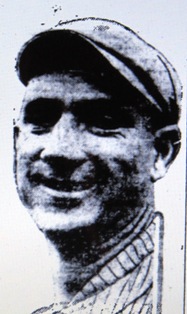
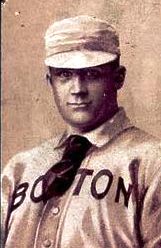
Hap Myers

29 Jul

When the 6’ 3” 175 pound Ralph Edward “Hap” Myers was let go by the Boston Braves after the 1913 season a reporter told Braves shortstop Rabbit Maranville he was sorry to see Myers go.  Maranville joked:

“Well, you might be, but I’m not.  Do you know that guy is so thin that every time I picked up a grounder I had to shade my eyes with my gloved hand to locate him before throwing the ball.”

Myers began his professional career after graduating from University of California, Berkeley in 1909, where he also played baseball.  The San Francisco native hit a combined .311 playing for the Sacramento Sacts in the Pacific Coast League, and the San Jose Prune Pickers and Santa Cruz Sand Crabs in the California League.

Myers went east in 1910 after being purchased by the Boston Red Sox, but became ill, with scarlet fever, and as a result appeared in only six games in Boston before being  sent first to the Toronto Maple leafs in the Eastern league, then the Louisville Colonels in the American Association.

Despite hitting just .240 with Louisville, Myers was selected by the St. Louis Browns in the Rule 5 draft.  The Red Sox claimed Myers still belonged to them and his contract was awarded to Boston, where he began the season, was sold to the St. Louis Browns, who quickly released him despite hitting .297 in 11 games, then back to the Red Sox where he hit .368 in twelve games before being sent to the Jersey City Skeeters in the Eastern League.

It was never clear why, in spite of hitting .333 in 81 at bats in 1910-1911, Myers couldn’t stick in the American League.

In 1912 he returned to the West Coast to play for the Spokane Indians in the Northwestern League where he led the league in hits, and runs, hit .328, and led all of professional baseball with 116 stolen bases.  The Portland Oregonian said:

“Myers base stealing smashes any previous performance in Northwestern League history.  You have to go back 20 years in official guide books to find any record to compare…and that includes every league in organized baseball.”

Spokane owner Joe Cohn went overboard in his praise of Myers in The Spokane Spokesman-Review:

“Best ballplayer in the Northwestern League by a long shot.  He is the greatest ballplayer I ever saw.  Boy I tell you this Myers is a wonder.  Ty Cobb, Hans Wagner, Tris Speaker and all of them have nothing on Myers…I think Myers has it on Cobb, Wagner, Lajoie, Jackson and the whole bunch.”

Myers, and Portland catcher Rex DeVogt were purchased by the Braves from Portland, Devogt would only last for three games, and six hitless at-bats in April of 1913.  Myers would become the Braves starting first baseman.  Another Pacific Coast League player, pitcher “Seattle Bill” James also joined the Braves.
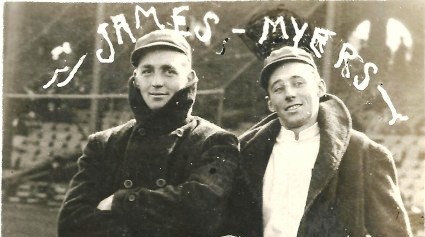
hap3

“Seattle Bill” James and “Hap” Myers

Myers got off to a slow start; he was hitting just .224 in early July, but was leading the National League in steals.  An article in The Tacoma Times said:

“When Hap Myers, recruit first baseman of the Boston Braves is in full stride stealing bases, he covers nine feet…the average stride of a sprinter is six feet. “

The article said the average player took 13 steps, roughly seven feet per step, between bases but Myers took only ten steps:

“Myers is something of a baseball curiosity, and his work is watched with interest by the fans.  If the time comes that the big fellow climbs into the .300 class as a batter, he is apt to become a veritable terror of the paths.”

He was also said to use “a bat of unusual length,” but the size was never mentioned.

After the slow start, Myers hit well in the second half of the season, ending with a .273 average and 57 stolen bases (second to Max Carey of the Pittsburgh Pirates who stole 61).  Despite his strong finish, Myers was replaced at first base for 22 games in August and September by Butch Schmidt, who was purchased from the Rochester Hustlers in the International League.
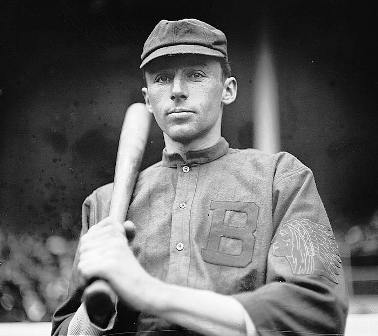
"Hap" Myers

“Hap” Myers

At the end of the season Myers was sold to the Hustlers, the deal was, in effect, a trade for Schmidt.  The Boston press simply said Myers did not get along with manager George Stallings; Myers told a reporter in San Francisco that there was another reason; baseball’s labor unrest:

  “I was assigned by the fraternity to get as many Braves as possible into the fraternity, and succeeded in enrolling nearly the entire team.  The powers that be evidently didn’t relish my actions for soon my every move began to bring calldowns and I was not surprised to read in the newspapers a little later that I had been sent to Rochester.”

Myers jumped Rochester to join the Federal League; his signing was reported months before he actually signed.  The Associated Press said in March of 1914:

“Although it has been generally understood that Hap Myers, last season’s first baseman of the Boston National has been under a Federal League contract for some time, the elongated first sacker did not put his name to a contract until yesterday afternoon.  Myers originally expected to play with Larry Schlafly on the Buffalo Federals, but was transferred to Brooklyn, and seemed altogether pleased with the move.”

Myers got off to a strong start, and The Sporting Life said:

“Brooklyn fans cannot understand why Hap was passed out of the National League. They have had a chance already to give his successor at first base on the Boston team (Butch Schmidt) the once over, and the general opinion is that- Hap Myers “lays all over.”

His success in Brooklyn didn’t last; in 92 games Myers hit just .220.

Hap’s story continued tomorrow.
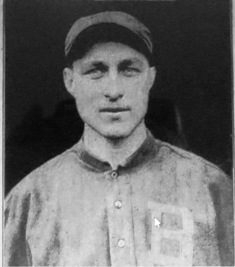
Butcher Boy Schmidt

25 Jul

Charles John “Butch” “Butcher Boy” Schmidt was credited by Connie Mack with being the catalyst for the Boston Braves World Series upset of Mack’s Philadelphia Athletics in 1914; one year later Schmidt walked away from baseball in his prime.

Butch Schmidt

Butch Schmidt

He was born in Baltimore in 1886, and played amateur ball while working in the family meat market, which earned him his nickname.

Schmidt signed as a pitcher with the Baltimore Orioles  in the Eastern League and assigned to the Holyoke Papermakers in the Connecticut State League, where he posted a 10-9 record.  In late August the Orioles recalled him, and he went 5-1 in 11 games with Baltimore.

The New York Highlanders drafted Schmidt and the 22-year-old pitcher started the 1909 season in New York.  He appeared in only one game, on May 11, giving up 10 hits and eight runs, four earned, in five innings.  Early in June he was returned to the Orioles.

After appearing in eight games on the mound with the Orioles, Schmidt was moved to first base.  After hitting .244 for the remainder of ’09, he hit .292, .291, and .274 the next three seasons, and was sold to the Rochester Hustlers in the International League, where he hit .321; he was purchased by the Boston Braves on August 22, and hit .308 in 22 games playing in place of Ralph “Hap” Myers.

At the end of the 1913 season Boston sold Myers’ contract to Rochester; The Boston Post reported that Braves manager George Stallings simply didn’t like Myers.  (Myers had a different theory for his release—that story next week)

Schmidt was installed as the Braves first baseman in 1914, and as Boston made their improbable run to the National league pennant Schmidt   hit .285 with 71 RBI and .990 fielding percentage, and finished 16th in the voting for the Chalmers Award, for the most valuable player in the National League; teammates Johnny Evers and Rabbit Maranville finished first and second in the voting.

Grantland Rice said in The New York Tribune:

“There are few greater first basemen in baseball and none who is steadier or a better fighter.  For Schmidt is also of the aggressive type and a hustler every second.”

The New York Times didn’t think quite as highly of Schmidt and on the eve of the World Series said the “advantage favors the Athletics” at first base:

(John “Stuffy”) McInnis makes exceptionally brilliant plays…has been through Worlds Series fire and proved just as cool as if he were playing an exhibition game in the springtime.  Schmidt has yet to face the strain and tension of the big baseball classic…While Schmidt is not a scientific batsman, he is a free swinger and hits the ball hard, but he doesn’t hit it often.”

The pressure of the series didn’t seem to bother Schmidt, the Braves first baseman hit .294 with five hits, two runs and two RBIs in the four game sweep of the Athletics; McInnis hit just .143.

In game one he made a play in the first inning that Connie Mack said set the tone for the series and “sparked the Braves.”  With runners on first and second with one out, Athletics third baseman Frank “Home Run” Baker hit a foul pop-up into short right field.  Athletics outfielder Eddie Murphy tagged up and attempted to go to third; The Associated Press said Schmidt made a “great throw…from a difficult angle,” to third baseman Charlie Deal to retire Murphy.

Stuffy McInnis, Eddie Murphy and "Home Run" Baker,

Stuffy McInnis, Eddie Murphy and “Home Run” Baker,

Early in the 1915 season Braves manager George Stallings called Schmidt “The best first baseman in the game,” but his performance at the plate slipped.  Schmidt hit just .251 with 60 RBIs.  The Braves again found themselves in 8th place in July, and while they made another strong run, finished 2nd, seven games behind the Philadelphia Phillies.

Despite the mediocre season at the plate, it was assumed the 28-year-old Schmidt would remain the Braves first baseman.  Schmidt shocked Stallings, Boston fans, and all of baseball when he announced in January of 1916 that he was retiring from baseball.

Butch Schmidt at bat

Butch Schmidt at bat

The Associated Press said Schmidt was leaving “to devote his entire time to his private business.”

Grantland Rice said Schmidt’s business included “six meat markets in Baltimore,” and that he earned $8000 a year from his stores.

The Sporting Life said it was just as likely that Schmidt, listed at 200 pounds, retired because:

Hard work in that old rubber shirt to get down to weight, especially when the extra weight comes off slowly, more slowly each succeeding season, is a trial that anyone would like to sidestep if he could. “

Boston manager George Stallings filled the void left by Schmidt by purchasing Ed Konetchy from the Pittsburgh Rebels from the newly defunct Federal League.

The Boston Post said the change at first base would not hurt the Braves:

“Konetchy, a heavier hitter than Schmidt, is just about as capable in other ways.”

Despite the confidence of The Post, Stallings was not convinced and continued to try to induce Schmidt to return; his efforts were unsuccessful.

After Konetchy hit .260 for the third place Braves in 1916 it was reported that Schmidt would return to the team.  After several weeks of speculation, Schmidt told The Boston Globe “no offer” could induce him to return to Boston.

Konetchy hit .272 and .236 the next two seasons, and each off season it was rumored Schmidt would return, and every year he stayed home where he continued to run his business and play semi-pro ball in Baltimore’s Inter-City League.

Before the 1919 season Konetchy was traded to the Brooklyn Robins and the Braves acquired Walter Holke from the Cincinnati Reds.  Holke hit .292 for the Braves in 1919, but rumors continued that Schmidt, out of organized baseball for four years, would be returning to Boston.  The Associated Press said:

“George Stallings of the Boston Braves is trying to get Charlie “Butch” Schmidt, the Baltimore butcher boy who played first base for the world’s champions of 1914, to return to the Boston Braves.  Schmidt is reported to be in wonderful condition as he has kept in practice since his retirement.”

Schmidt never returned to professional ball, and was finally removed from Boston’s reserve list in 1922.

Butch Schmidt walked away from professional baseball and never looked back; he died in 1952 of a heart attack while inspecting cattle at the Baltimore Union Stock Yards.

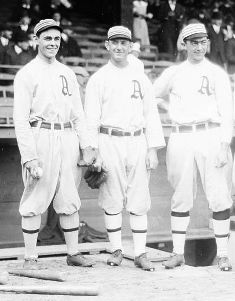
Memorial Day—Major League Baseball’s First World War Casualty

27 May

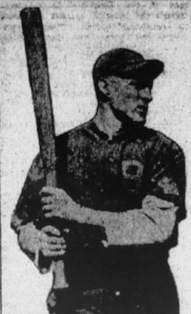
By the time he enlisted in the United States Army in July of 1917, Edward Leslie “Harvard Eddie” Grant had retired from baseball to practice law in Boston.

He attended Harvard, but only played baseball as a freshman; he was declared ineligible after being paid for playing with a semi-pro team.  After that Grant played intramural baseball at Harvard and played with Northeastern outlaw teams during the summer.

In 1905 Grant made his Major League debut when the visiting Cleveland Naps recruited him to fill in for two games at second base for Hall of Famer Napoleon Lajoie against the Boston Americans—he was 3 for 8 and made one error.

He was with the Jersey City Skeeters in the Eastern League in 1906, hitting .322, which earned him a contract with the Philadelphia Phillies.  He would spend the next nine seasons in the National League, also playing for the Cincinnati Reds and New York Giants.  Grant was never a star, but he was popular with fans and the press.  The New York Times said:

“He was a handy utility player and could fill in any position on the infield.  While never a heavy batsman, he was skillful fielder and a smart baserunner.”

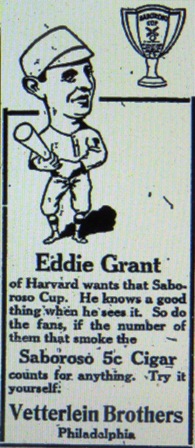
1910 Advertisement for the  Vetterlein Brothers Cigar Company; the Saboroso Cup mentioned in the ad was presented to the phillies or Athletics player with the highest batting average.

1910 Advertisement for the Vetterlein Brothers Cigar Company; the Saboroso Cup mentioned in the ad was presented to the Phillies or Athletics player with the highest batting average.

Grant was among the first wave of prominent athletes to join the military, making his enlistment news.  A wire service article under the headline “Eddie Grant Joins Uncle Sam’s League” appeared in numerous papers across the country.

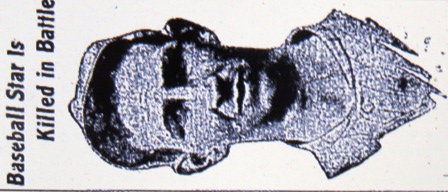
On October 5 1918, he would become the first Major League player to be killed during World War I, The Associated Press said:

“Captain Edward Grant, former third baseman of the New York National League Club, and attached to the 307th Infantry, was killed by a shell when leading a unit to the aid of the famous ‘Lost Battalion.’

“The battalion was surrounded for five days in the Argonne Forest and Captain Grant was killed in one of the attempts to reach it.”

Grant was originally buried in the Argonne Forest, and his body was later moved to the Meuse-Argonne American Cemetery.

Count Campau Explains the “Science of the Sport”—Part 2

28 Mar

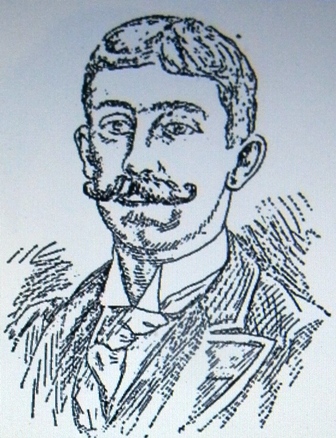
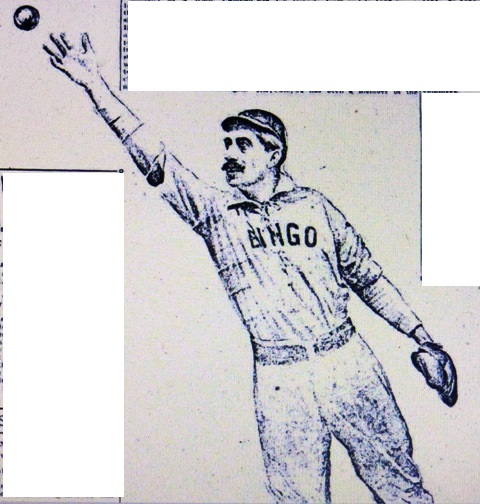
Charles “Count” Campau was among the fastest and best base runners of the 19th Century; he stole 63 bases in 147 games major league games, and stole 100 with Savannah and New Orleans in 1887.  In 1900 Campau, then 36 appears, not to have slowed down much.

The Binghamton (NY) Press said at a “field day” competition in Montreal, Campau “circled the bases in 14 ½ seconds and won a handsome gold watch, which he now carries as a souvenir of the feat.”  The Press also said “At one time Campau challenged any baseball player in the world to run a match race of 100 yards for 100.”

"Count" Campau

“Count” Campau

In 1893 Campau wrote an article for the New Orleans Times-Picayune about the “Science of the Sport,” last week‘s post included his comments about the battery, this week, the rest of the article:

“Many people will not believe that a third baseman’s position is one of the hardest and most trying.  As soon as he makes a hot pick-up he must immediately send the ball to first to score the batter out.  He must be a quick, hard and accurate thrower, or a fast base runner will have a good chance to get to first.

“The short stop and second baseman, as a rule, generally work together, but the short stop aids the baseman more than he receives help, in fact, the second baseman is a sort of short stop.  Should a batter be right-handed the grounder will invariably go to the short stop.  If a man has already reached first, the short stop depends upon the second baseman to be at the bag, and send the ball to him…A left-hand batter will send the ball between first and second, where the second baseman generally plays.  Should there be a man on first, the short stop is looked upon to cover the bag, and if the hit is a fast grounder and both men are quick throwers, a double can be easily worked.

“The first baseman is a mean position to play.  It looks easy, but is hard.  He has got to play a short stop game, must be a sure catcher of a thrown ball and is supposed to get a low thrown ball or a high one, and must catch a ball either on the left or right side.  This position is the best place for a captain; for he can see every play that is made better than should he be in the outfield, and can readily argue a decision with an umpire without walking a mile to do so.

“The outfield must be greatly depended upon and must catch all the balls in that territory..  The outfielders have not as much work as the infielders, but they have to look up at Old Sol and must have a good pair of eyes.  They must be hard, quick throwers to be of any value to the team and have got to watch the base runners and use judgment  as to the proper place to throw the ball…A person can be a good fly ball catcher with diligent practice.  He must know where to run and judge a ball.  As soon as he can do this there will be no trouble to succeed.

“A captain must be a cool man and be able to command respect from his men and let them know that his rulings must be obeyed…When his side is in he should instruct his men how to bat, when to bunt or sacrifice. “

Campau said “Baseball is a great exercise, for it is played with brain and every muscle, and daily practice will make any person become strong quick, for every muscle is brought into play and is developed.”

Campau played and managed until the 1905 season, finishing his career with the Binghamton Bingoes in the New York State League; released by Binghamton mid-season, he became an umpire, working in the Southern, Eastern and New York State Leagues June of 1907.

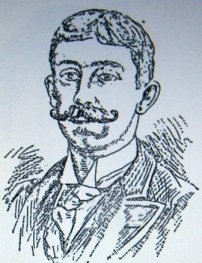
Charles Columbus "Count" Campau 1904

Charles Columbus “Count” Campau 1904

Campau gave up umpiring for thoroughbred racing; he served as a handicapper, clerk of scales and placing judge at a variety of race tracks, including Kenilworth Park in Buffalo, King Edwards Park in Canada, Oriental Park in Cuba, and finally, the Fair Grounds in his adopted home of New Orleans.

Campau died in 1938.

“Bill Abstein Denies he is a Bonehead”

20 Feb

Pittsburgh Pirate owner Barney Dreyfuss and manager Fred Clarke felt all they needed to win a World Series was a first baseman.  Since winning the National League Pennant with Kitty Bransfield in 1903, only one Pirate first baseman hit better than .260 (Del Howard .292 in 1905).

In 1908 the Pirates finished second with four different first basemen, Harry Swacina, Alan Storke, Jim Kane and Warren Gill; none played more than 50 games, none hit better than .258 and they combined for 29 errors.

The man who took over in 1909, and was with the Pirates for their World Series victory, might have preferred to have never been given the job.

Bill Abstein had played eight games at second base and in the outfield for the Pirates in 1906, before returning to minors.

-Abstein had put up respectable, but by no means spectacular, numbers with the Shreveport Pirates in the Southern Association and Providence Grays in the Eastern League from 1906 to 1908—but as early as August of 1908 The Pittsburgh Press said he was the answer to the Pirates problem at first base:

“Fred Clarke is very eager to secure Bill Abstein from Providence.  Bill is rated the best first baseman in the Eastern League, and he would no doubt strengthen the Pirates where they are weak.”

When Abstein joined the Pirates before the 1909 season The Press said:

“The acquisition of bill Abstein has rounded our infield nicely.  He’s the best first baseman we have had in years and he certainly fits in nicely.”

???????????????????????????????

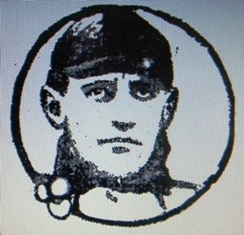
Abstein, Providence 1908

In a letter sent to Dreyfuss with his contract, Abstein told the Pirate owner:

“Fred Clarke will not have to worry about a first baseman after he sees this big German hustling around the bag.”

In keeping with his career performance, Abstein had a respectable season for the pirates.  He hit .260 and drove in 70 runs.  His 27 errors were only a slight improvement over 1908’s first baseman by committee.

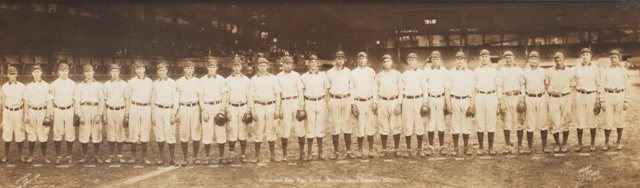
The Pirates won 110 games and won the National League Pennant by six and half games over the Chicago Cubs and met the Detroit Tigers in the World Series.  The series would be the beginning of the end of Abstein’s Major League career.

09pirates

1909 World Champion Pittsburgh Pirates, Abstein 11th from left.

Abstein struggled at the plate (6 for 29 with nine strikeouts) and in the field (5 errors total, 2 each in games 3 and 4).  The Pirates won the series in seven games, but despite the victory, Abstein quickly became the subject of ridicule in Pittsburgh.

An Associated Press article after the series said:

“During the games with Detroit Abstein appeared to forget all that he knew about base ball.  He ran the bases foolishly, made a number of costly errors, failed to hit and disobeyed orders.  In fact, his playing was worse than that of any other man on either team.  The other Pirates, seeing that Abstein was the ‘goat’ for the combination, kept up the cry against him…Before the series was ended many of the Pirates shunned Abstein and it was reported he would be traded.”

The Pittsburgh Press was less generous:

“Bill Abstein denies he is a bonehead and says baseball is largely a case of ‘if-you-can-get-away-with-it,’ well it’s a cinch that Bill couldn’t in the National League.”

The Pirates were unable to trade Abstein and finally put him on waivers.  He was claimed by his hometown St. Louis Browns.

Even though the Pirates had actually won the Worlds Series and even though Abstein was gone, that didn’t mean the Pirates, and The Pittsburgh Press, wouldn’t continue to pile on.

Barney Dreyfuss told The Associated Press shortly after Abstein was claimed by St. Louis:

“We have discarded the weakest offensive player we had—Abstein—and hope to improve the team by doing so.”

Dreyfuss also claimed:

“Fred (Clarke) told me as early as last June that we should get someone else for Abstein’s place in 1910, as Bill mixed up the team’s plays too frequently.”

The Pittsburgh Leader said:

“(Abstein) had deplorable batting weaknesses which the opposing pitchers were certain to fathom in time.”

The Pittsburgh Press was even less generous:

“Bill Abstein is reported to be making a hit with the Browns by his work in the spring practice.  Just wait about three months friends, before declaring Bonehead Bill a wonder.”

When the Pirates sold pitcher Vic Willis the St. Louis Cardinals in February of 1910, newspapers reported that Willis and Abstein had “engaged in a bitter fight,” during the series.

Abstein quickly wore out his welcome in his own hometown of St. Louis.  Abstein made 11 errors in 23 games at first base and hit .149; he was released on June 2, 1910.  It appears Abstein was no more popular with Browns Manager Jack O’Connor than he was in Pittsburgh.  O’Connor was quoted in The St. Louis Times in May:

“How did Abstein get away with it last year?  How could he make plays like he has been making for me and get away with it all year for Pittsburgh?  I never dreamed that some of the plays made by him were even possible.”

His Major League career over, Abstein returned to the minor leagues for seven seasons.  He had one above average year with the Los Angeles Angels in the Pacific Coast League in 1914; in 202 games he hit .308, with 234 hits and 40 doubles.

Abstein moved on, Pittsburgh apparently did not.  For years, Pittsburgh newspapers took every opportunity to take a shot at the first baseman.  In 1915 The Pittsburgh Press, in an article about the revolving door the Pirates still had at first base–in the five post-Abstein seasons, the Pirates had four different starting first baseman–(emphasis theirs):

“No one will ever forget the way Bill did NOT play the bag in the Worlds Series.  In fact, Bill did NOT play the bag all the time he was stationed there.”

Pittsburgh finally seemed to move on by the time they won their next world Championship in 1925.  Abstein died in St. Louis in 1940.

“Big, Good-Hearted and Foolish”

9 Jan

Almost immediately there was trouble for manager John McGraw after the New York Giants acquired Larry McLean from the St. Louis Cardinals, August 6, 1913—it was one of the few times in his career when the trouble wasn’t McLean’s fault.

With Chief Meyers hurt McGraw needed a catcher and traded the popular Doc Crandall to the Cardinals for McLean.  The day after the trade The Cincinnati Commercial Tribune reported that McGraw had “exchanged fisticuffs” with five of his players:

“Crandall was very popular among the club members, and there was much bitterness felt at his loss…The players passed hot words (at McGraw), and several blows were struck.”

McGraw was left with a bloody nose from the fight, and less than two weeks later reacquired Crandall from St. Louis.

McLean thrived in New York, a United Press story said:

“The big lad has been slamming the horsehide at a terrific gait, and has been displaying wonderful form behind the plate…Larry is said to be behaving himself better than he ever has since joining the big show.”

McLean hit .320 for the pennant-winning Giants and went 6 for 12 in their World Series loss to the Philadelphia Athletics.  He earned the praise of McGraw and despite diminishing skills, remained a model citizen for all of 1914 and part of 1915.

That all changed in June of 1915.  McLean had a clause in his contract which would have earned him an additional $1000 if he did not drink during the season.  McGraw’s right-hand man, scout Richard “Sinister Dick” Kinsella, had accused McLean of drunkenness and as a result was suspended for 10 days by McGraw.

Larry McLean, 1915

Larry McLean, 1915

In the lobby of the Buckingham Hotel in St. Louis, McLean accused Kinsella of making up the charge that he’d been drinking in order to cheat him out of the promised bonus.  Words were exchanged and then a fight broke out.  There was the McGraw-Kinsella version and the McLean version.

McGraw and Kinsella said McLean was carrying a length of gas pipe, and “came into the lobby with a number of rough companions.”

Kinsella’s version was as colorful as it was questionable:

“I picked up a chair and broke it over McLean’s head.  That frightened his gang of ruffians and they fled.  McLean continued to fight until McGraw and I chased him into the street, where he jumped into an automobile filled with women and begged for protection.”

McLean told reporters “I whipped McGraw and all of his associates with my two fists, I did not use a gas pipe, and he “exhibited his bruised right hand as evidence.”

McLean was finished with the Giants.

In March of 1916 The Associated Press reported that McLean had purchased the New Haven Murlins of the Eastern League and said “Larry will manage the club and catch.”  Either the report was erroneous or the deal fell through.  McLean never again played professional baseball and spent 1916 playing with semi-pro teams in New York.

Before the 1917 season baseball writer Ren Mulford reported that McLean might be signed by the Reds:

 Wouldn’t it be odd if Big Larry would come out of the swamp and stick to his spikes into dry ground?  Larry McLean, big, good-hearted and foolish, always his own worst enemy might come back if he willed it so.”

McLean never joined the Reds.

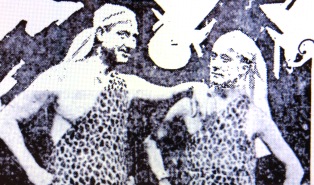
Also in 1917 several newspapers reported that McLean was becoming an actor, The New London (CT) Day said McLean “is now a real moving picture actor,” and included a picture of McLean with another actor “as Egyptian slaves in ‘The Siren,’ a movie soon to be released.”  (The film “The Siren” is described on IMDB as a western—what film, if any McLean actually appeared in is unknown)

Larry McLean, 1915

Larry McLean as an Egyptian slave in a 1917 film

In 1919 McLean was “in serious condition,” in a New York hospital as a result of burns received in a Turkish bath when he lost consciousness after entering a room.  He had been suffering from pneumonia and was in a weakened condition.”

That was the last that was heard of McLean until March 24, 1921.  McLean and a friend named Jack McCarthy were in a bar in Boston’s South End.  The bartender (John Connor) claimed McLean became enraged when he refused to give him cigarettes and threatened to “beat him up:”

 “McLean started to climb the bar to attack him.  McCarthy was helping McLean over the counter when Connor reached for a pistol, and fired… McLean staggered out to the sidewalk where he fell.”

Connor claimed that the previous evening McLean had chased another bartender “up and down the barroom…and forced him to leave to save himself from a beating.

McCarthy was also shot and died in the hospital six days later.  (Some recent sources, such as Bill James in “The New Bill James Historical Baseball Abstract” erroneously identify McCarthy as John Arthur “Jack” McCarthy, a former Major League player.  The McCarthy who was shot with McLean was John F. McCarthy.  Incidentally, John Arthur McCarthy is one of a very few Major League players for whom death information is unknown)

Connor was being held without bail at the time of McCarthy’s death and, according to The Boston Post, eventually pleaded guilty to manslaughter and was sentenced to one year in prison.

Anger Management

27 Dec

Thomas Timothy “Tim” Flood just couldn’t control himself.

Flood was a solid infielder and somewhat erratic hitter.  As a 17-year-old he hit .364 with the New Orleans Pelicans in the Southern Association in 1894 but hit .266 in his minor league career and .233 as a Major Leaguer.

He had a late season 10-game trial with his hometown St. Louis Perfectos in the National League in 1899.  He was given his next shot in the National league in 1902 when he was signed by Ned Hanlon’s Brooklyn Superbas to fill the void left at second when veteran Tom Daly jumped his contract to join the Chicago White Sox.

Flood was an upgrade in the field, and while a weaker hitter than Daly, he quickly became a favorite of Hanlon who named him Brooklyn’s captain for the 1903 season.

Tim Flood

Tim Flood

1903 was not a good season for the new captain; he continued to struggle at the plate and dealt with a knee injury that limited him to 84 games.  He was also suspended for two games in July for a physical altercation in Cincinnati with umpire James “Bug” Holiday.  Holiday, a former Major Leaguer had a stormy half season as a National league umpire and resigned several days after tangling with Flood.

Flood was released by Brooklyn in March of 1904 and joined the Los Angeles Angels in the Pacific Coast League.

He was a very popular player in Los Angeles and captained the Angeles in 1904 and part of 1905 until he assaulted Ira “Slats” Davis, another former Major Leaguer turned umpire during a game in June of 1905. Eugene Bart, president of the league suspended flood indefinitely.

Newspapers reported that Flood said he would “never fight another arbitrator whether he is in the right or wrong.”

In 1906, he signed with the Altoona Mountaineers in the “outlaw” Tri-State League, where he appears to have kept his pledge and had an incident-free season.

In 1907, he joined  the Toronto Maple Leafs in the Eastern League and managed to play 29 games before he was in trouble again.  Flood assaulted an umpire named John Conway during a game in Toronto; the attack included a kick to the umpire’s chest.

Flood was arrested.

He was charged with assault and ordered to appear in front of a magistrate. Friends told Flood the hearing would be a formality and that he should plead guilty and receive a small fine.

No one told Magistrate George Taylor Denison who said, “This sort of thing must be discouraged,” and sentenced Flood to “Fifteen days in jail with hard labor.” At the same time Patrick Powers, president of the Eastern League, banished Flood from the league.

Toronto fans were outraged and immediately began circulating petitions which “included the names of several clergymen” and were presented by team officials to Minister of Justice Allen Bristol Aylesworth in hopes of getting Flood pardoned.

Opinions of the punishment varied.  Several newspapers carried the following poem which lamented Flood’s fate for “Sassing” an umpire:

“’Holy Moses!’  In Toronto

There is news to make you pale

Sass the umpire if you want to—

That is, want to go to jail!

There is woe among the batters,

As around the field they scud;

And their pride is torn to tatters

By the fate of poor Tim Flood

Fifteen days in jail for Timmy

Soon the parks will close so tight

That you couldn’t with a jimmy

Let in one small streak of light.”

Others, including two former players, said Flood got what he deserved and implied that his behavior was not limited to the three well-publicized incidents.

Charles “Count” Campau, a former Major Leaguer and umpire, who had been a teammate of Flood’s in New Orleans said:

“I am sorry to see anyone go to jail, but, for the good of baseball. I am glad to see Tim Flood out of it for good. Rowdies of the Flood type are a disgrace to any sport or business, and especially baseball. He was always mixed up in just this way and was chased out of California, where b« was playing, for the same kind of tricks. Umpire baiting was always his long suit, and, from what I can understand, his attack on Umpire Owens [sic] was a most cowardly one: Flood is a good ballplayer, but his hasty temper, his meanness has put him out of the game forever, and incidentally Into Jail.”

Charles "Count" Campau

Charles “Count” Campau

Tim Murnane, Major Leaguer turned baseball writer said:

“Tim Flood has a new record, and will now be in a position to go back to his trade and give up the game he was unfitted for.  The courts all over the country should follow the example of the Canadian judge, who sent a ballplayer to lock-up for assaulting an umpire.  It wouldn’t take many decisions of this kind to drive the bad men out of the sport.  Imagine a player taking a running jump at a man and hitting him in the breast with his spiked shoes!”

Tim Murnane

Tim Murnane

After serving 10 days, Minister of Justice Aylesworth ordered Flood released.  The player, in various reports, claimed he lost between 10 and 16 pounds during his incarceration, citing the poor quality of the food.

President Powers rejected pleas from the Toronto management to reinstate Flood and permanently banned him from the Eastern League; however, contrary to Campau’s and Murnane’s wishes, Flood was out of baseball for less than a month.

Flood was signed before the end of July by the Saint Paul Saints in the American Association and vowed, as he had before, that he was a changed man.

It appears 10 days in jail might have made a difference.  Flood was named manager of the Saints in 1908 and continued to play and manage in the minor leagues for five more seasons, apparently without incident.

In 1914, The Sporting Life reported, with no irony, that Flood was hired as an umpire in the Northern League.

Flood died in St’ Louis in 1929.

Zimmer Rules

20 Dec

After Charles “Chief” Zimmer’s single, difficult season managing the Philadelphia Phillies he briefly became a National League umpire.

Reports said the adjustment from player and manager to umpire were difficult at first.  According to a brief story that appeared in several newspapers on the eve of Opening Day:

“Chief Zimmer umpired the Pittsburgh-Little Rock game last week, but he could not resist coaching the players, for he forgot himself once in the third inning and yelled ‘Look out!’ to (Tommy) Leach when Little Rock was trying to catch him off first.”

But by May he seemed to have eased into his new position, telling reporters:

“I hesitated about taking up the work, knowing that the life of an umpire is supposed to be filled with anything but joy.  However, I can honestly say that I am more than pleased with the experience thus far.  I have had no trouble at all, and players and spectators have accorded me the best treatment.  I don’t think I’d give up my present work to go back to catching.”

In September The Pittsburgh Press said there was “No doubt (Zimmer) will be reappointed,” as a National League umpire in 1905, but by January it was announced that he had not been retained.

Zimmer entertained offers to play for the Toledo Mud Hens of the American Association and the Rochester Bronchos of the Eastern League, but instead took a position as an Eastern League umpire.

He returned as a player/manager the following season with the Little Rock Travelers in the Southern Association.

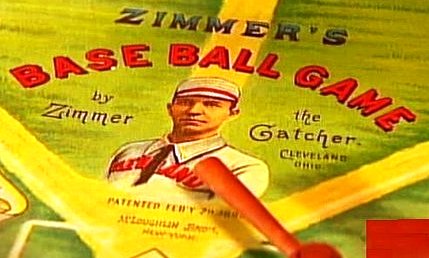
Through it all Zimmer was one of baseball’s earliest and best self-promoters.  In addition to endorsing Zimmer’s Baseball Game and his cigars, produced in what The Sporting Life said was “an extensive cigar factory in Cleveland.”  Zimmer always talked to reporters and always gave them something to write about, including his ideas for rule changes.

Zimmer's Baseball Game

Zimmer’s Baseball Game

In 1905 The Pittsburgh Press said “’Chief’ Zimmer has a scheme which he thinks would increase batting without abolishing the foul strike rule.” (The “scheme” was not Zimmer’s idea; it had been advocated by some for more than two decades, including “Cap” Anson and Zimmer’s former boss, Cleveland part owner Davis Hawley).  The plan would:

“Increase the territory of the fielders without increasing the length of the base lines…new foul lines (would be) drawn from the home plate to the fences.  At the point where they would pass first and third bases the lines would be six feet distant from the bases, gradually increasing the distance from the present foul lines as they neared the fences.”

Later he can out in favor of abolishing the foul strike rule when the issue was briefly discussed in the aftermath of the relatively low-scoring 1905 World Series.

In 1909 Zimmer suggested another rule; this one would essentially eliminate intentional walks by allowing any man on base to advance one base after a walk.  Zimmer said:

“It’s not right for a pitcher to take away Lajoie’s chance of hitting by walking him when there are men on bases.  I saw Larry passed four times in two games last fall.  He was paid to hit with the men on bases…Pitchers would have to put the ball over and the good batters would get a chance to do what they are paid for.”

Luckily like most of the other odd rule changes suggested during baseball’s first several decades, Zimmer’s “schemes” received little traction as both would have radically altered the game.  But Zimmer’s rules did succeed in accomplishing what they were most likely intended to do: they kept Zimmer’s name in the paper long after his career was over.

A final post on Zimmer and, perhaps, his greatest contribution tomorrow.

Brother Joe’s Holdout

29 Nov

Joseph Aloysius “Brother Joe” Corbett got his nickname because lived in the shadow of his older sibling—“Gentleman Jim” Corbett, World Heavyweight Champion.

Baseball was Jim’s first love, and he aspired to pro career, but his time in professional baseball was limited to about three dozen games for a variety of minor league teams from 1897-1900 when his boxing fame made him a drawing card.

Jim was very protective of Joe, and contemporaneous newspaper accounts indicate that he served as something of an agent for his younger brother.

Joe, at 19-years-old and with limited experience in college and two California-based minor leagues, was given a trial with the Washington Senators in 1895—said to be a result of Jim’s friendship with Senators manager Gus Schmelz.  Joe went 0-2 for Washington and was released.

After pitching for the Norfolk Braves in the Virginia League and Scranton Miners in the Eastern League in 1896, Corbett earned another trip to the Big Leagues with Ned Hanlon’s great Baltimore Orioles team, the O’s were 90-39, 9.5 games ahead of the second place Cleveland Spiders.

Joe Corbett

Corbett was 3-0, and won two games against Cleveland in the Temple Cup, the National League post season 7-game series between the first and second place teams.

At the close of the Temple Cup series, while Jim was in New York, Hanlon got Joe to sign a $1400 contract in Baltimore for the 1897 season.

The 1897 Orioles finished in second place, but Corbett established himself as a rising star, posting a 24-8 record.  The Orioles sent Joe a contract for $2100.  Joe returned it unsigned and demanded $3000, and according to some reports, $300 in travel expenses.

The Orioles offered to split the difference.  Joe refused.

Ultimately the parties ended up either $100 apart, or with the Orioles relenting (depending on the source).  Joe still refused, and sat out the entire season.

Some sources, like the book “Baseball Hall of Shame 4,” claim Corbett’s holdout was over Hanlon’s failure to keep a promise to buy Joe a suit for winning 20 games.  The articles from that period and the quotes from the principles would make the suit story appear apocryphal and of later vintage.

Jim Corbett blamed the dispute on Hanlon, who he felt took advantage of his brother with the $1400 contract for 1897. “Gentleman Jim” said:

“Hanlon, as you know, is the cheapest magnate in baseball…he knows very well that I would not allow Joe to sign for such a measly salary and he took advantage of my absence. “

Jim said he told his brother to “Quit Hanlon for all time.”

Joe sat out 1898.  Before the 1899 season Joe told reporters:

“I have gone out of the baseball business for good.”

Like his brother, who retired from the ring on numerous occasions, Joe would be back.

More tomorrow.

Gentleman Jim

“A Vain and Foolish Kick”

23 Nov

The Brooklyn Bridegrooms won the 1890 National League Championship by 6 ½ games over the Chicago Colts behind pitcher Tom Lovett who posted a 30-11 record.

Just three years earlier there was speculation that Lovett’s career might be over due to overwork.

Tom Lovett, 1890

Born in Providence, Rhode Island in 1863, Lovett began his professional career with Waterbury in the Connecticut State League in 1884.  He appeared in 16 games for Philadelphia Athletics in the American Association in 1885 and was in the New England League with the Lynn/Newburyport Clamdiggers.

In 1887 he signed with the Bridgeport Giants in the Eastern League and dominated the league in May and early June.  Despite getting off to a fast start (the team was 20-5 in May), Bridgeport was suffering a decline in attendance and the franchise was in trouble.

At the same time community leaders in Oshkosh, Wisconsin were determined to win the Northwest League championship, and they put enough money together to offer to purchase Lovett who was 21-3, as well as Tug Wilson, Bridgeport’s catcher and leading hitter, and shortstop Dan Shannon, the Eastern League’s leading base stealer.

Lovett was 20-2 for Oshkosh (40-7 for the season) and they easily won the championship, but he did not pitch during the season’s closing days; The Sporting Life reported that “Lovett is said to be lame in the arm.”

Despite speculation well into the next spring that his arm was permanently “lamed,” Lovett recovered and posted a 30-14 season in 1888 with Omaha in the Western Association.   In the fall of 1888 he was purchased by Brooklyn, then in the American Association.

Lovett was 17-10 in his first season with Brooklyn, and followed that with his pennant-winning performance in 1890.  He then dropped to 23-19 in 1891 as the team fell to 6th place; Lovett threw a 4-0 no-hitter in June against the New York Giants.

After the 1891 season Brooklyn attempted to cut his salary to $2800 (various sources say he either earned $3000 or $3500 in 1891).  Lovett demanded $3500 and turned down a compromise offer of $3200.

He said he could earn more money operating his tavern in Providence and chose to sit out the 1892 season.

The Sporting Life called it, “A vain and foolish kick against salary reduction.”

In this case the critics might have been correct.  The Lovett-less Grooms improved from 61-76 in 1891 to 95-59 in 1892.

Hat in hand, he returned to Brooklyn for the 1893 season signing for $2400.

Lovett pitched in only 14 games and had a 3-5 record before hurting his arm again.  The following season he pitched for the Boston Beaneaters until he was released in July.  His Major League career over, Lovett finished 1894 in the Eastern League with the Providence Clamdiggers and spent 1895 with the renamed Providence Grays in the same league.

Lovett, with Boston 1894

Lovett, most likely baseball’s first true hold out, spent the rest of his life in Providence and died in 1928.