Most fans know that the first confirmed major league unassisted triple play was turned by Neal Ball of the Cleveland Naps July 19, 1909, and that one credited to Paul Hines of the Providence Grays against the Boston Red Caps May 8, 1878 has been disputed.
What most don’t know is that the first confirmed unassisted triple play in professional baseball was turned on August 18, 1902 by Hal O’Hagan of Rochester in an Eastern League game in Jersey city, New Jersey. The New York Times called it “The Greatest Play Ever Made in Baseball.”
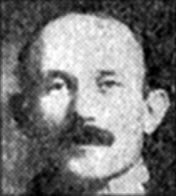
Patrick Henry “Hal” O’Hagan had two brief stays in the major leagues. He played in one game as a twenty-two-year-old rookie with Washington in 1892, and trials with Chicago and New York in the National League and Cleveland in the American League in 1902.
After being released by the Giants in mid-July, O’Hagan was signed by Rochester to manage and play first base.
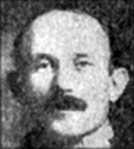
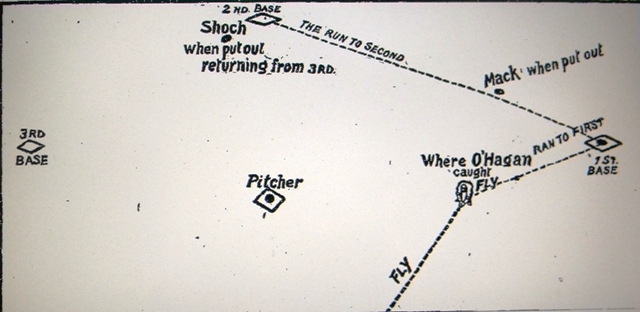
John Butler was batting for Jersey City with George Shoch on second and “Mack” on first (every contemporary newspaper account identified the runner on first this way, it was probably catcher/1st baseman Frank McManus). Butler attempted a sacrifice bunt as The Times reported “O’Hagan ran in and caught the ball within a few inches of the ground, a seemingly impossible catch.”
According to the glowing account: “Having in his quick-thinking mind the possibility of a triple play, O’Hagan, with the coolness and agility which are part of a baseball player’s earning capacity, ran back and placed his foot on the initial bag thus completing a double play.” O’Hagan then ran to second as Shoch returned from third, “It was a hot race, but O’Hagan, ball in hand, reached the bag first, thus dismissing the side.”
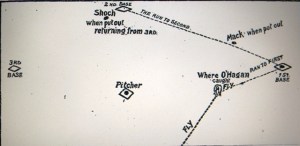
Diagram of the play published in The New York Times and several newspapers across the country
O’Hagan continued playing until 1908, finishing his career with Lynn in the New England League. He passed away on January 14, 1913 in Newark, New Jersey at 43 years old.
0.000000
0.000000
Tags: Baseball, Boston Red Caps, Cleveland Naps, Eastern League, Frank McManus, George Shoch, Hal O'Hagan, John Butler, National League, Neal Ball, New England League, New York Giants, Paul Hines, Providence Grays
 Baseball History Daily