Tag Archives: Frank Chance

“The Story of the Story Fogel Wrote”

9 Jul

The day before Philadelphia Phillies president and owner Horace Fogel was banned from baseball by his fellow National League magnates, one of the witnesses in the case against him said Fogel was being “used” by the “instigator” of the story that appeared in The Chicago Evening Post, and contributed to the action taken by the National League.

The charge seemed to confirm a rumor that swirled around the Fogel case for months; that the Philadelphia Phillies owner was acting on behalf of Cubs owner Charles W. Murphy.

Under the headline, “The Story of the Story Fogel Wrote,” William S. Forman, sports editor of The Evening Post wrote:

“Charles W. Murphy authorized me to tell Fogel that Murphy had suggested writing the story.  On this representation Fogel wrote it and signed it.  He sent it to Murphy, who read it before I ever saw it.  It came to me from Murphy’s office; and if Murphy had not approved the story it never would have been published.  The man who is morally responsible for that article and the charges it contained is Murphy himself, and I have Fogel’s own word for it that he wrote it simply “to help Murphy fight his battles” with the National League.

“It is not the first time Murphy has made Fogel the goat.  Previously Murphy had sent me another article signed by Fogel and told me Fogel had writing it, and wanted it published…Months afterward I learned that Murphy himself had writing it and Fogel had merely signed it because he was requested to do so by the Cubs’ President.  It was a defense of Murphy who had been criticised…by a Chicago baseball writer.”

Charles Webb Murphy
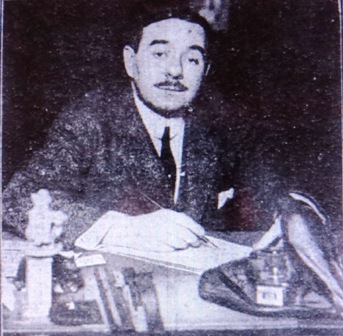
Charles Webb Murphy

Murphy, who spent his entire National League career engaged in countless feuds with fellow owners, players, managers, umpires and writers, denied the charge and said Forman was motivated to tell the story as a result of one of Murphy’s other feuds, telling reporters:

“This is a lot of rubbish; why I hardly know this man Forman, but I can guess readily that his paper is sore because we let Frank Chance go.  His paper thinks that by pounding me it will make a hit with Chicago fans, but it will find it is mistaken.“

The Associated Press said the other league owners were not buying Murphy’s explanation:

“(I)t is claimed that every magnate expects charges will be brought against (Murphy) by President (Thomas) Lynch and he may go the way of Fogel if the test votes to date are any criterion.”

Despite the rumors and the “test votes,” Murphy said “the suggestion that charges will be brought against me is all rubbish.”

Murphy was correct.  Despite the evidence, and despite his ongoing feuds with the league president and at least half of the National League magnates, charges were never brought by the league.

Murphy had another feud-filled, stormy year in Chicago in 1913.  After the season The Associated Press said:

“For the first time since the problem of pushing Charles W. Murphy out of the National League received serious consideration there is smooth working machinery ready to grip the club president and move him to a seat beside Horace Fogel. “

While a deal was being made to get Murphy out of the National League, Damon Runyon said:

“We grant you that Charles Webb Murphy should be thrown out of baseball, if only to quiet the beating pulse, and lave the fevered brow of Chicago, but we do not go to be o’ nights with a dull anger smoldering in our in’ards and we do not get up o’ mornings low in mind and spirits and feeling that out existence is is blackened and posterity besmirched because Charles Webb Murphy is still around.  We know that when they throw him out, as they doubtless will throw him out, there will be someone else ready to take his place as official Bugaboo, for there must be a Bugaboo in baseball, else we might have no baseball.”

Eventually it was agreed that Charles Phelps Taft would purchase Webb’s interest in the Cubs, and he resigned as team president in February of 1914; although it was unclear just how much the sale netted him.  Murphy said he owned 53 percent of the team’s stock and that the sale was for more than $500,000.  Frank Chance, Mordecai Brown, and others claimed Murphy “Never owned more than fifteen or twenty percent of the club stock.”

But the transaction with Taft would not be the end of Murphy.

Murphy was still owned part of the Cubs’ West Side Grounds and Philadelphia’s Baker Bowl, home of the Phillies.  In addition it was reported at the close of the 1914 season that Murphy held a mortgage on the Cubs stock, and claimed to own a controlling interest in the Philadelphia Phillies.

The Chicago Examiner said:

“Charles W. Murphy, who everybody supposes was ‘kicked out’ of baseball last spring, is not out at all, but very much in…He practically admits it himself when he does not deny controlling Cub stock , and asserts that he may take over the Philadelphia club before long… (National League President John Tener) declared some months ago that Murphy was out of the National League, now admits that Murphy may own some stock that he does not know about.

“Murphy says openly that he is Tener’s landlord, meaning that Tener is a stockholder in the Phillies and that the Phillies owe Murphy plenty of rent for their grounds.”

The Examiner said Murphy was interfering with the negotiations to sell the Cubs to Charles Weeghman, and at the same time was owed a lump sum payment of more than $100,000 by the other Phillies investors; if the payment was not received “at the stated time Murphy will foreclose and take possession of the Phillies.”

In The Philadelphia Inquirer, Phillies President William F. Baker quickly denied Murphy’s assertion that the former Cubs owner was in a position to take possession of his ballclub and that Tener ever owned stock in the team:

“It is true that Murphy and Mr. Taft own the Philadelphia ballpark, which the club has leased for a long time. But that does not alter the fact that Murphy is in no way interested in the club’s affairs…I intend to call the attention of the National League to this matter for the purpose of stopping Murphy for all time.”

William F. Baker
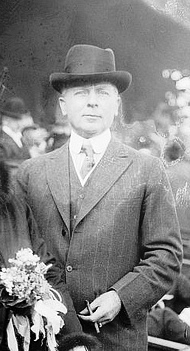
William F. Baker

By late December of 1914 Murphy was finally out of the National League for good.

As for whether Murphy was forced of baseball or left of his own accord, several recent sources point to a self-serving article Murphy wrote in “Baseball Magazine” in 1919 as evidence that he was not forced out.  Murphy, while acknowledging that Tener “was not ‘crazy’ about me,” Murphy said:

“No force was required. Despite that fact I read every once in a while that I was forced out of baseball–knocked down the back steps, as it were, and kicked into the yards behind… I sold out to Mr. Charles P. Taft and without force, but for what every other thing of value is obtained–a price. Imagine a man being forced to take $500,000 for a baseball franchise.”

Given that the $500,000 figure, while repeated credulously in countless books and articles in the last 100 years, has never been confirmed (it’s fairly certain that most of Murphy’s stake in the Cubs strictly on paper and was, in fact, Taft money, making Chance and Brown’s speculation on the value more realistic), and that Murphy conveniently left out his attempts to insert himself in the operations of two team the year after “no force was required” to remove him from the game, his protestations should be taken at face value.  Although he retained his interest in the Baker Bowl, he was never actively involved in the operations of a team again.

Murphy, who started his professional life as a sportswriter (for Taft’s Cincinnati Enquirer), managed to remain involved in baseball by writing articles about the game for “Baseball Magazine,” many, like the one quoted above, focused on restoring his reputation.

Murphy returned to Wilmington, Ohio where he financed the construction of the Murphy Theater, a landmark that still stands.  He eventually returned to Chicago where he died in 1931.  The Associated Press said he left “An estate estimated at nearly $3,000,000,” his stake in the Baker Bowl and the ownership of the theater being his largest assets.

Murphy made one last pitch to get back in the game–next week.

“Said–Tinker to Evers to Chance”

5 Jul

???????????????????????????????

Franklin Pierce Adams’ famous poem “Baseball’s Sad Lexicon” appeared in The New York Evening Mail in 1910 and immortalized Chicago Cubs shortstop Joe Tinker, second baseman Johnny Evers and first baseman Frank Chance—within three years, the above cartoon appeared in newspapers along with a new, less well-known, poem written by Adams’ colleague at The Evening Mail, James P. Sinnott.

By 1913, baseball fans became aware that Tinker and Evers had barely spoken to each other since 1905, and the rivalry among the three exploded in public.  The former teammates, now all managers, Tinker with the Cincinnati Reds, Evers with the Cubs, and Chance, the recently deposed Cubs manager, with the New York Yankees.

In February Chance told reporters that Tinker was a better player than Evers; Evers responded and accused Tinker of trying to “tamper” with pitcher Larry Cheney and other members of the Cubs, as for Chance he said:

“I do not know whether Chance is jealous of my getting the position of leader, and I do not like to think so, but from the remarks he is making, I am forced to.”

By March, Hugh Fullerton said in The Chicago Examiner that Evers was unable to control his players; he said “Chance could whip any man on (the) team—Evers can’t,” and predicted a fourth place finish for the Cubs (they finished third).  Tinker’s Reds finished seventh in the National League; Chance’s Yankees were seventh in the American.

Sinnott’s poem appeared at the end of September:

“A Manager’s life is tough!

Said Tinker to Evers to Chance—

‘A manager’s road is rough!’

Said Tinker to Evers to Chance—

‘Here are we three, a lookin’ on

The big world’s series game,

In which we once were principals,

In which we gained our fame’

‘A manager’s life is no cinch!’

Said Tinker to Evers to Chance—

I’d almost as soon be Lynch!’

Said Tinker to Evers to Chance.”

“Lynch” was Thomas Lynch, who was about to be replaced as president of the National League.

It would not be until 1924, shortly before Chance’s death that the three reconciled.  Chance had been hired to manage the Chicago White Sox, but became too ill and returned home to California; he was replaced by Evers.

Chance summoned his former teammates to California that spring, where the three spent several days together.  Chance died in September.  Tinker, Evers and Chance, were inducted into the Hall of Fame together in 1946.

Tinker, Evers and Chance

Tinker, Evers and Chance

“Mique” Fisher 2

7 May

On October 12, 1906, with the World Series between the Chicago White Sox and Chicago Cubs deadlocked at two games apiece, August “Garry” Herrmann, President of the National Commission, received a telegram from Fresno, California:

“Fresno will give $25,000 guarantee; guarantee 40,000 fans and sunshine for deciding game of World Series.

–Mike Fisher”

Fisher said the offer to bring the series and Fresno native Frank Chance to town was backed by “the businessmen here.”

It is doubtful Herrmann took the offer seriously, and it’s probably just as doubtful that Fisher took it seriously, but it was picked up by newspapers across the country, and Fisher enjoyed the publicity.

It was a last bit of publicity before his career in organized baseball ended.  Later in the month he was dismissed as manager of the Fresno Raisin Eaters, and the team was dropped from the Pacific Coast League (PCL) the following spring.

Within weeks Fisher had moved on to a new project; he announced that he was in the process of forming a team to travel to Hawaii.  The San Francisco Call said “It will be the first American ball team to make the trip across the Pacific in a little over nineteen years,” since Spalding’s world tour.

In conjunction with Jesse Woods, a Honolulu promoter, Fisher organized a tour of the Hawaiian Islands with a team of PCL stars.

Mike Fisher

Mike Fisher

Upon his return, Fisher got more ink on the West Coast, when he headed to Nevada with Charlie Irwin of the San Francisco Seals; the two met with businessmen in the mining towns of Goldfield and Tonopah to discuss forming a professional league—Fisher told The San Jose Mercury News that he was now “against organized baseball,” and if he got involved in the league “it will be an outlaw organization.”

Fisher chose not to get involved in the new league, but immediately went to work on an even more ambitious tour than the 1907 Honolulu trip.

With the sponsorship of the Reach Sporting Goods Company, Fisher would accompany a group of stars to China, Japan and the Philippines.  Early publicity promised the travelers would include Ty Cobb, Hal Chase, and Frank Chance.

When the ship set sail in November of 1908 those three stars were not on board, but “several hundred fans and friends” were present when the steamer China left the port in San Francisco to see the group off.  The team was substantially the same as the one that toured Hawaii the previous year—an aggregation of PCL stars and a few National and American League players– and consisted of: Jim Delahanty, George Hildebrand, Bill Burns, Pat Flaherty, Jack Bliss, Babe Danzig, Harry McArdle, Nick Williams, Joe Curtis, Heine Heitmuller, Jack Graney and Bill “Brick” Devereaux.

Despite the failure to land Cobb, Chase or Chance for the tour, the West Coast press applauded Fisher for even attempting the trip, The Call said:

“The undertaking which he has fathered and which is so successfully underway at the present time is a big proposition.  With the single exception of the around-the-world trip of the A.G. Spaldings years ago, nothing on as big a scale as this has ever been attempted.  To take a team of American baseball players over a journey that will total 10,000 miles before they return, to play games in China, Japan, Manila and Honolulu is something that two or three years ago would have been laughed at as an impossibility.”

The tour lasted more than three months, with the team barnstorming through Japan, China, the Philippines and Hawaii, playing local and US Service member teams.  Though reports varied, the team played between twenty and thirty games, and lost no more than four.

While they drew large crowds throughout the trip, the newspapers back home reported that the tour was a financial disaster; when the players arrived back in San Francisco on February 15, 1909 aboard the Tenyo Maru, Fisher responded to the reports:

“I hear that it has been said that the trip was a financial frost.  Well, anybody who says that is a liar.  We broke even in Japan and made money in Manila and Honolulu.  I am satisfied with the trip.”

Fisher didn’t mention the financial results in China; likely because that leg of the tour was a disaster financially.  Years later he would tell a story about the team’s experience there, complete with his usual exaggerations:

“In one game we played in Canton we had 150,000 people inside, and as the gatemen had been instructed to accept Chinese money it required the combined efforts of the entire team to tote the money up to the hotel.  A special staff of accountants was busy all night totaling it up and in the morning we discovered we had $46.15.”

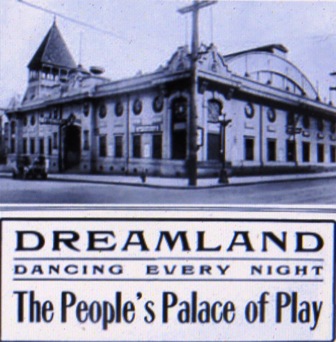
Fisher promised to take a team to Australia the following year.  The trip never took place; instead Fisher purchased a Seattle dance hall called the Dreamland, and quickly became the target of the pious women of the city.  Early in 1910 Fisher was indicted by “The King County grand jury, as a direct result of the activity of the Women’s Clubs,” for violating liquor laws, allowing “unescorted women” into his dance hall, and other assorted charges.  A special prosecutor, Justice William Henry White, one of the most respected jurists in Washington State, was appointed to prosecute Fisher and other club owners targeted by the women.

Ever the promoter, Fisher used the indictment to promote his dance hall and rally public support.  After the indictment was handed down Fisher sponsored a “Sermon in the Dreamland rink.”  According to The Seattle Times, Fisher engaged Reverend Frank Herthum, who “has liberal ideas about amusements.”

Mike Fisher's Dreamland Dancehall, Seattle

Mike Fisher’s Dreamland Dance Hall, Seattle

Herthum preached, and Fisher presented a free vaudeville show.  The paper said Fisher had stirred up a “protest against the effort to close the dance hall without having provided a substitute where clerks, servant girls and employees in the shops may pass an evening to their liking.”  At the same time The Times noted that the prosecutor was becoming impatient with the women who brought the charges because they continually promised to provide evidence that “has not yet come to light.”  The charges were quietly dismissed within weeks.

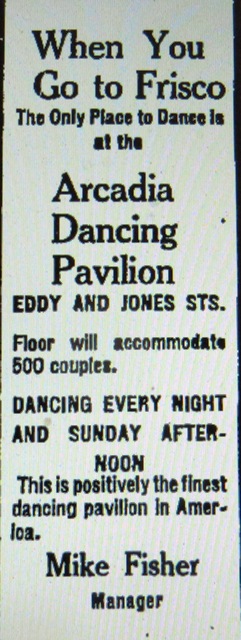
Fisher left Seattle sometime in 1911 and began operating the Arcadia Dance Hall in San Francisco.

Advertisement for Fisher's Arcadia Dancing Pavilion.

Advertisement for Fisher’s Arcadia Dancing Pavilion.

In January of 1917 Fisher made headlines in California when he announced that he was directing an effort to restart the California State League, which had folded after the 1915 season.  He said he would have clubs in Sacramento, Fresno, Stockton and San Jose.  Within two weeks Fisher abandoned the plan.  The San Jose Mercury News was not surprised:

“Mr. Fisher, the wonderful getter of publicity, has his publicity and is through.  Probably he has done wonders for his dance emporium or whatever it is he runs.”

The following year the San Francisco Seals of the Pacific Coast League came on the market; the first name reported as a potential buyer was Mike Fisher.  Fisher again got his headlines, but it was his old friend Charlie Graham who got the team.  Graham, and a group of investors purchased the Seals and the former catcher was installed as manager.

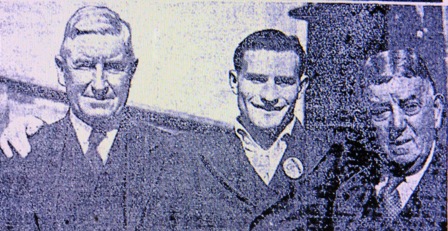
Charlie Graham, left, Mique Fisher, right, with World Middleweight Champion and actor Freddie Steele.

Charlie Graham, left, Mique Fisher, right, with World Middleweight Champion and actor Freddie Steele.

With his friend in charge The Mercury News said Fisher became a fixture “around the San Francisco ballpark ever since Graham bought in on the Seals in 1918,” he would remain a fixture at Recreation Park, and later at Seals Stadium for more than 20 years , and continued to provide copy for West Coast s sports writer

As a result of his friendship with Graham, who recommended he get the honor, 77-year-old Fisher was selected to travel to Cooperstown to represent the PCL at baseball’s centennial celebration in 1939.  The man who so loved seeing his name in the paper  received headlines one more time, when he died in San Francisco on June 6, 1943.

Murphy Calls Out an Umpire

12 Oct

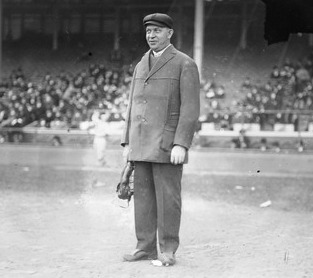
Three years before Chicago Cubs President Charles Murphy ousted legendary manager Frank Chance, he picked a fight with the most powerful and respected umpire in baseball.

In September of 1909 the second place Cubs had just taken three of five games from the league-leading Pirates in Pittsburgh.

On September 9 Murphy filed a formal protest with the league over the fourth game of the series (won by the Pirates 6-2) charging that umpire Bill Klem “(D)eliberately acted as a conspirator, robbing the Cubs of any reasonable chance for victory.”

The Cubs had argued several calls by Klem during the game and Manager Frank Chance and Cubs’ infielders Joe Tinker and Harry Steinfeldt were fined for comments made to the umpire.

Murphy questioned Klem’s honesty and demanded that he not be allowed to serve as umpire in any games played by his team and that the game be replayed.

Klem was an unlikely person to have his integrity questioned.  Generally credited with professionalizing umpiring, he had come forward with fellow umpire Jim Johnstone the previous season to report they had been offered a bribe to help determine the outcome of the October 8 Cubs game with the New York Giants to decide the pennant (the make-up game for the September 23 “Merkle’s Boner” game).

While the league never released specific details of the bribe attempt, the allegations made by the umpires were found to be true and barred the “unnamed conspirators” from any Major League ballpark. Both umpires were commended by the league for demonstrating to the “American public the honesty and integrity of our national game.”

League President John Heydler (appointed after the suicide of Harry Pulliam) immediately announced his support for Klem in the dispute.  Murphy responded by announcing he would ensure Heydler would not be reappointed president of the league that winter—Murphy would be successful spearheading the effort to replace Heydler.

Murphy was never able to cite any specific reasons for his charges and was pressured to drop the protest, which he eventually did, but Klem remained indignant and asked to have his name cleared.  According to newspaper reports:

“The umpire does not propose to let the matter rest.  He considers that his reputation has been attacked, and he therefore will ask the league to investigate him.”

There’s no record that the investigation was ever conducted.

Klem attended that year’s winter meetings in order to be on hand when Murphy was pressured to make a formal, public apology.

Chicago Cubs President Charles Murphy

More on Murphy and his feuds in the coming weeks.

Demon Rum–or Demon Rum as an Excuse to Replace a Popular Manager

8 Oct

The 2011 Boston Red Sox were only the latest in a long history of alcohol taking the blame for a team’s poor performance.

As the Chicago Cubs faded into third place during the waning days of the 1912 season, team president Charles Murphy issued an order for “total abstinence” and all players would have a temperance calls in future contracts.

The move was not unprecedented—since 1909 Barney Dreyfus of the Pittsburgh Pirates had required his players to sign a temperance pledge.  What made Murphy’s order so newsworthy was that over the course of several days he issued numerous, often contradictory, “clarifications” and because it quickly became apparent the move was a intended to wrest control of his ballclub from Manager Frank Chance.

Murphy’s original statement said that “loose living and training methods” led to the team’s poor finish. At the same time he provided cover for popular Cub outfielder Frank Schulte who had been suspended by Chance in September his nighttime activities during a crucial August road trip in Cincinnati.  The Cubs lost three of four games to the Reds and fell out of contention.    Murphy’s statement presented Schulte as a man incapable of any personal responsibility:

“I desire to say that in my judgment Schulte has been more sinned against than sinner…from what I could gather he was a victim of too many so-called friends…if we had a rule similar to that in vogue in Pittsburgh this player could not have been led into temptation.”

Chicago Cubs President Charles Murphy

The implication being that Chance had perhaps overreacted by suspending “the more sinned against” Schulte.  This statement was further complicated by Murphy’s several “clarifications,” some of which seemed to support Chance’s decision while some did not.

Chance quickly defended his players and his reaction to Murphy revealed just how bad the relationship was between the team president and his manager:

“Murphy only thinks of the team when it’s winning…his statement reflects upon me personally, and I have been in the business too long to allow Murphy or anyone else to insult me.”

Making matters worse, and calling Murphy’s motives into question was that Chance issued his response from a hospital bed in New York.  As a result of being hit in the head by numerous pitches throughout his career, Chance had developed a blood clot near his brain and had undergone surgery just a few days earlier.

Murphy didn’t hesitate to use Chance’s health issues against him.

A month earlier, plagued by doubts about his condition and suffering from severe headaches, Chance had suggested to Murphy that he might not be able to manage the Cubs in 1913.  At the time Murphy told his manager to wait until after the surgery to make a decision about his future.  Now he was using that conversation to assert that Chance had issued his resignation.

Once Murphy began claiming Chance had, in effect, quit in August the Chicago media which had almost universally supported the “abstinence pledge” called foul.  The Chicago Tribune and Chicago Examiner both said Murphy was using the conversation and the pledge as cover to run the legendary Chance—who led the Cubs to four pennants and two World Championships—out of town.

Chance went.  But he didn’t go quietly.

The manager had acquired 10 percent of the Cubs, shares Murphy had been trying to purchase for more than a year.  Chance sold the shares to Harry Ackerland a Pittsburgh investor who President Murphy did want owning part of his team.  Despite Murphy’s efforts to block the sale, it went through.

Chance was claimed on waivers by Cincinnati, but after the Reds acquired Joe Tinker from the Cubs and named him manager, Chance was waived to New York, where he became manager of the Yankees.

Chance led the Yankees for two losing seasons, managed the Los Angeles Angels in the Pacific Coast League in 1916 and ’17, and closed out his career with one dismal season in Boston; the Red Sox finished 61-91 under Chance.

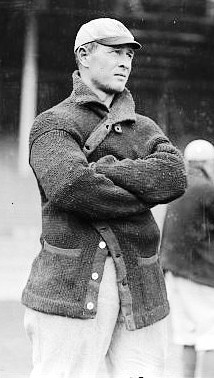
Frank Chance

Johnny Evers was named Cubs manager for the 1913 season—the Cubs again finished third.

From the day Murphy issued his initial statement until Chance died in 1924, “The Peerless Leader” never missed an opportunity to take a shot at Murphy.

When the Cubs were sold to Cincinnati publishing magnate Charles Phelps Taft (President William Howard Taft’s half-brother) before the 1914 season Murphy claimed that he had made more than a half million dollars on the deal.  Chance and former Cubs pitcher Mordecai Brown (who had his own feud who Murphy who released him after the 1912 season, allegedly without giving Brown money he was owed for playing in that year’s “City Series” with the Chicago White Sox) quickly responded.  Both players confirmed what had long been rumored—that Murphy had been bankrolled by Taft who retained a majority of the shares.   Murphy, said Chance, “Never owned more than fifteen or twenty percent of the club stock.”

Both players also charged that Murphy’s treatment of his players was a primary reason for the formation of the upstart Federal League—at best an oversimplification of the conditions which led to Major League Baseball’s last “third league.”

Another Charles Murphy feud later this week.

.