Tag Archives: Fred Pfeffer

“There is a Constant fear that Someday the Men will Decline to go on the field.”

31 Mar

The St. Louis Maroons were a big league franchise for just three seasons.  After winning the inaugural (and only) Union Association championship in 1884, the team was absorbed into the National League and was a dismal 36-72 in 1885, and 43-79 in 1886.

The club disbanded after the ’86 season and throughout the winter there was speculation about whether the franchise would end up in Kansas City (where local businessmen were looking to replace the Cowboys, who also went broke after the ’86 season) and Indianapolis.

The deal was finalized on March 8 when the franchise and nine players were sold to Indianapolis.  The Indianapolis News announced on the front page:

The Base Ball Deal

It Is Finally Completed

The story said:

“There is general rejoicing about the city over the certainty of having a league baseball club here.”

The team would be called the Hoosiers, and play at the Seventh Street Grounds, a ballpark owned by local businessman John Tomlinson Brush.
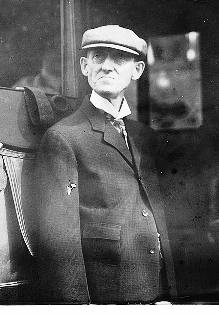
John T. Brush

John T. Brush

Brush was the driving financial force behind the deal and had been involved in local baseball in Indianapolis for several years, first having financed and organized a local amateur league in the city in order to promote his business—the When Store, and later the When Clothing Company—he was also an investor in the short-lived 1884 incarnation of the Hoosiers who struggled through one twelfth-place (29-78) season in the American Association.

The Hoosiers first year was unsuccessful and chaotic.

The first manager was George Walter “Watch” Burnham, who had been a National League umpire for 41 games in 1883 and one in 1886.  His role in the effort to acquire the franchise, his selection as manager, and the manner in which he acquired his nickname, gave some pause about the seriousness of the Indianapolis operation.
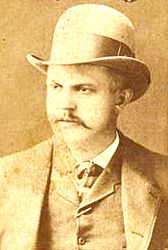
"Watch" Burnham

“Watch” Burnham

The Chicago Tribune said:

“The promoter of the Indianapolis movement is George W. Burnham, known as “Watch” Burnham.  At Cleveland, in 1883, while acting as a league umpire, he endeavored to establish himself in the public esteem by buying a watch, having ‘Presented to George W. Burnham by his friend and admirers’ inscribed on it, then having it sent out to him on the field during the progress of the game.  It is not surprising that some of the league people are suspicious of the Hoosier effort.”

Brush was not the team’s original president, that duty fell to a local attorney named Louis Newberger who spent his entire two-month tenure in the position complaining that he had no time to run the team; Brush took over as president in late May.

The Hoosiers limped to a 6-22 start—no doubt aided by 22 straight road games from May 5 through May 30.  Burnham resigned once, just five games into the season, but returned a few days later.  By mid May, as the team struggled through their endless road trip, The Chicago Tribune said a mutiny was expected:

“The dissatisfaction on the part of the players with Burnham, the manager, amounts almost to insubordination and there is a constant fear that someday the men will decline to go on the field.”

The Tribune said Burnham had fined “the entire team,” and Captain Jack Glasscock “said he would be black-listed before he would play again under the management of Burnham, but was finally prevailed upon to do so.”
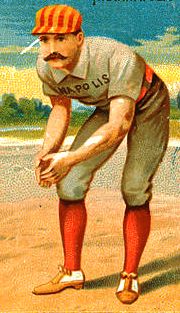
Jack Glasscock

Jack Glasscock

Upon the team’s return to Indianapolis Burnham was replaced with team secretary Fred Thomas.  Thomas, like Burnham, had no professional experience as a player or manager, and his tenure was not much more successful.  The club lost 18 of 29 games with him at the helm.

The team’s third manager also had no previous professional experience.  Horace Fogel was a sportswriter for The Philadelphia Press when he was tapped to be the third manager.  The Indianapolis News said hopefully:

“Mr. Horace Fogel, the new manager, is a good-looking young man, and makes a favorable impression on a stranger.  He is evidently very anxious to make the club a winner.”

The same July day The News opined on Fogel the paper also noted that maintenance of the ballpark had also angered some fans:

“Very unwisely the management had the chairs in the gallery varnished recently and yesterday several ladies had their dresses ruined.”

Things were no better under Fogel.  The Hoosiers went 20-49 under their third manager, and finished their inaugural season in eighth place with a 37-89 record.

The News said:

“Staring out under unfavorable circumstances…with inefficient management throughout the season, and many more defeats than victories, the club nevertheless, was accorded a generous support.”

The 1888 season became a matter of civic pride for the team’s ownership, local businesses and the newspaper.

In January it was announced that the Hoosiers would have a manager with at least some experience.  Harrison “Harry” Spence had played and managed in, among others, the Eastern, Northwestern and New England Leagues.  The News said of the new manager:

“A number of ball players of various clubs, who know Harry Spence…speak very highly of him.  Sam Thompson says he is a thorough gentleman, well liked by the players, and a fine manager.”

The News said the success of the Hoosiers was necessary for the future Indianapolis:

“Business and professional men are all interested in it, for, aside from the pleasure they derive from witnessing the games, they recognize the fact that the club is of great benefit in advertising the enterprise and prosperity of the city.”

The paper organized a campaign called “Boom for Baseball.”  Sixty-eight local businessmen “representing the leading establishments in the city,” donated their advertising space back to the newspaper “for the purpose of setting forth the advantages that will accrue to the city, from the maintenance of a National League Baseball Club here.”

Brush told the paper:

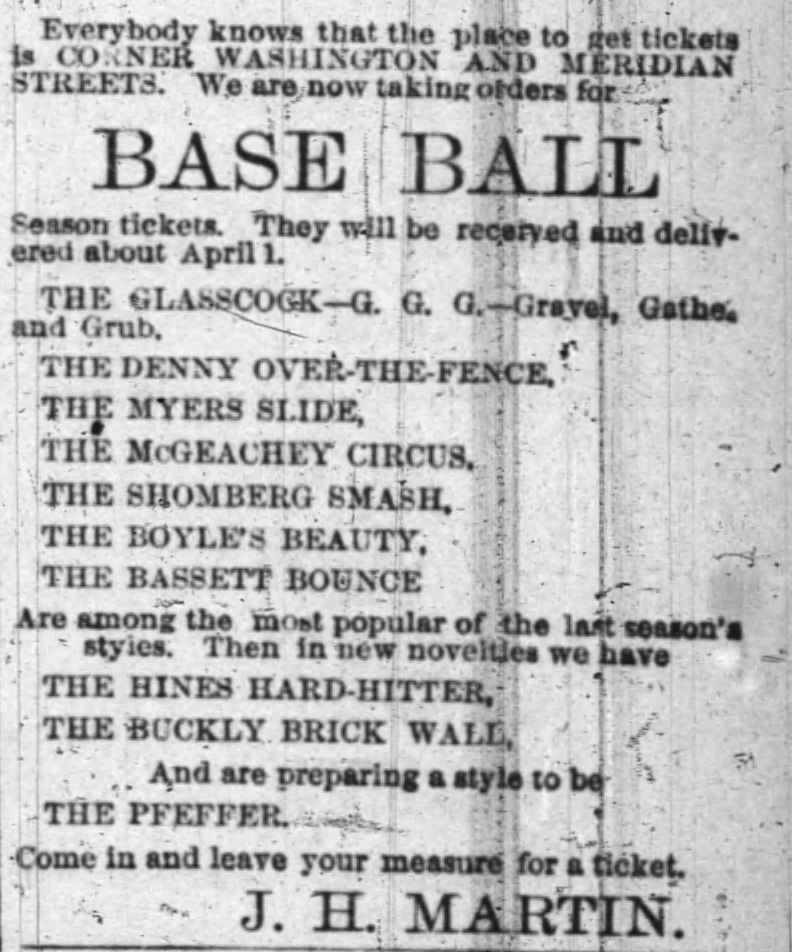
“We want at least five hundred subscribers for season tickets, and with this as a guarantee, we can get the money we want.  If any such player as (Fred) Pfeffer or (Larry) Twitchell can be bought we can and will buy him, and we can get the club in first-class shape for opening the season.”

Season tickets were sold for $25 each, and Brush said “We will have a grandstand that will be a beauty, with all the latest improvements, so that there will not be one uncomfortable seat in it.  Then we will have a space set aside for carriages and a special department for ladies and their escorts.”
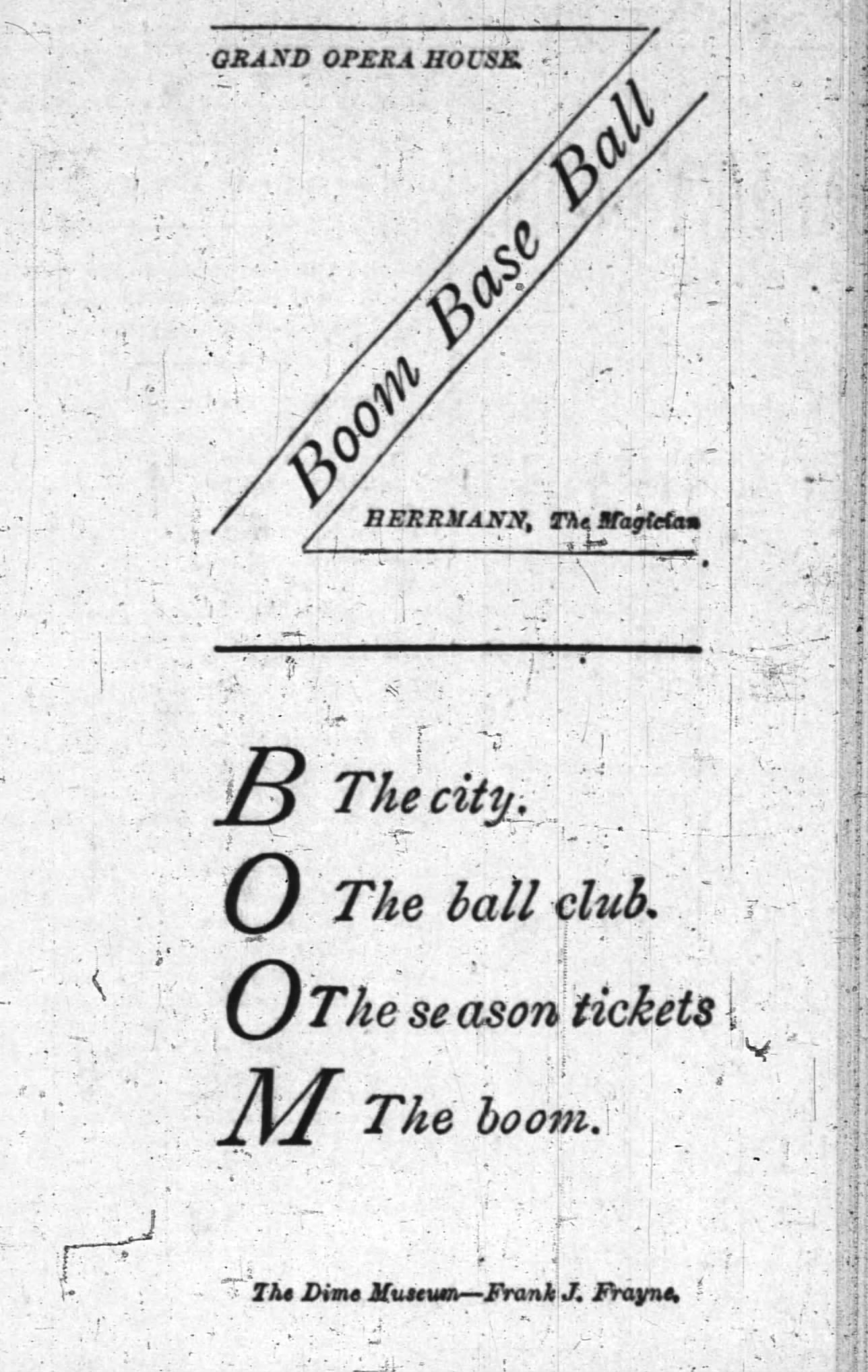
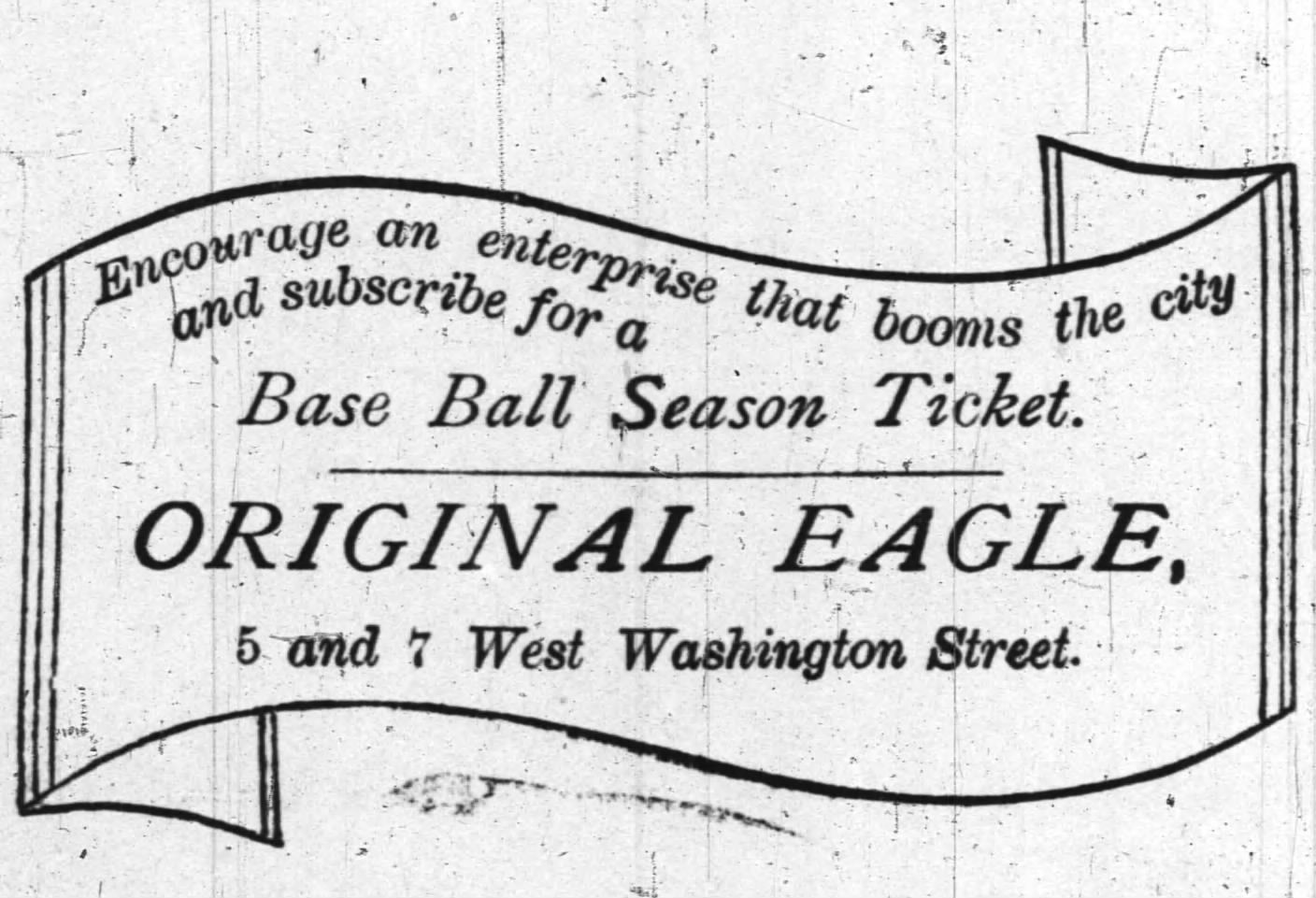
88indy4 88indy2

Some of the advertisements from Indianapolis' "Baseball Boom"  campaign

Some of the advertisements from The Indianapolis’ News’ “Baseball Boom” campaign

Most importantly, Brush assured the people of Indianapolis that they “would have a ballclub here that nobody would be ashamed of.”

He was wrong.

While not as bad as 1887, the Hoosiers got off to a 2-11 start, and struggled to a 50-85 seventh place finish, 36 games behind the champion New York Giants.

By 1889 Indianapolis had all but given up.  The team nearly went under before the season started.  In January a headline in The News said:

The Ball Club Gone

With debts of more than $5,000, the paper said Brush would “surrender the franchise” to the league.  Brush was able to raise enough capital to keep the club operating for one more sub .500 season (59-75), and another seventh place finish.  The only highlights for Indianapolis in 1889 was the arrival of 18-year-old Indiana native Amos Rusie, who posted a 12-10 record, and Jack Glasscock who hit .352, for the Hoosiers.

The team was dropped after the 1889 season, but not because of money.  The National League bought out Brush’s Hoosiers and the Washington Nationals.  Brush received a reported $67,000 for the team, he also received stock in the New York Giants as payment for former Hoosier players.  One year earlier when The News reported that Brush was on the verge of losing the team, the paper claimed “the franchise is now worth $15,500 cash.”  While that figure might have been low there was no doubt that Brush did well on the deal.  A year later he was president and majority stock holder of the Cincinnati Reds.

Indianapolis would only be a major league city one more time; in 1914 the Hoosiers were champions of the Federal League, but were relocated the following season, becoming the Newark Peppers.
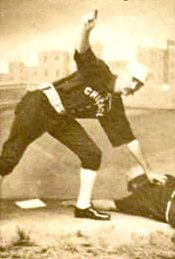
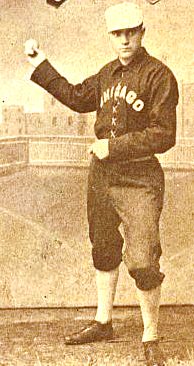
“Sunday was not a ‘real’ Ball Player”

15 Jan

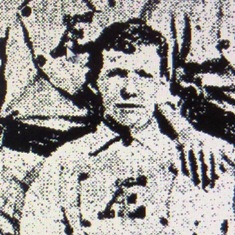
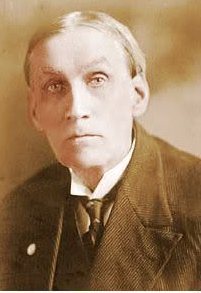
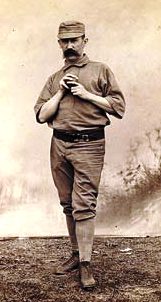
Fred Pfeffer, a member of the Chicago White Stockings “Stonewall Infield” in the 1880s, became the proprietor of a number of popular saloons in Chicago.  He opened Pfeffer’s Theater Court Buffet on State Street in 1911; the tavern, located in the alley between the Majestic and  McVicker’s Theaters, was a popular meeting place for athletes, vaudeville performers and newspaper reporters.

Fred Pfeffer

Fred Pfeffer

In 1912 Harvey Woodruff of The Chicago Tribune was present when Pfeffer and Jimmy Ryan held forth on some of their teammates:

Billy Sunday was the only successful ‘made’ ball player I ever heard of in the history of baseball.  Not a man on our team except (Cap) Anson had any confidence in Sunday when he joined the club (in 1883), nor for a long time afterward, for that matter.  Anson liked Sunday because he was like lightning in getting to first base.  Sunday was not a great hitter.  He could scarcely be called a great fielder, but he was the fastest man of his time in legging it down to first base.  My, how he could run!  But after Billy was on first I would sooner have had Anson there, and none of us accused Anse of being the best base runner of his time.  We thought Billy was too daring.

“But Anson insisted Sunday would make a ball player.  So he was taught to bat, to field, and to run bases.  Anson spent more time with him than with all the rest of us put together.  What skill Sunday attained was developed.  Most of us finally admitted that Anson’s judgment was justified, but others on the team retained to the last their opinion that Sunday was not a ‘real’ ball player.

“Those who obstinately kept that opinion might have been influenced in part by prejudice, for those were times when team discipline was not as severe as now, and Sunday chose his companions.”

Billy Sunday

Billy Sunday

Pfeffer told The Tribune reporter that Ned Williamson had the best arm he had seen.

While playing as an amateur in his native Louisville in 1881 Pfeffer had “won a gold medal, which is still in his possession for throwing a ball 400 feet.”  After joining the White Stockings he participated in a throwing contest at Chicago’s Lake Front Park “and threw the ball 399 feet and six inches.”  He was beaten by six inches by Williamson.

The mention of Williamson’s arm strength reminded Ryan of “an incident of the trip around the world taken by the White Stockings” after the 1888 season:

“Following one of the exhibitions in England, some native cricketers were holding a competition in throwing a cricket ball.  A crowd circled the field beyond the range of the throws, taking a keen interest in the sport.  Williamson, who had not allowed his baseball duties to prevent his enjoyment at a nearby pub, watched the proceedings for a time with growing impatience.

“Finally, swaggering up to the circle, Williamson said: ‘Let me take that ball for a minute.’ Then, scarcely setting himself for the effort, he hurled the ball.  It soared clear over the heads of the crowd on the outskirts. “

Ryan claimed no one knew exactly how far Williamson’s throw traveled because “everyone was so surprised (by the distance of his throw) no attempt was made even to recover the ball.”

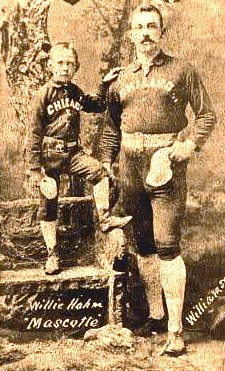
Ned Williamson with White stockings mascot

Ned Williamson with White stockings mascot

The subject next turned to bunting.  Pfeffer said

“We knew the bunt, but seldom practiced it.  Those were the days when long hits were wanted, and the play would not have been popular.  We more often played a variation of what is known now as the hit and run.  It seems to me there were more players who could hit to right field then.

“I often have been asked whether all the great hitters of that time were swingers who clasped their bats at the end of the handle.  I do not recall that we held our bats any differently from the players of today.  Some held it near the end and some did what you now call ‘choking it.’ I think, perhaps the proportion of chop hitters was less then, for everyone liked to see long drives.”

Pfeffer continued entertaining patrons and reporters at the Theater Court Buffet until the passage of the Eighteenth Amendment put him out of business—his obituary said he sold “bar and all” for $1.50.  Pfeffer died in Chicago in 1932.

Sam Barkley and the Mobster

29 Oct

Samuel W. Barkley’s brief career on the diamond was highlighted by two legal disputes over his services; his life off the field was more complicated and interesting.

Barkley rose from amateur and semi-pro teams around Wheeling, West Virginia, to a solid season (.306, league-leading 39 doubles) as a 26-year-old rookie with the Toledo Blue Stockings in the American Association in 1884. Among his teammates in Toledo were Fleetwood and Welday Walker.

Toledo was only a major league franchise in 1884—The Toledo Blade said the team had lost “nearly $10,000–and disbanded,” selling five players, including Barkley, to the St. Louis Browns—the sale included pitcher Tony Mullane, who attempted to sign with Cincinnati after agreeing to sign with St. Louis, leading to his year-long suspension. By the time all the legal wrangling was done, only Barkley and Curt Welch reported to the Browns.

After a .268 season in St. Louis, owner Chris Von der Ahe sold him to the Pittsburgh Alleghenys, but Barkley had already signed a contract with the Baltimore Orioles. The American Association suspended and fined Barkley; Barkley sued. The dispute was settled with Barkley being reinstated and Pittsburgh paying the fine on his behalf.

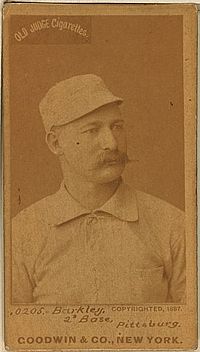
Sam Barkley

Sam Barkley

After two years in Pittsburgh, he was purchased by the Kansas City Cowboys, and that’s when his life got more interesting.

In Chicago, he met an 18-year-old woman named Dora Feldman, who followed him to Kansas City, where as The Toledo News-Bee said, “most of his money was thrown at the feet of the young woman.”

The Chicago Inter Ocean said Barkley claimed, that the day before he married Dora, “she went to her room in a Kansas City hotel and took poison, fearing he would not marry her.”

Despite the suicide attempt, the two married.

He hit just .216 in 1888 but was hitting .284 the following year when he was sold to the Toledo Black Pirates in the International League. After just 50 games there his career was over. At some point during the 1888 season he suffered a knee injury he said ended his career:

“I knocked a safe one to left field, and was dancing around between first and second bags when (Mike) Mattimore, the Philadelphia (Athletics) pitcher attempted to catch me napping. He ran to the base line, and as I attempted to slide back to the first bag he unintentionally gave me the ‘knee’ and it injured severely the knee cap on my left leg.”

With his playing days behind him, Barkley, who was reported to have made as much as $1,800 a season with the Alleghenys, returned to Pittsburgh with a young wife who had aspirations to be an actress and opened a cigar store.

It didn’t end well.

After just more than a year in business, The Pittsburgh Press said Barkley’s store on Smithfield Street closed by order of the sheriff, due to “claims aggregating $3,600.”

The couple moved to Chicago.

Initially, things went better there.

Barkley opened a tavern at 292 West Madison Street, and he and Dora had a son who was born around 1895.

Shortly after they returned to Chicago Dora met Chicago’s first crime boss Michael Cassius “Mike” McDonald.

Richard Henry Little of The Chicago Tribune said McDonald, “never held office but ruled the city with an iron hand.”

McDonald built a gambling and protection syndicate, controlled the Garfield Park racetrack, and solidified his control of the city as leader of the local Democratic Party. He was also heavily involved in legitimate businesses—he owned The Chicago Globe newspaper and financed the building of Chicago’s first elevated rail line.

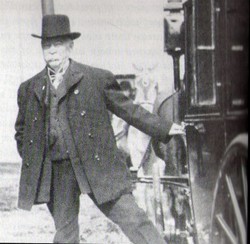
Mike McDonald

Mike McDonald

Years later Barkley told The Inter Ocean about his wife’s first meeting with McDonald:

“She was introduced to him at a box party in McVicker’s Theater shortly after the close of the big fair (World’s Columbia Exposition), in 1893…I remember the night distinctly. Dora came home to our place at 319 Washington Boulevard and told me that she had met a very fascinating old man (McDonald was 44), who was reputed to have a lot of money.

“’Watch me get a piece of that money,’ Dora said to me, jestingly, and fool that I was I laughed at the supposed joke.”

Dora Feldman Barkley McDonald

Dora Feldman Barkley McDonald

There are several versions of what happened next. One involves an elaborate (seemingly too elaborate) story that suggested Barkley was lured by a friend of McDonald into a compromising position involving women and drugs—only to be “caught” by his wife. The more likely version was that he was simply paid off—The Inter Ocean said he received $30,000 to divorce Dora.

Barkley never acknowledged receiving the money and only said:

“(Dora and McDonald) had planned between them to oust me, and no matter what I might have done, it would have been all the same in the long run. With his money and his influence, McDonald could put it over me any time he wanted.”

Dora eventually became McDonald’s second wife in 1898, (his first wife, who once shot a police officer—she was acquitted—had eloped to Europe with a soon to be former priest).

By 1897, Barkley had opened a new tavern at 15 North Clark Street, which was frequently in the news.

Sam Barkley

Sam Barkley

The Chicago Tribune called it a “notorious saloon,” and The Chicago Daily News reported on several occasions that the bar had its license revoked temporarily for various criminal activities and violations; in 1900 The Inter Ocean said a grand jury report was “almost an indictment of the city administration for its toleration of the dives, all-night saloons, and resorts for thieves and the depraved.” Of Barkley’s location the grand jury said:

“Men and women drinking, swearing and carousing, with music; open after midnight in the past. Several murders have been committed in front of this door.”

As with all such “clean-up” drives during that era in Chicago, nothing came of the grand jury report.

Dora again made headlines in 1907—and as a result so did her ex-husband.

The Inter Ocean said:

‘Mike ‘ M’Donald’s Wife Kills Artist in His Studio

“Dora McDonald, wife of Michael C. McDonald, millionaire, politician, traction man, and ex-gambler, shot and killed Webster S. Guerin, an artist, behind the locked doors of his studio in the Omaha Building, LaSalle and Van Buren Streets yesterday.”

Barkley was quickly contacted by reporters and told his sad story of how Dora had left him. The paper said:

“The story that Sam Barkley slowly grieved his life away over the loss of his pretty wife is disproved by the discovery of Sam Barkley alive and prosperous in Chicago today.”

Dora McDonald was eventually acquitted, but Mike McDonald did not live to see it, he died during her trial.

Barkley fell on hard times in Chicago soon after the killing. In August of 1908 a six-inning benefit baseball game was played at Comiskey Park between two Chicago City League teams–“Nixey” Callahan‘s Logan Squares and the Rogers Parks–“to raise enough money to start him in the cigar business.”

The Chicago Examiner said, “A fair-sized crowd turned out.”

Fred Pfeffer played first base for the Rogers Parks and “was the hero of the game with two hits besides fielding in grand style,” another former big leaguer, Emil Gross, served as umpire.

Shortly after that Barkley was operating a cigar store in his hometown, Wheeling, West Virginia.

There was one last chapter in the Barkley story. Soon after he returned to West Virginia he was living in poverty and became ill, and died on April 20, 1912. The Chicago Daily News said several days before his death a former baseball acquaintance was summoned to his side:

Billy Sunday called on him. He talked baseball for a while and then religion. At the end Sam liked both equally well.”

Billy Sunday

Billy Sunday

Dora McDonald was contacted for a comment:

“It is a closed incident—it’s so long ago that I knew him. But I’m sorry.”

She eventually married a doctor, moved to California and died in 1930.

“The Sudden Reappearance of ‘Silver’ King”

27 Jun

Oliver Perry “O.P.” Caylor wrote in June of 1896 in The New York Herald:

“One of the baseball surprises of the season is the apparently successful reappearance of ‘Silver’ King upon the National League diamond.  Without any warning the Washington club sent him in against the Pittsburgh team, and he not only won his game, but held the latter down to six hits, Of course all this caused a great deal of gossip wherever baseball is a subject of interest.”

When Charles Frederick “Silver” King (born Koenig), took the mound for the Washington Senators and beat the Pittsburgh Pirates 8 to 1 in the second game of a May 30 doubleheader, it was his first appearance in professional baseball in nearly three years.

King had been one of baseball’s best pitchers of the 1880s, with a 142-70 record from 1887-1890 while playing for Charlie Comiskey, first with the St. Louis Browns in the American Association and then following Comiskey to the  Chicago Pirates in the Players League.

Comiskey (8) and pitcher Silver King (14) with the 1888 St. Louis Browns, King would follow Comiskey to the Chicago Pirates in the Players League in 1890

Comiskey, seated center(8) and Silver King standing second from right (14) with the 1888 St. Louis Browns, King would follow Comiskey to the Chicago Pirates in the Players League in 1890

Caylor said that during Flint’s heyday:

“His most successful delivery was what is known as ‘the cross fire,’ first used effectively, I believe, by (Charles “Old Hoss”) Radbourne and at present the prominent stock in trade of (Wilfred “Kid”) Carsey of the Philadelphias (Phillies).  It consists of standing on the extreme end of the pitcher’s plate, stepping away still farther from the direct line towards the batsman and sending the ball across the home base at an angle, which, although small, is very bothersome to the man with the bat.”

Silver King

Silver King

Caylor said King was “put out of the business” in 1893 when “the pitcher’s box was set back five feet,” (to the current 60’ 6”).  While King’s record slipped during the last two seasons the distance was 55 feet to a combined 36-53 while pitching for the Pirates and New York Giants, he had respectable ERAs of 3.11 and 3.29.  After the rule change King went 8-10 with a 6.08 ERA pitching for the Giants and Comiskey’s Cincinnati Reds in 1893, and then disappeared.

Caylor thought there was “a great deal of significance to King’s return to the diamond,” and predicted a trend:

“It means managers, having exhausted the new crop and finding nothing before them worth a trial, are forced to look behind and try to rekindle some of the half burned out embers. Washington not only took up King, but they gave (Les) German a trial after the New York club let him go.  (Cap) Anson (Chicago Colts) went back to (Fred) Pfeffer after finding (Algernon “Algie”) McBride, (Josh) Reilly and (George) Flynn wanting and was even forced to put himself into his nine to fill out the weak spots.”

Caylor said it was “astonishing  to look over the list of new material which was brought into the National League last spring and notice how small a part of it has been able to keep ‘in the swim.’  Every day one hears that some younger player has been released or that another has been loaned or farmed to a minor league club.”

Caylor’s prediction of success for the “trend,” and the players named was a mixed bag.  Anson, who had never really gone away, hit .331 in 108 games, for the Colts, but Pfeffer hit just .244 in 94 games. German fared the worst, he was 2-20 in 1896 and 3-5 the following season before being released in August.

King managed to post a 16-16 record for the Senators in 1896 and ’97 but never found his early career form.  After the 1897 season, he returned to St. Louis where he died in 1938.

Caylor would become ill the following season, and died in October of 1897.

The Curve and The Spitter

26 Jun

Hugh A. “Hughey” Reid only appeared in one professional game; he went 0-4 and played right field in a game for the American Association’s Baltimore Canaries against the White Stockings in Chicago in August of 1874,  as was the practice at the time, Baltimore recruited Reid, a local semi-pro player to fill in for the injured Oscar Bielaski.

Reid wasn’t known in the amateur and semi-pro leagues in Chicago as an outfielder.  He was considered one of the best pitchers in town, and played for the Chicago Aetnas, one of the premier teams in the city, and according to The Chicago Tribune “The champion amateur team of 1869.”

Hugh Reid

Hugh Reid

Among Reid’s teammates with the Aetnas were future big leaguers Jimmy Hallinan and Reid’s brother-in-law and catcher Paddy Quinn.

Reid worked as a stereotyper (made metal printing plates), for The Chicago Evening Post after his career ended.

In 1920, Reid was interviewed by Alfred Henry “Al” Spink, founder of The Sporting News.  By 1920, Spink, who had played amateur baseball in Chicago against Reid with a team called the Mutuals (named for the more famous aggregation in New York), had relocated to Chicago and was writing for The Evening Post.

Al Spink

Al Spink

The occasion was “field day exercises of the old timers” at Pyott Park at the corner of Lake Street and Kilpatrick Avenue in Chicago; the days events were followed by a banquet.  “Cap” Anson, Charles Comiskey, Hugh Nicol, and Fred Pfeffer were among the dozens of former pro, semi-pro, and amateur players who attended.

Spink described the 70-year-old Reid; “same old smile, same old swagger, same old don’t care a tinker’s, same old Hughey.”

Nine years earlier Spink had credited William Arthur “Candy” Cummings with originating the curveball in his book “The National Game,” but by 1920 others were making the case for different candidates.  Spink asked Reid his opinion:

“Without a doubt Cummings was the first pitcher to put the curve on the ball.

“As Cummings was using the outcurve as early as 1867, and Bobby Matthews only broke into the game at Baltimore in 1869, there is very little doubt as to who discovered the art of curving.

“In fact, it was not until years later, when the rules allowed the pitchers to raise their arm above the waist, that Matthews became master of the curve.”

Candy Cummings

Candy Cummings

Reid also talked about the pitch Mathews did introduce:

“I am quite sure that Mathews was the first to work the delivery mow bearing the insanitary name

“Before delivering the ball he would rub it hard on his trousers, always on the same spot, where the seams are the farthest apart…he would draw his two fingers across his lips, take the ball with two fingers and a thumb and send it in with only fair speed.  He had perfect control and usually sent the ball about waist-high for a player calling for a low ball.  The break came just in front of the plate and the ball usually went into the ground or very high in the air.  Few line drives were made off of Mathews.”

Bobby Mathews

Bobby Mathews

Reid also talked about Alphonse Case “Phonney” Martin.  At the same time that Spink was making the case for Cummings in “The National Game,” Martin told William Aulick of The New York Globe that he developed the pitch. Aulick concluded:

“Some people say this was the first cousin of the curve ball, but they don’t say this when old Alphonse Martin is around.  He insists it wasn’t anyone’s cousin–it was Mister Curve himself.”

Reid disagreed, he described Martin’s pitch as a “freak ball,” and said:

“I first saw Martin pitch down on the old lake front grounds in Chicago against the original White Stocking team.  He simply threw a slow lob ball that came so slow you had to nearly break your back to hit it.  But, at that, his delivery was a success, and most of the balls hit from it went high in the air and came down in some fielder’s hands…He threw a slow teaser that reached the plate about shoulder-high and dropped while still spinning.”

Alphonse "Phonney" Martin

Alphonse “Phonney” Martin

Reid insisted Martin’s pitch was not a curve:

“Cummings and Cummins alone was the originator of the curve.”

“The Greatest Team Ever Organized”

24 Apr

Hopes were high for The Players League, and for Chicago’s franchise, the Pirates, in the newly formed baseball brotherhood.

Rumors had been reported for more than two months, but finally on January 18 The Chicago Daily News said that Charlie Comiskey “came to town yesterday morning, and at 4 o’clock signed…for three years,” to serve as captain and manager; the contract was said to be worth “$5,000 per annum.”

President Charles A. Weidenfelder had built a strong ballclub, with major assists from Fred Pfeffer, Chicago White Stockings second baseman, who encouraged most of that team to jump to the new league, and Frank Brunell, a former Chicago newspaper man who was secretary of the new league, and traveled to St. Louis to encourage Comiskey to jump to the brotherhood.

There was an embarrassing moment in March when Chicago newspapers reported that the carpenters union was complaining that non-union labor was being used to build the team’s ballpark at Thirty-Eighth Street and Wentworth Avenue.    The secretary of the union was quoted in The Chicago Tribune saying  Brunell had “promised to make it right.  But he didn’t.”

Despite the  irony of a league borne out of the game’s first labor movement betraying organized labor (there were similar difficulties in Boston and Philadelphia), enthusiasm for the new league was high; in Chicago the expectations were higher.  A week before the season opened The Chicago Tribune said:

“The elements which go to make up a great team are united in the Chicago Brotherhood Club, which, on paper, is the greatest team ever organized.”

Comiskey’s club opened the season on April 19 in Pittsburgh.  According to The Chicago Inter Ocean:

“It was a great day for the Players League…There were 9,000 people by the turnstiles’ count to see the fun…It was by all odds the biggest crowd that had ever turned out to witness an opening game of ball in Pittsburgh.”

The pregame festivities included a parade through the streets of Pittsburgh featuring both teams, league officials and a Grand Army of the Republic brass band.

“(Pittsburgh) Manager (Ned) Hanlon was presented with an immense floral horseshoe, Comiskey with a big floral ball on a stand of floral bats, Pfeffer with a basket of roses…(Chicago’s Arlie) Latham ‘stood on his head, with a smile well-bred, and bowed three times’ to the ladies.  (He had) the legend ‘We are the people’ in great black letters on (his) broad back.”

After the fanfare, “Pfeffer and the boys played a particularly brilliant game,” as Chicago defeated Pittsburgh 10-2.

Box Score--Chicago Pirates/Pittsburgh Burghers, Opening Day, 1890.

Box Score–Chicago Pirates/Pittsburgh Burghers, Opening Day, 1890.

Opening Day was the high point for Chicago. The league as a whole struggled financially and attendance dropped sharply after the initial excitement wore off.  Only eight games into the season, barely 500 people attended Chicago’s game in Cleveland on May 1.

Comiskey’s “greatest team ever organized,” was never able to keep pace with the league champion Boston Reds and finished fourth in the eight team league, 10 games back.

The Chicago Times lamented the team’s poor showing and blamed it on a “lack of discipline,” (the article appeared in slightly different form in several newspapers):

“The outside world cannot fully realize the bitter disappointment felt here over the poor showing made by Comiskey’s team during the season just closed.  Surely it was strongest aggregation of players ever collected in one club, but its lack of success was mainly from two causes—lack of discipline and the miserable condition of certain members of the club.

“There has been absolutely no discipline in the team, and some of the men paid as much attention to Comiskey’s orders as they would to a call from some church congregation.  An order to sacrifice was met with a smile of scorn, and the ball was hammered down to an infielder, who made an easy double play.”

The Times said “(Tip) O’Neill, Latham, Pfeffer, (Jimmy) Ryan and others utterly ignored Comiskey’s mandates, and in consequence there was continual disorder.”

The paper’s primary target was shortstop Ned Williamson.  The criticisms might have been unjustified: the former White Stockings favorite had struggled with the knee injury he sustained on the 1888-89 world tour, and might have already been ill as his health would decline rapidly, and he’d be dead by 1894; the victim of tuberculosis:

“Williamson played a game of which an amateur should have been ashamed, and was thirty pounds overweight throughout the season.”

The paper promised “there will be numerous, changes in the club, provided the players League is still in existence,” in 1891.

It was not to be.  By November league secretary Brunell told The Chicago Herald:

“The jig is up.  We are beaten and the Brotherhood is no more.”

Brunell attempted to put a positive spin on the news, telling the paper it was mistaken to infer the “Brotherhood has weakened.”  Rather “we began to see that the interest in baseball was on the wane, and in order to prevent it from dying out entirely…we finally concluded that a consolidation of forces (with the National League and American Association) would be better for all concerned.”

The Herald wasn’t buying Brunell’s statement:

Brunell’s talk has finally let in the light on a subject previously enveloped in darkness.  It appears now that the Players League folks actually courted a knockout, and bankrupted themselves from pure patriotic motives.  The ex-secretary is a funny little man.”

Brunell would go on to found The Daily Racing Form in 1894.

Comiskey returned to the St. Louis Browns in the American Association.  Tip O’Neill, who also jumped the Browns to join the Players League, returned to St, Louis with his manager.

Comiskey (8) was joined in Chicago by three members of his American Association championship teams in St. Louis.  Arlie Latham (7), Tip O'Neill (11), and pitcher Silver King (14) who posted a 30-22 record.

Comiskey (8) was joined in Chicago by three members of his American Association championship teams in St. Louis. Arlie Latham (7), Tip O’Neill (11), and pitcher Silver King (14) who posted a 30-22 record.

Fred Pfeffer stayed in Chicago, spending one more turbulent season with Cap Anson, before being traded to the Louisville Colonels.

Arlie Latham, “The Freshest Man on Earth” went to the Cincinnati Reds in the National League.

Ned Williamson never played again.

Profiles of Members of Spalding’s World Tour, “The Stonewall Infield”

23 Apr

While with the players who took part in the world tour between the 1888 and ’89 seasons, Si Goodfriend observed:

 “My experience in traveling with baseball clubs, the circumstances of which necessarily brings about a close association, has impressed me with the fact that most of them are, as a rule, men of far more intelligence and better manners than they are generally given credit for.”

Among those players were all four members of the Chicago White Stockings “Stonewall Infield:” Adrian Constantine “Cap” Anson, Nathaniel Frederick “Fred” Pfeffer, Edward Nagle “Ned” Williamson, and Thomas Everett “Tom” Burns.

Goodfriend said of Anson:

“Decidedly the most unique and interesting figure of all is that of Captain Anson.  He shows the same peculiarities of temperament off as on the ball field.  He takes advantage of every point he sees and, and holds it…He may not admire a fellow baseball player personally, but this will not induce him to detract from his skill or standing as a player.

“’Old Anse’ has genuine sporting blood in him, and will bet on anything that turns up…There isn’t anything (aboard)the ship he won’t bet on if he has a fair chance of winning.  Anson’s nature is not nearly as harsh as some people imagine.  The rippling water in the moonlight or the graceful soaring of a bird will draw out the greatest sentiments from him.”

Like John Tener, Anson would enter politics, but was less successful.  After being elected Chicago’s city clerk in 1905, he was defeated in the Democratic primary for Cook County (IL) Sheriff in 1907

"Cap" Anson

“Cap” Anson

Of Pfeffer he observed:

“(He) is handsome and has no striking mental characteristics.  He has a long, flowing, brown mustache and soft brown eyes, both of which would readily come under the head of a womanly ‘lovely.’  To show the nature of the man I need only mention a little incident that is causing him much worry at the present time.  His only relative is his mother who lives in Louisville.  Before leaving on the trip he promised to write to her regularly and while on the ocean he promised to cable home from every point possible.  He did not know there was no cable from Honolulu, and now he is worrying himself that his old mother will be anxious about him until he can cable from Auckland.  It will seem an age to him until that city is reached.”

Pfeffer, along with “Monte” Ward was a leader in baseball’s nascent labor movement, Pfeffer was frequently at odds with Anson, and led the exodus of most of the White Stockings’ starters to the Players League.  Despite that, in 1918 Anson called Pfeffer the game’s all-time greatest second baseman after sportswriter Grantland Rice said Eddie Collins of the White Sox was the best ever.

Fred Pfeffer

Fred Pfeffer

Williamson, he said, was “unassuming” and:

“(A) big tender-hearted fellow, whom everybody likes.  He writes in an exceedingly clever and interesting style, and can ‘fake’ a good story like a veteran journalist.”

Ned Williamson with White stockings mascot

Ned Williamson with White stockings mascot

Williamson wrote his own dispatches from the tour which became popular features in Chicago papers.  He injured his knee on the tour and A.G. Spalding refused to help him with medical expenses; the 36-year-old Williamson jumped to the Players League in 1890, but his health began to deteriorate that year while playing for the Chicago Pirates.  He died of tuberculosis in 1894.

Goodfriend on third baseman Burns:

“(He) is a bright, intelligent man, who spends most of his time in reading; works of a standard heavy and weighty character being favorites.  He has the reputation of being a great dresser, and is said to have as many trunks with him as a New York belle would carry to Saratoga.”

Tom Burns

Tom Burns

Nearly a decade after the tour, Burns would be the man who replaced Anson as manager of the Chicago National League ballclub.  Burns took the reins of the “Orphans” in 1898, ending Anson’s 19-year run as manager.

Burns was named manager of the Jersey City Skeeters in the Eastern League in 1902, but died just weeks before the beginning of the season.

Filling in the Blanks— H. Pipp

1 Nov

Baseball Reference lists H. Pipp with the 1887 Big Rapids team in the Northern Michigan League.  Five years later he became a minor sensation in Chicago.

In January of 1892 Cap Anson announced that he had found a new second baseman for the Chicago Colts.  The signing of Henry L. Pipp of Kalkaska, Michigan was described by The Sporting Life:

“The good Captain dug up his latest phenom in the wilds of Michigan…Pipp is 26 years old, 6 ft. 2 in. high 205 pounds heavy, and as quick as a cat.”

The Chicago Daily News called Pipp “Anson’s great find.”

The Chicago Tribune was less impressed, and concerned that the untested Pipp might replace the popular Fred Pfeffer (sent to Louisville after a dispute with Anson) at second base:  “That would be a dangerous thing to do.  Second base is key to an infield as Anson learned to his cost in 1890,” (the Colts finished in second place with Bob Glenalvin at second after Pfeffer jumped to the Players League).

In March Pipp went to Hot Springs, Arkansas with the Colts, but the reviews were not good.  New York Giants shortstop “Shorty” Fuller said:

“Anson’s team (can’t win) unless he gets a second baseman.  He must have a man to take Pfeffer’s place that can play ball.  That man Pipp won’t do.  We played against him at Hot Springs and he is slower than molasses in January.”

Henry Pipp

With much less fanfare than his signing, Pipp was quietly let go before the season began, the Tribune simply said, “Pipp could not play the position.”

Henry Pipp returned to Michigan.

He owned a hardware store, received a U.S. patent in 1917 for a “Holding device” he invented, and played baseball for more than 20 years in Michigan based leagues.

There is another “Pipp” listed on the 1887 Big Rapids roster—it is most likely Pipp’s brother William.

William left Michigan in the early 1890s for Chicago.  His son, Henry’s nephew, became famous as the man replaced as New York Yankees first baseman by Lou GehrigWally Pipp.

Henry Pipp died in Benton Harbor, Michigan on February 16, 1936.