Tag Archives: Harry Wright

“The ‘Original’ up-behind-the-bat Man”

17 Apr

Douglas L. Allison was largely forgotten by 1907.

He caught for Harry Wright’s Cincinnati Red Stockings from 1868-1870, joined the newly formed National Association as a member of Nick Young’s Washington Olympics in 1871, and was an inaugural member of the Hartford Dark Blues during the National League’s first season in 1876; in total he played for parts of 10 seasons in the American Association, National League, and National Association.
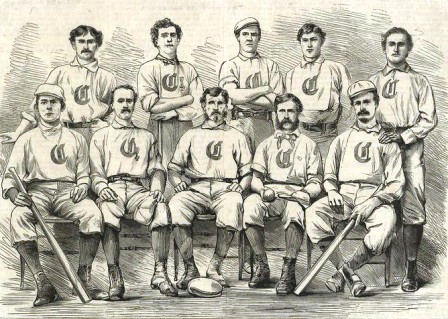
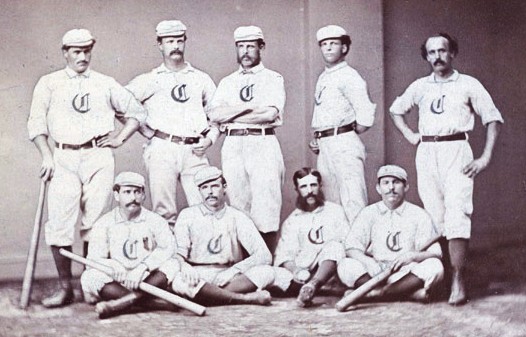
Doug Allison, standing third from left, with the 1869 Cincinnati Red Stockings

Doug Allison, standing middle, with the 1869 Cincinnati Red Stockings

It was the death of a contemporary that brought him back into the public eye.

On April 21, 1907, Nathan Woodhull “Nat” Hicks died in Hoboken, NJ.  Hicks had also been a catcher, having played for the New York Mutuals, Philadelphia Whites and Cincinnati Reds in the National Association and National League from 1872-1877.

Hicks’ obituary, including the one in The New York Times, gave him credit for being the first catcher to stand directly behind the batter:

“To catch behind the bat without the elaborate protection of mask, protector, great glove, and shin guards, as Nat Hicks was the first to do, required a grit and endurance that few of the high-priced artists of the diamond today would care to emulate.  Hicks created a sensation by catching behind the bat with his naked hands and body unprotected.”

Doug Allison couldn’t let that stand, and he contacted a reporter from The Associated Press to set the record straight:

“Nat Hicks was a great catcher for the short period that he stood in the limelight of public opinion, but the press of the country is away off in giving him credit as the ‘original’ up-behind-the-bat man.”

While coming forward to claim the distinction, Allison insisted it wasn’t important to him:

“Not that I wish to claim any such record, for after all it does not carry any great weight or glory, but just the same I think figures will prove that I was among the first, if not the first, of any of the backstops  to attempt that trick that was the mystery of the game.”

Allison said that while catching for a team in the Manayunk neighborhood of Philadelphia he developed a “theory,” and “began to believe it possible to get close up to the bat,” in order to prevent runners from stealing:

“I put my theory in action, and that was way back in 1866…My success in this style of play was remarkable, and naturally the talk of the place, until our game began to draw crowds simply because ‘Allison was behind the bat.’  This is not egotism, but the fact, and my method soon had lots of imitators.”

Allison said the following season while playing with the “Gearys, the leading amateur team of Philadelphia,” he was discovered by “that greatest of all baseball generals—Harry Wright.” And while with the Red Stockings he “continued up under the bat with plenty of success.”

As for “my friend Nat Hicks,” Allison said:

“(He) did not break into the game until 1870 and could not have started that play for which so many newspapers have been giving him credit, and while disliking to cloud their stories, it seems right to correct the popular impression of this important epoch in the history of baseball.”

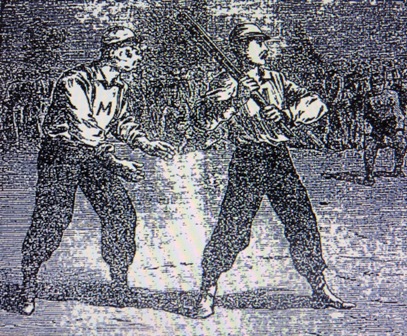
A print from the 1870s depicting "Nat" Hicks "behind the bat" with the New York Mutuals.

A print from the 1870s depicting “Nat” Hicks “behind the bat” with the New York Mutuals.
Having set the record straight, Allison returned to his job in the dead letter office of the United States Post Office in Washington D.C.  He died in 1916 at age 70.
Things I Learned on the Way to Looking Up Other Things #2

8 Apr

A few items from 1888 to 1890:

Largest bat 

Jonah William “Quiet Joe” Knight appeared in the National League as a pitcher for six games with the Philadelphia Quakers in 1884, posting a 2-4 record, and returned in 1890 as a left fielder with the Cincinnati Reds, hitting .312 in 127 games.  He also spent 16 seasons in the minor leagues and was one of the premier hitters in the Eastern League.

When Knight joined the Reds in 1890 The Cincinnati Post said he “uses a larger bat than any other professional.”  Reds shortstop Ollie Beard said:

“I can hardly swing the bat Knight uses let alone hit a ball with it.”

It was said Knight had his bats made to order in his home town St. Catherine’s Ontario, Canada.

joeknight

“Quiet Joe” Knight

Baseball in German

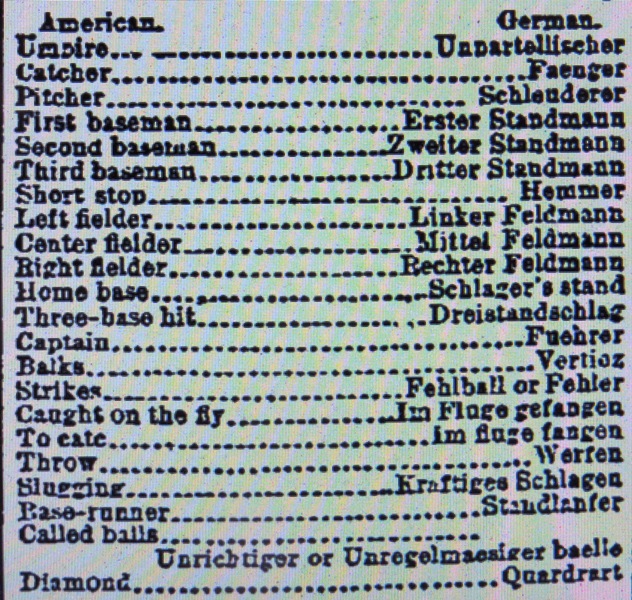
The Boston Herald reported in 1890 that New York’s German language paper Staats-Zeitung hired a baseball editor and would be recapping National League and American Association games:

“Naturally he has been obliged to invent words to describe the technical plays and points and how well he’s succeeded  will be seen from the following:”

???????????????????????????????

Harry Wright’s Team Unimpressive

After the 1887 season Hall of Famer and baseball pioneer Harry Wright took his Philadelphia Quakers on a tour of West Coast along with the Chicago White Stockings, New York Giants and St. Louis Browns; playing exhibition games against each other and with California League teams.

After seeing Philadelphia play The San Francisco Call was unimpressed with the National League’s second place team:

“The ‘Phillies’ will have to improve wonderfully to make their games at all interesting.  They may plead excuses, but they cannot disguise the fact that they played rank ball, and very rank at that.  Their initial effort stamps them as about fourth class, and it will require a brilliant rally to convince people in this section that they are ball-players.  There is not a team in the California League that will not give them a hard game and perchance defeat them.”

Unfortunately there is no record of  how Philadelphia fared on the rest of the tour.

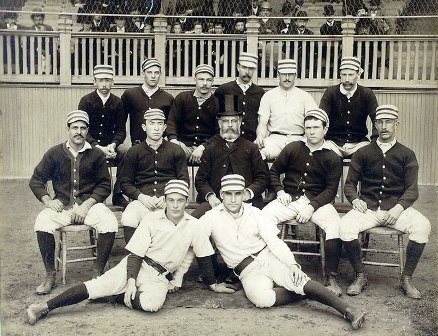
Harry Wright, center, with his 1887 Philadelphia Quakers

Harry Wright, center, with his 1887 Philadelphia Quakers

“The Money in Baseball” 1884

14 Mar

In 1884, under the headline “The Money in Baseball,” The Boston Globe expressed their antipathy about the “enormous salaries which the ‘kings of the profession’ demand.”

The Globe observed that “The best pitchers get as much money for working a few hours each day during seven months as many college professors receive for the entire year’s service.”

George Wright, Hall of Famer, and brother and teammate of Harry Wright with the 1869 Cincinnati Red Stockings, told the paper

“The money paid the entire team would put a poor team on the field today.  My brother Harry was the most expensive man on the team, and he got $2000 for being captain and playing center field.  I was in my regular position at short and drew $1800.”

Wright said several players on the Red Stockings were paid less than $1000.

1869 Red Stockings, Harry Wright, standing third from left, George Wright standing to the right of him.

1869 Red Stockings, Harry Wright, standing third from left, George Wright standing to the right of him.

By comparison The Globe said:

“The salary list of the Boston League club amounts to $25,000 in round numbers…It is impossible to estimate how much has been paid in salaries to ballplayers throughout the country.  The eight League clubs will certainly average as much as Boston’s total…In the Union Association are eight more clubs…there is not much doubt that the eight clubs pay at least $125,000 in salaries.  The American Association has twelve clubs…the salary list of these three largest baseball associations in the country aggregate between $500,000 and $600,000.”

A Really Bad Idea II

23 Oct

Last week I told you about Chicago Colts President Al Hart’s connection with the proposed rule to change the shape of the diamond.  He wasn’t the only baseball pioneer who considered adopting rule changes which would have completely changed the game.

William Henry “Harry” Wright, called by many “The Father of Baseball,” was among the most respected figures of baseball’s first two decades.  The Philadelphia Record described his importance:

 “Harry Wright has done more than any other man to bring baseball to its present high standing.”

Wright’s story has been told many times and in many places.  This lesser known story focuses on two rules changes he championed.

Harry Wright

After the 1893 season Wright’s contract was not renewed as manager of the Philadelphia Phillies he accepted the position of “Chief of Umpires” of the National League.  The Philadelphia Record reported on a number of rule changes he advocated, including this:

 “Harry Wright thinks that players should not be allowed to question an umpire’s decision during the progress of a game, or to speak to him while the ball is in play, and that he should have the power of taking out of the contest any player (or manager) who breaks the rule.”

While not necessarily a bad idea, if adopted Wright’s idea would have drastically changed the game for several generations of famous umpire baiters.

One other rule change Wright promoted, as reported by The Sporting Life, would certainly have been a bad idea:

 “(A)llowing a base runner to run on a fly ball instead of returning and registering at the base.”

While Wright’s idea never was seriously considered for incorporation into the rule book, it had advocates as late as 1899, four years after his death.

Washington Senators Manager Arthur Irwin endorsed the rule with this colorful description:

 “Uncertainty is the life of the game, and the more uncertain the uncertainty the higher does the interest key itself…for instance (John) McGraw, one of the most daring base runners in the league Is on first base with two men out, and a run needed to win the game (Wilbert) Robinson follows with a fly to center field, and at the stroke of the bat away scuds Mac. His get-away is the cue that brings the spectators to their feet.  ‘Will he score?  Can (Joe) Kelley field that ball home to cut him off at the plate?’ Around the runway fly the twinkling feet of the little Napoleon of the Orioles.   It’s a chase of life and death between Mac and the ball. Kelley swings the sphere on two bounds to Duke Farrell at the plate.  Mac slides into the rubber, and beats the throw by an abbreviated whisker.

“Can you imagine a more intense climax to a game of ball? Why, the game would be full of such play if the idea of running on a fly ball became a rule.  It would increase the base running, produce more plays in the field, and keep the outfielders almost as busy as the inner circle, when the bases were occupied.”

Of course Irwin failed to consider the scenario where the winning run is on third base and scores on a routine fly ball with two outs.

Arthur Irwin