Tag Archives: Joe Jackson

“We are beginning to have a Very Active Doubt as to the Value of Professional Baseball in American Life”

29 Aug

Coming on the heels of the fallout from the Black Sox scandal, The Chicago Tribune announced a change in editorial policy three weeks after “Shoeless” Joe Jackson, Eddie Cicotte, Oscar “Happy” Felsch., Claude “Lefty” Williams, Arnold “Chick” Gandil, George “Buck” Weaver, Fred McMullin, and Charles “Swede” Risberg were acquitted of conspiring to fix the 1919 World Series.
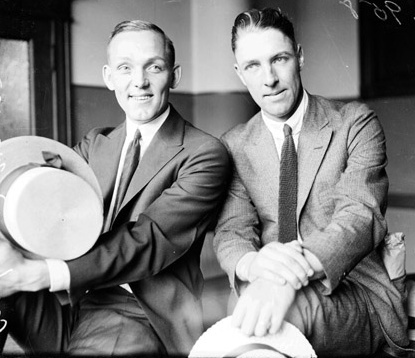
Buck Weaver and Swede Risberg during the trial

Buck Weaver and Swede Risberg during the trial

The paper said:

The Tribune has begun to use the compressor on professional baseball stories. The baseball reporters write them well, but we are getting a little tired of the subject. We are beginning to have a very active doubt as to the value of professional baseball in American life.”

The paper said baseball received a “black eye which jury verdicts did not whiten.”

The Tribune said they would place a greater emphasis on coverage of amateur sports which “produce sound citizenry.”  Professional baseball was also making Americans soft:

“The majority of spectators get only eye and mouth exercise.  We have conceded that the professional game stimulated the youngsters and that they played with more earnestness on the lots because they admired Babe Ruth.  We still admit that professional baseball is a stimulus to boys, but journalism has overfed it with space.  The Tribune is down to about a half column now for games in which the home teams play, which is justified parochialism, and to a bare statement of vital statistics regarding the other clubs.  That is enough.”

Other newspapers applauded the policy; surprisingly most didn’t cite corruption in baseball as the reason, but the rather, as The Baltimore Sun said because professional sports only provide “vicarious exercise.”  The Louisville Courier-Journal said watching baseball was even a threat to manhood:

“Two hours of inactivity in the grand stand or bleachers is not productive of muscle or sinew.  The same amount of time spent in tennis, golf, swimming or any number of games would be infinitely better for American manhood.”

Others found the new policy foolish.  The Portland Oregonian said:

The Chicago Tribune, which is regarded by its management, and doubtless by many of its readers, as the world’s greatest newspaper, has decided to blue-pencil professional baseball…The theory on which the sport page is built is that the public is entitled to what it wants…Telling the readers of sports that they should want something else, and will be given that something, is a decided innovation.”

The Duluth News-Tribune said facetiously:

“The fact that both teams (the Cubs and White Sox) are near tail-enders may not have anything to do with it.”

Then there was The Idaho Statesman which said The Tribune’s policy was a “meritorious undertaking,” but didn’t go far enough:

“There are a world of other professional sports not half as white as the Black Sox, that might come under the publicity axe with resulting good to the public…Horseracing is professional and it has produced a fine crop of crooks—more than baseball in its blackest days could possibly yield.  Our own so-called wild west sports have been placed in the professional class and everybody knows they are largely fake.  Wrestling hasn’t the whitest record in the world and prize fighting is anything but a Sunday school game.  Nobody ever got very much exercise out of any of these sports, except the participants and we are not sure that our citizenship is any sounder for having witnessed them.  The Tribune isn’t through with its job as we view the situation.”

The most prescient response was from The Montgomery (AL) Advertiser:

“We expect to see The Tribune gradually slipping back to its old ways.”

Ten days after the original policy was announced The Tribune declared victory, and revealed their real motive:

“An encouraging sign is the changing attitude of the press toward highly commercialized sport. The papers are coming to the conclusion they have been giving away millions of dollars’ worth of advertising to boost box office receipts for promoters who have no special regard for the public.”

But within weeks the “The World’s Greatest Newspaper” had, as The Advertiser predicted, begun “slipping back” to the way baseball had previously been covered.  By the beginning of the 1922 season, notwithstanding the lingering effects of the game’s greatest scandal, or no indication that Americans were getting any more exercise, baseball stories in The Tribune looked no different than stories that appeared before August of 1921.
Roy Spruell

14 Aug

Throughout the first half of the 20th Century there were thousands of independent and industrial league baseball teams that operated across the country; the only distinction, in many cases, between the quality of these teams and their players and those in “professional” leagues was the “professional” teams were recognized by The National Association of Professional Baseball Leagues.

Given the economics of the game, which usually required players to be employed during the off season, it was often as profitable, or even more so, to play with an independent or semi-professional team that either paid the same or more as the “professional” leagues or provided the player with a job.

As a result, there are thousands of players, who while well-known names in the towns, cities and regions where they played, have been largely forgotten.

Roy Layton Spruell is one of them.

From 1920 until 1939 Spruell was a fixture in Southern baseball, specifically on the Gulf Coast, although his “official” statistics only indicate limited “professional” appearances between 1924 and 1936.

Spruell appears to have been born January 25, 1900 in Birmingham, Alabama according to state records and census data, (his grave lists his birth year as 1902, but like many players of his era, he likely subtracted a couple of years at some point during his career and the new date stuck).

Raised in Mobile, Alabama, he first made a name for himself in 1920 pitching with industrial teams at the Southern Kraft Paper Mill and White Swann Laundry Company in Mobile.

Two years later he was a member of an independent team in Mississippi, the Ocean Springs Regulars.  In addition to Ocean Springs, the loosely affiliated semi-pro league included independent teams from nearby Mississippi towns Biloxi, Gulfport, Pascagoula  and Wiggins, and industrial teams out of New Orleans, including the Choro Colas (later renamed RC Cola), the Tokay Teas.

The following season Spruell played for another Southern Kraft Mills team; contemporary newspaper accounts alternately called the team either the Moss Point or the Kreole Papermakers—the mill was located in Moss Point, Mississippi, but the team appears to have played home games in nearby Kreole.  Spruell’s older brother Harvey was his teammate with the Papermakers.

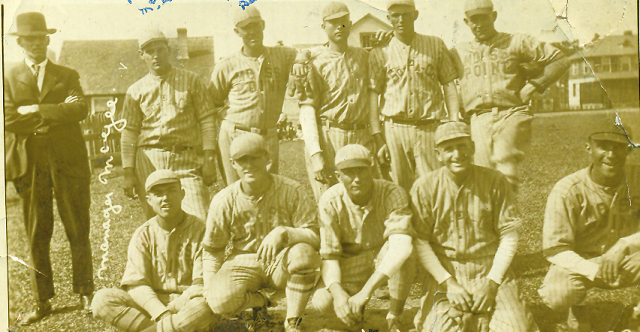
The 1923 Papermakers, Roy Spruell is standing second from right.  His brother Harvey is in the middle of the front row.   The other players are identified as: Standing at left - Manager McGee 2nd from left  - Pat McGee 3rd from left  - Matt Delmas 4th from left-unidentified. 6th from left - Sam Leslie   Seated at left - Johnnie Cunningham 2nd from left - Brother Nelson 4th from left - John Bell

The 1923 Papermakers, Roy Spruell is standing second from right. His brother Harvey is in the middle of the front row. The other players:: Standing Manager McGee, Pat McGee, Matt Delmas, unidentified, Roy Spruell, and Sam Leslie
Seated Johnnie Cunningham, Brother Nelson, Harvey Spruell, and John Bell.


In 1924 he signed his first professional contract, posting an 11-12 record for the fifth place Laurel Lumberjacks, in the six-team Cotton States League.  The following season, pitching for the last place (51-70) Alexandria Reds, Spruell was 14-10.

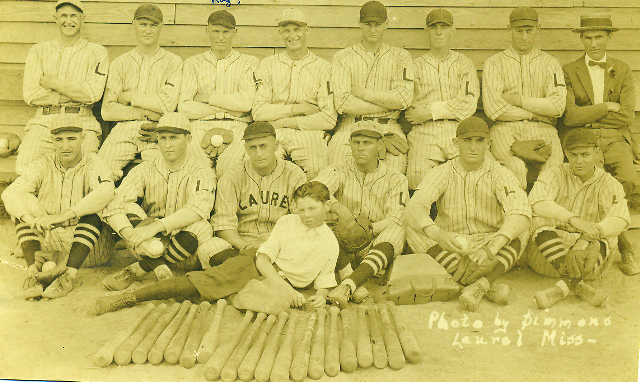
1924 Laurel Lumberjacks.  Roy Spruell is in the top row, third from left.  The player seated on the far left in the front row appears to be future big league pitcher Ray Moss who pitched for the Brooklyn Robins and Boston Braves.

1924 Laurel Lumberjacks. Roy Spruell is in the top row, third from left. The player seated on the far left in the front row appears to be Ray Moss, the only member of the Laurel club to play in the big leagues,; he pitched for the Brooklyn Robins and Boston Braves.

Spruell had his best professional season in 1926 as a member of the Hattiesburg Pinetoppers.  He led the team to the Cotton States championship with a 22-8 record, and got his name in newspapers across the country in August.  The Associated Press said:

“Friday the 13th was far from unlucky for Roy Spruell, pitching star of the Hattiesburg club of the Cotton States League, Spruell hurled the first no hit, no run game of his career.”

Spruell allowed just two walks (shortstop/manager Herschel Bobo also made an error) to the Monroe Drillers, but still only faced the minimum 27 batters.

The 1926 Cotton States League champion Hattiesburg Pinetoppers.  Roy Spruell is standing third from left.  Manager/shortstop Herschel Bobo is kneeling far left.

The 1926 Cotton States League champion Hattiesburg Pinetoppers. Roy Spruell is standing third from left. Manager/shortstop Herschel Bobo is kneeling far left.

At the end of the 1926 season Spruell was purchased by the Houston Buffaloes of the Texas League, but never played in Texas.  He started the season with the Memphis Chickasaws in the Southern Association and was released to the Knoxville Smokies in the South Atlantic League in May of 1927.  He was 10-10 in Knoxville and also appeared in 20 games in outfield.  The Spartanburg Herald called Spruell “the elongated righthander,” (he was listed variously from 6’ to 6’ 2”).

Spruell returned to the Smokies for the 1928 season, but a hand injury led to a slow start and with a 1-3 record at the end of May he was released and returned to the Cotton States League. He pitched professionally through the 1930 season, but struggled with injuries his last three seasons and pitched for several teams:  Laurel and Hattiesburg again (he also pitched for the Baton Rouge Essos when the Hattiesburg franchise relocated there during the 1929 season) as well as the Jackson Senators in the Cotton States League, and the Jacksonville Tars in the Southeastern League.

Spruell spent the next decade playing with and managing independent and industrial league teams in the South.  He played from 1931 to 1935 in the Mississippi Coast League, a strong semi-pro league with teams sponsored by union and industrial interests.

He left the Gulf Coast the following year, relocating in Savannah, Georgia where he played for and managed the Union Baggers—the company team of the Union Bag and Paper Company, operator of the world’s largest paper mill.  The team was considered one of Georgia’s best semi-pro and industrial teams, playing in the Coastal League, which included teams in Georgia, Florida and South Carolina.

The Union Baggers, circa 1937.  Roy Spruell, standing second from right.

The Union Baggers, circa 1937. Roy Spruell, standing second from right.

Spruell’s baseball career appears to have ended around 1940.

He eventually relocated to Pensacola, Florida and worked for the Florida Pulp and Paper Company; he suffered a heart attack at work and died in 1950

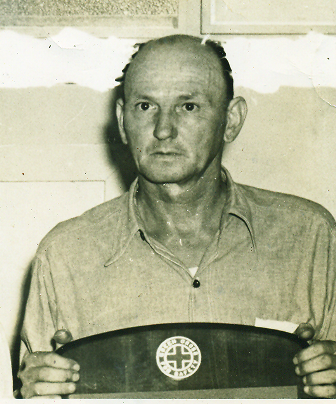
Roy Spruell shortly before his death in 1950.

Roy Spruell shortly before his death in 1950.

Like thousands of others who played baseball in small and large towns, and small and large leagues, throughout the country, Roy Spruell’s career brings to mind a passage from W. P. Kinsella’s great novel “Shoeless Joe:”

“For some reason, I recall the question at the bottom of the form sent by the Baseball Hall of Fame to everyone who has ever played professional baseball: ‘If you had it to do over again, would you play professional baseball?’  The historian at Cooperstown, Clifford S. Kachline, said he couldn’t recall even one ex-player answering ‘no’ to the question.  I wonder if any other profession can say the same?”

Thank you to Roy Spruell’s grandchildren, Paula Grady and Bob Gattis for sharing the photographs used in this post as well as a copy of Mr. Spruell’s obituary. 

Defending their own Honor

12 Aug

In 1909 the Atlanta Crackers won their second Southern Association championships in three seasons.  Big things were expected for 1910; the team’s two 20-game-winning pitchers Tom Fisher and Harold Johns were returning.

The team the Southern press called “the hitless wonders,” which hit .222 while winning the championship added two new bats, outfielder Arista DeHaven, .336 with the Terre Haute Hottentots in the Central League and Charlie Seitz, .326 with the Norfolk Tars in the Virginia League.

But it took very little for near panic to take hold in Atlanta.

Only eight games into the season the Crackers were 3-5, tied for sixth place.  The Birmingham Age-Herald was ready to pronounce the defending champions finished, and said “there was dissention and dissatisfaction in the ranks.”   The article said that manager Adolph Otto “Dutch” Jordan had already lost control of his team.

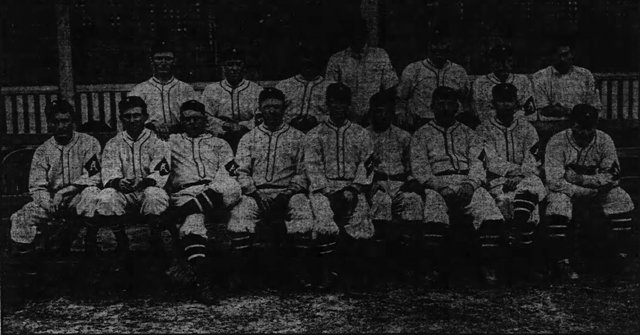
The 1910 Atlanta Crackers:  Standing, from Left to right: Arista DeHaven, Charlie Seitz, Paul Sentell, Brown Rogers, Hyder Barr, Roy Moran, and Ed Hohnhorst,  Seated from left: Scott Walker, Hank Griffin, Syd Smith, Otto Jordan, Bick Bayless, Erskine Mayer, Harry Matthews, Harold Johns and Tom Fisher.

The 1910 Atlanta Crackers: Standing, from Left to right: Arista DeHaven, Charlie Seitz, Paul Sentell, Brown Rogers, Hyder Barr, Roy Moran, and Ed Hohnhorst, Seated from left: Scott Walker, Hank Griffin, Syd Smith, Dutch Jordan, Dick Bayless, Erskine Mayer, Harry Matthews, Harold Johns and Tom Fisher.

It wasn’t enough for the team to simply deny the charges; in an unprecedented move they went right to the fans to assure them they were trying to win and happy to be members of the Crackers.

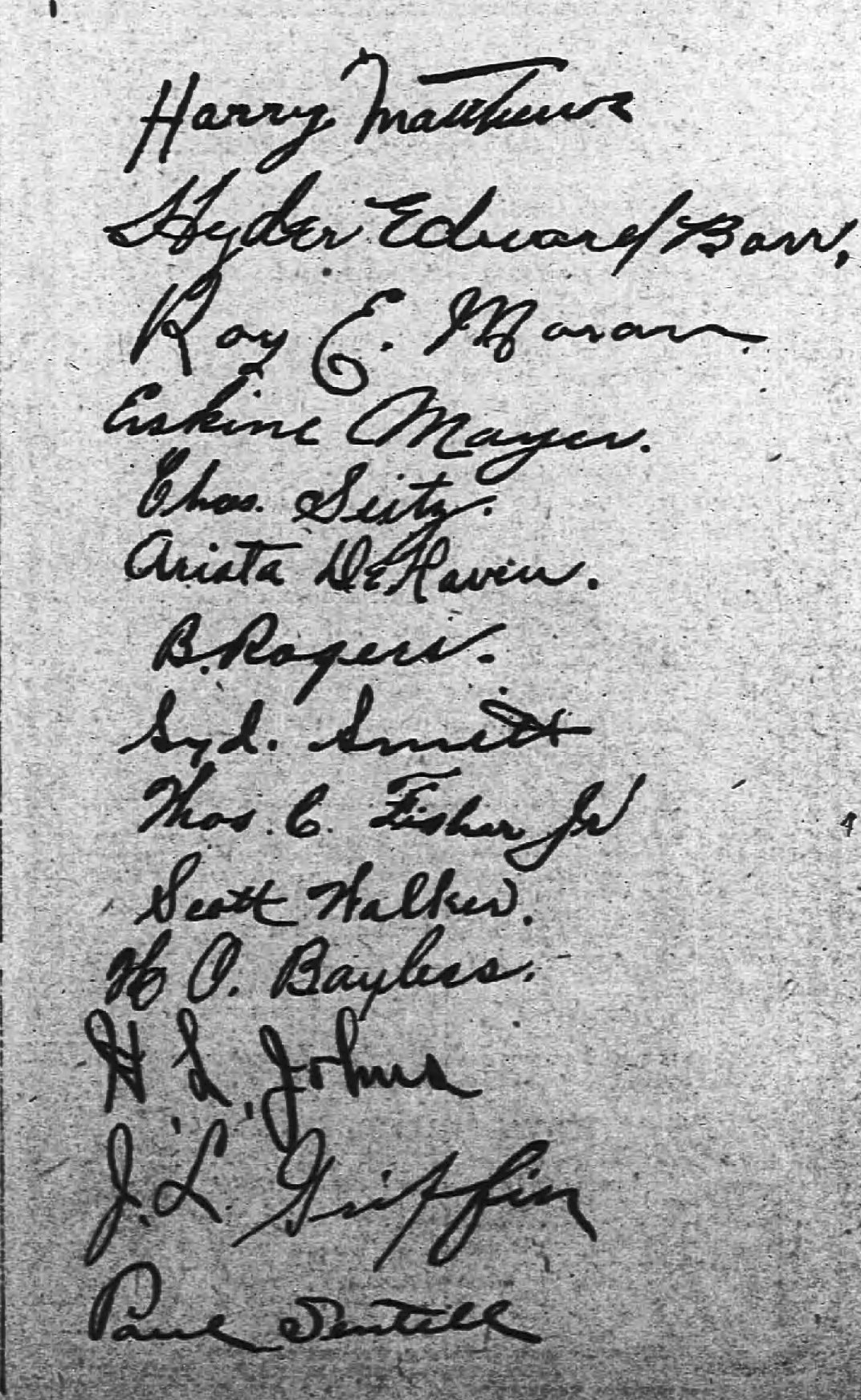
On May 1, The Atlanta Constitution ran a letter “gotten up without solicitation by the boys and the autographs of each and every man is attached hereto:”

A Card to the Faithful Fans of Atlanta:

We the undersigned players of the 1910 ballclub, appreciating to the full the kind of loyal support always accorded us by the good citizens of Atlanta, desire hereby to register an emphatic protest against a statement recently made in a Birmingham paper to the effect that there was dissention among us, and that this dissention, so it was alleged, was the cause of our defeats on the last road trip.

Without stopping to discuss the real reasons which gave us more defeats than victories, we wish to state that it gives us much satisfaction to put our friends on notice that there is not one word of truth in this malicious slander, and further, that we know of no reason why there should be any dissention in our club…It should be further interesting to state, as we do, that the very best of feeling prevails among us all, and there is not one of us who is not doing his very utmost to land another pennant for Atlanta.  We simply ask our friends to continue to put their faith in us, and in return, we desire to give them the assurance that, whether we win another pennant, or not, we are firmly determined to play the best and sincerest ball of our careers—at least so far as honest and persevering effort can aid in bringing about so happy a result.  We confidently hope to amply show both friend and foe, long before the summer of 1910 has passed into baseball history, just how basely we have been misrepresented by this idle and empty charge.

The signatures of the 1910 atlanta Crackers that appeared with their open letter to the fans.

The signatures of the 1910 Atlanta Crackers that appeared with their open letter to the fans.

After the slow start, and their pledge to “play the best and sincerest ball” of their careers,  Atlanta played well the remainder of the season, finishing with a 75-63 record, but the New Orleans Pelicans, behind “Shoeless Joe’ Jackson’s league leading .354 average, and the pitching of 41-year-old Ted Breitenstein (19-9, 1.53 ERA), and 31-year-old Otto Hess (25-9), went wire-to-wire, winning the pennant with a record of 87-53.

Atlanta would not win another pennant until 1913.

Hap Myers

29 Jul

When the 6’ 3” 175 pound Ralph Edward “Hap” Myers was let go by the Boston Braves after the 1913 season a reporter told Braves shortstop Rabbit Maranville he was sorry to see Myers go.  Maranville joked:

“Well, you might be, but I’m not.  Do you know that guy is so thin that every time I picked up a grounder I had to shade my eyes with my gloved hand to locate him before throwing the ball.”

Myers began his professional career after graduating from University of California, Berkeley in 1909, where he also played baseball.  The San Francisco native hit a combined .311 playing for the Sacramento Sacts in the Pacific Coast League, and the San Jose Prune Pickers and Santa Cruz Sand Crabs in the California League.

Myers went east in 1910 after being purchased by the Boston Red Sox, but became ill, with scarlet fever, and as a result appeared in only six games in Boston before being  sent first to the Toronto Maple leafs in the Eastern league, then the Louisville Colonels in the American Association.

Despite hitting just .240 with Louisville, Myers was selected by the St. Louis Browns in the Rule 5 draft.  The Red Sox claimed Myers still belonged to them and his contract was awarded to Boston, where he began the season, was sold to the St. Louis Browns, who quickly released him despite hitting .297 in 11 games, then back to the Red Sox where he hit .368 in twelve games before being sent to the Jersey City Skeeters in the Eastern League.

It was never clear why, in spite of hitting .333 in 81 at bats in 1910-1911, Myers couldn’t stick in the American League.

In 1912 he returned to the West Coast to play for the Spokane Indians in the Northwestern League where he led the league in hits, and runs, hit .328, and led all of professional baseball with 116 stolen bases.  The Portland Oregonian said:

“Myers base stealing smashes any previous performance in Northwestern League history.  You have to go back 20 years in official guide books to find any record to compare…and that includes every league in organized baseball.”

Spokane owner Joe Cohn went overboard in his praise of Myers in The Spokane Spokesman-Review:

“Best ballplayer in the Northwestern League by a long shot.  He is the greatest ballplayer I ever saw.  Boy I tell you this Myers is a wonder.  Ty Cobb, Hans Wagner, Tris Speaker and all of them have nothing on Myers…I think Myers has it on Cobb, Wagner, Lajoie, Jackson and the whole bunch.”

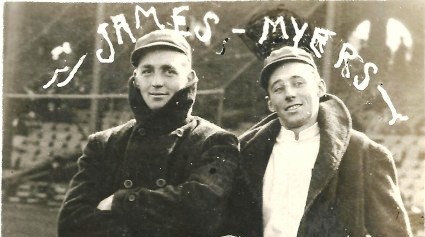
Myers, and Portland catcher Rex DeVogt were purchased by the Braves from Portland, Devogt would only last for three games, and six hitless at-bats in April of 1913.  Myers would become the Braves starting first baseman.  Another Pacific Coast League player, pitcher “Seattle Bill” James also joined the Braves.

hap3

“Seattle Bill” James and “Hap” Myers

Myers got off to a slow start; he was hitting just .224 in early July, but was leading the National League in steals.  An article in The Tacoma Times said:

“When Hap Myers, recruit first baseman of the Boston Braves is in full stride stealing bases, he covers nine feet…the average stride of a sprinter is six feet. “

The article said the average player took 13 steps, roughly seven feet per step, between bases but Myers took only ten steps:

“Myers is something of a baseball curiosity, and his work is watched with interest by the fans.  If the time comes that the big fellow climbs into the .300 class as a batter, he is apt to become a veritable terror of the paths.”

He was also said to use “a bat of unusual length,” but the size was never mentioned.

After the slow start, Myers hit well in the second half of the season, ending with a .273 average and 57 stolen bases (second to Max Carey of the Pittsburgh Pirates who stole 61).  Despite his strong finish, Myers was replaced at first base for 22 games in August and September by Butch Schmidt, who was purchased from the Rochester Hustlers in the International League.

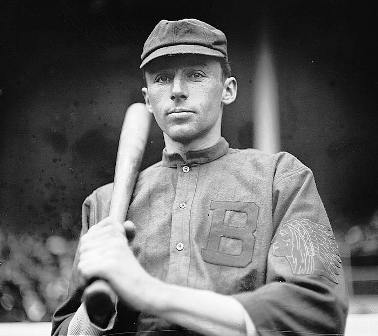
"Hap" Myers

“Hap” Myers

At the end of the season Myers was sold to the Hustlers, the deal was, in effect, a trade for Schmidt.  The Boston press simply said Myers did not get along with manager George Stallings; Myers told a reporter in San Francisco that there was another reason; baseball’s labor unrest:

  “I was assigned by the fraternity to get as many Braves as possible into the fraternity, and succeeded in enrolling nearly the entire team.  The powers that be evidently didn’t relish my actions for soon my every move began to bring calldowns and I was not surprised to read in the newspapers a little later that I had been sent to Rochester.”

Myers jumped Rochester to join the Federal League; his signing was reported months before he actually signed.  The Associated Press said in March of 1914:

“Although it has been generally understood that Hap Myers, last season’s first baseman of the Boston National has been under a Federal League contract for some time, the elongated first sacker did not put his name to a contract until yesterday afternoon.  Myers originally expected to play with Larry Schlafly on the Buffalo Federals, but was transferred to Brooklyn, and seemed altogether pleased with the move.”

Myers got off to a strong start, and The Sporting Life said:

“Brooklyn fans cannot understand why Hap was passed out of the National League. They have had a chance already to give his successor at first base on the Boston team (Butch Schmidt) the once over, and the general opinion is that- Hap Myers “lays all over.”

His success in Brooklyn didn’t last; in 92 games Myers hit just .220.

Hap’s story continued tomorrow.

“I Object to Being Made a Freak.”

17 Jul

In 1913 American League President Ban Johnson set out to put an end to the practice the Baseball Writers Association called “A growing Evil,” ghost-written articles appearing under the by-lines of famous ballplayers.

William Peet of The Washington Herald revealed the identities of the ghost writers in March of 1913; Gerhard “Roger” Tidden of The New York World had been the man responsible for articles bearing the name of Ty Cobb, but Tidden died just three months after the revelation.   While the practice waned after 1913, Cobb remained defiant, and continued “authoring” a syndicated column for the next several years.

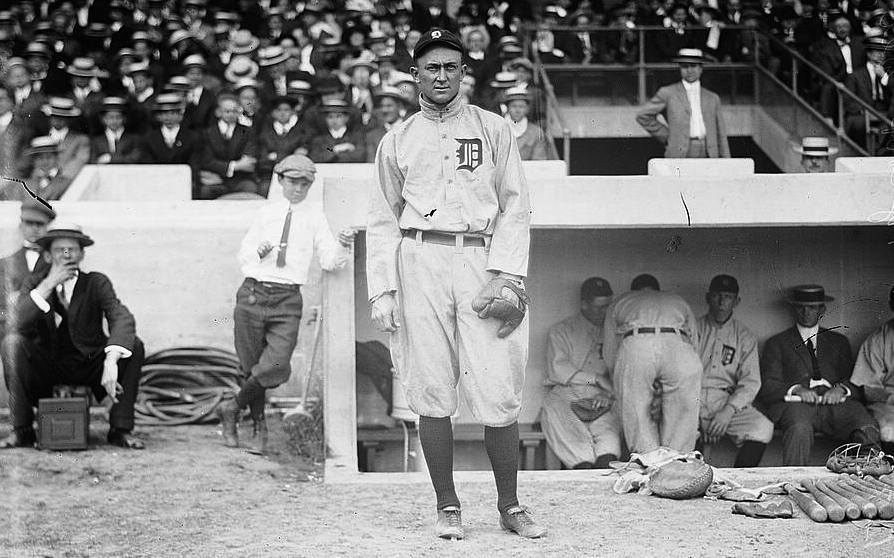
Ty Cobb

Ty Cobb

Cobb’s articles, for the most part, steered clear of trouble with the league president, but the assertions he made about the Chicago White Sox and manager Clarence “Pants” Rowland in June of 1915 caused a major stir.

Cobb said:

“Battery signal stealing, which has been the cause of several scandals in big league baseball threatens to make more trouble this season if anyone is able to prove what is generally suspected about one of the American League clubs.

“I will not mention the name of the organization which has been accused by the opposing players…because I couldn’t present any proof.”

Cobb then went on for seven paragraphs trying to present proof, and provided enough hints to make it clear he was talking about the White Sox.

Cobb’s said

 “The team I have in mind has won almost all its home games…It looks mighty funny, though, the way this club could hit at home and the feeble manner in which it has been swatting on the road and almost all of the Tigers will take an oath that something out-of-the-way is coming off.”

Chicago, through 49 games, was in first place; 22-8 at home and 9-10 on the road.  Detroit was in second place a game back.  If he left any doubt Cobb said later in the column when discussing the American League pennant race in general:

“The White Sox, who burned up things at home, have not been doing so well on the road.”

Everyone, including American League President Ban Johnson, assumed Cobb was talking about the Sox.  Johnson said:

 “(Cobb) must prove the charges, or I will keep him from playing baseball.  If any man in the American League makes a charge of dishonesty and refuses to back up his charge with the absolute evidence, that man will have to get out of the game.”

The White Sox were less concerned; The Chicago Tribune said the charges made Sox players “grin,” and Rowland told reporters:

“I suppose we had out tipping instruments planted in the Polo Grounds when we made nineteen hits in New York the other day.”

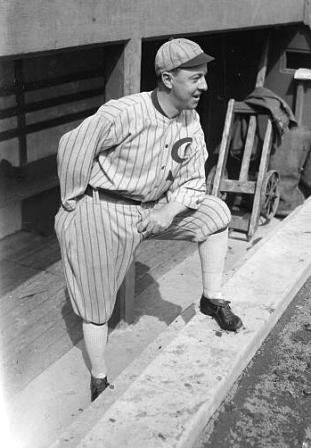
Clarence "Pants" Rowland

Clarence “Pants” Rowland

In his next column Cobb issued a non-denial denial and at the same time openly, and loudly, defied Johnson:

“I made no specific charge against the White Sox…What I did say was that a strong rumor of sharp practice was abroad, and I reiterate that statement right here.”

___

“Mr. Johnson even went to the extreme of saying that he would drive me out of baseball.  He hasn’t done this yet and I expect to stay around for a few more days.  If the league president is willing to pay the salary that my three-year contract calls for, I will be perfectly willing to take a vacation at that, for I have long wanted to do a number of things that baseball interferes with.”

Cobb reiterated the charges and offered no evidence, but said he was justified in making the claims because his manager might have believed them:

“(Tigers) Manager (Hughie) Jennings thought the report sufficiently serious to detail one of our players for plain clothes duty in the bleachers, and he also wrote Manager (Bill) Donovan of New York, telling him of a warning we had received and cautioning him to be on the lookout.  So you see the signal tipping report was not a creature of my own imagination, but a matter of sufficient seriousness to warrant an investigation by our manager in his official capacity.”

Cobb’s only bit of backtracking was to say that if “it should be proved the White Sox tried signal stealing it would be without the knowledge of Mr. (Charles) Comiskey.”  Cobb said Comiskey “wouldn’t countenance anything of this sort for a moment.”

Cobb took one last swing at Ban Johnson, charging the league president with giving “sensational interviews” about him to get “the people excited artificially. If this is Mr. Johnson’s idea, I wish he would abandon it.  I object to being made a freak.”

If there was any doubt whether the American League’s star player or the league president wielded more power, it became obvious within a week.

Johnson, who The Associated Press said “long has been opposed to players permitting their name to be used over baseball stories,” decided not only had Cobb not written the columns, but claimed “a Detroit newspaperman” made up the allegations “out of whole cloth,” and incredibly said that Cobb had “no knowledge,” of the columns despite Cobb being quoted by numerous sources discussing the charges.

Ban Johnson

Ban Johnson

Hugh Fullerton of The Chicago Examiner summed it up best:

“We are rather surprised each morning upon picking up our newspaper to discover that Ty Cobb is still making two-base hits, two steals and catching a few flies instead of being driven out of baseball by (Ban) Johnson.  By the way how did Johnson get into baseball?”

As quickly as Johnson backed down, the charges went away.  Despite the strong start the White Sox faded, and continued to fade even after the acquisition of “Shoeless Joe” Jackson on August 21, finishing third, nine and a half games behind the pennant-winning Boston Red Sox and seven games behind the Tigers.

Cobb led the league for the ninth straight season, hitting .369.

The one legacy from the brief 1915 controversy seems to be Cobb’s dislike of Rowland, who later became a scout for the Tigers.  In his 1984 book “Ty Cobb,” Charles C. Alexander said Cobb only agreed to manage the Tigers before the 1921 season because he was told:

 “Pants Rowland, whom Cobb considered an incompetent fraud, might very well get it and Cobb would have to play for him.”

Rowland, who remained in baseball until 1959 as a manager, scout and executive with the Los Angeles Angels in the Pacific Coast League and Chicago Cubs in the National League, appears to have also held a grudge.   Up until his death at age 90 in 1969, Rowland often said two of his former players, Jackson and Eddie Collins were better than Cobb.

 In 1953 at the Old Timers Baseball Association of Chicago Banquet Rowland said “I wouldn’t have traded (Collins) for Cobb.  What made him greater than Cobb was that he inspired the entire ball club.  Ty was an individualist.  He was interested only in Cobb.”

Rowland called Jackson the “greatest natural hitter,’ he ever saw, and said Ted Williams, not Cobb, was the only player “of the same make-up.”

A Thousand Words–Ray Schalk/George Sisler

28 Jun

cracker1916sisler

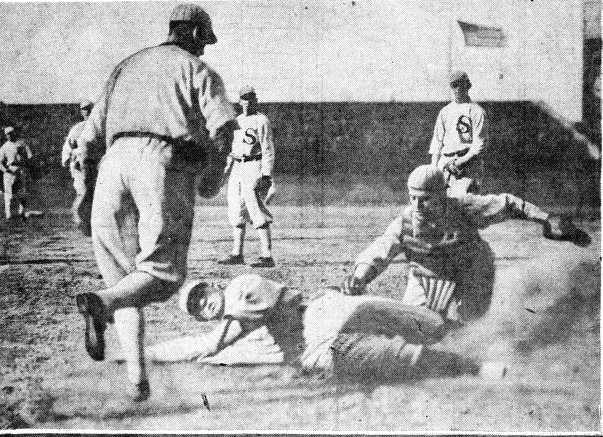
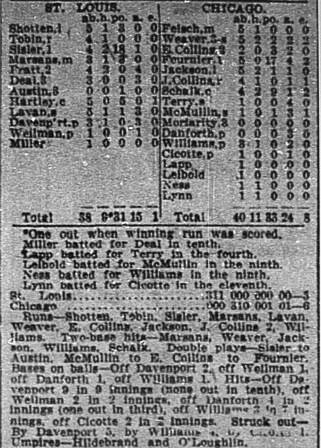
A rare 1916 photo of two Hall of Famers.  Chicago White Sox catcher Ray “Cracker” Schalk tags out George Sisler at first base ending a rundown after the St. Louis Browns first baseman was caught off first by Sox pitcher Claude “Lefty” Williams.  The play, which also included  leftfielder “Shoeless” Joe Jackson, was scored 1-3-4-3-6-1-7-2–Williams-Jake FournierEddie Collins-Fournier-Zeb Terry-Williams-Jackson-Schalk.  The White Sox won the April 17 game 6-5.

The Box Score

The Box Score

Ty Cobb, Joe Jackson, Harry Hooper and Quackery

15 Feb

Baseball history is full of stories of products that have been routinely used in the belief they give players an edge.  Some, like steroids and amphetamines have obvious benefits; others like Power Balance bracelets provide none.

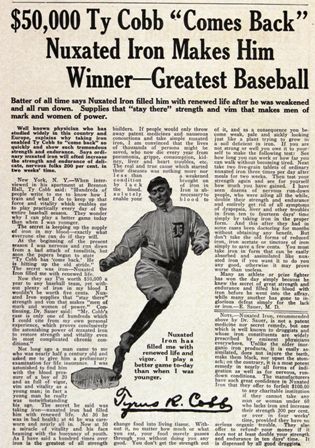
In 1916 advertisements began to appear in newspapers and magazines across the country for a new miracle drug from DAE Health Laboratories in Detroit: Nuxated Iron.

An ad featuring Ty Cobb said “Greatest Baseball Batter of all time says Nuxated Iron filled him with renewed life after he was weakened and all run down.”

Cobb said in the advertisement:

“At the beginning of the present season I was nervous and run down from a bad attack of tonsillitis, but soon the papers began to state ‘Ty Cobb has come back, he is hitting up the old stride.’ The secret was iron—Nuxated Iron filled me with renewed life.

“Now they say I’m worth $50,000 a year to any baseball team.”

cobbnux

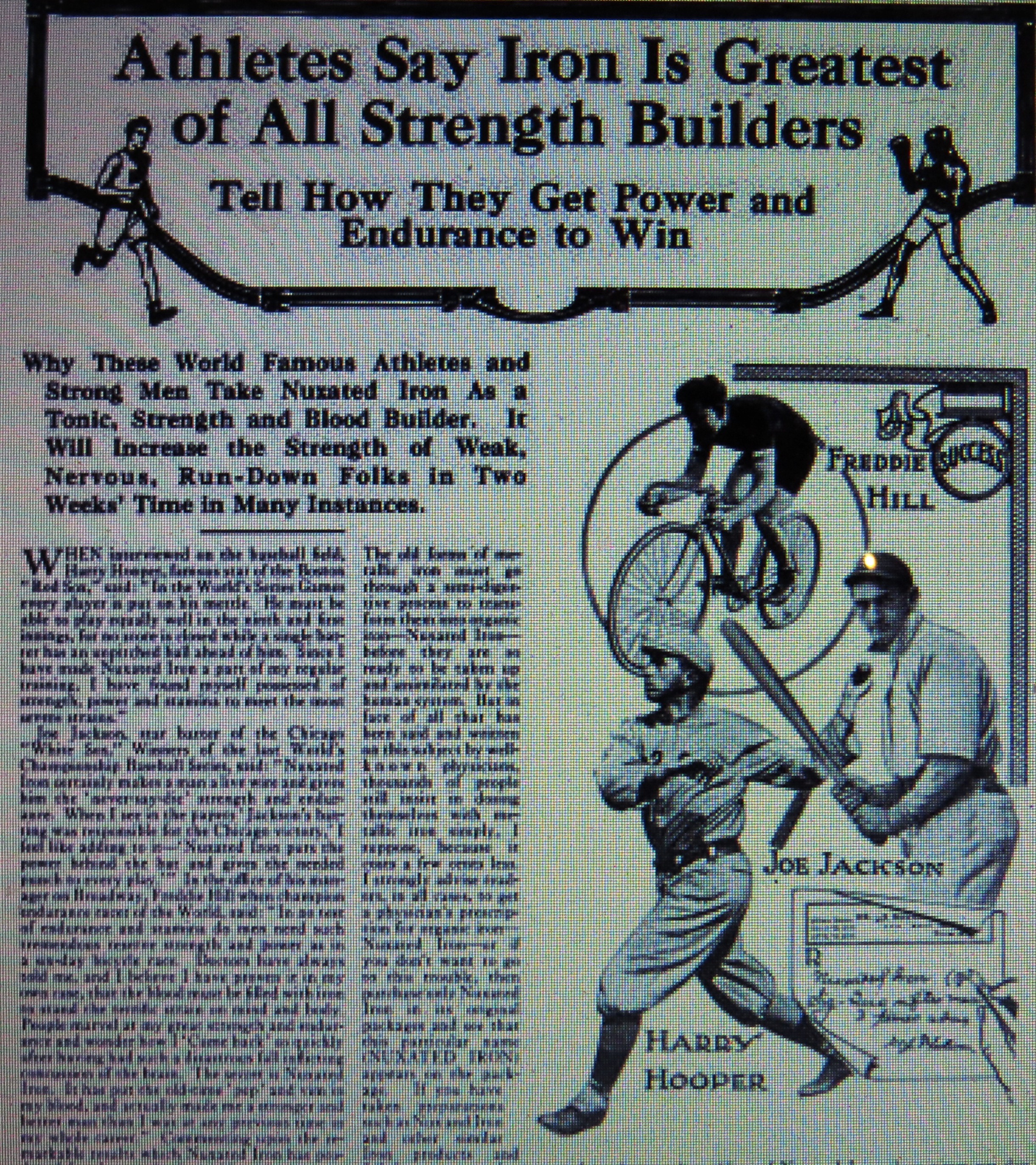
Other ads for Nuxated Iron began to appear, featuring boxer Jess Willard, cyclist Freddie Hill and baseball stars Harry Hooper and Joe Jackson.  Hooper said:

“Since I have made Nuxated Iron a part of my regular training, I have found myself possessed of strength, power and stamina to meet the most severe strains.”

Jackson said:

Nuxated Iron certainly makes a man a live wire and gives him the ‘never-say-die strength and endurance.”

The illiterate Jackson added: “When I see in the papers ‘Jackson’s batting was responsible for the Chicago victory,” I feel like adding to it—‘Nuxated Iron puts the power behind the bat and gives the needed punch to every play.’”

???????????????????????????????

The Journal of the American Medical Association took notice of the Nuxated Iron ad campaign and in October of 1916 had this to say about the “miracle drug:”

“Newspapers whose advertising ethics are still in the formative stage have, for some months past, been singing—at so much a song—the praised of “Nuxated Iron.”  The public has been that this nostrum is what makes Ty Cobb, “the greatest baseball batter of all time,” a “winner” and is what helped Jess Willard “to whip Frank Moran” besides being the “untold secret” of Willard’s “great triumph over jack Johnson.”

All that DAE would say about the ingredients were:

“Formula—The valuable blood, nerve force and tissue building properties of this preparation are due to organic iron in the form of ferrum peptonate in combination with nux vomica (strychnine) phosphoglycerate and other valuable ingredients.

But alas, The AMA Journal was not impressed with the claims made by Nuxated Iron’s endorsements:

“The Journal felt that it owed it to the public to find out just how much iron and nux vomica there were in ‘Nuxated Iron.’  Packages of the nostrum…were subjected to analysis.”

What the analysis found was that the formula that made Ty Cobb a “winner,” offered no health benefits:

“There is only one-twenty-fifth of a grain of iron in each ‘Nuxated Iron’ tablet, while the amount of nux vomica…is practically negligible…In a dollar bottle of ‘Nuxated Iron’ the purchaser gets, according to our analysis, less than 2 ½ grams of iron; in 100 Blaud’s Pills, which can be purchased at any drug store for from 50 to 75 cents, there are 48 grains of iron.”

To sum up their analysis The Journal called the claims made by Nuxated Iron “the sheerest advertising buncombe.”

Contemporary sources said Cobb earned as much as $1000 for his endorsement of Nuxated Iron; there is no record of what Hooper or Jackson were paid, but all three disappeared as paid spokesmen for the product by early 1917.

Nuxated Iron stayed on the market, and stayed in the crosshairs of the AMA until at least 1921.  But by then, the company no longer used baseball players to sing their players.

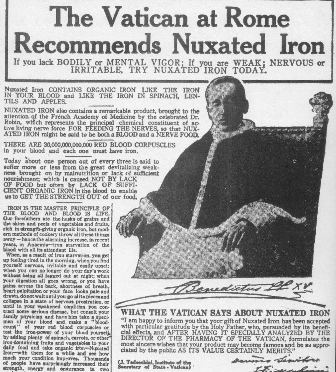
The 1921 ad campaign for Nuxated Iron sought a higher authority to promote the product’s benefits, and featured a picture of Pope Benedict XV under the headline:

“The Vatican at Rome Recommends Nuxated Iron.”

pope