Tag Archives: John McGraw

Sammy Strang

5 Nov

Samuel Strang Nicklin, “The Dixie Thrush,” was one of baseball’s great renaissance men.

Born in Tennessee in 1876, he was the scion of one of Chattanooga’s most prominent families.  His father John Bailey Nicklin served in the Union Army during the Civil War, moved to Chattanooga in 1866, and served as mayor from 1887-1889.
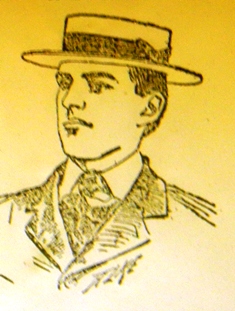
Sammy Strang

Samuel Nicklin spent one year at the University of Tennessee where he starred on the football and baseball teams. He also had two short stints in professional baseball 1893 and 1896, which included 14 games with the Louisville Colonels in the National League when he was 19.  Late in 1896, he enlisted as a private in the Tennessee Volunteers, served in Spanish-American War and rose to the rank of captain.

After leaving the service, Nicklin signed a contract with Cedar Rapids Bunnies in the Western Association and dropped his last name; he was known as Sammy Strang for the rest of his career.

The Milwaukee Journal said of the name change:

“(Strang) came of a rich southern family with deep prejudices against professional ball.”

This “prejudice” likely had nothing to do with it given that in addition to serving as Chattanooga mayor, the elder Nicklin was active in professional baseball, serving as president of the Southern Association in the 1890s.

A career .269 hitter, Strang was best known for being one of baseball’s first regular pinch-hitters while playing for John McGraw’s New York Giants from 1905 until June of 1908.  According to The Associated Press:

“McGraw noted the regularity with which he hit in pinches.  So he called him a ‘pinch hitter’—and the term stuck.”

During the 1909 season, Strang began coaching the baseball team at West Point.  He retired from baseball after playing from 1908-1910 with the Baltimore Orioles in the Eastern League, to study opera.
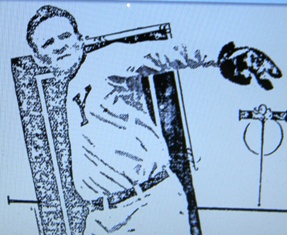
Sammy Strang

During his baseball career, Strang was known for writing songs and singing but decided to seriously pursue a music career in 1910.  He traveled to Paris where he trained under Jean De Reszke, one of the greatest male opera stars of the 1890s.

Upon returning from Paris, he chose not to accept an offer to join an opera company and instead returned to West Point, where he continued as coach until 1917.

Strang returned Tennessee shortly before his father’s death in 1919 to manage and take over ownership of the struggling Chattanooga Lookouts in the Southern League.  While the Lookouts did not win a league championship during Strang’s tenure, he was credited with turning the franchise around and sold the team, for which he paid nothing 1919, for a reported $75,000 in 1927, while retaining ownership of the stadium, Andrews Field.

Unfortunately, Strang’s most ambitious plan–to sign Satchel Paige in 1926–never materialized.

According to Larry Tye’s book “Satchel Paige: The Life and Times of an American Legend,”   Strang failed in an attempt to sign Paige for $500 to pitch a game against the Atlanta Crackers. Paige said of the deal:

“I just had to let him paint me white.”

Samuel Strang Nicklin died in Chattanooga in 1932.
A Really Bad Idea II

23 Oct

Last week I told you about Chicago Colts President Al Hart’s connection with the proposed rule to change the shape of the diamond.  He wasn’t the only baseball pioneer who considered adopting rule changes which would have completely changed the game.

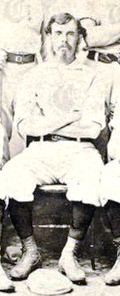
William Henry “Harry” Wright, called by many “The Father of Baseball,” was among the most respected figures of baseball’s first two decades.  The Philadelphia Record described his importance:

 “Harry Wright has done more than any other man to bring baseball to its present high standing.”

Wright’s story has been told many times and in many places.  This lesser known story focuses on two rules changes he championed.

Harry Wright

After the 1893 season Wright’s contract was not renewed as manager of the Philadelphia Phillies he accepted the position of “Chief of Umpires” of the National League.  The Philadelphia Record reported on a number of rule changes he advocated, including this:

 “Harry Wright thinks that players should not be allowed to question an umpire’s decision during the progress of a game, or to speak to him while the ball is in play, and that he should have the power of taking out of the contest any player (or manager) who breaks the rule.”

While not necessarily a bad idea, if adopted Wright’s idea would have drastically changed the game for several generations of famous umpire baiters.

One other rule change Wright promoted, as reported by The Sporting Life, would certainly have been a bad idea:

 “(A)llowing a base runner to run on a fly ball instead of returning and registering at the base.”

While Wright’s idea never was seriously considered for incorporation into the rule book, it had advocates as late as 1899, four years after his death.

Washington Senators Manager Arthur Irwin endorsed the rule with this colorful description:

 “Uncertainty is the life of the game, and the more uncertain the uncertainty the higher does the interest key itself…for instance (John) McGraw, one of the most daring base runners in the league Is on first base with two men out, and a run needed to win the game (Wilbert) Robinson follows with a fly to center field, and at the stroke of the bat away scuds Mac. His get-away is the cue that brings the spectators to their feet.  ‘Will he score?  Can (Joe) Kelley field that ball home to cut him off at the plate?’ Around the runway fly the twinkling feet of the little Napoleon of the Orioles.   It’s a chase of life and death between Mac and the ball. Kelley swings the sphere on two bounds to Duke Farrell at the plate.  Mac slides into the rubber, and beats the throw by an abbreviated whisker.

“Can you imagine a more intense climax to a game of ball? Why, the game would be full of such play if the idea of running on a fly ball became a rule.  It would increase the base running, produce more plays in the field, and keep the outfielders almost as busy as the inner circle, when the bases were occupied.”

Of course Irwin failed to consider the scenario where the winning run is on third base and scores on a routine fly ball with two outs.

Arthur Irwin

Jack Ogden

28 Sep

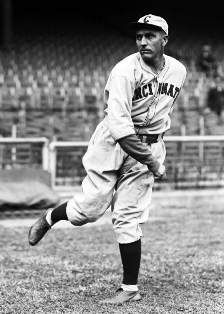
John Mahlon Ogden had limited success in three stints in Major League Baseball, but for an eight year period he was one of the greatest minor league pitchers in history.

Born in 1897, Ogden played baseball at Swarthmore College (where his brother, Major League pitcher Warren “Curly” Ogden also played), and went directly to John McGraw’s New York Giants.  The 20 year old appeared in five games for the Giants before being shipped to the Newark Bears in the International League where he went 5-5 with a 1.48 ERA.  Ogden spent 1919 with the Rochester Hustlers posting a 10-13 record with a 2.37 ERA.

His career took off the next season with the Baltimore Orioles.  The 22 year old Ogden led the International League champions with a 27-9 record—future Hall of Famer Lefty Grove was 12-2 for the O’s that year.  Egan followed that up with an incredible 31-8 record with a 2.29 ERA in 1921.  Beginning on May 10 Ogden won 18 straight decisions, finally losing 3-2 to the Jersey City Skeeters on July 22.  Ogden then won his next five starts.  Baltimore won their third of seven straight IL championships (Grove was 25-10 with a 2.56 ERA).

Over the next six seasons Ogden went 133-63, including a 28-win season in 1925, the last championship in Baltimore’s domination of the International League.

Jack Ogden

Ogden made it back to the Major Leagues with the Saint Louis Browns in 1928 and ’29 where he was a combined 19-24 with an ERA above 4. Ogden was acquired by Cincinnati for the 1930 season, but due to an illness he announced his retirement and took a high school coaching job.

Ogden attempted a comeback in 1931, going a combined 6-10 for the Reds in ’31 and ’32, followed by two more minor league stints with Rochester (after being traded by the Reds to Cardinals) and Baltimore.  He retired for good in 1934 and accepted the position of Vice President and General Manager of the Orioles and became assistant to Philadelphia Phillies President Gerald Nugent in 1939.

In 1941 Ogden bought controlling interest of the Elmira Pioneers in the Eastern League.  His son, John Jr., also a star pitcher and basketball player at Swarthmore, helped Ogden operate the team until he was drafted in 1943.   PFC John Mahlon Ogden Jr. was killed in France on August 8, 1944. Ogden sold the Elmira franchise shortly after his son’s death.

Ogden continued in baseball serving as a scout for a number of teams and managed high school and college teams.  He passed away in 1977 in Philadelphia.

Ogden is a member of the International League Hall of Fame.

Baseball’s First Chinese Player

30 Jul

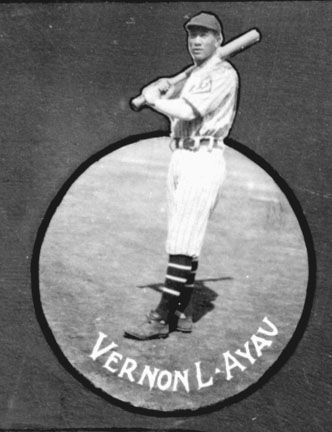
Vernon L. Ayau’s professional career lasted less than half of one season, but in the process, he became the first Chinese player in professional baseball and his signing nearly broke up a league.

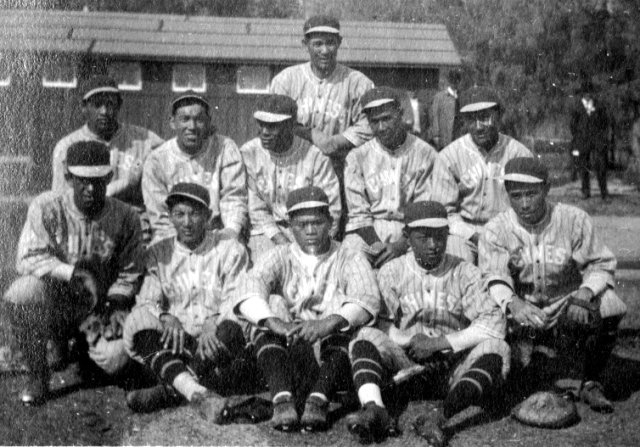
Ayau, born January 31, 1894, in Maui, Hawaii, played on the Chinese University of Hawaii team that toured the US in 1913, 14 and 15.  He was said to have caught the eye many in professional baseball including New York Giants manager John McGraw.

Chinese University Team

Ayau was described as a slick fielding shortstop with an excellent arm, but a weak hitter.  In December of 1916, he was offered a contract by Bill Leard, manager of the Seattle Giants in the Northwestern League.  Leard played against Ayau when he went to Hawaii after the 1916 season with an all-star team put together by former Northwestern and Pacific Coast League player Charles “Cy” Swain.

Within weeks, Northwest League players passed a petition expressing their displeasure with the signing, and newspapers in league cities came out strongly against Ayau.

Anti-Chinese sentiment was especially strong in areas where Chinese workers were being hired as miners, and mining unions in Butte and Great Falls (two league cities) threatened to “take action to have (Ayau) removed from the league.”  Shortly before the signing, a Chinese mine worker had been dropped from a bridge into the Missouri River by members of the miners union.

Leard received death threats but along with Seattle’s ownership held his ground and Ayau was on Seattle’s opening day roster.

His time with Seattle only lasted until May 20 when Leard announced his release.  Despite the early threats of boycotts and other action, he was actually signed and released by Tacoma and later Vancouver in the Northwest League over the next six weeks.

By July 1917, Ayau’s career in professional baseball was over.  He hit only .203 in 133 at bats with the three teams.  Contemporary news reports noted his weak hitting but universally praised his glove and arm.  That month he joined a semi-pro team in Wildwood, NJ that also included his former Chinese University teammate Lee Tin.

After serving in the US Army as a member of the infantry in France, Ayau returned to New Jersey where he continued to play semi-pro ball for several years.

He died in Penns Grove, New Jersey on March 28, 1976.