Tag Archives: Louisville Colonels

Burns “Put the Punishment on Phyle”

20 Nov

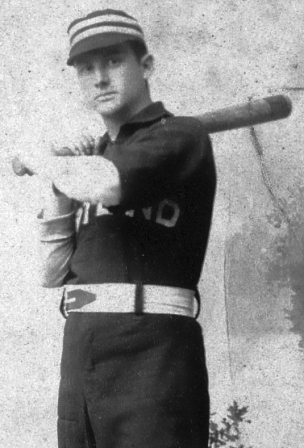
After holding out over a temperance clause the Chicago Orphans added to his contract, Bill Phyle finally signed in late March of 1899.  He reported to spring training in New Mexico anywhere from 10 to 30 pounds overweight (depending on the source) and struggled all season to regain the form he showed the previous season.

On April 17 he was beaten 8-0 by the Louisville Colonels in first start.

On April 25 he lost 3-2 to the St. Louis Perfectos.  The Chicago Tribune said “Phyle gave away the game by distributing bases on balls in just the spots where timely hits followed and transformed the favors into tallies that gave the victory.”

William Phelon, The Chicago Daily News baseball writer, disagreed.  He said Phyle’s “work was of sterling quality.”

Regardless, Chicago Manager Tom Burns didn’t give Phyle another opportunity to pitch for more than a month.

Phelon said it was a mistake for Burns to not use Phyle.  The Chicago Inter Ocean said after the team lost seven of nine games in May “it is passing strange that young Phyle is not given a chance.  On last year’s form Phyle is as good as, if not better than (Jack) Taylor.  The paper called Phyle’s performance in the St. Louis game “gilt-edged” and blamed the loss on “comrades that gave the victory to the enemy.”

Finally, on May 28 Phyle pitched again.   He lost 4 to 3 to the Washington Senators; he gave up three runs on five straight hits with two outs in the ninth.

He lost again on June 1, 7-1 to the Philadelphia Phillies.  Phelon’s opinion of the pitcher was unchanged, and said the losses were simply bad luck:

“Phyle has now lost four straight games.  It is Phyle’s luck to be stuck in whenever the other pitchers have won about three straight, and the team is just about unavoidably due to lose.”

On June 5 Phyle did his best pitching of the season–a victory he is not credited with in the record books.

With the Orphans trailing the Baltimore Orioles 3 to 2 in the third inning, pitcher Clark Griffith was ejected for arguing a called ball.  The Chicago Tribune said:

“It was a queer game.  Phyle pitched after Griffith had been benched…holding the Orioles helpless.”

Chicago won 9 to 4.  And while the Chicago newspapers credited the victory to Phyle, the record books do not.
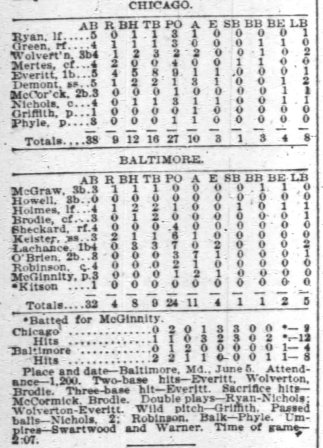
Box score for June 5 game.  Phyle relieved Clark Griffith in the 3rd inning.

Box score for June 5 game. Phyle relieved Clark Griffith in the 3rd inning.

Phyle became ill later the same week, (some sources said it was recurring malaria), a week later he fell off a bicycle and missed two more weeks.  When he returned to the team on June 22, the Boston Beaneaters beat him 5 to 1.

He was credited with his first “official” win on July 1—a game The Inter Ocean called “a comedy of errors,” and a “depressing exhibition.”   He beat the New York Giants 10 to 9, allowing 10 hits and giving up seven runs in the first two innings.  Each team committed seven errors.
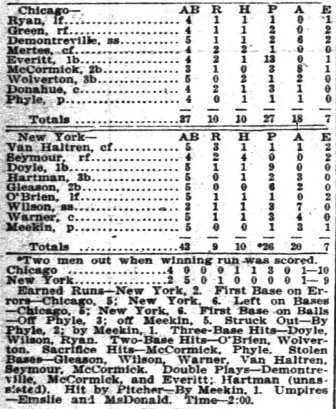
Box score of Bill Phyle's only "official" victory of 1899.

Box score of Bill Phyle’s only “official” victory of 1899.

Chicago went into a slump that would last for the rest of the season; after Phyle’s July 1 win the team was 38-24, in third place, and went 37-49 the rest of the way finishing eighth.

Phyle lost again on July 9 and July 24, and rumors began to circulate that he would be released or traded back to Charlie Comiskey’s St. Paul Saints.

On August 6 Phyle lost 10 to 9 to the Cleveland Spiders.  One week later while the team was on the road, The Inter Ocean reported that he “was sent home by manager Burns.”

The Tribune called Phyle “the scapegoat” and said he and three unnamed teammates  “celebrated after beating a horse race at Washington and Manager Burns, to call a halt, put the punishment on Phyle.

Phelon wrote in The Daily News:

“When the club started for Philadelphia he was told to go home ‘You are through young man, go back to Chicago,’ said Burns, and Phyle went back.  He went back in a rage too, and says he will tell (team president) Jim Hart a lot of things. He says that he has been held up to public derision as a drunkard, all season, and that Burns plays favorites, allowing his friends to jag up as much as they wish and turning all the trouble on others.”

Phelon remained supportive of the pitcher in The Daily News, but in The Sporting Life he reported that Phyle, a former boxer, had deserted the team in early August to go to “St. Louis to see a prize fight, and was not on hand when sorely needed.”

While the relationship between Hart and Burns was strained, and Burns would be replaced at season’s end, Phyle’s complaints went nowhere with the team president and he was suspended without pay.

Ten days after Phyle was suspended Phelon reported that the Baltimore Orioles had offered to trade for or buy Phyle,” (John) McGraw has taken quite a fancy to the young pitcher.”  Hart refused to make a deal.

Phyle never pitched for Chicago again, he is credited with a 1-8 record and 4.20 ERA.

The last Bill Phyle chapter—tomorrow.
Bowerman by TKO

5 Nov

“The Popular Magazine,” a literary magazine that billed itself as a “magazine for men and women who like to read about men,” was published by Street & Smith from 1903 until 1931.

In 1904, the magazine told the story of a fight the previous season involving New York Giants catcher Frank Bowerman.

Frank Bowerman

Frank Bowerman

Bowerman was not kept by Fred Clarke when the Pirates and Louisville Colonels merged after the 1899 season; his contract was assigned to the  Giants.  Apparently some bad blood remained into 1903, and according to the magazine, Giants manager John McGraw used Bowerman’s grudge and some comments made by Clarke to try to light a fire under his team:

“When the Giants were in Pittsburgh (on June 1) last season McGraw noticed that there was bad feeling in the team.  The men stood in little knots in the hotel corridor glowering at other players; they rode to the field in a bus without exchanging a word; the preliminary practice, usually so brilliant, was dull and lifeless.  This worried McGraw.”

John McGraw

John McGraw

The article said McGraw had figured out the cause a few days later in Chicago; Bowerman had sat in the grandstand for that June 1 game, being unable to play due to an injured thumb.  Jack Warner caught Christy Mathewson that day.  What McGraw discovered was that Clarke said Bowerman was overheard criticizing Warner’s work behind the plate, blaming his teammate for one of the two runs scored off of Mathewson:

“This, of course, was tantamount to Bowerman’s asserting his superiority over Warner, a boast that ballplayers are rarely guilty of.”

McGraw cornered Bowerman who insisted Clarke had told “the meanest lie that ever was told, and I told Jack Warner so, but he don’t believe it.”  McGraw told him to keep quiet about it until the Pirates visited New York on June 26.

“(McGraw) proceeded to reinject that esprit de corps by a measure so drastic that it horrified ball patrons all over the country, who, however, thought it merely an incident of the brutality of ballplayers.  Instead of that, it was a well-planned scheme of a crafty general.”

When the Pirates arrived at the Polo Grounds on the morning of the 26th, McGraw took Bowerman aside:

“’Frank, have you got a good right swing?’  The Michigan Lumberman smiled grimly and clenched a fist knotted and as hard as Hercules’ war club.  ‘Well, it’s up to you, then,’ advised McGraw, “to put life in the team. Don’t lose any time.’ Bowerman understood.

“”’I’d like to speak to you a minute,’ he said to Clarke, as the Pittsburgh captain was passing through the gate on his way to the clubhouse.  They went into the stuffy box office; where there was hardly room to swing a cat.  Three times Bowerman demanded an explanation, offering to bring McGraw and Warner in as witnesses…Clarke went down three times and finally admitted he had enough…The Giants played that day, to use the expression of a rooter, as though they were ‘fighting their weight in wildcats.’  Bowerman and Warner coached each other with pet names, and walked lovingly from the victorious field arm in arm, while Fred Clarke was buying a pound of raw beef.”

Fred Clarke

Fred Clarke

“The Popular Magazine” story added an element that differed from the coverage in New York and Pittsburgh newspapers—while each town pointed fingers at the other (in Pittsburgh Bowerman was an out of control thug, while in New York, Clarke got what he deserved for stirring up trouble) no one else suggested that McGraw engineered the fight to motivate his club against the first place Pirates.

The Giants weren’t able to catch Pittsburgh, finishing in second place six and a half games behind the Pirates.

National League President Harry Pulliam initially announced that there would be no punishment for either player because the fight did not take place on the field, three weeks later, under pressure from Pirates owner Barney Dreyfuss, Pulliam fined Bowerman $100.

Jimmy Rogers

16 Sep

In January of 1897 owner Barney Dreyfuss and the directors of the Louisville, Colonels met to determine the future of the club.  The Louisville Courier-Journal said:

“The most important meeting in the history of the Louisville Base-ball club was held last night at the Louisville Hotel.  It was marked by more liberality than had been shown by the club during all the years since it became a member of the big league.”

No one was surprised that Dreyfuss’ protégé, team secretary Harry Clay Pulliam was named team president, nor was it surprising that Charles Dehler was retained as vice president.

But no one had predicted the Colonel’s choice to replace Bill McGunnigle as manager.

McGunnigle had succeeded John McCloskey, and the two combined for a 38-93 record and a twelfth place finish.

James F. “Jimmy” Rogers would be a first-time manager; three months short of his 25th birthday and only 110 games into his major league career.  The Courier-Journal knew so little about the new manager that the paper got his age and place of birth wrong, and also reported incorrectly that he had minor league managerial experience.

While he had only played 72 games with Louisville in 1896 and only 60 at first base, The Courier-Journal called Rogers “the best first baseman the Colonels ever had.”  Even so, the paper acknowledged that “as a manager he is yet to be tried.”

Just why was he the right man to manage the team?

“One of the chief reasons Rogers was selected was that he is sober.”

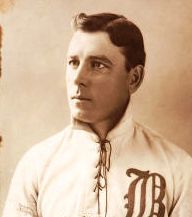
Jimmy Rogers

Jimmy Rogers

Despite being “the best first baseman the Colonels ever had,” Rogers opened the season as the team’s starting second baseman; thirty-five-year-old minor league home run king Perry Werden, acquired from the Minneapolis Millers of the Western League played first base for Louisville.

The team won five of their first seven games, and then went 12-22 through June 16 when Rogers was fired as manager and released; he was hitting .144 and made 16 errors in forty games at second base.

Rogers was replaced as manager by Fred Clarke; the future Hall of Famer was two weeks shy of his 24th birthday.

The Cincinnati Post said the outgoing manager was not only to blame for the team’s poor performance but also for center fielder Ollie Pickering’s slump; Pickering hit .303 after joining Louisville in August of 1896 but was hitting .243 on the day Rogers was let go:

“The claim is made that Jimmy Rogers is responsible for the decline of Pickering.  The Virginian created a sensation last fall, but “Manager Jimmy” tacked the title “Rube” to Pick, and it broke his heart.”

Ollie "Rube" Pickering

Ollie “Rube” Pickering

Pickering was released in July, signed with the Cleveland Spiders, and apparently recovered from his broken heart, hitting .352 in 46 games for Cleveland.

Rogers would never play another major league game.  He was signed by the Pittsburgh Pirates the day after Louisville released him, but became ill with the flu and never played for them.  A month later he joined the Springfield Ponies in the Eastern League and finished the season with them.  Rogers played for East Coast minor league teams until in August of 1899 when he became ill while playing with the Norwich Witches in the Connecticut League.

In January of 1900, Rogers died at age 27.  Two different explanations for his death appear in various newspapers; both may be wrong.  The Courier-Journal and several other newspapers said his death was the result of the lingering effects of “being struck on the head by a pitched ball several years ago while playing in the National League.”

The New Haven (CT) Register repeated the story about Rogers being hit by a pitch, and said that while that injury contributed to his death, he had died of Bright’s disease—a kidney ailment now referred to as nephritis.

Rogers’ Connecticut death certificate listed the cause of death as a bacterial inflammation of the brain.

“Fear of the Black List has Stopped Many a Crooked Player from Jumping”

9 Sep

For a brief period in the mid1890s, George Jouett Meekin was considered among the top pitchers in the game; he might never have had the opportunity, but for what The Sporting Life called “The disastrous effects of Chairman Young’s somersault.”

Jouett Meekin

Jouett Meekin

 John Montgomery Ward, Meekin’s manager with the New York Giants, said he was, along with Amos Rusie, Tim Keefe, John Clarkson and Kid Nichols, the “most marvelous pitchers as ever lived.”

Charles “Duke” Farrell, who caught Meekin and Rusie with the Giants, said:

“Sometime, it seemed to me that (Meekin) was actually faster…Rusie’s speed struck the glove with a bruising deadening, heavy shock, and Meekin’s fastest gave a sharp, sudden sting.”

But in 1891 Meekin was a 24-year-old pitcher in his third season with the St. Paul Apostles in the Western Association. The New Albany, Indiana native became a well-known amateur player across the Ohio River in Louisville before signing his first professional contract with the Apostles in 1889.  His sub .500 winning percentage was not enough to keep the American Association’s eighth place Louisville Colonels, from inducing Meekin to jump his contract with St. Paul.

In June Meekin jumped; at the same time third baseman Harry Raymond jumped to Colonels from the Western League’s Lincoln Rustlers.

The National Board of Control, created after the 1890 season as part of the “peace agreement” between the National League and The American Association after the collapse of the Players League, to arbitrate contract disputes, acted quickly.  Board Chairman (and National League President) Nick Young announced that Meekin and Raymond would be “forever ineligible to play with or against a National Agreement club.”  The statement, signed by Young, also said:

“This order or any other that may hereafter be made for the same cause, will never be modified or revoked during the existence of the present board, whose term of office will not expire for five years.”

The move was applauded by the press and no less a figure than “the father of baseball,” Henry Chadwick, who called Raymond and Meekin part of a “venal cabal” of jumping players.

Despite the promise that the order would “never be modified or revoked,” Young did just that.  Within weeks of issuing the order, both players were reinstated.

The backlash was swift.

The Cleveland Plain Dealer called the reversal “nauseating.”  The Cincinnati Times-Star said it was “one of the greatest mistakes ever made.”  The Milwaukee Evening Wisconsin said Young and the board chose to “toss the National Agreement into the fire.”

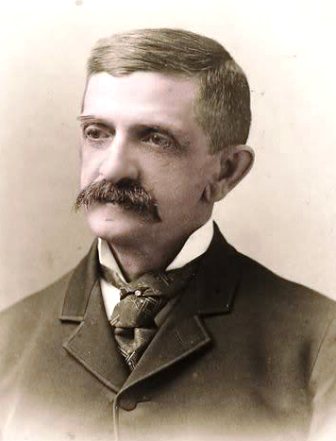
nickyoungpix

Nick Young

James Edward Sullivan, founder of the Amateur Athletic Union (AAU) said the reinstatement of the “arch-culprits” Meekin and Raymond “was the worst in the history.”  He predicted dire consequences as a result:

“Heretofore the fear of the black list has stopped many a crooked player from jumping or doing dishonest work.  But from now on it will be different.  A precedent has been formed.”

Raymond jumped back to Lincoln, taking Colonels’ pitcher Phillip “Red” Ehret with him to the Rustlers.  Meekin remained with Louisville and moved to the National League with the Colonels the following season.

Meekin had a 10-year big league career as a result of Young’s reversal.

From 1891-93, Meekin was 29-51 with Louisville and the Washington Senators and was traded to the Giants (along with Duke Farrell) before the 1894 season.  He was 33-9, and fellow Indiana native Amos Rusie was 36-13, for the 2nd place Giants.  Meekin had two complete game victories in the Giants four game sweep of the first-place Baltimore Orioles in the Temple Cup series (Rusie won the other two games).

The New York Evening Journal called Meekin “Old Reliable,” and said, “He can push ‘em up to the plate in any old style, and is factor with the stick.”  The pitcher hit .276 with 29 RBI in 183 at bats in 1894 (including hitting 3 triples in a game on July 4) and was a career .243 hitter.

Meekin won 102 more games (including 26, and 20 win seasons in 1896 and ’97), but as O. P. Caylor said in The New York Herald he suffered from “a lack of control.”  Meekin walked 1056 batters and struck out only 901 in more than 2600 innings, he also hit 89 batters; in 1898, he broke Hughie Jennings nose with a pitch.

After posting a 16-18 record for the seventh place Giants in 1898, Meekin, along with Rusie, and second baseman William “Kid” Gleason, were blamed by New York owner Andrew Freeman for the team’s disappointing finish.  Freeman told reporters:

“Meekin, Rusie and Gleason will be either sold or traded.  We do not want them.  I’m going to break up cliques in the team even if I have to get rid of every man.  There must be harmony.  Without it we can’t win games.  We have too many men who are simply playing for their salaries and do not seem to care whether they win or not.”

Rusie had injured his arm late in the season and sat out the next two years.  Meekin and Gleason, despite Freedman’s promise, returned to the Giants for the 1899 season.  The team finished in tenth place, and Meekin struggled with a 5-11 record.

He was sold to the Boston Beaneaters in August for a reported $5000, although it was commonly assumed that the Giants received much less, or simply “loaned” Meekin to Boston for the stretch run; a charge made by Brooklyn Superbas manager Ned Hanlon.  Although Hanlon’s charges have become “fact” in countless books and articles over the years, several newspapers, including The Pittsburgh Press refuted Hanlon’s story:

“All that talk and fuss about Freedman giving Jouett Meekin to Boston in order to help that team win the pennant and thus get even with Brooklyn is nonsense.  The truth of the matter is that Freedman thought Meekin’s days as a pitcher were over, and he offered him to the Pittsburgh club, but President (William) Kerr thought the same way and did not take him.  At the time Boston’s pitching corps was in bad shape and manager (Frank) Selee took a chance on the big fellow.  There was no underhand dealing in the matter at all.”

Meekin was 7-6 with a 2.83 ERA for Boston, but the team finished second to Brooklyn.  He was released by Boston before the 1900 season and pitched just two games with the Pittsburgh Pirates before being released again in July.  He finished the season with the Grand Rapids Furniture Makers in the Western Association and spent 1902 in the Southern Association with the Memphis Egyptians.

Meekin returned home to New Albany, Indiana, where, in 1910, according to The Trenton True American “his earnings from baseball are well invested in real estate.”

Meekin slipped into relative obscurity by the time he died in 1944.

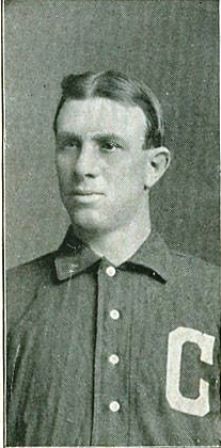
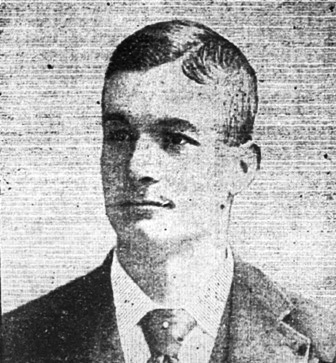
The original picture that appeared with this post–now below–was misidentified as Jouett Meekin in this blog and by The Louisville courier-Journal in 1897.  According to Mark Fimoff co-chair SABR Pictorial History Committee, the picture was actually Lave Cross.  

Lave Cross--picture earlier misidentified as Jouett Meekin.

Lave Cross–picture earlier misidentified as Jouett Meekin.

Things I Learned on the Way to Looking up Other Things #5

8 Aug

Johnny Evers “Ardent Worshipper of Hoodoo Lore”

Edward Lyell Fox was a war correspondent in World War I; after the war he was accused of taking money to write stories favorable to the German government.  Before that he wrote extensively about baseball for several American magazines.

In 1910, writing for “The Columbian Magazine”, Fox interviewed Johnny Evers of the Chicago Cubs about the “almost unbelievable efforts made by ballplayers to offset what they firmly believe to be ‘hoodoos.’”

Evers was one of the most superstitious players in the game, “an ardent worshipper of voodoo lore,” according to Fox, and Evers said the Cubs “are more superstitious than any team in the big leagues,” and that manager Frank Chance “is one of the most ardent respecters of diamond ‘hoodoos.’”

It’s not certain that Evers’ claim that “most players firmly believe in,” the superstitious he listed for Fox, but it’s clear he believed them:

 “If any inning is favorable to a player, he will try to lay his glove down on the same spot where he had placed it the inning before.

“While going to different parks in cars, the sight of a funeral cortege is always regarded as an ill omen.”

Evers also said the sight of a handicapped person was also an “ill omen…unless you toss him a coin.”

On the other hand Evers said a wagon load of empty barrels was a sign of good luck.

Johnny Evers,

Johnny Evers,


“Too much of a Good Thing”

Even in baseball’s infancy that were critics that said the popularity of the game was “too much of a good thing.”

In September of 1865 The Philadelphia Inquirer editorialized:

 “Let us take, for instance, the base ball (sic) pastime, which is now assuming the proportions of a violent and widespread mania.”

The culprit, according to the editorial, was the athletic club teams that were growing in popularity and  no longer “satisfied with a game or two a week.”

 “(S)ome of these associations devote, three, four or five days at a time to their games; that they are not satisfied with playing on their own grounds for their own benefit and amusement, but that they thirst for popular applause, and are rapidly transforming their members into professional athletes…They issue their challenges, and hotly contend for mastery with clubs belonging to other cities.”

 The Inquirer did predict one aspect of baseball’s new popularity:

 “It can be easily seen that this spirit must soon lead on to gambling. So far the only prize of the base ball and cricket matches has been a ball or some implement of the game, but private wagers have undoubtedly been laid upon the playing of certain clubs, and money has changed hands upon results.”

The Enquirer was also concerned that the game defied “common sense” because “during the heats of summer violent bodily exercise should be avoided; but upon this subject common sense and the base ball mania seem to be sadly at variance.”

The editorial concluded that “the young men,” make sure “they do not depreciate themselves to the level of prize fighters or jockeys, who expend their vim on horse races and matches made for money.”

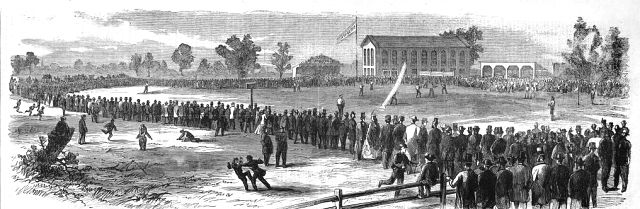
Athletic of Philadelphia versus Atlantic of Brooklyn, in Philadelphia October 30, 1865--"a violent and widespread mania."

Athletic of Philadelphia versus Atlantic of Brooklyn, in Philadelphia October 30, 1865–“a violent and widespread mania.”


Odds, 1896

Early in 1896 The New York Sun reported on “an early development of interest.”  A local bookmaker had issued odds on the 1896 National League race:

“He lays odds of 3 to 1 against Baltimore finishing first; 7 to 2 against Cleveland and Boston;  4 to 1 Philadelphia and New York; 7 to 1 Chicago; 8 to 1 Brooklyn and Pittsburgh; 15 to 1 Cincinnati; 40 to 1 Louisville; 100 to 1 Washington, while (Christian Friedrich “Chris”) von der Ahe’s outfit (St. Louis) is the extreme outsider on the list.  Any lover of the German band can wager any amount and “write his own ticket.”

The final standings:

1. Baltimore Orioles

2. Cleveland Spiders

3. Cincinnati Reds

4. Boston Beaneaters

5. Chicago Colts

6. Pittsburgh Pirates

7. New York Giants

8. Philadelphia Phillies

9. Washington Senators

10. Brooklyn Bridegrooms

11. St. Louis Browns

12.  Louisville Colonels

1896 Orioles, 3 to 1 favorites, won the National League Championship.

1896 Orioles, 3 to 1 favorites, won the National League Championship.

Hap Myers

29 Jul

When the 6’ 3” 175 pound Ralph Edward “Hap” Myers was let go by the Boston Braves after the 1913 season a reporter told Braves shortstop Rabbit Maranville he was sorry to see Myers go.  Maranville joked:

“Well, you might be, but I’m not.  Do you know that guy is so thin that every time I picked up a grounder I had to shade my eyes with my gloved hand to locate him before throwing the ball.”

Myers began his professional career after graduating from University of California, Berkeley in 1909, where he also played baseball.  The San Francisco native hit a combined .311 playing for the Sacramento Sacts in the Pacific Coast League, and the San Jose Prune Pickers and Santa Cruz Sand Crabs in the California League.

Myers went east in 1910 after being purchased by the Boston Red Sox, but became ill, with scarlet fever, and as a result appeared in only six games in Boston before being  sent first to the Toronto Maple leafs in the Eastern league, then the Louisville Colonels in the American Association.

Despite hitting just .240 with Louisville, Myers was selected by the St. Louis Browns in the Rule 5 draft.  The Red Sox claimed Myers still belonged to them and his contract was awarded to Boston, where he began the season, was sold to the St. Louis Browns, who quickly released him despite hitting .297 in 11 games, then back to the Red Sox where he hit .368 in twelve games before being sent to the Jersey City Skeeters in the Eastern League.

It was never clear why, in spite of hitting .333 in 81 at bats in 1910-1911, Myers couldn’t stick in the American League.

In 1912 he returned to the West Coast to play for the Spokane Indians in the Northwestern League where he led the league in hits, and runs, hit .328, and led all of professional baseball with 116 stolen bases.  The Portland Oregonian said:

“Myers base stealing smashes any previous performance in Northwestern League history.  You have to go back 20 years in official guide books to find any record to compare…and that includes every league in organized baseball.”

Spokane owner Joe Cohn went overboard in his praise of Myers in The Spokane Spokesman-Review:

“Best ballplayer in the Northwestern League by a long shot.  He is the greatest ballplayer I ever saw.  Boy I tell you this Myers is a wonder.  Ty Cobb, Hans Wagner, Tris Speaker and all of them have nothing on Myers…I think Myers has it on Cobb, Wagner, Lajoie, Jackson and the whole bunch.”

Myers, and Portland catcher Rex DeVogt were purchased by the Braves from Portland, Devogt would only last for three games, and six hitless at-bats in April of 1913.  Myers would become the Braves starting first baseman.  Another Pacific Coast League player, pitcher “Seattle Bill” James also joined the Braves.

hap3

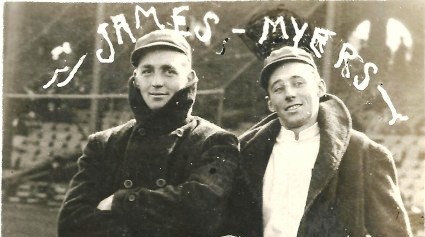
“Seattle Bill” James and “Hap” Myers

Myers got off to a slow start; he was hitting just .224 in early July, but was leading the National League in steals.  An article in The Tacoma Times said:

“When Hap Myers, recruit first baseman of the Boston Braves is in full stride stealing bases, he covers nine feet…the average stride of a sprinter is six feet. “

The article said the average player took 13 steps, roughly seven feet per step, between bases but Myers took only ten steps:

“Myers is something of a baseball curiosity, and his work is watched with interest by the fans.  If the time comes that the big fellow climbs into the .300 class as a batter, he is apt to become a veritable terror of the paths.”

He was also said to use “a bat of unusual length,” but the size was never mentioned.

After the slow start, Myers hit well in the second half of the season, ending with a .273 average and 57 stolen bases (second to Max Carey of the Pittsburgh Pirates who stole 61).  Despite his strong finish, Myers was replaced at first base for 22 games in August and September by Butch Schmidt, who was purchased from the Rochester Hustlers in the International League.

"Hap" Myers

“Hap” Myers

At the end of the season Myers was sold to the Hustlers, the deal was, in effect, a trade for Schmidt.  The Boston press simply said Myers did not get along with manager George Stallings; Myers told a reporter in San Francisco that there was another reason; baseball’s labor unrest:

  “I was assigned by the fraternity to get as many Braves as possible into the fraternity, and succeeded in enrolling nearly the entire team.  The powers that be evidently didn’t relish my actions for soon my every move began to bring calldowns and I was not surprised to read in the newspapers a little later that I had been sent to Rochester.”

Myers jumped Rochester to join the Federal League; his signing was reported months before he actually signed.  The Associated Press said in March of 1914:

“Although it has been generally understood that Hap Myers, last season’s first baseman of the Boston National has been under a Federal League contract for some time, the elongated first sacker did not put his name to a contract until yesterday afternoon.  Myers originally expected to play with Larry Schlafly on the Buffalo Federals, but was transferred to Brooklyn, and seemed altogether pleased with the move.”

Myers got off to a strong start, and The Sporting Life said:

“Brooklyn fans cannot understand why Hap was passed out of the National League. They have had a chance already to give his successor at first base on the Boston team (Butch Schmidt) the once over, and the general opinion is that- Hap Myers “lays all over.”

His success in Brooklyn didn’t last; in 92 games Myers hit just .220.

Hap’s story continued tomorrow.

“Baseball by Electricity”

11 Jul

In 1886, The Electrical Review told the story of the first attempts at “reproducing almost instantly a vivid view of the exact situations and plays in a game of baseball.”

The original plan was hatched by three telegraph operators in Nashville, Tennessee who “turned their enthusiasm for baseball to good account.”   J. U Rust, E.W. Morgan, and A.H Stewart made the first attempt to transmit a game between Chattanooga and Nashville in 1884:

“To do this they leased a wire from Nashville to Chattanooga, one end of which was on the ball field, with an expert operator, who was accurately informed in baseball playing, seated watching the game and immediately telegraphing each play as it progressed.  At the Nashville end of the wire were two other telegraphic and baseball experts.  As they received the record from their partner, one man reproduced it verbally to the audience, while the other man manipulated cards bearing the names of the players, around a painted view of the ball field which was placed in full view of the audience.”

The following season Southern League games were transmitted to opera houses in several of the league cities by Morgan & Co. “the ingenious firm” created by the three telegraph operators.

On July 9, 1886 Morgan & Co. transmitted the game between the Detroit Wolverines and the Chicago White Stockings from Chicago’s West Side Park to the Detroit Opera House. The “unique entertainment before a crowd of 600 persons,” was described by The Electrical Review:

“On the stage was a huge landscape—it would have done well as a drop curtain—having a well-painted perspective view of a baseball diamond and outfield.  At the points on the picture representing the positions of batsman, pitcher catcher and basemen, are openings into which may be shoved cards bearing the names of the players, and into which these names are placed as the telegraph operator seated at his instrument reads to the audience the progress of the game, even to the smallest details.”

The crowd at the Opera House “was wrought up to a very high pitch of enthusiasm.  For instance, when the operator read—with (Abner) Dalrymple’s name appearing as batsman—“foul fly to left,” the audience fairly held its breath, and when the next instant the operator called out, ‘and out to (James “Deacon”) White,’ there came a storm of applause, just such as heard on a veritable ball field…the excitement was intense.”

The Chicago White Stockings defeated the Detroit Wolverines 8-2 on July 9, on there way to the 1886 National League championship

The Chicago White Stockings defeated the Detroit Wolverines 8-2 on July 9, on their way to the 1886 National League championship

By the end of the 1886 season, games were presented in opera houses in Chicago, Boston, New York and Cincinnati.  By the end of the decade the practice would become commonplace in all big league cities.

By the mid 1890s the system for presenting games to the public had become much more advanced.

The Baltimore Morning Herald said in September of 1894:

“The ball game today between the Baltimore (Orioles) and Louisville (Colonels) clubs will be given as usual from the stage at Ford’s Grand Opera House at 4 o’clock by electricity.  The system utilized for the first game in the city is ‘The Compton Electric Baseball Game Impersonator.’   It has been used in New York and elsewhere with unbounded success.  It is a contrivance so ingenious that the slightest move of the players is visible, and the anxiety and interest of those present is just as great as though they had been occupying the grandstand.  Every strike is recorded and illustrated, and, whether at the bat, running the bases or in the field, all the players are known and watched…a visible reproduction of the game is given to the minutest detail.”

By the end of that season the Compton system was used to transmit games to fans in New York, Chicago, Philadelphia and Washington, and it, and numerous systems developed by competitors would become commonplace over the next four decades.

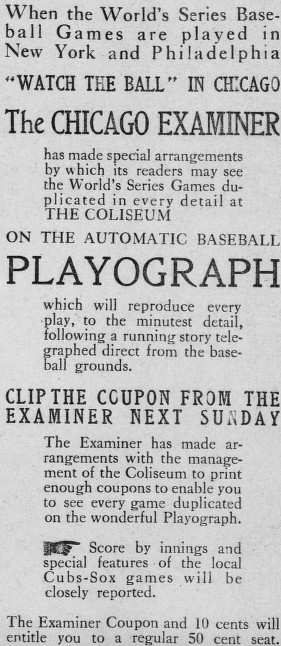
The Chicago Examiner sponsored the "automatic Baseball Playograph" exhibition of the 1913 World Series between the New York Giants and Philadelphia Athletics.

The Chicago Examiner sponsored the “automatic Baseball Playograph” exhibition of the 1913 World Series between the New York Giants and Philadelphia Athletics.

Usually sponsored by local newspapers, the exhibitions were an especially popular method for following the World Series in real-time.   It was not until 1938 (when the New York Yankees, New York Giants, and Brooklyn Dodgers became the last teams to have their games broadcast on radio) that the technological descendants of Morgan & Co. became completely obsolete.

“To be Hissed and Hooted at in the East is too much”

20 Jun

In 1886  Thomas Jefferson “Tom” York retired after a fifteen-year career.   As a 20-year-old he joined the Troy Haymakers in the National Association in 1871, he was with the Hartford Dark Blues for the National League’s inaugural season in 1876, and finished with the Baltimore Orioles in the American Association; he also served two brief stints as a player/manager with the Providence Grays.

York, who suffered from rheumatism, had considered retiring before the 1894 season after the Cleveland Blues sold him to the Orioles, but The Baltimore American said he was induced to continue playing with a $5000 salary and “the scorecard and cushion (concession)” at Oriole Park.  After hitting just .233 in 1884, he was only able to play in 22 games the following season before calling it quits.

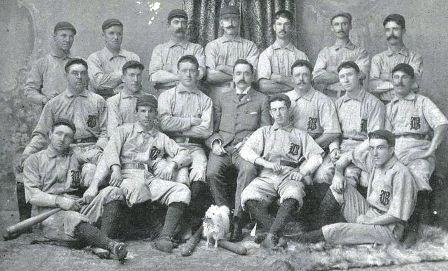
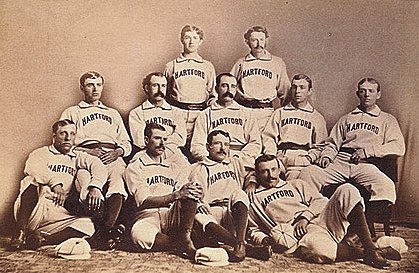
Tom York, middle row, far right, with the 1876 Hartford Dark Blues

Tom York, middle row, far right, with the 1876 Hartford Dark Blues

Just before the beginning of the 1886 season York was hired as an American Association umpire.  After the May 22 game in Baltimore which the Orioles lost 2-1 to the Louisville Colonels, The Baltimore Sun said:

“(York) received a dispatch yesterday ordering him to Brooklyn.  Instead of going he telegraphed his resignation.  His reason for doing so was the abuse he received from some of the spectators of Saturday’s game.  In fact, he was nearly equal to that of John Kelly, ‘the king of umpires.’  He declared (Pete) Browning’s hit near the foul line a fair hit.  He was in the best position to know, but, as it was made at a critical point, some of the audience objected, and York came in for pretty severe abuse.”

The paper said York also made a “questionable decision,” when he “evidently forgot that it was not necessary to touch a runner in a force,” and incorrectly called a runner safe at second:

“York became discouraged and the Association lost a good umpire.”

Within weeks York became a National League umpire; that didn’t last long either.

On June 30, the Kansas City Cowboys lost at home to the New York Giants 11-5, The Chicago Inter Ocean said York “was escorted from the grounds by the police on account of disapproval manifested over his umpiring.”

Less than a month later, after York was “roundly hissed” at the Polo Grounds after making “some very close decisions against the New Yorks,” in a July 22 game against the Philadelphia Quakers, he sent a telegram to National League President Nicholas Young resigning his position.  York told The New York Times:

“I have been badly treated in the West, but to be hissed and hooted at in the East is too much.  I have often heard that an umpire’s position was a thankless one, but I have never realized it before.  It’s bad enough to be hissed and called a thief, but in the West when the local club loses an umpire in fortunate if he escapes with his life.  Of all the cities in the league Kansas City is the worst.”

York said there was another incident Kansas City the day before he was escorted from the field by police:

“On June 29 when the New York men beat the Cowboys 3 to 2 (William “Mox”) McQuery hit a ball over the fence, but it was foul by 25 feet, and I declared it so.  After the game Vice President (Americus) McKim, of the Kansas City club wanted to know how much money I would get from the New Yorks fir That decision.  I remarked that I received my salary from the league and did not take a penny from the New Yorks or any other none.  Then he grew furious, and said he would end my days.  This in conjunction with other things incidental to the life of an umpire has made me tired of the business, and I intend to make room for some other victim.”

Despite quitting both leagues within two months, The Baltimore American said the American Association sent York a telegram in two months later “asking him if he wanted an appointment as umpire.”  The paper said “York replied no, emphatically, as his past experience was sufficient to justify his remaining at home.”

York remained at home for the rest of the season and the next, but while he never worked as an umpire again he returned to baseball in 1888 as manager of the Albany Governors in the International Association.  Over the next decade he was connected with several East Coast minor leagues, including the Connecticut State League, the New York State League and the Eastern Association, as a manager and executive.

York retired to New York where he became one of the many former players employed at the Polo Grounds at the behest of manager John McGraw.  In 1922 The New York Telegraph described his position:

“York has the pleasant post of trying to keep the actors, tonsorial artists and plumbers out of the press stand.  It is old tom who examines your pink paste board and decides whether you are eligible for a seat in the press cage.”

Tom York, 1922

Tom York, 1922

In February of 1936, as preparations were being made for York, along with James “Deacon” White, George Wright, Tommy Bond,  to be honored that summer at the  All-Star Game  as the last four surviving players from the National League’s first season, the former player, manager, executive and umpire died in New York.

“A Baseball with a Mystery Attached to it”

13 Jun

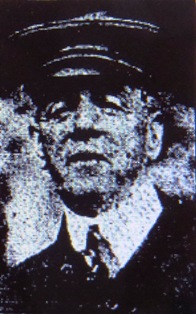
The Chicago Tribune’s Hugh Fullerton claimed that somewhere at Chicago’s West Side Grounds, home of the Cubs, “if it has not decayed, there is a baseball with a mystery attached to it.”

Hugh Fullerton

Hugh Fullerton

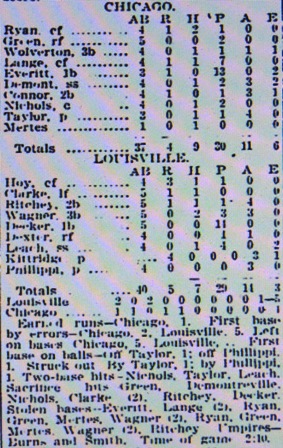
The incident took place on May 11, 1899 “in the middle of a hot game between Louisville (Colonels) and Chicago…this ball disappeared—and as far as anyone knows never yet has been found.”

Fullerton said:

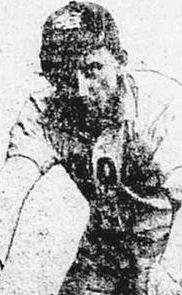
“The score was 4 to 4 in the seventh inning, with Chicago at bat, when Arthur Nichols, the little catcher, came up with one man out. He whanged into the ball and drove it safe to right.  Charlie Dexter threw to second and Nichols slid safe just as the ball arrived.  Tommy Leach was covering second base, and as Nichols slid he lost sight of the ball.  He said it struck his forearm and fell to the ground, and when he started to pick it up it wasn’t there.  He thought it was under Nichols and waited until the runner arose. The ball was not there.

“Nichols waited and held the base, fearing the ball was hidden and he would be tagged out. (Claude) Ritchey and Leach were busy hunting for it.  Everybody joined in.  Still Nichols feared a trick and stuck to the bag.  After five minutes umpire (William) Smith, who was working on the bases, called the Louisville players down, and after accusing them of hiding the ball threw a new one into play.  Chicago kicked and Nichols was ordered to run home.  He ran, but Smith sent him back to second and ordered play begun with a new ball.”

Art Nichols

Art Nichols

Pitcher Jack Taylor singled to right, and Nichols was thrown out at home plate by Dexter.  Louisville went on to win the game 5-4 in ten innings.

Fullerton said:

“Leach, Nichols and Ritchey, the only men near the ball, vowed they never saw it.  What really became of it no one seems to know.”

The Box Score

The Box Score

“The Deterioration in the Morale of the Players”

10 Jun

The Chicago Tribune had had enough:

“The deterioration in the morale of the players has been followed by deterioration in that of the spectators.  The latter relish the obscene profanity and the slugging exploits of the hulking brutes of the baseball field.”

The Tribune provided an “account of the more disgraceful of the many rows witnessed by spectators of baseball games,” during the just-ended 1899 season:

“May 2—Row at Pittsburgh—St. Louis game.  (Frank) Bowerman was put out of the game.  (Jack) O’Connor was taken off the field by the police, and the crowd chased umpires (Tom) Burns and (William) Smith.

May 19—Umpire Burns put (Giants’ William “Kid”) Gleason out of the game at St. Louis.  Gleason’s protest was so strong Burns forfeited the game to St. Louis.

June 1—Row on the grounds at Washington.

June 16—After a long wrangle and continued rowing on the field at New York.  Umpire Burns forfeited the game to Brooklyn.

June 16—(Fred) Clarke and (Clarence “Cupid”) Childs fight on the field in Louisville.

June 27—Rowdy action of players caused the crowd at the Pittsburgh game to mob umpire (James “Chippy”) McGarr.

July 18—(Tommy) Corcoran slugged (John) McGraw at Baltimore after being first attacked, and his action started a riot.

July 26—(Emerson “Pink”) Hawley, (Fred) Tenney, and (Hugh) Duffy engaged in a game of fisticuffs at Cincinnati.

Aug 16—(Oliver “Patsy”) Tebeau, McGraw and (George “Candy”) LaChance fought at Baltimore

Aug 18—Riot at Baltimore game started by (Tim) Donahue throwing a handful of dirt at (Steve) Brodie’s face.

Sept 1—Childs and Aleck Smith fight on the field in Louisville.

Sept 7—Riots at St. Louis and Brooklyn.

Sept 15—Clarke taken off Philadelphia grounds by police.

Sept 16—Chicago players jerked (Ed) Swartwood around the diamond because he called the game in the eighth inning on account of darkness.

Oct 9—(George “Win”) Mercer assaulted (Al) Mannassau at Washington.

Oct 14—(Jimmy) Scheckard assaulted umpire (John) Hunt, refused to retire, and Hunt forfeited the game to Brooklyn.”

Cupid Childs, repeat offender

Cupid Childs, repeat offender

Al Mannassau, assaulted by Win Mercer in Washington

Al Mannassau, assaulted by Win Mercer in Washington

In addition to the fans, The Tribune blamed team owners:

 “For the multifarious minor acts of blackguardism and rowdyism of which the hired men of the club owners were guilty there is no room.  It is sufficient to say that they, like the graver offenses mentioned above, did not wound the feelings or jar on the nerves of the proprietors of these baseball roughs.  Those proprietors seem to have come to the conclusion that audiences like these ruffianly interludes.”

Like hundreds of predictions before and thousands more to come over the years, The Tribune saw dire consequences for baseball given the current state of the game:

“There was a time when Chicagoans went to see the games of the Chicago club because they had a feeling of proprietorship in that organization.  That day is over.  Men do not go to see games out of local pride, nor do they go to see fine playing.  They go to listen to the language of the slums and to witness the horseplay and brutalities of the players or performers.  When these have lost their attractions professional baseball will disappear. “