Tag Archives: National League

Bill Brennan versus Philadelphia

10 Jul

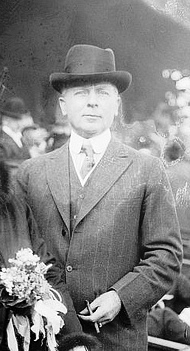
Umpire William “Bill” Brennan was at the center of the controversy that led to Philadelphia Phillies owner Horace Fogel being banished from the National League.  Fogel maintained that the 1912 pennant race was fixed, and that Brennan and the rest of the league’s umpires were in the tank for the champion New York Giants.

After Fogel was expelled Brennan dropped a threatened libel suit against him and the umpire’s life went back to normal, until August 30, 1913.

Fogel was working the game in Philadelphia’s Baker Bowl between the Phillies and the New York Giants.  The Giants, who were in first place by nine games, were trailing the Phillies 8-6 in the ninth inning.

Harry “Moose” McCormick, pinch-hitting for Fred Merkle, led off the inning with a groundout to second baseman Otto KnabeThe Philadelphia Inquirer said:

“As the big Giants’ pinch hitter started for the players’ bench he motioned towards the center field bleachers and shouted to Brennan that the white shirts there had blinded him.”

Brennan walked out to the center field bleachers and told the fans seated in the area to vacate their seats:

“They greeted him with jeers and catcalls; Brennan paused helplessly for minute and then walked back into the diamond.  Approaching Mike Doolan, captain of the Phillies, he ordered him to have the crowd removed.  Doolan laughed and said that it was impossible.  Then Brennan walked over to the New York bench and held a conference with Manager (John) McGraw.”

Philadelphia manager Charles “Red” Dooin had been ejected earlier in the game, so Brennan told acting manager Hans Lobert to move the crowd out of center field.  Lobert and the Phillies “explained that it could not be done.”

Brennan again went out to the center field bleachers, this time ordering a Philadelphia police officer to remove the crowd:

“The bluecoat laughed at him and said that he could not, under any circumstances, take his orders.

“’You’re under my orders,’ said Brennan.

“’I’m under no orders except from my sergeant or captain,’ was the answer.”

The crowd of 22,000 was “storming angrily for the game to proceed,” and the other umpire, Mal Eason, suggested the game be continued and played under protest.  Instead, Brennan again huddled with McGraw.

“Strangely enough, McGraw, who is generally the most volatile man in the world and charges all over the field in excitement, this time, remained quietly on the New York Players’ bench.”

Brennan walked back on the field and said, “This game is forfeited to New York, 9 to 0.”  The Giants were “running towards the clubhouse before (Brennan) completed his statement,” according to The Inquirer.

“Bedlam cut loose at that instant.  Screaming in rage the bleacherites by the thousands poured over the low rail into the playing field…a cushion seat struck Brennan in the face as he was walking towards the exit…His walk turned into an undignified run.  The bleach crowd had first tried to stop the New York players who butted their way to safety.  Then they turned toward Brennan.”

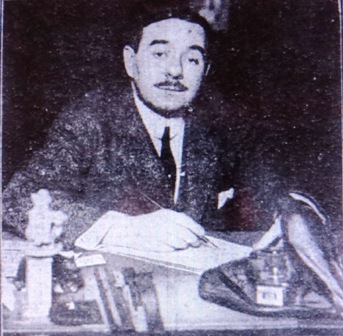
Bill Brennan

Bill Brennan

Escorted by police “with drawn revolvers,” Breen was able to get off the field.   Mobs formed outside the Baker Bowl and pursued the Giants, and Brennan, with his police escort, on their separate routes to the North Philadelphia Railroad Station:

“Brennan and his guard reached the entrance to the station just at the instant McGraw and his players came fleeing around the corner at Broad Street.  The police forsook the umpire to try and head off the larger crowd behind the New Yorkers.  With drawn guns they held them at bay for a few minutes. “

While police held two mobs at bay, a third waited for Brennan inside the station and “jumped upon him by the dozens.  (Brennan) was beaten to the ground, rose, (and) was beaten down again.”

The Inquirer claimed that McGraw and Brennan in their haste to escape the crowd boarded the wrong train, “an extra fare train from Pittsburgh,” rather than the train to New York.

Despite the mob, the chaos, and the “Missiles of all kinds,” that were thrown by Phillies fans, there was only one injury.  Giants’ utility man Arthur Tillie Shafer was hit in the head with a brick, but was not seriously injured.

Two days later National League President Thomas Lynch assigned Brennan to work the Phillies September 1 double-header with the Dodgers. The Inquirer said:

“President Lynch, of the National league, exhibited anything but a keen sense of delicacy in sending Brennan in to umpire the two games between the Phillies and Brooklyn on Monday,  or perhaps he is trying to work up a reputation as a humorist.”

National League President Thomas Lynch

National League President Thomas Lynch

Philadelphia won both games without any serious incidents.  The Inquirer headline read:

“Man Who Helped Giants Couldn’t Aid Dodgers.”

Two days later Lynch reversed Brennan’s decision, The Associated Press said:

“Lynch, in his decision says that Umpire Brennan exceeded his authority in declaring the game forfeited to the New York club and formally awards it to the Philadelphia team by a score of 8 to 6.”

While New York appealed Lynch’s decision, Brennan‘s troubles were just starting.

He learned that a warrant was issued for his arrest in Philadelphia; a Phillies fan named Henry Russell claimed “Brennan in his efforts to get out of the park pummeled him and knocked him to the ground where he was trampled by the crowd.”  At the same time, it was rumored that Brennan would be let go by the National League.  The Associated Press said:

“(Tom Lynch) is certain to let him out, it is said if he is reelected, and if another man is chosen to head the circuit he will be instructed by his nominators to dispense with Brennan.  It is not the case of the forfeit that mitigates against Brennan so much, according to the yarn circulated, but his generally inconsistent work in games where the spirit of battle ran high.  He is said to be over excitable.”

Two weeks after Lynch’s decision, he was overruled by the National League Board of Directors, and it was determined that the game would be completed on October 2,

The Philadelphia Record and The Inquirer called the decision unfair and gave the second place Phillies “all the worst of it.”

In the end, the decision made no difference.  The Phillies, nine games behind the Giants on the day of the forfeit, never got closer than seven games out of first place, and finished the season twelve and a half games behind the Giants.  The pennant was a foregone conclusion when what The Inquirer called “The longest game on record,” was finally completed.

The anti-climactic two-thirds of an inning ended quickly on October 2.  Tacked on to the beginning of a double-header, pitcher George Chalmers faced three batters:  John “Red” Murray grounded out, John “Chief” Meyers singled; Eddie Grant ran for Meyers and was forced at second on Larry McLean’s ground ball.  The Phillies “ran from the bench and danced in glee at the speedy decision in favor of the long-standing dispute.”
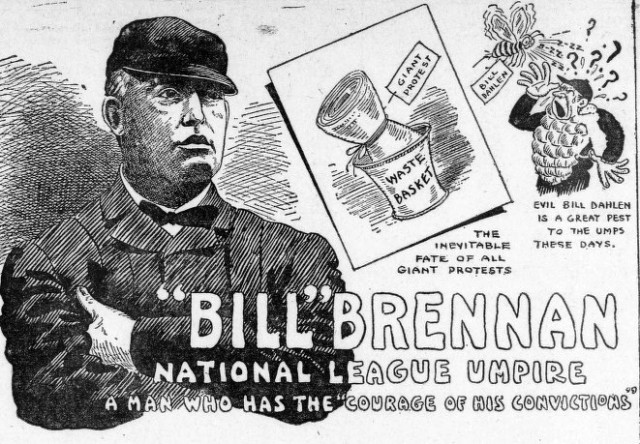
billbrennan

After New York won the 1913 pennant, Giant pitcher and cartoonist Al Demaree featured Brennan in one of his nationally syndicated cartoons.

In December Lynch resigned as National League president; the following month it was announced that Brennan had jumped from the National League, signing a three-year contract to become a Federal League umpire (the league would only last two seasons).

The last word in the Brennan/Philadelphia controversy belonged to a journeyman boxer and fight promoter in Superior, Minnesota named Curly Ulrich.  Three weeks after the 1913 season ended The Duluth News-Tribune said Brennan, a St. Paul resident,  “attended the bouts in Superior.”  Promoter Ulrich introduced him:

“Ladies and gentlemen, I wish to present to you Bill Brennan, National League umpire and member of the New York Giants.”

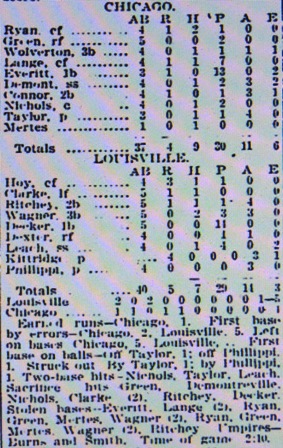
The box score as it appeared on August 31
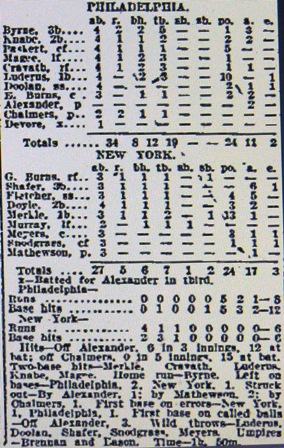
The box score as it appeared on August 31
“The Story of the Story Fogel Wrote”

9 Jul

The day before Philadelphia Phillies president and owner Horace Fogel was banned from baseball by his fellow National League magnates, one of the witnesses in the case against him said Fogel was being “used” by the “instigator” of the story that appeared in The Chicago Evening Post, and contributed to the action taken by the National League.

The charge seemed to confirm a rumor that swirled around the Fogel case for months; that the Philadelphia Phillies owner was acting on behalf of Cubs owner Charles W. Murphy.

Under the headline, “The Story of the Story Fogel Wrote,” William S. Forman, sports editor of The Evening Post wrote:

“Charles W. Murphy authorized me to tell Fogel that Murphy had suggested writing the story.  On this representation Fogel wrote it and signed it.  He sent it to Murphy, who read it before I ever saw it.  It came to me from Murphy’s office; and if Murphy had not approved the story it never would have been published.  The man who is morally responsible for that article and the charges it contained is Murphy himself, and I have Fogel’s own word for it that he wrote it simply “to help Murphy fight his battles” with the National League.

“It is not the first time Murphy has made Fogel the goat.  Previously Murphy had sent me another article signed by Fogel and told me Fogel had writing it, and wanted it published…Months afterward I learned that Murphy himself had writing it and Fogel had merely signed it because he was requested to do so by the Cubs’ President.  It was a defense of Murphy who had been criticised…by a Chicago baseball writer.”

Charles Webb Murphy

Charles Webb Murphy

Murphy, who spent his entire National League career engaged in countless feuds with fellow owners, players, managers, umpires and writers, denied the charge and said Forman was motivated to tell the story as a result of one of Murphy’s other feuds, telling reporters:

“This is a lot of rubbish; why I hardly know this man Forman, but I can guess readily that his paper is sore because we let Frank Chance go.  His paper thinks that by pounding me it will make a hit with Chicago fans, but it will find it is mistaken.“

The Associated Press said the other league owners were not buying Murphy’s explanation:

“(I)t is claimed that every magnate expects charges will be brought against (Murphy) by President (Thomas) Lynch and he may go the way of Fogel if the test votes to date are any criterion.”

Despite the rumors and the “test votes,” Murphy said “the suggestion that charges will be brought against me is all rubbish.”

Murphy was correct.  Despite the evidence, and despite his ongoing feuds with the league president and at least half of the National League magnates, charges were never brought by the league.

Murphy had another feud-filled, stormy year in Chicago in 1913.  After the season The Associated Press said:

“For the first time since the problem of pushing Charles W. Murphy out of the National League received serious consideration there is smooth working machinery ready to grip the club president and move him to a seat beside Horace Fogel. “

While a deal was being made to get Murphy out of the National League, Damon Runyon said:

“We grant you that Charles Webb Murphy should be thrown out of baseball, if only to quiet the beating pulse, and lave the fevered brow of Chicago, but we do not go to be o’ nights with a dull anger smoldering in our in’ards and we do not get up o’ mornings low in mind and spirits and feeling that out existence is is blackened and posterity besmirched because Charles Webb Murphy is still around.  We know that when they throw him out, as they doubtless will throw him out, there will be someone else ready to take his place as official Bugaboo, for there must be a Bugaboo in baseball, else we might have no baseball.”

Eventually it was agreed that Charles Phelps Taft would purchase Webb’s interest in the Cubs, and he resigned as team president in February of 1914; although it was unclear just how much the sale netted him.  Murphy said he owned 53 percent of the team’s stock and that the sale was for more than $500,000.  Frank Chance, Mordecai Brown, and others claimed Murphy “Never owned more than fifteen or twenty percent of the club stock.”

But the transaction with Taft would not be the end of Murphy.

Murphy was still owned part of the Cubs’ West Side Grounds and Philadelphia’s Baker Bowl, home of the Phillies.  In addition it was reported at the close of the 1914 season that Murphy held a mortgage on the Cubs stock, and claimed to own a controlling interest in the Philadelphia Phillies.

The Chicago Examiner said:

“Charles W. Murphy, who everybody supposes was ‘kicked out’ of baseball last spring, is not out at all, but very much in…He practically admits it himself when he does not deny controlling Cub stock , and asserts that he may take over the Philadelphia club before long… (National League President John Tener) declared some months ago that Murphy was out of the National League, now admits that Murphy may own some stock that he does not know about.

“Murphy says openly that he is Tener’s landlord, meaning that Tener is a stockholder in the Phillies and that the Phillies owe Murphy plenty of rent for their grounds.”

The Examiner said Murphy was interfering with the negotiations to sell the Cubs to Charles Weeghman, and at the same time was owed a lump sum payment of more than $100,000 by the other Phillies investors; if the payment was not received “at the stated time Murphy will foreclose and take possession of the Phillies.”

In The Philadelphia Inquirer, Phillies President William F. Baker quickly denied Murphy’s assertion that the former Cubs owner was in a position to take possession of his ballclub and that Tener ever owned stock in the team:

“It is true that Murphy and Mr. Taft own the Philadelphia ballpark, which the club has leased for a long time. But that does not alter the fact that Murphy is in no way interested in the club’s affairs…I intend to call the attention of the National League to this matter for the purpose of stopping Murphy for all time.”

William F. Baker

William F. Baker

By late December of 1914 Murphy was finally out of the National League for good.

As for whether Murphy was forced of baseball or left of his own accord, several recent sources point to a self-serving article Murphy wrote in “Baseball Magazine” in 1919 as evidence that he was not forced out.  Murphy, while acknowledging that Tener “was not ‘crazy’ about me,” Murphy said:

“No force was required. Despite that fact I read every once in a while that I was forced out of baseball–knocked down the back steps, as it were, and kicked into the yards behind… I sold out to Mr. Charles P. Taft and without force, but for what every other thing of value is obtained–a price. Imagine a man being forced to take $500,000 for a baseball franchise.”

Given that the $500,000 figure, while repeated credulously in countless books and articles in the last 100 years, has never been confirmed (it’s fairly certain that most of Murphy’s stake in the Cubs strictly on paper and was, in fact, Taft money, making Chance and Brown’s speculation on the value more realistic), and that Murphy conveniently left out his attempts to insert himself in the operations of two team the year after “no force was required” to remove him from the game, his protestations should be taken at face value.  Although he retained his interest in the Baker Bowl, he was never actively involved in the operations of a team again.

Murphy, who started his professional life as a sportswriter (for Taft’s Cincinnati Enquirer), managed to remain involved in baseball by writing articles about the game for “Baseball Magazine,” many, like the one quoted above, focused on restoring his reputation.

Murphy returned to Wilmington, Ohio where he financed the construction of the Murphy Theater, a landmark that still stands.  He eventually returned to Chicago where he died in 1931.  The Associated Press said he left “An estate estimated at nearly $3,000,000,” his stake in the Baker Bowl and the ownership of the theater being his largest assets.

Murphy made one last pitch to get back in the game–next week.

The National League versus Horace Fogel

8 Jul

In 1912 Horace Fogel, president and owner of the Philadelphia Phillies and umpire William Thomas “Bill” Brennan were at the center of baseball’s biggest controversy: Fogel  accused Brennan and others with favoring the pennant winning New York Giants.

Fogel first suggested that St. Louis manager Roger Bresnahan was “pulling for” New York after the Giants won two of three games from the sixth place Cardinals in August.

Less than a month later Fogel would turn his attention to the umpires, and National League President Thomas Lynch.  Fogel was not a fan of the league president to begin with; the previous December The New York Times said that Fogel had been coerced by Cincinnati Reds owner August Herrmann into supporting Lynch’s reelection at the league meeting in New York:

“It was reported about the Waldorf yesterday that… (Chicago Cubs President Charles) Murphy and Fogel would not vote against Mr. Lynch because President Herrmann had in his possession a letter which was sent to him by mistake from Fogel, when it should have been sent to Murphy.  Mr. Fogel, it seems, put Mr. Murphy’s letter in the envelope addressed to Mr. Herrmann.  It is said to contain something important about the relations of the Philadelphia and Chicago clubs.”

Horace Fogel

Horace Fogel

On September 7 Fogel wrote a letter to Lynch attacking the league’s umpires in general and Brennan specifically, and  according to The Philadelphia Inquirer “hinting that Lynch had some influence in their poor officiating.”

A week later an article, said to be authored by Fogel, appeared in The Chicago Evening Post that repeated the charges made in the letter to Lynch.  Fogel also sent Herrmann a telegram telling the Reds owner he felt the National League pennant race was “crooked.”

Brennan was the first umpire to respond.  He sent a letter to the National Baseball Commission on September 30 demanding an apology from Fogel for impugning “the impartiality of National League umpires.”

Fogel repeated his accusations again in letters sent the following week to the seven other National League team presidents, and promised to “make startling disclosures.”

On October 17 The Associated Press said his counterparts voted to “formally draw up charges against President Fogel of the Philadelphia club for his remarks reflecting on the integrity of National League umpires.”

Brennan told reporters that he would be filing a libel suit against the Phillies owner.

William "Bill" Brennan

William “Bill” Brennan

A hearing was scheduled for November 26.  President Lynch said:

“If the charges can be proved, then the umpires in question should be blacklisted and the president of the league should step down in disgrace.  If the charges are not true, some step should be taken to see that this man no longer represents a club in the National League.”

Fogel responded:

“I probably will begin an action for criminal libel against (Lynch) at an early date.  I have retained Hughey Jennings (the Tiger manager was also an attorney in Scranton, PA) as one of my lawyers, and I intend to have several of the best men in Philadelphia.”

As the members of the National League executive committee gathered at New York’s Waldorf Astoria Hotel to determine whether he should be expelled from the league, the Philadelphia magnate attempted and end run; he announced that he had relinquished day-to-day operations of the team VP Albert D. Wiler.  By doing so Fogel’s attorney (Jennings did not represent him at the hearing) claimed the league “had no right to try Fogel, as he was no longer an officer of the National League.”

The proceedings went forward with Fogel facing seven specific charges:

  1.  The accusation against Bresnahan

  2. An allegation that he told reporters on September 5 that the pennant race was fixed.

  3. The letter to Lynch attacking the umpires and hinting that Lynch was influencing their decisions.

  4. The article in The Chicago Evening Post repeating the charges made in the letter to Lynch.

  5. The telegram to Herrmann.

  6. The letters to the other seven club presidents.

  7. The allegations Fogel made both publicly and privately, about Brennan.

The Philadelphia Inquirer said:

“Fogel denied charges one and two and maintains that charge three was a privileged letter and not for publication.  While he did not actually deny writing the article that appeared in The Chicago Evening Post, he declared that the statement was not authorized and said it must have been misinterpreted.  He said he simply wanted to see reforms made and was not attacking anybody or anything in connection with baseball.  He denied outright the charges that he had said anything derogatory to umpire Brennan and claims privilege of the letters and telegrams.”

Besides Fogel,  three New York reporters testified that Fogel made the statements attributed to him in the press, while “Fogel had a flock of Philadelphia scribes who politely but forcibly insisted the New York men were romancing.”

After a six-hour hearing over two days the committee unanimously found Fogel guilty of five of the charges (the letter to Lynch and telegram to Herrmann were deemed privileged and those counts were dismissed).  The League ruled that Fogel was “forever excluded from participation,” in the National League.

The Inquirer said:

“Mr. Fogel had no sooner read the decision than he countered it with a defiant statement.  Before the meetings began he had expected such a decision, he declared.  ‘The jury was packed against us, ‘he asserted, and he practically told the magnates who had expelled him from their councils that he would pay no attention to their findings.”

Fogel did have his defenders, author, and Heart Newspaper correspondent,  Damon Runyon said:

“As we understand the matter, Horace Fogel has been found guilty of  conversation in the first degree.”

Damon Runyon, supported Fogel

Damon Runyon, supported Fogel

Fogel’s defiance and threats against Lynch, the league, and the magnates who had ousted him.  The Chicago Evening Post reported in February of 1913 that Fogel “has accepted an offer of $10,000 to write a series of articles in which he will later attempt to prove that baseball is a crooked game.”

Instead he launched a magazine, rumored to be funded by Charles Phelps Taft, brother of the President, who had bankrolled Fogel’s initial purchase of the Phillies. “Baseball Weekly” began publication in  March, 1913, and over the course of the next several months set out to discredit the game, focusing on two points, which had been and would continue to be the major criticisms of organized baseball.

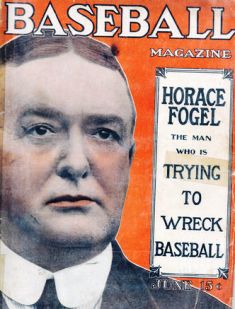
Fogel railed against the reserve clause, calling it “virtual baseball slavery,” and argued that organized baseball violated the Sherman Antitrust Act,  earning him the June 1913 cover of rival  “Baseball Magazine,” and the title, “The Man who is Trying to Wreck Baseball.”

Fogel would remain a baseball gadfly for the next decade.  Took ill in the early 20s and died in Philadelphia in 1928.

June 1913 edition of "Baseball Magazine"

June 1913 edition of “Baseball Magazine”

His interest in the team was purchased by a group led by William H. Locke, former secretary of the Pittsburgh Pirates.  When Locke died in October of 1913, his uncle, former New York Police Commissioner William Baker took control of the Phillies, leading the team until his death in 1930.

Brennan announced after Fogel was banned that he would drop his proposed $10,000 libel suit, telling The Associated Press:

“I am satisfied, I immediately demanded a hearing before the National League heads and Fogel’s trial was brought about as a result of my demands.”

Later this week; an allegation that Fogel was a patsy, and umpire Brennan’s other battle in the City of Brotherly Love.

“Said–Tinker to Evers to Chance”

5 Jul

???????????????????????????????

Franklin Pierce Adams’ famous poem “Baseball’s Sad Lexicon” appeared in The New York Evening Mail in 1910 and immortalized Chicago Cubs shortstop Joe Tinker, second baseman Johnny Evers and first baseman Frank Chance—within three years, the above cartoon appeared in newspapers along with a new, less well-known, poem written by Adams’ colleague at The Evening Mail, James P. Sinnott.

By 1913, baseball fans became aware that Tinker and Evers had barely spoken to each other since 1905, and the rivalry among the three exploded in public.  The former teammates, now all managers, Tinker with the Cincinnati Reds, Evers with the Cubs, and Chance, the recently deposed Cubs manager, with the New York Yankees.

In February Chance told reporters that Tinker was a better player than Evers; Evers responded and accused Tinker of trying to “tamper” with pitcher Larry Cheney and other members of the Cubs, as for Chance he said:

“I do not know whether Chance is jealous of my getting the position of leader, and I do not like to think so, but from the remarks he is making, I am forced to.”

By March, Hugh Fullerton said in The Chicago Examiner that Evers was unable to control his players; he said “Chance could whip any man on (the) team—Evers can’t,” and predicted a fourth place finish for the Cubs (they finished third).  Tinker’s Reds finished seventh in the National League; Chance’s Yankees were seventh in the American.

Sinnott’s poem appeared at the end of September:

“A Manager’s life is tough!

Said Tinker to Evers to Chance—

‘A manager’s road is rough!’

Said Tinker to Evers to Chance—

‘Here are we three, a lookin’ on

The big world’s series game,

In which we once were principals,

In which we gained our fame’

‘A manager’s life is no cinch!’

Said Tinker to Evers to Chance—

I’d almost as soon be Lynch!’

Said Tinker to Evers to Chance.”

“Lynch” was Thomas Lynch, who was about to be replaced as president of the National League.

It would not be until 1924, shortly before Chance’s death that the three reconciled.  Chance had been hired to manage the Chicago White Sox, but became too ill and returned home to California; he was replaced by Evers.

Chance summoned his former teammates to California that spring, where the three spent several days together.  Chance died in September.  Tinker, Evers and Chance, were inducted into the Hall of Fame together in 1946.

Tinker, Evers and Chance

Tinker, Evers and Chance

A Thousand Words–Joe Tinker

1 Jul

Quick hits Monday through Friday this week for the holiday–regular items will return next week.

joetinkerkids

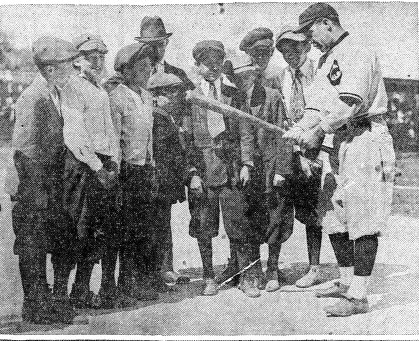
Joe Tinker, manager of the Chicago Cubs shows boys from the Chicago Schools Baseball League the finer of points of hitting before a July 1916 game with the Boston Braves.

Tinker returned to the Cubs in 1916 after having managed the Chicago Whales to the Federal League pennant the year before.  Whales owner Charles Weeghman purchased the Cubs after the Federal League folded and installed Tinker as manager.  Chicago fans had high expectation for Tinker’s team, because in addition to the manager, Weeghman brought most of the key players from the Federal champions to the Cubs.  But after a 9-17 record in July.  Rumors began to swirl that Weeghman would replace Tinker as manager after the Cubs owner traded for catcher Art Wilson on July 29; Wilson had been a Weeghman favorite when he caught for the Whales.

In August, Tinker blamed the Cubs disappointing season on third baseman Heinie  Zimmerman, telling The Chicago Daily News:

“Zimmerman is no good to the ball team.  he does not take any interest in his work and does not care whether the club wins or loses.  He did not report for practice yesterday and on other days is always the last one out for work.  Most of the players feel he does not belong on the team.  He is killing the harmony we had and that is why I would prefer to dispose of him.  He won’t play ball and does not use any judgment and with a man like that a flag cannot be won.”

Tinker survived the season, Zimmerman did not.  He was traded to the New York Giants on July 28.

The Cubs finished in 5th place, 67-86.  Tinker was let go after the season, he was not replaced by Wilson, as rumored, but instead by Fred Mitchell, who after a fifth place in 1917 led the Cubs to the National League pennant in 1918.

Tinker managed, and was a part owner, of  the Columbus Senators in the American Association in 1917 and ’18.

“The Sudden Reappearance of ‘Silver’ King”

27 Jun

Oliver Perry “O.P.” Caylor wrote in June of 1896 in The New York Herald:

“One of the baseball surprises of the season is the apparently successful reappearance of ‘Silver’ King upon the National League diamond.  Without any warning the Washington club sent him in against the Pittsburgh team, and he not only won his game, but held the latter down to six hits, Of course all this caused a great deal of gossip wherever baseball is a subject of interest.”

When Charles Frederick “Silver” King (born Koenig), took the mound for the Washington Senators and beat the Pittsburgh Pirates 8 to 1 in the second game of a May 30 doubleheader, it was his first appearance in professional baseball in nearly three years.

King had been one of baseball’s best pitchers of the 1880s, with a 142-70 record from 1887-1890 while playing for Charlie Comiskey, first with the St. Louis Browns in the American Association and then following Comiskey to the  Chicago Pirates in the Players League.

Comiskey (8) and pitcher Silver King (14) with the 1888 St. Louis Browns, King would follow Comiskey to the Chicago Pirates in the Players League in 1890

Comiskey, seated center(8) and Silver King standing second from right (14) with the 1888 St. Louis Browns, King would follow Comiskey to the Chicago Pirates in the Players League in 1890

Caylor said that during Flint’s heyday:

“His most successful delivery was what is known as ‘the cross fire,’ first used effectively, I believe, by (Charles “Old Hoss”) Radbourne and at present the prominent stock in trade of (Wilfred “Kid”) Carsey of the Philadelphias (Phillies).  It consists of standing on the extreme end of the pitcher’s plate, stepping away still farther from the direct line towards the batsman and sending the ball across the home base at an angle, which, although small, is very bothersome to the man with the bat.”

Silver King

Silver King

Caylor said King was “put out of the business” in 1893 when “the pitcher’s box was set back five feet,” (to the current 60’ 6”).  While King’s record slipped during the last two seasons the distance was 55 feet to a combined 36-53 while pitching for the Pirates and New York Giants, he had respectable ERAs of 3.11 and 3.29.  After the rule change King went 8-10 with a 6.08 ERA pitching for the Giants and Comiskey’s Cincinnati Reds in 1893, and then disappeared.

Caylor thought there was “a great deal of significance to King’s return to the diamond,” and predicted a trend:

“It means managers, having exhausted the new crop and finding nothing before them worth a trial, are forced to look behind and try to rekindle some of the half burned out embers. Washington not only took up King, but they gave (Les) German a trial after the New York club let him go.  (Cap) Anson (Chicago Colts) went back to (Fred) Pfeffer after finding (Algernon “Algie”) McBride, (Josh) Reilly and (George) Flynn wanting and was even forced to put himself into his nine to fill out the weak spots.”

Caylor said it was “astonishing  to look over the list of new material which was brought into the National League last spring and notice how small a part of it has been able to keep ‘in the swim.’  Every day one hears that some younger player has been released or that another has been loaned or farmed to a minor league club.”

Caylor’s prediction of success for the “trend,” and the players named was a mixed bag.  Anson, who had never really gone away, hit .331 in 108 games, for the Colts, but Pfeffer hit just .244 in 94 games. German fared the worst, he was 2-20 in 1896 and 3-5 the following season before being released in August.

King managed to post a 16-16 record for the Senators in 1896 and ’97 but never found his early career form.  After the 1897 season, he returned to St. Louis where he died in 1938.

Caylor would become ill the following season, and died in October of 1897.

Browning and Delahanty

25 Jun

John Anthony “Honest Jack” Boyle played in the American Association, Players League and National League from 1886 to 1898.

Boyle’s career was on the decline by the end of the 1898 season (he had only appeared in six games with the Philadelphia Phillies that year), but was effectively ended in November when he was the victim of a mysterious knife attack in his hometown of Cincinnati.

The Cincinnati Commercial Tribune said Boyle was “attacked from behind by an unknown man, who, before the player could defend himself, plunged a knife into his shoulder.”

A piece of the knife broke off in Boyle’s shoulder and he didn’t play regularly again until 1905 when he appeared in 101 games for the Toledo Mud Hens in the American Association ; he was a player-manager for the Terre Haute Hottentots in the Central League the following season.

Jack Boyle

Jack Boyle

By 1910 Boyle, who was operating a saloon in Cincinnati, told William A. Phelon of The Chicago Tribune that the two best hitters he ever saw were Pete Browning and Ed Delahanty, and provided a window into the minds of two of the biggest stars of the 19th Century:

“(T)here never were two men more radically different in their ideas of and their opinions of the game than these two great sluggers.  They looked at the game from totally different angles, and they regarded their occupation with widely varying views.

“Pete Browning was an artist.  To him baseball was an art or a profession and batting an absorbing passion.

“Delahanty was a workman.  Baseball to him was labor or a trade, and batting simply part of the daily toil.

“When Browning left the field the game wasn’t over.  He continued to talk batting, theorize on batting, figure out new ideas on batting, and I think, dreamed of batting all night long.

Pete Browning

Pete Browning

“When Delahanty left the ballpark the game was all through for the day, exactly as if he was a laborer going home to supper.  He ceased to think baseball.

Ed Delahanty

Ed Delahanty

“If Browning failed to make a hit at the time of need, he would have tears in his eyes and would bitterly bewail his misfortune.  If Delahanty fell down in the pinch, he shrugged his shoulders, hoofed back to the bench and began to talk racing or the weather.

“When an outfielder galloped to the fence and pulled down one of Browning’s mighty drives, Pete would regard it as a personal insult, and glower at the outfielder like a baffled tiger.  When a fielder robbed Del of a home run, Ed would grunt ‘Good catch, boy, didn’t think you’d get it’ and forget it forever.

“If you had told Pete Browning that the business was losing money, and that you would have to cut his salary next season, he would have accepted the money rather than lose the chance to play the game.  If you handed that talk to Delahanty, he would have sneered scornfully and remarked that you’d have to come up with 500 more beans before he’d even look at a contract.

“Neither Pete nor Del cared much where their teams finished on the season.  Pete thought only of hits and the glory of making them.  Del thought of a comfortable winter life on the money he had made in the summertime.”

Boyle said the only thing the two really had in common was an inability to bunt:

“Del wouldn’t simply try.  Pete, with much groaning and protestation, would be coaxed to make the attempt, but his attempts were fizzles.”

Boyle, or Phelon, omitted the other thing the two had in common: serious drinking problems that hurt them on and off the field and contributed to their early deaths.

Boyle died in Cincinnati in 1913.

“To be Hissed and Hooted at in the East is too much”

20 Jun

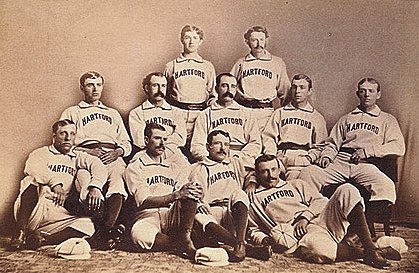
In 1886  Thomas Jefferson “Tom” York retired after a fifteen-year career.   As a 20-year-old he joined the Troy Haymakers in the National Association in 1871, he was with the Hartford Dark Blues for the National League’s inaugural season in 1876, and finished with the Baltimore Orioles in the American Association; he also served two brief stints as a player/manager with the Providence Grays.

York, who suffered from rheumatism, had considered retiring before the 1894 season after the Cleveland Blues sold him to the Orioles, but The Baltimore American said he was induced to continue playing with a $5000 salary and “the scorecard and cushion (concession)” at Oriole Park.  After hitting just .233 in 1884, he was only able to play in 22 games the following season before calling it quits.

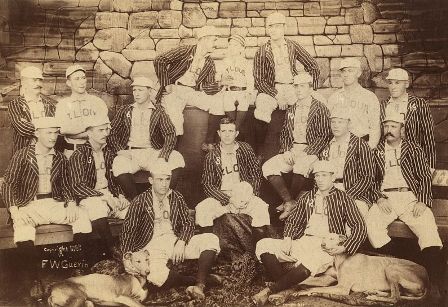
Tom York, middle row, far right, with the 1876 Hartford Dark Blues

Tom York, middle row, far right, with the 1876 Hartford Dark Blues

Just before the beginning of the 1886 season York was hired as an American Association umpire.  After the May 22 game in Baltimore which the Orioles lost 2-1 to the Louisville Colonels, The Baltimore Sun said:

“(York) received a dispatch yesterday ordering him to Brooklyn.  Instead of going he telegraphed his resignation.  His reason for doing so was the abuse he received from some of the spectators of Saturday’s game.  In fact, he was nearly equal to that of John Kelly, ‘the king of umpires.’  He declared (Pete) Browning’s hit near the foul line a fair hit.  He was in the best position to know, but, as it was made at a critical point, some of the audience objected, and York came in for pretty severe abuse.”

The paper said York also made a “questionable decision,” when he “evidently forgot that it was not necessary to touch a runner in a force,” and incorrectly called a runner safe at second:

“York became discouraged and the Association lost a good umpire.”

Within weeks York became a National League umpire; that didn’t last long either.

On June 30, the Kansas City Cowboys lost at home to the New York Giants 11-5, The Chicago Inter Ocean said York “was escorted from the grounds by the police on account of disapproval manifested over his umpiring.”

Less than a month later, after York was “roundly hissed” at the Polo Grounds after making “some very close decisions against the New Yorks,” in a July 22 game against the Philadelphia Quakers, he sent a telegram to National League President Nicholas Young resigning his position.  York told The New York Times:

“I have been badly treated in the West, but to be hissed and hooted at in the East is too much.  I have often heard that an umpire’s position was a thankless one, but I have never realized it before.  It’s bad enough to be hissed and called a thief, but in the West when the local club loses an umpire in fortunate if he escapes with his life.  Of all the cities in the league Kansas City is the worst.”

York said there was another incident Kansas City the day before he was escorted from the field by police:

“On June 29 when the New York men beat the Cowboys 3 to 2 (William “Mox”) McQuery hit a ball over the fence, but it was foul by 25 feet, and I declared it so.  After the game Vice President (Americus) McKim, of the Kansas City club wanted to know how much money I would get from the New Yorks fir That decision.  I remarked that I received my salary from the league and did not take a penny from the New Yorks or any other none.  Then he grew furious, and said he would end my days.  This in conjunction with other things incidental to the life of an umpire has made me tired of the business, and I intend to make room for some other victim.”

Despite quitting both leagues within two months, The Baltimore American said the American Association sent York a telegram in two months later “asking him if he wanted an appointment as umpire.”  The paper said “York replied no, emphatically, as his past experience was sufficient to justify his remaining at home.”

York remained at home for the rest of the season and the next, but while he never worked as an umpire again he returned to baseball in 1888 as manager of the Albany Governors in the International Association.  Over the next decade he was connected with several East Coast minor leagues, including the Connecticut State League, the New York State League and the Eastern Association, as a manager and executive.

York retired to New York where he became one of the many former players employed at the Polo Grounds at the behest of manager John McGraw.  In 1922 The New York Telegraph described his position:

“York has the pleasant post of trying to keep the actors, tonsorial artists and plumbers out of the press stand.  It is old tom who examines your pink paste board and decides whether you are eligible for a seat in the press cage.”

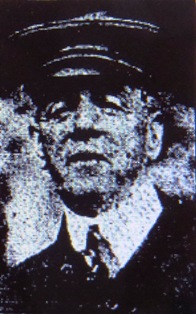
Tom York, 1922

Tom York, 1922

In February of 1936, as preparations were being made for York, along with James “Deacon” White, George Wright, Tommy Bond,  to be honored that summer at the  All-Star Game  as the last four surviving players from the National League’s first season, the former player, manager, executive and umpire died in New York.

“Atlanta’s Baseball Bullies”

17 Jun

During the 1885 season, Lewis Henke of the Southern League’s Atlanta Atlantas was killed during a game; the death was attributed to on-field rowdyism by the Southern press who hoped the death of the popular player would help end brawling behavior in the league.

In January of 1886, the Atlantas hired a new manager, William Aloysius “Blondie” “Billy” Purcell.   Purcell had split the 1885 season between the Philadelphia Athletics in the American Association and the Boston Beaneaters in the National League, hitting .279 in 87 games.  The Sporting Life said:

 “Billy will make a good manager, and is capable of securing a team—even at this late date—to win the championship. “

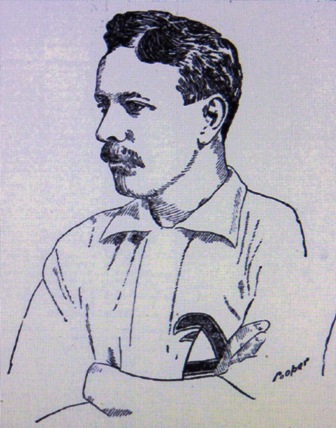
William "Blondie" Purcell

William “Blondie” Purcell

Purcell came to Atlanta with an excellent reputation, The Philadelphia Inquirer described him as being “Of a genial, happy disposition,” who was very popular when playing for the Athletics, and in 1883 and ’84 as a member of the Quakers.

That changed quickly, just two weeks into the season The Macon Telegraph said under the headline “An Alleged Conspiracy against Purcell,” that the new manager had incurred the wrath of his players by “ruling the team with an iron hand.”

After the rough start, the team appears to have turned their wrath towards their opponents and became the most hated team in the league.

Over the course of the next four months, Southern papers chronicled the bad behavior of the Atlanta squad.

It started with a game against the Charleston Seagulls when Purcell was accused of cheating, The Charleston News and Courier said:

“Manager Purcell was playing in the left field and the Charleston team was at the bat.  During the inning one of the Charleston team batted a ball to left field.  It went over the fielder’s head and, after striking the fence, rebounded and then went into the ditch.  The fielder started for it, but after running only a short distance took a ball from his shirt pocket and through it to the diamond.  The remarkable rapidity with which the ball was fielded was loudly applauded at the time…The fielder subsequently went to the ditch, picked up the ball and tossed it in the diamond…The incident was witnessed by several people, and the statement can be substantiated if the proof is demanded.”

Cheating turned to “bullying” as the season progressed.

The Savannah Times dubbed the team “Purcell’s Plug-Uglies,” and said of them after a July game:

“From the start of the game yesterday the Atlantas began their rowdyism, (Tom) Lynch was running to first in the first inning, the ball got there just ahead of him, Lynch deliberately struck (Jim) Field with his fist…from then on the whole team began to kick and try to hack the umpire.  In this Purcell was ably assisted by (John “Monk”) Cline and (John “Cub”) Stricker, two of the rowdiest  ball players that have been seen on our field…The conduct of the Atlanta club was most reprehensible, and has placed them in an exceedingly unenviable light.”

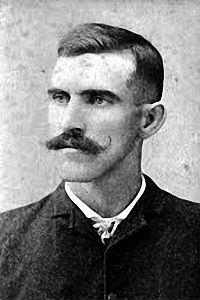
Tom Lynch, one of Atlanta's bullies

Tom Lynch, one of Atlanta’s bullies

Earlier that month after a couple of close wins over the Seagulls, The News and Courier again criticized the Atlantas saying the team “ought to be kicked out of the league,” and said:

“(T)here was an immense crowd present to witness the game, but their afternoon’s pleasure was completely spoiled by the disgusting behavior of the visitors, whose kicking and sharp practices are sufficient to drive any respectable audience from a ball field.”

After another game in Charleston, The News and Courier said Purcell’s team used “blasphemous and obscene language,” and:

“Those who attended the game this afternoon are outspoken in their condemnation of the disgraceful behavior of the Atlanta team, and declare that either they should not be allowed to continue in the league, or that they should be made to behave themselves at least decently in the presence of the communities where they have to play.”

The Macon Telegraph called the team “Atlanta’s Baseball Bullies,” and said after a game in which Purcell was fined $10 “for his ungentlemanly remarks,” that Atlanta played “good ball,” but that it was “marred” by their conduct.  The paper also said:

“The Atlanta team is evidently akin to the bulldozing idea.  The bullies and braggarts who compose the team have evidently been taught that an umpire is a very insignificant personage and to be influenced by blackguardism.”

Similar charges of “rowdyism” and “bullying” were made throughout the season.

The Atlanta Constitution saw nothing wrong with the team and blamed the criticisms from the papers in other Southern Association on “jealousy” over the team’s success.

With Atlanta holding on to a small lead for the league championship, the most serious charges would wait until the final weeks of the season, and include two of Atlanta’s most prominent citizens …tomorrow.

“A Baseball with a Mystery Attached to it”

13 Jun

The Chicago Tribune’s Hugh Fullerton claimed that somewhere at Chicago’s West Side Grounds, home of the Cubs, “if it has not decayed, there is a baseball with a mystery attached to it.”

Hugh Fullerton

Hugh Fullerton

The incident took place on May 11, 1899 “in the middle of a hot game between Louisville (Colonels) and Chicago…this ball disappeared—and as far as anyone knows never yet has been found.”

Fullerton said:

“The score was 4 to 4 in the seventh inning, with Chicago at bat, when Arthur Nichols, the little catcher, came up with one man out. He whanged into the ball and drove it safe to right.  Charlie Dexter threw to second and Nichols slid safe just as the ball arrived.  Tommy Leach was covering second base, and as Nichols slid he lost sight of the ball.  He said it struck his forearm and fell to the ground, and when he started to pick it up it wasn’t there.  He thought it was under Nichols and waited until the runner arose. The ball was not there.

“Nichols waited and held the base, fearing the ball was hidden and he would be tagged out. (Claude) Ritchey and Leach were busy hunting for it.  Everybody joined in.  Still Nichols feared a trick and stuck to the bag.  After five minutes umpire (William) Smith, who was working on the bases, called the Louisville players down, and after accusing them of hiding the ball threw a new one into play.  Chicago kicked and Nichols was ordered to run home.  He ran, but Smith sent him back to second and ordered play begun with a new ball.”

Art Nichols

Art Nichols

Pitcher Jack Taylor singled to right, and Nichols was thrown out at home plate by Dexter.  Louisville went on to win the game 5-4 in ten innings.

Fullerton said:

“Leach, Nichols and Ritchey, the only men near the ball, vowed they never saw it.  What really became of it no one seems to know.”

The Box Score

The Box Score