Tag Archives: National League

Crazy Schmit in Cleveland

10 May

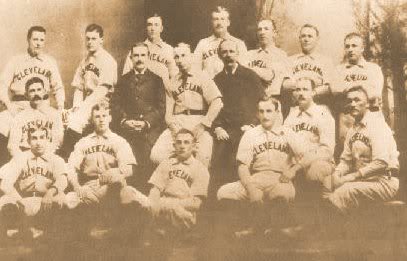
Crazy Schmit pitched for the Cleveland Spiders in 1899; compiling a 2-17 with a 5.86 ERA for the 20-134 last place team (in Schmit’s defense the 1899 Spiders were one of the worst teams in history, losing 24 straight at one point, and Schmit’s ERA was a half of a run better than the team ERA).

The pitcher had grown tired of his nickname “Crazy,” and of references to his behavior as “tacky.”  After being called both by The Cincinnati Enquirer in August, he responded:

“I have stood this sort of thing just about long enough.  I am neither tacky nor crazy, and without wanting to throw any flowers at myself, I will make the statement that there is not another left-handed pitcher in the business who used as good judgment when pitching as I do.

“Furthermore, I am the only left-hander in the business who has an effective slow ball.  Some of these ten-thousand-dollar beauties and phenoms look like thirty cents to me.  I can also swell up and say that I threw the Phillies down this year.  I beat that hard-hitting gang by a score of 6 to 2.”

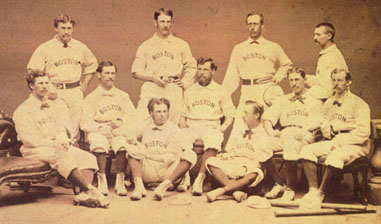
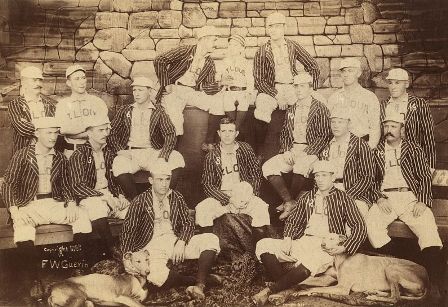
1899 Cleveland Spiders--finished 20-134

1899 Cleveland Spiders–finished 20-134
Within weeks Schmit was let go by Cleveland;  The Baltimore American reported on the release of the former and future Oriole:

“Pitcher Schmit, that queer and original baseball character, was yesterday given his ten days’ notice of release by the Cleveland club management and afterward notified that he had been fined for insubordination.”

The American quoted Schmit:

“I was released I suppose because it had been reported that I was not doing my best to win and because the owners were displeased with me for several accidents that happened to me.  I missed the train in Chicago, and while I was riding into Cincinnati from one of the suburbs with a young lady who may one day be Mrs. Schmit, lightning struck the trolley wire and I missed the train again.  I guess that is why I was fined.  They wished to make an example of me.  I do not mind the release, as I can easily get another and better position, but I hate that $50 fine, because my salary is not quite as high as that of some bank presidents.”

Despite his release and his record, Schmit still considered himself a great pitcher, blamed his career statistics on the teams he played with, and the more he spoke the more valuable he became as a player:

“I have in my career pitched for fourteen tail-end clubs and I am done with them.  Unless I can pitch for some club that can win a game occasionally I will stop pitching ball.  The longer I pitch the more stuck I am on myself as a pitcher.  I have pitched good ball for Cleveland, but who could win with six and eight errors behind him, and misplays that are far worse than errors and that go as hit.

“I am the most popular player on the circuit and the only man who knows how to coach as a science.  If some of these managers knew something of the theatrical business they would wire on and advertise I am to pitch a certain game.  When it is known I am to pitch I have often brought enough into the box office in a single game to pay my whole salary for the season several times over.  We played before 14,000 people in Chicago and of that number fully 5,000 came to see me.”

Schmitt did not “easily get another or better position” in 1899 or 1900—he sat out the remainder of 1899 and spent 1900 in the Interstate and New York State Leagues.  Schmit opened the season at 2-3 in five games with the Columbus Senators before being released; there are no surviving records for his New York State League games with the team that split the season between Elmira and Oswego.  The next season John McGraw would give him a chance to pitch in the American League.

More Crazy Schmit next week.

Crazy Schmit

9 May

In 1913, Giants manager John McGraw, wrote an article that ran in newspapers across the country, in which he made the case that baseball had “practically eliminated the ‘bad actor,’” citing the World Series and the development of the game as a business as the primary factors.

McGraw said many of the players of his day “had paths worn from the ballpark to some favorite saloon and back to the grounds.”  McGraw singled out one player in particular to make his point.

Frederick “Crazy” Schmit pitched for parts of five seasons for five different American and National League teams from 1890-1901, posting a career record of 7-36.  (Schmit’s name was almost universally misspelled by contemporary newspapers–the misspellings have been corrected in quotes that reference him).

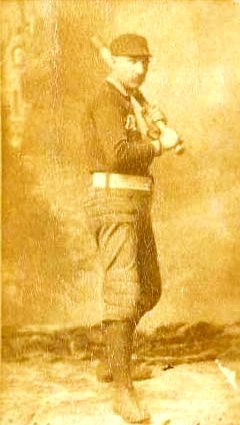
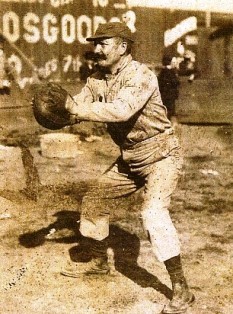
Crazy Schmit

Crazy Schmit

McGraw wrote (and likely embellished) about Schmit, who was his teammate in 1892 and ’93 and who he managed in 1901 with the Baltimore Orioles:

  “(W)e had a pitcher named Schmit generally and aptly called ‘Crazy’ Schmit.  His habits were nothing for a temperance society lecturer to dwell upon as an example…I called (Schmit) into a corner the day before the first game (of a series with the Cleveland Blues) and told him that I wanted him to pitch the next afternoon and asked him to get into good shape.  He said he would be out there with everything on the ball.  That was one thing about him—he never knocked his own ability.

“But Schmit’s notion of preparations did not coincide with mine.  I learned afterwards that he went directly from my lecture to his favorite loafing place and remained there telling his friends what he would do to Cleveland the next day.”

McGraw claimed that Schmit fell down on the mound (there’s no contemporary report o confirm it) and:

“Those were the days of quick action, so I rushed into the box from third base where I was playing, sore enough to do anything.

‘Get out of here.’  I yelled at him ‘You are released.’

“He laboriously regained his feet, and with ludicrous dignity walked out of the pitcher’s box and toward the exit of the park.  As he left he whirled on me and exclaimed dramatically: ‘I go to tell the world that the great Schmit has been released.”

McGraw said the pitcher only made it as far as the same tavern he had been at the day before, “and we had to send his clothes to him.”

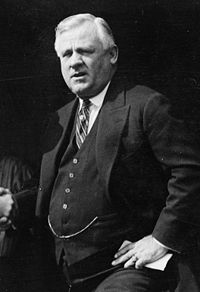
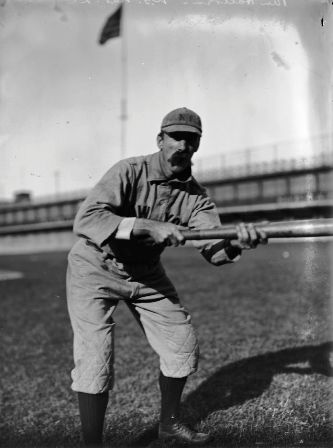
John McGraw

John McGraw

McGraw wrote that before he released Schmit he used a tactic he later tried with “Bugs” Raymond; withholding money from the pitcher to keep him from spending it on liquor:

“After a time I began to miss baseballs in great numbers from the clubhouse and my suspicions were aroused, so I followed Schmit when he left the grounds one night…Schmit proceeded to a corner and mounted a soapbox which he produced from the bushes nearby, and then he pulled five or six league balls, partly used, out of his pocket and began to auction them off as ‘genueen leeg balls.’  For some of them he got as high as $5 apiece.  Or rather, he received $5 for the first one, and then I interrupted him and took the rest away.”

Schmit was released by the Orioles on June 10, 1901; he continued to pitch in semi-pro and outlaw leagues for more than a decade and worked as a scout–for the New York Giants, managed by John McGraw.

Another “Crazy” Schmit story tomorrow.

Lewis Henke

3 May

Lewis Henke played first base for the Atlanta Atlantas in the Southern League in 1885. The Atlanta Constitution said:

“He was the swiftest and most baring baserunner on the Atlanta nine.”

And

“(A) favorite not only in Atlanta, but wherever he was known…perhaps the most popular player in the Southern League.”

On August 14 Atlanta was hosting the Nashville Americans, when according to The Macon Telegraph:

“In the fourth inning Henke, in making the first base, ran violently against the knee of (Charles “Lefty”) Marr, of the Nashvilles, the knee joint striking him apparently full in the stomach. Henke showed immediately that he was badly hurt, and in a moment was lying stretched out almost on the base. He was carried from the field to the dressing room…Although he had clearly made his base after heavy hit, no one of the players, no one of the great crowd looking on, knew that the infallible umpire above had decided differently, and called him out.”

Henke’s liver was ruptured in the collision and the Cincinnati native died of the injury the following day.

The New York Times blamed the death on “Bad feelings” between the two teams, which resulted in “much ugly work on the field, such as tripping each other, etc..”

Henry “Red” Bittman was Henke’s teammate, fellow Cincinnatian and best friend; they had come to Atlanta together in 1884 to play for the city’s entry in the Georgia State League. He was at his friend’s bedside.

According to The Times:

“Henke observing his friend by his side this evening whispered to him: ‘Bitt, do not play today; I feel that I am dying.’ ‘What shall I tell your wife for you?’ Bittman inquired. ‘Just tell her I got hurt in yesterday’s game and died from it,’ he replied as he again closed his eyes, and in three minutes he was dead.”

The Telegraph said that later that evening:

“At half past ten the manager (Gus Schmelz) escorted the remains to the depot, and walked beside the undertaker’s team through the streets with barred (sic) heads. The dead man’s comrades, rough and hard, were deeply afflicted, and some of the cried like children over the coffin…Henke, the dead baseballist, was carried west on the 10:40 train tonight on the Western and Atlantic to Cincinnati.”

???????????????????????????????

Lewis Henke, standing–Henry “Red” Bittman, seated

While some attributed Henke’s death to the “bad blood” and “ugly work on the field,” no one publicly singled out the popular “Lefty” Marr for blame. Years later, Edward Cuba Bruffey, a long-time reporter and editor for The Atlanta Constitution said:

“The death of Henke completely prostrated Marr, and it was several days before he was able or willing to return to the game. I am not certain now, but I think Marr was one of the men who accompanied the body to Cincinnati for the funeral.”

The Southern League owners pledged to play benefit games to raise money for Henke’s wife and child.

Tickets for the Atlanta benefit went on sale the final week of August. The Constitution said:

“Henke’s wife and child are destitute. There is not one of the thousands who have seen him play and applauded him his pluck and skill who could not afford to buy tickets to the benefit…every dollar taken in will go to his family.”

The benefit became a bit of a scandal in Atlanta; and it’s unclear whether games were played throughout the league as promised.

The Atlanta game raised $159.85 for the widow, but it took more than six months for the money to get to her. Ownership of the Atlanta franchise changed hands after the 1885 season and the former management of the club never gave the money raised from the game to Henke’s family.

In February of 1886 The Macon Telegraph said the new chairman of the Atlanta Baseball Association, Steve Ryan had advanced the money to the widow and “received a guarantee that he will be reimbursed” by the former owners. According to The Telegraph:

“(Ryan) saved the old directorship from a very ugly legal squabble. With the remittance Mr. Ryan forwarded to Mrs. Henke a spicy and sympathetic letter…It would be rich and rewarding reading as it touches up the old directorship interestingly. “

Henke’s best friend Henry Bittman played five more seasons in the minor leagues; including 87 games as “Lefty” Marr’s teammate with the Nashville Americans in 1886. In 1889 he appeared in four games with the Kansas City Cowboys in the American Association. He died in Cincinnati in 1929 at the age of 67.

Charles

Charles “Lefty” Marr

Marr played professional ball until 1898, including parts of four seasons in the American association and National League. His best seasons were with the Columbus Solons in 1889 and the Cincinnati Reds in 1890. The left-hander played 129 games at third base and 29 at shortstop in the big leagues. He died in Connecticut in 1912.

The Ross Barnes Case

2 May

Charles Roscoe “Ross” Barnes was one of the greatest players of his era, and largely forgotten today.

Barnes was a member Harry Wright’s Boston Red Stocking teams in the National Association from 1871-1875 and won the National League’s first batting title hitting .429 in 1876 as a member the Chicago White Stockings.

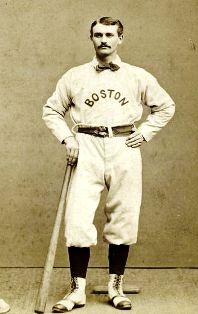
Ross Barnes

Ross Barnes

Teammates and contemporaries had no doubt about how good he was.

“Orator Jim” O’Rourke called Barnes “the greatest second baseman the game ever saw.”  In 1896, A.G. Spalding “declared Ross Barnes to have been the greatest ballplayer in America,” and Tim Murnane said of Barnes:

“His left-handed stops of hard-hit balls to right field were the prettiest stops ever made on the Boston grounds. As a base-runner no man of the present day is his equal, and as a batsman he must be reckoned very high.”

1871 Red Stockings. Spalding, standing second from left, Barnes, standing far right, O'Rourke, seated far left.

1871 Red Stockings. Spalding, standing second from left, Barnes, standing far right, O’Rourke, seated far left.

Some of Barnes’ success was due to the rule at the time regarding  balls that rolled foul in the infield, The Sporting Life said:

“It was Barnes who was the first to master the fair-foul hit. He was able to drive the ball so that it would land fair and then swing in foul just outside of the reach of the third baseman.”

Barnes became ill in 1877, although he started the season with the White Stockings, The Chicago Inter Ocean said in early May “he is now, and has been all spring, very sick with few signs of improvement.”  After a slow start, Barnes was out for more than three months before returning in late August.

The Chicago Tribune said:

“Barnes made his reappearance with the Whites, and played his old position at second base,  but he showed evidence of physical weakness and lack of practice,”

Barnes appeared in only 22 games, hitting .272.

The second baseman,  who was earning $2500 for the season, and as was often the case in 19th Century baseball,  was not paid for the time he missed.  Early in 1878 Barnes filed a lawsuit against the White Stockings to collect more than $1,000 the team did not pay him while he was ill.

Cook County Judge Mason B. Loomis heard the case, which The Inter Ocean said:

“(I)s a new one in the experience of ball clubs, and the result is looked forward to with some interest  in sporting circles.”

The result was not favorable for ballplayers.  Judge Loomis ruled against Barnes, The Tribune said:

“This makes clear the point that players are not legally entitled to wages when laid off by sickness.”

While some owners did pay players during time missed due to illness and injury, teams had the right, after 15 days, to suspend any player without pay; and the legal precedent established in Barnes’ case remained until 1916 when the “injury clause” was rescinded.

Barnes attempted to return to the White Stockings in 1878, but The Tribune said he “has never fully recovered,” from the illness, and was released.

He played with and managed the London Tecumsehs in the International Association in 1878, then made two comeback attempts with the Cincinnati Reds in 1879, and the Boston Red Stockings in 1881, his career was over at age 31.

Barnes retired to Chicago and was working for Peoples Gas, Light and Coke Co. when he died in 1915 at age 65.

“California Wonder”

30 Apr

Two West Coast ballplayers dubbed “California Wonder” by the press made their Major League debuts less than a week apart in 1887.  One went on to be one of the best leadoff hitters of his era; the other remains almost completely unknown.

George Van Haltren was a 21-year-old left-handed pitcher, outfielder and first baseman who had played two seasons with the Oakland franchise in the California and California State Leagues.

James McMullin, birth date unknown, had pitched for Mike Finn’s San Francisco Pioneers in 1886.

Mike Finn, manager, San Francisco Pioneers

Mike Finn, manager, San Francisco Pioneers

Van Haltren’s rights were acquired by the Pittsburgh Alleghenys, but because of his mother’s illness he said he would instead play for the San Francisco Haverlys.  The Chicago White Stockings traded for Van Haltren in April, but he still refused.  The Sporting Life said “the California Wonder will not come east,” quoted him saying:

“No, I will not play with Chicago this season; but if my left arm holds out and my parents are blessed with good health I will be open to Eastern engagements next season.”

The White Stockings threatened to have him blacklisted for not reporting but Van Haltren dug his heels in; only changing his mind after his mother passed away in May.

The Chicago Inter Ocean announced that he had arrived in town on June 25 and would be making his debut for the White Stockings on the two days later:

“(Van Haltren) at one time retired the Pioneer Club of San Francisco with a hit, and struck out seventeen men.  If he can continue this record here the Chicagos will come out of the race this season with another set of figures to put on the big flag at the park.”

Van Haltren’s debut was not good.  He walked 16 Boston Beaneaters and lost 17 to 11.  He finished the season 11-7, and would spend one more season as a full-time pitcher; going 13-13 in 1888 (he was 15-10, splitting time between the mound and outfield with the Brooklyn Ward’s Wonders in the Players league in 1890).  Van Haltren would distinguish himself as one of the game’s best leadoff men, hitting better than .300 every year from 1889-1901, except for 1892 when he hit .293.

Van Haltren ended his career in 1903 with 2544 hits.

George Van Haltren

George Van Haltren

McMullin’s debut was no better than Van Haltren’s.

He began the 1887 season with the Pioneers, but was acquired in June by the new York Mutuals of the American Association.

When McMullin joined the club The Sporting Life said:

“The Mets have got their new California pitcher and like him well in practice.  He has plenty of speed.”

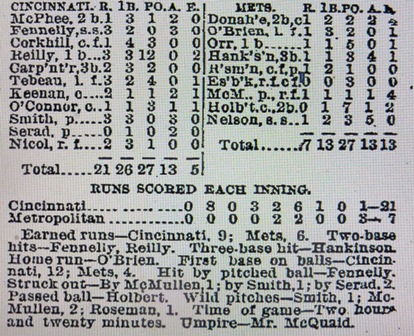
McMullin made his debut on July 2 against the Cincinnati Red Stockings.  The New York Times said of his performance, under the headline, “A ‘Wonder’ Exploded.  The Mets’ California Pitcher A Failure:”

“The debut of McMullen, the ‘California Wonder,’ was made (in Cincinnati) today in the presence of nearly 7,000 people, who went into hysterics from laughing at the awful exhibition given by the Wonder and his support.  He was utterly unable to get the ball over the plate and was miserably supported in the field.  After the third inning he retired to right field and there made a couple of errors.”

He gave up eight runs, made four errors and had two wild pitches in a 21-7 drubbing.

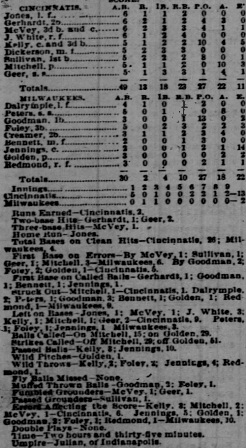
The box score from McMullin's debut.

The box score from McMullin’s debut.

McMullin only made two more appearances for the Metropolitans, and while he was credited with wins in both games his performance was no better; in his eight-day, three-game career he pitched 21 innings, gave up  25 runs (18 earned),  25 hits, walked 19, and struck out 2.  He made a total of five errors, and had one hit in 12 at bats.  The Mets released him on July 10.

And with that McMullin disappeared—there is no record of him having pitched anywhere after he left New York, there’s no record of whether he  threw and batted left-handed or right-handed, no pictures survive, and no record of when or where he died.  Another enigmatic figure of professional baseball’s early years.

“The Greatest Team Ever Organized”

24 Apr

Hopes were high for The Players League, and for Chicago’s franchise, the Pirates, in the newly formed baseball brotherhood.

Rumors had been reported for more than two months, but finally on January 18 The Chicago Daily News said that Charlie Comiskey “came to town yesterday morning, and at 4 o’clock signed…for three years,” to serve as captain and manager; the contract was said to be worth “$5,000 per annum.”

President Charles A. Weidenfelder had built a strong ballclub, with major assists from Fred Pfeffer, Chicago White Stockings second baseman, who encouraged most of that team to jump to the new league, and Frank Brunell, a former Chicago newspaper man who was secretary of the new league, and traveled to St. Louis to encourage Comiskey to jump to the brotherhood.

There was an embarrassing moment in March when Chicago newspapers reported that the carpenters union was complaining that non-union labor was being used to build the team’s ballpark at Thirty-Eighth Street and Wentworth Avenue.    The secretary of the union was quoted in The Chicago Tribune saying  Brunell had “promised to make it right.  But he didn’t.”

Despite the  irony of a league borne out of the game’s first labor movement betraying organized labor (there were similar difficulties in Boston and Philadelphia), enthusiasm for the new league was high; in Chicago the expectations were higher.  A week before the season opened The Chicago Tribune said:

“The elements which go to make up a great team are united in the Chicago Brotherhood Club, which, on paper, is the greatest team ever organized.”

Comiskey’s club opened the season on April 19 in Pittsburgh.  According to The Chicago Inter Ocean:

“It was a great day for the Players League…There were 9,000 people by the turnstiles’ count to see the fun…It was by all odds the biggest crowd that had ever turned out to witness an opening game of ball in Pittsburgh.”

The pregame festivities included a parade through the streets of Pittsburgh featuring both teams, league officials and a Grand Army of the Republic brass band.

“(Pittsburgh) Manager (Ned) Hanlon was presented with an immense floral horseshoe, Comiskey with a big floral ball on a stand of floral bats, Pfeffer with a basket of roses…(Chicago’s Arlie) Latham ‘stood on his head, with a smile well-bred, and bowed three times’ to the ladies.  (He had) the legend ‘We are the people’ in great black letters on (his) broad back.”

After the fanfare, “Pfeffer and the boys played a particularly brilliant game,” as Chicago defeated Pittsburgh 10-2.

Box Score--Chicago Pirates/Pittsburgh Burghers, Opening Day, 1890.

Box Score–Chicago Pirates/Pittsburgh Burghers, Opening Day, 1890.

Opening Day was the high point for Chicago. The league as a whole struggled financially and attendance dropped sharply after the initial excitement wore off.  Only eight games into the season, barely 500 people attended Chicago’s game in Cleveland on May 1.

Comiskey’s “greatest team ever organized,” was never able to keep pace with the league champion Boston Reds and finished fourth in the eight team league, 10 games back.

The Chicago Times lamented the team’s poor showing and blamed it on a “lack of discipline,” (the article appeared in slightly different form in several newspapers):

“The outside world cannot fully realize the bitter disappointment felt here over the poor showing made by Comiskey’s team during the season just closed.  Surely it was strongest aggregation of players ever collected in one club, but its lack of success was mainly from two causes—lack of discipline and the miserable condition of certain members of the club.

“There has been absolutely no discipline in the team, and some of the men paid as much attention to Comiskey’s orders as they would to a call from some church congregation.  An order to sacrifice was met with a smile of scorn, and the ball was hammered down to an infielder, who made an easy double play.”

The Times said “(Tip) O’Neill, Latham, Pfeffer, (Jimmy) Ryan and others utterly ignored Comiskey’s mandates, and in consequence there was continual disorder.”

The paper’s primary target was shortstop Ned Williamson.  The criticisms might have been unjustified: the former White Stockings favorite had struggled with the knee injury he sustained on the 1888-89 world tour, and might have already been ill as his health would decline rapidly, and he’d be dead by 1894; the victim of tuberculosis:

“Williamson played a game of which an amateur should have been ashamed, and was thirty pounds overweight throughout the season.”

The paper promised “there will be numerous, changes in the club, provided the players League is still in existence,” in 1891.

It was not to be.  By November league secretary Brunell told The Chicago Herald:

“The jig is up.  We are beaten and the Brotherhood is no more.”

Brunell attempted to put a positive spin on the news, telling the paper it was mistaken to infer the “Brotherhood has weakened.”  Rather “we began to see that the interest in baseball was on the wane, and in order to prevent it from dying out entirely…we finally concluded that a consolidation of forces (with the National League and American Association) would be better for all concerned.”

The Herald wasn’t buying Brunell’s statement:

Brunell’s talk has finally let in the light on a subject previously enveloped in darkness.  It appears now that the Players League folks actually courted a knockout, and bankrupted themselves from pure patriotic motives.  The ex-secretary is a funny little man.”

Brunell would go on to found The Daily Racing Form in 1894.

Comiskey returned to the St. Louis Browns in the American Association.  Tip O’Neill, who also jumped the Browns to join the Players League, returned to St, Louis with his manager.

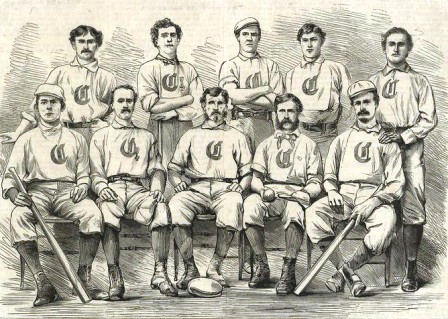
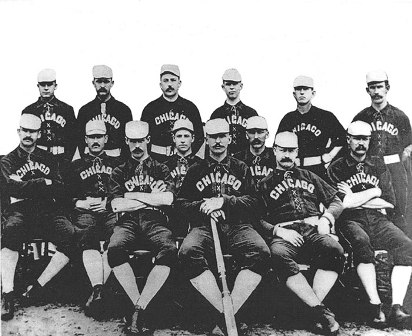
Comiskey (8) was joined in Chicago by three members of his American Association championship teams in St. Louis.  Arlie Latham (7), Tip O'Neill (11), and pitcher Silver King (14) who posted a 30-22 record.

Comiskey (8) was joined in Chicago by three members of his American Association championship teams in St. Louis. Arlie Latham (7), Tip O’Neill (11), and pitcher Silver King (14) who posted a 30-22 record.

Fred Pfeffer stayed in Chicago, spending one more turbulent season with Cap Anson, before being traded to the Louisville Colonels.

Arlie Latham, “The Freshest Man on Earth” went to the Cincinnati Reds in the National League.

Ned Williamson never played again.

Profiles of Members of Spalding’s World Tour, “The Stonewall Infield”

23 Apr

While with the players who took part in the world tour between the 1888 and ’89 seasons, Si Goodfriend observed:

 “My experience in traveling with baseball clubs, the circumstances of which necessarily brings about a close association, has impressed me with the fact that most of them are, as a rule, men of far more intelligence and better manners than they are generally given credit for.”

Among those players were all four members of the Chicago White Stockings “Stonewall Infield:” Adrian Constantine “Cap” Anson, Nathaniel Frederick “Fred” Pfeffer, Edward Nagle “Ned” Williamson, and Thomas Everett “Tom” Burns.

Goodfriend said of Anson:

“Decidedly the most unique and interesting figure of all is that of Captain Anson.  He shows the same peculiarities of temperament off as on the ball field.  He takes advantage of every point he sees and, and holds it…He may not admire a fellow baseball player personally, but this will not induce him to detract from his skill or standing as a player.

“’Old Anse’ has genuine sporting blood in him, and will bet on anything that turns up…There isn’t anything (aboard)the ship he won’t bet on if he has a fair chance of winning.  Anson’s nature is not nearly as harsh as some people imagine.  The rippling water in the moonlight or the graceful soaring of a bird will draw out the greatest sentiments from him.”

Like John Tener, Anson would enter politics, but was less successful.  After being elected Chicago’s city clerk in 1905, he was defeated in the Democratic primary for Cook County (IL) Sheriff in 1907

"Cap" Anson

“Cap” Anson

Of Pfeffer he observed:

“(He) is handsome and has no striking mental characteristics.  He has a long, flowing, brown mustache and soft brown eyes, both of which would readily come under the head of a womanly ‘lovely.’  To show the nature of the man I need only mention a little incident that is causing him much worry at the present time.  His only relative is his mother who lives in Louisville.  Before leaving on the trip he promised to write to her regularly and while on the ocean he promised to cable home from every point possible.  He did not know there was no cable from Honolulu, and now he is worrying himself that his old mother will be anxious about him until he can cable from Auckland.  It will seem an age to him until that city is reached.”

Pfeffer, along with “Monte” Ward was a leader in baseball’s nascent labor movement, Pfeffer was frequently at odds with Anson, and led the exodus of most of the White Stockings’ starters to the Players League.  Despite that, in 1918 Anson called Pfeffer the game’s all-time greatest second baseman after sportswriter Grantland Rice said Eddie Collins of the White Sox was the best ever.

Fred Pfeffer

Fred Pfeffer

Williamson, he said, was “unassuming” and:

“(A) big tender-hearted fellow, whom everybody likes.  He writes in an exceedingly clever and interesting style, and can ‘fake’ a good story like a veteran journalist.”

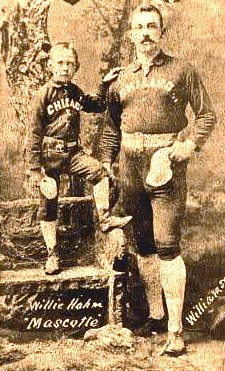
Ned Williamson with White stockings mascot

Ned Williamson with White stockings mascot

Williamson wrote his own dispatches from the tour which became popular features in Chicago papers.  He injured his knee on the tour and A.G. Spalding refused to help him with medical expenses; the 36-year-old Williamson jumped to the Players League in 1890, but his health began to deteriorate that year while playing for the Chicago Pirates.  He died of tuberculosis in 1894.

Goodfriend on third baseman Burns:

“(He) is a bright, intelligent man, who spends most of his time in reading; works of a standard heavy and weighty character being favorites.  He has the reputation of being a great dresser, and is said to have as many trunks with him as a New York belle would carry to Saratoga.”

Tom Burns

Tom Burns

Nearly a decade after the tour, Burns would be the man who replaced Anson as manager of the Chicago National League ballclub.  Burns took the reins of the “Orphans” in 1898, ending Anson’s 19-year run as manager.

Burns was named manager of the Jersey City Skeeters in the Eastern League in 1902, but died just weeks before the beginning of the season.

Filling in the Blanks, Pearson, Minneapolis Millers, 1884

18 Apr

Baseball Reference lists “Pearson” as a pitcher for the Minneapolis Millers in the Northwestern League in 1884.

Edward Pool Pearson’s professional career was brief and ended dramatically.

Born in Waterloo, New York in 1859, Pearson attended Hobart College, where he studied mathematics.

He pitched three seasons with the Hobart team—his battery mate there was James Adelbert McCauley, who also made his professional debut with the Millers in 1884, and went on to play with the St. Louis Browns, Buffalo Bisons, Chicago White Stockings and Brooklyn Grays in the National League and American Association.

jim McCauley, Pearson's teammate at Hobart and with Minneapolis

jim McCauley, Pearson’s teammate at Hobart and with Minneapolis

Pearson was 5-7 with a 1.54 ERA in 13 appearances with the Millers when he took the mound to pitch against the Milwaukee Brewers on August 7.  According to The Associated Press:

“Pearson, the pitcher for the Minneapolis Club, while delivering the ball, broke his arm above the elbow.  It broke with a snapping sound that could be heard all over the diamond, the ball rolling along the grass to the Captain’s line.  Pearson uttered a loud cry of pain and fell to the ground.  He was immediately carried to a doctor’s office, where the broken bone was set…The accident will necessitate his retirement from the diamond, as he has no desire to ever play ball again.”

After the injury he  returned to Hobart, graduated in 1885 and received a Master’s Degree in 1889.  Pearson died in 1932.

“The ‘Original’ up-behind-the-bat Man”

17 Apr

Douglas L. Allison was largely forgotten by 1907.

He caught for Harry Wright’s Cincinnati Red Stockings from 1868-1870, joined the newly formed National Association as a member of Nick Young’s Washington Olympics in 1871, and was an inaugural member of the Hartford Dark Blues during the National League’s first season in 1876; in total he played for parts of 10 seasons in the American Association, National League, and National Association.

Doug Allison, standing third from left, with the 1869 Cincinnati Red Stockings

Doug Allison, standing middle, with the 1869 Cincinnati Red Stockings

It was the death of a contemporary that brought him back into the public eye.

On April 21, 1907, Nathan Woodhull “Nat” Hicks died in Hoboken, NJ.  Hicks had also been a catcher, having played for the New York Mutuals, Philadelphia Whites and Cincinnati Reds in the National Association and National League from 1872-1877.

Hicks’ obituary, including the one in The New York Times, gave him credit for being the first catcher to stand directly behind the batter:

“To catch behind the bat without the elaborate protection of mask, protector, great glove, and shin guards, as Nat Hicks was the first to do, required a grit and endurance that few of the high-priced artists of the diamond today would care to emulate.  Hicks created a sensation by catching behind the bat with his naked hands and body unprotected.”

Doug Allison couldn’t let that stand, and he contacted a reporter from The Associated Press to set the record straight:

“Nat Hicks was a great catcher for the short period that he stood in the limelight of public opinion, but the press of the country is away off in giving him credit as the ‘original’ up-behind-the-bat man.”

While coming forward to claim the distinction, Allison insisted it wasn’t important to him:

“Not that I wish to claim any such record, for after all it does not carry any great weight or glory, but just the same I think figures will prove that I was among the first, if not the first, of any of the backstops  to attempt that trick that was the mystery of the game.”

Allison said that while catching for a team in the Manayunk neighborhood of Philadelphia he developed a “theory,” and “began to believe it possible to get close up to the bat,” in order to prevent runners from stealing:

“I put my theory in action, and that was way back in 1866…My success in this style of play was remarkable, and naturally the talk of the place, until our game began to draw crowds simply because ‘Allison was behind the bat.’  This is not egotism, but the fact, and my method soon had lots of imitators.”

Allison said the following season while playing with the “Gearys, the leading amateur team of Philadelphia,” he was discovered by “that greatest of all baseball generals—Harry Wright.” And while with the Red Stockings he “continued up under the bat with plenty of success.”

As for “my friend Nat Hicks,” Allison said:

“(He) did not break into the game until 1870 and could not have started that play for which so many newspapers have been giving him credit, and while disliking to cloud their stories, it seems right to correct the popular impression of this important epoch in the history of baseball.”

A print from the 1870s depicting "Nat" Hicks "behind the bat" with the New York Mutuals.

A print from the 1870s depicting “Nat” Hicks “behind the bat” with the New York Mutuals.

Having set the record straight, Allison returned to his job in the dead letter office of the United States Post Office in Washington D.C.  He died in 1916 at age 70.

Alamazoo Jennings

16 Apr

Alfred Gorden Jennings earned his nickname the day after his only professional game, as the catcher for the  Milwaukee Grays in 1878; and it was given to him by on of the most famous baseball writers of the era.

The Grays had three catchers in 1878; Charlie Bennett, Will Foley and Bill Hobart, all of whom were injured on August 15 while Milwaukee was in Cincinnati for a series with the Reds.   Grays Manager Jack “Death to Flying Things” Chapman found Jennings, who had been playing with local semi-pro and amateur teams for a decade, and put him in the lineup for the August 15 game.

Pitcher Mike Golden was on the mound for Milwaukee, and Jennings told sportswriter Rem Mulford Jr. years later:

“We were all mixed in our signs.  I signed for an outcurve and got an inshoot which broke a couple of fingers.  ‘Go ahead,’ I said, ‘ I’ll stay here all day even if I have to stop ‘em with my elbows.  You can’t drive me away.’  Well they didn’t.”

Jennings was officially credited with 10 passed balls (he claimed he had 17), a record that stood until 1884.

The morning after the game in The Cincinnati Enquirer, the headline on Oliver Perry “O. P.” Caylor’s story read:

Alamazoo Jennings Makes His Debut Behind the Bat

His Gall Holds Out but His Hands Weaken

Caylor said:

“(Jennings) looked so large and handsome and very like a catcher that Manager Chapman was mashed, and straightaway engaged him, and clinched the bargain with a dinner.  When Al pulled on his sole- leather gloves and poised near the grandstand at three o’clock, the crowd scarcely breathed.  Zip came the ball from Golden’s hand; bang it went against the backstop because Al had stooped too late to pick it up.  It took several minutes for him to gauge the speed of Golden’s pitching, but he got it down fine at last, and stopped a ball every once in awhile.  But, the low comedy parts came in when the new catcher went up close behind the bat.  A batter had but to get on first base and a run was scored.  They went to second and third without danger, and tallied on a passed ball.”

Jennings told Mulford his reaction to Caylor’s story:

“I read a few lines and wanted to fight.  I read a few lines more and had to laugh.”

The Box Score

The Box Score

That game was the end of Jennings’ one-day professional career.  Shortly afterwards he began a more than 10-year run as a minor league umpire in the Bluegrass, Southern, Northwestern and Interstate Leagues.  He also served as an umpire in the Union Association in 1884, his only season in a major league.

Mulford would occasionally update his readers about Jennings, of whom he said:

“With all his peculiarities, Amamazoo is a good fellow, and he has as many friends in and out of the profession as anybody ever connected with the great national game.”

By 1891 he gave up umpiring to become “The Parched Corn King of America,”selling his product in “three cities–Cincinnati, Covington and Newport—and netting every day ten times the amount of the original capital invested in the enterprise.”

by November of 1894 Jennings had moved on from the “parched corn” business, to “pushing an insect killer,” when as The Sporting Life said: “Death entered another victory upon his scorebook.”  He was 43-years-old.

The Enquirer said for his funeral his friends ordered a “floral piece…over seven feet high.  It is made of beautiful flowers.  Two large floral bats cross each other above, and below then are two floral balls, and at the bottom of the piece the inscription: ‘His Last Decision.'”