
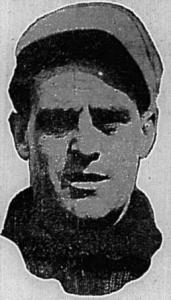
George Bernard “Chief” Borchers was a West Coast phenom. The Sacramento native was so good as a 16-year-old in 1885 that the town’s two professional teams battled for his services. After pitching half the season for one club, The Sacramento Record-Union said:
“George Borchers, heretofore pitcher for the Alta Baseball Club, has resigned his position in that club and will hereafter pitch for the Unions.”
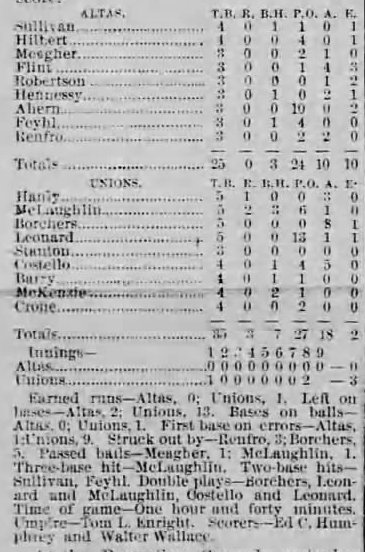
Box score for Borchers’ first start for the Sacramento Unions (July 26, 1885) after jumping the Sacramento Altas. Borchers beat his former team 3 to 0.
He played for the California League’s Sacramento Altas in 1886 and the Oakland Greenhood & Morans in the same league in 1887. The Sporting Life said of him:
“Borchers is possessed of Herculean strength, great endurance, and is a heavy batsman.”
The Sacramento Bee said Borchers “would soon rank as one of best pitchers on the coast,” if he got “command of the ball and his temper.”
Before the 1888 season the 19-year-old became the subject of a bidding war. He pitched several games against the New York Giants during John Montgomery Ward’s barnstorming/honeymoon tour of the West Coast in the winter of 1887.
Ward told New York reporters that Borchers was the best pitcher in the California League. The Sporting Life called him “Ward’s especial favorite,” and “Ward’s find.” By January The Boston Post said he turned down an offer from the Beaneaters, The San Francisco Chronicle said he rejected the Detroit Wolverines, and The Philadelphia Times said “(Athletics Manager Bill) Sharsig is hopeful to sign Borchers.” The Times also said Ward’s Giants had made an offer but:
“The young man wanted a mortgage on Central Park and a large chunk of Coney Island.”
The San Francisco Chronicle said Borchers came from a wealthy family (his father owned a brewery) and were “opposed to his playing ball.”
Whatever the reason, Borchers opened the 1888 season with the Greenhood & Morans. He pitched at least four games for Oakland before it was announced on May 2 that the 19-year-old had signed a major league contract. The Chronicle said:
“The baseball world was thrown into a state of excitement yesterday when the press dispatches made the unexpected announcement that George Borchers prize pitcher of the Greenhood & Moran club, had been signed to pitch for the Chicagos.”
The paper said when White Stockings President Al Spalding sent a telegram to Borchers asking his terms, the pitcher, “treated the telegram as more of a joke than anything else, and in the spirit of fun telegraphed back” asking for $3000, with a $500 advance.
“He never dreamed of receiving a favorable answer, and his surprise can well be imagined when a few hours later the answer came accepting his terms.”
Despite being what The Chronicle claimed was the “largest salary ever paid to a California player in the East,” Borchers immediately regretted the agreement:
“He says he does not feel much like leaving here and would like to back out if he could, but, knowing that he is legally bound by his act, he will of course stand by it.”
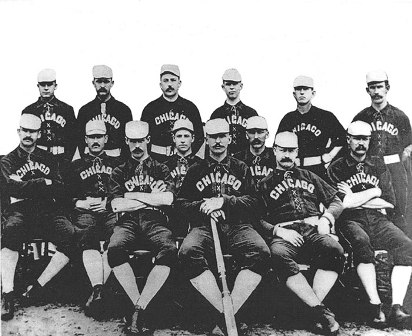
The pitcher arrived in Chicago on May 13 to great fanfare. The Chicago Tribune said “if he equals the reports of his ability that precede him, the team will be as nearly invincible as it is possible for a baseball organization to be.”
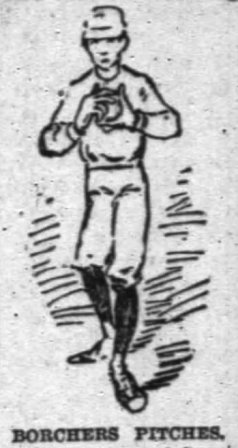
Caricature of Borchers from The Chicago Tribune–1888
White Stockings shortstop Ned Williamson, who batted against Borchers on a West Coast trip, compared him to another California pitcher who made his big league debut at age 19:
“He pitched more like Charley Sweeney than any other man I ever saw, and Sweeney was as good as any that ever stepped in the box.”
Borchers made his debut on May 18. The Chicago Inter Ocean said:
“Another wonder has been discovered and the Chicago Ball Club has it. The wonder is George Borchers, the California pitcher. He was put in the box to pitch for the Chicagos yesterday against the Bostons in the closing game of the series. The result is manifest in the score—13 to 0…Borchers was made the hero of the hour. He has come to stay, and his work yesterday is a guarantee of his ability to keep his place.”
The Chicago Tribune was more subdued than The Inter Ocean:
“(Borchers) has an easy delivery. Good curves and great speed, but his command of the ball remains to be determined. Yesterday he was wild. Three wild pitches were charged to him, and with a less active and reliable man than (Tom) Daly behind the bat more would have been recorded. Those that got by Daly were extremely wild. Still he was effective.”
The game, played in the rain at West Side Park, in what The Chicago Daily News called “practically a swamp,” was called after five innings.
The papers couldn’t agree on the attendance either–The Inter Ocean said it was 3000, The Tribune, 1500 and The Daily News 2000.
Borchers allowed just three hits and beat Charles “Old Hoss” Radbourn in his first major league game.
Things went downhill from there; the rest of Borchers’ story on Monday.
 Baseball History Daily