Tag Archives: Pacific Coast League

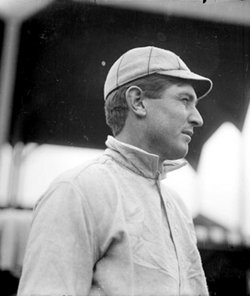
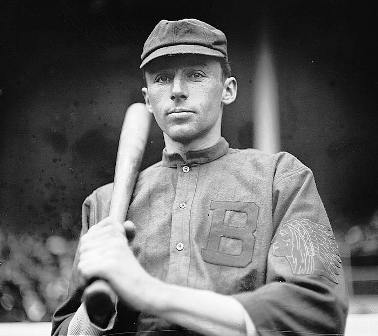
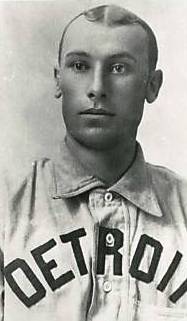
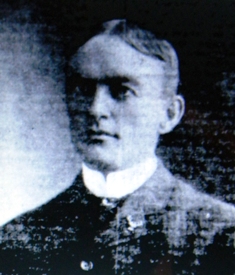
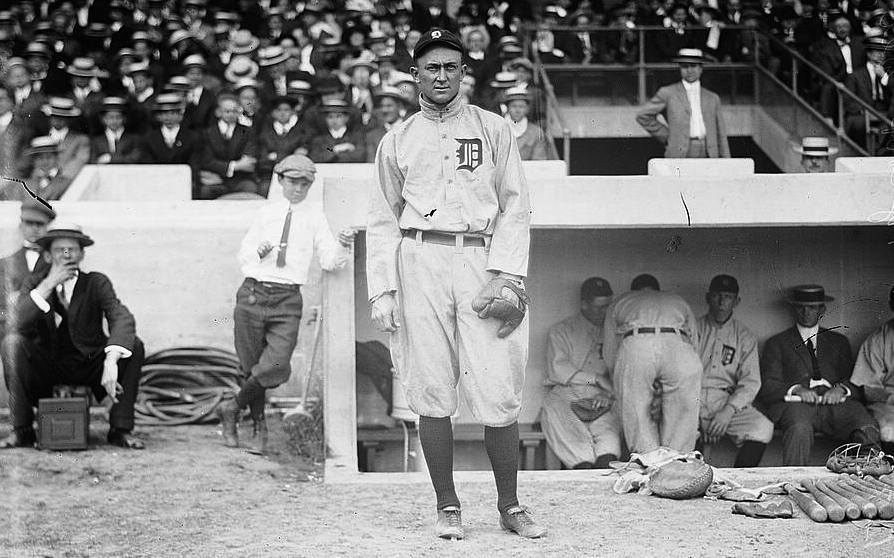
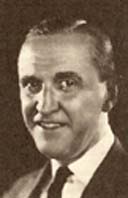
Fred Abbott

9 Oct

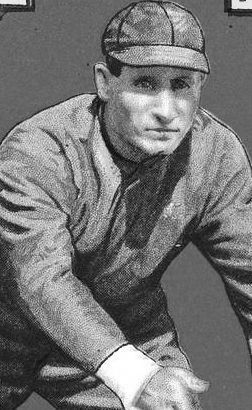
Fred Abbott (born Harry Frederick Winbigler) spent more than a decade in the minor leagues before the Cleveland Naps purchased his contract from the New Orleans Pelicans prior to the 1903 season.  The 28-year-old rookie appeared in 77 games for the Naps.

Fred Abbott

Fred Abbott

After his first big league season he told The Cleveland Press about his most embarrassing moment with the Naps:

“I was behind the bat in a game at Washington one day last summer when the batter hit a ball straight up over my head.  I should judge it went nine miles high.  As I tore off my mask a bleacherites flashed the sun’s rays in my eyes by aid of a looking-glass.  It nearly blinded me.

“’I can’t see it,’ I shouted, expecting either (Earl) Moore, who was pitching or Hick (“Cheerful” Charlie Hickman), who was at first, to take the ball.  But neither man stirred.  Instead Cheerful took my latitude and Earl my longitude.

“’Go toward first two steps,’ yelled Moore.  I did.

“’Go back about three feet,’ shouted Hick.  I did.

“Now put your hands straight over your head,’ howled both men in chorus when they had got me placed.  I did.

“And although my eyes were shut tight, the ball dropped straight into my hands.”

Abbott played one more season in Cleveland, and played for the Philadelphia Phillies in 1905.  The Phillies sold his contract to the Toledo Mud Hens in the American Association (AA).

Abbott laid down roots in Toledo.  He played five seasons there and operated a bowling alley and pool hall on Euclid Avenue with his teammate Harry Hinchman; until Hinchman took over as Mud Hens manager.

The Pittsburgh Press said:

“Rather tough on a baseball player when your own business partner releases you and sells your ability to play to a club on the other side of the country? “

Hinchman had succeeded James “Ducky” Holmes as manager late in the 1910 season; Abbott was sold to the Los Angeles Angels in the Pacific Coast League shortly after the season ended:

“One of Hinchman’s first managerial duties was to sell his partner to the Los Angeles club, Hinchman believing that Fred had been connected to the Toledo club too long and that both he and the club would be benefited by the change.”

Abbott wasn’t thrilled, but took the news in stride:

“Gee, I had been in Toledo so long that I had about made up my mind that I was going to die in the harness there…It’s a good move sending me to Los Angeles, but I will have to put in a longer season there than in the AA, and the pay offered is just the same.  I didn’t like that angle to the case very well, but they have got us ballplayers where they want us and I suppose it is up to Fred to run along and play.”

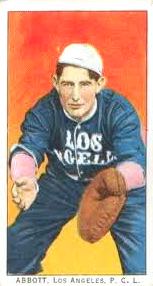
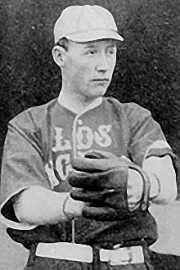
Fred Abbott with Los Angeles Angels 1911

Fred Abbott with Los Angeles Angels 1911

Los Angeles apparently grew on Abbott; he only spent one season with the Angels before retiring, but remained in L.A. until his death in 1935.

“Krug Seemingly Lost his Head”

25 Sep

The 1902 Southern Association season was so contentious that a headline in The Atlanta Constitution said the day after it ended:

To the Relief of All the Season is Now Over

In addition to the months-long battle between Charlie Frank and the league, there was an on-field incident that The Columbus (GA) Daily Enquirer called “an exhibition as was never before seen on an Atlanta Diamond.”  Henry “Heine” Krug was at the center of it.

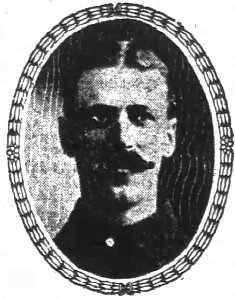
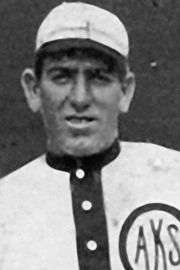
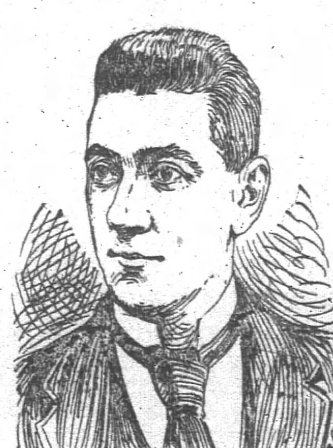
Henry Krug

Henry Krug, 1902

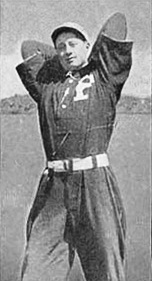
In February of 1902, Ed Peters, new owner and president of the Atlanta Firemen signed Ed Pabst to manage the team.  Pabst had played the previous season with the San Francisco Wasps in the California League and brought with him to Atlanta his friend Krug, a 25-year-old shortstop who had been playing for West Coast professional teams since he was 17.

When Krug was signed The Constitution said he was “beyond doubt the star of the Pacific Coast,”

The Sporting Life said Krug had already signed a contract with the Philadelphia Phillies, but jumped the Phillies to join Atlanta.

Krug’s average never dipped below .300, and was very popular with fans and the press.  The Constitution called him “The best all-around professional of the Southern Association” in June.

On July 15 the paper noted his “dashing, errorless work that has been classed as phenomenal.”

Two days later the tone changed dramatically.

The fourth place Firemen were playing Charlie Frank’s Memphis Egyptians and Krug was having a rough day.  Early in the game a throw from first baseman George Winters hit Krug “and gave him a severe blow in the mouth.”  Krug had walked off the field, intending to leave the game, but came back.  He probably shouldn’t have.

Krug went on to make three errors, two of which The Constitution said “in the opinion of the crowd might have been avoided.”

The crowd began to taunt Krug and “Instead of taking the roast the bleachers proceeded to give him as any sensible player would take it, Krug seemingly lost his head and with all the vicious intent imaginable, he secured the ball and threw it with all his strength into the bleachers.”

The Constitution said Krug, “phenomenal” just two days earlier, now said the shortstop’s “conduct on former occasions has been offensive to the patrons of the game.”  Although Krug was ejected from a game earlier in the week, there didn’t appear from newspaper reports to be any pattern of “offensive conduct.”

Atlanta bleacher fans “dodged the sphere” and no one was hurt.  Team president Peters immediately approached Ed Pabst and “instructed him to order Krug out of the game.”  Pabst refused:

“He did not like what he considered an infringement on his prerogative, and at once tendered his resignation as manager of the Atlanta team.  President Peters was just as ready to accept as Manager Pabst was to tender, and within the space of a few seconds the ball player who has been managing the Atlanta team since the playing season of 1902 opened found himself deposed.”

Ed Pabst

Ed Pabst

Peters took over as manager and remained in the position for the rest of the season.  His first act as manager was to remove Krug from the game and suspend him.  The Constitution said:

“Krug’s baby act was witnessed by Sergeant Martin and policemen Norman and Hollingsworth.  They placed him under arrest.”

Some reports said a bottle and rock were thrown at Krug, but the player said he didn’t see that and was reacting only to the verbal taunts.  He appeared in court the following day and was fined $10.75; The Daily Chronicle said, “Krug appeared very penitent.”

Peters sold Krug’s contact to the New Orleans Pelicans the following day, but Krug refused to report sending a wire to Peters and Pelicans owner Abner Powell saying “that if he could not play in Atlanta he would not play,” in the league.

Despite the incident, there was no shortage of interest in Krug’s services.  In addition to New Orleans, the Phillies, who he jumped to join Atlanta and the San Francisco franchise in the California League offered him contracts.

Krug signed with Philadelphia and made his debut with the Phillies on July 26; the day after Atlanta management petitioned the National Association of Baseball Leagues (NAPBL) to blacklist Krug.

No action was taken and Krug played out the season in Philadelphia, hitting .227 in 53 games.  He spent 1903 with the San Francisco Seals in the Pacific Coast League (PCL).  Peters sold his interest in Atlanta in 1903.

Before the 1904 season, the PCL and the NAPBL reached an agreement that made the league part of the National Association and no more an “outlaw league.”  As part of the deal, PCL players who were under contract with other teams were returned.  As a result, Krug returned to Atlanta.

The Constitution assured their readers:

“He has promised to be good and to do his best to help the team win.  It is the belief of many fans in this city that he wishes to redeem the past.”

Krug played two incident-free, if unspectacular seasons in Atlanta, then played in the New York State League with the Scranton Miners and the American Association with the Indianapolis Indians.

krug1

Henry Krug,1907

The 31-year-old returned to San Francisco, where he was “negotiating for a place with the California State League,” and had accepted a position coaching the baseball team at Cogswell College.  Krug underwent surgery for “an abscess upon his throat” on January 12, 1908, and died from complications from the operation two days later.

Two months after his death all had been forgiven in Atlanta.  The Constitution named him to the paper’s “All-Atlanta Ball Team,” the best professional players to have played in the city.  Krug “was a power with the stick.  No better man ever played on the Atlanta team when it came to breaking up a game.”

“The Disappearing Oakland Infielder”

7 Aug

James Ernest “Jimmy” Frick began his career with the Iola Gasbags in the Missouri Valley League in 1904, hitting .331 in 106 games.  While Frick began the 1905 season with the Oklahoma City Mets in the Western Association, a “C” level league, press reports said he could have played at a higher level and The Sporting Life said St. Louis Cardinals, Hall of Famer pitcher Charles “Kid” Nichols “cannot understand why Jimmy Frick of Oklahoma City persists in hiding out it the bushes when he can make good in fast company.”

Frick was hitting above .300 in July when he was sold to the Seattle Siwashes in the Pacific Coast League; he hit .252 in 18 games until August 18 when The Associated Press said Frick “disappeared mysteriously.”

Four days later The Seattle Star said Frick who “was very popular” with local fans had jumped the Siwashes and rejoined Oklahoma City having been promised “$1000 and a chance to manage the team next year.”

Whether the reported deal was actually promised to Frick is unknown.  While he returned to Oklahoma City he never joined the Mets and finished the season with the Wichita Jobbers.

At the end of the 1905 season multiple teams laid claim to him.  The Associated Press said:

“The case of J. Frick who was claimed by Indianapolis, Wichita, Seattle and Oklahoma City was referred to Secretary (John) Farrell (of the National Association).”

In February of 1906 Frick was awarded to Wichita then immediately traded to the Toronto Maple Leafs in the Eastern League.  He spent the next five and a half years in the Eastern League with Toronto, the Baltimore Orioles and the Newark Indians.

On July 16, 1910, while with Baltimore, Frick was hit in the head with a pitch.  In August The Sporting Life said he had not yet returned to the lineup:

 “(Frick) is in a bad way in this city, as the result of being hit on the head by a pitched ball during the last home series of the Birds. Although the accident happened at least three weeks ago, Frick’s head is still in bad condition, his face is swollen and dizziness seizes him on the slightest provocation. It is doubtful if Frick will play again this season.”

He did return at the tail end of the season, but only appeared in a few games.  In 1911 he was sold to Newark, and after hitting just .200 in 28 games he was sold to the Troy Trojans in the New York State League.

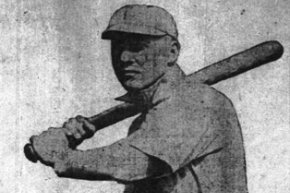
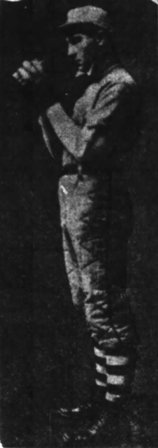
Jimmy Frick

Jimmy Frick

Before the 1912 season, Harry Wolverton, third baseman and manager of the Oakland Oaks in the Pacific Coast League, was named manager of the New York Highlanders in the American League.  Oakland hired Bayard “Bud” Sharpe to manage the team; one of his first moves was to purchase Frick from Troy to fill the void Wolverton left at third.

By March 7 The Associated Press said Sharpe was “somewhat exercised about infielder Frick.”  The new third baseman had arrived in Oakland by train several days earlier, but had not arrived at the Oaks training camp in Livermore, California and had not been heard from him.  Sharpe showed up the following day, but it was reported he had spent several days in an Oakland hospital—it was not reported why he was hospitalized.

Frick began the season as the Oaks starting third baseman, but after hurting his foot in April, August “Gus” Hetling filled in and Frick never returned to the regular lineup.

On September 17, with Oakland in a battle for the pennant with the Vernon Tigers, the team was in Los Angeles when Frick, according to The Associated Press left his room at the Hotel Rosslyn and “dropped from sight.”

The Los Angeles Examiner said the Oakland team and the Los Angeles Police Department had looked for Frick for more than a week and found no sign of the infielder.  The Associated Press said “all of Frick’s haunts have been searched,” and that the disappearance “may hurt Oakland in their fight for the pennant, as he is considered the best utility infielder on the team.”

Herb McFarlin, Secretary of the Oaks, said:

“Frick has always been a steady player, not inclined to drink or run around.  He always has been absolutely dependable.”

On October 4 The Associated Press said “the disappearing Oakland infielder” had been found by his wife:

“He had been ill in a Los Angeles Hospital, assuming an alias so that he would not be bothered.”

As with his spring disappearance there was no mention as to why Frick was in the hospital.

On October 5 he was with the Oaks in Portland for a game with the Beavers, he did not play, but was “out on the coaching line rooting for his team.”

Frick was with the team on October 27 when they took both games of a double-header in Los Angeles; Vernon won both games of a doubleheader from Portland, and Oakland took the pennant with a winning percentage of .591 to Vernon’s .587.

Frick saw little action in the final weeks of the season, his replacement Hetling hit .297 and was awarded a Chalmers Automobile as the league’s most valuable player.

Gus Hetling, Frick's replacement at third

Gus Hetling, Frick’s replacement at third

Frick and his wife went to Portland at the end of the season, and in late November planned to leave for Oklahoma City where they owned a farm.  On November 20 Mrs. Frick went to pick up tickets for the trip, when she returned home, she found Jimmy Frick dead.  He committed suicide by drinking carbolic acid. (Baseball Reference incorrectly lists his date of death as November 18),

The Portland Oregonian said Frick had been “ill and despondent,” and said he was suffering from “brain fever.”  (Brain fever is an antiquated and vague term used for inflammation of the brain).

None of the stories about Frick’s suicide and “brain fever” mentioned the severe injury he had received when he was hit in the head in 1910, so  it’s impossible to determine whether it contributed to the erratic behavior that year, hospital stays, or death of the disappearing Oakland infielder.”

“Branding us as if we were a Band of Convicts”

1 Aug

When the directors of the Pacific Coast League (PCL) met in Los Angeles in January of 1912, The Los Angeles Examiner said the league would be introducing a new innovation:

“President (Allan) Baum said each player will be given a uniform bearing upon the left arm a number he will wear throughout the season.  On all score cards sold at games every man of each team will be named in consecutive order.”

The plan wasn’t immediately embraced.  The Portland Oregonian said several players on the Portland Beavers were against the idea, pitcher Frederick “Spec” Harkness said:

“Of course, I don’t like this branding us as if we were a band of convicts…Hap Hogan (Wallace “Happy Hogan” Bray, manager of the Vernon Tigers) must have been the man who got this freaky legislation past the magnates at Los Angeles for the numbers go nicely with Vernon’s convict suits.”

Frederick "Spec" Harkness

Frederick “Spec” Harkness

The idea was actually the inspiration of Oakland Oaks president Edward Walters.

Major League players and executives also objected to the idea, Tigers president Frank Navin was quoted in The Detroit Times:

“It is a 10-1 bet that the players would rather suffer salary cuts all along the line than be labeled like a bunch of horses.”

Despite early objections, PCL players eventually accepted the inevitable, even Harkness who caused a stir among superstitious teammates when he requested number thirteen.

Roscoe Fawcett, sportswriter of The Portland Oregonian said:

“(Harkness) has put superstition to rout by sending in a request for number 13 under the new Pacific Coast League system of placarding players.”

By March the numbering idea gained some acceptance, and the desire for number 13 had caught on; there was a competition for the number among the Portland Beavers.  The Oregonian said Harkness “now finds his claim disputed by Benny Henderson, Walter Doan and others.”

In the end Harkness (who was born on December 13) received the number.  Given the rampant superstitions of early 20th Century players, most teams simply didn’t issue number 13 to any player.  The only other player in the PCL reported to have worn the number was Oakland pitcher Harry Ables.

Harry Ables

Harry Ables

The PCL’s experiment in uniform numbers was largely unsuccessful.  The Oregonian said the armbands were too small and “cannot be read from 90 feet away.”

By the end of the season, Vernon manager Hogan and Portland manager Walter “Judge” McCredie both of whom enthusiastically supported the numbers, were of the opinion that “the present trial has been a fizzle.”

The biggest criticism of the experiment was the failure of the system to achieve its chief goal, “numbering the men did not help out the sale of scorecards.”

Numbers were eliminated before the 1913 season and the PCL did not use uniform numbers again until the early 1930s.

Hap Myers

29 Jul

When the 6’ 3” 175 pound Ralph Edward “Hap” Myers was let go by the Boston Braves after the 1913 season a reporter told Braves shortstop Rabbit Maranville he was sorry to see Myers go.  Maranville joked:

“Well, you might be, but I’m not.  Do you know that guy is so thin that every time I picked up a grounder I had to shade my eyes with my gloved hand to locate him before throwing the ball.”

Myers began his professional career after graduating from University of California, Berkeley in 1909, where he also played baseball.  The San Francisco native hit a combined .311 playing for the Sacramento Sacts in the Pacific Coast League, and the San Jose Prune Pickers and Santa Cruz Sand Crabs in the California League.

Myers went east in 1910 after being purchased by the Boston Red Sox, but became ill, with scarlet fever, and as a result appeared in only six games in Boston before being  sent first to the Toronto Maple leafs in the Eastern league, then the Louisville Colonels in the American Association.

Despite hitting just .240 with Louisville, Myers was selected by the St. Louis Browns in the Rule 5 draft.  The Red Sox claimed Myers still belonged to them and his contract was awarded to Boston, where he began the season, was sold to the St. Louis Browns, who quickly released him despite hitting .297 in 11 games, then back to the Red Sox where he hit .368 in twelve games before being sent to the Jersey City Skeeters in the Eastern League.

It was never clear why, in spite of hitting .333 in 81 at bats in 1910-1911, Myers couldn’t stick in the American League.

In 1912 he returned to the West Coast to play for the Spokane Indians in the Northwestern League where he led the league in hits, and runs, hit .328, and led all of professional baseball with 116 stolen bases.  The Portland Oregonian said:

“Myers base stealing smashes any previous performance in Northwestern League history.  You have to go back 20 years in official guide books to find any record to compare…and that includes every league in organized baseball.”

Spokane owner Joe Cohn went overboard in his praise of Myers in The Spokane Spokesman-Review:

“Best ballplayer in the Northwestern League by a long shot.  He is the greatest ballplayer I ever saw.  Boy I tell you this Myers is a wonder.  Ty Cobb, Hans Wagner, Tris Speaker and all of them have nothing on Myers…I think Myers has it on Cobb, Wagner, Lajoie, Jackson and the whole bunch.”

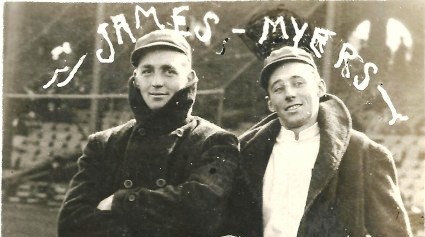
Myers, and Portland catcher Rex DeVogt were purchased by the Braves from Portland, Devogt would only last for three games, and six hitless at-bats in April of 1913.  Myers would become the Braves starting first baseman.  Another Pacific Coast League player, pitcher “Seattle Bill” James also joined the Braves.

hap3

“Seattle Bill” James and “Hap” Myers

Myers got off to a slow start; he was hitting just .224 in early July, but was leading the National League in steals.  An article in The Tacoma Times said:

“When Hap Myers, recruit first baseman of the Boston Braves is in full stride stealing bases, he covers nine feet…the average stride of a sprinter is six feet. “

The article said the average player took 13 steps, roughly seven feet per step, between bases but Myers took only ten steps:

“Myers is something of a baseball curiosity, and his work is watched with interest by the fans.  If the time comes that the big fellow climbs into the .300 class as a batter, he is apt to become a veritable terror of the paths.”

He was also said to use “a bat of unusual length,” but the size was never mentioned.

After the slow start, Myers hit well in the second half of the season, ending with a .273 average and 57 stolen bases (second to Max Carey of the Pittsburgh Pirates who stole 61).  Despite his strong finish, Myers was replaced at first base for 22 games in August and September by Butch Schmidt, who was purchased from the Rochester Hustlers in the International League.

"Hap" Myers

“Hap” Myers

At the end of the season Myers was sold to the Hustlers, the deal was, in effect, a trade for Schmidt.  The Boston press simply said Myers did not get along with manager George Stallings; Myers told a reporter in San Francisco that there was another reason; baseball’s labor unrest:

  “I was assigned by the fraternity to get as many Braves as possible into the fraternity, and succeeded in enrolling nearly the entire team.  The powers that be evidently didn’t relish my actions for soon my every move began to bring calldowns and I was not surprised to read in the newspapers a little later that I had been sent to Rochester.”

Myers jumped Rochester to join the Federal League; his signing was reported months before he actually signed.  The Associated Press said in March of 1914:

“Although it has been generally understood that Hap Myers, last season’s first baseman of the Boston National has been under a Federal League contract for some time, the elongated first sacker did not put his name to a contract until yesterday afternoon.  Myers originally expected to play with Larry Schlafly on the Buffalo Federals, but was transferred to Brooklyn, and seemed altogether pleased with the move.”

Myers got off to a strong start, and The Sporting Life said:

“Brooklyn fans cannot understand why Hap was passed out of the National League. They have had a chance already to give his successor at first base on the Boston team (Butch Schmidt) the once over, and the general opinion is that- Hap Myers “lays all over.”

His success in Brooklyn didn’t last; in 92 games Myers hit just .220.

Hap’s story continued tomorrow.

“He was Not Crazy as Reported”

18 Jul

Ervin Thomas “Erve” “Dutch” Beck hit the first home run in the American League; on April 25, 1901, the second day of the season, as a member of the Cleveland Blues; Beck homered off White Sox pitcher John Skopec at Chicago’s South Side Park.

It was a highlight in a short, promising career, like many at the turn of the 20th Century, destroyed by alcoholism.

Beck was considered the best young player in Toledo, Ohio when he joined the Adrian Reformers in the Michigan State League as a 16-year-old in 1895, then for the next five seasons, he was the star of his hometown Toledo Mud Hens in the Interstate League.  For the two seasons in Toledo for which complete records survive, Beck hit .298 in 1898 with 11 home runs and, a league-leading .360 with 15 home runs in 1900.
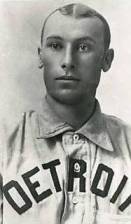
Erve Beck

Erve Beck

Earning the Nickname “Home run Dutch” in the Toledo papers, Beck was credited with 67  during his five seasons with the Mud Hens;  he would remain the team’s all-time career home run leader until 2007 when Mike Hessman (currently with the Louisville Bats in the International League) hit his 68th as a Mud Hen.

Beck also had a brief trial with the Brooklyn Superbas in the National League in 1899, hitting .167 in eight September games.

It’s unclear exactly when Beck’s problems with alcohol began, but according to fellow Ohioan Ed Ashenbach (alternately spelled Ashenback by several contemporary sources), a minor league contemporary who wrote a book in 1911 called “Humor among the Minors”,  it was well-known during Beck’s career that he was “addicted to strong drink,” and as a result suffered from “hallucinations.”

Ed Ashenbach

Ed Ashenbach (Ashenback)

Before the 1901 season, Beck, whose rights were held by the Cincinnati Reds, jumped to the Cleveland Blues in the newly formed American League; the twenty-two-year-old hit .289 and accounted for six of Cleveland’s twelve home runs.

Beck jumped back to the Reds before the 1902 season and received rave reviews early in the season.  The Cincinnati Tribune seemed to like him more at second base than veteran Heine Peitz:

“Erve Beck looks more like a second baseman than anyone who has filled the position since (Bid) McPhee went into retirement (in 1899).  He covers the ground, seems to know where to play and is capable of swinging the bat with some effect.”

His teammate, pitcher Frank “Noodles” Hahn claimed Beck hit the ball “harder than (Napoleon) Lajoie.”

Beck hit better than .300 playing second base in May but went to the bench when Peitz, who was filling in behind the plate for an injured Bill Bergen returned to second.

In June first baseman Jake Beckley missed a week with an injury and Beck filled in there; The Cincinnati Enquirer’s Ren Mulford said:

“(Beck) played the bag in splendid style…In handling ground balls Beck is as good as Beckley, and he is a better thrower… Beck gave another display of his versatility by plugging up a hole in right field.  He made one catch that was a lollapalooza…Most players would have lost heart when benched as Beck was, but he remained as chipper as a skunk during his term of inactivity, and gladly accepted the opportunity to get back into the swim. Beck is a phlegmatic soul, who takes life, as he finds it without a growl.”

In spite of a .305 batting average in 48 games and the great press he received, Beck was released by the Reds in July.  Whether the release was simply because he was the odd man out with Peitz, Beckley and right fielder Sam Crawford healthy or as a result of drinking is unknown.

Beck was signed almost immediately by the Detroit Tigers where he took over at first base after Frank “Pop” Dillon was sent to the Baltimore Orioles.  He hit .296 in 41 games but was again released at the end of the season.

Beck would never return to the big leagues.

In 1903 he .331 for the Shreveport Giants in the Southern Association, he jumped Shreveport the following season and played for the Portland Browns in the Pacific Coast League.   He returned to the Southern Association with the New Orleans Pelicans in 1905.  After starting the 1906 season in New Orleans, he was released in July and signed by the Nashville Volunteers; his combined average with both Southern Association teams was .211.

Beck’s drinking was, according to Ashenback and contemporary newspaper accounts, common knowledge by the time he wore out his welcome in Nashville in August and was sold to the Augusta Tourists in the South Atlantic League.

That stop would last for only one game.

The 27-year-old, four years removed from the American League, played first base for the Tourists on August 6.  Augusta second baseman Ed McKernan said, “It was evident when he reported there was something amiss with him,” and claimed Beck chased “an imaginary flock of geese away from first base” during the game.

The following day, according to The Augusta Chronicle, Beck “created a sensation in the clubhouse…causing all but two of the players to leave the house.”  As a result, Augusta released him.

The following day The Chronicle said:

“(Beck) ran amuck this morning and created great excitement on the street.

“While in a room on the third floor of the Chelsea hotel the big infielder suddenly began to see things and sprang from the third story window to the ground below.  Only two intervening telephone wires and a rose bush saved his life.

“He then darted down an alley and hid himself in a store.  He was finally captured and came quietly back to his room with a policeman and (Tourists outfielder Frank) Norcum.”

The Sporting Life assured their readers that Beck “was not crazy, as reported, but only suffering from the effects of a (drunken) spree.”

McKernan said “During his convalescence…Beck would smilingly avow his determination to abstain from strong drink.”

There were varying reports regarding the extent of his injuries, and it’s unknown whether he was physically able to play after the fall, but Beck would never play professionally again.

He returned to Toledo where he operated a tavern and appears to have been unable “to abstain from strong drink;” he died in 1916 of Articular Rheumatism complicated by Hepatic Cirrhosis.

“I Object to Being Made a Freak.”

17 Jul

In 1913 American League President Ban Johnson set out to put an end to the practice the Baseball Writers Association called “A growing Evil,” ghost-written articles appearing under the by-lines of famous ballplayers.

William Peet of The Washington Herald revealed the identities of the ghost writers in March of 1913; Gerhard “Roger” Tidden of The New York World had been the man responsible for articles bearing the name of Ty Cobb, but Tidden died just three months after the revelation.   While the practice waned after 1913, Cobb remained defiant, and continued “authoring” a syndicated column for the next several years.

Ty Cobb

Ty Cobb

Cobb’s articles, for the most part, steered clear of trouble with the league president, but the assertions he made about the Chicago White Sox and manager Clarence “Pants” Rowland in June of 1915 caused a major stir.

Cobb said:

“Battery signal stealing, which has been the cause of several scandals in big league baseball threatens to make more trouble this season if anyone is able to prove what is generally suspected about one of the American League clubs.

“I will not mention the name of the organization which has been accused by the opposing players…because I couldn’t present any proof.”

Cobb then went on for seven paragraphs trying to present proof, and provided enough hints to make it clear he was talking about the White Sox.

Cobb’s said

 “The team I have in mind has won almost all its home games…It looks mighty funny, though, the way this club could hit at home and the feeble manner in which it has been swatting on the road and almost all of the Tigers will take an oath that something out-of-the-way is coming off.”

Chicago, through 49 games, was in first place; 22-8 at home and 9-10 on the road.  Detroit was in second place a game back.  If he left any doubt Cobb said later in the column when discussing the American League pennant race in general:

“The White Sox, who burned up things at home, have not been doing so well on the road.”

Everyone, including American League President Ban Johnson, assumed Cobb was talking about the Sox.  Johnson said:

 “(Cobb) must prove the charges, or I will keep him from playing baseball.  If any man in the American League makes a charge of dishonesty and refuses to back up his charge with the absolute evidence, that man will have to get out of the game.”

The White Sox were less concerned; The Chicago Tribune said the charges made Sox players “grin,” and Rowland told reporters:

“I suppose we had out tipping instruments planted in the Polo Grounds when we made nineteen hits in New York the other day.”

Clarence "Pants" Rowland

Clarence “Pants” Rowland

In his next column Cobb issued a non-denial denial and at the same time openly, and loudly, defied Johnson:

“I made no specific charge against the White Sox…What I did say was that a strong rumor of sharp practice was abroad, and I reiterate that statement right here.”

___

“Mr. Johnson even went to the extreme of saying that he would drive me out of baseball.  He hasn’t done this yet and I expect to stay around for a few more days.  If the league president is willing to pay the salary that my three-year contract calls for, I will be perfectly willing to take a vacation at that, for I have long wanted to do a number of things that baseball interferes with.”

Cobb reiterated the charges and offered no evidence, but said he was justified in making the claims because his manager might have believed them:

“(Tigers) Manager (Hughie) Jennings thought the report sufficiently serious to detail one of our players for plain clothes duty in the bleachers, and he also wrote Manager (Bill) Donovan of New York, telling him of a warning we had received and cautioning him to be on the lookout.  So you see the signal tipping report was not a creature of my own imagination, but a matter of sufficient seriousness to warrant an investigation by our manager in his official capacity.”

Cobb’s only bit of backtracking was to say that if “it should be proved the White Sox tried signal stealing it would be without the knowledge of Mr. (Charles) Comiskey.”  Cobb said Comiskey “wouldn’t countenance anything of this sort for a moment.”

Cobb took one last swing at Ban Johnson, charging the league president with giving “sensational interviews” about him to get “the people excited artificially. If this is Mr. Johnson’s idea, I wish he would abandon it.  I object to being made a freak.”

If there was any doubt whether the American League’s star player or the league president wielded more power, it became obvious within a week.

Johnson, who The Associated Press said “long has been opposed to players permitting their name to be used over baseball stories,” decided not only had Cobb not written the columns, but claimed “a Detroit newspaperman” made up the allegations “out of whole cloth,” and incredibly said that Cobb had “no knowledge,” of the columns despite Cobb being quoted by numerous sources discussing the charges.

Ban Johnson

Ban Johnson

Hugh Fullerton of The Chicago Examiner summed it up best:

“We are rather surprised each morning upon picking up our newspaper to discover that Ty Cobb is still making two-base hits, two steals and catching a few flies instead of being driven out of baseball by (Ban) Johnson.  By the way how did Johnson get into baseball?”

As quickly as Johnson backed down, the charges went away.  Despite the strong start the White Sox faded, and continued to fade even after the acquisition of “Shoeless Joe” Jackson on August 21, finishing third, nine and a half games behind the pennant-winning Boston Red Sox and seven games behind the Tigers.

Cobb led the league for the ninth straight season, hitting .369.

The one legacy from the brief 1915 controversy seems to be Cobb’s dislike of Rowland, who later became a scout for the Tigers.  In his 1984 book “Ty Cobb,” Charles C. Alexander said Cobb only agreed to manage the Tigers before the 1921 season because he was told:

 “Pants Rowland, whom Cobb considered an incompetent fraud, might very well get it and Cobb would have to play for him.”

Rowland, who remained in baseball until 1959 as a manager, scout and executive with the Los Angeles Angels in the Pacific Coast League and Chicago Cubs in the National League, appears to have also held a grudge.   Up until his death at age 90 in 1969, Rowland often said two of his former players, Jackson and Eddie Collins were better than Cobb.

 In 1953 at the Old Timers Baseball Association of Chicago Banquet Rowland said “I wouldn’t have traded (Collins) for Cobb.  What made him greater than Cobb was that he inspired the entire ball club.  Ty was an individualist.  He was interested only in Cobb.”

Rowland called Jackson the “greatest natural hitter,’ he ever saw, and said Ted Williams, not Cobb, was the only player “of the same make-up.”

A Thousand Words–Jim Jeffries and Baseball

12 Jul

jeffries


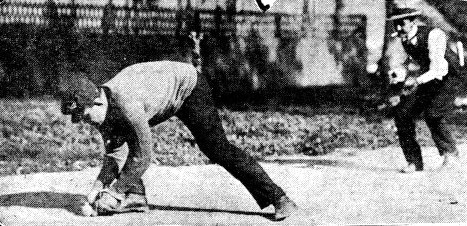
Former Heavyweight Champion Jim Jeffries fields a ground ball at his ranch in Burbank, California as he prepares for “The Fight of the Century,” against reigning  champion Jack Johnson; Johnson pummeled the former champ on July 4 in Reno, Nevada, retaining his title on a TKO in the 15th round.

Behind him is Harley M. “Beanie” Walker, sports editor of The Los Angeles Examiner.

A decade earlier, while champion, Jeffries along with fellow fighters John L.  Sullivan and “Gentleman Jim” Corbett began making appearances as umpires (Corbett also played at times) in many minor league games.  The use of fighters as umpires appears to have been the idea of Atlantic League president, and future Hall of Famer Ed Barrow, although all three fighters appeared at professional games in many leagues across the country.   When Barrow died in 1953, Al Abrams of The Pittsburgh Post-Gazette said he once paid Jeffries “60 percent of the gate receipts,” for appearing at a game.

After Jeffries defeated Corbett in 1900 he did a series of  appearances at ballparks across the country. The Kansas City Star said:

“Jeffries had an easy time as the players were so scared they forgot all the baiting tactics.”

Jeffries often included a sparring exhibition as part of his appearance, when he didn’t, fans usually left disappointed.    The St. Joseph (MO) Herald said during his 1900 ballpark tour:

“He merely walked up and down between first and second bases, but was not heard either by the crowd or the players, to make any decisions…The crowd had expected that Jeffries, besides umpiring the game throughout, would be placed on exhibition and put through his paces…such remarks as ‘Where’s the punching bag?’ and ‘Who’s going to box with him?’ were heard among the crowd, and when no bag or sparring mate was produced the disappointment of the spectators was so apparent that it had a depressing effect on the teams.”

Jim Jeffries

Jim Jeffries

“Beanie” Walker would leave the newspaper business in 1917 and become a screenwriter for movie producer Hal Roach, writing title cards during the silent film era and dialogue for talkies.  Walker wrote for Roach’s films featuring Laurel & Hardy, Harold Lloyd, and Our Gang.

Beanie Walker

Beanie Walker

Walker is also credited with coining the nickname for a  redheaded teenage pitcher for the Los Angeles Angels in the Pacific Coast League with an excellent fastball, who would became the first big league player from Arizona.  Lee William “Flame” Delhi only pitched one game for the Chicago White Sox;  the 19-year-old, who had already pitched nearly 700 inning of professional ball (not including two seasons of winter ball), had a dead arm by the time he joined the Sox.

Flame Delhi

Flame Delhi


“All Men were his Friends”

12 Jun

Among the reasons Rube Levy remained one of the most popular figures in West Coast baseball was his refusal to accept offers to play for teams outside of California.  The San Francisco Chronicle said:

“With all his vast experience on the baseball diamond, the young man has never ventured beyond the confines of the state in which he was born…Time and time again Rube has received princely offers from Eastern magnates bidding against each other, but he always declined their advances.  He knew that California needed him, and he said he never would desert the state.  This sacrifice on his part is what has endeared Reuben in the hearts of the populace and why he is always greeted with plaudits.”

Reuben "Rube" Levy

Reuben “Rube” Levy

Levy disappeared from professional rosters after the 1896 season, but appears to have remained active as a player and umpire in semi-pro baseball in San Francisco.

Levy, along with his brother David who also played professional ball on the West Coast in the 1880s and 90s, also worked for the San Francisco Fire Department.  A  city report from 1898 shows the brothers working out of Engine Company 14 on McAllister Street.  Reuben, badge number 187, was an assistant foreman, David, number 184, a hoseman.

In 1899 he became an umpire in the California League.  Early in the season The Sporting Life said “he is not altogether conversant with the playing rules,” and later said he “is umpiring in style, but is a little off on balls and strikes.”

The following season Levy returned as a player with the San Francisco Brewers in the California League.   On April 2, 1900 The Chronicle, which incorrectly said he had been away from professional ball for seven years, said of the crowd:

“It applauded every move made by Rube Levy, who played out in the western prairie for San Francisco, and made one hit and four putouts and otherwise distinguished himself before rooters who used to yell for him years ago.  Old timers referred to the epoch when Rube used to be the darling of the kindergarten bleachers at the old Haight Street Grounds, when 2000 shrill-voiced youngsters, at 10 cents a voice used to go into ecstasies over Rube.”

The article said of the 37-year-old, “(He) chased flies and caught them as cleverly as though he were Rube’s grandson.”

Levy appeared in 87 games in 1900, hitting .205, and returned to umpiring the following season.

In 1903 he joined the newly formed Pacific Coast League.  It’s more likely he acquired the position because of his brother-in-law, rather than based on his reputation as an umpire.  Levy’s wife was the former Rebecca Fisher, sister of Mike “Mique” Fisher one of the league’s founders and owner/manager of the Sacramento Senators.

"Mique" Fisher, Levy's brother-in-law.

“Mique” Fisher, Levy’s brother-in-law.

The reviews of his work as an umpire never improved, The San Francisco Call said about one game: “He did not give either nine the worst of it, He was just impartially rank.”   The Los Angeles Times was especially critical of his work, calling him “notoriously incompetent.”

He managed to remain on the league umpire staff through the 1904 season.

The Spokane Daily Chronicle summed up his career as an arbiter:

“He was anything but a success as an umpire, but he had the reputation of being one of the few men in the business who refused to get mad.  The players started in time and again to bait him and get him mad, but Rube always preserved his abundant good humor.”

After the 1904 season Levy opened a cigar store on Fillmore Street in San Francisco.  On February 8, 1907 the 42-year-old Levy died after a brief illness, his death was attributed to a brain tumor.

The Sporting Life said of his death:

“(T)here was never a more popular ball player in San Francisco, and of whom it can be truly said that all men were his friends.”

Ernest Nichols

6 Jun

Ernest Nichols seemed destined for stardom.  He was the subject of a bidding war before he ever pitched in a professional game.  The San Francisco Chronicle said that his hometown San Francisco Seals wanted to sign him, but had a lot of competition:

Parke Wilson wanted him for the Pacific Coast League in Seattle (the Siwashes), Matt Stanley recommended him to (Dan) Dugdale for the opposition team in Seattle (the Chinooks of the Pacific National League), and Spokane came along with a contract calling for a large figure and took Nichols away from the other bidders.”

Ernest Nichols

Ernest Nichols

The 21-year-old, six-foot, 190 pound right-hander was in high demand after pitching for the amateur Reliance Athletic Club team of Oakland in Northern California’s Mid-Winter League, and an independent team in Vancouver in 1902.  The Chronicle said:

“Speed and control were Nichols’ strong suit, and he had the remarkable record of thirty-five strikeouts in two consecutive games (with Vancouver).”

Upon joining the Spokane Indians Nichols immediately lived up to the hype.  By mid July he had started 24 games, winning 20.  During a one week stretch in June he beat the Tacoma Tigers four times.  The Chronicle said Nichols, who supported his mother and sisters had his salary “raised voluntarily by the Indians.”

On July 20 Nichols and two teammates went swimming at the pool in Natatorium Park, park of the amusement park that also included the Indians’ ballpark.   After swimming, the three began to watch a ballgame between two local teams.  The Spokane Spokesman-Review said:

“(Nichols) complained of cramps.  The three started to walk to catch a car.  When a car arrived he was lifted aboard and speeded to Dr. Kimball’s office.  The doctor saw that he was dead.”

He died of septic endocarditis.  Two days later The Spokesman-Review said:

“The last sad rites were rendered to the remains of pitcher Ernest Nichols yesterday afternoon by his friends and associates who knew him intimately and by a great mass of the public who knew him only through his baseball fame. “

Nichols’ body was returned to San Francisco and plans were quickly made to play a benefit game in his honor in Spokane.  The game between the Indians and the Butte Miners raised $1025.

In October of 1903 The Chronicle said:

“In all the league averages no box man is found with a record approaching that of the late Ernest Nichols, the San Francisco boy who won 20 out of a possible 24 games before death called him.”