Tag Archives: Pacific Coast League

“Calvo has been the Victim of a Cruel and Merciless Conspiracy”

4 Jun

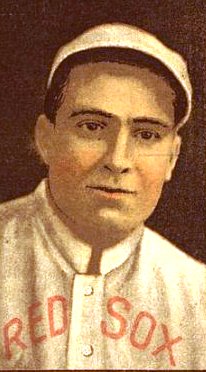
When he signed 18-year-old Jacinto “Jack” Calvo Gonzalez, Washington Senators manager/owner Clark Griffith was no stranger to Cuban players, having managed Armando Marsáns and Rafael Almeida with the Cincinnati Reds, but Calvo’s signing was the beginning of Griffith’s 40-plus year commitment to signing players from Cuba.  During his tenure the Senators signed more than half of the 63 Cuban players in the major leagues.

Calvo was “discovered” while playing with Almendares in the Cuban National League, where he hit .342 in 19 games.  He made even more of an impression during a series Almendares played against the New Orleans Pelicans of the Southern Association, Calvo hit .400 and his older brother Tomas hit .385.

???????????????????????????????

He also hit .400 during a six-game series with the Philadelphia Athletics, The Associated Press said he didn’t compile those numbers facing minor league pitchers picked up for the series, but “against (Eddie) Plank, (Jack) Coombs, and (Charles “Chief”) Bender.”

When rumors circulated that Washington might have signed Calvo, Bender said:

“I never saw a faster youngster in my life; he can hit too, and looks for the entire world like a class ball player…If Griffith has signed him he will never regret it, for there is no chance for him to be a failure.”

By December of 1912 Griffith had Calvo under contract.  The Pittsburgh Press said:

“The young Cuban sent a letter to Griff, written in Spanish.  ‘They did not teach Spanish where I went to school,’ said The Old Fox, ‘so I can’t translate the missive.  However, as he signed his contract I guess everything is alright.’”

The Boston Red Sox signed Tomas Calvo later in December.

While Tomas never made it in Boston, Jacinto made his debut with the Senators on May 9; he hit only .242, but everyone noticed his arm.  After a June game with the St. Louis Browns, The Associated Press said:

“The youngster astonished the bugs yesterday with his remarkable throwing arm.  At one time he heaved the ball from the right field fence directly to (Germany) Schaefer’s hands at second.”

On August 13 Calvo was sent to the Atlanta Crackers in the Southern Association and made his first appearance with the team the following day, batting seventh, going 1 for 4.  The Atlanta Constitution said “He’s fast, fields pretty well, throws like a shot and meets the ball squarely.”

Calvo only lasted 10 days in Atlanta.  He was hit on the right arm with a pitch thrown by Charles “Curly” Brown of the Montgomery Rebels.  He was returned to the Senators and did not appear in another game that season.  (Some sources show Calvo with the Long Branch Cubans in the New York New Jersey League—it was most likely his brother Tomas, an infielder, rather than career outfielder Jacinto, who played shortstop for the team in 94 games).

Calvo started the 1914 season with the Los Angeles Angels in the Pacific Coast League.  After only 11 games (he was 4-8 with one double, one triple and a stolen base) he was sent to the Victoria Bees in the Northwestern League.  Later in the season a story came out explaining his abrupt departure from Los Angeles.
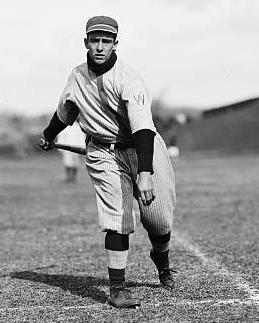
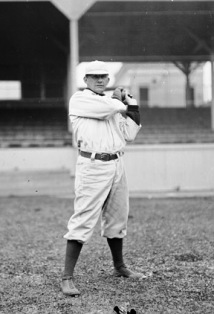
Calvo with the Washington Senators

Calvo with the Washington Senators

The Spokane Spokesman-Review said, “Calvo has been the victim of a cruel and merciless conspiracy,” despite the fact that “in the exhibition games last spring against the White Sox Calvo loomed up head and shoulders above the other Angel gardeners, out hitting them by a wide margin and displaying more speed on the bags than the whole Angel team combined.”

The paper claimed that a female reporter:

“(o)n one of the local papers…dragged out of him the fact that his father was a rich sugar planter in Havana, and that he played baseball for fun and not for money…That was the beginning of the end for little Calvo. “

The story said fans began harassing Calvo, and:

“Instead of coming to his rescue, the players on the Angel team ‘rode’ the boy unmercifully.  It was pathetic to see the friendless little Cuban trying to get into the good graces of his teammates.  One day, in the clubhouse the boy sat down on a bench and cried before them all.  His spirit was broken.”

Calvo hit .289 for Victoria in 1914, and spent the spring of 1915 with the Senators before being release before the beginning of the season.  After his release he played with his brother Tomas for the Long Branch Cubans, by then a member of the Independent Negro League; he also played for Havana in the Cuban-American Negro Clubs Series.

Calvo next played for the Vancouver Beavers in the Northwestern League and the San Francisco Seals in the Pacific Coast League, hitting .329 in 1916, and slipping to .263 in 1917. After the 1917 season, the outfielder returned, unsigned, the contract sent to him by Seals owner Charlie Graham.

Calvo had been very popular in San Francisco during his nearly two seasons with the Seals, but was criticised by fans and local press for his holdout, especially because he was holding out on the even more popular Graham.  The San Francisco Chronicle said:

“He sent his terms, and as they were exactly what he asked for before.  (Charlie) Graham is wondering why the Cuban went to the trouble to wire at all.”  The paper criticised Calvo for “asking for more money than he got last year,” while “better players than he have submitted to a salary slash on account of war conditions.”
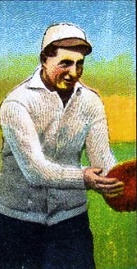
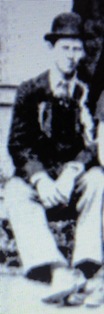
San Francisco Seals owner Charlie Graham

San Francisco Seals owner Charlie Graham

The Chronicle lamented the fact that Seals outfielder Biff Schaller would miss the entire season with an injury, otherwise “Calvo could have stayed in Havana for all that anyone here cares.”

As it turned out, Calvo did stay in Havana.  For all of 1918 and ’19, not returning to the states until 1920.  Tomorrow–Jacinto Calvo’s return.
“The Worst Bone Play Ever Made in Baseball”

16 May

The Pacific Coast League pioneer and all-star self-promoter Mique Fisher spent his later years as a near-constant source of material for west Coast sports writers.

In 1937 William Lair Hill Gregory, who wrote for The Portland Oregonian for nearly 60 years wrote about a play in 1904 that Fisher called “the worst bone play ever made in baseball;” it involved pitcher James Marcellin St. Vrain, and happened when Fisher was managing the Tacoma Tigers to a pennant; winning both halves of the 1904 Pacific Coast League season:

“On the Tigers was a southpaw pitcher named Jimmy St. Vrain.  In a close game one day, St. Vrain singled and with two outs was on second.  The batter lashed a line drive out of the shortstop’s reach, but right over St. Vrain’s head.

“’What did that left-hander do when he should have been scoring the winning run,’ complains Mique, ‘but reach up and catch the ball! Of course he was out…hit by a batted ball.’”

Jim St. Vrain

Jim St. Vrain

St. Vrain is also known for another boneheaded play alleged to have happened during his brief, 12-game career as a pitcher for the Chicago Orphans.  The story was first told The Detroit Free Press in 1906 by Tigers outfielder Davy Jones, who had been St. Vrain’s teammate in Chicago; Jones later told the same story to Lawrence Ritter in the great baseball book “The Glory of Their Times.”  The version in the book—aided by another 50-years of telling the story, and more colorful—is included below.

 “He was a left-handed pitcher and a right-handed batter. But an absolutely terrible hitter — never even got a loud foul off anybody.

“Well, one day we were playing the Pittsburgh Pirates and Jimmy was pitching for us. The first two times he went up to bat that day he looked simply awful. So when he came back after striking out the second time Frank Selee, our manager, said, “Jimmy, you’re a left-handed pitcher, why don’t you turn around and bat from the left side, too? Why not try it?”

“Actually, Frank was half-kidding, but Jimmy took him seriously. So the next time he went up he batted left-handed. Turned around and stood on the opposite side of the plate from where he was used to, you know.  And darned if he didn’t actually hit the ball. He tapped a slow roller down to Honus Wagner at shortstop and took off as fast as he could go … but instead of running to first base, he headed for third!

“Oh, my God! What bedlam!  Everybody yelling and screaming at poor Jimmy as he raced to third base, head down, spikes flying, determined to get there ahead of the throw. Later on, Honus told us that as a matter of fact, he almost did throw the ball to third.

“‘I’m standing there with the ball in my hand,” Honus said, looking at this guy running from home to third, and for an instant there I swear I didn’t know where to throw the damn ball. And when I finally did throw to first, I wasn’t at all sure it was the right thing to do!'”

Davy Jones

Davy Jones

“Mique” Fisher 2

7 May

On October 12, 1906, with the World Series between the Chicago White Sox and Chicago Cubs deadlocked at two games apiece, August “Garry” Herrmann, President of the National Commission, received a telegram from Fresno, California:

“Fresno will give $25,000 guarantee; guarantee 40,000 fans and sunshine for deciding game of World Series.

–Mike Fisher”

Fisher said the offer to bring the series and Fresno native Frank Chance to town was backed by “the businessmen here.”

It is doubtful Herrmann took the offer seriously, and it’s probably just as doubtful that Fisher took it seriously, but it was picked up by newspapers across the country, and Fisher enjoyed the publicity.

It was a last bit of publicity before his career in organized baseball ended.  Later in the month he was dismissed as manager of the Fresno Raisin Eaters, and the team was dropped from the Pacific Coast League (PCL) the following spring.

Within weeks Fisher had moved on to a new project; he announced that he was in the process of forming a team to travel to Hawaii.  The San Francisco Call said “It will be the first American ball team to make the trip across the Pacific in a little over nineteen years,” since Spalding’s world tour.

In conjunction with Jesse Woods, a Honolulu promoter, Fisher organized a tour of the Hawaiian Islands with a team of PCL stars.

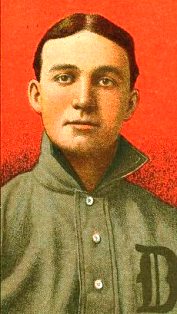
Mike Fisher

Mike Fisher

Upon his return, Fisher got more ink on the West Coast, when he headed to Nevada with Charlie Irwin of the San Francisco Seals; the two met with businessmen in the mining towns of Goldfield and Tonopah to discuss forming a professional league—Fisher told The San Jose Mercury News that he was now “against organized baseball,” and if he got involved in the league “it will be an outlaw organization.”

Fisher chose not to get involved in the new league, but immediately went to work on an even more ambitious tour than the 1907 Honolulu trip.

With the sponsorship of the Reach Sporting Goods Company, Fisher would accompany a group of stars to China, Japan and the Philippines.  Early publicity promised the travelers would include Ty Cobb, Hal Chase, and Frank Chance.

When the ship set sail in November of 1908 those three stars were not on board, but “several hundred fans and friends” were present when the steamer China left the port in San Francisco to see the group off.  The team was substantially the same as the one that toured Hawaii the previous year—an aggregation of PCL stars and a few National and American League players– and consisted of: Jim Delahanty, George Hildebrand, Bill Burns, Pat Flaherty, Jack Bliss, Babe Danzig, Harry McArdle, Nick Williams, Joe Curtis, Heine Heitmuller, Jack Graney and Bill “Brick” Devereaux.

Despite the failure to land Cobb, Chase or Chance for the tour, the West Coast press applauded Fisher for even attempting the trip, The Call said:

“The undertaking which he has fathered and which is so successfully underway at the present time is a big proposition.  With the single exception of the around-the-world trip of the A.G. Spaldings years ago, nothing on as big a scale as this has ever been attempted.  To take a team of American baseball players over a journey that will total 10,000 miles before they return, to play games in China, Japan, Manila and Honolulu is something that two or three years ago would have been laughed at as an impossibility.”

The tour lasted more than three months, with the team barnstorming through Japan, China, the Philippines and Hawaii, playing local and US Service member teams.  Though reports varied, the team played between twenty and thirty games, and lost no more than four.

While they drew large crowds throughout the trip, the newspapers back home reported that the tour was a financial disaster; when the players arrived back in San Francisco on February 15, 1909 aboard the Tenyo Maru, Fisher responded to the reports:

“I hear that it has been said that the trip was a financial frost.  Well, anybody who says that is a liar.  We broke even in Japan and made money in Manila and Honolulu.  I am satisfied with the trip.”

Fisher didn’t mention the financial results in China; likely because that leg of the tour was a disaster financially.  Years later he would tell a story about the team’s experience there, complete with his usual exaggerations:

“In one game we played in Canton we had 150,000 people inside, and as the gatemen had been instructed to accept Chinese money it required the combined efforts of the entire team to tote the money up to the hotel.  A special staff of accountants was busy all night totaling it up and in the morning we discovered we had $46.15.”

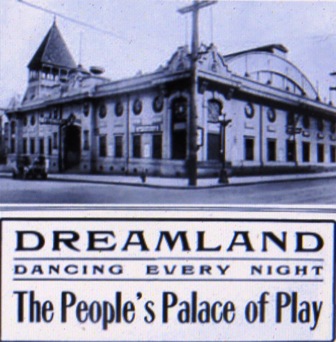
Fisher promised to take a team to Australia the following year.  The trip never took place; instead Fisher purchased a Seattle dance hall called the Dreamland, and quickly became the target of the pious women of the city.  Early in 1910 Fisher was indicted by “The King County grand jury, as a direct result of the activity of the Women’s Clubs,” for violating liquor laws, allowing “unescorted women” into his dance hall, and other assorted charges.  A special prosecutor, Justice William Henry White, one of the most respected jurists in Washington State, was appointed to prosecute Fisher and other club owners targeted by the women.

Ever the promoter, Fisher used the indictment to promote his dance hall and rally public support.  After the indictment was handed down Fisher sponsored a “Sermon in the Dreamland rink.”  According to The Seattle Times, Fisher engaged Reverend Frank Herthum, who “has liberal ideas about amusements.”

Mike Fisher's Dreamland Dancehall, Seattle

Mike Fisher’s Dreamland Dance Hall, Seattle

Herthum preached, and Fisher presented a free vaudeville show.  The paper said Fisher had stirred up a “protest against the effort to close the dance hall without having provided a substitute where clerks, servant girls and employees in the shops may pass an evening to their liking.”  At the same time The Times noted that the prosecutor was becoming impatient with the women who brought the charges because they continually promised to provide evidence that “has not yet come to light.”  The charges were quietly dismissed within weeks.

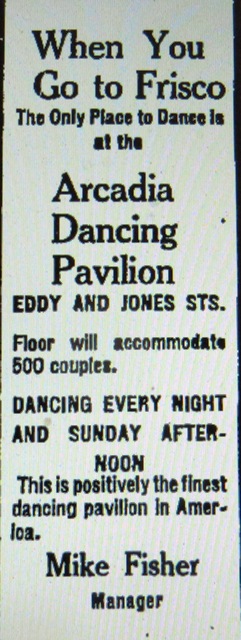
Fisher left Seattle sometime in 1911 and began operating the Arcadia Dance Hall in San Francisco.

Advertisement for Fisher's Arcadia Dancing Pavilion.

Advertisement for Fisher’s Arcadia Dancing Pavilion.

In January of 1917 Fisher made headlines in California when he announced that he was directing an effort to restart the California State League, which had folded after the 1915 season.  He said he would have clubs in Sacramento, Fresno, Stockton and San Jose.  Within two weeks Fisher abandoned the plan.  The San Jose Mercury News was not surprised:

“Mr. Fisher, the wonderful getter of publicity, has his publicity and is through.  Probably he has done wonders for his dance emporium or whatever it is he runs.”

The following year the San Francisco Seals of the Pacific Coast League came on the market; the first name reported as a potential buyer was Mike Fisher.  Fisher again got his headlines, but it was his old friend Charlie Graham who got the team.  Graham, and a group of investors purchased the Seals and the former catcher was installed as manager.

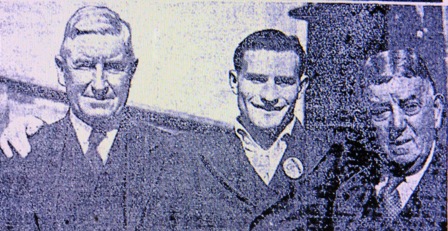
Charlie Graham, left, Mique Fisher, right, with World Middleweight Champion and actor Freddie Steele.

Charlie Graham, left, Mique Fisher, right, with World Middleweight Champion and actor Freddie Steele.

With his friend in charge The Mercury News said Fisher became a fixture “around the San Francisco ballpark ever since Graham bought in on the Seals in 1918,” he would remain a fixture at Recreation Park, and later at Seals Stadium for more than 20 years , and continued to provide copy for West Coast s sports writer

As a result of his friendship with Graham, who recommended he get the honor, 77-year-old Fisher was selected to travel to Cooperstown to represent the PCL at baseball’s centennial celebration in 1939.  The man who so loved seeing his name in the paper  received headlines one more time, when he died in San Francisco on June 6, 1943.

“Mique” Fisher and the PCL

6 May

Michael Angelo “Mique” Fisher is one of the forgotten pioneers of the Pacific Coast League (PCL).  Fisher had no given middle name, but adopted the name Angelo “after the famed painter he admired.”

Born in New York City in 1862, Fisher’s family relocated to Sacramento, California shortly after the end of the Civil War.  Fisher was a semi-pro outfielder with teams in San Francisco, Oakland and Sacramento, and in 1884-85 played for the San Francisco Haverlys in the California League.  Sometime later in the decade he joined the Sacramento police force.

Fisher’s only connection with baseball from 1885 until he was nearly 40-tears-old was as a fan and as a friend of a young catcher named Charlie Graham who had played at Santa Clara University and in the California League.

In 1902 Detective Captain Fisher made a career change.

The Sacramento Gilt Edges in the California League were owned by a local businessman named Arthur Beebe.  Beebe, according to The Sporting Life “incurred the displeasure of his associates in the league owing to his continual kicking against the umpires appointed by President (James T.) Moran.”

At a league meeting in February the franchise was taken away from Beebe and awarded to Fisher.  The San Francisco Call said Beebe blamed the move on San Francisco owner Henry Harris, who he said “is backing Mike Fisher.”

Michael Angelo “Mique” Fisher, circa 1905

Michael Angelo “Mique” Fisher, circa 1905

There’s no contemporary reference to why Harris preferred Fisher to Beebe, but within a year Harris would spearhead the effort to expand the California League to the Pacific Northwest—forming the PCL, and might simply have wished to pack the league with allies for the planned expansion.

The new Sacramento owner’s first move was to sign Charlie Graham, who played for Harris in San Francisco in 1901; Graham was named captain.  The Gilt Edges got off to a horrible start, but according to The Sporting Life “managed to replace the weak ones with men that worried other clubs at all stages, and finally crawled up into the .400 class.”

In December of 1902 The Seattle Times reported that Harris’ scheme was official:

“The California League will be known next year as the Pacific Coast League.  It will expand and take in Seattle and Portland.”

The Los Angeles Angels won the first PCL championship, but it was another Los Angeles team that caused the most excitement for Fisher and Sacramento in 1903.

In March three of Fisher’s players, Win Cutter, Charles Doyle and George Hildebrand jumped to the Los Angeles team, in the newly formed Pacific National League—they were said to have been recruited by former teammate Elmer Stricklett.  Hildebrand agreed to return, but Fisher took action as the other two prepared to board a train for L.A.  The San Francisco Call said:

“There was a sensational scene at the railway depot this afternoon, when Michael Fisher, manager of the Sacramento baseball nine, appeared with a police officer armed with warrants and caused Cutter and Doyle, two of the start players, to be placed under arrest on charges of obtaining money under false pretenses.”

The players were held in jail until they agreed to return to Fisher’s club, and the charges were dropped.

After the 1903 season Fisher relocated the franchise to Tacoma, Washington; the move brought better geographical balance to the league, and gave the PCL a foothold in a city that had just been vacated by the rival Pacific National League.

Charlie Graham remained team captain and the pitching staff was improved with the addition of Jim St. Vrain and Orval Overall.  Fisher’s Tacoma Tigers took the pennant, winning both halves of the split season schedule.

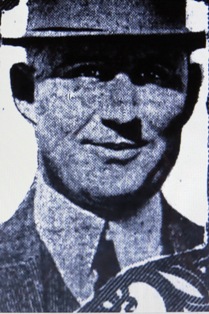
Charlie Graham

Charlie Graham

it was Graham, not Fisher, who was generally given credit for the success of the team.  As The Portland Oregonian later said:

“Mique Fisher in the strict sense of the term never was a great manager.  In a general way he knew baseball, but as a master of the fine points of the game as it should be played he was not up to the big thing…It was Graham who taught the players how to play the game.”

The paper did concede that Fisher was a good players’ manager:

“His players liked him and worked hard for him and that always helped a whole lot.”

Other tended to dismiss Fisher, The Spokane Daily Chronicle called him:

“The man who has acted as the original blast furnace for the hot air factory.”

Fisher not only had his baseball acumen questioned, but the move to Tacoma turned out to be disastrous from a business standpoint. The Oregonian said the Tigers won in 1904 despite “little enthusiasm,” from the city of Tacoma.  Fisher also began to run afoul of his investors, according to The Daily Chronicle:

“It is no secret  the stockholders have been losing money and blame for that is laid on the manager.”

The 1905 Tigers started strong, winning the first half—again playing to small, indifferent crowds, then fell apart in the second half, finishing last.  The Tigers were badly beaten five games to one in a postseason series by the Los Angeles Angels.

In September of 1905, Fisher announced that a six-game series with the Oakland Oaks would be played in Spokane, Washington, giving rise to rumors that the team would relocate there the following season.  The rumor also stirred up a conflict with the Northwestern League, who laid claim to Spokane and took their case to the National Commission.

Fisher initially denied that the team had designs on Spokane, but in October he this telegram to The Spokane Chronicle:

“To Sporting Editor…Spokane has been awarded to the Coast League by the National Commission.”

The San Francisco Bulletin said the league needed to abandon Tacoma and:

“It certainly seems that the admission of Spokane is the only logical course for the league to pursue.”

Logic did not win out.  By November Fisher had negotiated a deal to move the team to Fresno, California, a town with roughly one-third the population of Spokane—the PCL made it official in January of 1906 that the Tacoma Tigers would become the Fresno Raisin Eaters.

Fisher had owned a half interest in the team in Tacoma, he gave up his ownership stake in Fresno and signed a three-year contract with the club.

It turned out to be another bad decision.

Fisher, for the first time, managed a team without Charlie Graham by his side.  The catcher started the season with the Boston Americans (his only big league season), but left the team in May to return to San Francisco a month after the 1906 earthquake—various sources attributed his departure to being homesick, wanting to be near family, or to attend to his wife who was ill; in any case he never returned east and signed with the Sacramento Cordovas in the California League in August.

Fresno was a last place team from wire-to-wire, finishing with a winning percentage well below .400.

The new ownership fired Fisher, who eventually sued the team to recover $500 he said he was promised if terminated before his three-year contract expired.  He never collected the $500 and told reporters:

I was gypped out of the franchise.”

Wallace “Happy Hogan” Bray was named to succeed Fisher as manager, but Fresno was dropped from the PCL after the Seattle Siwashes withdrew from the league, in order to maintain an even number of teams.

Fisher’s managerial career was over, but his baseball career was not; more on that tomorrow.

Things I Learned on the Way to Looking Up Other Things #1

7 Mar

There are many interesting, odd, great stories I stumble across when researching that are too short for a full post.

Sydney J. Harris, the late Chicago Daily News and Sun-Times Columnist had a regular feature by the same title as this post.  It seemed an appropriate name for this feature—so with a hat tip to Mr. Harris:

Arrested for Refusing to Fight Forest Fire

In December of 1911, Boston Red Sox pitcher Charley Hall and Pacific Coast League outfielder Harry Price were teammates on a winter league baseball team in Ventura, California, when a forest fire broke out in the area.  According to The Associated Press:

“When the fire was at its height Hall and Price…were sitting on the veranda of a hotel,  a deputy fire warden ordered them to fight the fire but they refused.”

Charley Hall, arrested for refusing to fight fire

Charley Hall, arrested for refusing to fight fire

Fire Warden John Kuhlman placed both players under arrest.  There is no record if they were ever convicted.

Baseball 1860

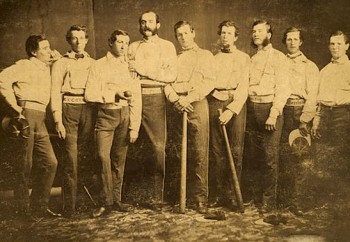
The New York Herald report on a July 5, 1860 game:

“The friendly game of ball between the Excelsior Club of Brooklyn and the Niagara Club of Buffalo resulted in an easy victory for the Excelsiors.

“The score was, Excelsior 50, Niagara 19.  In the fifth inning the Excelsiors made twenty-four runs.”

The Excelsiors, 1860

The Excelsiors, 1860

Carrier Pigeons

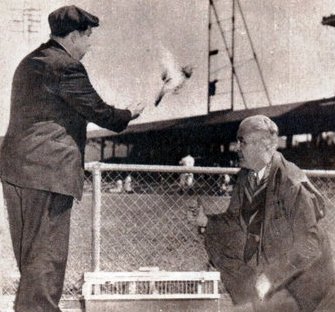
According to The Philadelphia Record in 1883 a zookeeper in Philadelphia used carrier pigeons dispatched between the zoo and Jefferson Street Grounds to provide updates on Athletic games.

Pigeons were also used by news organizations for the next several decades.  In 1900 The Milwaukee Journal bragged of their “carrier pigeon news service” which delivered updates from Milwaukee Park to the newspaper offices.  According to The Journal, sometimes the pigeons were more interesting to Brewers fans than the games.

The Journal’s carrier pigeon service attracted much attention on the field, and as each bird was released from the grand stand, the spectators of the game invariably lost interest for a moment in the diamond as they watched the bird dart upward and shape its course toward the city.

“Even the members of the contesting teams allowed their attention to be distracted at times by the unusual spectacle, and once, at the beginning of the sixth inning, when one of the liberated birds swooped down past big Perry Werden (Minneapolis Millers first baseman) as he stood guard over the initial bag…(Werden) raised an imaginary gun as though to take a shot at the pigeon, and of course the bleachers laughed.

“That The Journal’s service by means of the birds in not unknown to Milwaukeeans was well illustrated by the conversation of people seated around the spot from which the birds were set free.  They discussed the enterprise and those who did not understand the plan were quickly enlightened by the others, who knew all about how fast the birds flew, how they were kept and how they carried the news.”

The practice was continued at The Journal over the next decade.

Cincinnati radio station WLW revived the practice for at least one game in 1939, when the station used pigeons to deliver information from a Reds game against the Pittsburgh Pirates to the studio.

Carrier Pigeons being released at Crosley Field,  Cincinnati, 1939

Carrier Pigeon being released at Crosley Field, Cincinnati, 1939

“Bill Abstein Denies he is a Bonehead”

20 Feb

Pittsburgh Pirate owner Barney Dreyfuss and manager Fred Clarke felt all they needed to win a World Series was a first baseman.  Since winning the National League Pennant with Kitty Bransfield in 1903, only one Pirate first baseman hit better than .260 (Del Howard .292 in 1905).

In 1908 the Pirates finished second with four different first basemen, Harry Swacina, Alan Storke, Jim Kane and Warren Gill; none played more than 50 games, none hit better than .258 and they combined for 29 errors.

The man who took over in 1909, and was with the Pirates for their World Series victory, might have preferred to have never been given the job.

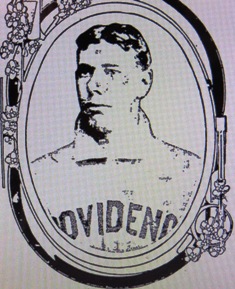
Bill Abstein had played eight games at second base and in the outfield for the Pirates in 1906, before returning to minors.

-Abstein had put up respectable, but by no means spectacular, numbers with the Shreveport Pirates in the Southern Association and Providence Grays in the Eastern League from 1906 to 1908—but as early as August of 1908 The Pittsburgh Press said he was the answer to the Pirates problem at first base:

“Fred Clarke is very eager to secure Bill Abstein from Providence.  Bill is rated the best first baseman in the Eastern League, and he would no doubt strengthen the Pirates where they are weak.”

When Abstein joined the Pirates before the 1909 season The Press said:

“The acquisition of bill Abstein has rounded our infield nicely.  He’s the best first baseman we have had in years and he certainly fits in nicely.”

???????????????????????????????

Abstein, Providence 1908

In a letter sent to Dreyfuss with his contract, Abstein told the Pirate owner:

“Fred Clarke will not have to worry about a first baseman after he sees this big German hustling around the bag.”

In keeping with his career performance, Abstein had a respectable season for the pirates.  He hit .260 and drove in 70 runs.  His 27 errors were only a slight improvement over 1908’s first baseman by committee.

The Pirates won 110 games and won the National League Pennant by six and half games over the Chicago Cubs and met the Detroit Tigers in the World Series.  The series would be the beginning of the end of Abstein’s Major League career.

09pirates

1909 World Champion Pittsburgh Pirates, Abstein 11th from left.

Abstein struggled at the plate (6 for 29 with nine strikeouts) and in the field (5 errors total, 2 each in games 3 and 4).  The Pirates won the series in seven games, but despite the victory, Abstein quickly became the subject of ridicule in Pittsburgh.

An Associated Press article after the series said:

“During the games with Detroit Abstein appeared to forget all that he knew about base ball.  He ran the bases foolishly, made a number of costly errors, failed to hit and disobeyed orders.  In fact, his playing was worse than that of any other man on either team.  The other Pirates, seeing that Abstein was the ‘goat’ for the combination, kept up the cry against him…Before the series was ended many of the Pirates shunned Abstein and it was reported he would be traded.”

The Pittsburgh Press was less generous:

“Bill Abstein denies he is a bonehead and says baseball is largely a case of ‘if-you-can-get-away-with-it,’ well it’s a cinch that Bill couldn’t in the National League.”

The Pirates were unable to trade Abstein and finally put him on waivers.  He was claimed by his hometown St. Louis Browns.

Even though the Pirates had actually won the Worlds Series and even though Abstein was gone, that didn’t mean the Pirates, and The Pittsburgh Press, wouldn’t continue to pile on.

Barney Dreyfuss told The Associated Press shortly after Abstein was claimed by St. Louis:

“We have discarded the weakest offensive player we had—Abstein—and hope to improve the team by doing so.”

Dreyfuss also claimed:

“Fred (Clarke) told me as early as last June that we should get someone else for Abstein’s place in 1910, as Bill mixed up the team’s plays too frequently.”

The Pittsburgh Leader said:

“(Abstein) had deplorable batting weaknesses which the opposing pitchers were certain to fathom in time.”

The Pittsburgh Press was even less generous:

“Bill Abstein is reported to be making a hit with the Browns by his work in the spring practice.  Just wait about three months friends, before declaring Bonehead Bill a wonder.”

When the Pirates sold pitcher Vic Willis the St. Louis Cardinals in February of 1910, newspapers reported that Willis and Abstein had “engaged in a bitter fight,” during the series.

Abstein quickly wore out his welcome in his own hometown of St. Louis.  Abstein made 11 errors in 23 games at first base and hit .149; he was released on June 2, 1910.  It appears Abstein was no more popular with Browns Manager Jack O’Connor than he was in Pittsburgh.  O’Connor was quoted in The St. Louis Times in May:

“How did Abstein get away with it last year?  How could he make plays like he has been making for me and get away with it all year for Pittsburgh?  I never dreamed that some of the plays made by him were even possible.”

His Major League career over, Abstein returned to the minor leagues for seven seasons.  He had one above average year with the Los Angeles Angels in the Pacific Coast League in 1914; in 202 games he hit .308, with 234 hits and 40 doubles.

Abstein moved on, Pittsburgh apparently did not.  For years, Pittsburgh newspapers took every opportunity to take a shot at the first baseman.  In 1915 The Pittsburgh Press, in an article about the revolving door the Pirates still had at first base–in the five post-Abstein seasons, the Pirates had four different starting first baseman–(emphasis theirs):

“No one will ever forget the way Bill did NOT play the bag in the Worlds Series.  In fact, Bill did NOT play the bag all the time he was stationed there.”

Pittsburgh finally seemed to move on by the time they won their next world Championship in 1925.  Abstein died in St. Louis in 1940.

Fielder Jones and the Chehalis Gophers

11 Feb

Most biographies of Fielder Jones—player-manager of the 1906 World Champion Chicago White Sox, the Hitless Wonders—mention that he managed the Chehalis Gophers, a team in the Washington State League, in 1910;  they never mention that he ended up there because of a near-fatal assault before he arrived.

The 36-year-old Jones left the White Sox after the 1908 season to settle in the Portland, Oregon and tend to his many business holdings in the area.  In 1909, he was named president of the Northwestern League, and served for one season.  According to West Coast newspaper reports, Jones was in the running to named president of the Pacific Coast League in 1910, before Thomas Graham was elected as a compromise candidate.

In the spring of 1910, Jones coached the Oregon Agricultural College (now Oregon State) baseball team to the school’s first conference championship.

At the same time, Jones was coaching at OAC, the Washington State League was getting underway—the league had been operating for at least three seasons, but 1910 was the first year it was recognized under baseball’s national agreement as an “official” minor league.

The Chehalis Gophers were led by 27-year-old Fred Nehring; he had previously played on the Pacific Coast, Northwestern and Connecticut State Leagues.  Nehring, who was born in Pueblo, Colorado in 1883, but grew up in Chehalis, had been playing on and off with the local team since leaving the Tacoma Tigers in 1908

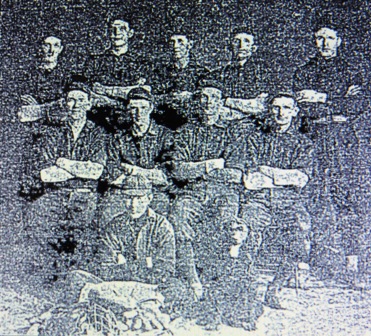
1908 Chehalis team. Fred Nehring standing 2nd from left, Tamp Osburn, standing 4th from left.

1908 Chehalis team. Fred Nehring standing 2nd from left, Tamp Osburn, standing 4th from left.

Another player who had spent time with Chehalis since 1908 was a pitcher known variously as “Tamp” Osburn, Osborn or Osborne (for the purpose of this story we’ll call him Osburn—most common usage by contemporaneous sources).  Tamp Osburn has, at least, two separate, partial listings on Baseball Reference.

Osburn was considered a talented pitcher, but an erratic character.  While pitching for the Spokane Indians in Northwestern League in 1907, he quit the team in June.  According to The Spokane Daily Chronicle:

“The whole trouble yesterday started when a couple of misplays in the eighth inning put a losing aspect on the game…Tamp blames the whole trouble on (William ‘Terry’) McKune, who he says ‘threw’ the game on him.”

Osburn had additional problems with teammates and developed a reputation as an eccentric, and like all eccentric pitchers of the era there was one he was often compared; The Daily Chronicle called him “The Rube Waddell of the Northwestern League.”

After playing together for Chehalis in 1908, both Nehring and Osburn played in the short-lived Inter-Mountain League in 1909; both returned to Chehalis after that league folded in July.

???????????????????????????????

“Tamp” Osburn, 1908 with Spokane Indians

On May 20, just after the 1910 season opened, the Chehalis team boarded a train.  According to The Chehalis Bee-Nugget:

“(Osburn) who had been drinking before the train left Chehalis became so unruly on the train that the train crew called on Fred Nehring, captain of the Chehalis team to quiet him.  Tamp resented Nehring’s efforts to keep him from cursing in the presence of ladies, and pulled a knife and began to slash Nehring…Two severe cuts…in the left arm, and the other was in the breast.  If the latter had been an inch farther over, it would have penetrated the lungs.”

Nehring had the wounds dressed, left the hospital against doctor’s advice and managed the Chehalis team “from the bench.”  Despite the seemingly quick recovery, Nehring only appeared in a few games the rest of the season.  Osburn was arrested.

The Chehalis team floundered for the next several weeks.  In late June, it was announced that Fielder Jones would join the team as manager and centerfielder.

Under Jones, who was still property of the White Sox and needed Charles Comiskey’s approval to play, Chehalis easily won the league championship; Jones hit .358 in 37 games.

Jones had agreed to play for the team for no salary and was only reimbursed for his expenses.  This arrangement nearly cost Chehalis the league championship.  According to The (Portland) Oregonian, the second place Raymond Cougars protested to the league and the National Commission that all wins under Jones should be forfeited because Jones “was not under contract.”  The protest was denied and Chehalis was declared league champion.

Osburn was sent to the Lewis County Jail while awaiting trial, and according to The Oregonian was involved in an attempted escape along with other prisoners who occupied the jail’s first floor, a week after his arrest.  The paper said of Osburn “the baseball player, and one other man were taken to the cells on the second floor and locked up securely.”

There is no record of whether Osburn was convicted; in any case, he was free by July of 1911 and was pitching for the Missoula, Montana franchise in the Union Association when The Helena Daily Independent reported that Osburn:

“The Missoula pitcher, who started a rough house in a Missoula cafe and pulled a knife on a stranger, drew a severe panning from the judge, who, after fining him $25, -said: ‘There are some good men on your team, who behave themselves, but there is a lot of you whose conduct is a disgrace to the city and the national game. We don’t want that kind of men in Missoula uniforms, and you fellows have got to stop such actions.”

Contemporaneous newspaper accounts say he was a native of Utah, but given the inconsistent spelling of his last name, and a full first name never being listed, the trail for Osburn ends after this 1911 incident.

Nehring remained in Chehalis where he died on February 19, 1936.

Jones returned briefly to baseball in 1914 and 1915 as manager of the Saint Louis Terriers in the Federal League.  He died in Portland in 1934.

Fielder Jones, 1914

Fielder Jones, 1914

A Thousand Words–Satchel Paige, Chicago White Sox

6 Feb

???????????????????????????????

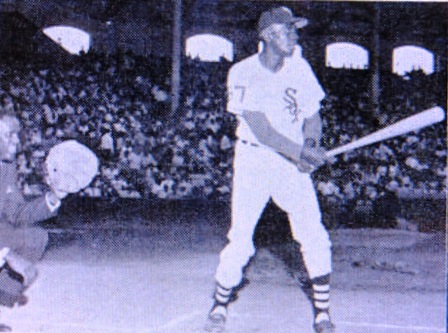
What if?  Satchel Paige in a White Sox uniform.  From 1938-1947 the Sox never finished better than 3rd, add Satchel Paige to those teams, which already had some good pitching including Ted Lyons, Eddie LopatThornton Lee, Monty Stratton and Orval Grove, and Sox fans might have had something to cheer about.  But of course, by the time Paige had a chance to play in the Major Leagues he was at least 42-years-old.  Paige would have helped at the box office as well.  For example, on July 18, 1942 the Sox drew slightly better than 24,000 for a doubleheader with the Detroit Tigers, across town at Wrigley Field a nearly identical amount came out to watch Paige pitch the first five innings for the Memphis Red Sox against the New York Cuban Stars.

Instead, all White Sox fans have is this rare photo taken in 1965 when Paige appeared with the Indianapolis Clowns at Comiskey Park (Chicago Cubs outfielder George Altman is the catcher in the picture).

——-

in 1935, Gene Coughlin, a sports writer for The Los Angeles Evening Post-Record wrote a column that went largely ignored, calling on organized baseball to break the color barrier which “not only makes (baseball) look ridiculous but is at the same time passing up increased business.”  Coughlin predicted that if a Pacific Coast League team were to sign Paige, it “would be good for an extra 10.000 in attendance every time he goes to the mound.  And he became good despite the inane prejudice that drives the colored baseball player to the sandlots and keeps him there.”

Coughlin’s column concluded:

“When you come right down to it, that baseball doesn’t give a darn whether it is pitched or caught by a white hand or a black one.  It is a symbol of game, a sport, and not a symbol of class distinction or color.”

Twelve years later organized baseball finally agreed.

Assumed Names–Happy Hogan

11 Jan
Wallace Bray 1890s

Wallace Bray 1890s

Some players became so closely associated with the name they adopted that their real name takes a century to catch up.  Wallace Louis Bray came from a prominent family in Santa Clara, California, and like many players at the turn of the 20th Century chose to play under an assumed name to spare the family the shame of having produced a professional ballplayer.  Baseball Reference and other sources still list him by his assumed name.

Bray went by the name Wallace Bray while playing baseball at Santa Clara University (other contemporary sources said he also attended the University of the Pacific)—one of his coaches was Major League pitcher Joe Corbett.  (There is some confusion because there is another player with the surname Hogan, Major Leaguer Willie Hogan attended Santa Clara seven years after Bray and also played in the Pacific Coast League at the same time and he was also sometimes called “Happy,” but Hogan was his given name).

Bray became Wallace Hogan when he signed his first professional contract with the Sacramento Senators in the California League in 1900, and picked up the nickname “Happy.”.

The Berkeley Daily Gazette said:

“He was dubbed “Happy” by the writers because of his sunny disposition.”

He become an extremely popular West Coast baseball figure and in 1903 he was still with Sacramento when they joined the Pacific Coast League, the league in which he played and managed for the next 12 seasons

While never a great player, he was considered a good catcher and infielder but he was a career .186 hitter; The San Francisco Chronicle called him “The most popular figure,” in the Pacific Coast League.

After playing for the Tacoma Tigers, Fresno Raisin Eaters and Los Angeles Angels, Bray was named manager of the new PCL franchise, the Vernon Tigers in 1909; Vernon finished last, but Hogan’s team, which moved to nearby Venice, improved each of the next 5 years and finished in 2nd place twice.

The Chronicle said:

“Taking a new club in a league of the highest minor classification…is quite a job.  Hogan made good with a bang, or his club has always been in the running and in addition it has always been a big attraction.”

The Associated Press said:

“(Hogan) is a human dynamo when on the baseball field.  The present position of the Vernon club in the pennant race is due mainly to his dynamic personality…Baseball players say Hap is the fairest manager in the league and that he treats his men better than any other coast league impresario.”

The Tigers got off to a great start in 1915 and were in first place on May 9, an off day, when Bray went swimming at Venice beach and “He contracted a severe cold and pneumonia set in.”  He missed several games, but “While it was reported several times that Hogan was in serious condition, it was confidently expected that he would pull through it all right.”

He did not pull through and died on May 17 at 37-years-old.

The Associated Press said of his funeral:

Roy Hitt, Doc White, Walter Carlisle, Dick Bayless, Frank Decanniere and Johnny Kane are the players who acted as pallbearers.  The other members of the club and prominent men in baseball acted as honorary pallbearers.  While the throng at the funeral viewed for the last time the face from which even death could not efface the famous smile, every baseball game played in the Coast League halted for five minutes, the stars of the diamond in many cities on the Coast stood with bared heads in silent prayer for the dead star. In accordance with Hogan’s wishes, the body was cremated.”

Wallace Louis "Happy Hogan" Bray 1912

Wallace Louis “Happy Hogan” Bray 1912

The Tigers went into a tailspin under new manager Dick Bayless, while they recovered in the second half the team finished 4th.

A benefit game was played to raise money for Bray’s widow on June 25 at Washington Park in Los Angeles.  The Sporting Life said:

“In the most remarkable tribute ever paid to the memory of any man in Los Angeles, 10,000 persons choked the stands.”

Larry McLean

8 Jan

At 6’ 5” John Bannerman “Larry” McLean is still the tallest catcher to have played in the Major Leagues nearly a century after his final game.  Born in New Brunswick, Canada, McLean’s ability was mostly overshadowed by his frequent off-field troubles during his career.

McLean bounced between the minor leagues, semi-pro teams, and trials with the Boston Americans, Chicago Cubs and Saint Louis Cardinals from 1901-1904.  McLean joined the Portland Beavers in the Pacific Coast League in 1905 and it was here that he developed into a good ballplayer and a first-rate baseball character.

Larry McLean

Larry McLean

McLean hit .285 in 182 games with Portland in 1905, but also started to show signs of the troubles that would plague him for the remainder of his career; Portland added a “temperance clause” to his contract and McLean, who had originally planned on a boxing career, loved to fight.

In 1906, while hitting .355 for Portland, and catching the eye of the Cincinnati Reds who would purchase his contract in August; McLean announced that he was going to become a professional fighter.

The wire report which ran in The Bakersfield Daily Californian said:

“McLean the giant catcher of the Portland team…He is so big that umpires walk out behind the pitcher so they judge balls and strikes…announces that he will fight any man in the world, Big Jeff (Jim Jeffries) not barred.”

The story said McLean was training with Tom Corbett (older brother of “Gentleman Jim” Corbett) and Corbett said he “has a ‘sure ‘nuff’ champion in the big catcher.”

Talk of a ring career temporarily ended when McLean joined the Reds, but McLean’s legend grew.  In November of 1906, he caught a murderer while in a subway station with his wife.  The Boston Post said the suspect:

“Was seen to pull a gun and pump five bullets (into the victim)…Larry started after him and collard him just outside the entrance.  (McLean had the suspect) pinioned so he could not move.  The police soon arrived and took charge of McLean’s prisoner.”

McLean was a huge hit with Havana fans the following winter when the Reds touring Cuba; The Sporting Life said:

“Larry McLean was the favorite and every time he caught a ball the crowd applauded. McLean has been dubbed by the baseball fans ‘Chiquito.’”

McLean and Chicago White Sox pitcher Frank Smith were mentioned at various times as possible opponents for heavyweight champion Jack Johnson; boxing writer Tommy Clark said in 1910 that McLean “Thinks he has a good chance of lowering Johnson’s colors.”

But while McLean was a fan favorite he regularly ran afoul of Cincinnati management and none of the managers he played for was able to keep him out of trouble.

While with the Reds McLean was arrested at least four times–for disorderly conduct, passing a bad check and two assaults.  In one case, at the Savoy Hotel in Cincinnati, McLean knocked a newspaper man from Toledo unconscious after the man “Reproved McLean for using a vile name.”

While serving a suspension for breaking team rules in 1910 McLean Said:

“When I get back to Cincinnati there will be 25,000 fans at the depot waiting to shake hands with me.”

Frank Bancroft, Reds secretary and former manager said in response:

“Twenty-five thousand, why, they’ve not that many barkeepers in Cincinnati”

McLean had worn out his welcome by 1910, but Cincinnati was not able to find any takers for the catcher.  Pittsburgh Pirates owner Barney Dreyfuss said, “I wouldn’t give 30 cents for Larry McLean.”

McLean stayed with the Reds for two more seasons, but when Joe Tinker took over the team one of his first moves was to sell McLean to the Saint Louis Cardinals in January of 1913.  McLean said he had finally learned his lesson and promised to behave with the Cardinals:

“They didn’t want me around because they said I was a bum. Now I’m going to fool Tinker.”

McLean did behave himself in Saint Louis and seemed to appreciate the opportunity he was given by his former Reds teammate, manager Miller Huggins, even earning a “good behavior” incentive in his contract, and was hitting .270 for the Cardinals, but the cash-strapped team went with the younger, cheaper Ivey Wingo behind the plate and traded McLean to the New York Giants for Pitcher Doc Crandall.

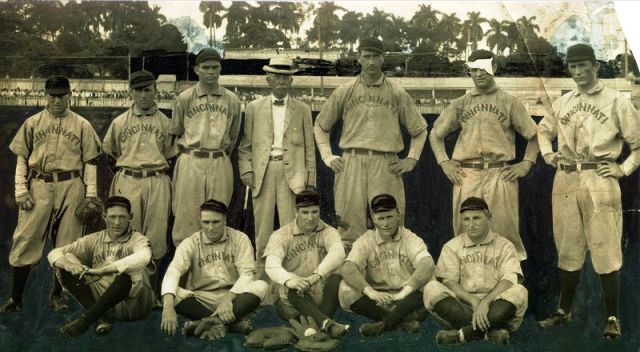
Larry McLean, standing end right, Miller Huggins, standing end left, and Frank Bancroft, standing middle (in suit) on the 1908 Cuban tour.

Larry McLean, standing 5th from left, Miller Huggins, standing end left, and Frank Bancroft, standing middle (in suit) on the 1908 Cuban tour.

The rest of the McLean story tomorrow.