Tag Archives: Pacific Coast League

Blame it on the Uniform

3 Jan

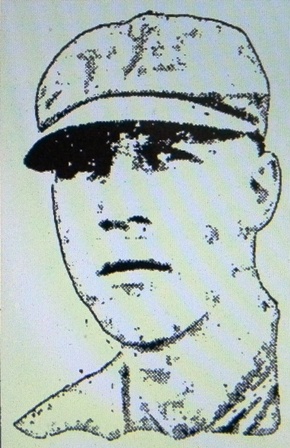
Justin Titus “Pug” Bennett could hit.  After playing baseball at tiny Blackburn College in Carlinville, Illinois, in 1895 and ’96, there’s no record of him again until 1899 when, at 25-years-old, he played with the Indiana-Illinois League franchise that began the season in Kokomo, Indiana and finished in Mattoon, Illinois.

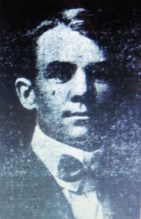
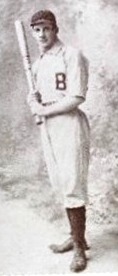
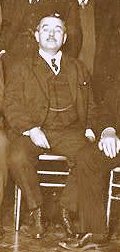
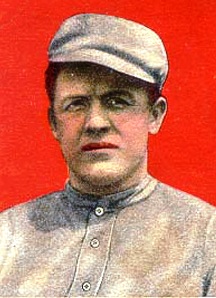
Pug Bennett circa 1904

Pug Bennett circa 1904

Back-to-back .300 seasons with the Nashville Volunteers in the Southern Association and the Seattle Siwashes in the Pacific Coast League earned the 32-year-old his first shot in the Major leagues.  The Bennett hit .248 for two seasons with the Saint Louis Cardinals and returned to the minor leagues with Seattle, now in the Northwestern League.

Bennett returned to his old ways for two seasons, hitting .305 and a league leading .314 in 1908 and 1909.

1910 was not going well for Bennett, the perennial .300 hitter was hovering around .240 all season.

The Spokane-Spokesman Review provided an explanation late in the season:

“(Bennett) claims the white uniform worn by the umpires is the principal stumbling block in the way of batting averages this year.  Bennett says the light suits shade the white ball and make any pitcher with a crossfire or a sharp break much more effective.”

Bennett might have had a point.  There was not a single hitter in the Northwestern League with more than 50 at bats who hit .300;  Lou Nordyke led the league with a .290 average.

The following year the umpires’ uniforms were changed.  Ten players hit over .300 and Art Bues led the league with a .352 average.  The 37-year-old Bennett, with the Vancouver Beavers, rebounded with a .300 season.

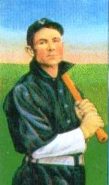
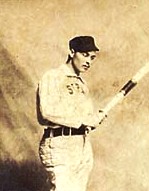
Pug Bennet, t-206 card with Vancouver

Pug Bennet, t-206 card with Vancouver

Bennett continued playing in the Northwestern League until 1917.  He lived in Washington until his death in 1935.

Anger Management

27 Dec

Thomas Timothy “Tim” Flood just couldn’t control himself.

Flood was a solid infielder and somewhat erratic hitter.  As a 17-year-old he hit .364 with the New Orleans Pelicans in the Southern Association in 1894 but hit .266 in his minor league career and .233 as a Major Leaguer.

He had a late season 10-game trial with his hometown St. Louis Perfectos in the National League in 1899.  He was given his next shot in the National league in 1902 when he was signed by Ned Hanlon’s Brooklyn Superbas to fill the void left at second when veteran Tom Daly jumped his contract to join the Chicago White Sox.

Flood was an upgrade in the field, and while a weaker hitter than Daly, he quickly became a favorite of Hanlon who named him Brooklyn’s captain for the 1903 season.
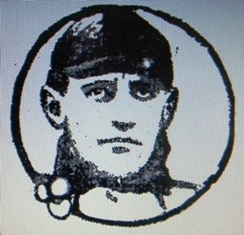
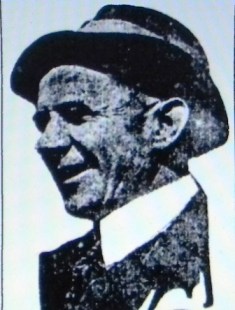
Tim Flood

Tim Flood

1903 was not a good season for the new captain; he continued to struggle at the plate and dealt with a knee injury that limited him to 84 games.  He was also suspended for two games in July for a physical altercation in Cincinnati with umpire James “Bug” Holiday.  Holiday, a former Major Leaguer had a stormy half season as a National league umpire and resigned several days after tangling with Flood.

Flood was released by Brooklyn in March of 1904 and joined the Los Angeles Angels in the Pacific Coast League.

He was a very popular player in Los Angeles and captained the Angeles in 1904 and part of 1905 until he assaulted Ira “Slats” Davis, another former Major Leaguer turned umpire during a game in June of 1905. Eugene Bart, president of the league suspended flood indefinitely.

Newspapers reported that Flood said he would “never fight another arbitrator whether he is in the right or wrong.”

In 1906, he signed with the Altoona Mountaineers in the “outlaw” Tri-State League, where he appears to have kept his pledge and had an incident-free season.

In 1907, he joined  the Toronto Maple Leafs in the Eastern League and managed to play 29 games before he was in trouble again.  Flood assaulted an umpire named John Conway during a game in Toronto; the attack included a kick to the umpire’s chest.

Flood was arrested.

He was charged with assault and ordered to appear in front of a magistrate. Friends told Flood the hearing would be a formality and that he should plead guilty and receive a small fine.

No one told Magistrate George Taylor Denison who said, “This sort of thing must be discouraged,” and sentenced Flood to “Fifteen days in jail with hard labor.” At the same time Patrick Powers, president of the Eastern League, banished Flood from the league.

Toronto fans were outraged and immediately began circulating petitions which “included the names of several clergymen” and were presented by team officials to Minister of Justice Allen Bristol Aylesworth in hopes of getting Flood pardoned.

Opinions of the punishment varied.  Several newspapers carried the following poem which lamented Flood’s fate for “Sassing” an umpire:

“’Holy Moses!’  In Toronto

There is news to make you pale

Sass the umpire if you want to—

That is, want to go to jail!

There is woe among the batters,

As around the field they scud;

And their pride is torn to tatters

By the fate of poor Tim Flood

Fifteen days in jail for Timmy

Soon the parks will close so tight

That you couldn’t with a jimmy

Let in one small streak of light.”

Others, including two former players, said Flood got what he deserved and implied that his behavior was not limited to the three well-publicized incidents.

Charles “Count” Campau, a former Major Leaguer and umpire, who had been a teammate of Flood’s in New Orleans said:

“I am sorry to see anyone go to jail, but, for the good of baseball. I am glad to see Tim Flood out of it for good. Rowdies of the Flood type are a disgrace to any sport or business, and especially baseball. He was always mixed up in just this way and was chased out of California, where b« was playing, for the same kind of tricks. Umpire baiting was always his long suit, and, from what I can understand, his attack on Umpire Owens [sic] was a most cowardly one: Flood is a good ballplayer, but his hasty temper, his meanness has put him out of the game forever, and incidentally Into Jail.”
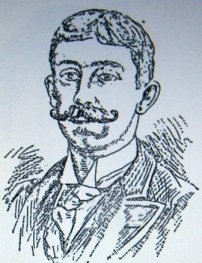
Charles "Count" Campau

Charles “Count” Campau

Tim Murnane, Major Leaguer turned baseball writer said:

“Tim Flood has a new record, and will now be in a position to go back to his trade and give up the game he was unfitted for.  The courts all over the country should follow the example of the Canadian judge, who sent a ballplayer to lock-up for assaulting an umpire.  It wouldn’t take many decisions of this kind to drive the bad men out of the sport.  Imagine a player taking a running jump at a man and hitting him in the breast with his spiked shoes!”
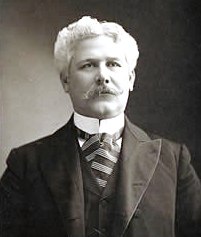
Tim Murnane

Tim Murnane

After serving 10 days, Minister of Justice Aylesworth ordered Flood released.  The player, in various reports, claimed he lost between 10 and 16 pounds during his incarceration, citing the poor quality of the food.

President Powers rejected pleas from the Toronto management to reinstate Flood and permanently banned him from the Eastern League; however, contrary to Campau’s and Murnane’s wishes, Flood was out of baseball for less than a month.

Flood was signed before the end of July by the Saint Paul Saints in the American Association and vowed, as he had before, that he was a changed man.

It appears 10 days in jail might have made a difference.  Flood was named manager of the Saints in 1908 and continued to play and manage in the minor leagues for five more seasons, apparently without incident.

In 1914, The Sporting Life reported, with no irony, that Flood was hired as an umpire in the Northern League.

Flood died in St’ Louis in 1929.

Brother Joe Goes Home

3 Dec

After the Saint Louis Cardinals released Joe Corbett in August of 1904, he returned to San Francisco and signed with the Seals of the Pacific Coast League.

There would be one more skirmish between Hanlon and Corbett.

Hanlon filed a grievance with the National Commission claiming that Corbett’s release did not make him a free agent, but instead released his rights back to Brooklyn.  Hanlon seemed to have a solid case.  Ed Grillo, former and future sports writer and then President of the American Association said:

“(Brooklyn) has a prima facie title to Corbett…The National League acquired complete control of Corbett’s services when he signed a St. Louis contract for 1904, and his release to Brooklyn is in conformity with the national agreement.  The law of the game is clearly with the Brooklyn club.”

San Francisco, with the support of the entire Pacific Coast League, ignored the complaint and put Corbett in the Seals’ lineup.  Hanlon ultimately backed down and Corbett was released to San Francisco.

Corbett appeared in 33 games for the Seals in 1904 and 05, posting a 17-13 record.  In September of 1905 he threatened to bring law suits against Hanlon, The Brooklyn club, and the National Commission:

“(O)n the ground that he has suffered in reputation by combined actions of baseball magnates (and) has been deprived from earning thousands of dollars, rightfully his, because of his pitching ability; and that he has been humiliated and disgraced in many ways.”

The threatened legal action made headlines, but doesn’t appear to have gone further.

Corbett also retired, again, that September.  Reporters, skeptical about this retirement (and given brother Jim’s multiple “retirements” from the ring) pressed Joe on the issue.  In reply he “Promised faithfully to never reappear.”

He kept his promise.  For a few months.

In 1906 he played for the Stockton Millers and San Jose Prune Pickers in the California League, and appeared in two games in the outfield for the Seals.

Corbett came back and retired twice more.  In 1909 he pitched 12 games for the Seals.  In 1916 he tried again; the Seals released him in May after four games.

Joe Corbett, 1916

Corbett and his wife had seven children, and when he wasn’t pitching he amassed quite a resume.  In addition to the various family businesses and newspaper work mentioned, Corbett worked at various times as baseball coach at Santa Clara College (1898-99, 1902-03), in the San Francisco Assessor’s office, clerk’s office, for an oil company, and the San Francisco branch of the Bank of Italy.

A few years before his death in 1945, Corbett was asked by The Associated Press if he had any advice for players who were considering defying the reserve clause and holding out. Joe said:

“If you think you’re right, stick to it.  But don’t forget, it’s pretty hard to beat those hours.”

And finally…Corbett was said to have worshiped “Gentleman Jim,” but was also known to sometimes tire of hearing what a great fighter his brother was.  Over time he developed a standard reply:

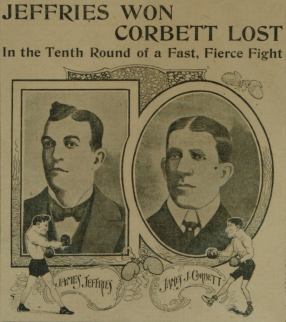
“I only saw him in the ring twice… (Bob) Fitzsimmons won the first time and Jeff (Jim Jeffries) knocked him out the second time.  But they tell me he was some fighter.”

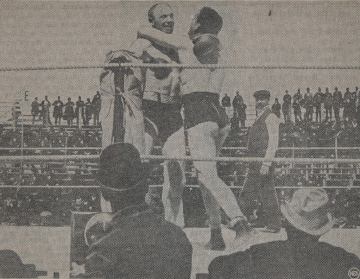
Corbett/Fitzsimmons

Corbett/Jeffries

Brother Joe Comes Back

30 Nov

Twenty-three-year-old Joe Corbett, brother of heavyweight champ “Gentleman Jim” Corbett announced his retirement before the 1899 season.  Corbett had written a column for The San Francisco Call during his 1898 hold out, and announced he was quitting that job too:

“I have (also) quit writing baseball news now, and take little or no interest in the game. I wouldn’t cross the street to see one.”

Corbett ran the livery stable his father had started in San Francisco, helped operate the family bar on Ellis Street, and within weeks had apparently regained his interest in the game and was back writing for The Call.  His responsibilities in the family businesses increased after his parent’s deaths in August of 1898 (Patrick Corbett shot and killed his wife then committed suicide).

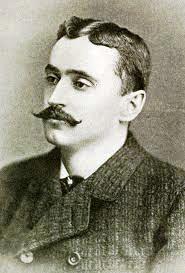
Joe Corbett

There remained significant interest in Corbett’s services; unfortunately for Joe he remained under the control of Ned Hanlon.  Hanlon had moved to the Brooklyn Superbas in 1899 as part of a stock swap between the Brooklyn and Baltimore franchises—he took several players with him, including “Wee Willie” Keeler, Hughie Jennings and Joe Kelley—he also kept Corbett’s rights.

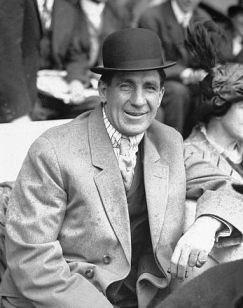
Ned Hanlon

Hanlon offered Corbett $2400 to play for Brooklyn and turned down offers to trade his rights.

According to California newspapers Corbett occasionally pitched in semi-pro games in 1899, but in 1900 The Sporting Life reported that Corbett was “dangerously ill,” and would probably never pitch again as a result of sciatic rheumatism.

Less than a year later The Sporting Life said Corbett was pitching for a team in Oakland, and the next year he appeared in five games for the Minneapolis Millers in the American Association—the retirement appeared to be over.

A successful January 1903 appearance on the mound in an exhibition game featuring barnstorming Major Leaguers renewed interest in Corbett again.  The Los Angeles Angels of The Pacific Coast League offered Joe a contract he couldn’t refuse, one that allowed him to tend to the family business interests in San Francisco during the season.

Newspaper reports said Corbett earned $5000 for the 1903 season, Angels manager Jim Morley said he wouldn’t say how much Joe earned but said that he had:

“Figured it out that Corbett will get 4.99 a curve.”

After going 23-16 for the Angels, the Major leagues again came calling.   Early reports had Corbett signing with the Pittsburgh Pirates, who offered $5000, but Joe eventually signed with the Saint Louis Cardinals.  While the Cardinals assured Joe that Ned Hanlon had relinquished Brooklyn’s claim, the Corbett family was not ready to end the feud with Hanlon.

Gentleman Jim, when asked if Joe would ever consider playing for his former manager again, told reporters:

“Hanlon couldn’t get Joe to twirl for him if he offers him a million dollars a year.”

Things didn’t go well in Saint Louis.  Joe Corbett was 5-8 when the Cardinals released him August 1.

Jim was, as always, Joe’s biggest defender:

“My brother Joe was getting $7000 for the season from the St. Louis club, but his heart was not in his work, simply because he was separated from his wife and little ones who were out in California.  Thinking of his family all the time impaired his effectiveness as a pitcher.”

Gentleman Jim

Joe returned to San Francisco where he added a hat store to growing stable of businesses; his rights returned to Hanlon and Brooklyn.

The final chapter of the Corbett story on Monday.

Three Balls in Play

28 Nov

Bill Speas played 22 seasons in the minor leagues.  At the height of his career he was numbered among the best fielders in the Pacific Coast League, and The Los Angeles Times said he had the best arm in the league.

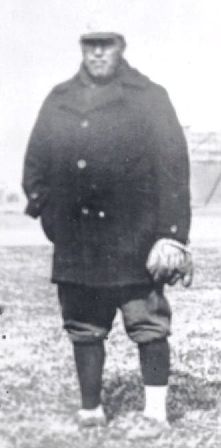
Bill Speas

Born in Ohio, Speas began his career with Mansfield Giants in the Ohio-Pennsylvania League in 1906; there he was involved in one of the most unusual plays ever in a game against the Youngstown Ohio Works.

Speas, the Giants left fielder, told the story several times over the years.  Harvey Bailey was pitching for Mansfield; Youngstown had runners on first and second:

“The batter hit a long foul to right field, which the right fielder went after, unobserved by the umpire who was behind the pitcher.  He immediately threw another ball to the catcher which bounded over his head…the umps tossed out another ball to Bailey who made a quick heave to the batter, not noticing that his catcher was not in position.”

The batter singled to left field, where Speas picks up the story:

“I got it and threw it into the plate; only it hit the grandstand instead.  In the meantime the fielder had recovered the foul ball (and the catcher had retrieved the other ball) and the shortstop had one, running a man down between second and third, and the second baseman had the other trying to catch a man between first and second…everybody was running around I was almost sick from laughing out there in left field“

The umpire, who caused most of the confusion, and whose name is lost to history, eventually ruled the foul ball and the ball he threw over the catcher’s head out of play.  Youngstown went on to win the game.

Lost Team Photos

19 Nov

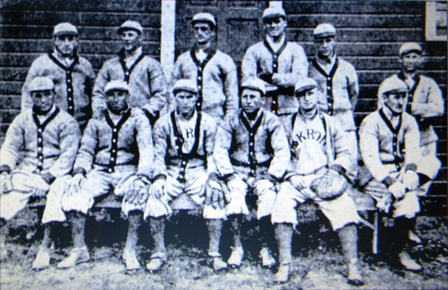
Another photo I’ve never seen published before, the 1908 Akron Champs, Ohio-Pennsylvania League Pennant Winners.

Top left to right:

Dick Breen—a minor leaguer for 12 seasons, his career overlapped with another career minor leaguer named Dick Breen—this Breen’s career came to an end in 1917, when while playing for the Reading Pretzels in the New York State League he got in a fight with Wilkes-Barre Barons  manager Jack “Red” Calhoun.  Both men were suspended indefinitely; Breen was released several days later, neither ever appeared in organized ball after that season.

Bill Speas—longtime minor league player and manager, Speas hit.284 in 22 seasons and won three Mississippi Valley League pennants as a player/manager with the Cedar Rapids Bunnies and Dubuque Dubs.

John Brackenridge—appeared in seven games for the Philadelphia Phillies in 1904, Brackenridge pitched in the Pacific Coast League from 1909-1913.

Fred “Buff” Ehman—a 6’ 4” (some sources list him an inch shorter) right-handed pitcher, the enigmatic Ehman was 81-36 for Akron from 1906-08, but according to The Akron Beacon Journal, was known for disappearing for days at a time and “sulking.” He had multiple trials with Major League clubs; according The Mansfield (OH) Daily Shield he never stuck with a team because of “his refusal to exert himself.”  Through 11 minor league seasons he won 214 games.

Wilbur Good—spent parts of 11 seasons in the Major Leagues: Joe Tinker said of him, “He is one of the fastest runners in the National League and still one of the poorest base runners.”

Edward Murphy—a light hitting catcher, Murphy played five seasons in the Ohio-Pennsylvania League.

Bottom left to right:

Bill Kommer—there is no listing for Kommer on any minor league data base.  He was left-handed pitcher who played for many amateur and semi-pro teams in Ohio during the first decade of the 20th Century;  he was released by Akron in July, there is no record of his statistics for the ’08 season.

William Hille—“Silent Bill” was a shortstop who played until 1917 primarily in the Texas and South Atlantic League.

Jim Callahan—his Major League career consisted of one game with the 1902 New York Giants; played three seasons for Akron (1906-08), was reported to have played in the Western League in 1909, but no records exist.

Matt BroderickThe Reading Eagle called him “one of the best shortstops who ever played on a minor league field,” Broderick played two games in the Major Leagues with Brooklyn in 1903—played minor league and amateur baseball for the remainder of the decade while working for Carpenter Steel Works in Reading, PA.

George Texter—one of the first players to sign with the Federal League in 1913, Texter played for the Indianapolis Hoosiers/New Jersey Pepper during the Fed’s two seasons as a Major League (1913-14).  Managed teams throughout the 1920s in the Ohio-Pennsylvania League (no longer recognized by the National Association, the OPL was nonetheless a strong semi-pro/industrial league during that period).

Cecil Armstrong—a dominant right-handed pitcher, first with the Youngstown Ohio Works team in 1905 during his three seasons with Akron (64-33 from 1906-08), Armstrong spent 1909 and 1910 with New Bedford Whalers in the New England League. Armstrong retired to Akron after the 1910 season.

George Treadway

16 Oct

A small item in the Louisville Courier-Journal near the end of the 1893 season created a major stir.  And while the story was almost immediately shown to be untrue, several books and articles over the years have tried to imply that it’s still an open question.

The story about George Treadway was written by Courier-Journal Baseball Editor Sam McKee who was traveling with the Baltimore Orioles of the National League:

“There can be little doubt that Treadway, Baltimore’s right fielder is a Negro…all the players say he is.”

Treadway attributed the story to a former teammate he refused to name, and told The Baltimore News:

“The story is the result of a piece of spite work on the part of a former member of the Baltimore team, and knowing the man as I do, I am not surprised that such a thing could emanate from him.”

Treadway went on to say that he had information about the player which would “Kill him eternally, as far as the baseball profession is concerned, but I prefer not to act in that underhanded way.”

Treadway said the story about him came out of an incident when he was playing with Denver in the Western Association when an opposing player had directed a racist epitaph at Treadway.

George Treadway

Both The Baltimore Afro-American and baseball columnist O.P. Taylor reported that the story was investigated and was untrue.  At the same time it came to light that Baltimore owner Harry Vonderhorst and manager Ned Hanlon had heard similar rumors and conducted an investigation before signing Treadway, The Sporting Life said:

“Manager Hanlon felt satisfied the report was without truth and Treadway was made a member of the team.”

The story quickly went away, but in recent years has been revived, and mostly in the absence of the facts.  For example:

“. . . the writers . . . compared Joe (Jackson) to Treadway . . . but they did not mention that Treadway had been driven out of baseball by opposing players and fans who bombarded him with taunts and slurs about his alleged or real Negro blood.” – From Say It Ain’t So, Joe!: The True Story of Shoeless Joe Jackson

This reference to Treadway, like most, ignores critical facts.  The taunts and slurs must not have been very effective—Treadway remained in the Major Leagues for two full seasons, and part of a third after the story broke, and he was “driven out of baseball” a full 11 years later at the age of 37.

Had there been any evidence that Treadway was African-American his tenure in professional baseball would have been similar in length to that of William Clarence Matthews a decade later.

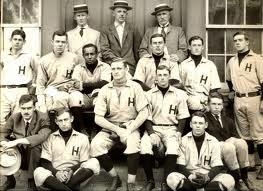
As the starting shortstop for Harvard University, Matthews faced four years of racial tension and boycotts—when the Crimson faced Georgetown in 1903 Georgetown’s manager,  and the team’s catcher, Samuel H. Apperious (Baseball Reference lists him as “William”) refused to participate in the game.

After graduating Matthews attempted to play professional baseball, signing with the Burlington team in the Vermont-based “outlaw” Northern League.  Upon arriving in Burlington Matthews was faced with another player boycott led by the same Sam Apperious, who was playing for the Montpelier-Barre team in the lead.  While there were rumors that Matthews might play Major League ball it never rose beyond speculation.

Matthews was, in effect,  “driven out of baseball.”

William Clarence Matthews with Harvard Baseball Team

George Treadway was in and out of professional baseball until 1904, but his absences were about the economics of early baseball and not questions about his race: from 1899-1901 Treadway played baseball for various teams in the Chicago area, including the White Rocks in the Chicago City League, while working for the Pullman Palace Car Company.

After leaving Chicago, Treadway played in the Pacific Northwest League and Pacific Coast League.  He stayed on the West Coast and settled in California until his death in 1928.

Matthews became an attorney, was actively involved in politics and served as legal counsel for Black Nationalist leader Marcus Garvey.  He also passed away in 1928.

Demon Rum–or Demon Rum as an Excuse to Replace a Popular Manager

8 Oct

The 2011 Boston Red Sox were only the latest in a long history of alcohol taking the blame for a team’s poor performance.

As the Chicago Cubs faded into third place during the waning days of the 1912 season, team president Charles Murphy issued an order for “total abstinence” and all players would have a temperance calls in future contracts.

The move was not unprecedented—since 1909 Barney Dreyfus of the Pittsburgh Pirates had required his players to sign a temperance pledge.  What made Murphy’s order so newsworthy was that over the course of several days he issued numerous, often contradictory, “clarifications” and because it quickly became apparent the move was a intended to wrest control of his ballclub from Manager Frank Chance.

Murphy’s original statement said that “loose living and training methods” led to the team’s poor finish. At the same time he provided cover for popular Cub outfielder Frank Schulte who had been suspended by Chance in September his nighttime activities during a crucial August road trip in Cincinnati.  The Cubs lost three of four games to the Reds and fell out of contention.    Murphy’s statement presented Schulte as a man incapable of any personal responsibility:

“I desire to say that in my judgment Schulte has been more sinned against than sinner…from what I could gather he was a victim of too many so-called friends…if we had a rule similar to that in vogue in Pittsburgh this player could not have been led into temptation.”

Chicago Cubs President Charles Murphy

The implication being that Chance had perhaps overreacted by suspending “the more sinned against” Schulte.  This statement was further complicated by Murphy’s several “clarifications,” some of which seemed to support Chance’s decision while some did not.

Chance quickly defended his players and his reaction to Murphy revealed just how bad the relationship was between the team president and his manager:

“Murphy only thinks of the team when it’s winning…his statement reflects upon me personally, and I have been in the business too long to allow Murphy or anyone else to insult me.”

Making matters worse, and calling Murphy’s motives into question was that Chance issued his response from a hospital bed in New York.  As a result of being hit in the head by numerous pitches throughout his career, Chance had developed a blood clot near his brain and had undergone surgery just a few days earlier.

Murphy didn’t hesitate to use Chance’s health issues against him.

A month earlier, plagued by doubts about his condition and suffering from severe headaches, Chance had suggested to Murphy that he might not be able to manage the Cubs in 1913.  At the time Murphy told his manager to wait until after the surgery to make a decision about his future.  Now he was using that conversation to assert that Chance had issued his resignation.

Once Murphy began claiming Chance had, in effect, quit in August the Chicago media which had almost universally supported the “abstinence pledge” called foul.  The Chicago Tribune and Chicago Examiner both said Murphy was using the conversation and the pledge as cover to run the legendary Chance—who led the Cubs to four pennants and two World Championships—out of town.

Chance went.  But he didn’t go quietly.

The manager had acquired 10 percent of the Cubs, shares Murphy had been trying to purchase for more than a year.  Chance sold the shares to Harry Ackerland a Pittsburgh investor who President Murphy did want owning part of his team.  Despite Murphy’s efforts to block the sale, it went through.

Chance was claimed on waivers by Cincinnati, but after the Reds acquired Joe Tinker from the Cubs and named him manager, Chance was waived to New York, where he became manager of the Yankees.

Chance led the Yankees for two losing seasons, managed the Los Angeles Angels in the Pacific Coast League in 1916 and ’17, and closed out his career with one dismal season in Boston; the Red Sox finished 61-91 under Chance.

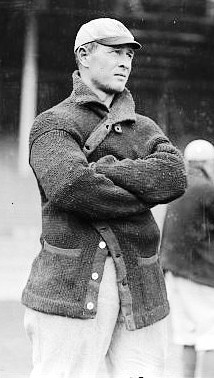
Frank Chance

Johnny Evers was named Cubs manager for the 1913 season—the Cubs again finished third.

From the day Murphy issued his initial statement until Chance died in 1924, “The Peerless Leader” never missed an opportunity to take a shot at Murphy.

When the Cubs were sold to Cincinnati publishing magnate Charles Phelps Taft (President William Howard Taft’s half-brother) before the 1914 season Murphy claimed that he had made more than a half million dollars on the deal.  Chance and former Cubs pitcher Mordecai Brown (who had his own feud who Murphy who released him after the 1912 season, allegedly without giving Brown money he was owed for playing in that year’s “City Series” with the Chicago White Sox) quickly responded.  Both players confirmed what had long been rumored—that Murphy had been bankrolled by Taft who retained a majority of the shares.   Murphy, said Chance, “Never owned more than fifteen or twenty percent of the club stock.”

Both players also charged that Murphy’s treatment of his players was a primary reason for the formation of the upstart Federal League—at best an oversimplification of the conditions which led to Major League Baseball’s last “third league.”

Another Charles Murphy feud later this week.

.

Ty Lober

27 Sep

Elmer “Ty” Lober was a long-time minor league player, manager in the Wisconsin State League, served in the Army in WWI and was a central figure in a scandal that briefly rocked the Pacific Coast League in 1914.

In September of 1914 police in Portland, Oregon announced the arrest of four men, and issued a warrant for a fifth.  The men were charged with “Wholesale traffic in school girls between the age of 14 and 16.”

Two of the men arrested were Portland outfielder Lober and third baseman Bobby Davis.  Also arrested were a local jeweler and an actor named Bert Roach (Roach would go on to appear in more than 300 films).  The warrant was issued for Mission Wolves and former Major League pitcher Frank Arellanes.

Early reports indicated that the players had confessed and that there would be several more arrests.  But the “open and shut case” described by West Coast newspapers seemed to quickly fall apart, and concerns about wide spread human trafficking among Pacific Coast League players quickly faded.

Just three weeks after the arrests the grand jury came back with indictments for only two of those arrested; Davis and Arellanes.  The cases against these two quickly fell apart also and all three players were in uniform at the beginning of 1915, Lober and Davis with Portland and Arellanes with Denver in the Western League.

Lober went on to play with Lincoln in the Western League before entering the service in 1918.  He spent 1920 with an independent team in Zanesville, Ohio and was signed to play with the Milwaukee Brewers in the American Association in 1921.  He finished his career with the Little Rock Travelers of the Southern Association in 1925 (he’s misidentified as “Lobar” on Baseball Reference).

Elmer “Ty” Lober

Lober managed and occasionally played for Two Rivers in the Wisconsin State League into the early 30s

He passed away on November 6, 1946 in Two Rivers.

More “Chief” Johnson

30 Aug

Last week I told you about George “Chief” Johnson’s release from the Chicago White Sox in the spring of 1913, allegedly because of his affiliation with the Winnebago (Ho-Chunk) Native-American Tribe.

Cincinnati Reds owner August Garry Herrmann and manager Joe Tinker were apparently more concerned with a good arm than the so-called “Winnebago ban,” and signed Johnson.

George “Chief” Johnson

Through the first month of the season, Johnson was the only effective Reds pitcher, winning three games (including two shutouts) for a team with a record of 5-16.

The New York Times took notice in an article, the racist tone of which was typical of the era:

“Big Chief Johnson of the Winnebagos [sic] is copper-colored and fat. At bat he displays as much activity as the wooden Redmen who hold forth at the doors of countless cigar stands. But on the mound this latest Indian to edge his way into the select circles of major leaguedom can deal out ciphers with as much success as the more illustrious Johnson of Washington.”

Johnson ended the season 14-16, with a 3.00 ERA for a team that finished 25 games under .500.

In 1914, the Federal League came calling.  Otto Knabe, Manager of the Baltimore Terrapins sent a telegram to Johnson asking for his terms.  According to Knabe, Johnson replied with a telegram sent collect saying “Will sign for $10,000 bonus and reasonable salary.” Knabe telegrammed Johnson collect “Asked for your terms, not Walter Johnson’s”

Otto Knabe

Johnson signed the following month with the Federal League Kansas City Packers for a more modest $3000 advance and $5000 salary; the only problem was that Johnson had already signed a contract with the Reds for 1914.

Johnson’s 1914 season was highlighted by a series of injunctions and court rulings that kept him sidelined for much of the season while organized baseball battled the upstart Federal League.  (The saga of the Federal League has been rehashed in numerous books and blogs, no need to reinvent the wheel here—I recommend this book)

Johnson played for Kansas City in 1914 and 1915 posting records of 9-10 and 17-17.  Throughout his tenure in Kansas City Johnson had numerous run-ins with the law over his drinking and was cited for desertion and non-support of his wife. Additionally, his weight ballooned to well over two hundred pounds.

Johnson’s major league career was over after 1915, but he pitched three more seasons in the Pacific Coast League.  Pitching for the Vernon Tigers near the end of the 1916 season Johnson was so out of shape that it was reported in the Los Angeles Times that the Portland Beavers chased him from a game in the third inning by having several hitters in a row lay down bunts that the overweight pitcher was unable to field.

Johnson reportedly returned in better shape in 1917 and was 25-23 pitching for Vernon and the San Francisco Seals.  Johnson returned  in 1918, posting a 2-6 record, and was joined in San Francisco for a short time by his brother John who appeared in one game for the Seals.

After his release by San Francisco Johnson barnstormed with a variety of teams throughout the Midwest and West and sold “snake-oil” in a traveling tent show.  On June 11, 1922, Johnson was in Des Moines, Iowa with his tent show when he was killed in a dispute over money during either a dice or poker game (news accounts varied).  Johnson’s killer, an African-American gambler named Ed Gillespie, was originally charged with first-degree murder, but the charges were reduced to manslaughter based on eye-witness accounts that claimed Johnson was “drunk and belligerent.”  He was buried at the Winnebago Cemetery in Winnebago, Nebraska.

A postscript.

A few days after Johnson’s death a small item appeared in Iowa newspapers; it was about a druggist in Des Moines who had agreed to put a display in his store window to promote Johnson’s tent show. The story said:

“Anyone anxious to own a nice horned rattlesnake may have one by taking the one left in his show window by the late Mr. Johnson.”