Tag Archives: Philadelphia Phillies

“The Story of the Story Fogel Wrote”

9 Jul

The day before Philadelphia Phillies president and owner Horace Fogel was banned from baseball by his fellow National League magnates, one of the witnesses in the case against him said Fogel was being “used” by the “instigator” of the story that appeared in The Chicago Evening Post, and contributed to the action taken by the National League.

The charge seemed to confirm a rumor that swirled around the Fogel case for months; that the Philadelphia Phillies owner was acting on behalf of Cubs owner Charles W. Murphy.

Under the headline, “The Story of the Story Fogel Wrote,” William S. Forman, sports editor of The Evening Post wrote:

“Charles W. Murphy authorized me to tell Fogel that Murphy had suggested writing the story.  On this representation Fogel wrote it and signed it.  He sent it to Murphy, who read it before I ever saw it.  It came to me from Murphy’s office; and if Murphy had not approved the story it never would have been published.  The man who is morally responsible for that article and the charges it contained is Murphy himself, and I have Fogel’s own word for it that he wrote it simply “to help Murphy fight his battles” with the National League.

“It is not the first time Murphy has made Fogel the goat.  Previously Murphy had sent me another article signed by Fogel and told me Fogel had writing it, and wanted it published…Months afterward I learned that Murphy himself had writing it and Fogel had merely signed it because he was requested to do so by the Cubs’ President.  It was a defense of Murphy who had been criticised…by a Chicago baseball writer.”

Charles Webb Murphy
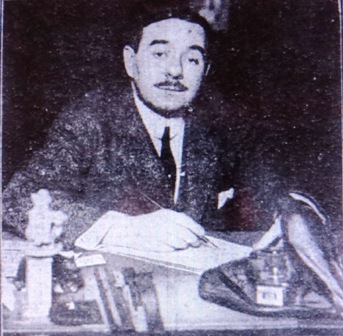
Charles Webb Murphy

Murphy, who spent his entire National League career engaged in countless feuds with fellow owners, players, managers, umpires and writers, denied the charge and said Forman was motivated to tell the story as a result of one of Murphy’s other feuds, telling reporters:

“This is a lot of rubbish; why I hardly know this man Forman, but I can guess readily that his paper is sore because we let Frank Chance go.  His paper thinks that by pounding me it will make a hit with Chicago fans, but it will find it is mistaken.“

The Associated Press said the other league owners were not buying Murphy’s explanation:

“(I)t is claimed that every magnate expects charges will be brought against (Murphy) by President (Thomas) Lynch and he may go the way of Fogel if the test votes to date are any criterion.”

Despite the rumors and the “test votes,” Murphy said “the suggestion that charges will be brought against me is all rubbish.”

Murphy was correct.  Despite the evidence, and despite his ongoing feuds with the league president and at least half of the National League magnates, charges were never brought by the league.

Murphy had another feud-filled, stormy year in Chicago in 1913.  After the season The Associated Press said:

“For the first time since the problem of pushing Charles W. Murphy out of the National League received serious consideration there is smooth working machinery ready to grip the club president and move him to a seat beside Horace Fogel. “

While a deal was being made to get Murphy out of the National League, Damon Runyon said:

“We grant you that Charles Webb Murphy should be thrown out of baseball, if only to quiet the beating pulse, and lave the fevered brow of Chicago, but we do not go to be o’ nights with a dull anger smoldering in our in’ards and we do not get up o’ mornings low in mind and spirits and feeling that out existence is is blackened and posterity besmirched because Charles Webb Murphy is still around.  We know that when they throw him out, as they doubtless will throw him out, there will be someone else ready to take his place as official Bugaboo, for there must be a Bugaboo in baseball, else we might have no baseball.”

Eventually it was agreed that Charles Phelps Taft would purchase Webb’s interest in the Cubs, and he resigned as team president in February of 1914; although it was unclear just how much the sale netted him.  Murphy said he owned 53 percent of the team’s stock and that the sale was for more than $500,000.  Frank Chance, Mordecai Brown, and others claimed Murphy “Never owned more than fifteen or twenty percent of the club stock.”

But the transaction with Taft would not be the end of Murphy.

Murphy was still owned part of the Cubs’ West Side Grounds and Philadelphia’s Baker Bowl, home of the Phillies.  In addition it was reported at the close of the 1914 season that Murphy held a mortgage on the Cubs stock, and claimed to own a controlling interest in the Philadelphia Phillies.

The Chicago Examiner said:

“Charles W. Murphy, who everybody supposes was ‘kicked out’ of baseball last spring, is not out at all, but very much in…He practically admits it himself when he does not deny controlling Cub stock , and asserts that he may take over the Philadelphia club before long… (National League President John Tener) declared some months ago that Murphy was out of the National League, now admits that Murphy may own some stock that he does not know about.

“Murphy says openly that he is Tener’s landlord, meaning that Tener is a stockholder in the Phillies and that the Phillies owe Murphy plenty of rent for their grounds.”

The Examiner said Murphy was interfering with the negotiations to sell the Cubs to Charles Weeghman, and at the same time was owed a lump sum payment of more than $100,000 by the other Phillies investors; if the payment was not received “at the stated time Murphy will foreclose and take possession of the Phillies.”

In The Philadelphia Inquirer, Phillies President William F. Baker quickly denied Murphy’s assertion that the former Cubs owner was in a position to take possession of his ballclub and that Tener ever owned stock in the team:

“It is true that Murphy and Mr. Taft own the Philadelphia ballpark, which the club has leased for a long time. But that does not alter the fact that Murphy is in no way interested in the club’s affairs…I intend to call the attention of the National League to this matter for the purpose of stopping Murphy for all time.”

William F. Baker
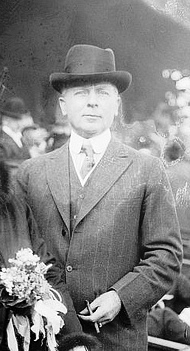
William F. Baker

By late December of 1914 Murphy was finally out of the National League for good.

As for whether Murphy was forced of baseball or left of his own accord, several recent sources point to a self-serving article Murphy wrote in “Baseball Magazine” in 1919 as evidence that he was not forced out.  Murphy, while acknowledging that Tener “was not ‘crazy’ about me,” Murphy said:

“No force was required. Despite that fact I read every once in a while that I was forced out of baseball–knocked down the back steps, as it were, and kicked into the yards behind… I sold out to Mr. Charles P. Taft and without force, but for what every other thing of value is obtained–a price. Imagine a man being forced to take $500,000 for a baseball franchise.”

Given that the $500,000 figure, while repeated credulously in countless books and articles in the last 100 years, has never been confirmed (it’s fairly certain that most of Murphy’s stake in the Cubs strictly on paper and was, in fact, Taft money, making Chance and Brown’s speculation on the value more realistic), and that Murphy conveniently left out his attempts to insert himself in the operations of two team the year after “no force was required” to remove him from the game, his protestations should be taken at face value.  Although he retained his interest in the Baker Bowl, he was never actively involved in the operations of a team again.

Murphy, who started his professional life as a sportswriter (for Taft’s Cincinnati Enquirer), managed to remain involved in baseball by writing articles about the game for “Baseball Magazine,” many, like the one quoted above, focused on restoring his reputation.

Murphy returned to Wilmington, Ohio where he financed the construction of the Murphy Theater, a landmark that still stands.  He eventually returned to Chicago where he died in 1931.  The Associated Press said he left “An estate estimated at nearly $3,000,000,” his stake in the Baker Bowl and the ownership of the theater being his largest assets.

Murphy made one last pitch to get back in the game–next week.
The National League versus Horace Fogel

8 Jul

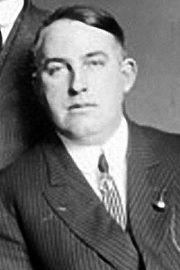
In 1912 Horace Fogel, president and owner of the Philadelphia Phillies and umpire William Thomas “Bill” Brennan were at the center of baseball’s biggest controversy: Fogel  accused Brennan and others with favoring the pennant winning New York Giants.

Fogel first suggested that St. Louis manager Roger Bresnahan was “pulling for” New York after the Giants won two of three games from the sixth place Cardinals in August.

Less than a month later Fogel would turn his attention to the umpires, and National League President Thomas Lynch.  Fogel was not a fan of the league president to begin with; the previous December The New York Times said that Fogel had been coerced by Cincinnati Reds owner August Herrmann into supporting Lynch’s reelection at the league meeting in New York:

“It was reported about the Waldorf yesterday that… (Chicago Cubs President Charles) Murphy and Fogel would not vote against Mr. Lynch because President Herrmann had in his possession a letter which was sent to him by mistake from Fogel, when it should have been sent to Murphy.  Mr. Fogel, it seems, put Mr. Murphy’s letter in the envelope addressed to Mr. Herrmann.  It is said to contain something important about the relations of the Philadelphia and Chicago clubs.”

Horace Fogel

Horace Fogel

On September 7 Fogel wrote a letter to Lynch attacking the league’s umpires in general and Brennan specifically, and  according to The Philadelphia Inquirer “hinting that Lynch had some influence in their poor officiating.”

A week later an article, said to be authored by Fogel, appeared in The Chicago Evening Post that repeated the charges made in the letter to Lynch.  Fogel also sent Herrmann a telegram telling the Reds owner he felt the National League pennant race was “crooked.”

Brennan was the first umpire to respond.  He sent a letter to the National Baseball Commission on September 30 demanding an apology from Fogel for impugning “the impartiality of National League umpires.”

Fogel repeated his accusations again in letters sent the following week to the seven other National League team presidents, and promised to “make startling disclosures.”

On October 17 The Associated Press said his counterparts voted to “formally draw up charges against President Fogel of the Philadelphia club for his remarks reflecting on the integrity of National League umpires.”

Brennan told reporters that he would be filing a libel suit against the Phillies owner.

William "Bill" Brennan

William “Bill” Brennan

A hearing was scheduled for November 26.  President Lynch said:

“If the charges can be proved, then the umpires in question should be blacklisted and the president of the league should step down in disgrace.  If the charges are not true, some step should be taken to see that this man no longer represents a club in the National League.”

Fogel responded:

“I probably will begin an action for criminal libel against (Lynch) at an early date.  I have retained Hughey Jennings (the Tiger manager was also an attorney in Scranton, PA) as one of my lawyers, and I intend to have several of the best men in Philadelphia.”

As the members of the National League executive committee gathered at New York’s Waldorf Astoria Hotel to determine whether he should be expelled from the league, the Philadelphia magnate attempted and end run; he announced that he had relinquished day-to-day operations of the team VP Albert D. Wiler.  By doing so Fogel’s attorney (Jennings did not represent him at the hearing) claimed the league “had no right to try Fogel, as he was no longer an officer of the National League.”

The proceedings went forward with Fogel facing seven specific charges:

  1.  The accusation against Bresnahan

  2. An allegation that he told reporters on September 5 that the pennant race was fixed.

  3. The letter to Lynch attacking the umpires and hinting that Lynch was influencing their decisions.

  4. The article in The Chicago Evening Post repeating the charges made in the letter to Lynch.

  5. The telegram to Herrmann.

  6. The letters to the other seven club presidents.

  7. The allegations Fogel made both publicly and privately, about Brennan.

The Philadelphia Inquirer said:

“Fogel denied charges one and two and maintains that charge three was a privileged letter and not for publication.  While he did not actually deny writing the article that appeared in The Chicago Evening Post, he declared that the statement was not authorized and said it must have been misinterpreted.  He said he simply wanted to see reforms made and was not attacking anybody or anything in connection with baseball.  He denied outright the charges that he had said anything derogatory to umpire Brennan and claims privilege of the letters and telegrams.”

Besides Fogel,  three New York reporters testified that Fogel made the statements attributed to him in the press, while “Fogel had a flock of Philadelphia scribes who politely but forcibly insisted the New York men were romancing.”

After a six-hour hearing over two days the committee unanimously found Fogel guilty of five of the charges (the letter to Lynch and telegram to Herrmann were deemed privileged and those counts were dismissed).  The League ruled that Fogel was “forever excluded from participation,” in the National League.

The Inquirer said:

“Mr. Fogel had no sooner read the decision than he countered it with a defiant statement.  Before the meetings began he had expected such a decision, he declared.  ‘The jury was packed against us, ‘he asserted, and he practically told the magnates who had expelled him from their councils that he would pay no attention to their findings.”

Fogel did have his defenders, author, and Heart Newspaper correspondent,  Damon Runyon said:

“As we understand the matter, Horace Fogel has been found guilty of  conversation in the first degree.”

Damon Runyon, supported Fogel

Damon Runyon, supported Fogel

Fogel’s defiance and threats against Lynch, the league, and the magnates who had ousted him.  The Chicago Evening Post reported in February of 1913 that Fogel “has accepted an offer of $10,000 to write a series of articles in which he will later attempt to prove that baseball is a crooked game.”

Instead he launched a magazine, rumored to be funded by Charles Phelps Taft, brother of the President, who had bankrolled Fogel’s initial purchase of the Phillies. “Baseball Weekly” began publication in  March, 1913, and over the course of the next several months set out to discredit the game, focusing on two points, which had been and would continue to be the major criticisms of organized baseball.

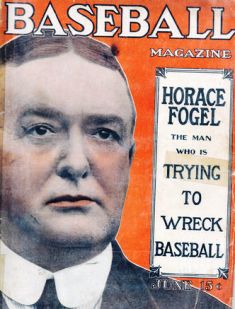
Fogel railed against the reserve clause, calling it “virtual baseball slavery,” and argued that organized baseball violated the Sherman Antitrust Act,  earning him the June 1913 cover of rival  “Baseball Magazine,” and the title, “The Man who is Trying to Wreck Baseball.”

Fogel would remain a baseball gadfly for the next decade.  Took ill in the early 20s and died in Philadelphia in 1928.

June 1913 edition of "Baseball Magazine"

June 1913 edition of “Baseball Magazine”

His interest in the team was purchased by a group led by William H. Locke, former secretary of the Pittsburgh Pirates.  When Locke died in October of 1913, his uncle, former New York Police Commissioner William Baker took control of the Phillies, leading the team until his death in 1930.

Brennan announced after Fogel was banned that he would drop his proposed $10,000 libel suit, telling The Associated Press:

“I am satisfied, I immediately demanded a hearing before the National League heads and Fogel’s trial was brought about as a result of my demands.”

Later this week; an allegation that Fogel was a patsy, and umpire Brennan’s other battle in the City of Brotherly Love.

“The Sudden Reappearance of ‘Silver’ King”

27 Jun

Oliver Perry “O.P.” Caylor wrote in June of 1896 in The New York Herald:

“One of the baseball surprises of the season is the apparently successful reappearance of ‘Silver’ King upon the National League diamond.  Without any warning the Washington club sent him in against the Pittsburgh team, and he not only won his game, but held the latter down to six hits, Of course all this caused a great deal of gossip wherever baseball is a subject of interest.”

When Charles Frederick “Silver” King (born Koenig), took the mound for the Washington Senators and beat the Pittsburgh Pirates 8 to 1 in the second game of a May 30 doubleheader, it was his first appearance in professional baseball in nearly three years.

King had been one of baseball’s best pitchers of the 1880s, with a 142-70 record from 1887-1890 while playing for Charlie Comiskey, first with the St. Louis Browns in the American Association and then following Comiskey to the  Chicago Pirates in the Players League.

Comiskey (8) and pitcher Silver King (14) with the 1888 St. Louis Browns, King would follow Comiskey to the Chicago Pirates in the Players League in 1890

Comiskey, seated center(8) and Silver King standing second from right (14) with the 1888 St. Louis Browns, King would follow Comiskey to the Chicago Pirates in the Players League in 1890

Caylor said that during Flint’s heyday:

“His most successful delivery was what is known as ‘the cross fire,’ first used effectively, I believe, by (Charles “Old Hoss”) Radbourne and at present the prominent stock in trade of (Wilfred “Kid”) Carsey of the Philadelphias (Phillies).  It consists of standing on the extreme end of the pitcher’s plate, stepping away still farther from the direct line towards the batsman and sending the ball across the home base at an angle, which, although small, is very bothersome to the man with the bat.”

Silver King

Silver King

Caylor said King was “put out of the business” in 1893 when “the pitcher’s box was set back five feet,” (to the current 60’ 6”).  While King’s record slipped during the last two seasons the distance was 55 feet to a combined 36-53 while pitching for the Pirates and New York Giants, he had respectable ERAs of 3.11 and 3.29.  After the rule change King went 8-10 with a 6.08 ERA pitching for the Giants and Comiskey’s Cincinnati Reds in 1893, and then disappeared.

Caylor thought there was “a great deal of significance to King’s return to the diamond,” and predicted a trend:

“It means managers, having exhausted the new crop and finding nothing before them worth a trial, are forced to look behind and try to rekindle some of the half burned out embers. Washington not only took up King, but they gave (Les) German a trial after the New York club let him go.  (Cap) Anson (Chicago Colts) went back to (Fred) Pfeffer after finding (Algernon “Algie”) McBride, (Josh) Reilly and (George) Flynn wanting and was even forced to put himself into his nine to fill out the weak spots.”

Caylor said it was “astonishing  to look over the list of new material which was brought into the National League last spring and notice how small a part of it has been able to keep ‘in the swim.’  Every day one hears that some younger player has been released or that another has been loaned or farmed to a minor league club.”

Caylor’s prediction of success for the “trend,” and the players named was a mixed bag.  Anson, who had never really gone away, hit .331 in 108 games, for the Colts, but Pfeffer hit just .244 in 94 games. German fared the worst, he was 2-20 in 1896 and 3-5 the following season before being released in August.

King managed to post a 16-16 record for the Senators in 1896 and ’97 but never found his early career form.  After the 1897 season, he returned to St. Louis where he died in 1938.

Caylor would become ill the following season, and died in October of 1897.

Browning and Delahanty

25 Jun

John Anthony “Honest Jack” Boyle played in the American Association, Players League and National League from 1886 to 1898.

Boyle’s career was on the decline by the end of the 1898 season (he had only appeared in six games with the Philadelphia Phillies that year), but was effectively ended in November when he was the victim of a mysterious knife attack in his hometown of Cincinnati.

The Cincinnati Commercial Tribune said Boyle was “attacked from behind by an unknown man, who, before the player could defend himself, plunged a knife into his shoulder.”

A piece of the knife broke off in Boyle’s shoulder and he didn’t play regularly again until 1905 when he appeared in 101 games for the Toledo Mud Hens in the American Association ; he was a player-manager for the Terre Haute Hottentots in the Central League the following season.

Jack Boyle

Jack Boyle

By 1910 Boyle, who was operating a saloon in Cincinnati, told William A. Phelon of The Chicago Tribune that the two best hitters he ever saw were Pete Browning and Ed Delahanty, and provided a window into the minds of two of the biggest stars of the 19th Century:

“(T)here never were two men more radically different in their ideas of and their opinions of the game than these two great sluggers.  They looked at the game from totally different angles, and they regarded their occupation with widely varying views.

“Pete Browning was an artist.  To him baseball was an art or a profession and batting an absorbing passion.

“Delahanty was a workman.  Baseball to him was labor or a trade, and batting simply part of the daily toil.

“When Browning left the field the game wasn’t over.  He continued to talk batting, theorize on batting, figure out new ideas on batting, and I think, dreamed of batting all night long.

Pete Browning

Pete Browning

“When Delahanty left the ballpark the game was all through for the day, exactly as if he was a laborer going home to supper.  He ceased to think baseball.

Ed Delahanty

Ed Delahanty

“If Browning failed to make a hit at the time of need, he would have tears in his eyes and would bitterly bewail his misfortune.  If Delahanty fell down in the pinch, he shrugged his shoulders, hoofed back to the bench and began to talk racing or the weather.

“When an outfielder galloped to the fence and pulled down one of Browning’s mighty drives, Pete would regard it as a personal insult, and glower at the outfielder like a baffled tiger.  When a fielder robbed Del of a home run, Ed would grunt ‘Good catch, boy, didn’t think you’d get it’ and forget it forever.

“If you had told Pete Browning that the business was losing money, and that you would have to cut his salary next season, he would have accepted the money rather than lose the chance to play the game.  If you handed that talk to Delahanty, he would have sneered scornfully and remarked that you’d have to come up with 500 more beans before he’d even look at a contract.

“Neither Pete nor Del cared much where their teams finished on the season.  Pete thought only of hits and the glory of making them.  Del thought of a comfortable winter life on the money he had made in the summertime.”

Boyle said the only thing the two really had in common was an inability to bunt:

“Del wouldn’t simply try.  Pete, with much groaning and protestation, would be coaxed to make the attempt, but his attempts were fizzles.”

Boyle, or Phelon, omitted the other thing the two had in common: serious drinking problems that hurt them on and off the field and contributed to their early deaths.

Boyle died in Cincinnati in 1913.

“The Deterioration in the Morale of the Players”

10 Jun

The Chicago Tribune had had enough:

“The deterioration in the morale of the players has been followed by deterioration in that of the spectators.  The latter relish the obscene profanity and the slugging exploits of the hulking brutes of the baseball field.”

The Tribune provided an “account of the more disgraceful of the many rows witnessed by spectators of baseball games,” during the just-ended 1899 season:

“May 2—Row at Pittsburgh—St. Louis game.  (Frank) Bowerman was put out of the game.  (Jack) O’Connor was taken off the field by the police, and the crowd chased umpires (Tom) Burns and (William) Smith.

May 19—Umpire Burns put (Giants’ William “Kid”) Gleason out of the game at St. Louis.  Gleason’s protest was so strong Burns forfeited the game to St. Louis.

June 1—Row on the grounds at Washington.

June 16—After a long wrangle and continued rowing on the field at New York.  Umpire Burns forfeited the game to Brooklyn.

June 16—(Fred) Clarke and (Clarence “Cupid”) Childs fight on the field in Louisville.

June 27—Rowdy action of players caused the crowd at the Pittsburgh game to mob umpire (James “Chippy”) McGarr.

July 18—(Tommy) Corcoran slugged (John) McGraw at Baltimore after being first attacked, and his action started a riot.

July 26—(Emerson “Pink”) Hawley, (Fred) Tenney, and (Hugh) Duffy engaged in a game of fisticuffs at Cincinnati.

Aug 16—(Oliver “Patsy”) Tebeau, McGraw and (George “Candy”) LaChance fought at Baltimore

Aug 18—Riot at Baltimore game started by (Tim) Donahue throwing a handful of dirt at (Steve) Brodie’s face.

Sept 1—Childs and Aleck Smith fight on the field in Louisville.

Sept 7—Riots at St. Louis and Brooklyn.

Sept 15—Clarke taken off Philadelphia grounds by police.

Sept 16—Chicago players jerked (Ed) Swartwood around the diamond because he called the game in the eighth inning on account of darkness.

Oct 9—(George “Win”) Mercer assaulted (Al) Mannassau at Washington.

Oct 14—(Jimmy) Scheckard assaulted umpire (John) Hunt, refused to retire, and Hunt forfeited the game to Brooklyn.”

Cupid Childs, repeat offender

Cupid Childs, repeat offender

Al Mannassau, assaulted by Win Mercer in Washington

Al Mannassau, assaulted by Win Mercer in Washington

In addition to the fans, The Tribune blamed team owners:

 “For the multifarious minor acts of blackguardism and rowdyism of which the hired men of the club owners were guilty there is no room.  It is sufficient to say that they, like the graver offenses mentioned above, did not wound the feelings or jar on the nerves of the proprietors of these baseball roughs.  Those proprietors seem to have come to the conclusion that audiences like these ruffianly interludes.”

Like hundreds of predictions before and thousands more to come over the years, The Tribune saw dire consequences for baseball given the current state of the game:

“There was a time when Chicagoans went to see the games of the Chicago club because they had a feeling of proprietorship in that organization.  That day is over.  Men do not go to see games out of local pride, nor do they go to see fine playing.  They go to listen to the language of the slums and to witness the horseplay and brutalities of the players or performers.  When these have lost their attractions professional baseball will disappear. “

Memorial Day—Major League Baseball’s First World War Casualty

27 May

By the time he enlisted in the United States Army in July of 1917, Edward Leslie “Harvard Eddie” Grant had retired from baseball to practice law in Boston.

He attended Harvard, but only played baseball as a freshman; he was declared ineligible after being paid for playing with a semi-pro team.  After that Grant played intramural baseball at Harvard and played with Northeastern outlaw teams during the summer.

In 1905 Grant made his Major League debut when the visiting Cleveland Naps recruited him to fill in for two games at second base for Hall of Famer Napoleon Lajoie against the Boston Americans—he was 3 for 8 and made one error.

He was with the Jersey City Skeeters in the Eastern League in 1906, hitting .322, which earned him a contract with the Philadelphia Phillies.  He would spend the next nine seasons in the National League, also playing for the Cincinnati Reds and New York Giants.  Grant was never a star, but he was popular with fans and the press.  The New York Times said:

“He was a handy utility player and could fill in any position on the infield.  While never a heavy batsman, he was skillful fielder and a smart baserunner.”

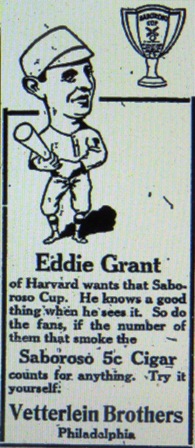
1910 Advertisement for the  Vetterlein Brothers Cigar Company; the Saboroso Cup mentioned in the ad was presented to the phillies or Athletics player with the highest batting average.

1910 Advertisement for the Vetterlein Brothers Cigar Company; the Saboroso Cup mentioned in the ad was presented to the Phillies or Athletics player with the highest batting average.

Grant was among the first wave of prominent athletes to join the military, making his enlistment news.  A wire service article under the headline “Eddie Grant Joins Uncle Sam’s League” appeared in numerous papers across the country.

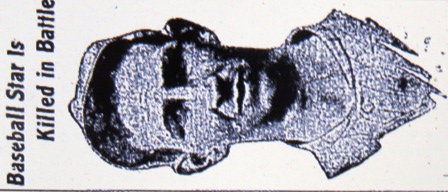
On October 5 1918, he would become the first Major League player to be killed during World War I, The Associated Press said:

“Captain Edward Grant, former third baseman of the New York National League Club, and attached to the 307th Infantry, was killed by a shell when leading a unit to the aid of the famous ‘Lost Battalion.’

“The battalion was surrounded for five days in the Argonne Forest and Captain Grant was killed in one of the attempts to reach it.”

Grant was originally buried in the Argonne Forest, and his body was later moved to the Meuse-Argonne American Cemetery.

Things I Learned on the Way to Looking Up Other Things #4

22 May

A Ballplayers Hands

Joe Ardner played second base in the National League for the Cleveland Blues in 1884 and the Cleveland Spiders in 1890; he played another 12 years in the minors.  In 1888 he was with the Kansas City Blues in Western League and provided the following explanation of the care and maintenance of an infielder’s hands:

“A ballplayer’s hands should not be hard, they should be soft.  When my hands are in perfect condition they are almost as soft as a lady’s.  Hard hands on a ballplayer will crack and get sore, but when the skin is pliable and tough there is little danger of the hands bruising, cracking or puffing.  Some folks imagine a ballplayer’s hands to be as hard as a board, but they are wrong.”

Joe Ardner

Joe Ardner

They have realized that the Umpire is Almost Human

National League President Harry Clay Pulliam was very pleased with how civilized his league had become by 1908.  In an interview with The Chicago Tribune he said:

“The game is getting cleaner all the time.  Why, I’ve only suspended about half a dozen men this year, to about forty last year, and I want to say that the players are trying harder to keep the game clean…They have realized that the umpires are almost human.  It’s business with the player now, and they’re banking instead of boozing…It’s a grand game, clean, wholesome, and it’s the spirit of contest that gives it its virility.  Civic pride is another vital adjunct to it.  Every town likes to have its own team a winner.  Sort of local pride or another form of patriotism, I call it.”

Harry Pulliam--National League President

Harry Pulliam–National League President

Soo League Night Games

The Copper Country Soo League was recognized as a league for the first time by the National Association of Professional Baseball Leagues in 1905; its last season in operation.  The four-team league located in Michigan’s Upper Peninsula was made up of mining towns along the Soo Line Railroad: the Calumet Aristocrats, the Sault Ste. Marie Soos, the Hancock Infants and the Lake Linden Lakers.

Nearly no records or roster information survives, other than that three future Major Leaguers played in the league: Donie Bush and Fred Luderus played for Sault Ste. Marie and Pat Paige played for Calumet.

In an effort to boost sagging attendance in June, the league first  attempted to merge with the Northern League, and when that effort failed announced a scheduling change.

The Duluth News-Tribune said:

“An innovation…will be introduced by managers of the clubs comprising the Copper Country Soo League.  Owing to the peculiar conditions which exist in some of the cities, it has been decided to play some of the games after supper as an experiment as it is believed the attendance will be larger.”

The Chicago Tribune‘s Hugh Fullerton said:

“(I)n the copper country baseball depends on miners for support…the plan proved quite a success…The miners would come out of their shift at 6 o’clock, the games were called at 6:30 and finished about 8:30 at twilight.  There were few games called by darkness.”

While the move helped three of the teams at the gate, the Sault Ste. Marie Soos failed to draw fans and disbanded late in August.

Calumet won the championship, and along with Hancock and Lake Linden  merged with the Northern league to form the Northern-Copper Country League–Calumet won the league’s first championship in 1906, playing a schedule of day games.


Future Phillies star Fred Luderus was a 19-year-old rookie with the Sault Ste. Marie Soos

Future Phillies star Fred Luderus was a 19-year-old rookie with the Sault Ste. Marie Soos

Crazy Schmit in Cleveland

10 May

Crazy Schmit pitched for the Cleveland Spiders in 1899; compiling a 2-17 with a 5.86 ERA for the 20-134 last place team (in Schmit’s defense the 1899 Spiders were one of the worst teams in history, losing 24 straight at one point, and Schmit’s ERA was a half of a run better than the team ERA).

The pitcher had grown tired of his nickname “Crazy,” and of references to his behavior as “tacky.”  After being called both by The Cincinnati Enquirer in August, he responded:

“I have stood this sort of thing just about long enough.  I am neither tacky nor crazy, and without wanting to throw any flowers at myself, I will make the statement that there is not another left-handed pitcher in the business who used as good judgment when pitching as I do.

“Furthermore, I am the only left-hander in the business who has an effective slow ball.  Some of these ten-thousand-dollar beauties and phenoms look like thirty cents to me.  I can also swell up and say that I threw the Phillies down this year.  I beat that hard-hitting gang by a score of 6 to 2.”

1899 Cleveland Spiders--finished 20-134

1899 Cleveland Spiders–finished 20-134

Within weeks Schmit was let go by Cleveland;  The Baltimore American reported on the release of the former and future Oriole:

“Pitcher Schmit, that queer and original baseball character, was yesterday given his ten days’ notice of release by the Cleveland club management and afterward notified that he had been fined for insubordination.”

The American quoted Schmit:

“I was released I suppose because it had been reported that I was not doing my best to win and because the owners were displeased with me for several accidents that happened to me.  I missed the train in Chicago, and while I was riding into Cincinnati from one of the suburbs with a young lady who may one day be Mrs. Schmit, lightning struck the trolley wire and I missed the train again.  I guess that is why I was fined.  They wished to make an example of me.  I do not mind the release, as I can easily get another and better position, but I hate that $50 fine, because my salary is not quite as high as that of some bank presidents.”

Despite his release and his record, Schmit still considered himself a great pitcher, blamed his career statistics on the teams he played with, and the more he spoke the more valuable he became as a player:

“I have in my career pitched for fourteen tail-end clubs and I am done with them.  Unless I can pitch for some club that can win a game occasionally I will stop pitching ball.  The longer I pitch the more stuck I am on myself as a pitcher.  I have pitched good ball for Cleveland, but who could win with six and eight errors behind him, and misplays that are far worse than errors and that go as hit.

“I am the most popular player on the circuit and the only man who knows how to coach as a science.  If some of these managers knew something of the theatrical business they would wire on and advertise I am to pitch a certain game.  When it is known I am to pitch I have often brought enough into the box office in a single game to pay my whole salary for the season several times over.  We played before 14,000 people in Chicago and of that number fully 5,000 came to see me.”

Schmitt did not “easily get another or better position” in 1899 or 1900—he sat out the remainder of 1899 and spent 1900 in the Interstate and New York State Leagues.  Schmit opened the season at 2-3 in five games with the Columbus Senators before being released; there are no surviving records for his New York State League games with the team that split the season between Elmira and Oswego.  The next season John McGraw would give him a chance to pitch in the American League.

More Crazy Schmit next week.

Things I Learned on the Way to Looking Up Other Things #2

8 Apr

A few items from 1888 to 1890:

Largest bat 

Jonah William “Quiet Joe” Knight appeared in the National League as a pitcher for six games with the Philadelphia Quakers in 1884, posting a 2-4 record, and returned in 1890 as a left fielder with the Cincinnati Reds, hitting .312 in 127 games.  He also spent 16 seasons in the minor leagues and was one of the premier hitters in the Eastern League.

When Knight joined the Reds in 1890 The Cincinnati Post said he “uses a larger bat than any other professional.”  Reds shortstop Ollie Beard said:

“I can hardly swing the bat Knight uses let alone hit a ball with it.”

It was said Knight had his bats made to order in his home town St. Catherine’s Ontario, Canada.

joeknight

“Quiet Joe” Knight

Baseball in German

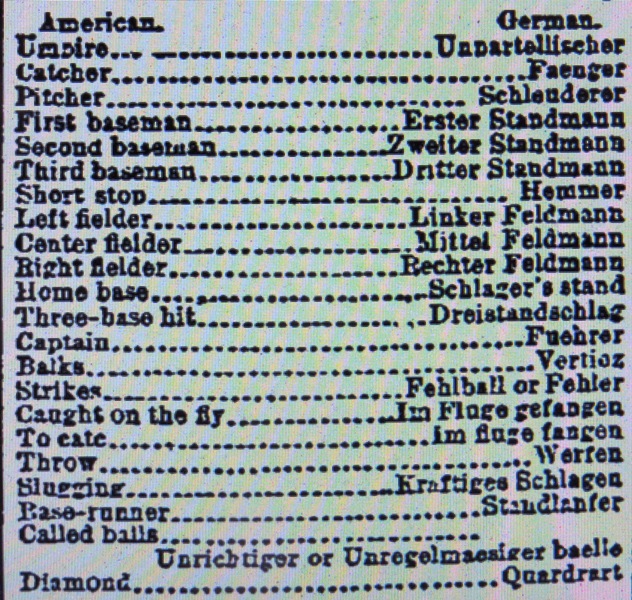
The Boston Herald reported in 1890 that New York’s German language paper Staats-Zeitung hired a baseball editor and would be recapping National League and American Association games:

“Naturally he has been obliged to invent words to describe the technical plays and points and how well he’s succeeded  will be seen from the following:”

???????????????????????????????

Harry Wright’s Team Unimpressive

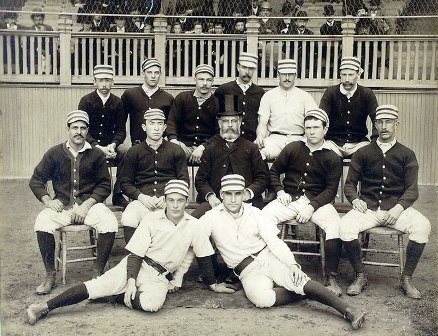
After the 1887 season Hall of Famer and baseball pioneer Harry Wright took his Philadelphia Quakers on a tour of West Coast along with the Chicago White Stockings, New York Giants and St. Louis Browns; playing exhibition games against each other and with California League teams.

After seeing Philadelphia play The San Francisco Call was unimpressed with the National League’s second place team:

“The ‘Phillies’ will have to improve wonderfully to make their games at all interesting.  They may plead excuses, but they cannot disguise the fact that they played rank ball, and very rank at that.  Their initial effort stamps them as about fourth class, and it will require a brilliant rally to convince people in this section that they are ball-players.  There is not a team in the California League that will not give them a hard game and perchance defeat them.”

Unfortunately there is no record of  how Philadelphia fared on the rest of the tour.

Harry Wright, center, with his 1887 Philadelphia Quakers

Harry Wright, center, with his 1887 Philadelphia Quakers

“One of the Two Greatest Sluggers”

28 Jan

On July 19, 1920, Babe Ruth hit his 30th home run of the season off Dickie Kerr of the Chicago White Sox, breaking the Major League record he had set the previous season.  Perry Werden, working as an umpire in the South Dakota League was largely forgotten.

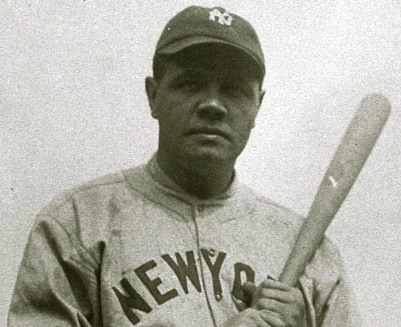
Babe Ruth

Babe Ruth

The Minneapolis Tribune, as a point of local pride, reminded readers that Ruth had not eclipsed the record set in their town:

“Beyond all doubt the mark made yesterday is a major league record of all time but the Babe has yet to equal the mark of 45 made by Perry Werden of the Minneapolis Western League club in 1895.”

Some reporters, like Al Spink of The Sporting News, dismissed Werden because “the park at Minneapolis, which was an unusually small inclosure (sic), with the right and left field fences close in.”  Regardless, Werden was back in the public eye; his forgotten record was revived as fans followed Ruth’s record season.  The Associated Press said:

“(Werden) admits that Babe Ruth has a harder swing than he had when he made his mark. ‘There is no doubt that Babe has it on all of them—modern and ancient’ says Werden”

When Ruth hit numbers 45 and 46, one in each game of a double-header at Fenway Park, The Associated Press said:

“(Ruth) broke all known world’s records for circuit drives in a single season.”

Werden, in his role as “the former holder of the home run record for organized baseball” was often asked about Ruth over the next decade.  Werden called Ruth “One of the two greatest sluggers that I have seen in fifty years.”

Perry Werden, 1930

Perry Werden, 1930

The only player Werden considered Ruth’s equal?   Ed Delahanty.

Werden told The North American Newspaper Alliance, in a nationally syndicated story:

“Ed Delahanty would have equaled or bettered the home run record of Babe Ruth if the lively ball had been in use…If Delahanty had any weakness no pitcher ever found out what it was.  He hit left-handers as easy and effectively as he did right-handers, and it made no difference to him where they threw the ball—high, low, inside, outside, curve fast ball or slow ball—they all looked alike to Big Ed.”

Werden said while playing first base for the Saint Louis Browns he saw just how hard Delahanty could hit:

“The Phillies had a runner on first base, and when Delahanty came up to bat we played in close for him, thinking he would bunt.  That was a mistake we never made again when Delahanty batted.  Instead of bunting he hit a ground ball so hard that it tore a shoe off George Pinkney, our third baseman, in addition to fracturing his right ankle.”

As further proof Werden said “Even with the lively ball…it was thirty-six years before Delahanty’s record of hitting four home runs in a single game was equaled by Lou Gehrig.”  Werden didn’t mention that Bobby Lowe had accomplished the same feat two years before Delahanty.

Ed Delahanty

Ed Delahanty

While Werden will never join Delahanty and Ruth in the Hall of Fame, he is remembered as one of the greatest minor league players of the 19th Century.  He died in Minneapolis in 1934.