Tag Archives: Philadelphia Phillies

“Hanlon Springs a Surprise on the Baseball Public”

14 Jan

Albert Joseph “Smiling Al” Maul’s best days seemed well behind him by 1898.  The 32-year-old Maul had posted a 16-12 record for the Pittsburgh Burghers in the Players League in 1890, but after returning to the National League the following season he had gone 39-44 through 1897.

Baltimore Orioles manager Ned Hanlon signed Maul after he was released by the Washington Senators in 1897.  The results were not good; in two games Maul gave up 9 hits and walked 8, posting a 7.04 ERA.  Baltimore released him at the end of the season and there were no takers for Maul at the beginning of 1898.
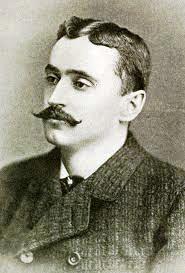
Ned Hanlon

Ned Hanlon

By June of 1898 The Baltimore Morning Herald said:

“For some time (Hanlon) has been hinting to his friends that he had something up his sleeve in the way of twirling talent that would surprise the natives, but when he let fall Al Maul’s name he was met with a chorus of merry ha-has.”

But by June Hanlon’s “surprise” was no longer met with laughter.

On June 5, The Sunday Herald headline said:

“Hanlon springs a surprise on the baseball world.”

Maul had shut out the Saint Louis Browns on three hits in his first start for Baltimore.
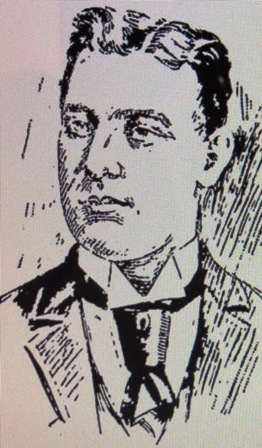
Al Maul

Al Maul

The Herald cautioned that “it’s too early to say that Maul is all right,” but all season he successfully filled the gap in Baltimore’s rotation caused by Joe Corbett’s holdout.

The New York World said Maul was:

“The most remarkable case on record of a restored glass arm.”

Maul’s comeback season became a sensation.  John Clarkson, who had not appeared in a game since 1894, told The Bay City (MI) Tribune he was serious about making his own comeback:

“I might be a second Al Maul, who can tell?”

Clarkson’s comeback never materialized, but Maul’s success continued all summer.

The Sporting Life credited Hanlon for his pitcher’s success:

“Al Maul’s experience this season is only another confirmation of the claim that Ned Hanlon can take any old thing and get good results from, it for a year or so.”

Maul finished the season with a 20-7 record and a 2.10 ERA, and Hanlon had high hopes for his pitcher the next season.  Maul, along with “Wee Willie” Keeler, Hughie Jennings and Joe Kelley moved to the Brooklyn Superbas as part of the stock swap between the Baltimore and Brooklyn franchises that led to Hanlon’s move to Brooklyn.

But the pitcher who won 20 games two years after his career was “over” was out of surprises.  After four games with Brooklyn in 1898, Hanlon released Maul.  Brief stints with the Philadelphia Phillies and New York Giants failed to rekindle the magic and Maul’s career came to an end after his release by the Giants in September of 1901.

Maul went on to coach baseball at Lehigh University and scouted for several years for the Philadelphia Athletics.  He died in 1958 at age 92.
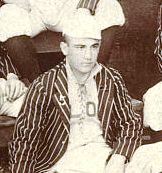
Elton Chamberlain

17 Dec

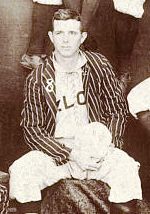
Elton Chamberlain (for the last thirty years always referred to by the nickname “Icebox,” but that name was not in common use for him contemporaneously; although he was called Iceberg fairly often.) was primarily known for two things: A righthander, he pitched ambidextrously in at least one game, and on May 30, 1894 he gave up four home runs and a single to Bobby “Link” Lowe—17 total bases, a record which stood for 60 years.

He was also embroiled in one of the early controversies over gambling while playing for the Cincinnati Reds in 1893 when he was accused by his manager, Charles Comiskey, of throwing the first game of a July 4 doubleheader against the Philadelphia Phillies.

The Cincinnati Enquirer said:

“Pitcher Elton Chamberlain of the Cincinnatis is accused of throwing the game to the Philadelphias yesterday morning. He is charged with being in league with Joe Brill, a local gambler.”

The story said Comiskey, notified of the allegation:

“(D)ecided to investigate (and) after a consultation with a club official, put Chamberlain in for three innings to watch him. Chamberlain’s pitching was very bad and be was taken out of the game in the third inning.”

Chamberlain’s teammates Jim Canavan and Silver King quickly came to his defense. King said he thought he would be the starting pitcher, not Chamberlain, until just before the game started; therefore Brill and Chamberlain could not have conspired.

Chamberlain said of the story:

“It was cruel and cowardly to try to ruin a man like that.”

The Sporting Life ripped The Enquirer and Comiskey:

“This is not the first time The Enquirer has accused ball players of dishonesty, and once it got into and lost a libel suit with Tony Mullane for accusing him of crookedness. Comiskey in his time has also made similar charges and Insinuations against guiltless players.”

The New York Herald said “The whole affair was so silly,” and seemed to have Comiskey in mind with this statement:

“The club official who suspends a player on the charge of dishonesty should be made to prove his charges or himself be forever barred from further connection with any club.”

The Herald also recommended that steps be taken to officially clear Chamberlain and punish those who accused him:

“The National Board should at once take up pitcher Chamberlain’s case and investigate it beyond the limit of doubt and when they reach the facts, whatever the facts; someone should be made to suffer.”

Cincinnati’s management, Comiskey included, quickly repudiated the charges that appeared in The Enquirer, although from all indications they were directly responsible for the charges being reported in the first place.

Elton Chamberlain

Elton Chamberlain

The headlines of July faded by August; there was no official investigation and no one was “made to suffer.”

Charles Comiskey

Charles Comiskey

Chamberlain finished the season with a 16-12 record and his 3.73 ERA led the Reds’ pitching staff. The following year was his last full season in the Major Leagues.

In 1895 he played for the Warren (PA) franchise in the Iron and Oil League. The team won the pennant behind the pitching of Chamberlain and another former Major Leaguer, Tom Vickery.

They also had a 21-year-old shortstop named Honus Wagner.

No statistics survive for that season, but forty years later Wagner, writing for The Pittsburgh Press, said Chamberlain “Seldom lost a ballgame for us,” and that Chamberlain and Vickery “gave out plenty of their knowledge to us youngsters.”

Chamberlain bounced around minor and semi-pro leagues after one last Major League trial with the Cleveland Spiders in 1896. In 1898 he accepted, then rejected, an offer to serve as a National League umpire. After turning down the umpire job Chamberlain, a Buffalo native, said he would become a professional boxer and challenged a local middleweight named Jack Baty to a fight that would include a $500 side bet. Baty’s fight record indicates the bout did not take place.

Chamberlain attempted to resume his baseball career with the Buffalo Bisons in the Western League in 1899—by July he was released and The Sporting Life reported that Chamberlain, a rabid horse player “is once more following the races.”

Chamberlain Died in Baltimore in 1929.

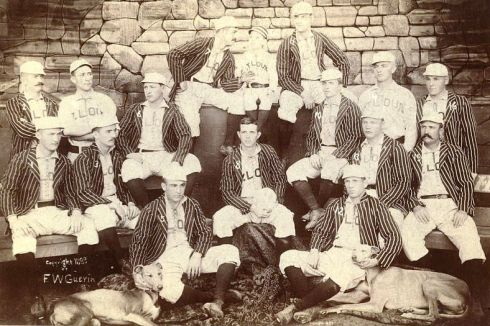
Chamberlain and Comiskey as teammates with the St. Louis Browns.  Chamberlain is 5, Comiskey 8.

Chamberlain and Comiskey were also teammates with the St. Louis Browns. Chamberlain is 5, Comiskey 8.

Lost Team Photos

19 Nov

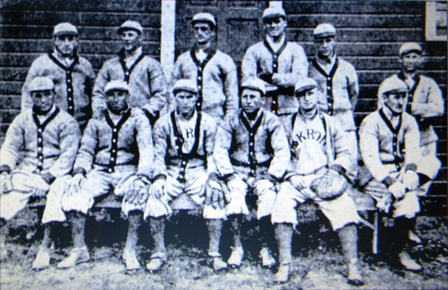
Another photo I’ve never seen published before, the 1908 Akron Champs, Ohio-Pennsylvania League Pennant Winners.

Top left to right:

Dick Breen—a minor leaguer for 12 seasons, his career overlapped with another career minor leaguer named Dick Breen—this Breen’s career came to an end in 1917, when while playing for the Reading Pretzels in the New York State League he got in a fight with Wilkes-Barre Barons  manager Jack “Red” Calhoun.  Both men were suspended indefinitely; Breen was released several days later, neither ever appeared in organized ball after that season.

Bill Speas—longtime minor league player and manager, Speas hit.284 in 22 seasons and won three Mississippi Valley League pennants as a player/manager with the Cedar Rapids Bunnies and Dubuque Dubs.

John Brackenridge—appeared in seven games for the Philadelphia Phillies in 1904, Brackenridge pitched in the Pacific Coast League from 1909-1913.

Fred “Buff” Ehman—a 6’ 4” (some sources list him an inch shorter) right-handed pitcher, the enigmatic Ehman was 81-36 for Akron from 1906-08, but according to The Akron Beacon Journal, was known for disappearing for days at a time and “sulking.” He had multiple trials with Major League clubs; according The Mansfield (OH) Daily Shield he never stuck with a team because of “his refusal to exert himself.”  Through 11 minor league seasons he won 214 games.

Wilbur Good—spent parts of 11 seasons in the Major Leagues: Joe Tinker said of him, “He is one of the fastest runners in the National League and still one of the poorest base runners.”

Edward Murphy—a light hitting catcher, Murphy played five seasons in the Ohio-Pennsylvania League.

Bottom left to right:

Bill Kommer—there is no listing for Kommer on any minor league data base.  He was left-handed pitcher who played for many amateur and semi-pro teams in Ohio during the first decade of the 20th Century;  he was released by Akron in July, there is no record of his statistics for the ’08 season.

William Hille—“Silent Bill” was a shortstop who played until 1917 primarily in the Texas and South Atlantic League.

Jim Callahan—his Major League career consisted of one game with the 1902 New York Giants; played three seasons for Akron (1906-08), was reported to have played in the Western League in 1909, but no records exist.

Matt BroderickThe Reading Eagle called him “one of the best shortstops who ever played on a minor league field,” Broderick played two games in the Major Leagues with Brooklyn in 1903—played minor league and amateur baseball for the remainder of the decade while working for Carpenter Steel Works in Reading, PA.

George Texter—one of the first players to sign with the Federal League in 1913, Texter played for the Indianapolis Hoosiers/New Jersey Pepper during the Fed’s two seasons as a Major League (1913-14).  Managed teams throughout the 1920s in the Ohio-Pennsylvania League (no longer recognized by the National Association, the OPL was nonetheless a strong semi-pro/industrial league during that period).

Cecil Armstrong—a dominant right-handed pitcher, first with the Youngstown Ohio Works team in 1905 during his three seasons with Akron (64-33 from 1906-08), Armstrong spent 1909 and 1910 with New Bedford Whalers in the New England League. Armstrong retired to Akron after the 1910 season.

The League That Billy Sunday Helped Shut Down

12 Nov

The Eastern Illinois League began with great promise in the spring of 1907 to fill the void created by the collapse of the first incarnation of the Kitty League.  Joe “Wagon Tongue” Adams, an Illinois native who appeared in one game for the 1902 St. Louis Cardinals, was said to be the guiding force behind  the league, he was also manager on the Pana Coal Miners.  Adams had helped create the Central Illinois League two years earlier with teams from many of the same cities—unlike the 1905 effort, the Eastern Illinois League was granted membership in the National Association.

The six-team league had franchises in Centralia, Charleston, Mattoon, Pana, Shelbyville and Taylorville, and elected Charles Welvert, a Pana businessman  league president.  Midway through the 1907 season the Centralia team relocated to nearby Paris, Illinois, and replaced Welvert as league president by Louis A. Godey Shoaff (often incorrectly spelled “Schoaff”), editor and publisher of The Paris Gazette.

The teams in Charleston, Mattoon, Pana and Paris were supported, as The Associated Press said, “In great part from saloon interests.”

The league made news in August, when during a heated series between the Mattoon Giants and the Pana Coal Miners, The Sporting Life reported that Mattoon second baseman Fred Wilson during a dispute with  Pana manager Adams:

“Wilson put Adams down with a straight jab on the jaw. The manager came up, but another blow in the same place fractured his chewing apparatus.”

The Mattoon Giants won the 1907 championship, led by the pitching of future Major Leaguer Grover Lowdermilk, who posted a 33-10 record with a 0.93 ERA.  Although records for the league are nearly nonexistent, contemporary newspaper accounts mention other past and future Major Leaguers who appeared in the league including Harry Patton, Joe Yeager (after his release from the St. Louis Browns in 1908), Cecil Coombs, and Hosea Siner.

The league appeared to be in good shape heading into 1908, adding teams in Danville, Illinois and Vincennes, Indiana.  But as it prepared for the beginning of its second season other forces were ensuring it would be its last.

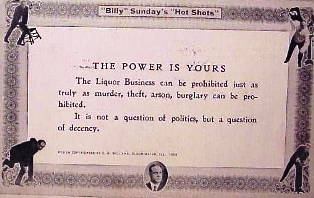
William Ashley “Billy” Sunday, the former outfielder for the Chicago White Stockings, Pittsburgh Alleghenys and Philadelphia Phillies, turned evangelist and temperance supporter was spending the early months of 1908 holding a five-week long  revival in Decatur, Illinois and advocating for citizens throughout Illinois to vote their towns dry during local option elections in April.

Sunday’s revival was a huge success, according to The Associated Press “there were 5,843 conversions;” and the service “on ‘booze’ was attended by 8,000 enthusiastic local optionists.”

When the polls closed on April 7, six of the league’s eight towns were voted dry.  The Associated Press said:

“With the saloons out of business, subscriptions of new stock (in the teams) will be cancelled in many instances.”

The league was in trouble.  It got worse worse when Sunday moved his revival to Charleston in April and began a new crusade against playing games on Sunday.

The 1908 season was chaotic.  New investors were scarce.  Some Sunday games were played, but attendance was down.  In July the Danville Speakers relocated to Staunton and the Pana Coal Miners moved to Linton, Indiana (incorrectly listed on Baseball Reference as Linton, Illinois).  Early in August the Mattoon Giants were on the verge of collapse.  The league finally disbanded on August 20, 1908, the Speakers were declared 1908 champions.

Professional baseball never returned to Charleston, Pana, Linton, Staunton, and Shelbyville.  Taylorville had a team in the Illinois-Missouri League in 1911.  Vincennes was part of the reformed Kitty League in 1910-11 and 1913.  Beginning in 1910 Danville was in and out of the Three-I League for the next forty years.  Mattoon did not have a professional team again until 1947, Paris until 1950.