Tag Archives: Pittsburgh Pirates

A Thousand Words–New Orleans Pelicans

13 Nov

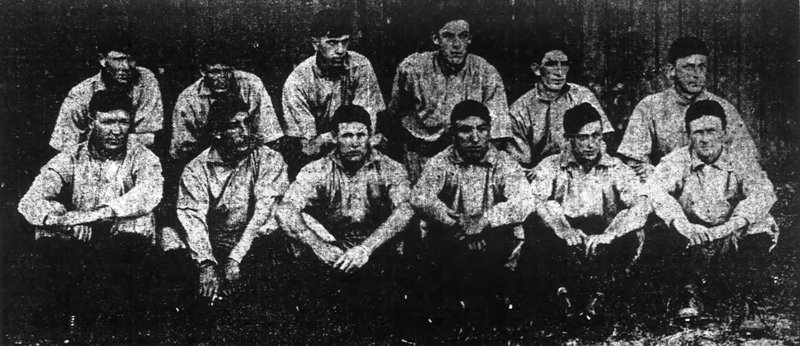
Another picture I’ve never seen published before—the 1906 New Orleans Pelicans of the Southern Association.

Top, Left to right.

Bill Phillipshe spent seven seasons in the Major Leagues with a 70-76 record; and won 256 games in a minor league career that began in 1890 and ended in 1909.

Mark “Moxie” Manuelwas said to have appeared as a both a left and right-handed pitcher for New Orleans in 1906 and 07, Manuel was a combined 37-26, earning him a second trip to the Major Leagues in 1908, where he posted a 3-4 record in 18 appearances for the Chicago White Sox.

Milo Stratton—a weak hitting (career .185) catcher who played in the minor leagues from 1903-1914.

William O’Brien—a .215 hitting first baseman in 1905 with the Toronto Maple  Leafs in the Eastern League and with the Pelicans in 1906.

Jake Atz—played for the Washington Senators in 1903 and the Chicago White Sox 1907-1909, a minor league manager for 21 seasons he won more than 1900 games.

Art Brouthers—a third baseman who played in 37 games for the 1906 Philadelphia Athletics, Brouthers managed the 1913 Paducah Indians to the Kitty League championship.  After his baseball career he was a hotel detective in Charleston, South Carolina.

Front, left to right

Whitey GueseGuese had several strong seasons in the minors, but in his lone Major League season with the Cincinnati Reds in 1901 he was 1-4.  The Youngstown Vindicator said, “He is a twirler who belongs to the disappointing species known as ‘morning glories.” And, “Seemingly has a heart like a canary.”

Joe Rickert—“Diamond Joe” Rickert stole 77 bases for the Pelicans in 1904; he played 15 games in the Major Leagues with the Pittsburgh Pirates and Boston Beaneaters.

William Blake—an outfielder with 13 different minor league teams from 1902 to 1910 and native of Louisville, Kentucky, little else is known.

Punch Knoll—another long-time minor league manager.  Knoll appeared in 79 games for the 1905 Washington Senators, he appeared in 3 games as a pinch hitter, collecting one hit, at 48-years-old while managing the Fort Wayne Chiefs in the Central League

Chick Cargo—brother of Major Leaguer Bobby Cargo, Charles “Chick” Cargo was a shortstop and 3rd baseman who played 19 seasons of minor league ball.

George Watt—Watt had three good seasons for the Little Rock Travelers, with a 53-34 record from 1902-1904.  He slipped to 20-37 in 1905-06 with Little Rock and New Orleans.  By 1907 he had dropped from “A” ball to “D” ball with the Zanesville franchise in the Pennsylvania-Ohio-Maryland League.  In 1908 he pitched for the Zanesville Infants in the Central League, was release in August after posting a 6-15 record and disappeared.

Tom Colcolough

26 Oct

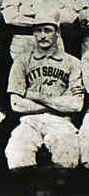
Thomas Bernard “Coke” Colcolough (his name was pronounced “Cokely”) posted a 14-11 record in parts of four seasons in the National League with the Pittsburgh Pirates and News York Giants.

His greatest baseball achievement has been lost to history.

Before the 1893 season, professional baseball eliminated the five and a half by four-foot pitcher’s box and replaced it with the rubber, while moving the distance to the current 60 feet, six inches.  Intended to increase offense the change had the desired effect increasing batting averages throughout baseball.

Not everyone immediately took to the new rule.  The Boston Globe and Cleveland Plain Dealer predicted the rule would be eliminated.  They were wrong, it was there to stay.

One consequence of the new rule was the sharp decline in no-hitters.  In the National League seven no-hitters were thrown between 1890 and 1892.  From the beginning of the 1893 season until Cy Young’s in September of 1897, there was but one:  On August 16, 1893, Bill Hawke of the Baltimore Orioles no-hit the Washington Senators.

Hawke’s was not the first professional no-hitter after the change.  That belonged to Charleston Seagulls pitcher Tom Colcolough on June 23 against the Montgomery Colts in the Southern Association.  The Sporting Life said:

“Colcolough, the rising young pitcher of the Charleston Club, has the honor of being the first pitcher under the new rules to dispose of an opposing team without a safe hit in a full game.  He accomplished the feat against the hard-hitting Montgomerys.”

Colcolough was 16-11 for Charleston and earned his first trip to the Major Leagues.   Prone to wildness (166 walks in 319 1/3 Major League innings), Colcolough was returned to the minor Leagues in 1895, pitching for the Wilkes-Barre Coal Barons in the Eastern League from 1895 through 1898.

Tom Colcolough

Colcolough earned one more shot in the National League with the Giants in 1899 posting a 4-5 record.  He was sent to Jim O’Rourke’s Bridgeport Orators in the Connecticut League in July and was released at the end of the season.

Colcolough returned to Charleston, South Carolina and served as a city councilman.  He passed away there in 1919.

Murphy Calls Out an Umpire

12 Oct

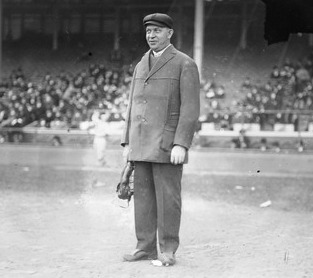
Three years before Chicago Cubs President Charles Murphy ousted legendary manager Frank Chance, he picked a fight with the most powerful and respected umpire in baseball.

In September of 1909 the second place Cubs had just taken three of five games from the league-leading Pirates in Pittsburgh.

On September 9 Murphy filed a formal protest with the league over the fourth game of the series (won by the Pirates 6-2) charging that umpire Bill Klem “(D)eliberately acted as a conspirator, robbing the Cubs of any reasonable chance for victory.”

The Cubs had argued several calls by Klem during the game and Manager Frank Chance and Cubs’ infielders Joe Tinker and Harry Steinfeldt were fined for comments made to the umpire.

Murphy questioned Klem’s honesty and demanded that he not be allowed to serve as umpire in any games played by his team and that the game be replayed.

Klem was an unlikely person to have his integrity questioned.  Generally credited with professionalizing umpiring, he had come forward with fellow umpire Jim Johnstone the previous season to report they had been offered a bribe to help determine the outcome of the October 8 Cubs game with the New York Giants to decide the pennant (the make-up game for the September 23 “Merkle’s Boner” game).

While the league never released specific details of the bribe attempt, the allegations made by the umpires were found to be true and barred the “unnamed conspirators” from any Major League ballpark. Both umpires were commended by the league for demonstrating to the “American public the honesty and integrity of our national game.”

League President John Heydler (appointed after the suicide of Harry Pulliam) immediately announced his support for Klem in the dispute.  Murphy responded by announcing he would ensure Heydler would not be reappointed president of the league that winter—Murphy would be successful spearheading the effort to replace Heydler.

Murphy was never able to cite any specific reasons for his charges and was pressured to drop the protest, which he eventually did, but Klem remained indignant and asked to have his name cleared.  According to newspaper reports:

“The umpire does not propose to let the matter rest.  He considers that his reputation has been attacked, and he therefore will ask the league to investigate him.”

There’s no record that the investigation was ever conducted.

Klem attended that year’s winter meetings in order to be on hand when Murphy was pressured to make a formal, public apology.

Chicago Cubs President Charles Murphy

More on Murphy and his feuds in the coming weeks.

Demon Rum–or Demon Rum as an Excuse to Replace a Popular Manager

8 Oct

The 2011 Boston Red Sox were only the latest in a long history of alcohol taking the blame for a team’s poor performance.

As the Chicago Cubs faded into third place during the waning days of the 1912 season, team president Charles Murphy issued an order for “total abstinence” and all players would have a temperance calls in future contracts.

The move was not unprecedented—since 1909 Barney Dreyfus of the Pittsburgh Pirates had required his players to sign a temperance pledge.  What made Murphy’s order so newsworthy was that over the course of several days he issued numerous, often contradictory, “clarifications” and because it quickly became apparent the move was a intended to wrest control of his ballclub from Manager Frank Chance.

Murphy’s original statement said that “loose living and training methods” led to the team’s poor finish. At the same time he provided cover for popular Cub outfielder Frank Schulte who had been suspended by Chance in September his nighttime activities during a crucial August road trip in Cincinnati.  The Cubs lost three of four games to the Reds and fell out of contention.    Murphy’s statement presented Schulte as a man incapable of any personal responsibility:

“I desire to say that in my judgment Schulte has been more sinned against than sinner…from what I could gather he was a victim of too many so-called friends…if we had a rule similar to that in vogue in Pittsburgh this player could not have been led into temptation.”
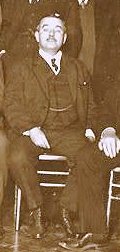
Chicago Cubs President Charles Murphy

The implication being that Chance had perhaps overreacted by suspending “the more sinned against” Schulte.  This statement was further complicated by Murphy’s several “clarifications,” some of which seemed to support Chance’s decision while some did not.

Chance quickly defended his players and his reaction to Murphy revealed just how bad the relationship was between the team president and his manager:

“Murphy only thinks of the team when it’s winning…his statement reflects upon me personally, and I have been in the business too long to allow Murphy or anyone else to insult me.”

Making matters worse, and calling Murphy’s motives into question was that Chance issued his response from a hospital bed in New York.  As a result of being hit in the head by numerous pitches throughout his career, Chance had developed a blood clot near his brain and had undergone surgery just a few days earlier.

Murphy didn’t hesitate to use Chance’s health issues against him.

A month earlier, plagued by doubts about his condition and suffering from severe headaches, Chance had suggested to Murphy that he might not be able to manage the Cubs in 1913.  At the time Murphy told his manager to wait until after the surgery to make a decision about his future.  Now he was using that conversation to assert that Chance had issued his resignation.

Once Murphy began claiming Chance had, in effect, quit in August the Chicago media which had almost universally supported the “abstinence pledge” called foul.  The Chicago Tribune and Chicago Examiner both said Murphy was using the conversation and the pledge as cover to run the legendary Chance—who led the Cubs to four pennants and two World Championships—out of town.

Chance went.  But he didn’t go quietly.

The manager had acquired 10 percent of the Cubs, shares Murphy had been trying to purchase for more than a year.  Chance sold the shares to Harry Ackerland a Pittsburgh investor who President Murphy did want owning part of his team.  Despite Murphy’s efforts to block the sale, it went through.

Chance was claimed on waivers by Cincinnati, but after the Reds acquired Joe Tinker from the Cubs and named him manager, Chance was waived to New York, where he became manager of the Yankees.

Chance led the Yankees for two losing seasons, managed the Los Angeles Angels in the Pacific Coast League in 1916 and ’17, and closed out his career with one dismal season in Boston; the Red Sox finished 61-91 under Chance.

Frank Chance

Johnny Evers was named Cubs manager for the 1913 season—the Cubs again finished third.

From the day Murphy issued his initial statement until Chance died in 1924, “The Peerless Leader” never missed an opportunity to take a shot at Murphy.

When the Cubs were sold to Cincinnati publishing magnate Charles Phelps Taft (President William Howard Taft’s half-brother) before the 1914 season Murphy claimed that he had made more than a half million dollars on the deal.  Chance and former Cubs pitcher Mordecai Brown (who had his own feud who Murphy who released him after the 1912 season, allegedly without giving Brown money he was owed for playing in that year’s “City Series” with the Chicago White Sox) quickly responded.  Both players confirmed what had long been rumored—that Murphy had been bankrolled by Taft who retained a majority of the shares.   Murphy, said Chance, “Never owned more than fifteen or twenty percent of the club stock.”

Both players also charged that Murphy’s treatment of his players was a primary reason for the formation of the upstart Federal League—at best an oversimplification of the conditions which led to Major League Baseball’s last “third league.”

Another Charles Murphy feud later this week.

.

Charlie Dexter, and the Other Charlie Dexter

14 Aug
Last week I told you about Charlie Dexter, former major leaguer, and one of the heroes of Chicago’s Iroquois Theater fire.  Not to be confused with the other Charlie Dexter, a minor league outfielder and first baseman of the same era.  The two were often conflated in contemporary newspaper accounts.

Charlie Dexter

The other Charlie Dexter, the career minor leaguer (1904-09), was born Oscar Schoenbecker in Ohio and was killed in a hunting accident in November of 1909 in Mount Holly, Ohio.  According to his obituary, in The Cincinnati Commercial Tribune he changed his name “fearing the jests of the old people in case he failed,” as a player.

Reading contemporary accounts of the major league Charlie Dexter is a study in dichotomies.  A year and a half before his heroics at the Iroquois theater were recounted in papers across the country, numerous papers echoed the sentiments of the Pittsburgh Press that Dexter’s release by Chicago had more to do with his being a “trouble maker” than his .227 average.

Numerous stories over the years hinted, or outright said that Dexter, like many players of the era, had a serious drinking problem. He was released by Boston after the 1903 season and returned to the minor leagues for the first time since 1895.
The end of line seemed to come in October of 1905 in Des Moines, when during what was described as a “Drinking binge” Dexter stabbed his friend, Milwaukee first baseman Henry “Quait” Bateman.  The earliest reports from Iowa papers and wire services said Bateman was either dead or near death and that “(Dexter) slashed Bateman across the breast, the blade cutting into the lung.”

Quait Bateman

Dexter was immediately arrested.  But within days the wire services were reporting that Bateman was not seriously injured and had refused to file charges.  Dexter was released from custody.  Other players who were present (none were named is stories) “Dexter and Bateman are on the best of terms and that their little quarrel had done nothing to mar their friendship.”  Without Bateman’s cooperation, a grand jury elected not to indict Dexter.

He played two more seasons in Des Moines, taking over as manager from Mike Kelly 20 games into the 1907 season and managing the team through 1908.

Dexter stayed in Iowa and was occasionally mentioned in local papers over the next few years in connection with amateur and semi-pro leagues.  Dexter shot himself in 1934 in Cedar Rapids, Iowa.  Bateman Died in Milwaukee on January 18, 1937.

One more story about the aftermath of the Bateman stabbing next week.