Tag Archives: Southern Association

“An Almost Complete Surrender”

23 Sep

At the close of the Southern Association’s tumultuous 1902 season league president William Kavanaugh, and the majority of the team owners, led by the New Orleans Pelicans’ Abner Powell, set out to oust Charlie Frank of the Memphis Egyptians.
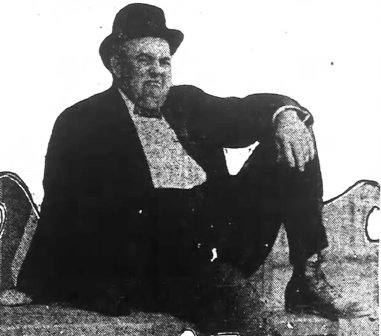
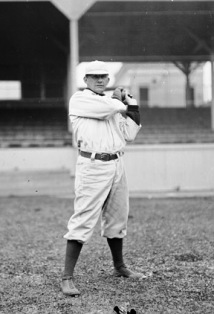
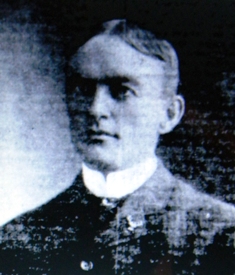
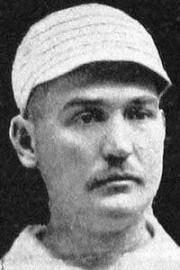
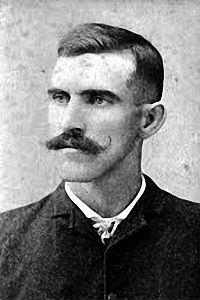
Charlie Frank

Charlie Frank

After a decade as a player, including two seasons with the St. Louis Browns in the National League, Frank was one of the founding members of the new Southern Association in 1901 and became the president and manager of the Memphis Egyptians.

The Atlanta Constitution said that right from the beginning Frank became “the storm center for southern baseball politics… (He) was constantly engaged in some sort of furious baseball litigation.”

After signing three players–Jim St. Vrain, Charlie Babb,  and Bill Evans—who were under contract with other teams during the 1902 season, Frank became embroiled in a months-long legal battle with the league and the National Association of Professional Baseball Leagues (NAPBL).

In October of 1902, Frank lost his legal battle, and it was thought that the time was right to force him out.  The New Orleans Times-Picayune said Powell and Kavanaugh were “confident that a new party” would take over the Memphis franchise and “do much better than the old.”

Powell, Kavanaugh, and the other league owners overestimated their influence in Southern baseball and underestimated Frank’s.

While Powell and company were trying to find a replacement for Frank, he was creating a new league.  The Constitution said:

“(Frank) determined to organize an outlaw league, got financial backing in Memphis and actually formed a circuit.”

The problem for the Powell group was that Frank’s proposed league, and its investors, were more financially sound than the existing league.  Charlie Frank challenged the Southern Association again, and again the Southern Association blinked.

Rather than losing the league, the other team owners accepted every one of Frank’s demands and welcomed him back.

The Associated Press called it “an almost complete surrender,” by the Powell-Kavanaugh contingent:

“Charles Frank retains the Memphis franchise; Memphis club and Frank restored to good standing; Memphis will be paid for all losses sustained during last season, on account of unplayed games, legal costs, etc…”

Additionally, Frank saw to it that every investor in his “new league” was reimbursed for their costs; the Association covered “all obligations made by the promoters,” including honoring the contracts of all players who had been signed, most of whom were absorbed into Southern Association teams.  Additionally, Chattanooga, Tennessee was dropped from the league and a franchise in Montgomery, Alabama was “awarded to the promoters” of Frank’s “new league.”

It was estimated that Frank received $5,000 in the settlement.  He put some of that money towards building a solid team for 1903, winning his first pennant.  Memphis won again in 1904; early in the season, Frank handed over the managerial reins to Lew Whistler.
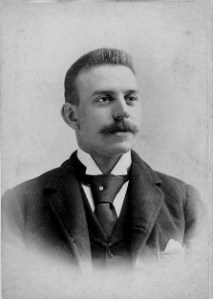
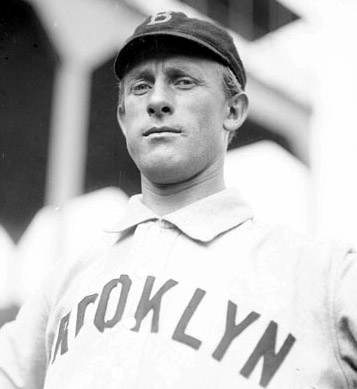
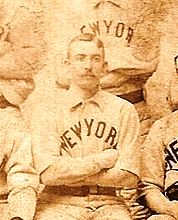
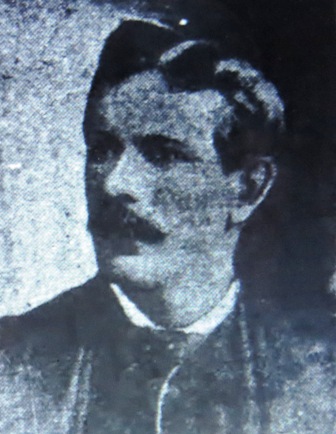
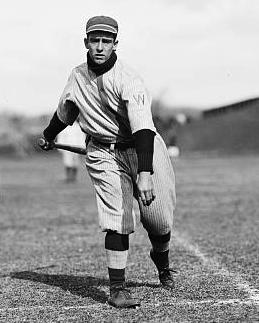
Lew Whistler

Lew Whistler

In 1905, Frank became president, principal owner, and manager of the New Orleans Pelicans, and promptly led them to a pennant— in spite of a Yellow Fever epidemic in New Orleans which required the team to relocate to Atlanta for part of the season.  Frank’s Pelicans also won pennants in 1910 and ’11.  He sold his interest in the team after the 1911 season but remained manager for two more years.
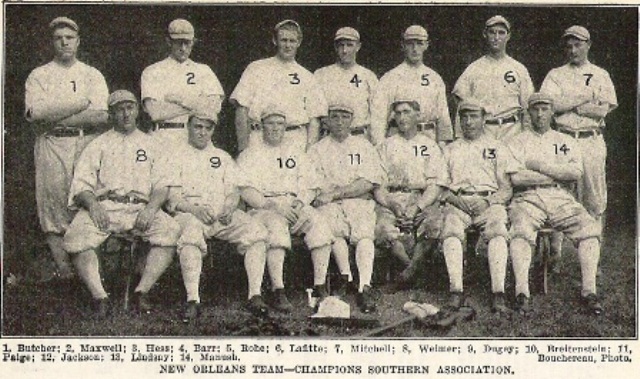
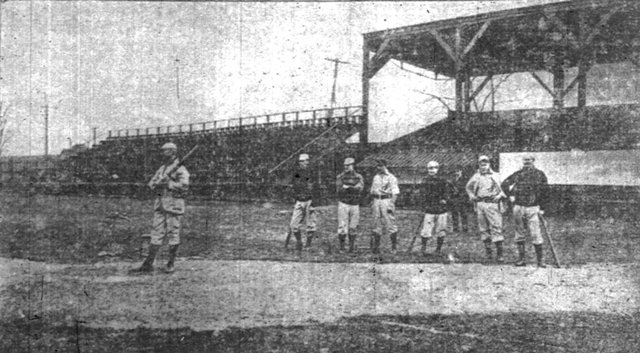
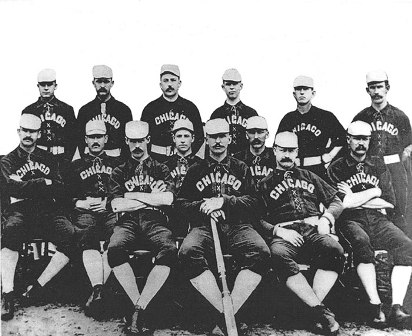
Charlie Frank's 1910 New Orleans Pelicans

Charlie Frank’s 1910 New Orleans Pelicans

In 1916 Frank returned to the Southern association again, organizing a stock company to purchase the Atlanta Crackers.  He managed Atlanta to a fifth place finish in 1916, and then won pennants in 1917 and ’19.

Frank sold his majority interest in the Crackers in May of 1921 but continued to manage the team.  In May of 1922, he resigned citing poor health—he died in Memphis three weeks later.
“Demoralizing a Successful Organization For the Sake of a Few Unimportant, Mediocre Ball Players”

19 Sep

When Charlie Babb jumped from the Indianapolis Indians of the American Association to the Memphis Egyptians in the Southern Association in June of 1902, he was not alone.

Pitcher Jim St. Vrain, recently released by the Chicago Orphans and under contract with the Tacoma Tigers in the Pacific Northwest League, signed with Memphis rather than going to Tacoma.

Another American Association player, Second baseman Bill Evans of the Columbus Senators, also jumped to Memphis.  The Cincinnati Enquirer said he jumped being suspended by the Senators for being “too drunk” to take the field on June 18.

Memphis manager Charlie Frank’s three new players would be a source of controversy in the Southern Association for the remainder of the season and a continuation of an ongoing feud over the league’s salary limit which The Sporting Life said: “a majority of the clubs are known to have violated.”

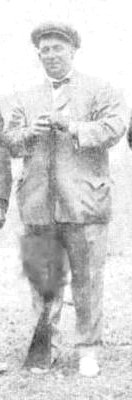
Charlie Frank

Charlie Frank

Southern Association President John Bailey Nicklin, acting on orders from Patrick T. Powers, president of National Association of Professional Baseball Leagues (NAPBL), ordered Frank not to play any of the three.  Frank not only defied the order but according to The Atlanta Constitution, gave Nicklin a “lecture in abuse,” and threatened to “break the league.”

Throughout July, the situation became increasingly absurd.

On July 11 Nicklin ordered umpire Ed Cline (the same Ed Cline who may, or may not, have initially approached Babb about jumping) to not allow St. Vrain to pitch against the Nashville Volunteers, managed by Frank’s biggest ally in the league, Isaac Newton “Ike” FisherThe Atlanta Constitution said Cline became mysteriously “sick and could not work,” although he “was upon the grounds while the game was being played.”  St. Vrain and the Egyptians beat the Volunteers 8 to 5 with “Red” Ehret and Nashville’s Bill Dammann acting as umpires.

After the game Frank was suspended for 10 games and threatened with being blacklisted if he played St. Vrain again.  Later that week Frank received a temporary injunction allowing him to continue using St. Vrain. And while Babb and Evans had been suspended by the league and were not covered by the ruling, Frank continued to put both in the lineup.  Frank also continued to manage the team despite his own suspension.

On July 25 Frank was again ordered by Nicklin not to play Babb and Evans.  This time, he complied, for one day.  The two players sat out an 8 to 4 victory over Atlanta (St. Vrain pitched for Memphis).  Both were again in the lineup the following day, and on July 27 Frank filed a suit against the league and Nicklin seeking $10,000 in damages.  He also sought and received an injunction “restraining President Nicklin from interfering with the playing of Babb and Evans.”

The Constitution began calling the team the “Memphis Injunctionists.”

The Sporting Life said Frank was:

“Demoralizing a successful organization for the sake of a few unimportant, mediocre ball players.”

Nicklin, the league, and the NAPBL blinked first.

Two days after the suit was filed an agreement was reached.  Babb and Evans would remain with Memphis and were reinstated from suspension; the fourth place Egyptians agreed to forfeit every game in which Babb and Evans participated in while under suspension—dropping the team to fifth place.

The controversy appeared to be over.  It wasn’t.

On August 4 the Egyptians arrived at Athletic Park in New Orleans to play the second place Pelicans.  The New Orleans Times-Picayune said:

“Under orders of (Pelicans) manager Abner Powell a big policeman today refused admission to St, Vrain, Evans and Babb, of the Memphis club, when they tried to enter.”

The game was canceled

The following day:

“Manager Frank again took his team to out to the park, but admission was refused to St. Vrain, Evans and Babb.”

The umpire, picked by the Pelicans, “declared the game forfeited to New Orleans,” and Powell shared with the press a telegram from the Little Rock Travelers which read:

“Congratulations upon your firm methods.  We will stand with you.”

Despite the earlier agreement, the NAPBL announced that Frank and St. Vrain were still under suspension.

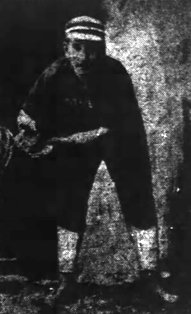
Jim St. Vrain

Jim St. Vrain

On August 9 the Shreveport Giants refused to allow St. Vrain into the ballpark for a double-header.  Memphis took the field for each game with only eight players and no pitcher.  They forfeited both games to the Giants.

Memphis was due to travel to Little Rock for a three-game series from the 11th through the 13th.  The Travelers announced that they “would not play with St. Vrain and Frank in the game.  Babb and Evans will be allowed to play (but) under protest.”

On August 12 Nicklin resigned at a meeting of league owners in Chattanooga (Memphis and Nashville refused to attend).  He said he was “almost helpless to enforce the rules of the league,” because of Frank’s numerous injunctions.  He was replaced by vice president William Kavanaugh.  A motion was passed to suspend Frank and St. Vrain indefinitely, but Babb and Evans were officially reinstated.  Again.

In response, Frank filed another $10,000 lawsuit naming every team in the league except Nashville.

On August 27 in Nashville, St. Vrain started for Memphis.  President Kavanaugh fined Nashville $1000 and “suspended that club for the balance of the season,” he threatened “drastic measures’ towards Memphis as well, but for the several injunctions that kept him from acting.  Two days later the suspension was lifted.

On August 30 a Little Rock judge enjoined Frank from “playing or attempting to play St. Vrain in any state.”

The Atlanta Constitution headline summed up the opinion of most Southern baseball fans on September 22:

To The Relief of All the Season is Now Over

As an appropriate end, Memphis beat Atlanta on the final day of the season behind the pitching of the still suspended Jim St. Vrain.

The no longer suspended Nashville Volunteers won the pennant.

The Indianapolis Indians, the team Charlie Babb jumped, won the American Association pennant.

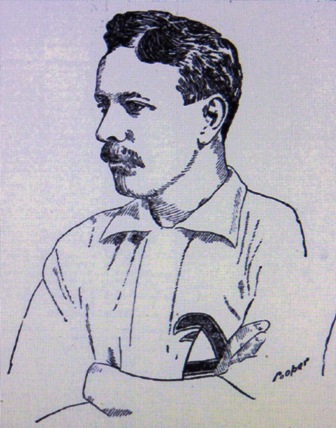
Charlie Babb

Charlie Babb

The Indianapolis papers had predicted that Babb’s career would be doomed when he jumped.  In 1903, he was purchased by the New York Giants.  He played in the National League with the Giants and Brooklyn Superbas through the 1905 season.  In 1906, he became a minor league player/manager; with the Memphis Egyptians.  He stayed with Memphis until 1910 and managed to become embroiled in one more controversy.

Jim St. Vrain was only 19-years-old during that 1902 season.  He finished 12-4 with Memphis.  He went to the West Coast in 1903.  His career was over after the 1905 season.

Bill Evans played in the Southern Association until 1906; he eventually became a member of three different teams who refused to play against him in 1902: New Orleans, Shreveport, and Little Rock.

Charlie Frank did just fine in the end.  More on that next week.

“Baseball will be in Utter Disrepute”

18 Sep

As common as contract jumping was during the first 30 years of organized baseball, there are very few cases in which the particular inducements that led to the player breaking his contract are available.  Such is the case with Charlie Babb.

Before the 1902 season, Babb, a 29-year-old journeyman infielder, signed to play with the Indianapolis Indians in the newly formed American Association (Indianapolis was a member of the Western Association in 1901).

The Sporting Life described  as “a base-hit killer,” but “anything but a graceful fielder.”  The St. Paul Dispatch said:

 “He covers all kinds of ground, and it is next to impossible to lay down a bunt and get away with it.”

Charlie Babb takes batting practice in Indianapolis in 1902.

Charlie Babb takes batting practice in Indianapolis in 1902.

Babb was installed at third base where The Indianapolis Times said he would be an improvement over previous third baseman Eddie Hickey who had committed 49 errors in 101 games in 1910; Babb told The Indianapolis News “he will try his best to make Indianapolis fans forget that there ever was a third-baseman by the name of Hickey.”

Babb quickly became a favorite with fans and the press.  When the Indians moved into second place in June The Times said Babb won games for the team with “his hands, feet and bat.” The News said:  “Babb can borrow a dollar from the left field bleacherites any time he wants to.”

Babb was hitting .308 in 182 at bats through June 22, and his popularity in the city was why a small item that appeared in several Midwest and Southern papers that day was largely ignored in Indianapolis.

Charlie Babb

Charlie Babb

It said that earlier in June, while the Indians were playing in Louisville, Babb was approached by Philip “Red” Ehret, a Louisville native who knew something about jumping, and currently played for the Memphis Egyptians in the Southern Association (some versions said it was a Southern Association umpire named Ed Cline who approached Babb).  The story said Ehret had “urged” Babb to jump and that “Babb turned him down.”

Disinterest over the story in Indianapolis turned to outrage two days later.  Babb had not turned Ehret and Memphis down; he jumped the Indians to join the Egyptians.

The News said:

“Babb, the deserter, was one of the most popular players ever in this city, and by his action it is doubtful he ever again will have such a place in the affections of any city.”

The Indianapolis papers provided precise details of just what was offered:  Babb would receive $45 more a month, a $300 bonus, $80 transportation expenses, and a winter job in Memphis.

The News said “Contract jumping is the greatest evil that afflicts baseball at present,” and warned that “baseball will be in utter disrepute,” if something wasn’t done to end the practice; Ignoring the “evil” of the reserve clause.

Orville “Sam” Woodruff replaced Babb at third base.  Within days, The News, which less than a month earlier had called Babb “the best third baseman” to ever play in Indianapolis; said Woodruff had played so well that “Indianapolis fans don’t care if he never comes back.”  The Times said “Babb has nothing on Orville Woodruff in the field or at the bat.”

Orville "Sam" Woodruff

Orville “Sam” Woodruff

Babb was not the only jumper to join Memphis is June.  Bill Evans, a Louisville native and friend of Ehret left the American Association’s Columbus Senators to join the Egyptians and Jim St. Vrain, after being released by the Chicago Orphans, signed with Memphis despite being the property of the Tacoma Tigers in the Pacific Northwest League.

Tomorrow: the fallout from Babb, Evans and St. Vrain signing with Memphis.

Roy Spruell

14 Aug

Throughout the first half of the 20th Century there were thousands of independent and industrial league baseball teams that operated across the country; the only distinction, in many cases, between the quality of these teams and their players and those in “professional” leagues was the “professional” teams were recognized by The National Association of Professional Baseball Leagues.

Given the economics of the game, which usually required players to be employed during the off season, it was often as profitable, or even more so, to play with an independent or semi-professional team that either paid the same or more as the “professional” leagues or provided the player with a job.

As a result, there are thousands of players, who while well-known names in the towns, cities and regions where they played, have been largely forgotten.

Roy Layton Spruell is one of them.

From 1920 until 1939 Spruell was a fixture in Southern baseball, specifically on the Gulf Coast, although his “official” statistics only indicate limited “professional” appearances between 1924 and 1936.

Spruell appears to have been born January 25, 1900 in Birmingham, Alabama according to state records and census data, (his grave lists his birth year as 1902, but like many players of his era, he likely subtracted a couple of years at some point during his career and the new date stuck).

Raised in Mobile, Alabama, he first made a name for himself in 1920 pitching with industrial teams at the Southern Kraft Paper Mill and White Swann Laundry Company in Mobile.

Two years later he was a member of an independent team in Mississippi, the Ocean Springs Regulars.  In addition to Ocean Springs, the loosely affiliated semi-pro league included independent teams from nearby Mississippi towns Biloxi, Gulfport, Pascagoula  and Wiggins, and industrial teams out of New Orleans, including the Choro Colas (later renamed RC Cola), the Tokay Teas.

The following season Spruell played for another Southern Kraft Mills team; contemporary newspaper accounts alternately called the team either the Moss Point or the Kreole Papermakers—the mill was located in Moss Point, Mississippi, but the team appears to have played home games in nearby Kreole.  Spruell’s older brother Harvey was his teammate with the Papermakers.

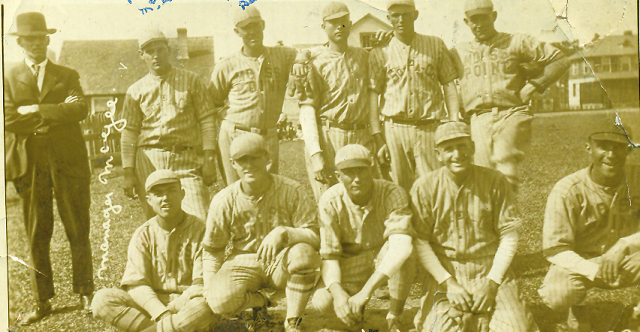
The 1923 Papermakers, Roy Spruell is standing second from right.  His brother Harvey is in the middle of the front row.   The other players are identified as: Standing at left - Manager McGee 2nd from left  - Pat McGee 3rd from left  - Matt Delmas 4th from left-unidentified. 6th from left - Sam Leslie   Seated at left - Johnnie Cunningham 2nd from left - Brother Nelson 4th from left - John Bell

The 1923 Papermakers, Roy Spruell is standing second from right. His brother Harvey is in the middle of the front row. The other players:: Standing Manager McGee, Pat McGee, Matt Delmas, unidentified, Roy Spruell, and Sam Leslie
Seated Johnnie Cunningham, Brother Nelson, Harvey Spruell, and John Bell.


In 1924 he signed his first professional contract, posting an 11-12 record for the fifth place Laurel Lumberjacks, in the six-team Cotton States League.  The following season, pitching for the last place (51-70) Alexandria Reds, Spruell was 14-10.

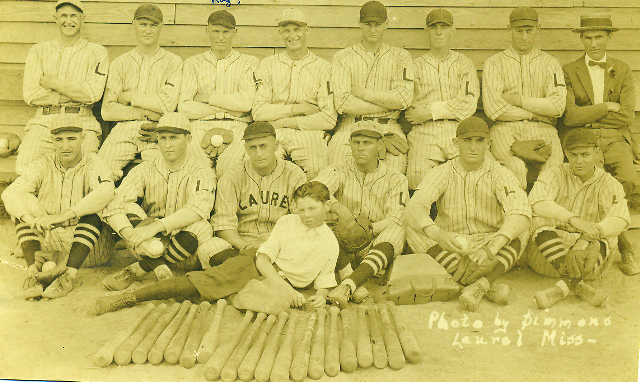
1924 Laurel Lumberjacks.  Roy Spruell is in the top row, third from left.  The player seated on the far left in the front row appears to be future big league pitcher Ray Moss who pitched for the Brooklyn Robins and Boston Braves.

1924 Laurel Lumberjacks. Roy Spruell is in the top row, third from left. The player seated on the far left in the front row appears to be Ray Moss, the only member of the Laurel club to play in the big leagues,; he pitched for the Brooklyn Robins and Boston Braves.

Spruell had his best professional season in 1926 as a member of the Hattiesburg Pinetoppers.  He led the team to the Cotton States championship with a 22-8 record, and got his name in newspapers across the country in August.  The Associated Press said:

“Friday the 13th was far from unlucky for Roy Spruell, pitching star of the Hattiesburg club of the Cotton States League, Spruell hurled the first no hit, no run game of his career.”

Spruell allowed just two walks (shortstop/manager Herschel Bobo also made an error) to the Monroe Drillers, but still only faced the minimum 27 batters.

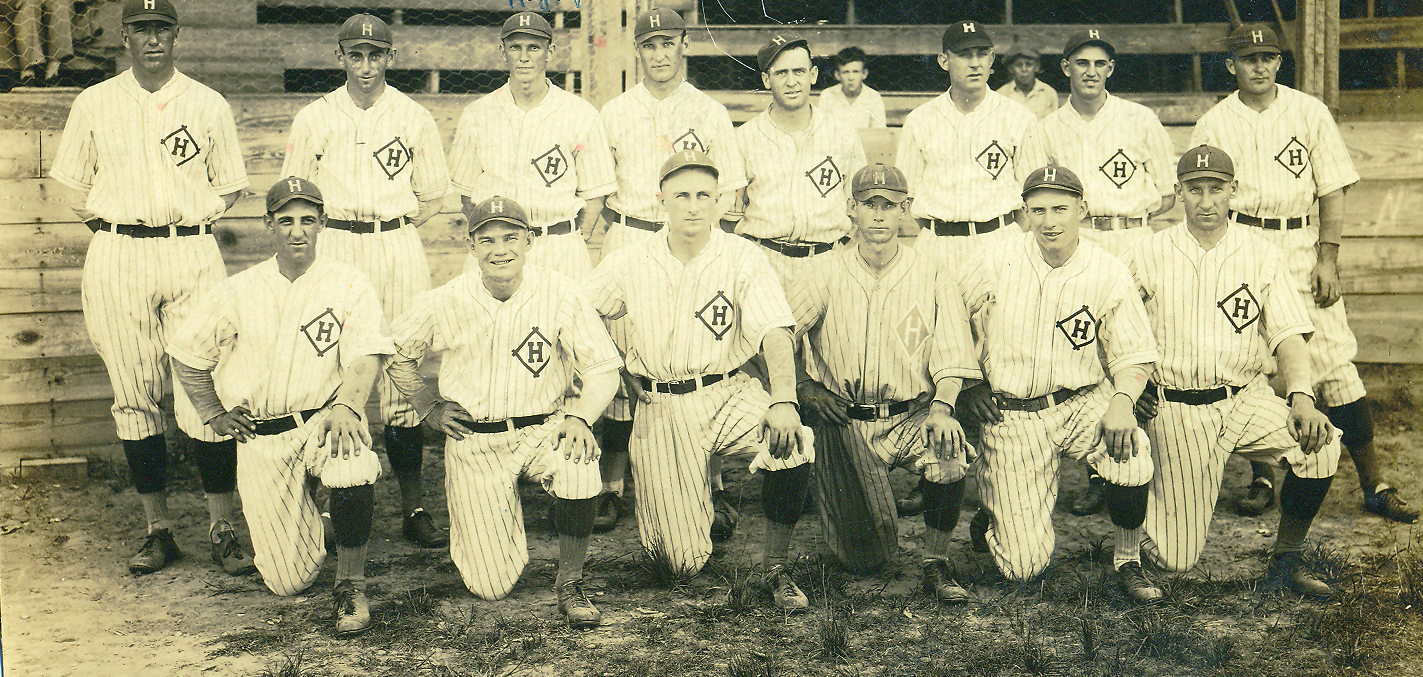
The 1926 Cotton States League champion Hattiesburg Pinetoppers.  Roy Spruell is standing third from left.  Manager/shortstop Herschel Bobo is kneeling far left.

The 1926 Cotton States League champion Hattiesburg Pinetoppers. Roy Spruell is standing third from left. Manager/shortstop Herschel Bobo is kneeling far left.

At the end of the 1926 season Spruell was purchased by the Houston Buffaloes of the Texas League, but never played in Texas.  He started the season with the Memphis Chickasaws in the Southern Association and was released to the Knoxville Smokies in the South Atlantic League in May of 1927.  He was 10-10 in Knoxville and also appeared in 20 games in outfield.  The Spartanburg Herald called Spruell “the elongated righthander,” (he was listed variously from 6’ to 6’ 2”).

Spruell returned to the Smokies for the 1928 season, but a hand injury led to a slow start and with a 1-3 record at the end of May he was released and returned to the Cotton States League. He pitched professionally through the 1930 season, but struggled with injuries his last three seasons and pitched for several teams:  Laurel and Hattiesburg again (he also pitched for the Baton Rouge Essos when the Hattiesburg franchise relocated there during the 1929 season) as well as the Jackson Senators in the Cotton States League, and the Jacksonville Tars in the Southeastern League.

Spruell spent the next decade playing with and managing independent and industrial league teams in the South.  He played from 1931 to 1935 in the Mississippi Coast League, a strong semi-pro league with teams sponsored by union and industrial interests.

He left the Gulf Coast the following year, relocating in Savannah, Georgia where he played for and managed the Union Baggers—the company team of the Union Bag and Paper Company, operator of the world’s largest paper mill.  The team was considered one of Georgia’s best semi-pro and industrial teams, playing in the Coastal League, which included teams in Georgia, Florida and South Carolina.

The Union Baggers, circa 1937.  Roy Spruell, standing second from right.

The Union Baggers, circa 1937. Roy Spruell, standing second from right.

Spruell’s baseball career appears to have ended around 1940.

He eventually relocated to Pensacola, Florida and worked for the Florida Pulp and Paper Company; he suffered a heart attack at work and died in 1950

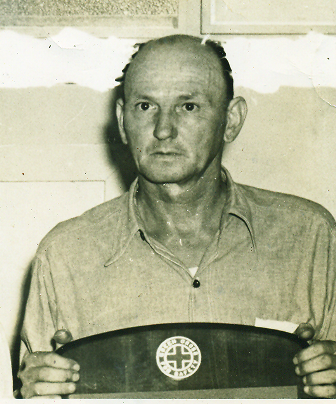
Roy Spruell shortly before his death in 1950.

Roy Spruell shortly before his death in 1950.

Like thousands of others who played baseball in small and large towns, and small and large leagues, throughout the country, Roy Spruell’s career brings to mind a passage from W. P. Kinsella’s great novel “Shoeless Joe:”

“For some reason, I recall the question at the bottom of the form sent by the Baseball Hall of Fame to everyone who has ever played professional baseball: ‘If you had it to do over again, would you play professional baseball?’  The historian at Cooperstown, Clifford S. Kachline, said he couldn’t recall even one ex-player answering ‘no’ to the question.  I wonder if any other profession can say the same?”

Thank you to Roy Spruell’s grandchildren, Paula Grady and Bob Gattis for sharing the photographs used in this post as well as a copy of Mr. Spruell’s obituary. 

Defending their own Honor

12 Aug

In 1909 the Atlanta Crackers won their second Southern Association championships in three seasons.  Big things were expected for 1910; the team’s two 20-game-winning pitchers Tom Fisher and Harold Johns were returning.

The team the Southern press called “the hitless wonders,” which hit .222 while winning the championship added two new bats, outfielder Arista DeHaven, .336 with the Terre Haute Hottentots in the Central League and Charlie Seitz, .326 with the Norfolk Tars in the Virginia League.

But it took very little for near panic to take hold in Atlanta.

Only eight games into the season the Crackers were 3-5, tied for sixth place.  The Birmingham Age-Herald was ready to pronounce the defending champions finished, and said “there was dissention and dissatisfaction in the ranks.”   The article said that manager Adolph Otto “Dutch” Jordan had already lost control of his team.

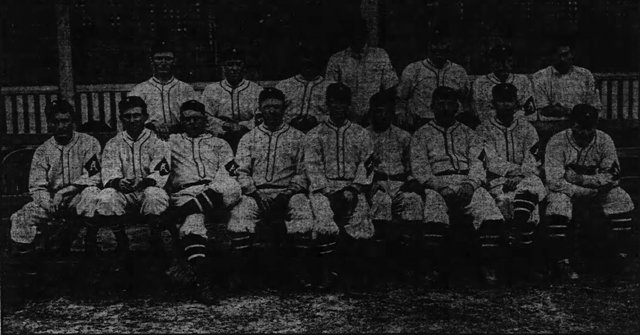
The 1910 Atlanta Crackers:  Standing, from Left to right: Arista DeHaven, Charlie Seitz, Paul Sentell, Brown Rogers, Hyder Barr, Roy Moran, and Ed Hohnhorst,  Seated from left: Scott Walker, Hank Griffin, Syd Smith, Otto Jordan, Bick Bayless, Erskine Mayer, Harry Matthews, Harold Johns and Tom Fisher.

The 1910 Atlanta Crackers: Standing, from Left to right: Arista DeHaven, Charlie Seitz, Paul Sentell, Brown Rogers, Hyder Barr, Roy Moran, and Ed Hohnhorst, Seated from left: Scott Walker, Hank Griffin, Syd Smith, Dutch Jordan, Dick Bayless, Erskine Mayer, Harry Matthews, Harold Johns and Tom Fisher.

It wasn’t enough for the team to simply deny the charges; in an unprecedented move they went right to the fans to assure them they were trying to win and happy to be members of the Crackers.

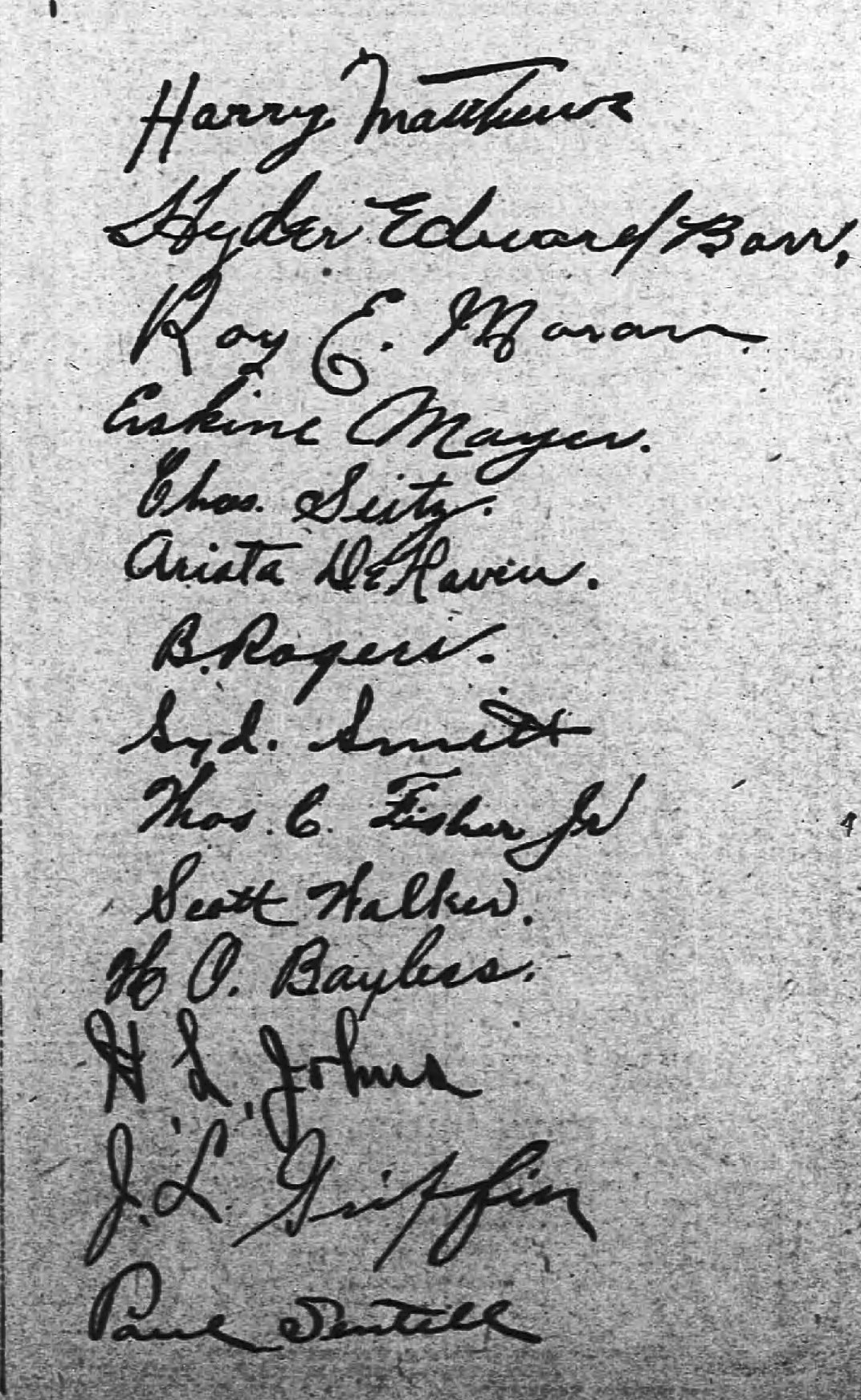
On May 1, The Atlanta Constitution ran a letter “gotten up without solicitation by the boys and the autographs of each and every man is attached hereto:”

A Card to the Faithful Fans of Atlanta:

We the undersigned players of the 1910 ballclub, appreciating to the full the kind of loyal support always accorded us by the good citizens of Atlanta, desire hereby to register an emphatic protest against a statement recently made in a Birmingham paper to the effect that there was dissention among us, and that this dissention, so it was alleged, was the cause of our defeats on the last road trip.

Without stopping to discuss the real reasons which gave us more defeats than victories, we wish to state that it gives us much satisfaction to put our friends on notice that there is not one word of truth in this malicious slander, and further, that we know of no reason why there should be any dissention in our club…It should be further interesting to state, as we do, that the very best of feeling prevails among us all, and there is not one of us who is not doing his very utmost to land another pennant for Atlanta.  We simply ask our friends to continue to put their faith in us, and in return, we desire to give them the assurance that, whether we win another pennant, or not, we are firmly determined to play the best and sincerest ball of our careers—at least so far as honest and persevering effort can aid in bringing about so happy a result.  We confidently hope to amply show both friend and foe, long before the summer of 1910 has passed into baseball history, just how basely we have been misrepresented by this idle and empty charge.

The signatures of the 1910 atlanta Crackers that appeared with their open letter to the fans.

The signatures of the 1910 Atlanta Crackers that appeared with their open letter to the fans.

After the slow start, and their pledge to “play the best and sincerest ball” of their careers,  Atlanta played well the remainder of the season, finishing with a 75-63 record, but the New Orleans Pelicans, behind “Shoeless Joe’ Jackson’s league leading .354 average, and the pitching of 41-year-old Ted Breitenstein (19-9, 1.53 ERA), and 31-year-old Otto Hess (25-9), went wire-to-wire, winning the pennant with a record of 87-53.

Atlanta would not win another pennant until 1913.

“He was Not Crazy as Reported”

18 Jul

Ervin Thomas “Erve” “Dutch” Beck hit the first home run in the American League; on April 25, 1901, the second day of the season, as a member of the Cleveland Blues; Beck homered off White Sox pitcher John Skopec at Chicago’s South Side Park.

It was a highlight in a short, promising career, like many at the turn of the 20th Century, destroyed by alcoholism.

Beck was considered the best young player in Toledo, Ohio when he joined the Adrian Reformers in the Michigan State League as a 16-year-old in 1895, then for the next five seasons, he was the star of his hometown Toledo Mud Hens in the Interstate League.  For the two seasons in Toledo for which complete records survive, Beck hit .298 in 1898 with 11 home runs and, a league-leading .360 with 15 home runs in 1900.

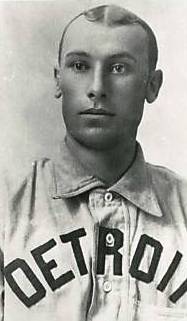
Erve Beck

Erve Beck

Earning the Nickname “Home run Dutch” in the Toledo papers, Beck was credited with 67  during his five seasons with the Mud Hens;  he would remain the team’s all-time career home run leader until 2007 when Mike Hessman (currently with the Louisville Bats in the International League) hit his 68th as a Mud Hen.

Beck also had a brief trial with the Brooklyn Superbas in the National League in 1899, hitting .167 in eight September games.

It’s unclear exactly when Beck’s problems with alcohol began, but according to fellow Ohioan Ed Ashenbach (alternately spelled Ashenback by several contemporary sources), a minor league contemporary who wrote a book in 1911 called “Humor among the Minors”,  it was well-known during Beck’s career that he was “addicted to strong drink,” and as a result suffered from “hallucinations.”

Ed Ashenbach

Ed Ashenbach (Ashenback)

Before the 1901 season, Beck, whose rights were held by the Cincinnati Reds, jumped to the Cleveland Blues in the newly formed American League; the twenty-two-year-old hit .289 and accounted for six of Cleveland’s twelve home runs.

Beck jumped back to the Reds before the 1902 season and received rave reviews early in the season.  The Cincinnati Tribune seemed to like him more at second base than veteran Heine Peitz:

“Erve Beck looks more like a second baseman than anyone who has filled the position since (Bid) McPhee went into retirement (in 1899).  He covers the ground, seems to know where to play and is capable of swinging the bat with some effect.”

His teammate, pitcher Frank “Noodles” Hahn claimed Beck hit the ball “harder than (Napoleon) Lajoie.”

Beck hit better than .300 playing second base in May but went to the bench when Peitz, who was filling in behind the plate for an injured Bill Bergen returned to second.

In June first baseman Jake Beckley missed a week with an injury and Beck filled in there; The Cincinnati Enquirer’s Ren Mulford said:

“(Beck) played the bag in splendid style…In handling ground balls Beck is as good as Beckley, and he is a better thrower… Beck gave another display of his versatility by plugging up a hole in right field.  He made one catch that was a lollapalooza…Most players would have lost heart when benched as Beck was, but he remained as chipper as a skunk during his term of inactivity, and gladly accepted the opportunity to get back into the swim. Beck is a phlegmatic soul, who takes life, as he finds it without a growl.”

In spite of a .305 batting average in 48 games and the great press he received, Beck was released by the Reds in July.  Whether the release was simply because he was the odd man out with Peitz, Beckley and right fielder Sam Crawford healthy or as a result of drinking is unknown.

Beck was signed almost immediately by the Detroit Tigers where he took over at first base after Frank “Pop” Dillon was sent to the Baltimore Orioles.  He hit .296 in 41 games but was again released at the end of the season.

Beck would never return to the big leagues.

In 1903 he .331 for the Shreveport Giants in the Southern Association, he jumped Shreveport the following season and played for the Portland Browns in the Pacific Coast League.   He returned to the Southern Association with the New Orleans Pelicans in 1905.  After starting the 1906 season in New Orleans, he was released in July and signed by the Nashville Volunteers; his combined average with both Southern Association teams was .211.

Beck’s drinking was, according to Ashenback and contemporary newspaper accounts, common knowledge by the time he wore out his welcome in Nashville in August and was sold to the Augusta Tourists in the South Atlantic League.

That stop would last for only one game.

The 27-year-old, four years removed from the American League, played first base for the Tourists on August 6.  Augusta second baseman Ed McKernan said, “It was evident when he reported there was something amiss with him,” and claimed Beck chased “an imaginary flock of geese away from first base” during the game.

The following day, according to The Augusta Chronicle, Beck “created a sensation in the clubhouse…causing all but two of the players to leave the house.”  As a result, Augusta released him.

The following day The Chronicle said:

“(Beck) ran amuck this morning and created great excitement on the street.

“While in a room on the third floor of the Chelsea hotel the big infielder suddenly began to see things and sprang from the third story window to the ground below.  Only two intervening telephone wires and a rose bush saved his life.

“He then darted down an alley and hid himself in a store.  He was finally captured and came quietly back to his room with a policeman and (Tourists outfielder Frank) Norcum.”

The Sporting Life assured their readers that Beck “was not crazy, as reported, but only suffering from the effects of a (drunken) spree.”

McKernan said “During his convalescence…Beck would smilingly avow his determination to abstain from strong drink.”

There were varying reports regarding the extent of his injuries, and it’s unknown whether he was physically able to play after the fall, but Beck would never play professionally again.

He returned to Toledo where he operated a tavern and appears to have been unable “to abstain from strong drink;” he died in 1916 of Articular Rheumatism complicated by Hepatic Cirrhosis.

“The Ty Cobb of Trapshooters”

15 Jul

Lester Stanley “Les” German broke into professional baseball with a bang in 1890.  The 21-year-old played for Billy Barnie’s Baltimore Orioles, a team that had dropped out of the American Association and after the 1889 season and joined the Atlantic Association, a minor league.

German was 35-9 in August when the American Association’s Brooklyn Gladiators folded in August, the Orioles returned to the association, and German returned to Earth; posting a 5-11 record for the big league Orioles.

German was a minor league workhorse for the next two and a half seasons.  He was 35-11 for the Eastern Association champion Buffalo Bisons in 1891; he appeared in 77 games and pitched 655 innings for the Oakland Colonels in the California League in 1892, and was 22-11 for the Augusta Electricians in the Southern Association in July of 1893 when his contract was purchased by the New York Giants.

Les German, 1894

Les German, 1894

German would never win in double figures again; In five seasons in the National League he was 29-52, including a 2-20 mark with the 1896 Washington Senators.

It was German’s next career that earned him the most notoriety.  A crack shot, German became one of the most famous trapshooters in the country for the next thirty years.  He won numerous championships and was often featured in Buffalo Bill’s Wild West Show with Annie Oakley.

A National Sports Syndicate article in 1918 said “Lester German is the Ty Cobb of trapshooters.”  The article said that beginning in 1908, when official records were first kept, German had maintained a “remarkable average,” shooting a t a better percentage than any other professional marksman.

Les German, 1918

Les German, 1918

As German’s reputation as a shooter grew, his legacy as a pitcher became inflated.

A mention of his baseball career in a 1916 issue of “The Sportsmen’s Review”, credited German, and his 9-8 record,  with “leading the Giants,” to their 1894 Temple Cup series victory over the Baltimore Orioles, there was no mention of Amos Rusie’s two shutouts .  A 1915 article in The Idaho Statesman inexplicably said German “headed the National League in both pitching and fielding” in 1895—German was 7-11 with a 5.54 ERA and committed 2 errors in 45 chances on the mound; he also made eight errors in 11 games he filled in for the injured George Davis at third base.

German operated a gun shop and continued to organize and participate in shooting tournaments until his death in Maryland in 1934.

Brought the League “Discredit throughout the South”

18 Jun

In the final weeks of the 1886 Southern Association season, second place Savannah travelled to Atlanta for a four game series against the league leaders.

Hours before the August 18 game, umpire John McQuade left Atlanta by train.  The Macon Telegraph called the circumstances of his departure “Mysterious.”  The Atlanta team said the umpire left town because he was bribed to throw the game by Isaac G. Haas, owner of Savannah.

The Telegraph said McQuade’s departure was the result of his being followed by a detective hired by Stephen Andrew Ryan, a wealthy Atlanta businessman who was one of the directors of the Atlanta team.

The paper quoted a Detective Jones:

“I was hired by Mr. Steve Ryan to shadow McQuade, and I did so.”

Jones went on to say that he saw the umpire speak with various people, including Haas, Savannah catcher John “Tug” Arundel and Ryan’s brother John, who claimed he tried to convince McQuade to stay and work the game.

Savannah pitcher Hank O’Day said the umpire told him “he had been offered money by Mr. Ryan, of the Atlantas, to stay and umpire the games in Atlantas favor and said that he would not and could not do so.”  Arundel said McQuade had told him he had been offered money by “one of the Atlanta officers.”

After McQuade left, Atlanta installed backup catcher Joe Gunson as umpire.  Atlanta shut out Savannah 2-0, The Constitution said “Gunson gave every close decision against Atlanta…his evident desire to be fair, carried him, frequently, too far.”

Joe Gunson, umpire for a day

Joe Gunson, umpire for a day

Savannah disagreed.   Haas demanded that, as had been done earlier in the year, when an umpire did not arrive in Savannah for a series—the teams selected umpires on alternating days.  Atlanta refused; claiming league rules gave them the right to name the umpire, and chose a former local player named George Whitlock to work the second game.

When Atlanta took the field at 3:30 PM the following day in front of a large crowd, the Savannah team was not present, The Telegraph said:

(Frank) Wells fired nine balls over the plate, which were caught by Gunson, and the umpire gave the game to the Atlanta by a score of 9-0.”

The Constitution said Savannah’s Hass “without cause declined to permit his men to play.”  The Atlanta police also got involved, arriving at the depot before the Savannah team was able to board a train and arresting five members of team, including O’Day and Arundel.

Arrested in Atlanta--Hall of Famer Hank O'Day

Arrested in Atlanta–Hall of Famer Hank O’Day

The Savannah Times said the police attempted to arrest the entire team, “but some of them dodged the officers and got away,” the five players were charged with “disorderly conduct and using profane language,” they were fined between $5 and $10 each and released.

The Times also claimed that Haas, and other Savannah team officers and fans were being “roughly handled,” and “pretty severely abused,” on the streets and in the hotels of Atlanta.

Within days McQuade made a statement under oath “that no Savannah director had endeavored to induce him to leave the city or bribe him in any way.”  McQuade also sent a letter to The Sporting Life and Southern newspapers claiming that Atlanta’s Ryan had tried to bribe him:

“Mr. Ryan, of the Atlanta club, came to me and said: ‘Here Mac, we must have the games; we have got to have them, and will give you one hundred dollars for each game.”

Regardless of the charges, and aided by the forfeited and canceled games, Atlanta won the Southern Association championship.  The season was over, but the allegations were not.

McQuade’s story was given additional credence after the end of the season.  Benjamin F. Young, a former Southern Association umpire, sent a letter to same publications McQuade had, and told a similar story.  Young’s letter implicated another prominent Atlanta citizen:  Henry Woodfin Grady, editor of The Atlanta Constitution, and a long-time supporter of baseball in Georgia.

Young said early in the 1886 season, while in Atlanta, Grady approached him and mentioned the hardship of umpire being responsible for their own travel expenses.  According to Young, Grady claimed he could “fix him up’ and said:

“’I can get passes for you on about every road you’ll have occasion to use.’  Knowing my reputation for honesty and fearing he had said too much, he failed to say ‘why’ he wanted me to take the passes, but it is evident he wanted me to favor Atlanta…Now a good many may say that Grady did not mean tany harm in offering me the passes.  If he had offered me money then of course, it would be a serious matter.  But Grady knew better than to offer me money, so he thought he could come to me in a roundabout way with the passes.”

By the turn of the century, charges such as these would have resulted in an investigation, but in Southern baseball in 1886, it was little more than a ripple.

At the end of season league meeting, the championship was “officially” awarded to Atlanta.

A resolution was introduced by the owners of the Charleston Seagulls which said Atlanta’s “treatment of visiting clubs, and behavior of their players,” had brought the league “discredit throughout the South,” and called for the team to be “censured and reprimanded.”  The resolution was adopted only after Charleston “was induced” to change “Atlanta” to “some club” in the text.

There were consequences; however, interest in baseball waned in Atlanta, and the city would not have another professional team until 1889.

Atlanta manager “Blondie” Purcell earned a return to the big leagues, finishing the 1886 season with the Baltimore Orioles in the American Association.  He played four more years, finishing with the Philadelphia Athletics in 1890.

Blondie Purcell

Blondie Purcell

Umpires McQuade and Young both finished 1886 in the American Association, and appear to have never again been approached with bribes.

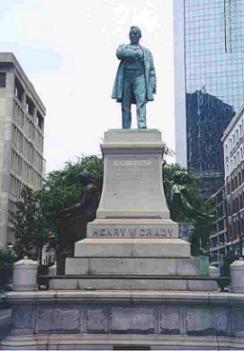
Henry Grady, newspaper editor, segregationist, and “Spokesman for the New South,’ died three years later.

Henry Woodfin Grady statue in Atlanta

Henry Woodfin Grady statue in Atlanta

Stephen Ryan’s dry goods business collapsed in 1891, with debts anywhere from $500,000 to $2 million depending on the source, including losing $16,000 on the Bob Fitzsimmons /Jack “Nonpareil” Dempsey fight.  Accused of hiding assets he was jailed for 13 months.  Upon his release he rebuilt his business only to suffer a similar collapse with a year.  He died in Atlanta in 1908.

“Atlanta’s Baseball Bullies”

17 Jun

During the 1885 season, Lewis Henke of the Southern League’s Atlanta Atlantas was killed during a game; the death was attributed to on-field rowdyism by the Southern press who hoped the death of the popular player would help end brawling behavior in the league.

In January of 1886, the Atlantas hired a new manager, William Aloysius “Blondie” “Billy” Purcell.   Purcell had split the 1885 season between the Philadelphia Athletics in the American Association and the Boston Beaneaters in the National League, hitting .279 in 87 games.  The Sporting Life said:

 “Billy will make a good manager, and is capable of securing a team—even at this late date—to win the championship. “

William "Blondie" Purcell

William “Blondie” Purcell

Purcell came to Atlanta with an excellent reputation, The Philadelphia Inquirer described him as being “Of a genial, happy disposition,” who was very popular when playing for the Athletics, and in 1883 and ’84 as a member of the Quakers.

That changed quickly, just two weeks into the season The Macon Telegraph said under the headline “An Alleged Conspiracy against Purcell,” that the new manager had incurred the wrath of his players by “ruling the team with an iron hand.”

After the rough start, the team appears to have turned their wrath towards their opponents and became the most hated team in the league.

Over the course of the next four months, Southern papers chronicled the bad behavior of the Atlanta squad.

It started with a game against the Charleston Seagulls when Purcell was accused of cheating, The Charleston News and Courier said:

“Manager Purcell was playing in the left field and the Charleston team was at the bat.  During the inning one of the Charleston team batted a ball to left field.  It went over the fielder’s head and, after striking the fence, rebounded and then went into the ditch.  The fielder started for it, but after running only a short distance took a ball from his shirt pocket and through it to the diamond.  The remarkable rapidity with which the ball was fielded was loudly applauded at the time…The fielder subsequently went to the ditch, picked up the ball and tossed it in the diamond…The incident was witnessed by several people, and the statement can be substantiated if the proof is demanded.”

Cheating turned to “bullying” as the season progressed.

The Savannah Times dubbed the team “Purcell’s Plug-Uglies,” and said of them after a July game:

“From the start of the game yesterday the Atlantas began their rowdyism, (Tom) Lynch was running to first in the first inning, the ball got there just ahead of him, Lynch deliberately struck (Jim) Field with his fist…from then on the whole team began to kick and try to hack the umpire.  In this Purcell was ably assisted by (John “Monk”) Cline and (John “Cub”) Stricker, two of the rowdiest  ball players that have been seen on our field…The conduct of the Atlanta club was most reprehensible, and has placed them in an exceedingly unenviable light.”

Tom Lynch, one of Atlanta's bullies

Tom Lynch, one of Atlanta’s bullies

Earlier that month after a couple of close wins over the Seagulls, The News and Courier again criticized the Atlantas saying the team “ought to be kicked out of the league,” and said:

“(T)here was an immense crowd present to witness the game, but their afternoon’s pleasure was completely spoiled by the disgusting behavior of the visitors, whose kicking and sharp practices are sufficient to drive any respectable audience from a ball field.”

After another game in Charleston, The News and Courier said Purcell’s team used “blasphemous and obscene language,” and:

“Those who attended the game this afternoon are outspoken in their condemnation of the disgraceful behavior of the Atlanta team, and declare that either they should not be allowed to continue in the league, or that they should be made to behave themselves at least decently in the presence of the communities where they have to play.”

The Macon Telegraph called the team “Atlanta’s Baseball Bullies,” and said after a game in which Purcell was fined $10 “for his ungentlemanly remarks,” that Atlanta played “good ball,” but that it was “marred” by their conduct.  The paper also said:

“The Atlanta team is evidently akin to the bulldozing idea.  The bullies and braggarts who compose the team have evidently been taught that an umpire is a very insignificant personage and to be influenced by blackguardism.”

Similar charges of “rowdyism” and “bullying” were made throughout the season.

The Atlanta Constitution saw nothing wrong with the team and blamed the criticisms from the papers in other Southern Association on “jealousy” over the team’s success.

With Atlanta holding on to a small lead for the league championship, the most serious charges would wait until the final weeks of the season, and include two of Atlanta’s most prominent citizens …tomorrow.

“Calvo May Come Out But No One Cares”

5 Jun

Jacinto Calvo and San Francisco Seals owner Charlie Graham were unable to come to terms on a contract for 1918, and the local press quickly turned on the outfielder.

The San Francisco Chronicle said:

“(Calvo) is a simple-minded Cuban boy…When he is hitting he can go around the bases in nothing flat.  When he has a batting slump, he develops water on the knee and can hardly limp up to the plate.”

He remained in Cuba and served as a police officer in Havana.

It was rumored again in 1919 that Calvo might return to the Seals, but The Chronicle, under the headline “Calvo May Come Out But No One Cares,” made it clear that twelve months had not softened opinions about the holdout outfielder:

“Calvo has written friends that he wants to come back, but if he stays in that dear old Havana until Charlie Graham coaxes him back, he will grow whiskers a foot long.  Graham really tried to get Calvo last year, for he was in a bad way for lack of outfielders, but if there is any coaxing to be done this year, Calvo will do it.”

Calvo

Calvo

Terms were not reached for 1919, and Calvo remained in Havana for another year.

In February of 1920 The Chronicle said Calvo, “Who bobs up every year about this time,” had written Graham saying he wanted to return to the Seals, then in March the paper reported that “The Havana World” said that Calvo “has joined the Franklin, PA independent team together with (Manuel) Cueto.”

Neither report proved true; instead, Calvo was signed by Clark Griffith for a second tour of duty with the Washington Senators.  In 17 games he had only one hit, a triple, in 23 at-bats before being sent to the Little Rock Travelers in the Southern Association in July.

Calvo could not hit American League pitching, but no one questioned his throwing arm; except teammate Stanley “Bucky” Harris.  The future Hall of Famer wrote in 1925, in a series of articles he wrote for The North American Newspaper Alliance, that his doubts about Calvo’s arm almost cost him his career:

“I thought I could hurl a baseball farther than anyone on the club and entered into a contest with Jack Calvo, an outfielder.  The Cuban has a reputation for having a great arm.  I had won a long-distance throwing contest…while with the Buffalo club.  That convinced me I could hold my own.”

Despite being warned against taking on Calvo by teammate Clyde Milan, Harris went ahead with the contest, the two stood in the infield:

“(Calvo) cut loose.  He threw the ball over the right field bleacher wall.  I realized it was a truly wonderful peg.”

Harris said he was concerned about being caught by manager Clark Griffith and rushed his throw:

“My elbow cracked as the ball left my hand.  It sounded to me as if a board had been broken across a fence…The ball dropped yards inside the park.”

Harris said for three weeks he “wondered if I ever would be able to throw a ball again.”  By the time Harris returned to the lineup, Calvo was on his way to Little Rock where he hit .306.

From 1921 through 1926 Calvo spent his summers playing baseball in the states; most notably in Fort Worth, where he helped lead the Texas league Panthers to two Dixie Series victories over the Southern Association champions in 1923 and ’24.  His winters were spent working as a lieutenant in Havana’s Harbor police and playing baseball in the Cuban League.

Calvo’s career ended abruptly in September of 1926.  The San Antonio Light reported that the former Fort Worth outfielder, then with the Memphis Chickasaws in the Southern Association “must forego baseball…and return to his job, his leave of absence was about to expire, and he packed up and beat it for a boat.”

Calvo played briefly in Cuba that winter but never played professionally again.  He was elected to the Cuban Baseball Hall of Fame in 1948 and died in Miami in 1965.