Tag Archives: Southern Association

Filling in the Blanks—”Wee Willie” Wilson

21 Sep

Baseball Reference includes listings for “H. Wilson,” “Herbert Wilson,” “W. Wilson” and another  “W. Wilson”, all playing at various times during the 1920s.  All four listings are actually for the same player:  Herbert Emanuel “Wee Willie” Wilson.

Born in Florida in 1896, Wilson began his professional career in 1920 after serving in World War I and playing semi-pro ball.  He was a member of the inaugural St. Petersburg Saints in the Florida State League along with Dexter “Legs” Rambo who I previously profiled.
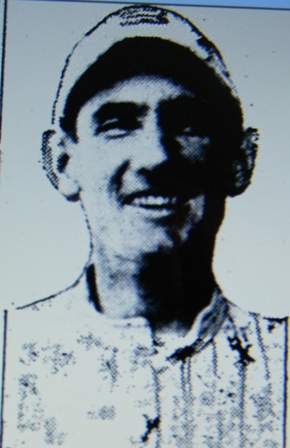
Herbert “Wee Willie” Wilson

Wilson was 5’ 10” and said to weigh no more than 150 pounds and as little as 125 in various newspaper accounts.

Wilson was a pitcher and middle infielder during the Saints mediocre seasons in 1920 and 1921 (he was 12-20 for the ’21 Saints).  In 1922 the Saints hired veteran minor leaguer George Block to manage the team (Baseball Reference does not cite Block’s time with the Saints, but does have an unrelated listing for a “Block” with the ’22 Saints).

Block kept very few players from the previous Saints teams, and built a formidable ball club.  Wilson was one of the few players who remained from the earlier team.

Led by future Major Leaguers Bunny Roser (the 20 year old earned his short 1922 shot at the major with the Saint Louis Browns after the Saints season), Elliot Bigelow (who hit .343), and manager Block who hit .411, the 1922 won their first Florida State League championship.

Wilson contributed a 13-10 record to the championship team.  Wilson followed with a 12-11 record in 1923.  In 1924 he broke out as star for the Saints, going 26-7.  The financially troubled league didn’t finish the season, however; and Wilson ended up with the Scranton Miners in the New York Penn League for the remainder of 1924 (the Herbert Walker listing on Baseball Reference also shows 7 games for Little Rock Travelers in the Southern Association that season, I can find nothing to indicate it’s the same player).

Where Wilson spent 1925 is uncertain.  Contemporaneous newspaper accounts seem to indicate he was back with the Saints, but no records are available for that team.   Some later accounts put him with Scranton but there are no records for him that season with the team.  He was in Scranton from 1926 to ’28 posting 14-7, 12-10 and 7-7 records.  Wilson finished his career with the High Point Pointers of the Piedmont League, where spent the last two months of the 1928 season.

Wilson returned to St. Petersburg after his playing days.   In 1942 The St. Petersburg Evening Independent reported that Wilson, despite being 46 years old, had volunteered to serve in the US Navy and was due to report to Norfolk, Virginia for training.

Wilson passed away in St. Petersburg in 1956.
21 Straight

20 Sep

The Delta League only lasted two seasons, 1904 and ’05, but James Baxter Sparks made the first a memorable one.

The 21 year old Yazoo City Zoos southpaw set a professional baseball record by winning 21 consecutive games.  During one week he beat the Brookhaven team in three straight games, then after one day off shut out the Jackson Senators.  Sparks also threw a no-hitter against Clarksdale during the streak.

The Sporting Life said that Sparks appeared in 33 games during the season but there is no record of his overall record for the season.

Sparks spent the majority of his career in the low minor leagues, the only exception being 1906 with the Atlanta Crackers in the Southern Association where he went 8-10.  From 1910-1912 he was 49-23 for Vicksburg in the Cotton States League.  His career ended with Meridian in the same league in 1913.

Sparks coached the University of Mississippi baseball team in 1917 and returned to the Cotton States League as a manager in 1923 and ’24 with the Clarksdale Cubs and Laurel Lumberjacks.  He died in Mississippi in 1956.

One more bit of trivia from the Delta League.  The 1904 season featured a scoreless 19 inning game between Jackson and Brookhaven on August 24—the longest scoreless game to end in a tie in professional baseball until the record was tied by the Dodgers and Reds in 1946.

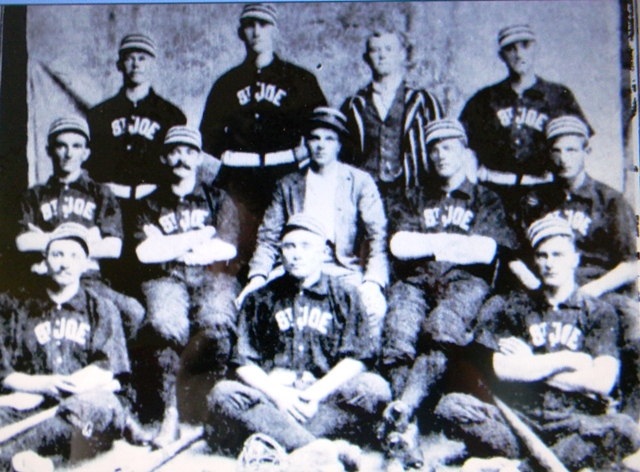
1893 St. Joseph Saints

19 Sep

This team is of interest to me mostly because I’ve never seen the photo I’ve posted published anywhere else—it is, I believe, the earliest photo of Hall of Famer Fred Clarke in a baseball uniform.

1893 St. Joseph Saints. Hall of Famer Fred Clarke is in the far right of the middle row.

Saint Joseph was part of the Western Association which disbanded in June of ’93 with the Saints in 2nd place at 11-8.

Clarke had the distinction of having the first two teams he played with be part of leagues which folded —he was with Hastings in the Nebraska State League in 1892.  Clarke ended up with Montgomery in the Southern Association for the remainder of ’93, that league’s season was also cut short because of a Yellow Fever outbreak in New Orleans.

In addition to Clarke, future major leaguers “Ducky” Holmes and Art Twineham were also with St. Joseph in 1893.

The team was owned by a local jeweler named Al Wendover, it was his only foray into professional baseball ownership.

Missing from the photo is pitcher Frank “Bones” Parvin a native Missourian who appeared in six games with the Saints.  Parvin was 6’ 3” and, depending on the news account, weighed between 150 and 180 pounds.  Parvin had an 87-81 record during an eight year minor league career with 13 different teams in the Midwest and South.  His real claim to fame however was that he was a cousin outlaws Frank and Jesse James.

Filling in the Blanks—J. Efird

14 Sep

Baseball Reference lists J. Efird, a pitcher in the Virginia League and Southern Association from 1911-1915.

Jasper Jerome “Jap” Efird was born December 30, 1890 in Albemarle, North Carolina.   Efird was a star pitcher for Washington and Lee University; his brother Walter Guy “Watt” Efird was the team’s catcher.

After leaving Washington and Lee Efrid signed with the Roanoke Tigers in the Virginia League.  The righthander won 70 games lost 37 for Roanoke from 1911-1913, including a 28-13 record in ’13.  In 1912 Efird won the final game of the season against the Petersburg Goobers giving Roanoke the league championship.

In February of 1914 the Atlanta Crackers of the Southern Association purchased Efird’s contract.  Before the season began Efird developed a sore arm and suffered from other ailments that limited to 6 appearances with Atlanta.  On May 24 Efird’s contract was sold back to Roanoke.

Jasper Jerome “Jap” Efird

Efird won 13 games for Roanoke in 1914 and posting an 18-11 record the following season for the Tigers, relocated to Suffolk, Virginia for the 1915 season.  Despite the respectable showing upon returning to the Virginia League, he never fully recovered from the arm problems and his career ended after the ’15 season, with a career 103-61 mark.

Efird returned to Albemarle where he passed away on May 27, 1935.

Game Called on Account of Singing

6 Sep

During a Delta League game between Clarksdale and Hattiesburg on July 12, 1904, the Clarksdale teams, led by manager David Gaston were riding the umpire for a series of questionable calls.

The team began singing a song which according to the Memphis Commercial Appeal “Umpire Davis said reflected on him.” (Umpire Davis’ first name is lost to history)

After several warnings to quit singing, the umpire awarded the game to Hattiesburg.  Likely the only time in history a game has been forfeited over a song.

William David Gaston was long-time figure in southern baseball, spending time as a player and manager in the South Atlantic and Cotton States Leagues as well as the Southern Association.  Contemporaneous newspaper accounts mention him as   a member of the Chattanooga Lookouts in 1901 and 1902, although Baseball Reference does not list him on either roster.

Born January 18, 1879 (BR incorrectly lists his year of birth as 1882), in Chattanooga, TN, Gaston remained active in local baseball until his death in that same city in 1948.

Escorted to the Canadian Border

31 Jul

John Morris “Moose” Baxter made it into six games for the 1907 St. Louis Cardinals hitting .190.  Baxter was born in Chippewa Falls, WI and played throughout the Midwest and Western US before his April ’07 cup of coffee with the Cardinals; he seems to have spent parts of each season between 1903 and 1906 playing independent ball in Canada—he appears on the rosters of independent teams in Calgary, Wetaskiwin and Banff during that period.

Many ballplayers of his era lived on the edges of the law, but Moose had the distinction of being escorted to the border of Canada and asked not to return.  Moose’s troubles began in 1908 while playing Montgomery in the Southern Association.  Baxter was unexpectedly released in June and Montgomery manager Jimmy Ryan said the move was “(F)or the good of the team.”  Within weeks, the newspapers in Southern Association cities reported that Moose was released for betting against his team.  He finished the season in New Orleans.

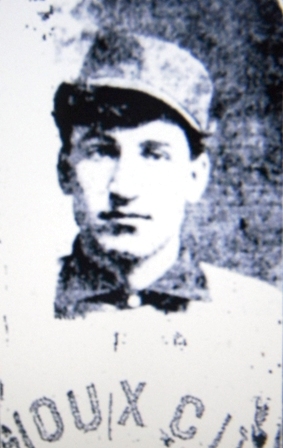
Moose Baxter Sioux City 1902

Moose played parts of two more seasons in the New York State and Western Canada Leagues but spent most of those two seasons playing independent ball in the Northwest United States and Canada.

Sometime in 1910 Moose ended up in Calgary, Alberta, Canada where he quickly made a name for himself and was described by the local papers as “The boss of the Tenderloin District.”  Moose ran Turkish baths and sold liquor in several establishments without bothering to get a license.  His brother Henry, who pitched for Edmonton in 1911 and also played independent ball in the Northwest, was his partner in the business.  After several run- ins with the law both brothers were arrested late in 1911, Moose was sentenced to six months in prison at Lethbridge, Alberta.

According to newspapers in Canada and Washington, upon his release Moose Baxter was given a week to sell off his considerable property in Calgary; and “Immediately placed in charge of Immigration Agent A.E. Humphries to be taken to the boundary line and given his freedom.”

After returning to the Northwest in 1912, Baxter split his time between Spokane, Washington and Portland, Oregon, appearing in city directories for both towns.  He died August 7, 1926, in Portland and was buried at Greenwood Memorial Terrace in Spokane.