Tag Archives: Southern League

Count Campau Explains the “Science of the Sport”—Part 2

28 Mar

Charles “Count” Campau was among the fastest and best base runners of the 19th Century; he stole 63 bases in 147 games major league games, and stole 100 with Savannah and New Orleans in 1887.  In 1900 Campau, then 36 appears, not to have slowed down much.

The Binghamton (NY) Press said at a “field day” competition in Montreal, Campau “circled the bases in 14 ½ seconds and won a handsome gold watch, which he now carries as a souvenir of the feat.”  The Press also said “At one time Campau challenged any baseball player in the world to run a match race of 100 yards for 100.”
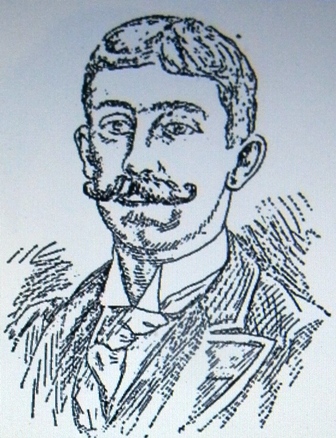
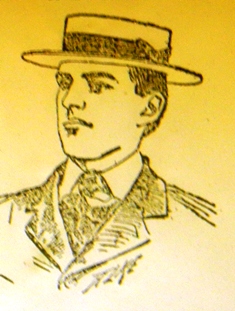
"Count" Campau

“Count” Campau

In 1893 Campau wrote an article for the New Orleans Times-Picayune about the “Science of the Sport,” last week‘s post included his comments about the battery, this week, the rest of the article:

“Many people will not believe that a third baseman’s position is one of the hardest and most trying.  As soon as he makes a hot pick-up he must immediately send the ball to first to score the batter out.  He must be a quick, hard and accurate thrower, or a fast base runner will have a good chance to get to first.

“The short stop and second baseman, as a rule, generally work together, but the short stop aids the baseman more than he receives help, in fact, the second baseman is a sort of short stop.  Should a batter be right-handed the grounder will invariably go to the short stop.  If a man has already reached first, the short stop depends upon the second baseman to be at the bag, and send the ball to him…A left-hand batter will send the ball between first and second, where the second baseman generally plays.  Should there be a man on first, the short stop is looked upon to cover the bag, and if the hit is a fast grounder and both men are quick throwers, a double can be easily worked.

“The first baseman is a mean position to play.  It looks easy, but is hard.  He has got to play a short stop game, must be a sure catcher of a thrown ball and is supposed to get a low thrown ball or a high one, and must catch a ball either on the left or right side.  This position is the best place for a captain; for he can see every play that is made better than should he be in the outfield, and can readily argue a decision with an umpire without walking a mile to do so.

“The outfield must be greatly depended upon and must catch all the balls in that territory..  The outfielders have not as much work as the infielders, but they have to look up at Old Sol and must have a good pair of eyes.  They must be hard, quick throwers to be of any value to the team and have got to watch the base runners and use judgment  as to the proper place to throw the ball…A person can be a good fly ball catcher with diligent practice.  He must know where to run and judge a ball.  As soon as he can do this there will be no trouble to succeed.

“A captain must be a cool man and be able to command respect from his men and let them know that his rulings must be obeyed…When his side is in he should instruct his men how to bat, when to bunt or sacrifice. “

Campau said “Baseball is a great exercise, for it is played with brain and every muscle, and daily practice will make any person become strong quick, for every muscle is brought into play and is developed.”

Campau played and managed until the 1905 season, finishing his career with the Binghamton Bingoes in the New York State League; released by Binghamton mid-season, he became an umpire, working in the Southern, Eastern and New York State Leagues June of 1907.
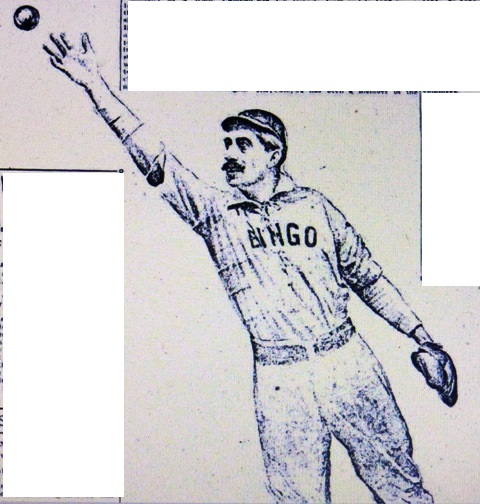
Charles Columbus "Count" Campau 1904

Charles Columbus “Count” Campau 1904

Campau gave up umpiring for thoroughbred racing; he served as a handicapper, clerk of scales and placing judge at a variety of race tracks, including Kenilworth Park in Buffalo, King Edwards Park in Canada, Oriental Park in Cuba, and finally, the Fair Grounds in his adopted home of New Orleans.

Campau died in 1938.
“An Umpire Nearly Lynched”

11 Mar

The above headline appeared on an Associated Press story in August of 1890.  Former Major Leaguer Jimmy Manning, then managing the Kansas City Blues in the Western Association had interceded to quell a riot at the end of a game with the Denver Grizzlies in Kansas City:

“Two questionable decisions by umpire Jovin (Sic) in the ninth inning, when Kansas City was about to tie the score, angered the crowd to such an extent that they swarmed into field, hooting and jeering the umpire.  Two young boys got hold of a rope, and in fun proposed to lynch him.  This added to the excitement, and it looked for a time as if the umpire would be mobbed.  Jimmy Manning climbed up to the top of the fence and addressed the mob.  He said the umpire had decided rightly and advised that no violence be attempted.  This quieted the mob to a degree.  In the meantime the players of both clubs formed a hollow square around the umpire and conducted him to the clubhouse.”

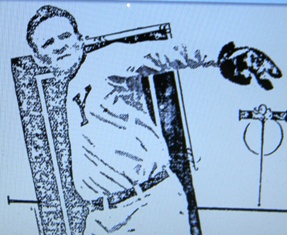
Jimmy Manning

Jimmy Manning

“Jovin” was actually Fred Jevne, a 26-year-old minor league veteran who had become an umpire just a month earlier.  After joining the Spokane franchise in the Pacific Northwest League in April, Jevne was suspended in May for punching an umpire.

In July The Spokane Falls Daily Chronicle said Jevne and teammate Tom Turner “quit the nine because they were excessively fined and ill-treated.”  According to the paper the two players showed up at the July, 1 game “in an intoxicated condition and acted like ruffians in the grand stand.” Turner was eventually reinstated and finished the season in Spokane, Jevne did not.

Since 1885 Jevne had played for a variety of teams in several leagues, including the Southern, International, and California.  When he was signed by Spokane to play center field and serve as captain, The Daily Chronicle said:

“Jevne is rather short.  He is a good batsman and a good player generally.  The San Francisco papers, when he played there, alternately praised him and berated him, but all agree that he was a good player.”

Jevne made one more attempt at playing, joining the Evansville Hoosiers in the Northwestern League in 1891.  He then returned to the Western Association as an umpire.

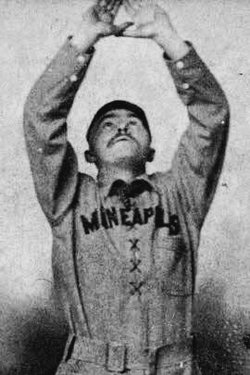
Fred Jevne

Fred Jevne with the Minneapolis Millers, 1889

In December of 1894 Jevne was named to the National League umpiring staff, where his work received mixed reviews.  In June The Baltimore Sun called him “As good an umpire as there is in the business.” In August, after a he worked a game between the Boston Beaneaters and Chicago Colts, The Boston Globe said “Umpire Jevne did poor work, both sides suffering from his yellow decisions.”  The Pittsburgh Press called Jevne’s performance in a September game between the Pittsburgh Pirates and Philadelphia Athletics “By far the worst exhibition of umpiring given this season.”

Jevne was not offered a position in the National League for 1896, and went to work in the Southern Association, where he seems to have a continued his fighting ways.  In July, The Birmingham Age-Herald said Jevne had missed the previous day’s game between the Montgomery Senators and Columbus River Snipes:

“Jevne, the regular umpire, arrived in town last night, but this morning loaded himself up with the spirit of hilarity, got into a fight with a citizen and when the hour for playing arrived was in the hands of the police, and failing to make bond was unavoidably absent from the field.”

Despite his troubles, or because of them, Jevne was asked to join the Interstate League at the end of the 1896 season because, according to The Sporting Life, umpires were losing control of games:

 “(Interstate League President Charles) Powers to-night wired for Fred Jevne the ex-National League umpire, who is so handy with his fists, to report for duty.”

Jevne was not popular with players or the press down south, and said his time in the Southern Association was difficult:

“It was no snap umpiring down South.  Fines didn’t go—were never paid—and so I used to remove men from the game.  Sometimes I would have to take out about half of a team before they would behave, and then the papers would roast me good and plenty the next morning…I had a scrap with a player named (Al) Gifford (Atlanta Crackers shortstop), and punched him in a car going from the grounds.  The local paper came out the next morning and urged the chartering of a special car for the umpire. So that he could be alone in his dignity, and another paragraph hinted that a cigar sign or dummy could be put in the special car for the umpire to punch”

Jevne appears to have returned to the Southern Association for parts of the 1897 and ’98 seasons.  He spent at least part of 1899 and 1900 in his hometown, Chicago, where he worked as an umpire in some college games.  In 1901 Jevne became a Western League umpire and that year met with a violent and mysterious end.

Initial newspaper reports said Jevne had fallen from a third story window in Denver’s Hotel Victor on August 2; he lingered for two days before dying. His body was returned to Chicago and he was buried at Graceland Cemetery.

However, several months after his death, Jevne’s brother Lloyd, a well-known three cushion billiard champion, told The Associated Press he was certain he had been murdered, and that before dying Jevne had said he was pushed:

“I saw Fred’s body after it was shipped back to Chicago, where the burial took place, and the most prominent feature of his injuries was the bruise on his nose.  Doctors I saw believe that he was struck across the face with some blunt object… When he was about to die it is not probable he would have told a falsehood.  He would not have said at that time that he had been pushed out the window.”

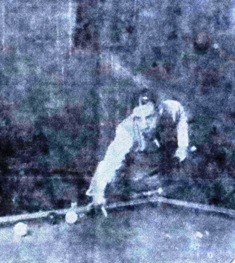
Lloyd Jevne

Lloyd Jevne

Whether Fred Jevne fell or was pushed from that hotel window has never been positively determined.

“King of the Natural Hitters”

25 Jan

Percival Wheritt “Perry” “Moose” Werden began his baseball career as a pitcher for the semi-professional team of his employer; the Ira Perry Pie Company in Saint Louis.  He was discovered by the St. Louis Browns who offered him a contract but ultimately signed with the Saint Louis Maroons in the Union Association.

(An oft-repeated story that Werden’s discovery involved him leaving a pie wagon unattended to join a game, resulting in the wagon being destroyed is almost certainly apocryphal, although it has been repeated as fact with little or no support by several writers)

In 1884 the 22-year-old was 12-1 with a 1.97 for the Maroons who at 94-19 won the Union Association pennant by 21 games; despite the strong start, Werden would never pitch in the Major Leagues again.

The Maroons joined the National League the following season and Werden ended up with the Memphis Reds in the Southern League.  He was primarily a catcher a first baseman, and his career as a pitcher pretty much ended; he appeared on the mound in only three games that season and had only 14 more minor league appearances over the next 10 years because of arm trouble.

Perry Werden, 1908

Perry Werden, 1908

From 1886-88, Werden played with five minor league teams and played three games in the National League with Washington in 1888.  In 1889, Werden joined the Toledo Black Pirates in the International League, where he became a great hitter.

Werden hit .394 for Toledo; in 424 at-bats, he had 167 hits, which was the hit record for the franchise for nearly 100 years, finally broken by Greg “Boomer” Wells in 1982 (Wells had 182 hits in 541 at-bats).

Toledo became a Major League franchise the following season, joining the American Association as the Maumees, Werden was the their starting first baseman, hit .295 and led the team in hits, runs, triples, and RBIs.  The Maumees finished 68-64 in their only season.

Werden was sold by Toledo to the Baltimore Orioles in 1891 and had another solid season, leading the team in hits, triples and RBI’s.  The following season he was signed by the Saint Louis Browns to replace Charles Comiskey at first base; Comiskey had jumped the Browns to join the Cincinnati Reds.

Werden hit .256 and .290 in two seasons with the Browns.  In 1894, he returned to the minor leagues with the Minneapolis Minnies in the Western League.  That’s where he became a legend.

In 1894, Werden exploded.  He hit .417 with 43 home runs.  In 1895, he improved to .428 with 45 home runs.

The Western League was no doubt a hitter’s league; eight players with at least 100 at-bats hit .400 or better in 1894 and 11 did so in 1895.  And the Minnies home field, Athletic Park, where Werden hit most of his home runs, was by all estimates a hitter’s paradise with a short (some sources say 250 feet) fence.

Regardless, 45 home runs would remain a professional baseball record until 1920. The Duluth News-Tribune said several years later that Werden hit seven home runs in a double-header in 1895; under the headline “Perry Werden was King of the Natural Hitters:”

“It was one of the greatest batting feats ever seen on a baseball lot anywhere.”

Werden had one last season in the Major Leagues.  At 35-years-old in 1897, he hit .301 for the Louisville Colonels, then returned to the minor leagues where he continued to hit well; .330 for his minor league career.

Werden became an umpire in the American Association in 1907, and became a baseball pioneer in 1908 when he joined the Indianapolis Indians in the same league; he was one of the first full-time coaches in professional baseball.  The Associated Press said:

“Perry Werden will go to Indianapolis to act as assistant manager, coach and advisor in general of the Indianapolis baseball club this year.”

In October The Indianapolis News declared Werden a success in the new role:

“Werden was one of the biggest factors in bringing Indianapolis her first pennant since 1902.  Without his services it’s highly probable the flag would have flown elsewhere”

The Indianapolis Star predicted that Werden’s “novel position,” would become the norm with the Indians, and throughout baseball.

Werden eventually returned to umpiring, working in the western, Dakota, South Dakota and Northern leagues.

His 43 home run season became news again in 1920 as Babe Ruth was closing in on Werden’s professional record.  Werden said there was one player in his era who was Ruth’s equal as a hitter.  Who was it?

Read about it on Monday.

The 1888 Texas Southern League

17 Jan

The Texas Southern League was in existence for half of one season; the reason for its creation was that the Dallas Hams were just too good a team in 1888.

In the winter of 1887 the Texas League was formed with six teams: the Dallas Hams, Austin Senators, Fort Worth Panthers, Galveston Giants, Houston Babies and San Antonio Missionaries.  Representatives from the Memphis Grays and New Orleans Pelicans in the Southern League, which was struggling to replace teams that had folded, also attended the meeting and lobbied for the league to be expanded to eight teams, but the six Texas-based teams voted not to include them;   New Orleans and Memphis joined the 4-team (down from 7) incarnation of the Southern League, which also included the Birmingham Maroons and Charleston Sea Gulls.

Charlie Levis, who had played Major League ball in The Union Association and American Association in 1884 and ’85 was named manager and played 1st base for Dallas.  Levis, a St. Louis native, brought in several Missourians including some who had spent time in the Major Leagues and built a strong team.

The Sporting News said Levis:

“Signed a team of professionals for Dallas that would do credit to almost any league in the country…They are all splendid fielders and batsmen and fair base runners.”

The team was so strong according to The Dallas Morning News that:

“So good was the Dallas team that club after club dropped out after repeated drubbings at its hands.  Dallas won so many consecutive victories that the other cities lost their appetite for baseball and withdrew.”

By late June, Dallas led the league with a winning percentage above .800; Austin and Fort Worth had dropped out and all the remaining teams were losing money with players often going several weeks between paydays.  At the same time, the Southern League was collapsing.  In early July, a deal was struck to create the five-team Texas Southern League with New Orleans joining Dallas, Galveston, Houston and San Antonio.

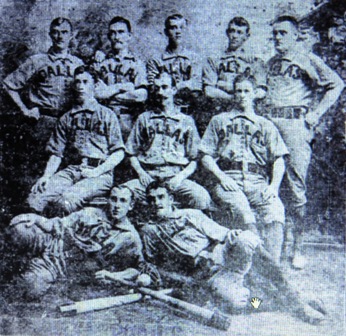
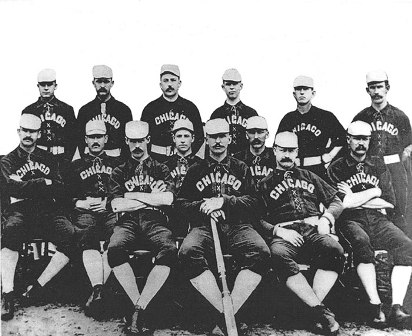
The 1888 Dallas Hams--Identifiable players: Front right Bill Goodenough, front left, Pat Whitaker, seated left, Ducky Hemp, standing left Charlie Levis, standing right John Fogerty,

The 1888 Dallas Hams–Identifiable players:
Front right Bill Goodenough, front left Ducky Hemp, seated left Pat Whitaker, standing left Charlie Levis, standing right John Fogarty,

While New Orleans provided some much-needed competition for Dallas the Texas Southern League half-season was not much different from the Texas League half-season.  Dallas finished with a winning percentage of .826, New Orleans finished second followed by San Antonio, Galveston and Houston.  The Morning News said on the final day of the season:

“The league is dead, and the Dallas club carries off the glory, waves high the pennant, and stands the champion club not only of the league but of all the South.”

The following season Austin and Fort Worth rejoined and the Waco Babies replaced the San Antonio Missionaries to again form a six-team Texas league; New Orleans returned to the Southern League, and the Texas Southern League was finished.

The story of one member of the 1888 Dallas Hams tomorrow.

Salaries–1897

15 Nov

After Amos Rusie ended his year-long holdout, the issue of salaries was, as it has been throughout the history of the game, hotly debated—some thought ballplayers were grossly overpaid during a period when the average annual salary in the United States was just under $675.

Amos Rusie

The Fort Wayne Gazette published the following in an effort to address “much questioning as to the salaries paid young players at the present time.”

According to The Gazette National League players averaged $175 to $250 a month “all the way up to $5000 for veterans.”

Other league salaries:

Eastern League: $100-$150 for young players $200-$250 for stars

Western League: $75-$150, up to $300 for stars

Atlantic League: $75-$250

Western Association: $65-$115

Southern League: $75-$100

New England League: $75-$125

Interstate League: $65-$150

The Gazette came down on the side of the players:

“It is customary to speak of the high salaries and easy lives of National League players but the kickers seldom realize that the man who now supports his little family in comfort on $300 a month—probably had to slave two years for perhaps $75 a month, $450 a year…and a probable loss of salary whenever the little league he played with disbanded in arrears.”

Sammy Strang

5 Nov

Samuel Strang Nicklin, “The Dixie Thrush,” was one of baseball’s great renaissance men.

Born in Tennessee in 1876, he was the scion of one of Chattanooga’s most prominent families.  His father John Bailey Nicklin served in the Union Army during the Civil War, moved to Chattanooga in 1866, and served as mayor from 1887-1889.

Sammy Strang

Samuel Nicklin spent one year at the University of Tennessee where he starred on the football and baseball teams. He also had two short stints in professional baseball 1893 and 1896, which included 14 games with the Louisville Colonels in the National League when he was 19.  Late in 1896, he enlisted as a private in the Tennessee Volunteers, served in Spanish-American War and rose to the rank of captain.

After leaving the service, Nicklin signed a contract with Cedar Rapids Bunnies in the Western Association and dropped his last name; he was known as Sammy Strang for the rest of his career.

The Milwaukee Journal said of the name change:

“(Strang) came of a rich southern family with deep prejudices against professional ball.”

This “prejudice” likely had nothing to do with it given that in addition to serving as Chattanooga mayor, the elder Nicklin was active in professional baseball, serving as president of the Southern Association in the 1890s.

A career .269 hitter, Strang was best known for being one of baseball’s first regular pinch-hitters while playing for John McGraw’s New York Giants from 1905 until June of 1908.  According to The Associated Press:

“McGraw noted the regularity with which he hit in pinches.  So he called him a ‘pinch hitter’—and the term stuck.”

During the 1909 season, Strang began coaching the baseball team at West Point.  He retired from baseball after playing from 1908-1910 with the Baltimore Orioles in the Eastern League, to study opera.

Sammy Strang

During his baseball career, Strang was known for writing songs and singing but decided to seriously pursue a music career in 1910.  He traveled to Paris where he trained under Jean De Reszke, one of the greatest male opera stars of the 1890s.

Upon returning from Paris, he chose not to accept an offer to join an opera company and instead returned to West Point, where he continued as coach until 1917.

Strang returned Tennessee shortly before his father’s death in 1919 to manage and take over ownership of the struggling Chattanooga Lookouts in the Southern League.  While the Lookouts did not win a league championship during Strang’s tenure, he was credited with turning the franchise around and sold the team, for which he paid nothing 1919, for a reported $75,000 in 1927, while retaining ownership of the stadium, Andrews Field.

Unfortunately, Strang’s most ambitious plan–to sign Satchel Paige in 1926–never materialized.

According to Larry Tye’s book “Satchel Paige: The Life and Times of an American Legend,”   Strang failed in an attempt to sign Paige for $500 to pitch a game against the Atlanta Crackers. Paige said of the deal:

“I just had to let him paint me white.”

Samuel Strang Nicklin died in Chattanooga in 1932.

Reports of His Death Were Greatly Exaggerated

18 Sep

Harry “Rube Allemang’s career was on the upswing at the close of the 1902 season; after a disappointing 4-15 record in his first season in pro ball with the Youngstown/Marion franchise in the Interstate League, Allemang had turned it around at Little Rock in the Southern League posting 20-4 and 19-11 season in 1901 and ’02.  (Contemporaneous newspaper accounts say he also played for Fort Wayne in the Interstate League in 1899, but there are not available records)

The Cincinnati Reds had just purchased Allemang’s contract and he was out celebrating with friends on the Evening on November 8.  Walking home at around 3 am, Allemang stumbled upon the lookout for a robbery in progress in the Mason City, West Virginia post office.  The lookout told Allemang to stop; when the pitcher kept walking he was shot, robbed and left for dead.

News of the shooting appeared in papers the following day:

Chicago Tribune: “Ball Player in Murdered”

New York Times: “Harry Allemang, Ballplayer, is Dying”

Fort Wayne Gazette: “Harry Allemang Mortally Wounded”

Arizona Republican: “Shot and Mortally Wounded”

The reports were premature.

Despite being shot just above the heart, with the bullet passing through his right lung, Allemang was out of the hospital in less than a month.  The Associated Press said “His case puzzles leading physicians.”

While still in the hospital he sent a letter to Reds owner August Herrmann to “Let you know I am still alive and expect to report in the spring.”

Allemang, with the bullet still lodged in his upper back, got ready for the 1903 season by doing ten mile runs while being pursued by blood hounds borrowed from the Mason County Sheriff.  But Allemang was never the same pitcher after the shooting.

He struggled that spring with the Reds and was sent to St.Paul in the American Association.   He was 12-11 in St. Paul in ’03 and 10-23 with Indianapolis in the same league in 1904.  After just two games with Sioux City in Western League in 1905, Allemang signed with the Niles Crowites in the Ohio-Pennsylvania League in May, and then jumped to an outlaw league team in Coatsville, Pennsylvania in July.  He came back to Southern League with Nashville in 1906, but lasted just six games, posting a 2-4 record.

Allemang passed away in Linton, Indiana in March of 1938—more than 35 years after the newspapers pronounced him dead.