Tag Archives: St. Louis Browns

”The Dreadful Rumor is Probably only too True”

16 Nov

The unpredictable, eccentric George Edward “Rube” Waddell made several attempts to parlay his baseball fame into an off-season sideline in the theater.

Waddell’s stage debut was December 5, 1900, in Brookville, Pennsylvania as part of “Hindman and Kummers’ Union Scout” touring company.   The Sporting Life did not approve, their headline read:

“Rude Waddell to Make a Clown of Himself for Cheap Theatrical Gain.”

The touring variety show appears to have been a success and included Waddell leading a brass band in a street parade and performing in skits.

Rube Waddell

Waddell’s next foray into the theater was in 1903.  He played a detective in a melodrama called “The Stain of Guilt.”   Waddell the actor was as difficult to control as Waddell the pitcher.  According to The Pittsburgh Press:

“On several occasions he has been numbered with the missing when the curtain has come up.”

The Chicago Tribune reviewed the play which made its debut at the city’s Alhambra Theater:

“Rube has what may be classified as a thinking part, for he isn’t called upon to say much.  In the four acts of the play he delivers himself of twenty-four words.”

The review ended with the facetious assertion that in the fourth act Waddell, “Fairly shines…he hurls twelve whole words at the cowering villain and grateful hero.”

The universally negative reviews might have dissuaded a lesser man than the self-proclaimed “Greatest baseball pitcher in the world.”  But Waddell was back the next year.

The Butler (PA) Times said:

“More alarming than the news of the probabilities of war between Russia and Japan, is the announcement that Rube Waddell, the notorious baseball player, is to join his ability as an actor…in the production of “A Daring Woman.”

The Times suggests hopefully that the announcement is a publicity stunt but concluded:

“A New York special says that Rube is in that city taking part in the rehearsals of the play, so that dreadful rumor is probably only too true.”

The play does not appear to have actually been staged.

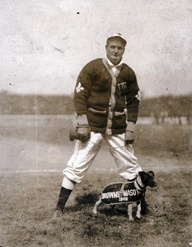
Waddell with St. Louis Browns Mascot


The League That Billy Sunday Helped Shut Down

12 Nov

The Eastern Illinois League began with great promise in the spring of 1907 to fill the void created by the collapse of the first incarnation of the Kitty League.  Joe “Wagon Tongue” Adams, an Illinois native who appeared in one game for the 1902 St. Louis Cardinals, was said to be the guiding force behind  the league, he was also manager on the Pana Coal Miners.  Adams had helped create the Central Illinois League two years earlier with teams from many of the same cities—unlike the 1905 effort, the Eastern Illinois League was granted membership in the National Association.

The six-team league had franchises in Centralia, Charleston, Mattoon, Pana, Shelbyville and Taylorville, and elected Charles Welvert, a Pana businessman  league president.  Midway through the 1907 season the Centralia team relocated to nearby Paris, Illinois, and replaced Welvert as league president by Louis A. Godey Shoaff (often incorrectly spelled “Schoaff”), editor and publisher of The Paris Gazette.

The teams in Charleston, Mattoon, Pana and Paris were supported, as The Associated Press said, “In great part from saloon interests.”

The league made news in August, when during a heated series between the Mattoon Giants and the Pana Coal Miners, The Sporting Life reported that Mattoon second baseman Fred Wilson during a dispute with  Pana manager Adams:

“Wilson put Adams down with a straight jab on the jaw. The manager came up, but another blow in the same place fractured his chewing apparatus.”

The Mattoon Giants won the 1907 championship, led by the pitching of future Major Leaguer Grover Lowdermilk, who posted a 33-10 record with a 0.93 ERA.  Although records for the league are nearly nonexistent, contemporary newspaper accounts mention other past and future Major Leaguers who appeared in the league including Harry Patton, Joe Yeager (after his release from the St. Louis Browns in 1908), Cecil Coombs, and Hosea Siner.

The league appeared to be in good shape heading into 1908, adding teams in Danville, Illinois and Vincennes, Indiana.  But as it prepared for the beginning of its second season other forces were ensuring it would be its last.

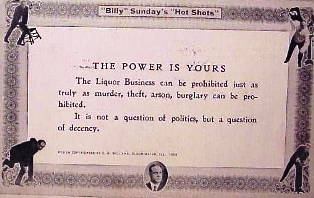
William Ashley “Billy” Sunday, the former outfielder for the Chicago White Stockings, Pittsburgh Alleghenys and Philadelphia Phillies, turned evangelist and temperance supporter was spending the early months of 1908 holding a five-week long  revival in Decatur, Illinois and advocating for citizens throughout Illinois to vote their towns dry during local option elections in April.
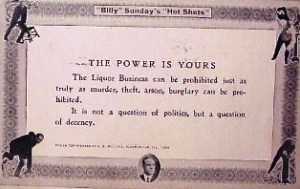
Sunday’s revival was a huge success, according to The Associated Press “there were 5,843 conversions;” and the service “on ‘booze’ was attended by 8,000 enthusiastic local optionists.”

When the polls closed on April 7, six of the league’s eight towns were voted dry.  The Associated Press said:

“With the saloons out of business, subscriptions of new stock (in the teams) will be cancelled in many instances.”

The league was in trouble.  It got worse worse when Sunday moved his revival to Charleston in April and began a new crusade against playing games on Sunday.

The 1908 season was chaotic.  New investors were scarce.  Some Sunday games were played, but attendance was down.  In July the Danville Speakers relocated to Staunton and the Pana Coal Miners moved to Linton, Indiana (incorrectly listed on Baseball Reference as Linton, Illinois).  Early in August the Mattoon Giants were on the verge of collapse.  The league finally disbanded on August 20, 1908, the Speakers were declared 1908 champions.

Professional baseball never returned to Charleston, Pana, Linton, Staunton, and Shelbyville.  Taylorville had a team in the Illinois-Missouri League in 1911.  Vincennes was part of the reformed Kitty League in 1910-11 and 1913.  Beginning in 1910 Danville was in and out of the Three-I League for the next forty years.  Mattoon did not have a professional team again until 1947, Paris until 1950.

Fall from Grace

24 Oct

Grayson S. “Gracie” Pierce played parts of three seasons in the major leagues and was a National League umpire selected to preside over the final game of the 1886 championship series.  It went downhill from there.

Pierce was born in New York City in 1860.  Nearly every contemporaneous newspaper account referred to him as “Grace,” not “Gracie.”

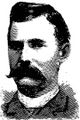
Grayson Pierce

Pierce hit .186 playing for five different teams in the American Association and National League during his brief big league career; he was only slightly more successful during his single minor league season playing with the Hartford Babies and Binghamton Bingoes in 1885.

During his playing career there are references to Pierce occasionally serving as an umpire in college and professional games, and according to The Cincinnati Commercial he worked as a longshoreman in New Orleans each winter; he became a National League umpire in 1886,

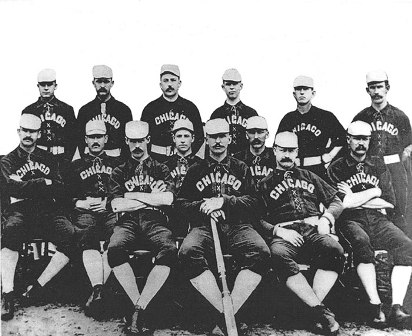
In October of 1886, The Chicago White Stockings of the National League met the St. Louis Browns in the 1886 World Series.  Pierce was selected to serve as umpire in game 5, but according to The St. Louis Globe- Democrat, “(H)e was not on the grounds, as a long search revealed.”

Pierce got his chance the following day—with St. Louis leading the series 3-2, he was again selected to serve as umpire.  It didn’t go well for the White Stockings or Pierce.

Chicago blew a 3-0 lead in the eighth inning and lost the game in the tenth.  Pierce’s performance was universally panned.  The Globe-Democrat said:

 “For Umpire Grace Pierce of the League staff had been selected.  His judgment was weak and his decisions throughout the game gave rather poor satisfaction.”

The Globe-Democrat’s assessment was echoed elsewhere as well.  The Chicago Inter Ocean said that among the crowd:

“There was much loud talking and opinions of Pierce were quite freely expressed.”

Pierce was not a member of the National League staff the following year and instead worked in the International Association.  In September, a variety of charges were made against Pierce by the owner of the Syracuse Stars.  The complaint, filed with the league, said Pierce was drunk at games in Syracuse and Newark, and also claimed as reported by The Rochester Post-Express:

 “(Pierce) had forced Con. Murphy (Cornelius Murphy) to drink against the latter’s will and that he took (Tom) Lynch out of bed at 10 o’clock at night and started out ‘to do the town’  both returning in the morning ‘boiling drunk.’”

Pierce denied the charges saying Murphy concocted the story after Pierce had ejected him from a game and fined him $3 in Newark.  The Post-Express sided with Pierce and said:

“Grace is not a total abstainer, but in his long career on the ball field he has never been charged with drunkenness.  So far as Con. Murphy is concerned it has never been known before that he would have to be forced to take a drink.”

As for the charges regarding the drinking binge with Lynch, Pierce said:

“I was going home I found Lynch drunk in the street, I took him home and put him to bed.”

There is no record of what became of the charges, but Pierce did continue working as an umpire on the East Coast through the 1891 season.

The Sporting Life reported that Pierce did not have a position with a league for the 1892 season.

He disappeared for two years and  was not heard from again until July of 1894 when The New York Times reported:

“(Pierce) formerly a baseball player and umpire, was arraigned before Justice Burke in the Harlem Police Court yesterday morning charged by Barney Brogan a liquor saloon keeper…with stealing $35 from his cash drawer after the saloon was closed.”

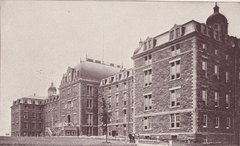
Pierce, who The Brooklyn Daily Eagle described as being “in a half-dazed condition” in court,   denied the charges but was unable to post the $1000 bond.  He was sent to Blackwell’s Island (the prison located on what is now Roosevelt Island). He became ill and died at City Hospital on Blackwell’s Island six weeks after his arrest.

City Hospital, Blackwell’s Island