Tag Archives: Toronto Maple Leafs

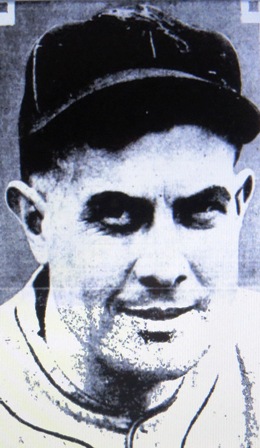
Hap Myers

29 Jul

When the 6’ 3” 175 pound Ralph Edward “Hap” Myers was let go by the Boston Braves after the 1913 season a reporter told Braves shortstop Rabbit Maranville he was sorry to see Myers go.  Maranville joked:

“Well, you might be, but I’m not.  Do you know that guy is so thin that every time I picked up a grounder I had to shade my eyes with my gloved hand to locate him before throwing the ball.”

Myers began his professional career after graduating from University of California, Berkeley in 1909, where he also played baseball.  The San Francisco native hit a combined .311 playing for the Sacramento Sacts in the Pacific Coast League, and the San Jose Prune Pickers and Santa Cruz Sand Crabs in the California League.

Myers went east in 1910 after being purchased by the Boston Red Sox, but became ill, with scarlet fever, and as a result appeared in only six games in Boston before being  sent first to the Toronto Maple leafs in the Eastern league, then the Louisville Colonels in the American Association.

Despite hitting just .240 with Louisville, Myers was selected by the St. Louis Browns in the Rule 5 draft.  The Red Sox claimed Myers still belonged to them and his contract was awarded to Boston, where he began the season, was sold to the St. Louis Browns, who quickly released him despite hitting .297 in 11 games, then back to the Red Sox where he hit .368 in twelve games before being sent to the Jersey City Skeeters in the Eastern League.

It was never clear why, in spite of hitting .333 in 81 at bats in 1910-1911, Myers couldn’t stick in the American League.

In 1912 he returned to the West Coast to play for the Spokane Indians in the Northwestern League where he led the league in hits, and runs, hit .328, and led all of professional baseball with 116 stolen bases.  The Portland Oregonian said:

“Myers base stealing smashes any previous performance in Northwestern League history.  You have to go back 20 years in official guide books to find any record to compare…and that includes every league in organized baseball.”

Spokane owner Joe Cohn went overboard in his praise of Myers in The Spokane Spokesman-Review:

“Best ballplayer in the Northwestern League by a long shot.  He is the greatest ballplayer I ever saw.  Boy I tell you this Myers is a wonder.  Ty Cobb, Hans Wagner, Tris Speaker and all of them have nothing on Myers…I think Myers has it on Cobb, Wagner, Lajoie, Jackson and the whole bunch.”

Myers, and Portland catcher Rex DeVogt were purchased by the Braves from Portland, Devogt would only last for three games, and six hitless at-bats in April of 1913.  Myers would become the Braves starting first baseman.  Another Pacific Coast League player, pitcher “Seattle Bill” James also joined the Braves.
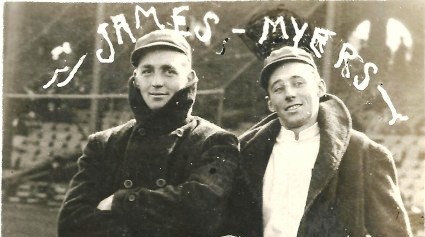
hap3

“Seattle Bill” James and “Hap” Myers

Myers got off to a slow start; he was hitting just .224 in early July, but was leading the National League in steals.  An article in The Tacoma Times said:

“When Hap Myers, recruit first baseman of the Boston Braves is in full stride stealing bases, he covers nine feet…the average stride of a sprinter is six feet. “

The article said the average player took 13 steps, roughly seven feet per step, between bases but Myers took only ten steps:

“Myers is something of a baseball curiosity, and his work is watched with interest by the fans.  If the time comes that the big fellow climbs into the .300 class as a batter, he is apt to become a veritable terror of the paths.”

He was also said to use “a bat of unusual length,” but the size was never mentioned.

After the slow start, Myers hit well in the second half of the season, ending with a .273 average and 57 stolen bases (second to Max Carey of the Pittsburgh Pirates who stole 61).  Despite his strong finish, Myers was replaced at first base for 22 games in August and September by Butch Schmidt, who was purchased from the Rochester Hustlers in the International League.
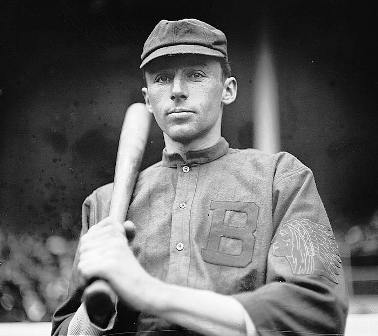
"Hap" Myers

“Hap” Myers

At the end of the season Myers was sold to the Hustlers, the deal was, in effect, a trade for Schmidt.  The Boston press simply said Myers did not get along with manager George Stallings; Myers told a reporter in San Francisco that there was another reason; baseball’s labor unrest:

  “I was assigned by the fraternity to get as many Braves as possible into the fraternity, and succeeded in enrolling nearly the entire team.  The powers that be evidently didn’t relish my actions for soon my every move began to bring calldowns and I was not surprised to read in the newspapers a little later that I had been sent to Rochester.”

Myers jumped Rochester to join the Federal League; his signing was reported months before he actually signed.  The Associated Press said in March of 1914:

“Although it has been generally understood that Hap Myers, last season’s first baseman of the Boston National has been under a Federal League contract for some time, the elongated first sacker did not put his name to a contract until yesterday afternoon.  Myers originally expected to play with Larry Schlafly on the Buffalo Federals, but was transferred to Brooklyn, and seemed altogether pleased with the move.”

Myers got off to a strong start, and The Sporting Life said:

“Brooklyn fans cannot understand why Hap was passed out of the National League. They have had a chance already to give his successor at first base on the Boston team (Butch Schmidt) the once over, and the general opinion is that- Hap Myers “lays all over.”

His success in Brooklyn didn’t last; in 92 games Myers hit just .220.

Hap’s story continued tomorrow.
Another “Rube”

4 Mar

Hall of Famer “Lefty” Grove and Jack Ogden were the best known pitchers of the great Baltimore Orioles teams that won seven straight International League Pennants from 1919-1925, but in 1923 both were out-pitched by James Arthur “Rube” Parnham.

Parnham began his professional career in 1914 with the Huntington Blue Sox in the Ohio State League.  In 1915 he joined the Raleigh Capitals in the North Carolina State League, managed by Connie Mack’s son Earle.  The 21-year-old was an unspectacular 9-15 for Raleigh, but caught the eye of the elder Mack and spent the spring of 1916 with Jacksonville with the Philadelphia Athletics.

Rube Parnham, 1917

Rube Parnham, 1917

Parnham returned to the North Carolina State League for the 1916 season, splitting time between Raleigh and the Durham Bulls, posting a 17-19; his contract was purchased by the Athletics in late August.  Nearly a month later Parnham made his Major League debut; he appeared in four games for Mack’s last place (36-117) ballclub, he was 2-1 with a 4.01 ERA.

Parnham was with the Athletics in Jacksonville again in 1917, but was sent to Baltimore before the beginning of the season.  He won 16 games for the Orioles and earned one more shot with Mack in Philadelphia; Parnham was 0-1 with a 4.09 ERA in two September appearances.

As Parnham started winning games for Baltimore he developed a reputation as a work horse; in 1917 he won both ends of a double-header against the Rochester Hustlers, pitching a total of 24 innings in two 3-2 victories; in 1919 he won both games of a twin bill twice.   At the same time he began to earn a reputation as “eccentric’ and “erratic,” the inevitable comparisons to Rube Waddell and his small time roots earned Parnham the nickname “Rube,” he was also known as “Uncle.”

Baltimore sold Parnham to the Louisville Colonels in the American Association in March of 1918, but within two months was sold back to Baltimore, where he rejoined manager Jack Dunn, with who he had, and would continue to have, a contentious relationship.  He won 22 games in 1918 and followed with 28 in 1919, leading the Orioles to their first championship since 1908.

As the Orioles jumped out to a quick lead in 1920 (Parnham was 5-0, and was joined on the pitching staff by Ogden and Grove) the erratic Rube Parnham surfaced again. He was prone to disappearing for days at a time and also appears to have been hurt.  By mid-season he was gone.

More recent accounts have said Parnham jumped the Orioles to play semi-pro ball in Pennsylvania; just as likely, Parnham, who was suspended in June by Dunn for being out of shape, and who was clearly overshadowed by Grove (12-2) and Ogden (27-9); as well as Jack Bentley (16-3) and Harry Frank (25-12), was let go.

Lending credence to Parnham not having jumped is a January 1922 Associated Press item that said the pitcher “whose arm went on him” would rejoin “the Baltimores for the 1922 season.  Parnham wrote Dunn that he believed he could come back next season and pitch successfully.”  He won 16 games for the Orioles in 1922.

The following season would be Parnham’s best; the 29-year-old pitcher led the Orioles with a 33-7 record, Grove was 27-10, Ogden 17-12.   In addition to out-pitching his two teammates, Parnham set an international League record by winning 20 consecutive games.

Parnham’s old ways returned before the 1924 season when he failed to report to Florida for spring training.  The Associated Press said:

“Rube never reported at the Oriole training camp in the south and never even deigned to notify Jack Dunn whether he was going to play ball this year.”

Parnham eventually reported, but had another stormy, abbreviated season.  With a 6-5 record and a 4.84 ERA, Dunn suspended the pitcher in June, and he appears to have not pitched for the Orioles again that season.

The only reference to Parnham in 1925 was a May game he pitched for a semi-pro team in Duquesne, Pennsylvania and was beaten 8-0 by the Homestead Grays.

His career appeared to be over, but Dunn, it seems was willing to give his pitcher one more chance.

The Baltimore Sun said shortly before the 1926 season:

“Uncle Rube Parnham, the most colorful figure in the International League, will be back on the mound for the Orioles next season.”

Parnham was 13-9 with a 5.05 ERA, and spent the entire season feuding with Dunn; It was the end of the Orioles dynasty, the Toronto Maple Leafs won the championship in 1926 and Baltimore would not finish first again until 1944.

The Orioles were finally through with Parnham, The Baltimore Sun said:

“There was so much trouble between Parnham and Dunn last year that it was apparent Rube had spent his last season with the Orioles.” “

The 32-year-old was still considered valuable enough that the Milwaukee Brewers in the American Association purchased the pitcher from Baltimore.

The Brewers expected big things from their new pitcher, The Milwaukee Journal said:

“At times his playfulness leads him away from the straight and narrow, and he nearly drove Jack Dunn nutty last season…But Parnham is a great pitcher, despite his eccentricities, and if (Brewers owner) Otto Borchert can hire a good keeper for him is certain to be a winner with the Brewers.”

By March Parnham had worn out his welcome with another manager when he didn’t bother to report to Hot Springs, Arkansas for spring training.  The Journal said:

“Disgusted with the dilatory tactics of Rube Parnham, Jack Lelivelt, boss of the Brewers, hinted Saturday night that unless the eccentric righthander reports at once that he would probably be turned back to Baltimore.  Former International Leaguers …have told the Milwaukee leader about some of Reuben’s idiosyncrasies  and Lelivelt is beginning to feel that he will become a stepsister to Kid trouble if he had the former Oriole on his club.”

Parnham never played for the Brewers, and was returned to Baltimore, but Dunn was finished with him as well and he was shipped off to the Reading Keystones.  After a 2-8 season split between Reading and the Newark Bears, Parnham’s career was over.

rube

Rube Parnham, 1923

Parnham retired to McKeesport, Pennsylvania, where the troubles that followed him throughout his career seem to have continued.  James Bready, an editor for The Baltimore Sun went to Pennsylvania to interview the former Oriole hero in 1961:

“The story was that he had gone downhill. Falling asleep in the snow, recently, he had lost several toes. On the phone, the director of a home for indigents said he would notify Parnham of the interview project. He gave me the street address — and a caution: ‘Try to get here before noon.’

“Paper, pen — I knocked and Rube beckoned me inside what today would be called a shelter. He was wearing an overcoat (I understand that better, now) and had not shaved recently. We sat down, facing, on two of half a dozen cot beds.  I tried a question. ”Gbbmhdahlr,” he replied. I stared at him; slowly, the meaning penetrated. I reached in my pocket and handed him a dollar.”

Parnham died two years later in McKeesport.

Anger Management

27 Dec

Thomas Timothy “Tim” Flood just couldn’t control himself.

Flood was a solid infielder and somewhat erratic hitter.  As a 17-year-old he hit .364 with the New Orleans Pelicans in the Southern Association in 1894 but hit .266 in his minor league career and .233 as a Major Leaguer.

He had a late season 10-game trial with his hometown St. Louis Perfectos in the National League in 1899.  He was given his next shot in the National league in 1902 when he was signed by Ned Hanlon’s Brooklyn Superbas to fill the void left at second when veteran Tom Daly jumped his contract to join the Chicago White Sox.

Flood was an upgrade in the field, and while a weaker hitter than Daly, he quickly became a favorite of Hanlon who named him Brooklyn’s captain for the 1903 season.

Tim Flood

Tim Flood

1903 was not a good season for the new captain; he continued to struggle at the plate and dealt with a knee injury that limited him to 84 games.  He was also suspended for two games in July for a physical altercation in Cincinnati with umpire James “Bug” Holiday.  Holiday, a former Major Leaguer had a stormy half season as a National league umpire and resigned several days after tangling with Flood.

Flood was released by Brooklyn in March of 1904 and joined the Los Angeles Angels in the Pacific Coast League.

He was a very popular player in Los Angeles and captained the Angeles in 1904 and part of 1905 until he assaulted Ira “Slats” Davis, another former Major Leaguer turned umpire during a game in June of 1905. Eugene Bart, president of the league suspended flood indefinitely.

Newspapers reported that Flood said he would “never fight another arbitrator whether he is in the right or wrong.”

In 1906, he signed with the Altoona Mountaineers in the “outlaw” Tri-State League, where he appears to have kept his pledge and had an incident-free season.

In 1907, he joined  the Toronto Maple Leafs in the Eastern League and managed to play 29 games before he was in trouble again.  Flood assaulted an umpire named John Conway during a game in Toronto; the attack included a kick to the umpire’s chest.

Flood was arrested.

He was charged with assault and ordered to appear in front of a magistrate. Friends told Flood the hearing would be a formality and that he should plead guilty and receive a small fine.

No one told Magistrate George Taylor Denison who said, “This sort of thing must be discouraged,” and sentenced Flood to “Fifteen days in jail with hard labor.” At the same time Patrick Powers, president of the Eastern League, banished Flood from the league.

Toronto fans were outraged and immediately began circulating petitions which “included the names of several clergymen” and were presented by team officials to Minister of Justice Allen Bristol Aylesworth in hopes of getting Flood pardoned.

Opinions of the punishment varied.  Several newspapers carried the following poem which lamented Flood’s fate for “Sassing” an umpire:

“’Holy Moses!’  In Toronto

There is news to make you pale

Sass the umpire if you want to—

That is, want to go to jail!

There is woe among the batters,

As around the field they scud;

And their pride is torn to tatters

By the fate of poor Tim Flood

Fifteen days in jail for Timmy

Soon the parks will close so tight

That you couldn’t with a jimmy

Let in one small streak of light.”

Others, including two former players, said Flood got what he deserved and implied that his behavior was not limited to the three well-publicized incidents.

Charles “Count” Campau, a former Major Leaguer and umpire, who had been a teammate of Flood’s in New Orleans said:

“I am sorry to see anyone go to jail, but, for the good of baseball. I am glad to see Tim Flood out of it for good. Rowdies of the Flood type are a disgrace to any sport or business, and especially baseball. He was always mixed up in just this way and was chased out of California, where b« was playing, for the same kind of tricks. Umpire baiting was always his long suit, and, from what I can understand, his attack on Umpire Owens [sic] was a most cowardly one: Flood is a good ballplayer, but his hasty temper, his meanness has put him out of the game forever, and incidentally Into Jail.”

Charles "Count" Campau

Charles “Count” Campau

Tim Murnane, Major Leaguer turned baseball writer said:

“Tim Flood has a new record, and will now be in a position to go back to his trade and give up the game he was unfitted for.  The courts all over the country should follow the example of the Canadian judge, who sent a ballplayer to lock-up for assaulting an umpire.  It wouldn’t take many decisions of this kind to drive the bad men out of the sport.  Imagine a player taking a running jump at a man and hitting him in the breast with his spiked shoes!”

Tim Murnane

Tim Murnane

After serving 10 days, Minister of Justice Aylesworth ordered Flood released.  The player, in various reports, claimed he lost between 10 and 16 pounds during his incarceration, citing the poor quality of the food.

President Powers rejected pleas from the Toronto management to reinstate Flood and permanently banned him from the Eastern League; however, contrary to Campau’s and Murnane’s wishes, Flood was out of baseball for less than a month.

Flood was signed before the end of July by the Saint Paul Saints in the American Association and vowed, as he had before, that he was a changed man.

It appears 10 days in jail might have made a difference.  Flood was named manager of the Saints in 1908 and continued to play and manage in the minor leagues for five more seasons, apparently without incident.

In 1914, The Sporting Life reported, with no irony, that Flood was hired as an umpire in the Northern League.

Flood died in St’ Louis in 1929.

A Thousand Words–New Orleans Pelicans

13 Nov

Another picture I’ve never seen published before—the 1906 New Orleans Pelicans of the Southern Association.

Top, Left to right.

Bill Phillipshe spent seven seasons in the Major Leagues with a 70-76 record; and won 256 games in a minor league career that began in 1890 and ended in 1909.

Mark “Moxie” Manuelwas said to have appeared as a both a left and right-handed pitcher for New Orleans in 1906 and 07, Manuel was a combined 37-26, earning him a second trip to the Major Leagues in 1908, where he posted a 3-4 record in 18 appearances for the Chicago White Sox.

Milo Stratton—a weak hitting (career .185) catcher who played in the minor leagues from 1903-1914.

William O’Brien—a .215 hitting first baseman in 1905 with the Toronto Maple  Leafs in the Eastern League and with the Pelicans in 1906.

Jake Atz—played for the Washington Senators in 1903 and the Chicago White Sox 1907-1909, a minor league manager for 21 seasons he won more than 1900 games.

Art Brouthers—a third baseman who played in 37 games for the 1906 Philadelphia Athletics, Brouthers managed the 1913 Paducah Indians to the Kitty League championship.  After his baseball career he was a hotel detective in Charleston, South Carolina.

Front, left to right

Whitey GueseGuese had several strong seasons in the minors, but in his lone Major League season with the Cincinnati Reds in 1901 he was 1-4.  The Youngstown Vindicator said, “He is a twirler who belongs to the disappointing species known as ‘morning glories.” And, “Seemingly has a heart like a canary.”

Joe Rickert—“Diamond Joe” Rickert stole 77 bases for the Pelicans in 1904; he played 15 games in the Major Leagues with the Pittsburgh Pirates and Boston Beaneaters.

William Blake—an outfielder with 13 different minor league teams from 1902 to 1910 and native of Louisville, Kentucky, little else is known.

Punch Knoll—another long-time minor league manager.  Knoll appeared in 79 games for the 1905 Washington Senators, he appeared in 3 games as a pinch hitter, collecting one hit, at 48-years-old while managing the Fort Wayne Chiefs in the Central League

Chick Cargo—brother of Major Leaguer Bobby Cargo, Charles “Chick” Cargo was a shortstop and 3rd baseman who played 19 seasons of minor league ball.

George Watt—Watt had three good seasons for the Little Rock Travelers, with a 53-34 record from 1902-1904.  He slipped to 20-37 in 1905-06 with Little Rock and New Orleans.  By 1907 he had dropped from “A” ball to “D” ball with the Zanesville franchise in the Pennsylvania-Ohio-Maryland League.  In 1908 he pitched for the Zanesville Infants in the Central League, was release in August after posting a 6-15 record and disappeared.