Tag Archives: Western League

Page Fence Giants

30 Sep

The Page Fence Giants would become one of the great early teams in black baseball; some sources say they played 156 games, winning 118 their first year.  But things did not go well in their first game.

Organized by John “Bud” Fowler and Grant “Home Run” Johnson, the team represented the Adrian, Michigan-based Page Woven Wire Fence Company; at the time the nation’s largest fence company;  Augustus “Gus” Parsons served as the team’s business manager and scheduled their games (he’s often misidentified as the team’s manager).

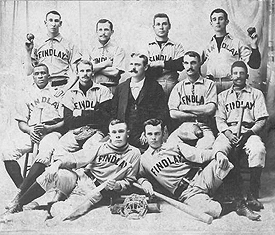
Grant "Home Run" Johnson, left center row and John "Bud" Fowler, right center row, with the independent Findley (OH) Sluggers in 1894.

Grant “Home Run” Johnson, left center row and John “Bud” Fowler, right center row, with the independent Findley (OH) Sluggers in 1894.

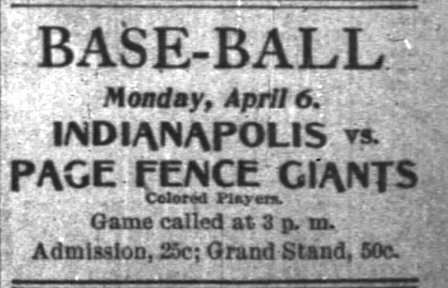
Their first game was scheduled for April 10 against the Western League’s Indianapolis Hoosiers.

The Indianapolis News said of the Giants:

“Besides playing ball they perform feats of tumbling, and there is a quartet among them that sings between innings.”

The team also would arrive in towns riding bicycles in parade formation (the Giants’ other sponsor was the Monarch Bicycle Company).

While they often played for mostly white crowds The News said the stands “were very nearly peopled” with black fans; they did not get the show they had hoped for:

“In the first inning the Indianapolis team had fourteen men to bat and scored eight runs.  It seemed evident that one more inning of slaughter like the first would precipitate a race riot, and President (and manager William “Bill”) Watkins diplomatically let up.  The ease with which Indianapolis did everything it wanted to, and the “rough deal” the colored team received at the hands of umpire Andrews conspired to make the score look like the original report of the Armenian massacre…The one-sided score, which misrepresents both teams as far as figures are concerned.”

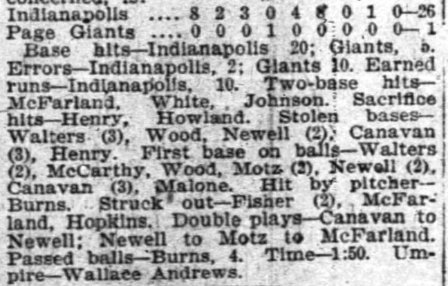
Page Fence lost 26-1.

The Box Score

The Box Score

They also lost two games against the Cincinnati Reds, then lost Fowler and pitcher George Wilson to the Adrian Reformers in the Michigan State League (where they were teammates of Honus Wagner).

The Giants returned to Indianapolis in 1896, losing 16-3 to the Hoosiers

The Giants returned to Indianapolis in 1896, losing 16-3 to the Hoosiers

Despite their first game, the Giants continued drawing crowds and winning games until they disbanded in 1898—with most of the players joining the newly formed Chicago Columbia Giants.

Jimmy Rogers

16 Sep

In January of 1897 owner Barney Dreyfuss and the directors of the Louisville, Colonels met to determine the future of the club.  The Louisville Courier-Journal said:

“The most important meeting in the history of the Louisville Base-ball club was held last night at the Louisville Hotel.  It was marked by more liberality than had been shown by the club during all the years since it became a member of the big league.”

No one was surprised that Dreyfuss’ protégé, team secretary Harry Clay Pulliam was named team president, nor was it surprising that Charles Dehler was retained as vice president.

But no one had predicted the Colonel’s choice to replace Bill McGunnigle as manager.

McGunnigle had succeeded John McCloskey, and the two combined for a 38-93 record and a twelfth place finish.

James F. “Jimmy” Rogers would be a first-time manager; three months short of his 25th birthday and only 110 games into his major league career.  The Courier-Journal knew so little about the new manager that the paper got his age and place of birth wrong, and also reported incorrectly that he had minor league managerial experience.

While he had only played 72 games with Louisville in 1896 and only 60 at first base, The Courier-Journal called Rogers “the best first baseman the Colonels ever had.”  Even so, the paper acknowledged that “as a manager he is yet to be tried.”

Just why was he the right man to manage the team?

“One of the chief reasons Rogers was selected was that he is sober.”

Jimmy Rogers

Jimmy Rogers

Despite being “the best first baseman the Colonels ever had,” Rogers opened the season as the team’s starting second baseman; thirty-five-year-old minor league home run king Perry Werden, acquired from the Minneapolis Millers of the Western League played first base for Louisville.

The team won five of their first seven games, and then went 12-22 through June 16 when Rogers was fired as manager and released; he was hitting .144 and made 16 errors in forty games at second base.

Rogers was replaced as manager by Fred Clarke; the future Hall of Famer was two weeks shy of his 24th birthday.

The Cincinnati Post said the outgoing manager was not only to blame for the team’s poor performance but also for center fielder Ollie Pickering’s slump; Pickering hit .303 after joining Louisville in August of 1896 but was hitting .243 on the day Rogers was let go:

“The claim is made that Jimmy Rogers is responsible for the decline of Pickering.  The Virginian created a sensation last fall, but “Manager Jimmy” tacked the title “Rube” to Pick, and it broke his heart.”

Ollie "Rube" Pickering

Ollie “Rube” Pickering

Pickering was released in July, signed with the Cleveland Spiders, and apparently recovered from his broken heart, hitting .352 in 46 games for Cleveland.

Rogers would never play another major league game.  He was signed by the Pittsburgh Pirates the day after Louisville released him, but became ill with the flu and never played for them.  A month later he joined the Springfield Ponies in the Eastern League and finished the season with them.  Rogers played for East Coast minor league teams until in August of 1899 when he became ill while playing with the Norwich Witches in the Connecticut League.

In January of 1900, Rogers died at age 27.  Two different explanations for his death appear in various newspapers; both may be wrong.  The Courier-Journal and several other newspapers said his death was the result of the lingering effects of “being struck on the head by a pitched ball several years ago while playing in the National League.”

The New Haven (CT) Register repeated the story about Rogers being hit by a pitch, and said that while that injury contributed to his death, he had died of Bright’s disease—a kidney ailment now referred to as nephritis.

Rogers’ Connecticut death certificate listed the cause of death as a bacterial inflammation of the brain.

Jim Lillie

28 May

The Sporting Life described Jim Lillie as “one of the most sensational of right fielders,” and “the rival of Mike (King) Kelly in the position.”  The New Haven Register said he earned his nickname “grasshopper”  as a result of his “agility in the outfield.”

His career was brief, and his short post-baseball life was tragic.

The 21-year-old Connecticut native was said to have been discovered by “Orator Jim” O’Rourke “on the lots and commons of New Haven.”  He played his first professional game on May 17, 1883 with the Buffalo Bisons in the National League.  Lillie appeared in 50 games, hitting .234. In November his hometown newspaper, The New Haven Register, got his position wrong (saying he was used primarily as a catcher—he caught in two games), but said “his record was highly credible,” and that he had already signed for the 1884 season.

Jim Lillie

Jim Lillie

Lillie spent two more seasons in Buffalo; leading the team in games played both seasons.  In 1884 he led National League outfielders with 41 assists; his 40 errors also led the league.  He committed 33 errors the following season; he hit .223 and .249 for the Bisons.  When the team disbanded after the 1885 season, his contract was assigned by the National League to the Kansas City Cowboys, who had been admitted to the league on a trial basis.

He had, for him, a typical season in the field: 30 errors (third in league), 30 assists (second) and 199 putouts (third).  He also had one of the all-time worst performances at the plate; hitting .175 in 426 at bats, with only nine extra base hits (all doubles), he finished the season with 82 total bases—for identical .197 on base and slugging percentages.

The 30-91 Cowboys were dissolved in February of 1887, with the players being sold to the league.

Lillie remained in Kansas City, and had the best season of his career with the Cowboys, now in the Western League.  He also met an 18-year-old woman named Nellie O’Shea, the daughter of a wealthy Kansas City contractor and said The Kansas City Star, “a young lady highly spoken of.”

Lillie, playing primarily in left field, hit .369; a hitter’s haven, the Western League leader, Jimmy Macullar hit .464, and Lillie’s average was good for 34th best in the league.

On December 29, 1887 Lillie married Nellie O’Shea.

He joined the Fort Worth Panthers in the Texas League around June 1 of 1888, but left the team in less than two weeks.  The Dallas Morning News said he was released, The New Haven Register said he left Texas to be with his wife and go to work for his father-in-law, “(Lillie) promised her to settle down,” and planned on returning to baseball for the 1889 season.

He never had the chance to return to the game.  On September 10, 1888, the Lillie’s child was stillborn.  Two days later, a fire broke out in their home.  The Associated Press said:

“(Nellie) was making preparations for supper when the accident occurred…She had moved the gasoline stove too near the cooking stove and in filling the reservoir with gasoline some of it became ignited.  The flames at once enveloped her…(Lillie) entered at that moment or (she) would have been burned to death…Lillie did not notice his own condition until after he had summoned  a physician.”

Mrs. Lillie lingered for nearly three weeks before dying of her injuries on October 4.  Lillie, who had attempted to remove his wife’s burning clothes, had his hands burned “down to the bone,” and initial reports said he’d have to have some of his fingers amputated.  There’s no record of how well his hands recovered, but he never played baseball again.

He stayed in Kansas City and according to The Kansas City Star “managed (Nellie’s) estate.”  Within two years he would contract typhoid fever, and he died November 9, 1890.  The Star said his last words were to a friend at his bedside:

“I am afraid, Charlie, it is three strikes and out.”

Things I Learned on the Way to Looking Up Other Things #4

22 May

A Ballplayers Hands

Joe Ardner played second base in the National League for the Cleveland Blues in 1884 and the Cleveland Spiders in 1890; he played another 12 years in the minors.  In 1888 he was with the Kansas City Blues in Western League and provided the following explanation of the care and maintenance of an infielder’s hands:

“A ballplayer’s hands should not be hard, they should be soft.  When my hands are in perfect condition they are almost as soft as a lady’s.  Hard hands on a ballplayer will crack and get sore, but when the skin is pliable and tough there is little danger of the hands bruising, cracking or puffing.  Some folks imagine a ballplayer’s hands to be as hard as a board, but they are wrong.”

Joe Ardner

Joe Ardner

They have realized that the Umpire is Almost Human

National League President Harry Clay Pulliam was very pleased with how civilized his league had become by 1908.  In an interview with The Chicago Tribune he said:

“The game is getting cleaner all the time.  Why, I’ve only suspended about half a dozen men this year, to about forty last year, and I want to say that the players are trying harder to keep the game clean…They have realized that the umpires are almost human.  It’s business with the player now, and they’re banking instead of boozing…It’s a grand game, clean, wholesome, and it’s the spirit of contest that gives it its virility.  Civic pride is another vital adjunct to it.  Every town likes to have its own team a winner.  Sort of local pride or another form of patriotism, I call it.”

Harry Pulliam--National League President

Harry Pulliam–National League President

Soo League Night Games

The Copper Country Soo League was recognized as a league for the first time by the National Association of Professional Baseball Leagues in 1905; its last season in operation.  The four-team league located in Michigan’s Upper Peninsula was made up of mining towns along the Soo Line Railroad: the Calumet Aristocrats, the Sault Ste. Marie Soos, the Hancock Infants and the Lake Linden Lakers.

Nearly no records or roster information survives, other than that three future Major Leaguers played in the league: Donie Bush and Fred Luderus played for Sault Ste. Marie and Pat Paige played for Calumet.

In an effort to boost sagging attendance in June, the league first  attempted to merge with the Northern League, and when that effort failed announced a scheduling change.

The Duluth News-Tribune said:

“An innovation…will be introduced by managers of the clubs comprising the Copper Country Soo League.  Owing to the peculiar conditions which exist in some of the cities, it has been decided to play some of the games after supper as an experiment as it is believed the attendance will be larger.”

The Chicago Tribune‘s Hugh Fullerton said:

“(I)n the copper country baseball depends on miners for support…the plan proved quite a success…The miners would come out of their shift at 6 o’clock, the games were called at 6:30 and finished about 8:30 at twilight.  There were few games called by darkness.”

While the move helped three of the teams at the gate, the Sault Ste. Marie Soos failed to draw fans and disbanded late in August.

Calumet won the championship, and along with Hancock and Lake Linden  merged with the Northern league to form the Northern-Copper Country League–Calumet won the league’s first championship in 1906, playing a schedule of day games.


Future Phillies star Fred Luderus was a 19-year-old rookie with the Sault Ste. Marie Soos

Future Phillies star Fred Luderus was a 19-year-old rookie with the Sault Ste. Marie Soos

Jot Goar

15 May

Joshua Mercer “Jot” Goar had one good minor league season.

Born in 1870 in New Lisbon, Indian, Goar’s early career is mostly unknown, although he appears to have pitched for the Muncie club in the Indiana State League in 1890 and for a variety of semi-pro teams in that state during the early 90s.  In one version of a story I told in January (“Remarkable Baseball Stunt”), “Baseball Magazine” identified Goar as the pitcher who gave up six hits in one inning without a run scoring in an Indiana State League game versus Anderson.

Goar was signed by the Toledo Swamp Angels in the Western League in 1895 (the team would relocate to Terre Haute, Indiana during the season).  While his numbers don’t look impressive, 13-19 with a 3.38 ERA and 345 hits in 288 innings, Goar was called “The best twirler in the Western League,” by The Sporting Life, and quickly became a highly sought after prospect.  Goar also hit .273 as a part-time outfielder.

His manager Denny Long told Indiana papers that Cap Anson “offered him a neat sum,” to sell Goar to Chicago.  Instead, the pitcher was purchased by the Pittsburgh Pirates; The Anderson Herald said Pittsburgh paid $3,200 for Goar:

“Jot Goar, considered the greatest find in the Western League this year…is looked upon to be one of (the Pirates) mainstays for next year.”

Gore joined Connie Mack’s Pirates in Hot Springs, Arkansas in the spring of ’96 and made the team; he made his debut with the team on April 18, pitching in relief in a 7-2 victory over the Louisville Colonels.  Gore struggled in three games with the Bucs, he allowed 25 earned runs on 36 hits and eight walks in 13 1/3 innings, losing his only decision, and was sold to the Grand Rapids Rippers in the Western League on May.

Jot_Goar

Jot Goar

No statistics survive for Goar’s 1896 season in Grand Rapids, but a mention of Goar in The New York American two years later said he had “deserted Grand Rapids,” at some point during the season.  Goar joined the Indianapolis Indians in 1897, and with a 25-9 record and a 1.39 ERA led the Indians to the Western League championship.  Goar was again highly sought after and his contract was purchased by the Cincinnati Reds.

Goar spent the winter refusing to sign a contract along with Frank “Noodles” Hahn, who had also pitched in Western League in 1897; the Cincinnati Enquirer said both players were asking for $1,800.  Goar finally signed in February, but the salary he settled upon was not reported, The Mansfield Daily Shield said:

 “Jot Goar has signed his Cincinnati contract and expects to play good ball this season.”

In March The Sporting News said:

“Jot Goar is showing more speed than any of the Reds pitchers.”

Goar did not live up to the expectations.  He hurt his arm in his first and only appearance; a two-inning mop up in an 11-5 loss to the Pirates, giving up, four hits, three runs, two earned, and a walk.

Pittsburgh Sports writer John Henry Gruber said Goar went to Reds manager Buck Ewing after the game “and at his own request was laid off until such time as he could get in shape.”

Goar returned to Indiana and for the remainder of 1898 and all of ’99 he managed and played first base for an independent team in his hometown in New Lisbon, that fall his team took part in a ballpark riot.  The Indiana State Journal said:

“The game of baseball between the Shamrock and Jot Goar teams on the Hagerstown grounds Sunday broke out in a riot.  Fists, clubs and stones were freely used and practically everyone who attended received some kind of injury.  The trouble arose over a decision of the umpire, who was Councilman John Geisler of Hagerstown.”

Gore began pitching again 1900 for the Indianapolis Hoosiers in the American League posting a 7-2 record in 10 games; he also played for the Western Association Hoosiers the following year, but there are no surviving records.

Goar returned again to New Lisbon, vowing that his pro career was not over, and accepted the position of postmaster and opened a general store while continuing to play for the local team. In 1904, The Sporting Life noted that he was still pitching in Indiana:

“Jot Goar, the old Cincinnati and Toledo pitcher, was doing things with the Connersville, Indiana team this season.  He pitched seven games for that club, six of which he won, the other being a 12-inning tie.  Only five runs were scored in the seven games, and he struck out seventy batters or an average of 10 a game.”

Goar gave up baseball after 1906.  He accidentally shot himself in the arm while hunting in 1907, and his general store burned to the ground, the 1911 “Reach Guide” said:

 “His place of business was completely ruined by a disastrous fire, which practically destroyed the business section of (New Lisbon).”

He rebuilt the store which he operated until 1921; Jot Goar died in 1947 at 77.

Charlie Hoover–Infinite Baseball Card Set

21 Mar

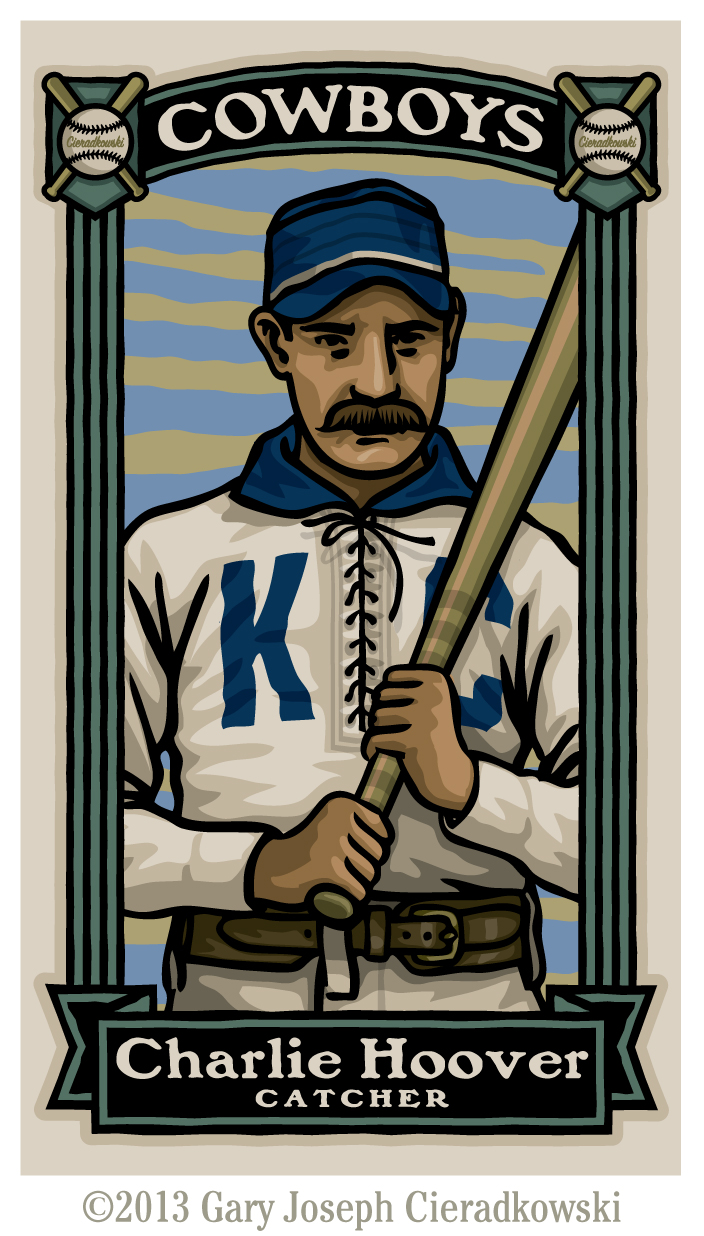
Gary Cieradkowski is an exceptionally talented artist from Covington, Kentucky.  Since 2010 he has produced the great Infinite Baseball Card Set Blog–with excellent stories and his incredible art work.  Gary contacted me recently about collaborating on a piece.  I chose Charlie Hoover.  Hoover was a talented, troubled 19th Century catcher who faded into obscurity and remains one of a handful of Major League players for which there is no information on the place or date of his death.  Read the piece here on Gary’s blog.

This is the card Gary created:

HOOVER_LG

“One of the Two Greatest Sluggers”

28 Jan

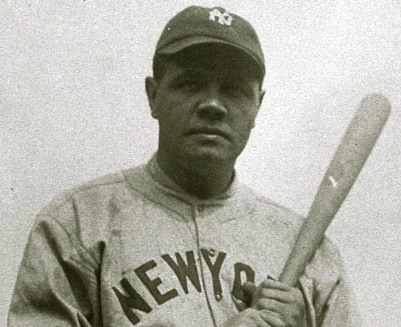
On July 19, 1920, Babe Ruth hit his 30th home run of the season off Dickie Kerr of the Chicago White Sox, breaking the Major League record he had set the previous season.  Perry Werden, working as an umpire in the South Dakota League was largely forgotten.

Babe Ruth

Babe Ruth

The Minneapolis Tribune, as a point of local pride, reminded readers that Ruth had not eclipsed the record set in their town:

“Beyond all doubt the mark made yesterday is a major league record of all time but the Babe has yet to equal the mark of 45 made by Perry Werden of the Minneapolis Western League club in 1895.”

Some reporters, like Al Spink of The Sporting News, dismissed Werden because “the park at Minneapolis, which was an unusually small inclosure (sic), with the right and left field fences close in.”  Regardless, Werden was back in the public eye; his forgotten record was revived as fans followed Ruth’s record season.  The Associated Press said:

“(Werden) admits that Babe Ruth has a harder swing than he had when he made his mark. ‘There is no doubt that Babe has it on all of them—modern and ancient’ says Werden”

When Ruth hit numbers 45 and 46, one in each game of a double-header at Fenway Park, The Associated Press said:

“(Ruth) broke all known world’s records for circuit drives in a single season.”

Werden, in his role as “the former holder of the home run record for organized baseball” was often asked about Ruth over the next decade.  Werden called Ruth “One of the two greatest sluggers that I have seen in fifty years.”

Perry Werden, 1930

Perry Werden, 1930

The only player Werden considered Ruth’s equal?   Ed Delahanty.

Werden told The North American Newspaper Alliance, in a nationally syndicated story:

“Ed Delahanty would have equaled or bettered the home run record of Babe Ruth if the lively ball had been in use…If Delahanty had any weakness no pitcher ever found out what it was.  He hit left-handers as easy and effectively as he did right-handers, and it made no difference to him where they threw the ball—high, low, inside, outside, curve fast ball or slow ball—they all looked alike to Big Ed.”

Werden said while playing first base for the Saint Louis Browns he saw just how hard Delahanty could hit:

“The Phillies had a runner on first base, and when Delahanty came up to bat we played in close for him, thinking he would bunt.  That was a mistake we never made again when Delahanty batted.  Instead of bunting he hit a ground ball so hard that it tore a shoe off George Pinkney, our third baseman, in addition to fracturing his right ankle.”

As further proof Werden said “Even with the lively ball…it was thirty-six years before Delahanty’s record of hitting four home runs in a single game was equaled by Lou Gehrig.”  Werden didn’t mention that Bobby Lowe had accomplished the same feat two years before Delahanty.

Ed Delahanty

Ed Delahanty

While Werden will never join Delahanty and Ruth in the Hall of Fame, he is remembered as one of the greatest minor league players of the 19th Century.  He died in Minneapolis in 1934.

“King of the Natural Hitters”

25 Jan

Percival Wheritt “Perry” “Moose” Werden began his baseball career as a pitcher for the semi-professional team of his employer; the Ira Perry Pie Company in Saint Louis.  He was discovered by the St. Louis Browns who offered him a contract but ultimately signed with the Saint Louis Maroons in the Union Association.

(An oft-repeated story that Werden’s discovery involved him leaving a pie wagon unattended to join a game, resulting in the wagon being destroyed is almost certainly apocryphal, although it has been repeated as fact with little or no support by several writers)

In 1884 the 22-year-old was 12-1 with a 1.97 for the Maroons who at 94-19 won the Union Association pennant by 21 games; despite the strong start, Werden would never pitch in the Major Leagues again.

The Maroons joined the National League the following season and Werden ended up with the Memphis Reds in the Southern League.  He was primarily a catcher a first baseman, and his career as a pitcher pretty much ended; he appeared on the mound in only three games that season and had only 14 more minor league appearances over the next 10 years because of arm trouble.

Perry Werden, 1908

Perry Werden, 1908

From 1886-88, Werden played with five minor league teams and played three games in the National League with Washington in 1888.  In 1889, Werden joined the Toledo Black Pirates in the International League, where he became a great hitter.

Werden hit .394 for Toledo; in 424 at-bats, he had 167 hits, which was the hit record for the franchise for nearly 100 years, finally broken by Greg “Boomer” Wells in 1982 (Wells had 182 hits in 541 at-bats).

Toledo became a Major League franchise the following season, joining the American Association as the Maumees, Werden was the their starting first baseman, hit .295 and led the team in hits, runs, triples, and RBIs.  The Maumees finished 68-64 in their only season.

Werden was sold by Toledo to the Baltimore Orioles in 1891 and had another solid season, leading the team in hits, triples and RBI’s.  The following season he was signed by the Saint Louis Browns to replace Charles Comiskey at first base; Comiskey had jumped the Browns to join the Cincinnati Reds.

Werden hit .256 and .290 in two seasons with the Browns.  In 1894, he returned to the minor leagues with the Minneapolis Minnies in the Western League.  That’s where he became a legend.

In 1894, Werden exploded.  He hit .417 with 43 home runs.  In 1895, he improved to .428 with 45 home runs.

The Western League was no doubt a hitter’s league; eight players with at least 100 at-bats hit .400 or better in 1894 and 11 did so in 1895.  And the Minnies home field, Athletic Park, where Werden hit most of his home runs, was by all estimates a hitter’s paradise with a short (some sources say 250 feet) fence.

Regardless, 45 home runs would remain a professional baseball record until 1920. The Duluth News-Tribune said several years later that Werden hit seven home runs in a double-header in 1895; under the headline “Perry Werden was King of the Natural Hitters:”

“It was one of the greatest batting feats ever seen on a baseball lot anywhere.”

Werden had one last season in the Major Leagues.  At 35-years-old in 1897, he hit .301 for the Louisville Colonels, then returned to the minor leagues where he continued to hit well; .330 for his minor league career.

Werden became an umpire in the American Association in 1907, and became a baseball pioneer in 1908 when he joined the Indianapolis Indians in the same league; he was one of the first full-time coaches in professional baseball.  The Associated Press said:

“Perry Werden will go to Indianapolis to act as assistant manager, coach and advisor in general of the Indianapolis baseball club this year.”

In October The Indianapolis News declared Werden a success in the new role:

“Werden was one of the biggest factors in bringing Indianapolis her first pennant since 1902.  Without his services it’s highly probable the flag would have flown elsewhere”

The Indianapolis Star predicted that Werden’s “novel position,” would become the norm with the Indians, and throughout baseball.

Werden eventually returned to umpiring, working in the western, Dakota, South Dakota and Northern leagues.

His 43 home run season became news again in 1920 as Babe Ruth was closing in on Werden’s professional record.  Werden said there was one player in his era who was Ruth’s equal as a hitter.  Who was it?

Read about it on Monday.

John Bradley

18 Jan

Two members of the 1888 Dallas Hams were shot and killed in Texas.

One, George Kittle, I wrote about in September.

John Bradley was the other one.

Charles M. “John” “Brad” Bradley (wrongly listed with the middle initial “H” on Baseball Reference) left Oil City, Pennsylvania where he was born in June of 1864, to go west and play baseball.  An article in The Louisville Courier Journal said he was born to wealth and left Pennsylvania because of his father’s disapproval of baseball:

“(Bradley) was surrounded with every luxury.  He acquired a collegiate education and all the ornamental accomplishments of modern times.  He was possessed of a charming tenor voice; was a brilliant pianist and an expert linguist.  He was passionately fond of the national game…An early disagreement with his father, the result of his penchant for baseball, led to an estrangement, and, troubles never coming singly, he was rejected by a young lady of Oil City, PA, to whom he was devoted.”

After playing in Corning, New York in 1885 Bradley went to Kansas.  Various sources place him with the Topeka Capitals in the Western League and/or a team in Abilene in 1886 though neither can be verified.  Bradley then played with the Emporia Reds in the Western League in 1887.

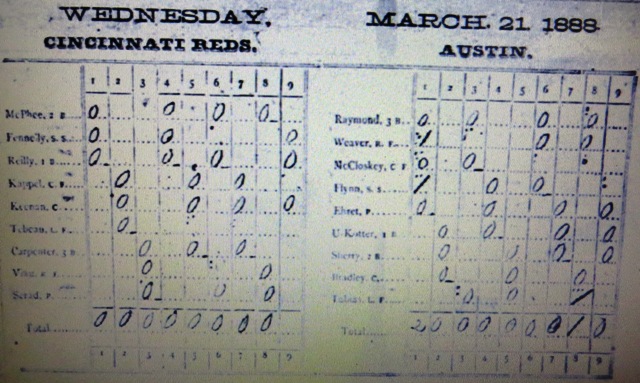
He signed with the Austin Senators in the newly formed Texas League in 1888.  In March, Bradley caught for Austin in two exhibition games with the Cincinnati Red Stockings of the American Association—the Statesmen lost the first game 2-0, but won the second 3-0.
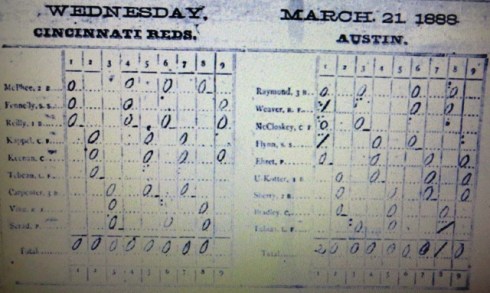
Box score of 1888 Austin -Cincinnati game won by Austin 3-0.

Box score of 1888 Austin-Cincinnati game won by Austin 3-0.

Bradley was Austin’s starting catcher until the dissolution of the Texas League in July.  When the reformed Texas Southern League commenced play later that month, Bradley was with Dallas where he shared catching duties with Kittle.

Bradley hit .158 as Dallas coasted to a championship.

The 1888 off season was an eventful one.

Bradley was offered a contract for 1889 with the St. Joseph Clay Eaters in the Western Association.

He also started seeing Dolly Love, “A woman of bad repute,” as The Dallas Morning News said; problem was Love was also involved with a livery driver named Tom Angus.

At the same time Bradley got in trouble with the law in December of 1888.  The Austin Weekly Statesman said:

“(Bradley) shot a man named Billups in a (Dallas) bar room, because Billups attacked him with an empty beer keg because he refused to pay for drinks.”

Bradley was charged with “assault with intent to kill” and was scheduled to appear in front of a Dallas Judge at the end of January.  He was also arrested twice in early January for altercations with Love at the brothel she operated.

Throughout the chaos Angus and Bradley were trading threats over Dolly Love.

The rivalry came to a head on January 16.  Shortly after 10:30 a.m., Bradley and a friend exited Swope & Mangold’s Saloon at the corner of Main and Austin to return to his room at the Grand Windsor Hotel across the street.  The Austin Weekly Statesman said Bradley was:

“Shot down like a dog by Tom Angus, a hack driver, who followed him and fired in his back.”

The Headline in The Dallas Morning News said:

“The Killing of Charles Bradley the Baseball Catcher, all about a Fallen Woman.”

Bradley was shot through the back and began to run as Angus fired two additional shots; after running about 120 feet, Bradley fell dead in the street.  Angus was immediately arrested and ordered held for trial.

A letter from five representatives of the Texas/Texas Southern League and addressed “To the Baseball Profession of the Union” was published in newspapers around the country soliciting funds “In order that able counsel may be obtained to conduct the prosecution,” the letter concluded:

“John Bradley played with Austin and Dallas in 1888, and had recently signed with St. Joe for the season of 1889. He was a gentleman, an excellent ballplayer and altogether an honor to our profession.  To ball players this case suggests not only a duty but a privilege, and we trust that a suitable response will be made.  Yours fraternally,

J. J. McCloskey, manager Austin team, I888.

Charles Levis, manager Dallas team 1888

Doug Crothers, manager Dallas team, 1889.

Kid Peeples, short stop Dallas team 1888.

Billy Joyce, third base Ft. Worth and New Orleans, 1888.”

It is unknown how much money was raised.

Dolly Love left Dallas for Fort Worth to escape the publicity.  Tom Angus spent more than a year in jail awaiting trial during which time he got married.  Dick Johnson, a friend of Angus’, who was at the scene of the shooting, was charged as an accessory, but was acquitted in a separate trial.

When the trial began in April of 1890 The Dallas Weekly Times-Herald headline called it:

“The Most Sensational Case that Has Been up for Years.”

Several witnesses, including a Dallas police officer testified that Bradley had also made threats against Angus in the weeks leading up to the killing, and that he often carried a gun.  Although Bradley wasn’t carrying a gun on the morning he was shot, and was shot in the back, the defense claimed that Angus had acted in self-defense.  Angus was found guilty, but sentenced to only five years in prison.

The sentence was upheld on appeal, the decision said:

“The accused should congratulate himself upon the mildness of the sentence.”

Angus was released from prison in the spring of 1895; in December he was arrested for shooting a man over a dispute about a horse.

Bradley was buried in Dallas.

Elton Chamberlain

17 Dec

Elton Chamberlain (for the last thirty years always referred to by the nickname “Icebox,” but that name was not in common use for him contemporaneously; although he was called Iceberg fairly often.) was primarily known for two things: A righthander, he pitched ambidextrously in at least one game, and on May 30, 1894 he gave up four home runs and a single to Bobby “Link” Lowe—17 total bases, a record which stood for 60 years.

He was also embroiled in one of the early controversies over gambling while playing for the Cincinnati Reds in 1893 when he was accused by his manager, Charles Comiskey, of throwing the first game of a July 4 doubleheader against the Philadelphia Phillies.

The Cincinnati Enquirer said:

“Pitcher Elton Chamberlain of the Cincinnatis is accused of throwing the game to the Philadelphias yesterday morning. He is charged with being in league with Joe Brill, a local gambler.”

The story said Comiskey, notified of the allegation:

“(D)ecided to investigate (and) after a consultation with a club official, put Chamberlain in for three innings to watch him. Chamberlain’s pitching was very bad and be was taken out of the game in the third inning.”

Chamberlain’s teammates Jim Canavan and Silver King quickly came to his defense. King said he thought he would be the starting pitcher, not Chamberlain, until just before the game started; therefore Brill and Chamberlain could not have conspired.

Chamberlain said of the story:

“It was cruel and cowardly to try to ruin a man like that.”

The Sporting Life ripped The Enquirer and Comiskey:

“This is not the first time The Enquirer has accused ball players of dishonesty, and once it got into and lost a libel suit with Tony Mullane for accusing him of crookedness. Comiskey in his time has also made similar charges and Insinuations against guiltless players.”

The New York Herald said “The whole affair was so silly,” and seemed to have Comiskey in mind with this statement:

“The club official who suspends a player on the charge of dishonesty should be made to prove his charges or himself be forever barred from further connection with any club.”

The Herald also recommended that steps be taken to officially clear Chamberlain and punish those who accused him:

“The National Board should at once take up pitcher Chamberlain’s case and investigate it beyond the limit of doubt and when they reach the facts, whatever the facts; someone should be made to suffer.”

Cincinnati’s management, Comiskey included, quickly repudiated the charges that appeared in The Enquirer, although from all indications they were directly responsible for the charges being reported in the first place.

Elton Chamberlain

Elton Chamberlain

The headlines of July faded by August; there was no official investigation and no one was “made to suffer.”

Charles Comiskey

Charles Comiskey

Chamberlain finished the season with a 16-12 record and his 3.73 ERA led the Reds’ pitching staff. The following year was his last full season in the Major Leagues.

In 1895 he played for the Warren (PA) franchise in the Iron and Oil League. The team won the pennant behind the pitching of Chamberlain and another former Major Leaguer, Tom Vickery.

They also had a 21-year-old shortstop named Honus Wagner.

No statistics survive for that season, but forty years later Wagner, writing for The Pittsburgh Press, said Chamberlain “Seldom lost a ballgame for us,” and that Chamberlain and Vickery “gave out plenty of their knowledge to us youngsters.”

Chamberlain bounced around minor and semi-pro leagues after one last Major League trial with the Cleveland Spiders in 1896. In 1898 he accepted, then rejected, an offer to serve as a National League umpire. After turning down the umpire job Chamberlain, a Buffalo native, said he would become a professional boxer and challenged a local middleweight named Jack Baty to a fight that would include a $500 side bet. Baty’s fight record indicates the bout did not take place.

Chamberlain attempted to resume his baseball career with the Buffalo Bisons in the Western League in 1899—by July he was released and The Sporting Life reported that Chamberlain, a rabid horse player “is once more following the races.”

Chamberlain Died in Baltimore in 1929.

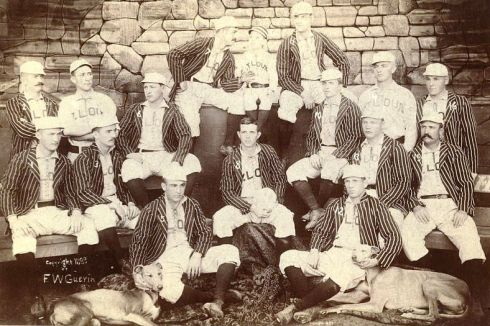
Chamberlain and Comiskey as teammates with the St. Louis Browns.  Chamberlain is 5, Comiskey 8.

Chamberlain and Comiskey were also teammates with the St. Louis Browns. Chamberlain is 5, Comiskey 8.