Tag Archives: World Series

“A Historical Account of a Great Game of Ball”

5 Mar

The headline above appeared in 1907 above an article written by Frederick North Shorey in The Freeman regarding a series between Andrew “Rube” Foster’s Leland Giants and Mike Donlin’s All-Stars “an aggregation composed of such noted players as Mike Donlin, Jake Stahl, Jimmie Ryan and Jimmy Callahan, probably the best semi-professional team in the country.”

Shorey said the series at South Side Park “exceeded in interest to the people it attracted anything that took place between the White Sox and Cubs last fall (1906 World Series).”

Rube Foster beat the Donlin All-Stars 3-1 in the first game, allowing only three hits:

“Rube Foster is the pitcher of the Leland Giants, and he has all the speed of (Amos) Rusie, the tricks of a Radbourne, and the heady coolness and deliberation of a Cy Young. What does that make him? Why, the greatest baseball pitcher in the country; that is what the best ballplayers of the white persuasion that have gone up against him say.”

Rube Foster
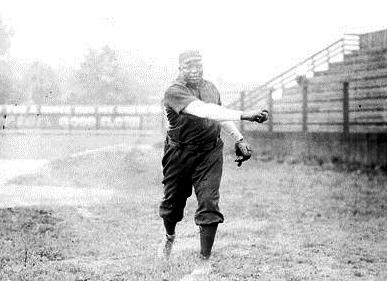
Rube Foster

Foster was so important to his fans, Shorey said:

“If it were in the power of the colored people to honor him politically or to raise him to the station to which they believe he is entitled, Booker T. Washington would have to be content with second place.”

The Chicago Tribune said of Foster’s domination of the All-Stars:
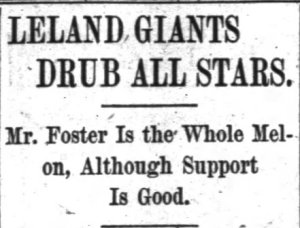
lelandsvsdonlins

Back to the series, and back to Shorey:

“While the all-stars were confident in their ability to win, several of the old players, including Mr. Donlin himself, who have known of the prowess of Mr. Foster…knew that it was by no means a certainty…but they had hopes that the colored team behind him might do something to undo the efforts of the twirler.

Mike Donlin
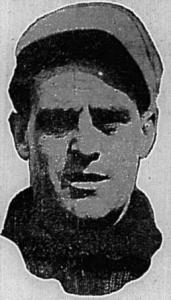
Mike Donlin

Shorey said the all-stars were over matched:

“The colored men set a new pace for base running, while foster’s cool, deliberate pitching was too much for the old-time players on Donlin’s team. Both teams put up brilliant fielding games.”

Foster pitched in four games in the series; he won all four.

David Wyatt–who had been a teammate of Foster’s with the Chicago Union Giants in 1902, and who in 1920 was asked by Foster to help draft the constitution of the Negro National League—also wrote about the series in The Freeman:

“All the baseball critics in the city were out to look the Lelands over, many under the impression that they were overrated. The most interested of the number was Mr. Comiskey, owner of the white Sox…After witnessing the first game the white sox boss said if it were possible he would have annexed the signature of at least three of the boys to contracts, and he was so enthused over the fast, snappy work of the Lelands that he had his world’s champions to lay over one day in Chicago to watch the boys play.”

Wyatt had higher hopes for “Baseball as the common leveler” in general and the series specifically:

“There was no color line drawn anywhere; our white brethren outnumbered us by a few hundred, and all bumped elbows in the grand stand, the box seats and bleachers; women and men alike, all whetted freely with one another on the possible outcome of the series, the effect it would have upon the future of the negro in baseball, the merits of the different players etc…”

Foster’s heroics, Wyatt’s hopefulness, Comiskey’s words and Chicago’s enthusiasm were, of course, not enough to change the status quo; regardless of the “Great game of ball,” played at South Side Park in that 1907 series, the color line would remain intact for four more decades.
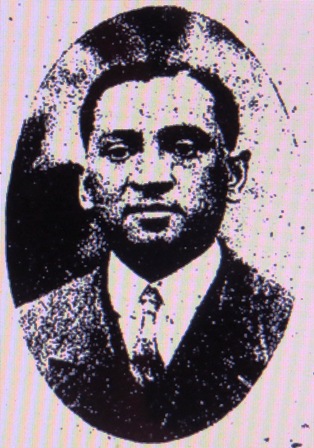
David Wyatt
David Wyatt

“Bill Abstein Denies he is a Bonehead”

20 Feb

Pittsburgh Pirate owner Barney Dreyfuss and manager Fred Clarke felt all they needed to win a World Series was a first baseman.  Since winning the National League Pennant with Kitty Bransfield in 1903, only one Pirate first baseman hit better than .260 (Del Howard .292 in 1905).

In 1908 the Pirates finished second with four different first basemen, Harry Swacina, Alan Storke, Jim Kane and Warren Gill; none played more than 50 games, none hit better than .258 and they combined for 29 errors.

The man who took over in 1909, and was with the Pirates for their World Series victory, might have preferred to have never been given the job.

Bill Abstein had played eight games at second base and in the outfield for the Pirates in 1906, before returning to minors.

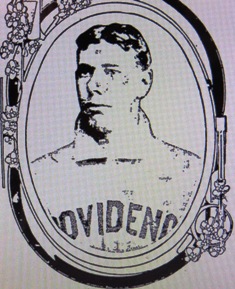
-Abstein had put up respectable, but by no means spectacular, numbers with the Shreveport Pirates in the Southern Association and Providence Grays in the Eastern League from 1906 to 1908—but as early as August of 1908 The Pittsburgh Press said he was the answer to the Pirates problem at first base:

“Fred Clarke is very eager to secure Bill Abstein from Providence.  Bill is rated the best first baseman in the Eastern League, and he would no doubt strengthen the Pirates where they are weak.”

When Abstein joined the Pirates before the 1909 season The Press said:

“The acquisition of bill Abstein has rounded our infield nicely.  He’s the best first baseman we have had in years and he certainly fits in nicely.”

???????????????????????????????

Abstein, Providence 1908

In a letter sent to Dreyfuss with his contract, Abstein told the Pirate owner:

“Fred Clarke will not have to worry about a first baseman after he sees this big German hustling around the bag.”

In keeping with his career performance, Abstein had a respectable season for the pirates.  He hit .260 and drove in 70 runs.  His 27 errors were only a slight improvement over 1908’s first baseman by committee.

The Pirates won 110 games and won the National League Pennant by six and half games over the Chicago Cubs and met the Detroit Tigers in the World Series.  The series would be the beginning of the end of Abstein’s Major League career.

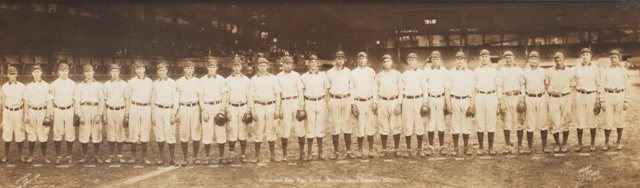
09pirates

1909 World Champion Pittsburgh Pirates, Abstein 11th from left.

Abstein struggled at the plate (6 for 29 with nine strikeouts) and in the field (5 errors total, 2 each in games 3 and 4).  The Pirates won the series in seven games, but despite the victory, Abstein quickly became the subject of ridicule in Pittsburgh.

An Associated Press article after the series said:

“During the games with Detroit Abstein appeared to forget all that he knew about base ball.  He ran the bases foolishly, made a number of costly errors, failed to hit and disobeyed orders.  In fact, his playing was worse than that of any other man on either team.  The other Pirates, seeing that Abstein was the ‘goat’ for the combination, kept up the cry against him…Before the series was ended many of the Pirates shunned Abstein and it was reported he would be traded.”

The Pittsburgh Press was less generous:

“Bill Abstein denies he is a bonehead and says baseball is largely a case of ‘if-you-can-get-away-with-it,’ well it’s a cinch that Bill couldn’t in the National League.”

The Pirates were unable to trade Abstein and finally put him on waivers.  He was claimed by his hometown St. Louis Browns.

Even though the Pirates had actually won the Worlds Series and even though Abstein was gone, that didn’t mean the Pirates, and The Pittsburgh Press, wouldn’t continue to pile on.

Barney Dreyfuss told The Associated Press shortly after Abstein was claimed by St. Louis:

“We have discarded the weakest offensive player we had—Abstein—and hope to improve the team by doing so.”

Dreyfuss also claimed:

“Fred (Clarke) told me as early as last June that we should get someone else for Abstein’s place in 1910, as Bill mixed up the team’s plays too frequently.”

The Pittsburgh Leader said:

“(Abstein) had deplorable batting weaknesses which the opposing pitchers were certain to fathom in time.”

The Pittsburgh Press was even less generous:

“Bill Abstein is reported to be making a hit with the Browns by his work in the spring practice.  Just wait about three months friends, before declaring Bonehead Bill a wonder.”

When the Pirates sold pitcher Vic Willis the St. Louis Cardinals in February of 1910, newspapers reported that Willis and Abstein had “engaged in a bitter fight,” during the series.

Abstein quickly wore out his welcome in his own hometown of St. Louis.  Abstein made 11 errors in 23 games at first base and hit .149; he was released on June 2, 1910.  It appears Abstein was no more popular with Browns Manager Jack O’Connor than he was in Pittsburgh.  O’Connor was quoted in The St. Louis Times in May:

“How did Abstein get away with it last year?  How could he make plays like he has been making for me and get away with it all year for Pittsburgh?  I never dreamed that some of the plays made by him were even possible.”

His Major League career over, Abstein returned to the minor leagues for seven seasons.  He had one above average year with the Los Angeles Angels in the Pacific Coast League in 1914; in 202 games he hit .308, with 234 hits and 40 doubles.

Abstein moved on, Pittsburgh apparently did not.  For years, Pittsburgh newspapers took every opportunity to take a shot at the first baseman.  In 1915 The Pittsburgh Press, in an article about the revolving door the Pirates still had at first base–in the five post-Abstein seasons, the Pirates had four different starting first baseman–(emphasis theirs):

“No one will ever forget the way Bill did NOT play the bag in the Worlds Series.  In fact, Bill did NOT play the bag all the time he was stationed there.”

Pittsburgh finally seemed to move on by the time they won their next world Championship in 1925.  Abstein died in St. Louis in 1940.

“Greatest Baseball Game Ever Contested”

13 Feb

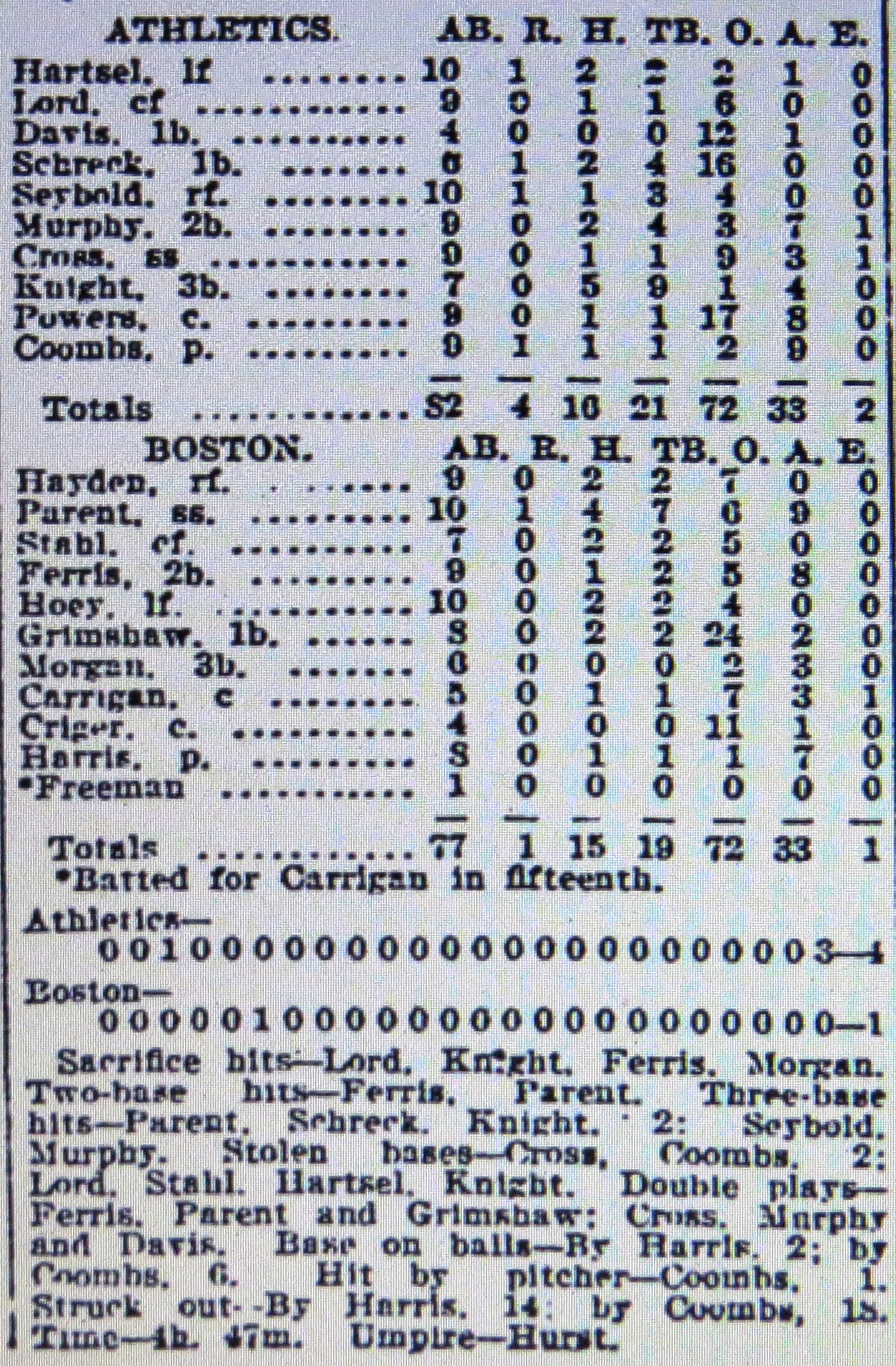
The Philadelphia Record headline called it the “Greatest Baseball Game Ever Contested, “ the September 1, 1906 game at Boston’s Huntington Avenue Grounds between the Philadelphia Athletics and the Boston Americans:

“What will go down in history as the most remarkable ball game ever played in a major league lasted 4 hours and 47 minutes to-day, and the champion Athletics beat the Bostons 4 to 1 in 24 innings.  It was a heart-breaking struggle all through, and to the astonishment of 18,000 people who saw the contest, the pitchers hung on until the last gun was fired.”

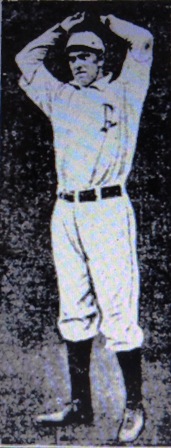
Rookie Jack Coombs pitched for Philadelphia, Joe Harris was on the mound for Boston.

Philadelphia scored a run in the third inning; Boston tied the game in the sixth:

“After that plenty of opportunities were offered, but owing to fast fielding and good pitching neither side could cross the plate.

“In the twenty-fourth, when darkness was fast covering the field, (Topsy) Hartsell led off with a single.  (Bris) Lord struck out, but Hartsell stole second…Shreck (Ossee Schrecongost) sent him home with a single over second.”

The Athletics added two more Runs as “The immense crowd filled out around the field.”

Coombs closed the Americans out in the twenty-fourth and “was cheered to an echo, some of the fans wanting to carry him on their shoulders from the field.”

The box score:

???????????????????????????????

“It was well that the game was concluded as it was, for it was too dark to go another inning, and the crowd began to murmur that the light was too dim when the last round began.  But the players themselves interposed no objection, for they were all deeply anxious to fight it out.”

Jack Coombs, 1906

Jack Coombs, 1906

Coombs would go on to a long career, highlighted by a 31-9 record, and three more wins over the Chicago Cubs in the World Series for the champion Athletics in 1910; overall he was 5-0 in World Series play.  He also pitched for the Brooklyn Robins and Detroit Tigers.

Harris is one of the ultimate hard-luck pitchers in the history of baseball.  He ended the 1906 season with a 2-21 record (the Americans were shut out 8 times when he pitched).  His Major League career was over after he went 0-7 in 1907; Harris ended his career with a 3-30 record.

Fall from Grace

24 Oct

Grayson S. “Gracie” Pierce played parts of three seasons in the major leagues and was a National League umpire selected to preside over the final game of the 1886 championship series.  It went downhill from there.

Pierce was born in New York City in 1860.  Nearly every contemporaneous newspaper account referred to him as “Grace,” not “Gracie.”

Grayson Pierce

Pierce hit .186 playing for five different teams in the American Association and National League during his brief big league career; he was only slightly more successful during his single minor league season playing with the Hartford Babies and Binghamton Bingoes in 1885.

During his playing career there are references to Pierce occasionally serving as an umpire in college and professional games, and according to The Cincinnati Commercial he worked as a longshoreman in New Orleans each winter; he became a National League umpire in 1886,

In October of 1886, The Chicago White Stockings of the National League met the St. Louis Browns in the 1886 World Series.  Pierce was selected to serve as umpire in game 5, but according to The St. Louis Globe- Democrat, “(H)e was not on the grounds, as a long search revealed.”

Pierce got his chance the following day—with St. Louis leading the series 3-2, he was again selected to serve as umpire.  It didn’t go well for the White Stockings or Pierce.

Chicago blew a 3-0 lead in the eighth inning and lost the game in the tenth.  Pierce’s performance was universally panned.  The Globe-Democrat said:

 “For Umpire Grace Pierce of the League staff had been selected.  His judgment was weak and his decisions throughout the game gave rather poor satisfaction.”

The Globe-Democrat’s assessment was echoed elsewhere as well.  The Chicago Inter Ocean said that among the crowd:

“There was much loud talking and opinions of Pierce were quite freely expressed.”

Pierce was not a member of the National League staff the following year and instead worked in the International Association.  In September, a variety of charges were made against Pierce by the owner of the Syracuse Stars.  The complaint, filed with the league, said Pierce was drunk at games in Syracuse and Newark, and also claimed as reported by The Rochester Post-Express:

 “(Pierce) had forced Con. Murphy (Cornelius Murphy) to drink against the latter’s will and that he took (Tom) Lynch out of bed at 10 o’clock at night and started out ‘to do the town’  both returning in the morning ‘boiling drunk.’”

Pierce denied the charges saying Murphy concocted the story after Pierce had ejected him from a game and fined him $3 in Newark.  The Post-Express sided with Pierce and said:

“Grace is not a total abstainer, but in his long career on the ball field he has never been charged with drunkenness.  So far as Con. Murphy is concerned it has never been known before that he would have to be forced to take a drink.”

As for the charges regarding the drinking binge with Lynch, Pierce said:

“I was going home I found Lynch drunk in the street, I took him home and put him to bed.”

There is no record of what became of the charges, but Pierce did continue working as an umpire on the East Coast through the 1891 season.

The Sporting Life reported that Pierce did not have a position with a league for the 1892 season.

He disappeared for two years and  was not heard from again until July of 1894 when The New York Times reported:

“(Pierce) formerly a baseball player and umpire, was arraigned before Justice Burke in the Harlem Police Court yesterday morning charged by Barney Brogan a liquor saloon keeper…with stealing $35 from his cash drawer after the saloon was closed.”

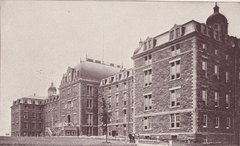
Pierce, who The Brooklyn Daily Eagle described as being “in a half-dazed condition” in court,   denied the charges but was unable to post the $1000 bond.  He was sent to Blackwell’s Island (the prison located on what is now Roosevelt Island). He became ill and died at City Hospital on Blackwell’s Island six weeks after his arrest.

City Hospital, Blackwell’s Island