Archive | June, 2013

A Thousand Words–Ray Schalk/George Sisler

28 Jun

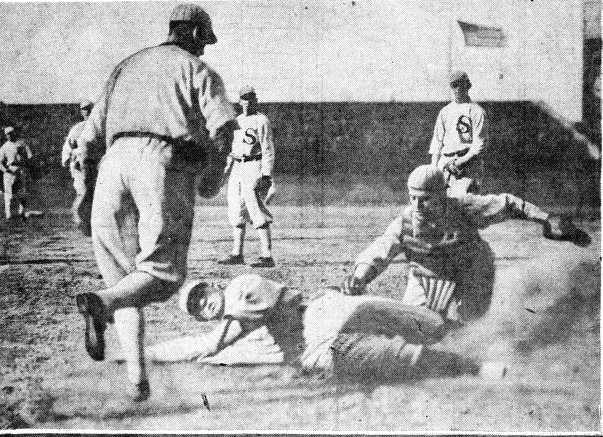
cracker1916sisler

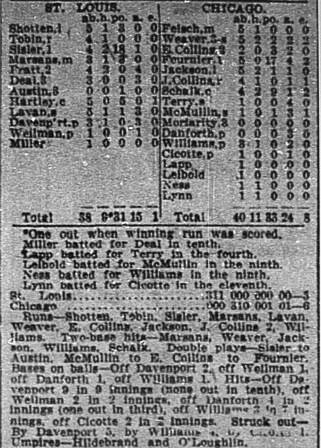
A rare 1916 photo of two Hall of Famers.  Chicago White Sox catcher Ray “Cracker” Schalk tags out George Sisler at first base ending a rundown after the St. Louis Browns first baseman was caught off first by Sox pitcher Claude “Lefty” Williams.  The play, which also included  leftfielder “Shoeless” Joe Jackson, was scored 1-3-4-3-6-1-7-2–Williams-Jake FournierEddie Collins-Fournier-Zeb Terry-Williams-Jackson-Schalk.  The White Sox won the April 17 game 6-5.

The Box Score

The Box Score

“The Sudden Reappearance of ‘Silver’ King”

27 Jun

Oliver Perry “O.P.” Caylor wrote in June of 1896 in The New York Herald:

“One of the baseball surprises of the season is the apparently successful reappearance of ‘Silver’ King upon the National League diamond.  Without any warning the Washington club sent him in against the Pittsburgh team, and he not only won his game, but held the latter down to six hits, Of course all this caused a great deal of gossip wherever baseball is a subject of interest.”

When Charles Frederick “Silver” King (born Koenig), took the mound for the Washington Senators and beat the Pittsburgh Pirates 8 to 1 in the second game of a May 30 doubleheader, it was his first appearance in professional baseball in nearly three years.

King had been one of baseball’s best pitchers of the 1880s, with a 142-70 record from 1887-1890 while playing for Charlie Comiskey, first with the St. Louis Browns in the American Association and then following Comiskey to the  Chicago Pirates in the Players League.

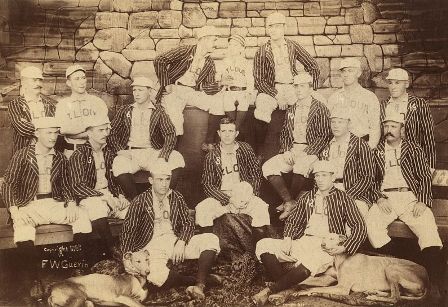
Comiskey (8) and pitcher Silver King (14) with the 1888 St. Louis Browns, King would follow Comiskey to the Chicago Pirates in the Players League in 1890

Comiskey, seated center(8) and Silver King standing second from right (14) with the 1888 St. Louis Browns, King would follow Comiskey to the Chicago Pirates in the Players League in 1890

Caylor said that during Flint’s heyday:

“His most successful delivery was what is known as ‘the cross fire,’ first used effectively, I believe, by (Charles “Old Hoss”) Radbourne and at present the prominent stock in trade of (Wilfred “Kid”) Carsey of the Philadelphias (Phillies).  It consists of standing on the extreme end of the pitcher’s plate, stepping away still farther from the direct line towards the batsman and sending the ball across the home base at an angle, which, although small, is very bothersome to the man with the bat.”

Silver King

Silver King

Caylor said King was “put out of the business” in 1893 when “the pitcher’s box was set back five feet,” (to the current 60’ 6”).  While King’s record slipped during the last two seasons the distance was 55 feet to a combined 36-53 while pitching for the Pirates and New York Giants, he had respectable ERAs of 3.11 and 3.29.  After the rule change King went 8-10 with a 6.08 ERA pitching for the Giants and Comiskey’s Cincinnati Reds in 1893, and then disappeared.

Caylor thought there was “a great deal of significance to King’s return to the diamond,” and predicted a trend:

“It means managers, having exhausted the new crop and finding nothing before them worth a trial, are forced to look behind and try to rekindle some of the half burned out embers. Washington not only took up King, but they gave (Les) German a trial after the New York club let him go.  (Cap) Anson (Chicago Colts) went back to (Fred) Pfeffer after finding (Algernon “Algie”) McBride, (Josh) Reilly and (George) Flynn wanting and was even forced to put himself into his nine to fill out the weak spots.”

Caylor said it was “astonishing  to look over the list of new material which was brought into the National League last spring and notice how small a part of it has been able to keep ‘in the swim.’  Every day one hears that some younger player has been released or that another has been loaned or farmed to a minor league club.”

Caylor’s prediction of success for the “trend,” and the players named was a mixed bag.  Anson, who had never really gone away, hit .331 in 108 games, for the Colts, but Pfeffer hit just .244 in 94 games. German fared the worst, he was 2-20 in 1896 and 3-5 the following season before being released in August.

King managed to post a 16-16 record for the Senators in 1896 and ’97 but never found his early career form.  After the 1897 season, he returned to St. Louis where he died in 1938.

Caylor would become ill the following season, and died in October of 1897.

The Curve and The Spitter

26 Jun

Hugh A. “Hughey” Reid only appeared in one professional game; he went 0-4 and played right field in a game for the American Association’s Baltimore Canaries against the White Stockings in Chicago in August of 1874,  as was the practice at the time, Baltimore recruited Reid, a local semi-pro player to fill in for the injured Oscar Bielaski.

Reid wasn’t known in the amateur and semi-pro leagues in Chicago as an outfielder.  He was considered one of the best pitchers in town, and played for the Chicago Aetnas, one of the premier teams in the city, and according to The Chicago Tribune “The champion amateur team of 1869.”

Hugh Reid

Hugh Reid

Among Reid’s teammates with the Aetnas were future big leaguers Jimmy Hallinan and Reid’s brother-in-law and catcher Paddy Quinn.

Reid worked as a stereotyper (made metal printing plates), for The Chicago Evening Post after his career ended.

In 1920, Reid was interviewed by Alfred Henry “Al” Spink, founder of The Sporting News.  By 1920, Spink, who had played amateur baseball in Chicago against Reid with a team called the Mutuals (named for the more famous aggregation in New York), had relocated to Chicago and was writing for The Evening Post.

Al Spink

Al Spink

The occasion was “field day exercises of the old timers” at Pyott Park at the corner of Lake Street and Kilpatrick Avenue in Chicago; the days events were followed by a banquet.  “Cap” Anson, Charles Comiskey, Hugh Nicol, and Fred Pfeffer were among the dozens of former pro, semi-pro, and amateur players who attended.

Spink described the 70-year-old Reid; “same old smile, same old swagger, same old don’t care a tinker’s, same old Hughey.”

Nine years earlier Spink had credited William Arthur “Candy” Cummings with originating the curveball in his book “The National Game,” but by 1920 others were making the case for different candidates.  Spink asked Reid his opinion:

“Without a doubt Cummings was the first pitcher to put the curve on the ball.

“As Cummings was using the outcurve as early as 1867, and Bobby Matthews only broke into the game at Baltimore in 1869, there is very little doubt as to who discovered the art of curving.

“In fact, it was not until years later, when the rules allowed the pitchers to raise their arm above the waist, that Matthews became master of the curve.”

Candy Cummings

Candy Cummings

Reid also talked about the pitch Mathews did introduce:

“I am quite sure that Mathews was the first to work the delivery mow bearing the insanitary name

“Before delivering the ball he would rub it hard on his trousers, always on the same spot, where the seams are the farthest apart…he would draw his two fingers across his lips, take the ball with two fingers and a thumb and send it in with only fair speed.  He had perfect control and usually sent the ball about waist-high for a player calling for a low ball.  The break came just in front of the plate and the ball usually went into the ground or very high in the air.  Few line drives were made off of Mathews.”

Bobby Mathews

Bobby Mathews

Reid also talked about Alphonse Case “Phonney” Martin.  At the same time that Spink was making the case for Cummings in “The National Game,” Martin told William Aulick of The New York Globe that he developed the pitch. Aulick concluded:

“Some people say this was the first cousin of the curve ball, but they don’t say this when old Alphonse Martin is around.  He insists it wasn’t anyone’s cousin–it was Mister Curve himself.”

Reid disagreed, he described Martin’s pitch as a “freak ball,” and said:

“I first saw Martin pitch down on the old lake front grounds in Chicago against the original White Stocking team.  He simply threw a slow lob ball that came so slow you had to nearly break your back to hit it.  But, at that, his delivery was a success, and most of the balls hit from it went high in the air and came down in some fielder’s hands…He threw a slow teaser that reached the plate about shoulder-high and dropped while still spinning.”

Alphonse "Phonney" Martin

Alphonse “Phonney” Martin

Reid insisted Martin’s pitch was not a curve:

“Cummings and Cummins alone was the originator of the curve.”

Browning and Delahanty

25 Jun

John Anthony “Honest Jack” Boyle played in the American Association, Players League and National League from 1886 to 1898.

Boyle’s career was on the decline by the end of the 1898 season (he had only appeared in six games with the Philadelphia Phillies that year), but was effectively ended in November when he was the victim of a mysterious knife attack in his hometown of Cincinnati.

The Cincinnati Commercial Tribune said Boyle was “attacked from behind by an unknown man, who, before the player could defend himself, plunged a knife into his shoulder.”

A piece of the knife broke off in Boyle’s shoulder and he didn’t play regularly again until 1905 when he appeared in 101 games for the Toledo Mud Hens in the American Association ; he was a player-manager for the Terre Haute Hottentots in the Central League the following season.

Jack Boyle

Jack Boyle

By 1910 Boyle, who was operating a saloon in Cincinnati, told William A. Phelon of The Chicago Tribune that the two best hitters he ever saw were Pete Browning and Ed Delahanty, and provided a window into the minds of two of the biggest stars of the 19th Century:

“(T)here never were two men more radically different in their ideas of and their opinions of the game than these two great sluggers.  They looked at the game from totally different angles, and they regarded their occupation with widely varying views.

“Pete Browning was an artist.  To him baseball was an art or a profession and batting an absorbing passion.

“Delahanty was a workman.  Baseball to him was labor or a trade, and batting simply part of the daily toil.

“When Browning left the field the game wasn’t over.  He continued to talk batting, theorize on batting, figure out new ideas on batting, and I think, dreamed of batting all night long.

Pete Browning

Pete Browning

“When Delahanty left the ballpark the game was all through for the day, exactly as if he was a laborer going home to supper.  He ceased to think baseball.

Ed Delahanty

Ed Delahanty

“If Browning failed to make a hit at the time of need, he would have tears in his eyes and would bitterly bewail his misfortune.  If Delahanty fell down in the pinch, he shrugged his shoulders, hoofed back to the bench and began to talk racing or the weather.

“When an outfielder galloped to the fence and pulled down one of Browning’s mighty drives, Pete would regard it as a personal insult, and glower at the outfielder like a baffled tiger.  When a fielder robbed Del of a home run, Ed would grunt ‘Good catch, boy, didn’t think you’d get it’ and forget it forever.

“If you had told Pete Browning that the business was losing money, and that you would have to cut his salary next season, he would have accepted the money rather than lose the chance to play the game.  If you handed that talk to Delahanty, he would have sneered scornfully and remarked that you’d have to come up with 500 more beans before he’d even look at a contract.

“Neither Pete nor Del cared much where their teams finished on the season.  Pete thought only of hits and the glory of making them.  Del thought of a comfortable winter life on the money he had made in the summertime.”

Boyle said the only thing the two really had in common was an inability to bunt:

“Del wouldn’t simply try.  Pete, with much groaning and protestation, would be coaxed to make the attempt, but his attempts were fizzles.”

Boyle, or Phelon, omitted the other thing the two had in common: serious drinking problems that hurt them on and off the field and contributed to their early deaths.

Boyle died in Cincinnati in 1913.

Baseball’s “Growing Evil”

24 Jun

By 1913 newspaper articles under the byline of a famous player were common in newspapers across the country, and most of the game’s biggest stars were represented.

Most fans of that era assumed the players did their own writing until an expose appeared in The Washington Herald in March of 1913.  Sports Editor William Peet wrote:

“The dear old public fell for this stuff and swallowed hook, bait and sinker.  An article under the signature of Christy Mathewson led three-fourths of the fans to believe that the great pitcher himself wrote it.”

According to Peet, players were paid between $250 and $1000 for each story “and not one of them wrote a single word,” but it was still a good investment:

“The newspapers themselves regarded these feature articles as good investments, for the reason that the stories were syndicated to 25 or more outside publications and the revenues derived not only paid the amount guaranteed the baseball player for the use of his name, but left a handsome profit.”

Peet exposed the writers behind the articles “written” by the game’s biggest stars:

Christy Mathewson and Jeff Tesreau/John Wheeler, The New York Herald

Walter Johnson/Ralph MacMillan, The Boston Journal/The Boston Herald

John McGraw/Walter Turnbull, The New York Evening Sun

John “Chief” Meyers/Jim McBeth, The New York American

Richard “Rube” Marquard/Bill Farnsworth, The Atlanta Georgian/Hearst Newspapers

Denton “Cy” Young/Sam Carrick, The Boston Post

Tris Speaker/Tim Murnane, The Boston Globe

“Smokey” Joe Wood/Jim O’Leary, The Boston Globe

Ty Cobb/Roger Tidden, The New York World

Hughie Jennings/George “Stoney” McLinn, The Philadelphia Press

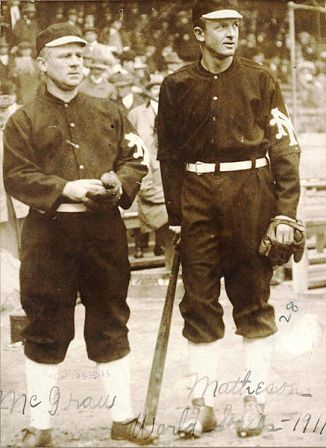
John McGraw and Christy Mathewson

John McGraw and Christy Mathewson

Peet called the practice dishonest, and said it had gone too far, and in New York and Boston the practice   had “become a mania.”  Peet singled out an article “written” by John McGraw criticizing “Chief” Myers that caused an “explosion,” and said the articles featuring “Rube” Marquard’s byline, and written by Farnsworth got Marquard “in bad with his teammates, for Farnsworth spared no one is his scathing criticisms.”

Pittsburgh Pirate manager Fred Clarke disagreed with the practice, telling Peet:

“I do not think it is any ball player’s place to butt into the newspaper end of the game…I think it is foolish for any player, especially those who take part in the world’s Series, to write about the games.”

As a result of Peet’s revelations the American League club owners condemned the practice of players’ names appearing on articles they did not write, but came just short of officially banning the practice. In September, the Baseball Writers Association petitioned the National Commission to end the “growing evil” of players authoring or appearing to author articles during the upcoming World Series.

The commission agreed, and American League President Ban Johnson informed Philadelphia Athletics manager Connie Mack on the eve of the World Series that star players Eddie Collins and Frank Baker “have been instructed not to write baseball stories or give the impression they are writing them.  If they ignore this request, a way of punishing them would be found. “

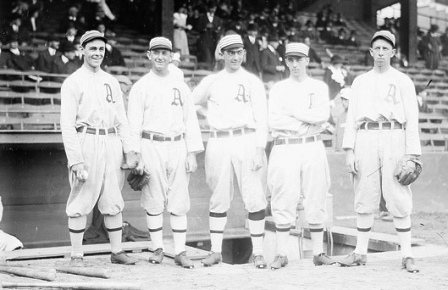
Frank Baker, center, Eddie Collins, far right,

Frank Baker, center, Eddie Collins, far right,

Johnson even threatened “Collins and Baker would not be permitted to take part in the World Series,” if they wrote articles or permitted their names to be attached to articles.

At one point Johnson and National Commission Chairman August Hermann said they would consider calling off the series if players refused to comply.  Dave Fultz, the former player, practicing attorney, and president of the Fraternity of Baseball Players, said members of the commission could be personally liable for damages if the series was cancelled.  Johnson and Herman’s threat to cancel the series as a whole was put to rest.

Mack argued that the players had contracts with newspapers and that Johnson had said earlier that players who were “capable” of writing their own articles would be permitted to do so, but as he prepared his team to play the New York Giants, he prepared for the worst, telling The Associated Press:

“(I)f the commission decides the players must not write under any conditions and players decide not to abide by the ruling, I will be prepared to put a team on the field,” The AP speculated that utility infielder John “Doc” Lavan  would play second base  and outfielder Rube Oldring would be moved to third base, with Amos Strunk taking Oldring’s place in the outfield.

Mack’s adjustments weren’t required.  Collins was allowed to write for The Philadelphia Record because his deal with the paper predated the commission’s ruling, and Baker did not write articles.  Together they led the Athletics to a 4-1 Series win, hitting .421 and .450.

Ghost written articles, and articles actually written by players never disappeared, but the practice became much less popular after the revelations and battles of 1913.

Satchel Paige Night, 1952

21 Jun

???????????????????????????????

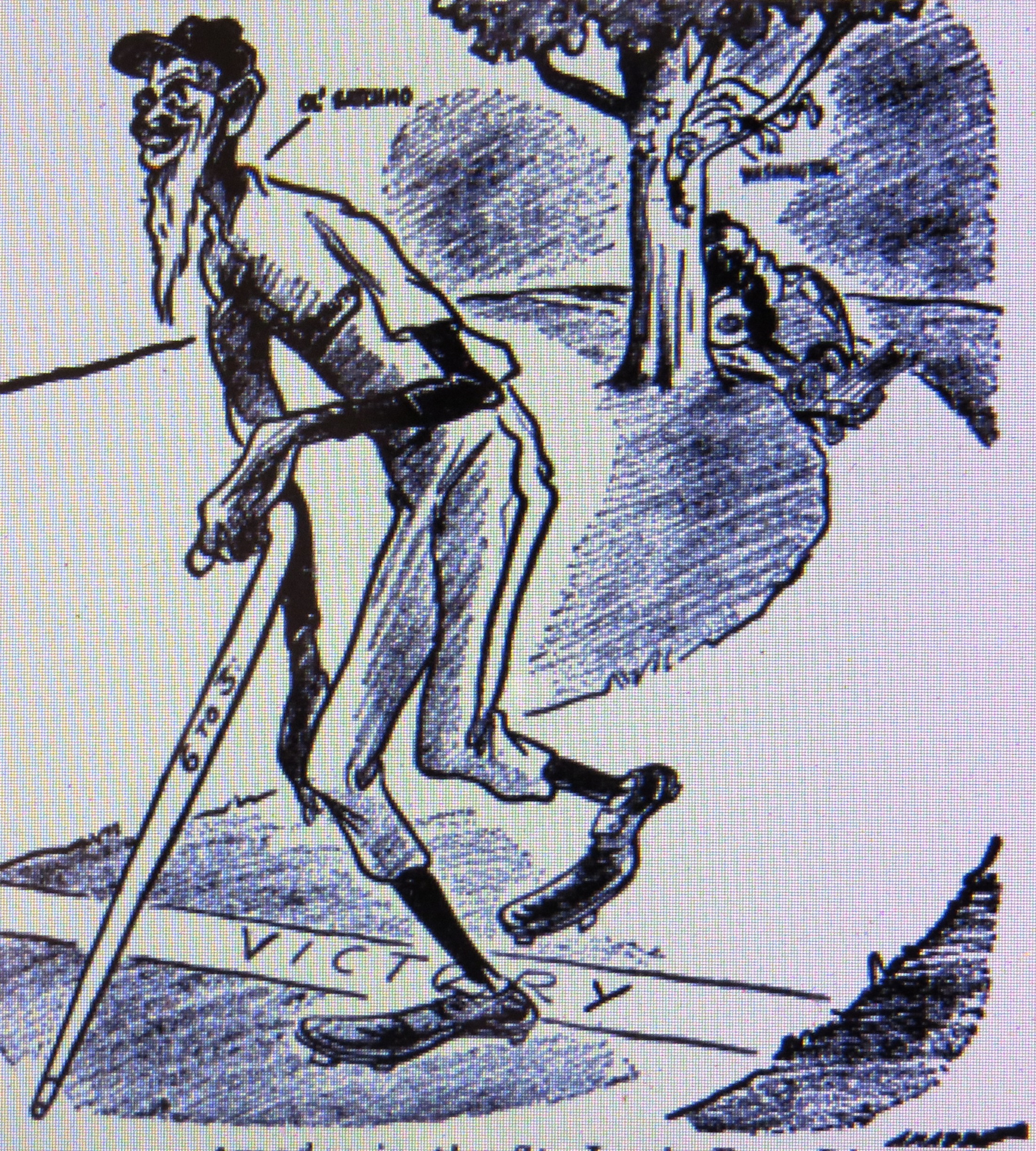
This cartoon of Satchel Paige  appeared in The St. Louis Post-Dispatch on July 29, 1952; drawn by the paper’s cartoonist Amadee Wohlschlaeger, who celebrated his 101st birthday last December.

Paige was primarily used as a reliever in 1952, but made one of his six starts the evening before against the Washington Senators on “Satchel Paige Night” at Sportsman’s Park in St. Louis.  The Associated Press said:

“A bearded player in a wheelchair was introduced as Paige’s first battery mate.”

Owner Bill Veeck gave him a boat called “Ole Satch 1,” a television, and a camera; his teammates presented him with a rod and reel.

Paige pitched 6 2/3 innings and was credited with the win in a 6-3 victory against the Washington Senators.

Later that month Senators manager Bucky Harris said in The Washington Afro-American:

“I swear to God, we would be in first place if we had Satchel Paige.”

???????????????????????????????The Box Score

“To be Hissed and Hooted at in the East is too much”

20 Jun

In 1886  Thomas Jefferson “Tom” York retired after a fifteen-year career.   As a 20-year-old he joined the Troy Haymakers in the National Association in 1871, he was with the Hartford Dark Blues for the National League’s inaugural season in 1876, and finished with the Baltimore Orioles in the American Association; he also served two brief stints as a player/manager with the Providence Grays.

York, who suffered from rheumatism, had considered retiring before the 1894 season after the Cleveland Blues sold him to the Orioles, but The Baltimore American said he was induced to continue playing with a $5000 salary and “the scorecard and cushion (concession)” at Oriole Park.  After hitting just .233 in 1884, he was only able to play in 22 games the following season before calling it quits.

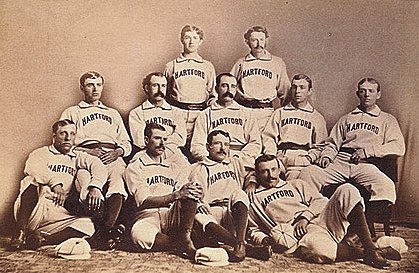
Tom York, middle row, far right, with the 1876 Hartford Dark Blues

Tom York, middle row, far right, with the 1876 Hartford Dark Blues

Just before the beginning of the 1886 season York was hired as an American Association umpire.  After the May 22 game in Baltimore which the Orioles lost 2-1 to the Louisville Colonels, The Baltimore Sun said:

“(York) received a dispatch yesterday ordering him to Brooklyn.  Instead of going he telegraphed his resignation.  His reason for doing so was the abuse he received from some of the spectators of Saturday’s game.  In fact, he was nearly equal to that of John Kelly, ‘the king of umpires.’  He declared (Pete) Browning’s hit near the foul line a fair hit.  He was in the best position to know, but, as it was made at a critical point, some of the audience objected, and York came in for pretty severe abuse.”

The paper said York also made a “questionable decision,” when he “evidently forgot that it was not necessary to touch a runner in a force,” and incorrectly called a runner safe at second:

“York became discouraged and the Association lost a good umpire.”

Within weeks York became a National League umpire; that didn’t last long either.

On June 30, the Kansas City Cowboys lost at home to the New York Giants 11-5, The Chicago Inter Ocean said York “was escorted from the grounds by the police on account of disapproval manifested over his umpiring.”

Less than a month later, after York was “roundly hissed” at the Polo Grounds after making “some very close decisions against the New Yorks,” in a July 22 game against the Philadelphia Quakers, he sent a telegram to National League President Nicholas Young resigning his position.  York told The New York Times:

“I have been badly treated in the West, but to be hissed and hooted at in the East is too much.  I have often heard that an umpire’s position was a thankless one, but I have never realized it before.  It’s bad enough to be hissed and called a thief, but in the West when the local club loses an umpire in fortunate if he escapes with his life.  Of all the cities in the league Kansas City is the worst.”

York said there was another incident Kansas City the day before he was escorted from the field by police:

“On June 29 when the New York men beat the Cowboys 3 to 2 (William “Mox”) McQuery hit a ball over the fence, but it was foul by 25 feet, and I declared it so.  After the game Vice President (Americus) McKim, of the Kansas City club wanted to know how much money I would get from the New Yorks fir That decision.  I remarked that I received my salary from the league and did not take a penny from the New Yorks or any other none.  Then he grew furious, and said he would end my days.  This in conjunction with other things incidental to the life of an umpire has made me tired of the business, and I intend to make room for some other victim.”

Despite quitting both leagues within two months, The Baltimore American said the American Association sent York a telegram in two months later “asking him if he wanted an appointment as umpire.”  The paper said “York replied no, emphatically, as his past experience was sufficient to justify his remaining at home.”

York remained at home for the rest of the season and the next, but while he never worked as an umpire again he returned to baseball in 1888 as manager of the Albany Governors in the International Association.  Over the next decade he was connected with several East Coast minor leagues, including the Connecticut State League, the New York State League and the Eastern Association, as a manager and executive.

York retired to New York where he became one of the many former players employed at the Polo Grounds at the behest of manager John McGraw.  In 1922 The New York Telegraph described his position:

“York has the pleasant post of trying to keep the actors, tonsorial artists and plumbers out of the press stand.  It is old tom who examines your pink paste board and decides whether you are eligible for a seat in the press cage.”

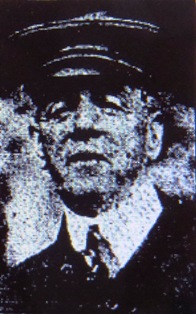
Tom York, 1922

Tom York, 1922

In February of 1936, as preparations were being made for York, along with James “Deacon” White, George Wright, Tommy Bond,  to be honored that summer at the  All-Star Game  as the last four surviving players from the National League’s first season, the former player, manager, executive and umpire died in New York.

“Topeka” Jack Johnson and the Negro National League

19 Jun

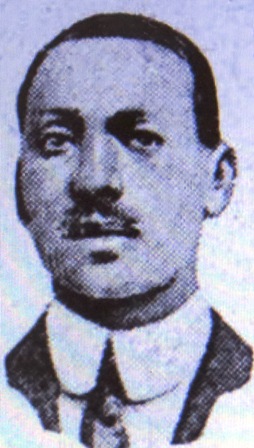
Ten years before Rube Foster organized it in 1920, Jack T. Jackson called for the creation of the Negro National League.  Johnson was variously nicknamed “Topeka Jack,” “Chicago Jack,” and “Kansas Jack,” and was occasionally confused with another Jack Johnson, the World Heavyweight Champion who also dabbled in baseball—“Topeka” Jack also did some boxing, further confusing the issue.

As a result of the common name and the confusion with his more famous namesake, there is very little biographical information available about him and no information survives regarding his birth or death, but for about a decade at the beginning of the 20th Century, he was an important figure in black baseball.

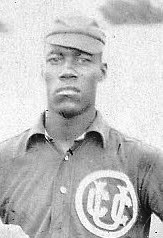
Jack T. Johnson

Jack T. Johnson

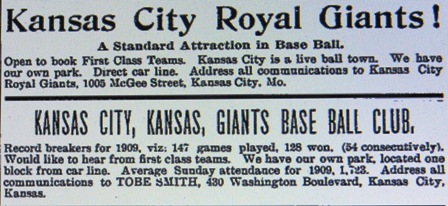
A shortstop and outfielder, he organized teams  in Topeka before going north and joining the Chicago Union Giants, and then the Minneapolis Keystones.  In 1909, he returned to Kansas to manage the Kansas City Giants, owned by Tobe Smith, and the following season he played for and managed the rival Kansas City (MO) Royal Giants owned by Kansas City businessmen M.B. Garrett and George Washington Walden.

George Washington Walden

George Washington Walden

On the eve of the 1910 season, with two rival franchises in Kansas City, and Chicago’s Rube Foster and Frank Leland battling over control of the Leland Giants, Johnson attempted to form a Negro National League.  He wrote an article which appeared in The Freeman, The Chicago Defender, and other papers:

“To my idea it will be one of the greatest things that has ever happened for the Negro, if it goes through.  There is no one that knows from the actual experience, better than I, under what trying conditions the Negro has been existing in baseball…in other words it has been very discouraging for the colored player.”

Johnson said the teams suffered at the box office because games were arranged on an ad hoc basis and often clubs would “show up with about one-half of the lineup being green youngsters that had never played a game together before,” and said many great players had quit the game because of the lack of organization.

“I contend that these conditions are not likely to occur with the clubs of the league as each club would practically be intact the season through, would have something to fight for and each manager would consequently show more interest.

“It has certainly been proven from the big leagues on down to the minors, that there is nothing in the world that beats organized baseball and harmony.  Of course we cannot expect to cope right along with the big leagues the first season or two, but we can follow their method and system as far as we go.  Good judgment can be used in adopting a schedule in regard to the shortest jumps, conflicting dates with white league clubs, etc…From the fact that most cities of the league would put out good, strong clubs, would be attractions that would draw at any time and at any place where baseball is known at all.  So many times the white fans have been heard to remark, ‘I would rather go to see those colored boys play than one of the big league games.’  To prove this look how they used to pass right by the White Sox gate at 39th Street to get to Auburn Park at 79th street to watch the Lelands.

“Then look at the prestige, standing and rating it will give each club under the heading ‘Negro National League.’  What a great thing it would be to have an official record and per cent kept of each club and player.  Then we will not have to argue and squabble as to the real merits (of Negro League players).”

The type of league Johnson envisioned was a decade away.

Johnson and George Washington Walden would have a bitter split after the 1910 season with Johnson leaving the Royal Giants and returning to the Kansas City (KS) Giants—the two resolved their differences the following year, according to The Freeman:

“At last war in Kansas City has come to a happy ending.  (Walden and Johnson) have at last got together and will give Kansas City the strongest baseball team she has ever had.”

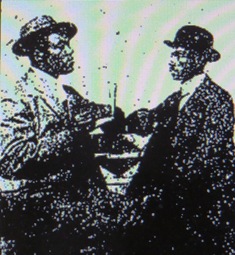
Jack T. Johnson and George Washington Weldon, 1912

Jack T. Johnson and George Washington Weldon, 1912

The newly formed Kansas City club operated as an independent barnstorming team and faded away by the early teens; Jack Johnson also faded away, his date and place of death unknown.

Competing advertisements for the Kansas City Royal giants and Giants in The Freeman, 1910

Competing advertisements for the Kansas City Royal Giants and Giants in The Freeman, 1910

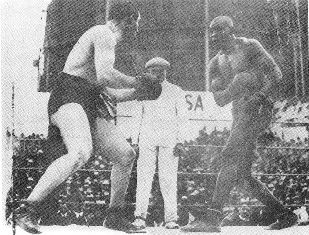
In 1920, while the former Heavyweight Champion Jack Johnson was serving his sentence at Leavenworth, Kansas for violation of the Mann act, he fought two exhibition matches on November 25, knocking out a Chicago fighter named Frank Owens and then “sparring” four rounds with a fighter billed as “Topeka Jack Johnson.”  Some sources have identified the fighter as the same “Topeka Jack,” but, at least, three different professional fighters (and likely more) used that name between 1900 and 1925, and none of the newspaper reports indicate it’s the same Johnson.

jackjohnsonb

The other Jack Johnson, fighting Tommy Burns in 1908

Brought the League “Discredit throughout the South”

18 Jun

In the final weeks of the 1886 Southern Association season, second place Savannah travelled to Atlanta for a four game series against the league leaders.

Hours before the August 18 game, umpire John McQuade left Atlanta by train.  The Macon Telegraph called the circumstances of his departure “Mysterious.”  The Atlanta team said the umpire left town because he was bribed to throw the game by Isaac G. Haas, owner of Savannah.

The Telegraph said McQuade’s departure was the result of his being followed by a detective hired by Stephen Andrew Ryan, a wealthy Atlanta businessman who was one of the directors of the Atlanta team.

The paper quoted a Detective Jones:

“I was hired by Mr. Steve Ryan to shadow McQuade, and I did so.”

Jones went on to say that he saw the umpire speak with various people, including Haas, Savannah catcher John “Tug” Arundel and Ryan’s brother John, who claimed he tried to convince McQuade to stay and work the game.

Savannah pitcher Hank O’Day said the umpire told him “he had been offered money by Mr. Ryan, of the Atlantas, to stay and umpire the games in Atlantas favor and said that he would not and could not do so.”  Arundel said McQuade had told him he had been offered money by “one of the Atlanta officers.”

After McQuade left, Atlanta installed backup catcher Joe Gunson as umpire.  Atlanta shut out Savannah 2-0, The Constitution said “Gunson gave every close decision against Atlanta…his evident desire to be fair, carried him, frequently, too far.”
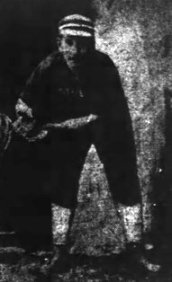
Joe Gunson, umpire for a day

Joe Gunson, umpire for a day

Savannah disagreed.   Haas demanded that, as had been done earlier in the year, when an umpire did not arrive in Savannah for a series—the teams selected umpires on alternating days.  Atlanta refused; claiming league rules gave them the right to name the umpire, and chose a former local player named George Whitlock to work the second game.

When Atlanta took the field at 3:30 PM the following day in front of a large crowd, the Savannah team was not present, The Telegraph said:

(Frank) Wells fired nine balls over the plate, which were caught by Gunson, and the umpire gave the game to the Atlanta by a score of 9-0.”

The Constitution said Savannah’s Hass “without cause declined to permit his men to play.”  The Atlanta police also got involved, arriving at the depot before the Savannah team was able to board a train and arresting five members of team, including O’Day and Arundel.
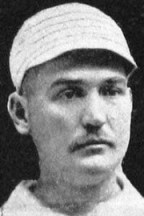
Arrested in Atlanta--Hall of Famer Hank O'Day

Arrested in Atlanta–Hall of Famer Hank O’Day

The Savannah Times said the police attempted to arrest the entire team, “but some of them dodged the officers and got away,” the five players were charged with “disorderly conduct and using profane language,” they were fined between $5 and $10 each and released.

The Times also claimed that Haas, and other Savannah team officers and fans were being “roughly handled,” and “pretty severely abused,” on the streets and in the hotels of Atlanta.

Within days McQuade made a statement under oath “that no Savannah director had endeavored to induce him to leave the city or bribe him in any way.”  McQuade also sent a letter to The Sporting Life and Southern newspapers claiming that Atlanta’s Ryan had tried to bribe him:

“Mr. Ryan, of the Atlanta club, came to me and said: ‘Here Mac, we must have the games; we have got to have them, and will give you one hundred dollars for each game.”

Regardless of the charges, and aided by the forfeited and canceled games, Atlanta won the Southern Association championship.  The season was over, but the allegations were not.

McQuade’s story was given additional credence after the end of the season.  Benjamin F. Young, a former Southern Association umpire, sent a letter to same publications McQuade had, and told a similar story.  Young’s letter implicated another prominent Atlanta citizen:  Henry Woodfin Grady, editor of The Atlanta Constitution, and a long-time supporter of baseball in Georgia.

Young said early in the 1886 season, while in Atlanta, Grady approached him and mentioned the hardship of umpire being responsible for their own travel expenses.  According to Young, Grady claimed he could “fix him up’ and said:

“’I can get passes for you on about every road you’ll have occasion to use.’  Knowing my reputation for honesty and fearing he had said too much, he failed to say ‘why’ he wanted me to take the passes, but it is evident he wanted me to favor Atlanta…Now a good many may say that Grady did not mean tany harm in offering me the passes.  If he had offered me money then of course, it would be a serious matter.  But Grady knew better than to offer me money, so he thought he could come to me in a roundabout way with the passes.”

By the turn of the century, charges such as these would have resulted in an investigation, but in Southern baseball in 1886, it was little more than a ripple.

At the end of season league meeting, the championship was “officially” awarded to Atlanta.

A resolution was introduced by the owners of the Charleston Seagulls which said Atlanta’s “treatment of visiting clubs, and behavior of their players,” had brought the league “discredit throughout the South,” and called for the team to be “censured and reprimanded.”  The resolution was adopted only after Charleston “was induced” to change “Atlanta” to “some club” in the text.

There were consequences; however, interest in baseball waned in Atlanta, and the city would not have another professional team until 1889.

Atlanta manager “Blondie” Purcell earned a return to the big leagues, finishing the 1886 season with the Baltimore Orioles in the American Association.  He played four more years, finishing with the Philadelphia Athletics in 1890.
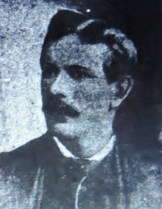
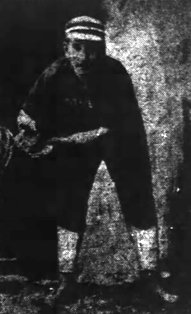
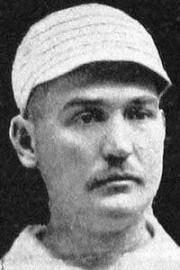
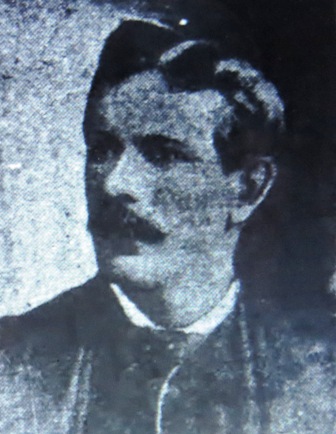
Blondie Purcell

Blondie Purcell

Umpires McQuade and Young both finished 1886 in the American Association, and appear to have never again been approached with bribes.

Henry Grady, newspaper editor, segregationist, and “Spokesman for the New South,’ died three years later.
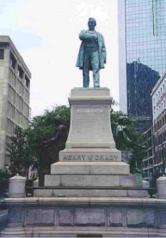
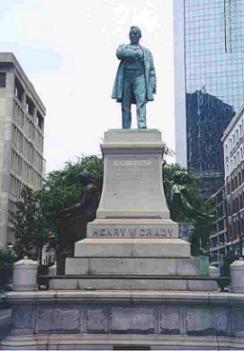
Henry Woodfin Grady statue in Atlanta

Henry Woodfin Grady statue in Atlanta

Stephen Ryan’s dry goods business collapsed in 1891, with debts anywhere from $500,000 to $2 million depending on the source, including losing $16,000 on the Bob Fitzsimmons /Jack “Nonpareil” Dempsey fight.  Accused of hiding assets he was jailed for 13 months.  Upon his release he rebuilt his business only to suffer a similar collapse with a year.  He died in Atlanta in 1908.

“Atlanta’s Baseball Bullies”

17 Jun

During the 1885 season, Lewis Henke of the Southern League’s Atlanta Atlantas was killed during a game; the death was attributed to on-field rowdyism by the Southern press who hoped the death of the popular player would help end brawling behavior in the league.

In January of 1886, the Atlantas hired a new manager, William Aloysius “Blondie” “Billy” Purcell.   Purcell had split the 1885 season between the Philadelphia Athletics in the American Association and the Boston Beaneaters in the National League, hitting .279 in 87 games.  The Sporting Life said:

 “Billy will make a good manager, and is capable of securing a team—even at this late date—to win the championship. “

William "Blondie" Purcell

William “Blondie” Purcell

Purcell came to Atlanta with an excellent reputation, The Philadelphia Inquirer described him as being “Of a genial, happy disposition,” who was very popular when playing for the Athletics, and in 1883 and ’84 as a member of the Quakers.

That changed quickly, just two weeks into the season The Macon Telegraph said under the headline “An Alleged Conspiracy against Purcell,” that the new manager had incurred the wrath of his players by “ruling the team with an iron hand.”

After the rough start, the team appears to have turned their wrath towards their opponents and became the most hated team in the league.

Over the course of the next four months, Southern papers chronicled the bad behavior of the Atlanta squad.

It started with a game against the Charleston Seagulls when Purcell was accused of cheating, The Charleston News and Courier said:

“Manager Purcell was playing in the left field and the Charleston team was at the bat.  During the inning one of the Charleston team batted a ball to left field.  It went over the fielder’s head and, after striking the fence, rebounded and then went into the ditch.  The fielder started for it, but after running only a short distance took a ball from his shirt pocket and through it to the diamond.  The remarkable rapidity with which the ball was fielded was loudly applauded at the time…The fielder subsequently went to the ditch, picked up the ball and tossed it in the diamond…The incident was witnessed by several people, and the statement can be substantiated if the proof is demanded.”

Cheating turned to “bullying” as the season progressed.

The Savannah Times dubbed the team “Purcell’s Plug-Uglies,” and said of them after a July game:

“From the start of the game yesterday the Atlantas began their rowdyism, (Tom) Lynch was running to first in the first inning, the ball got there just ahead of him, Lynch deliberately struck (Jim) Field with his fist…from then on the whole team began to kick and try to hack the umpire.  In this Purcell was ably assisted by (John “Monk”) Cline and (John “Cub”) Stricker, two of the rowdiest  ball players that have been seen on our field…The conduct of the Atlanta club was most reprehensible, and has placed them in an exceedingly unenviable light.”

Tom Lynch, one of Atlanta's bullies

Tom Lynch, one of Atlanta’s bullies

Earlier that month after a couple of close wins over the Seagulls, The News and Courier again criticized the Atlantas saying the team “ought to be kicked out of the league,” and said:

“(T)here was an immense crowd present to witness the game, but their afternoon’s pleasure was completely spoiled by the disgusting behavior of the visitors, whose kicking and sharp practices are sufficient to drive any respectable audience from a ball field.”

After another game in Charleston, The News and Courier said Purcell’s team used “blasphemous and obscene language,” and:

“Those who attended the game this afternoon are outspoken in their condemnation of the disgraceful behavior of the Atlanta team, and declare that either they should not be allowed to continue in the league, or that they should be made to behave themselves at least decently in the presence of the communities where they have to play.”

The Macon Telegraph called the team “Atlanta’s Baseball Bullies,” and said after a game in which Purcell was fined $10 “for his ungentlemanly remarks,” that Atlanta played “good ball,” but that it was “marred” by their conduct.  The paper also said:

“The Atlanta team is evidently akin to the bulldozing idea.  The bullies and braggarts who compose the team have evidently been taught that an umpire is a very insignificant personage and to be influenced by blackguardism.”

Similar charges of “rowdyism” and “bullying” were made throughout the season.

The Atlanta Constitution saw nothing wrong with the team and blamed the criticisms from the papers in other Southern Association on “jealousy” over the team’s success.

With Atlanta holding on to a small lead for the league championship, the most serious charges would wait until the final weeks of the season, and include two of Atlanta’s most prominent citizens …tomorrow.