During the Chicago Cubs disappointing fifth place finish, with a 67-89 record in 1916, the team hit just .239.
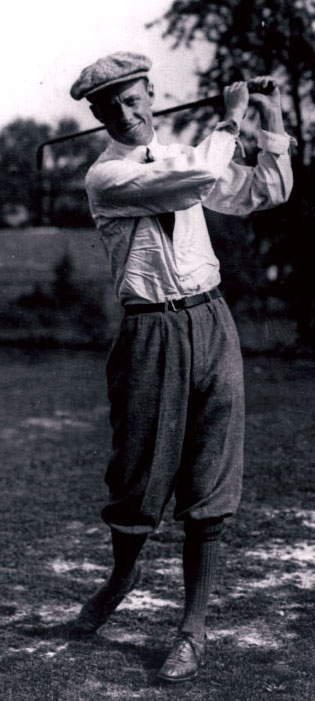
When Manager Joe Tinker was replaced by Fred Mitchell, team owner Charles Weeghman announced that golfer Charles “Chick” Evans, who in 1916 became the first to win the U.S. Amateur and U.S. Open in the same year, would be accompanying the team on their spring training trip to Pasadena, California.
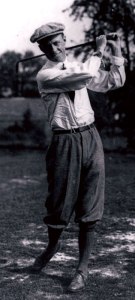
Chick Evans
Weeghman told The Chicago Day Book’s Mark Shields that Evans would teach the hitters “a golf follow through” intended “to increase the batting of the regulars. Shields said Weeghman “Points to (Frank) Schulte, (Heine) Zimmerman and (Tris) Speaker as strong hitters who use a golf style.”
Weeghman told The Associated Press (AP):
“There is form in the driving of a golf ball, but there is none in driving a baseball. Applying the form of golf to baseball was responsible for the wonderful driving power of Frank Schulte and Heine Zimmerman.”
The Cubs’ owner allowed that Schulte knew nothing about golf, but said “(H)e unconsciously used the same swing.”
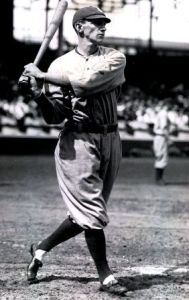
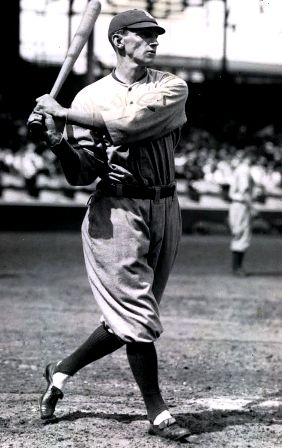
Frank Schulte’s swing
Weeghman said the golfer would not be paid for services in order to maintain his amateur standing.
Evans told The Chicago Daily News that “the batsmen don’t have the knowledge of stance, grip and manner of swinging that the more successful golfers possess. “
He told The International News Service that he had considered a career in baseball:
“Chick says that he might have become a baseball player after having pitched a no-hit game for his high school (Evanston Academy).”
Evans claimed “a torn ligament at the shoulder” derailed his plans.
The response to the Cubs’ plan was immediate.
The Daily News said:
“Chick Evans is going to teach the Cubs how to bat, thereby accomplishing something no one else even considered possible.”
Rabbit Maranville told The AP the story was “a funny one,” and that he was sure that the decision to bring in Evans was strictly Weeghman’s, and likely not endorsed by the Cubs’ new manager:
“Doesn’t seem to me as if (Fred) Mitchell is responsible for that stunt. I guess it’s being wished on him.
“In baseball the batter needs courage. He does not know when the pitcher is going to slip a notch in his control…Courage is the big asset in batting, and with all the respect in the world to golf, where is there any great courage needed in driving the golf ball?”
While John Brinsley “J.B.” Sheridan, the sports editor of The St. Louis Globe-Democrat, said ballplayers may derive some benefit from a golfer’s advice:
“Baseball is far behind golf in its self-analysis. The keen minds of many generations of Scotch students have been devoted to the science of golf. So far, no keen analytical mind has been given to baseball. Men who do know the game are usually inarticulate and cannot tell what they know.”
Sheridan outlined how golf in general, and Evans in particular, could help:
“Drawing back the club or the bat slowly is most important. If the striking implement is drawn back too quickly or with a jerk, the player is thrown off balance and his eye is put out of focus.
“It is notable that the great hitters, Speaker, Joe Jackson, Eddie Collins and others carry their bats well behind them and do not draw back quickly.”
Additionally, Sheridan said other “golf maxims will help” hitters, including:
“Hit off the (front) foot. Keep your eye on the ball. Do not hit too hard. Follow through.”
Weeghman’s plan was finally shelved shortly before the team departed for the West Coast. The Daily News said the United States Golf Association (USGA) could strip Evans of his amateur standing:
“If Evans uses his ability as a golfer to aid him in attempting to instruct ballplayers how to swing their bats, it appears that he will take a long chance.”
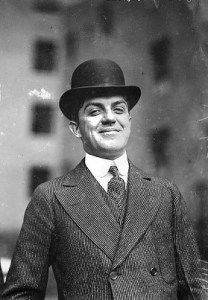
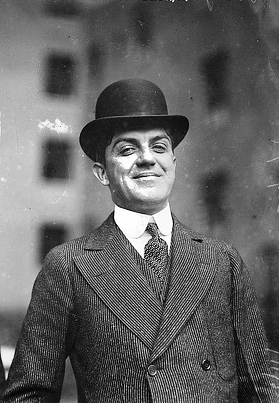
Charles Weeghman
Evans was in California at the same time as the Cubs in March, and although newspapers had announced he would accompany the team “over the Sante Fe” railroad on the trip, it is unclear whether he actually traveled with the team. The AP said he “stayed far away” from the Cubs’ practices in order to not run afoul of the USGA, but one paragraph in The Chicago Tribune the day after the club’s first practice in Pasadena was rained out, likely exposed the Cubs’ owner’s real intention for wanting Evans in California:
“(The rain) did not keep Prexy Weeghman from tackling Chick Evans in a golf match. They had played only twelve of the eighteen holes when the mist became so active it stopped the contest. At the finish, the score stood $11 to $1 in favor of the national amateur champion.”
The Cubs posted a slightly improved 74-80 record, but once again finished in fifth place. Whether the lack of instruction from Chick Evans was a factor or not, the team’s batting average was .239; identical to their 1916 average.
Tags: Charles Weeghman, Chicago Cubs, Chick Evans, Eddie Collins, Frank Schulte, Fred Mitchell, Heinie Zimmerman, Joe Jackson, Joe Tinker, John Sheridan, Rabbit Maranville, Tris Speaker




 Baseball History Daily