Archive | August, 2015

Lost Advertisements–Lajoie for Nuxated Iron

7 Aug

lajoienuxated


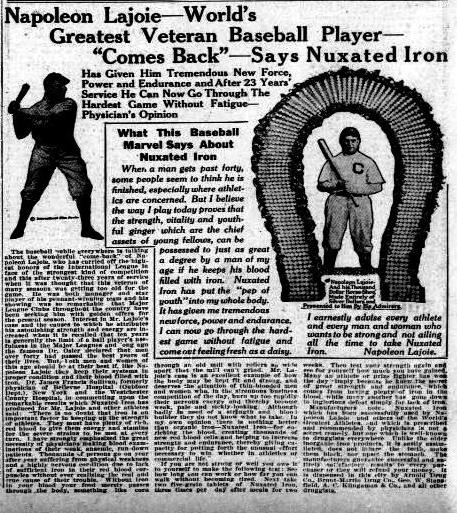
Not to be outdone by Ty Cobb, Harry Hooper and Joe Jackson who also endorsed the new “miracle drug” from DAE Health Laboratories in Detroit in 1916, Napoleon Lajoie took his turn in an advertisement for Nuxated Iron.

Napoleon Lajoie–World’s Greatest Veteran Baseball Player–‘Comes Back’ says Nuxated Iron Has Given him Tremendous New Force, Power and Endurance After 23 Years’ Service He Can Now Go Through The Hardest Game Without Fatigue–Physicians’s Opinion

Lajoie’s testimonial for the product said:

“When a man gets past forty, some people seem to think he is finished, especially where athletics are concerned.  But I believe the way I play today proves that the strength, vitality and youthful ginger which are the chief assets of young fellows, can be possessed to just as a great a degree by a man of my age if he keeps his body full of iron.  Nuxated Iron has put the ‘pep of youth’ into my whole body.”

Most doctors disagreed with Lajoie’s assessment.

The Journal of the American Medical Association took notice of the Nuxated Iron ad campaign and in October of 1916 had this to say about the “miracle drug:”

“Newspapers whose advertising ethics are still in the formative stage have, for some months past, been singing—at so much a song—the praised of “Nuxated Iron.”  The public has been that this nostrum is what makes Ty Cobb, “the greatest baseball batter of all time,” a “winner” and is what helped Jess Willard “to whip Frank Moran” besides being the “untold secret” of Willard’s “great triumph over Jack Johnson.”

All that DAE would say about the ingredients were:

“Formula—The valuable blood, nerve force and tissue building properties of this preparation are due to organic iron in the form of ferrum peptonate in combination with nux vomica (strychnine) phosphoglycerate and other valuable ingredients.

But alas, The AMA Journal was not impressed with the claims made by Nuxated Iron’s endorsements:

“The Journal felt that it owed it to the public to find out just how much iron and nux vomica there were in ‘Nuxated Iron.’  Packages of the nostrum…were subjected to analysis.”

What the analysis found was that the formula that made Ty Cobb a “winner,” offered no health benefits:

“There is only one-twenty-fifth of a grain of iron in each ‘Nuxated Iron’ tablet, while the amount of nux vomica…is practically negligible…In a dollar bottle of ‘Nuxated Iron’ the purchaser gets, according to our analysis, less than 2 ½ grams of iron; in 100 Blaud’s Pills, which can be purchased at any drug store for from 50 to 75 cents, there are 48 grains of iron.”

To sum up their analysis The Journal called the claims made by Nuxated Iron “the sheerest advertising buncombe.”

Cobb was said to have earned as much as $1000 for his endorsement, there is no record of what Lajoie was paid.

Nuxated Iron remained on the market until at least 1921; although by then they had sought a higher power to endorse the product.

Portions of this post appeared in one about the Cobb advertisement for Nuxated Iron, published February 15, 2013.

 

Griff’s Invention

5 Aug

Bob “Buster” Bescher arrived in Cincinnati a right-handed hitter.  In 1909, he led the National League with 54 stolen bases but hit just .240.

Bescher

Bescher

Bescher’s manager, Clark Griffith would compare him to Ty Cobb in an interview with Harry Salsinger of The Detroit News:

“If Bescher could hit he would probably set a pace for base-stealing that would never be equaled…Bescher gets away like Cobb, and his success lies mostly in getting away.  He is running in his first few steps.  He has a great pair of limbs and is in stride at the jump.  He is lightning fast.”

The Cincinnati Enquirer said:

“Bescher is a big, strong fellow, naturally left-handed, who was, unfortunately, coached to bat right-handed when he was a kid.”

Griffith set out to change that before the 1910 season.  In January, The Enquirer said:

“A device for batting practice was shipped to Bob Bescher at his home in London (Ohio) by Manager Griffith yesterday.  The arrangement was constructed according to Griff’s order, and it was designed to give Buster practice in batting left-handed before he goes South with the club six weeks or so hence.”

Clark Griffith

Clark Griffith

The paper described Griffith’s invention:

“The device consists of a ball of regulation size, but fitted with an extra cover, to which stout rubber cords are attached, one on each side.  One of the cords is to be fastened to the floor and the other to the ceiling, allowing the ball to swing loosely at about the height of the batter’s waist.  When the ball is struck with a bat, the flexible cord allows it to swing several yards and it returns with great force, coming back at about the speed of a pitched ball.  Then it is time for Buster to get busy with the club and soak it out again.”

A diagram of Griffith's invention.

A diagram of Griffith’s invention.

The Enquirer said Griffith hoped Bescher would add “30 or 40 points” to his average batting left-handed.

“He is the best base runner in the National League…Griff has sent him instructions to hit only left-handed with the new machine, and he hopes that Bob will be a regular Ty Cobb when he reports in March.”

Bescher batted almost exclusively left-handed during spring training in Hot Springs, Arkansas and became a switch-hitter that season, and seems to have benefitted from Griffith’s invention—but never became a “regular Ty Cobb.”

He improved his average to .250 in 1910 and again led the league with 70 stolen bases.  The next two seasons he hit .275 and a career-high .281, leading the league with 81 and 67 steals.

Bescher

Bescher

In 1913, Bescher slowed, hitting just .258 and stealing 38 bases.  He bounced from the New York Giants to the St. Louis Cardinals and Cleveland Indians over the next five seasons, never hitting better than .270 or stealing more than 39 bases.  He played minor league ball through the 1925 season.

“Slow Man’s Steal”

3 Aug

The New York Evening Journal said:

“The newest wrinkle in the baseball season of 1911 is a discovery by (John) Chief Meyers.”

Chief Meyers

Chief Meyers

The New York Giants’ catcher called is the “Slow man’s steal.”

“On two occasions now the Indian has pulled this play, and the National League is laughing because he worked it successfully on (Bill) Bergen and (George) Peaches Graham, two of the best catchers in the league.

“Some time ago the Chief realized that it would be impossible for him to trust his speed, which he has not, in stealing a base so he decided to work it with his head.”

Meyers, the paper said, knew that as a slow runner he could induce catchers to throw to first base if he took a long lead off.

“Having figured this out, the Chief gets on the bag and gradually eases himself down the line until he sees the catcher is watching him.  He then takes another step towards second base and the catcher naturally shoots the ball to first.  Instead of making an effort to get back to the base the Indian starts for second the minute he sees the catcher draw back his arm.  Both times that he has worked it the first baseman has been caught making a touch for the runner sliding back to first, only to look up and see him sliding into second. “

The Evening Journal called it “(O)ne of the greatest mirth-provoking plays on the diamond,” and said when Meyers worked the play on Graham and Boston Rustlers first baseman Fred Tenney, (T)he stands broke into howls of laughter.”

Fred Tenney

Fred Tenney

Meyers said:

“I call it the slow man’s steal because a fast man couldn’t do it.  The catcher would expect him to run to second and a good throw would head him off.  Besides, the pitcher would hold a fast man up at first and not allow him to take the lead.”

Meyers stole five more bases the rest of 1911, there is no record of how many of those incorporated the “Slow man’s steal.”