Archive | August, 2016

Things I Learned on the Way to Looking Up Other Things #21

8 Aug

Community Relations in Rochester, 1896

The 1896 Rochester Blackbirds battled the Providence Grays for the Eastern League championship all season—Providence ended up winning the pennant—but four Rochester players apparently found time for off-field activities as well.

The following spring The Rochester Democrat and Chronicle said:

“Joseph Smith is suing his wife for divorce and has named these ballplayers as co-respondents:  Willie Calihan, Charlie Dooley, Tommy Gillen and ‘Sun’ Daly.”

By the time Mr. Smith filed for divorce, Gillen and Daly were with the Scranton Red Sox.
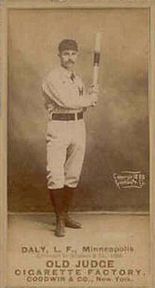
Sun Daly

Sun Daly

Baseball’s Biggest Fan, 1899

Joseph Allen Southwick might have invented baseball tourism.  The Associated Press told his story in 1899:

“Southwick, who is a merchant, probably holds the record for traveling the most miles each year to enjoy the game of baseball.  He usually travels 5,000 each baseball season to see the great American game, but this year he will close with some miles over 6,000.”

Southwick, who was in his 60s, “acquired his fondness for the game when the old Athletic Club men were the heroes of the diamond.”

He “(H)as gone as far west as Pittsburgh…as far south as Baltimore and Washington, as far east as Boston, and has made many trips to New York, Philadelphia, and Brooklyn.”
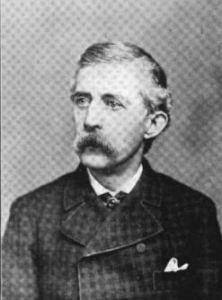
Southwick

Southwick

“He has a wonderful memory for baseball facts and can describe with considerable gusto celebrated plays and games which were made a quarter of a century ago.  He has no other hobby than going to see a baseball match, which is his only recreation.”

But, The AP said he was not a stereotypical 19th Century “Crank;”

“Mr. Southwick does not ride on a free pass, never ‘roots’ nor bets on the game.  He has only a limited acquaintance with baseball players and, as a rule, goes to the baseball game and leaves the grounds without exchanging conversation with anybody.”

The story concluded:

“When the items of railroad fare, meals, and hotel fares are considered in connection with Mr. Southwick’s baseball enthusiasm, it gives him the distinction of spending more money than any other enthusiast in the country.”

Southwick, who owned three dry goods stores in Trenton—The Southwick Combination Stores–lived for another decade.  His obituary in The Trenton Times failed to mention his interest in baseball.

Caylor on Welch, 1893

In a column in September of  1893, in The New York Herald, OP Caylor shared a warning for players:
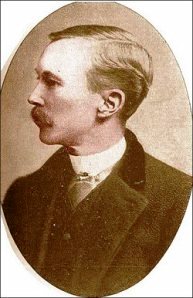
O.P. Caylor

O.P. Caylor

 “Among the announcements recently made in the news columns of trade depression was one that the pottery hands in an East Liverpool (OH) yard had their wages reduced to $1.25 for a day of 10 hours.  Among these laborers who thus suffered was Curtis Welch, the once famous outfielder of the equally famous St. Louis Browns.  Only a few years ago he was acknowledged to be the greatest outfielder playing ball, and he held his club to his own terms every year.  The St. Louis officials were glad to pay him as much an hour for his work then as he earns now in a week.

Curt Welch

Curt Welch

“But like many other brilliant players who have wrecked their own lives, Welch took to drink and his downfall was rapid.  Now he is laboring for the means to keep life in his body.”

Welch was released by the Louisville Colonels in May and returned home to East Liverpool to work as a potter.  He returned to professional baseball in 1894 and 1895 in the Eastern and Pennsylvania State Leagues, but became ill and died of Tuberculosis in 1896.

Frank Hough of The Philadelphia Inquirer said of news of Welch’s death:

“(W)as sad but not unexpected…Poor Curt! He had the besetting weakness of many another gifted ballplayer, and to that unfortunate weakness his untimely death may be attributed.”
“I’ve no Uniform that will fit a Giraffe like you”

3 Aug

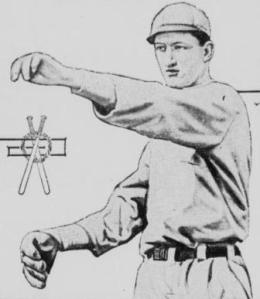
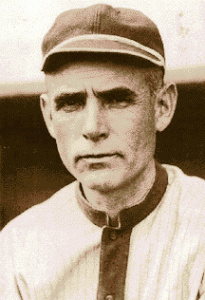
Most biographies of Harry “Slim” Sallee, if they mention his brief time with the New York Highlanders in 1906, simply say he never appeared in a game because of “(A)n abundance of pitcher’s” on Clark Griffith’s club which battled the Chicago White Sox for the pennant.

The colorful 6’ 3” 180 pond Sallee, with the Cardinals in West Baden, Indiana before the 1912 season, told a reporter for The St. Louis Republic that there was more to his departure from New York, and while the story might have been a creation of Sallee’s imagination, it seems more appropriate for a pitcher as famous for hard-drinking, suspensions, and fines as he was for his 174 career wins.

Slim Sallee

Slim Sallee

Sallee reminded the reporter he was:

“An American League discard…Yes, sirree, I was turned down cold by Clark Griffith when the ‘Old Fox’ was managing the New York Americans …I joined the Yanks in the fall in St. Louis, Griff looked me over and said: ‘I’ve no uniform that will fit a giraffe like you.  Maybe I’ll be able to get one in Chicago.  Here’s a ticket—handing me a pocket register to keep tabs on people passing through the turnstile—go out and check up the bleacher gate this afternoon.

“Four thousand geeks passed through the bleacher turnstile at Sportsman’s Park that afternoon and I kept punching that register until I became almost black in the face.”

Sallee said he was given the same assignment in Chicago on September 21 -23 when New York took three out of four games from the White Sox and moved into first place.  New York went to Detroit and lost three straight, then dropped a game in Cleveland on the 27th,dropping three games back of the White Sox.  In Cleveland:

“‘Griff dug up an old uniform and told me to warm up.  The thermometer hung around the freezing point.

Clark Griffith

Clark Griffith

“Wonder if that crazy man thinks I’m goin’ to cut loose and take chances of ruinin’ my salary wing in this kind of weather said I to myself.

“Griff went to the plate himself. I ‘lobbed’ a  couple over and the ‘Old Fox’ roared like a mad bull. ‘You’ve got a lot of nerve trying to slip that stuff over on me,’ growled Griff.  ‘Put something on that ball.  I can’t detect anything that looks like a wiggle on your curve and you haven’t shown enough speed to break a pane of glass.’”

Sallee said he told Griffith:

“I’m there, Clarkie, old chap, with the real goods, but I couldn’t think of cuttin’ loose with my speed in this kind of weather.  I’m a hothouse plant from down in Old Alabama—I played with Birmingham that year.  Give me a chance when the sun is shinin’ and the thermometer is around 90 in the shade, and I’ll show you some pitchin’ that will curl your grey locks.”

Sallee said Griffith threatened to put him “back on the gate.”

“’No, you don’t,’ said I. ‘Pay me off and also come across with a ticket for Higginsport (Ohio, Sallee’s hometown) I’m through with the New York club and Clark Griffith.  And don’t send for me next spring.”

Whether because of too much depth on the mound or because of the story Sallee told, Griffith sold him to the Williamsport Millionaires in the Tri-State League.  Sallee went 22-5 in Williamsport in 1907 and the Cardinals purchased his contract in August

“I might now be a politician in Chicago”

1 Aug

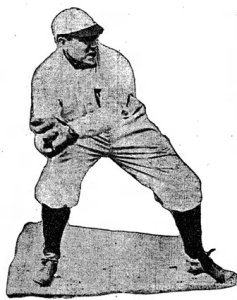
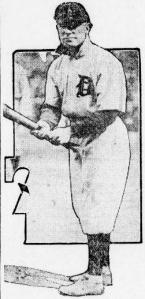
As part of his series of syndicated articles asking major league players to describe “How I Win,” journalist Joseph B. Bowles spoke to Detroit Tigers infielder Charley O’Leary:

Charley O'Leary

Charley O’Leary

“I learned how to win from (Tigers Manager Hughie) Jennings.  Now before he came to Detroit the team was as flat as Aunt Jemima’s pancakes, but he threw about a quart of Fleishman’s yeast into us, and we rose.

O’Leary played three seasons with the Tigers under managers Ed Barrow, Bobby Lowe and Bill Armour before Jennings arrived in 1907—those teams finished in seventh, third and  sixth place.

“The recipe for winning is to mix ginger, yeast and horseradish with horse sense and keep stirring all the time.  Thinking and hustling, figuring on every point, watching all the time for an opening and taking all sorts of chances is what wins.  One man can’t win—unless he happens to be the fellow who can stir up a dozen others and keep them fighting all the time and never giving up.  Without a leader, the best team will slack up the pace once in a while and maybe get discouraged.”

As for individual achievements , O’Leary said:

“All the success I have had has come from studying batters while I was in the infield and studying base runners when they got on the bases.  A player almost can tell from the way the batter and the base runner act what they are trying to d, or going to try to do if he only keeps his eyes open.”

O’Leary said he never attempted to steal signs, but:

“(I) can tell by the actions and the situation what is coming off.  Then (when playing short) I want a second baseman alongside of me who understands me and whom I understand, so we can work together.  There are some men who prevent each other from doing their best work.

“I make a study of where batters hit, and every day I get the fullest accounts possible of all the games played and study out where the balls were hit to.  Batters change rapidly.  Sometimes a player hits to left field for weeks, and the next time we meet him in a series, he is hitting to right field.  I find it important to know all the time, for sometimes it is five or six weeks until we play against him again, and in that time he may have changed completely.  I keep talking to pitchers who have worked against certain men and reading about them to see how they are batting.  Then too, lots of times, a weak batter will have a batting streak and a pitcher and infielder ought to know this before starting a series against him.  The best part of my success, I think, has been in being where the ball was hit, and a whole lot of this has come from studying batters.”

O'Leary

O’Leary

O’Leary, who had a reputation as a hot head early in career, said something else contributed to his success:

“I used to think fighting umpires helped win, but I want to say that is a mistake.  Playing square with the umpires and treating them decently and playing fair with opponents is the only way to win.  Fair play ought to be the foundation of the game.  I play as hard and fight as hard for a game as anyone, but would rather lose than hurt another player, or try to make an umpire look bad to a crowd.”

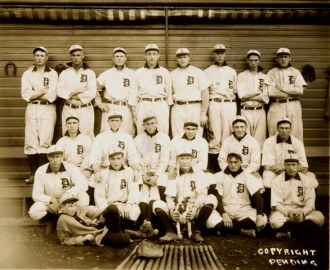
1909 Tigers. O'Leary is far right, bottom row. Jennings is at center of bottom row holding dog.

1907 Tigers. O’Leary is far right, bottom row. Jennings is at center of bottom row holding dog.

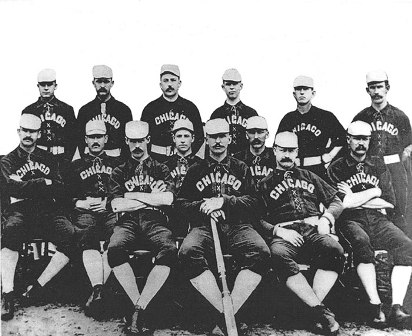
O’Leary did not make his big league debut until the age of 28 in 1904, and the Chicago native later told a reporter for The Detroit News that he nearly gave the game up for years earlier during his first professional season—with the 1900 White Sox, in the not yet a major league American League:

“The first team I ever played on, outside of (amateur teams) around Chicago, was the White Sox, and they took me to Detroit with them to play a Sunday game.  I nearly quit right then and there.  If I had I might now be a politician in Chicago.

“It was one of those games played out at Burns Park (Burns, just west of Detroit’s city limits, opened in 1900 to host Sunday games and circumvent Detroit’s blue laws).  We won by one run and as we left the park the crowd came at us with beer bottles.  It was the bottom of the bus for everybody , and as I was the most scared I got there first, I guess.  Anyway, everybody else pulled on top of me, and we rode into town that way.

“I was nearly smothered.  They had a hard time inducing me to believe that that was not an everyday occurrence.”