Archive | August, 2019

Things I Learned on the way to Looking up Other Things #38

5 Aug

Scrappy Bill and Small Ball

The New York Herald lamented in August of 1897 about New York manager Bill Joyce:
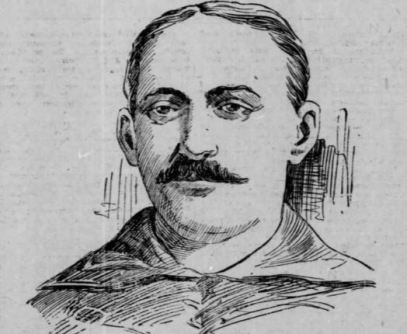
scrappy.JPG

Joyce

“Scrappy’s Giants are doing less sacrificing than any team in the major league. Mike Tiernan has but one sacrifice to his credit. Scrappy, like Ed Hanlon, regards sacrificing as a necessary evil—a last resort.”

The paper wanted him to follow the example of Fred Clarke:

“(T)he captain of the Colonels in a firm believer in sacrificing early in the game for one run, as well as late in the contest, when a tally is of more importance than at an early stage of the game.”

Joyce’s third-place Giants sacrificed just 45 times in 1897; Clarke’s 11th-place Colonels were fourth with 101.

Cy’s Arm

During spring training in 1905, Naps pitcher Bill Bernhard told The Cleveland News:

“There is no use talking, there is only one Cy Young. When the rest of us pitchers report in the spring we act as if those deceiving arms of ours were made of glass and humor them accordingly. But not so with old Cy. The very day he reached Hot Springs a week or so ago, he cut loose as if he had been pitching all winter. Great Scott, but he had speed to burn, and the next day and the next it was just the same. And curve them? Well, you ought to have seen the old boy.”
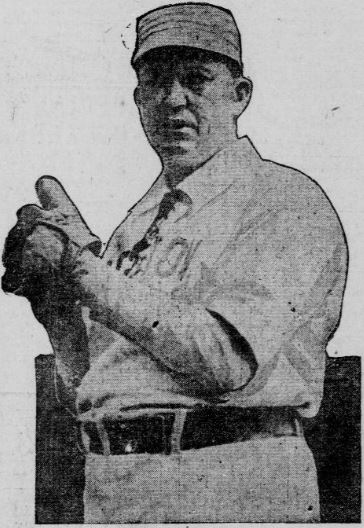
cyyoung

Young

That season, the 38-year-old Young was 18-19 with a 1.83 ERA for the Boston Americans.

Johnson’s “Destiny”

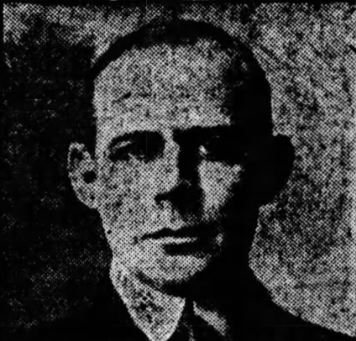
Grantland Rice’s lede in The New York Herald Tribune on the final game of the 1924 World Series:
rice

Rice

“Destiny, waiting for the final curtain, stepped from the wings today and handed the king his crown.

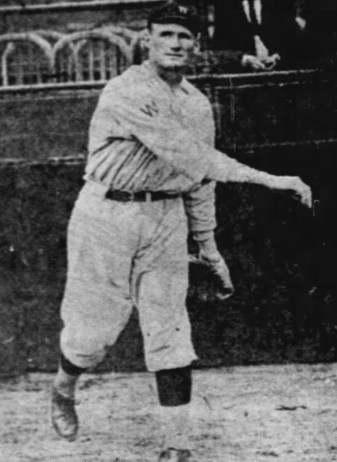
“In the latest and most dramatic moment of baseball’s 60 years of history the wall-eyed goddess known as Fate decided that old ‘Barney’ had waited long enough for his diadem of gold and glory. So, after waiting 18 years, Walter Johnson found at last the pot of shining gold that waits at the end of the rainbow.

“For it was Johnson at last, the old Johnson brought back from other years with his blazing fastball singing across he plate for the last four rounds, who stopped the Giant attack from the ninth inning through the 12th and gave Washington’s fighting ballclub its World’s Series victory, 4 to 3.

Washington won just at the edge of darkness, and it was Johnson’s great right arm that turned the trick. As (Earl) McNeely doubled and (Muddy) Ruel galloped over the plate with the winning run in the last of the 12th, some 32,000 fans rushed upon the field with a roar of triumph never known before, as for more than 30 minutes, packed in one vast, serried mass around the bench, they paid Johnson and his mates a tribute that no one present will ever forget.”
johnson.jpg

Johnson

Rice’s account of the game was recognized as the best “major league baseball story of the year” by the Baseball Writers Association of America.

 

“Diabolical—Nothing Else.”

2 Aug

The introduction of baseball cards in cigarette packages by the American Tobacco Company was largely uncontroversial—except in the company’s backyard, the heart of tobacco country.

The Charlotte Observer was the first large paper to condemn the practice. In August of 1909 the paper editorialized:

“(T)rading upon the small boy’s passion for baseball as well as for collecting to make a cigarette fiend of him, is diabolical—nothing else.”

The Observer described the “mania” among the city’s boys:

“More especially the likenesses of Ty Cobb and Hans Wagner are most desired, and until a week ago only a few pictures of Cobb had been found, two of these being in the possession of the Buford Hotel cigar stand.”

wagnercobb

“Most desired” among the boys of Charlotte

The paper said 13 Cobb cards were then found in purchases made at “The Wilson Drug Store, on East Trade Street,” and “The boys of the street went wild.”

The Observer conceded that some of the younger boys took the cards then sold the five-cent packs of cigarettes were offered to passers by for two packs for five cents, but maintained their editorial opinion that young kids were being induced to smoke.

The Raleigh News and Observer agreed about the “baseball picture bait,” and added:

“The cigarette trust, it seems, would stop at nothing to get money.”

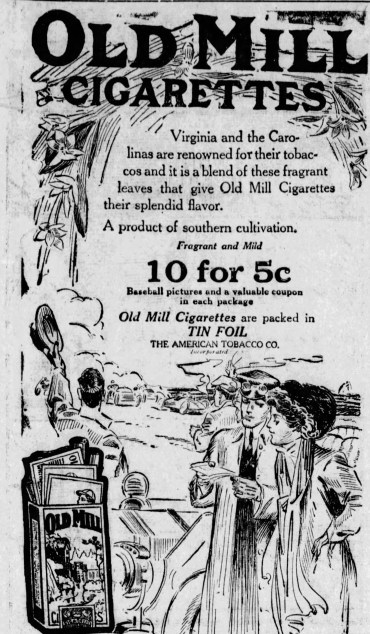
oldmill.JPG

Old Mill ad “Baseball pictures and a valuable coupon in each package.”

The cause was taken up by numerous papers across the state, The Statesville Landmark said:

“(I)f the enormity of the offense was appreciated as it should be it would arouse a spirit of indignation in North Carolina that would stop this traffic in the bodies and souls of boys.”

The Winston Sentinel said:

“It will do more to start young boys smoking than any other agency of which we can conceive.”

The Raleigh Times said the introduction of the “baseball pictures” coincided with an increase in “the number of licenses to sell cigarettes” in the city:

“That the boys are buying the cigarettes is a settled fact and there are always people who will sell anything for money.”

But smoking wasn’t the only concern. The Reidsville Review said:

“Almost any day groups of youngsters may be seen on the streets of Reidsville ‘matching’ pictures of baseball men. It seems a harmless amusement, yet it is gambling all the same, and has been so decided by a judge in Washington (NC). He dismissed the first bunch of boys brought before him for matching baseball pictures with a reprimand but intimated that hereafter he would impose the gamblers’ sentence.”

“Matching pictures” was simply flipping game where a card was won or lost if landed face up or down.

One major daily paper in the state took up the cause of the tobacco company, The Greensboro News said:

“Considerable criticism, and of a right severe kind, has been leveled lately at certain cigarette manufacturers for their practice of putting pictures of baseball players in their cigarette boxes.”

The paper said the “criticism” was based on an incorrect notion, and claimed “we have our doubts” that more children were smoking:

“Our observation is that he relies mainly on begging his pictures from the large boys and grown men.”

The paper acknowledged, “Of course, some very small boys smoke,” but claimed the increase in cigarette sales was not because of the “baseball pictures,” and instead due to changing “tastes of the public,” for “ready-made cigarettes” rather than rolling them themselves.

The paper concluded their theory was “far more reasonable than the baseball picture idea.”

The brief outcry changed nothing—by the time American Tobacco introduced cards, the company which had a virtual monopoly on the sale of “ready-made” or manufactured cigarettes since it was formed, had a near monopoly on the sale of all tobacco. At the same time, the company was already defending itself from the federal anti-trust case that led to the 1911 Supreme Court decision which dissolved the company.

The “baseball picture” craze did result in at least one homicide in North Carolina. In 1910, The Laurinburg Exchange reported that a 16-year-old had hit another 16-year-old “in the head with a ginger ale bottle,” during an argument over a “matching game with baseball pictures out of cigarette packages,” rendering the victim unconscious–he never regained consciousness and died a week later.