Archive | April, 2021

“Suspend him Again, Brother Petit”

7 Apr

Edward “the Only” Nolan, the 22-year-old rookie pitcher for the Indianapolis Blues was scheduled to pitch against the Providence Grays on June 20, 1878, but just over a month after his major league debut, “The Only” was already mired in controversy.

The Cincinnati Enquirer said:

“Nolan did not pitch today—cause why, he was suspended, and is at present under a very dark cloud of suspicion.”

The paper said W.B. Petit, president of the Indianapolis club had received, “telegraphic information” from Indiana that it was “generally understood in the pool-rooms” that the Grays would win the game if Nolan started, and alluded to, “several decidedly loose plays” made by Nolan during his two previous starts.

On June 15, Nolan and Indianapolis lost 7 to 4 to the Boston Red Stockings; Nolan committed three errors—“inexcusable muffs” according to The Boston Globe. The day before the suspension, Nolan gave up nine runs and committed five errors in a loss to the Grays.
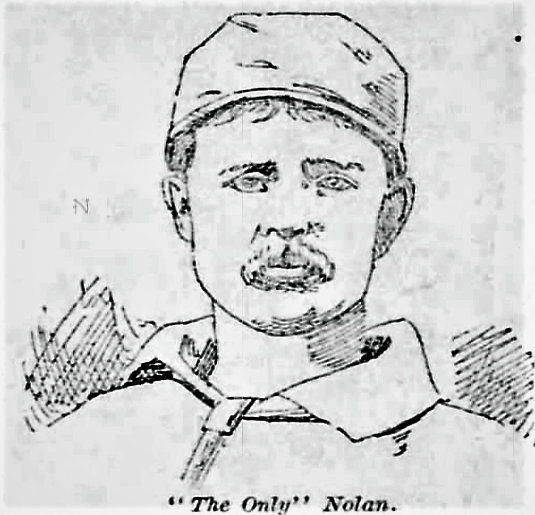
The Hoosiers play in recent days, just a month and a half into the season led The St. Louis Globe-Democrat to predict that the team, “stands a much better chance of disbanding than of winning the championship.”

The Enquirer said the pitcher had been suspended based on the charges:

“Nolan seems quite indifferent, while the rest of the nine show discontent and disgust with his conduct.”

Petit met with the team before the game in Providence, and during the game:

“(Catcher Silver) Flint appeared to be broken up about something and was quite morose…The Nolan business seems to have demoralized the whole party.”

The Indianapolis People pronounced the pitcher guilty and yawned at the news:

“It was discovered that (Nolan) was selling out the games to the gamblers. As if this was anything new in base ball literature!”

The Indianapolis Journal said of Nolan, who had played for Indianapolis the previous season when the team was a member of League Alliance:

“It is known to many that he was picked up in that sort of rascality last fall, and in the judgment of the elect he should never have been given his place again. He was only retained through the clemency of the directors, and his play all through the season thus far indicates that the confidence of the directory in his reformation was misplaced”

The Journal addressed the team’s directors directly:

“If they didn’t know it before, The Journal will hasten to inform them that the only way to make a club successful is to preserve its integrity.”

The paper was not waiting for an investigation and said Nolan, “should never be permitted to pitch another game for the Indianapolis club.”

Five days later the Indianapolis directors issued a letter reinstating Nolan, which said in part:

“The charges against you of crooked ballplaying have been carefully investigated and we fail to find proof of an irregularity on your part in this respect.”

The People noted:

“We believe the Scotch used to return the verdict ‘not proven,’ declining to take the responsibility of saying the accused was ‘Not guilty.’”

“The Only” beat Cincinnati in his first game back. A 9 to 5 victory: he committed one error and gave up just one earned run.  The Indianapolis News said he was, “Quite effective.”

The suspicions never completely dissipated. When Nolan was “batted out of his position” by Boston in 12 to 4 loss on July 14, O.P. Caylor in The Enquirer said:

“Suspend him again, Brother Petit.”

The Journal also questioned Nolan’s performance in the game with Boston:

“(He) acted in a very disagreeable manner and threw the game away from the start.”

Nolan’s relative honesty on the field was overshadowed in August by his general lack of honesty when, days after leaving the team for the funeral of his brother “William” in Paterson, New Jersey, The Chicago Tribune said:

“(He) has been acting strangely of late, and Thursday refused duty on the ground that his brother was daed…It appears from the best evidence at hand, that no brother was dead, or ill.”

He was su a pended by the club.

The Indianapolis News, in reporting Nolan’s expulsion acknowledged that “his habits have utterly ruined him,” but defended his integrity and used the occasion to take a shot at Caylor:

“Nolan’s expulsion is believed by the stockholders of the club to be caused by his bad habits ad not from crookedness. Last spring, in the knowledge of one of the stockholders, the gamblers of Cincinnati made several attempts to buy him and failed. That they did not succeed has prejudiced the reporter of The Cincinnati Enquirer against him to the full extent of his ability and from that time forward that paper has studiously abused and misrepresented not only Nolan but the entire Indianapolis club.”

Nolan was not reinstated until 1881 and had four more brief major league stints in the National League, American Association, and Union Association. He finished his career 23-52 record in 79 games with five different clubs.

Nolan’s hometown newspaper, The Patterson Morning Call said he gave up baseball in 1887—he was just 30—after signing a contract to play in the Eastern League:

“He was met by Mayor C.D. Beckwith of this city. The mayor offered him to name him to the police force.”
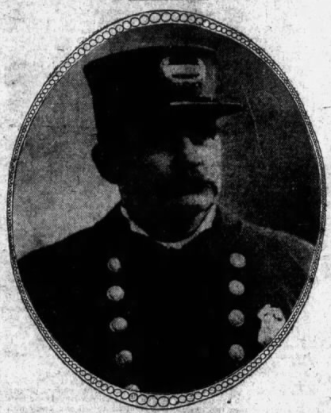
Sgt. Nolan

Nolan spent 16 years on the force, rising to the rank of sergeant; he died in Patterson in 1913.

“Keister was Bogus”

5 Apr

In March of 1901, second baseman Bill Keister jumped the St. Louis Cardinals for the Baltimore Orioles; St. Louis signed Dick Padden a week later to replace him.

Patsy Tebeau, who had managed the Cardinals to a 42-50 record before being let go in August, had no shortage of vitriol for his former player. He told The St. Louis Globe-Democrat:

“Padden has Keister beaten in every department of the game, and when it comes to ‘inside play’ the Baltimorean is entirely lost sight of.”

Keister had been purchased by the Cardinals with John McGraw and Wilbert Robinson before the 1900 season. The purchase of Keister had, said Tebeau, cost St. Louis “a good round chunk. And while not “Knocking any, it was illy spent.”

Tebeau

Then more knocking:

“Keister was bogus, a gold brick, a nonentity or what you will, and much of our ill-success in the early part of the race was due to his bobbling.”

Keister was not just bad, but historically bad, he said:

“If I live to be as old as Henry Chadwick, I never will forget a play Keister made in Philadelphia. We were playing a red-hot game with the Phillies, with a score of 2 to 1 in our favor along about the seventh inning. (Roy) Thomas and (Jimmy) Slagle both began by getting on base and (Ed) Delahanty sacrificed them along. (Napoleon) Lajoie followed with a stinging bounder straight at Keister. It came to him quick as a flash and on the first bound.  Fast as Thomas is, he was a goner at the plate had Billy slapped the ball home.

“But he didn’t, nor did he play it safe and shoot to (first baseman Dan) McGann. He balked for a moment and then slammed the sphere to the third corner. McGraw wasn’t within 15 feet of the sack but seeing the throw he ran over best he could. Biff came the ball, McGraw, and Slagle all in a heap.

“Slagle was safe, McGraw had his ankle turned, and the sphere kept on to the fence. All three runners scored, we were beaten, and McGraw, besides, was laid up for several weeks.”

Keister

Tebeau called it, “the worst play that was ever made by a professional.”

The play in question happened on May 25, and he got most of the details correct; except the score was 2 to 0 and it happened in the sixth inning. The Globe-Democrat described the play less dramatically the previous spring:

“Lajoie hit fast and high to Keister. The little second-sacker threw to McGraw at third, in an attempt to head off Slagle. The ball and runner reached ‘Muggsy’ at the same time. In the collision McGraw was spiked in the foot and the leather rolled to the fence, giving the Quakers their lone three runs in the contest.”

The St. Louis Post-Dispatch and The Republican both wrote that McGraw was on the bag awaiting Keister’s throw, contrary to Tebeau’s recollection.

All three papers agreed that McGraw was badly injured beyond having his “ankle turned.” In addition to the collision, the Cardinals captain was spiked in the foot. The Post-Dispatch said the game was delayed 10 minutes before McGraw returned to the field—he was removed from the game after the end of the inning. The Republic said his toe was “badly split” and that he, “dropped like a poppy cut down by a cane twirled in the hands of a careless stroller.”

With McGraw in and out of the lineup over the next several weeks, the Cardinals went from 3 ½ games back to 11 games back after a disastrous 5-15 June.

Tebeau held a grudge:

“I consider that Keister was a star in Oysterville in 1899, but out in Missouri, where the ‘fans’ have got to be shown, he was about the worst I ever saw.”

“The worst” Tebeau ever saw played three more seasons in the major leagues; Keister was playing outfield and hitting .320 for the Phillies in August of 1903 when he tore a ligament before the August 26 game in Brooklyn. He never played in the major leagues again but played eight more seasons in the minors.

Tebeau never managed in the big leagues again. He killed himself 18 years later; Louis Dougher of The Washington Times said Tebeau wrote in a suicide note:

“I am a very unhappy and miserable man.”

“I’m Disappointed in Baseball”

2 Apr

“I don’t want no rockin’ chair, I don’t want no triple-A. I want to pitch in the majors again. I want a chance. I never really had a chance.”

In 1962, 55-year-old Satchel Paige was looking for one last chance.

He talked to Tom McEwen, sports editor of The Tampa Tribune about his frustration while, “on one of those hurry-up barnstorming tours with the Kansas City Monarchs.”

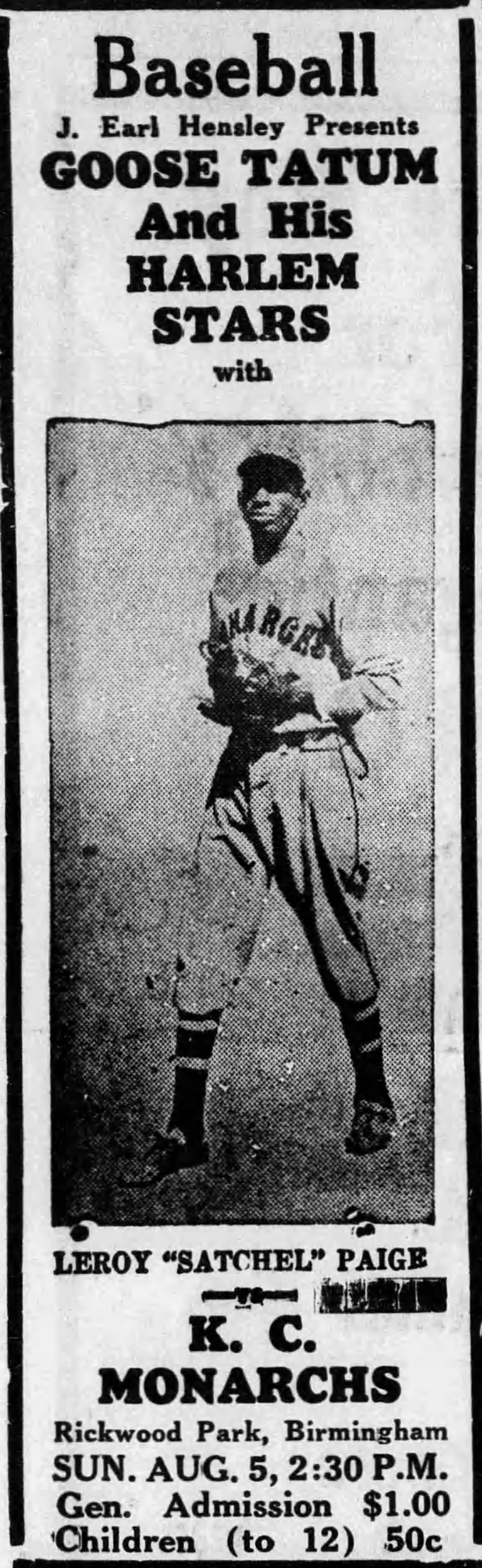
Paige spent a large part of that summer playing for Goose Tatum’s Harlem Stars in dozens of games with Ted Rasberry’s Kansas City Monarchs in the Midwest and South.

Tatum and Paige

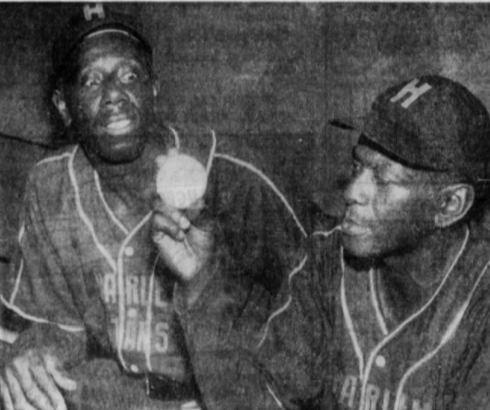
Any notion that traveling with those two great stars was glamorous was addressed by a 19-year-old member of the Monarchs, named Eddie Brooks, who told The Charlotte Observer when the teams played there that he was “disillusioned after two months” on tour:

“Somehow I thought it would be different from this. The only reason I’m here is that some major league scout might see me somewhere and give me a chance in organized ball.”

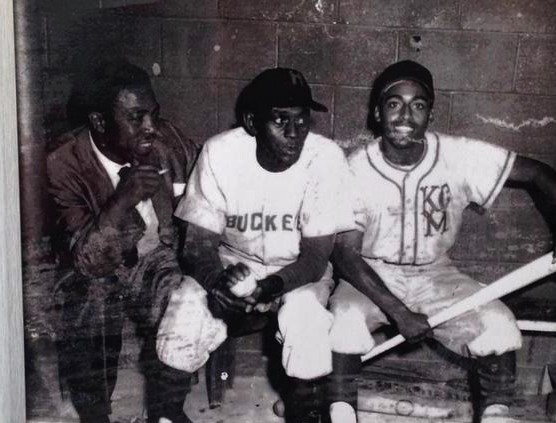
Brooks never got a chance in organized ball, but became a well-known high school basketball coach in his hometown, and more than 50 years later told The Peoria Journal Star the experience with the Monarchs—he also played with the team in 1965–motivated him to finish college:

“I was still a young man, so to see those older guys I looked up to like Satch and Goose out there scrapping for money from town to town, it left an impression on me…I got my rear end back to Macomb (Western Illinois University) to finish the few hours I needed for my degree.”

Brooks with Tatum and Paige

Paige shared Brooks’ frustration:

“Paige doesn’t really like what he’s doing. He doesn’t like the role he’s in. He believes he is a pitcher, not an antique, that his long, remarkably durable arm is still good enough for the big time.

“’I’d rather pitch against Mantle and Maris tomorrow than anything else in the world,’ he said.”

So certain that he could still compete in the major leagues, Paige said:

“Nobody in the world can tell me I can’t hold up my end and if I can’t, they don’t have to pay me a nickel.”

The lack of a chance to prove himself, left him disillusioned:

“I’m really a disappointed man. I’m disappointed in baseball.”

He said that he’d never gotten over his release from the Baltimore Orioles after the franchise relocated from St. Louis:

“I still got that letter. The letter said I was a number one pitcher, but they didn’t want no old men on the team. They said they were going for youth. Well, they ain’t won the pennant yet and I see where clubs are paying $100,000 bonuses for players that never throwed a ball.’

“The time they turned me a-loose, I was in the All-Star game, this is the first time I said this to anybody, but I got to answer back. You asked and I got to answer. The more I think of being turned a-loose, the madder I get.”

Rasberry said Paige had “pitched 159 innings this summer, pitching every night, three or four innings.”

Paige said he could likely throw a lot harder than he was that summer, “if I could have a little rest, As it is you ride and pitch, ride and pitch, sometime 500 to 700 miles between games.”

An ad from the 1962 tour

He admitted he could no longer pitch nine innings, but:

“I’m as good as anybody for five or six, Yes, as good as (Don) Drysdale. Don’t get me wrong. I don’t like to talk about myself. But if I get a chance and I’m wrong, I’ll hush up.”

It took three years for his final chance.