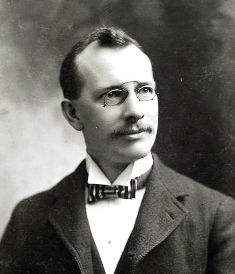
Filling in the Blanks—”Wee Willie” Wilson

21 Sep

Baseball Reference includes listings for “H. Wilson,” “Herbert Wilson,” “W. Wilson” and another  “W. Wilson”, all playing at various times during the 1920s.  All four listings are actually for the same player:  Herbert Emanuel “Wee Willie” Wilson.

Born in Florida in 1896, Wilson began his professional career in 1920 after serving in World War I and playing semi-pro ball.  He was a member of the inaugural St. Petersburg Saints in the Florida State League along with Dexter “Legs” Rambo who I previously profiled.
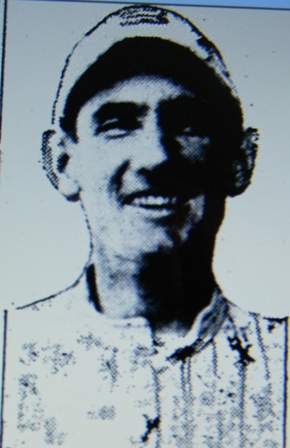
Herbert “Wee Willie” Wilson

Wilson was 5’ 10” and said to weigh no more than 150 pounds and as little as 125 in various newspaper accounts.

Wilson was a pitcher and middle infielder during the Saints mediocre seasons in 1920 and 1921 (he was 12-20 for the ’21 Saints).  In 1922 the Saints hired veteran minor leaguer George Block to manage the team (Baseball Reference does not cite Block’s time with the Saints, but does have an unrelated listing for a “Block” with the ’22 Saints).

Block kept very few players from the previous Saints teams, and built a formidable ball club.  Wilson was one of the few players who remained from the earlier team.

Led by future Major Leaguers Bunny Roser (the 20 year old earned his short 1922 shot at the major with the Saint Louis Browns after the Saints season), Elliot Bigelow (who hit .343), and manager Block who hit .411, the 1922 won their first Florida State League championship.

Wilson contributed a 13-10 record to the championship team.  Wilson followed with a 12-11 record in 1923.  In 1924 he broke out as star for the Saints, going 26-7.  The financially troubled league didn’t finish the season, however; and Wilson ended up with the Scranton Miners in the New York Penn League for the remainder of 1924 (the Herbert Walker listing on Baseball Reference also shows 7 games for Little Rock Travelers in the Southern Association that season, I can find nothing to indicate it’s the same player).

Where Wilson spent 1925 is uncertain.  Contemporaneous newspaper accounts seem to indicate he was back with the Saints, but no records are available for that team.   Some later accounts put him with Scranton but there are no records for him that season with the team.  He was in Scranton from 1926 to ’28 posting 14-7, 12-10 and 7-7 records.  Wilson finished his career with the High Point Pointers of the Piedmont League, where spent the last two months of the 1928 season.

Wilson returned to St. Petersburg after his playing days.   In 1942 The St. Petersburg Evening Independent reported that Wilson, despite being 46 years old, had volunteered to serve in the US Navy and was due to report to Norfolk, Virginia for training.

Wilson passed away in St. Petersburg in 1956.
21 Straight

20 Sep

The Delta League only lasted two seasons, 1904 and ’05, but James Baxter Sparks made the first a memorable one.

The 21 year old Yazoo City Zoos southpaw set a professional baseball record by winning 21 consecutive games.  During one week he beat the Brookhaven team in three straight games, then after one day off shut out the Jackson Senators.  Sparks also threw a no-hitter against Clarksdale during the streak.

The Sporting Life said that Sparks appeared in 33 games during the season but there is no record of his overall record for the season.

Sparks spent the majority of his career in the low minor leagues, the only exception being 1906 with the Atlanta Crackers in the Southern Association where he went 8-10.  From 1910-1912 he was 49-23 for Vicksburg in the Cotton States League.  His career ended with Meridian in the same league in 1913.

Sparks coached the University of Mississippi baseball team in 1917 and returned to the Cotton States League as a manager in 1923 and ’24 with the Clarksdale Cubs and Laurel Lumberjacks.  He died in Mississippi in 1956.

One more bit of trivia from the Delta League.  The 1904 season featured a scoreless 19 inning game between Jackson and Brookhaven on August 24—the longest scoreless game to end in a tie in professional baseball until the record was tied by the Dodgers and Reds in 1946.

1893 St. Joseph Saints

19 Sep

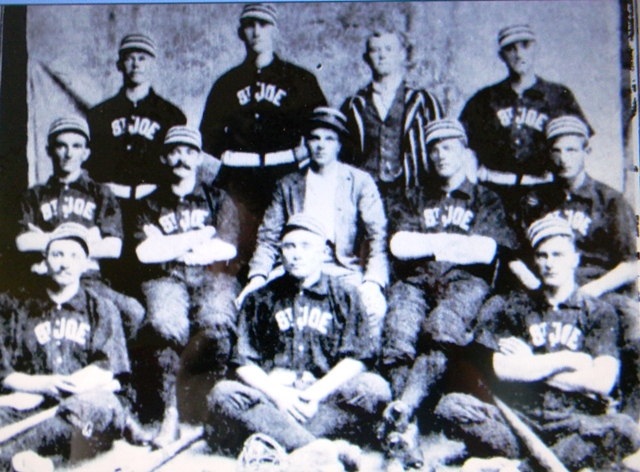
This team is of interest to me mostly because I’ve never seen the photo I’ve posted published anywhere else—it is, I believe, the earliest photo of Hall of Famer Fred Clarke in a baseball uniform.

1893 St. Joseph Saints. Hall of Famer Fred Clarke is in the far right of the middle row.

Saint Joseph was part of the Western Association which disbanded in June of ’93 with the Saints in 2nd place at 11-8.

Clarke had the distinction of having the first two teams he played with be part of leagues which folded —he was with Hastings in the Nebraska State League in 1892.  Clarke ended up with Montgomery in the Southern Association for the remainder of ’93, that league’s season was also cut short because of a Yellow Fever outbreak in New Orleans.

In addition to Clarke, future major leaguers “Ducky” Holmes and Art Twineham were also with St. Joseph in 1893.

The team was owned by a local jeweler named Al Wendover, it was his only foray into professional baseball ownership.

Missing from the photo is pitcher Frank “Bones” Parvin a native Missourian who appeared in six games with the Saints.  Parvin was 6’ 3” and, depending on the news account, weighed between 150 and 180 pounds.  Parvin had an 87-81 record during an eight year minor league career with 13 different teams in the Midwest and South.  His real claim to fame however was that he was a cousin outlaws Frank and Jesse James.

Reports of His Death Were Greatly Exaggerated

18 Sep

Harry “Rube Allemang’s career was on the upswing at the close of the 1902 season; after a disappointing 4-15 record in his first season in pro ball with the Youngstown/Marion franchise in the Interstate League, Allemang had turned it around at Little Rock in the Southern League posting 20-4 and 19-11 season in 1901 and ’02.  (Contemporaneous newspaper accounts say he also played for Fort Wayne in the Interstate League in 1899, but there are not available records)

The Cincinnati Reds had just purchased Allemang’s contract and he was out celebrating with friends on the Evening on November 8.  Walking home at around 3 am, Allemang stumbled upon the lookout for a robbery in progress in the Mason City, West Virginia post office.  The lookout told Allemang to stop; when the pitcher kept walking he was shot, robbed and left for dead.

News of the shooting appeared in papers the following day:

Chicago Tribune: “Ball Player in Murdered”

New York Times: “Harry Allemang, Ballplayer, is Dying”

Fort Wayne Gazette: “Harry Allemang Mortally Wounded”

Arizona Republican: “Shot and Mortally Wounded”

The reports were premature.

Despite being shot just above the heart, with the bullet passing through his right lung, Allemang was out of the hospital in less than a month.  The Associated Press said “His case puzzles leading physicians.”

While still in the hospital he sent a letter to Reds owner August Herrmann to “Let you know I am still alive and expect to report in the spring.”

Allemang, with the bullet still lodged in his upper back, got ready for the 1903 season by doing ten mile runs while being pursued by blood hounds borrowed from the Mason County Sheriff.  But Allemang was never the same pitcher after the shooting.

He struggled that spring with the Reds and was sent to St.Paul in the American Association.   He was 12-11 in St. Paul in ’03 and 10-23 with Indianapolis in the same league in 1904.  After just two games with Sioux City in Western League in 1905, Allemang signed with the Niles Crowites in the Ohio-Pennsylvania League in May, and then jumped to an outlaw league team in Coatsville, Pennsylvania in July.  He came back to Southern League with Nashville in 1906, but lasted just six games, posting a 2-4 record.

Allemang passed away in Linton, Indiana in March of 1938—more than 35 years after the newspapers pronounced him dead.

June Cass

17 Sep

World War I cost Daniel June Cass his shot to play in the Major Leagues.

Born in Scotland, South Dakota June 25, 1894, Cass hit .336 in 28 games for the Des Moines Boosters in the Western League in 1916. After hitting .284 the following season with Des Moines Cass was purchased by the Washington Senator.

Cass joined the Senators in Augusta, Georgia for Spring Training and according to the Associated Press was set to make the Clark Griffith’s team, but for his draft status:

“Based on the fact that he is in class 1 of the draft and his number in the order of liability is so low, being in the first 400, that there is no assurance he would be able to remain with the Griffmen more than a month or two…if retained the Washington club would have to pay $3000 for Cass under the agreement with Des Moines, and the pilot (Griffith) figures it would be poor business policy.”

Although the article went on to say Cass would probably not be able to displace any of the starters, his speed alone would have benefitted Washington’s aging outfield.  (No stolen base records survive for his Western League tenure, but Cass was always mentioned as one of the best base stealers in the league in contemporaneous newspaper accounts)

Cass was returned to Des Moines and hit .327 in 24 games before reporting to Great Lakes Naval Training Station in Illinois on June 6.  Cass served the remainder of the year.

Cass returned to Des Moines for 1919 season, and got off to a good start hitting .308 and leading the league in stolen bases through 80 games.  It was also reported by the Associated Press that the Senators again had an interest in purchasing Cass.

In late July 0f 1919 Cass developed a case on tonsillitis, developed quinsy and died on July 28.

Filling in the Blanks—J. Efird

14 Sep

Baseball Reference lists J. Efird, a pitcher in the Virginia League and Southern Association from 1911-1915.

Jasper Jerome “Jap” Efird was born December 30, 1890 in Albemarle, North Carolina.   Efird was a star pitcher for Washington and Lee University; his brother Walter Guy “Watt” Efird was the team’s catcher.

After leaving Washington and Lee Efrid signed with the Roanoke Tigers in the Virginia League.  The righthander won 70 games lost 37 for Roanoke from 1911-1913, including a 28-13 record in ’13.  In 1912 Efird won the final game of the season against the Petersburg Goobers giving Roanoke the league championship.

In February of 1914 the Atlanta Crackers of the Southern Association purchased Efird’s contract.  Before the season began Efird developed a sore arm and suffered from other ailments that limited to 6 appearances with Atlanta.  On May 24 Efird’s contract was sold back to Roanoke.

Jasper Jerome “Jap” Efird

Efird won 13 games for Roanoke in 1914 and posting an 18-11 record the following season for the Tigers, relocated to Suffolk, Virginia for the 1915 season.  Despite the respectable showing upon returning to the Virginia League, he never fully recovered from the arm problems and his career ended after the ’15 season, with a career 103-61 mark.

Efird returned to Albemarle where he passed away on May 27, 1935.

“A Leaden Messenger of Death”

12 Sep

George Kittle played in Texas and Nebraska from 1888-90.  Very little is known about his life before 1888, other than that he was most likely born in Taylorville, Illinois between 1860 and 1862.

Kittle appears in Texas in 1888 as an outfielder and catcher for Dallas in the Texas Southern League and Fort Worth in the Texas League.  In 1889 he pitched for the Austin Senators in the Texas League posting a 25-16 record.  Kittle spent the first half of 1890 pitching for the Waco Babies.  He was 9-8 when, on June 20, he was sold to Omaha in Western Association.

No records exist for Kittle’s time in Omaha and he was not listed on the roster of any team for 1891, but it appears he was playing baseball in or around Waco that season.

On January 19, 1892 Kittle and two friends entered one of Waco’s legal brothels.  Just after arriving one of Kittle’s friends became involved in altercation with another customer.  Hattie Tyree, who operated the brothel, became involved in the dispute and had a physical altercation with Kittle.  She returned to her room and came back with a pistol.  She fired one shot at Kittle, who was immediately taken from the brothel to a nearby hotel and a doctor was called.  Kittle died from the gunshot wound early the following morning.

Ren Mulford Jr., the famous baseball writer for the Cincinnati Enquirer and  Sporting Life described the shooting:

“George Kittle, the Texas Leaguer, was sent to his grave by a siren named Hattie Tyree, who fired a leaden messenger of death into him at Waco. That murder was cold blooded.”

Ren Mulford

Tyree’s trial was a sensation in Waco, where she was well known; Kittle was not the first person she had shot in her house (the first had survived).  Despite public outcry and multiple witnesses who testified that Kittle was not the aggressor in the altercation, Tyree was acquitted by a Texas jury in the spring of 1882.

Who is the Real Jack Rowan?

10 Sep

John Albert Rowan was born in New Castle, Pennsylvania in 1886. After compiling an 18-10 record for Leavenworth in the Western Association, the twenty-year-old earned a one-game audition with the 1906 Detroit Tigers. Rowan gave up eleven earned runs on fifteen hits and five walks in a 13-5 loss to the Chicago White Sox. He made it back to the big leagues with Cincinnati in 1908 and pitched parts of 7 seasons in the Major Leagues with the Reds, Phillies, and Cubs.

Rowan was more or less forgotten by July of 1958 when a small Associated Press item announcing his death in his room at a Detroit hotel appeared in newspapers.

Jack Rowan

For the previous 20 years Rowan had spent his summer days at Briggs Stadium, the site of his Tiger debut in 1906 (Bennett Park, the Tigers’ stadium from 1895 to 1911 was on the same site. Replaced by Navin Field in 1912, renamed Briggs after the 1935 expansion). The Tigers were planning on honoring the former pitcher at an upcoming game.

One problem:

The day after the announcement of Rowan’s death a man in Dayton, Ohio told reporters he was the real Jack Rowan.

The Detroit Rowan had his supporters. One of his pallbearers swore he saw him pitch that game for the Tigers, although he remembered it as “1907 or 8.” Bishop John Donovan of the Detroit Catholic Diocese was certain the man whose funeral he presided over was Rowan; the bishop had interceded on the Detroit Rowan’s behalf years earlier to help him get a baseball pension.

Win Clark, secretary-treasurer of the Association of Professional Ball Players of America, was also sure the Detroit Rowan was the real Rowan; after all, they had been sending him pension checks for years.

But many said his stories were inconsistent and that he gave his age at 85 years old, 13 years older than Rowan’s listed age.

The Dayton Rowan insisted he was the real Rowan and had his own supporters. Dayton sports writers were sure the local man was the former pitcher, who had finished his career in Dayton in 1917—but the Dayton Rowan gave his age as 68, four years younger than Rowan should have been.

Neither man had any living family to back up their claim.

Ultimately, the living Rowan, the one in Dayton, prevailed. It was generally determined that he was the former Major League pitcher, the Detroit Rowan deemed an imposter.

The Dayton Rowan showing reporters a photo of the 1910 Cincinnati Reds

The Dayton Rowan died in 1966 and is buried there—interesting given that one of his arguments for his legitimacy after the Detroit Rowan’s death in 1958 was, “If he is the real man why isn’t he being buried in New Castle along with the rest of his family?”

Filling in the Blanks—Dooley, 1896 Bridgeport Victors

7 Sep

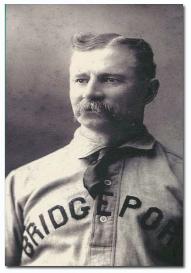
Baseball Reference lists “Dooley”on the roster of the Bridgeport Victors, managed by Hall of Famer Jim O’Rourke, of the Naugatuck Valley League.

Philip Dooley was a 23 year old third baseman playing his first season of professional baseball.  Born in Bridgeport, he had played semi-pro ball the last several years while working for the Bridgeport Gas Company.  According to the Bridgeport Evening Post and Sporting Life Dooley was “The best amateur third baseman in the state.”

On June 6, 1896 Dooley was on a boat with friends on a local reservoir when, it was reported, the boat capsized “(D)ue to the recklessness of his companions in rocking the boat.”   Accounts varied, with some saying Dooley’s companions were able to swim to shore, other saying they were rescued.  In either case, Dooley was unable to get to shore and drowned.

Bridgeport Manager “Orator Jim” O’Rourke

Game Called on Account of Singing

6 Sep

During a Delta League game between Clarksdale and Hattiesburg on July 12, 1904, the Clarksdale teams, led by manager David Gaston were riding the umpire for a series of questionable calls.

The team began singing a song which according to the Memphis Commercial Appeal “Umpire Davis said reflected on him.” (Umpire Davis’ first name is lost to history)

After several warnings to quit singing, the umpire awarded the game to Hattiesburg.  Likely the only time in history a game has been forfeited over a song.

William David Gaston was long-time figure in southern baseball, spending time as a player and manager in the South Atlantic and Cotton States Leagues as well as the Southern Association.  Contemporaneous newspaper accounts mention him as   a member of the Chattanooga Lookouts in 1901 and 1902, although Baseball Reference does not list him on either roster.

Born January 18, 1879 (BR incorrectly lists his year of birth as 1882), in Chattanooga, TN, Gaston remained active in local baseball until his death in that same city in 1948.