Demon Rum–or Demon Rum as an Excuse to Replace a Popular Manager

8 Oct

The 2011 Boston Red Sox were only the latest in a long history of alcohol taking the blame for a team’s poor performance.

As the Chicago Cubs faded into third place during the waning days of the 1912 season, team president Charles Murphy issued an order for “total abstinence” and all players would have a temperance calls in future contracts.

The move was not unprecedented—since 1909 Barney Dreyfus of the Pittsburgh Pirates had required his players to sign a temperance pledge.  What made Murphy’s order so newsworthy was that over the course of several days he issued numerous, often contradictory, “clarifications” and because it quickly became apparent the move was a intended to wrest control of his ballclub from Manager Frank Chance.

Murphy’s original statement said that “loose living and training methods” led to the team’s poor finish. At the same time he provided cover for popular Cub outfielder Frank Schulte who had been suspended by Chance in September his nighttime activities during a crucial August road trip in Cincinnati.  The Cubs lost three of four games to the Reds and fell out of contention.    Murphy’s statement presented Schulte as a man incapable of any personal responsibility:

“I desire to say that in my judgment Schulte has been more sinned against than sinner…from what I could gather he was a victim of too many so-called friends…if we had a rule similar to that in vogue in Pittsburgh this player could not have been led into temptation.”
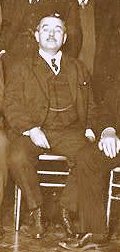
Chicago Cubs President Charles Murphy

The implication being that Chance had perhaps overreacted by suspending “the more sinned against” Schulte.  This statement was further complicated by Murphy’s several “clarifications,” some of which seemed to support Chance’s decision while some did not.

Chance quickly defended his players and his reaction to Murphy revealed just how bad the relationship was between the team president and his manager:

“Murphy only thinks of the team when it’s winning…his statement reflects upon me personally, and I have been in the business too long to allow Murphy or anyone else to insult me.”

Making matters worse, and calling Murphy’s motives into question was that Chance issued his response from a hospital bed in New York.  As a result of being hit in the head by numerous pitches throughout his career, Chance had developed a blood clot near his brain and had undergone surgery just a few days earlier.

Murphy didn’t hesitate to use Chance’s health issues against him.

A month earlier, plagued by doubts about his condition and suffering from severe headaches, Chance had suggested to Murphy that he might not be able to manage the Cubs in 1913.  At the time Murphy told his manager to wait until after the surgery to make a decision about his future.  Now he was using that conversation to assert that Chance had issued his resignation.

Once Murphy began claiming Chance had, in effect, quit in August the Chicago media which had almost universally supported the “abstinence pledge” called foul.  The Chicago Tribune and Chicago Examiner both said Murphy was using the conversation and the pledge as cover to run the legendary Chance—who led the Cubs to four pennants and two World Championships—out of town.

Chance went.  But he didn’t go quietly.

The manager had acquired 10 percent of the Cubs, shares Murphy had been trying to purchase for more than a year.  Chance sold the shares to Harry Ackerland a Pittsburgh investor who President Murphy did want owning part of his team.  Despite Murphy’s efforts to block the sale, it went through.

Chance was claimed on waivers by Cincinnati, but after the Reds acquired Joe Tinker from the Cubs and named him manager, Chance was waived to New York, where he became manager of the Yankees.

Chance led the Yankees for two losing seasons, managed the Los Angeles Angels in the Pacific Coast League in 1916 and ’17, and closed out his career with one dismal season in Boston; the Red Sox finished 61-91 under Chance.
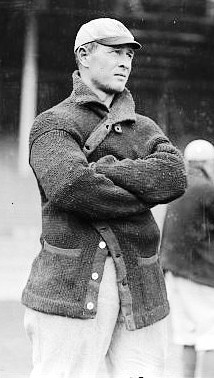
Frank Chance

Johnny Evers was named Cubs manager for the 1913 season—the Cubs again finished third.

From the day Murphy issued his initial statement until Chance died in 1924, “The Peerless Leader” never missed an opportunity to take a shot at Murphy.

When the Cubs were sold to Cincinnati publishing magnate Charles Phelps Taft (President William Howard Taft’s half-brother) before the 1914 season Murphy claimed that he had made more than a half million dollars on the deal.  Chance and former Cubs pitcher Mordecai Brown (who had his own feud who Murphy who released him after the 1912 season, allegedly without giving Brown money he was owed for playing in that year’s “City Series” with the Chicago White Sox) quickly responded.  Both players confirmed what had long been rumored—that Murphy had been bankrolled by Taft who retained a majority of the shares.   Murphy, said Chance, “Never owned more than fifteen or twenty percent of the club stock.”

Both players also charged that Murphy’s treatment of his players was a primary reason for the formation of the upstart Federal League—at best an oversimplification of the conditions which led to Major League Baseball’s last “third league.”

Another Charles Murphy feud later this week.

.
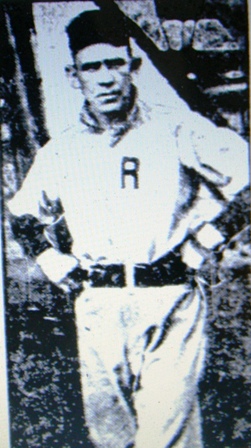
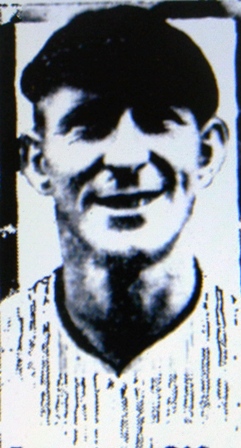
“Champ” Fertsch

5 Oct

A bullet nearly ended Edward “Champ” Fertsch’s career before it really got started.

Fertsch was born in Moorestown, New Jersey (birthplace incorrectly listed as Reading, PA in Baseball Reference) in 1874. The 5’ 10” 175 pound righthander played with the Carlisle Colts of the Cumberland Valley League in 1895, then pitched for Salisbury in the unaffiliated Peach Tree League in Maryland and Taunton in the New England League—records are incomplete or nonexistent for these seasons.

Fertsch joined the Reading Coal Heavers of the Atlantic League in 1898 and played two seasons, winning 14 games in 1899.  In 1900 Fertsch split time between New Castle in the Interstate League and Buffalo Bisons in the then minor league American League.  Fertsch’s contract was purchased by the Brooklyn Superbas, but he never had the opportunity to report the following spring.

That fall Fertsch was hunting with a friend, as the friend climbed a fence his gun discharged and Fertsch was hit the left arm.  Initially the arm was to be amputated, but Fertsch implored doctors to save it.

Assuming his career was over Brooklyn released Fertsch, but he sufficiently recovered to rejoin the Coal Heavers for the 1901 season.

According to the Reading Eagle “Fertsch cannot use the limb very well in delivering or batting, but it does not seem to hinder his twirling.”

“Champ” Fertsch

No records survive for the 1901 season, but Fertsch pitched well enough coming off the shooting to earn another shot in the Eastern League; splitting time with the Providence Grays and the Jersey City Skeeters Fertsch posted a 17-11 record.

Fertsch remained in the Eastern League for the next four seasons (no statistics survive for 1902 or ‘03), after 9-10 and 11-14 seasons in 1904 and ’05, Fertsch played the next four seasons with the Lancaster Red Roses and Reading Pretzels in the Tri-State League.

Again no complete records are available for those years, but Fertsch was frequently referred to in the Eagle as Reading’s and the Tri-State’s “Highest paid professional ballplayer.”

Fertsch was plagued by arm injuries after returning to the Tri-State and retired at the close of the 1909 season.  He became an umpire in the Tri-State League in 1910, but only served for one season because of a league rule change which no longer allowed umpires to be residents of one of the Tri-State club’s cities.

Fertsch again attempted to pitch for Reading in 1911, but only appeared in one game.

After baseball Fertsch was considered one the best bowlers in Pennsylvania.

He died in Reading in 1964.

Superstitions

4 Oct

Baseball history is rife with stories of superstitions, “hoodoo” and all manner of irrational beliefs meant to improve performance and win games.

George Mullin who won more than 200 games in the first two decades of the 20th century, primarily with the Detroit Tigers, was well known to seek things to bring him luck and avoid “hoodoo.”

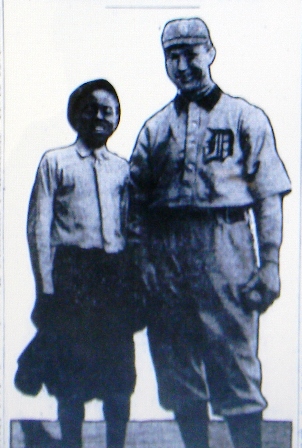
It’s a fairly well-known story that Mullin was one of the Tiger players who believed that team mascot Ulysses Harrison, an orphaned African-American child taken in by Ty Cobb and called “Lil Rastus,” brought him luck.  After Harrison was dismissed as Tiger mascot Mullin was one of the players instrumental in bringing the youth back for the 1909 season, and on at least one occasion “kidnapped” Harrison from Cobb’s room and had him stay in his in order bring him luck on the mound the following day.

Surely Mullin’s 29-8 record in 1909 helped to cement his belief in “luck.”

Tiger mascot Ulysses Harrison with pitcher George Mullin

Another of Mullin’s superstitions is less well known.

According to the Fort Wayne News Mullin was convinced that “For a pitcher to have his mug taken after twirling a winner means a defeat sure in the next game.”

Mullin had very particular rules for having his photo taken:

“If one day is allowed to pass by after the victory the hoodoo is powerless.  By the same token it is safe to have the picture taken just before he starts to pitch.”

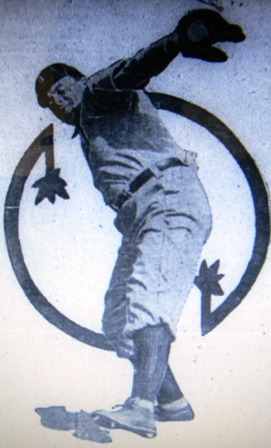
George Mullin, in a photograph presumably not taken the day after a victory.

After retiring in 1915, Mullin became a police officer in Wabash, Indiana and died there in 1944.

Filling in the Blanks—All-Time Great Name Edition

3 Oct

Baseball Reference lists H.A. Magendie as a member of the San Francisco Athletics and San Francisco Californias of the Pacific League in 1878 and the San Francisco Eagles of the Pacific League and San Francisco Californias of the California League in 1879.

Hippolyte Aloise (some public records have his middle name a Aloysius) Magendie was born in Stockton, California in 1856 and graduated from St. Mary’s College of California in 1875.

No records exist for the teams Magendie plated for, but a box score from the San Francisco Chronicle from August of 1878 lists him as a second baseman, and the accompanying article provides a nice example of 19th century baseball writing:

“Magendie hit the leather sphere to between first and second base which was handsomely caught by Daniels with his left hand.”

After his brief baseball career Magendie became a journalist and playwright.  His only surviving work I was able to find is a play entitled “Parents by Proxy, A Comedy-Drama in Four Acts,” a copy of which is in the Library of Congress.

Magendie died in San Francisco on August 8, 1907.

What Happened to Trammell Scott?

2 Oct

Trammell Scott (Incorrectly listed as Trammel in multiple sources) was born in 1886 to a prominent Dalton, Georgia family.  After playing baseball at the University of Georgia, Scott played minor league ball in the south.  He spent time in the Georgia State League, South Atlantic League, and the Carolina Association—he was said to have also played with Houston in the Texas League but no statistics survive.

After his brief playing career Scott was the victim of a near fatal shooting in 1916.  The Atlanta Constitution covered the story closely and reported that Scott, while “In a dying condition,” told his mother “I told you they would get me.”  Trammell recovered, but never identified his assailant and no motive or suspects were ever identified–just 10 days after the shooting Atlanta Chief of Detectives Newport Langford said they were closing their investigation. and according to the Constitution “Leaving the mystery unsolved.”

Scott joined the army in World War I, was decorated for bravery in action and promoted to the rank of Major.

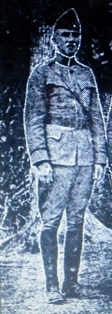
Trammell Scott 1919

Upon returning to Georgia Scott became a well known sportsman.  He was boxing referee and later served on the state boxing commission, owned a sporting goods store, was actively involved in local semi-pro baseball and basketball, and was prominent hunter and breeder of champion bird dogs.

In January of 1938 Scott was named interim President of the Southern Association in a contentious split vote.  At the end of the year he was named President.

In December of 1942 Scott boarded a train in Atlanta to attend the baseball winter meetings in Chicago.  Due to arrive for the league meeting at 4 pm, Scott’s train was delayed.

When the meeting convened without Scott, the owners who opposed his original appointment seized the opportunity.  Thomas Watkins from Memphis, Larry Gilbert of New Orleans, Roy Thompson of Little Rock and Bob Allen of Knoxville led a revolt which was soon joined by Paul Florence of Birmingham.

Within an hour Scott had been voted out and replaced by Billy Evans, a former American League umpire and one time general manager of the Cleveland Indians and Boston Red Sox.  Evans was at the meeting in hopes of landing a different position, but the Southern Association bosses settled on him as the new compromise candidate to run the league.

There was a problem.  No one attempted to reach Scott to inform him of the decision.

That evening, having finally arrived in Chicago, Scott hurried to the National Association dinner meeting of all the league presidents.  Taking his seat, the Associated Press noted “It was a tense moment as (National Association) President William G. Bramham informed Scott the Southern had named a new president.”

Scott said he never saw his dismissal coming and said league owners threw him “A low curve,” by replacing him in the manner they did.

Less than three weeks after his dismissal Scott was turkey hunting on friend’s farm near Newton, Georgia.  After returning for the day, Scott told his friends he was returning to the fields in search of a turkey he had wounded earlier in the day.  The following day Scott was found with a gunshot wound to the chest.

The medical examiner ruled that the wound was self-inflicted but the official ruling said it was “Undetermined whether the shooting was accidental or pre-meditated.”

Many of Scott’s friends said that in spite of being embarrassed by his dismissal he was far from distraught and noted that while being an experienced hunter, Scott was not always careful, “On occasion he was known to have leaned a loaded shotgun against his middle while lighting a cigaret (sic).” This, they speculated, could have caused the type of injury that killed Scott.

Scott was interred at Westview Cemetery in Atlanta—the whole story about two shootings 25 years apart, buried with him.

Jack Ogden

28 Sep

John Mahlon Ogden had limited success in three stints in Major League Baseball, but for an eight year period he was one of the greatest minor league pitchers in history.

Born in 1897, Ogden played baseball at Swarthmore College (where his brother, Major League pitcher Warren “Curly” Ogden also played), and went directly to John McGraw’s New York Giants.  The 20 year old appeared in five games for the Giants before being shipped to the Newark Bears in the International League where he went 5-5 with a 1.48 ERA.  Ogden spent 1919 with the Rochester Hustlers posting a 10-13 record with a 2.37 ERA.

His career took off the next season with the Baltimore Orioles.  The 22 year old Ogden led the International League champions with a 27-9 record—future Hall of Famer Lefty Grove was 12-2 for the O’s that year.  Egan followed that up with an incredible 31-8 record with a 2.29 ERA in 1921.  Beginning on May 10 Ogden won 18 straight decisions, finally losing 3-2 to the Jersey City Skeeters on July 22.  Ogden then won his next five starts.  Baltimore won their third of seven straight IL championships (Grove was 25-10 with a 2.56 ERA).

Over the next six seasons Ogden went 133-63, including a 28-win season in 1925, the last championship in Baltimore’s domination of the International League.

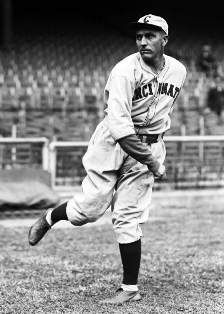
Jack Ogden

Ogden made it back to the Major Leagues with the Saint Louis Browns in 1928 and ’29 where he was a combined 19-24 with an ERA above 4. Ogden was acquired by Cincinnati for the 1930 season, but due to an illness he announced his retirement and took a high school coaching job.

Ogden attempted a comeback in 1931, going a combined 6-10 for the Reds in ’31 and ’32, followed by two more minor league stints with Rochester (after being traded by the Reds to Cardinals) and Baltimore.  He retired for good in 1934 and accepted the position of Vice President and General Manager of the Orioles and became assistant to Philadelphia Phillies President Gerald Nugent in 1939.

In 1941 Ogden bought controlling interest of the Elmira Pioneers in the Eastern League.  His son, John Jr., also a star pitcher and basketball player at Swarthmore, helped Ogden operate the team until he was drafted in 1943.   PFC John Mahlon Ogden Jr. was killed in France on August 8, 1944. Ogden sold the Elmira franchise shortly after his son’s death.

Ogden continued in baseball serving as a scout for a number of teams and managed high school and college teams.  He passed away in 1977 in Philadelphia.

Ogden is a member of the International League Hall of Fame.

Ty Lober

27 Sep

Elmer “Ty” Lober was a long-time minor league player, manager in the Wisconsin State League, served in the Army in WWI and was a central figure in a scandal that briefly rocked the Pacific Coast League in 1914.

In September of 1914 police in Portland, Oregon announced the arrest of four men, and issued a warrant for a fifth.  The men were charged with “Wholesale traffic in school girls between the age of 14 and 16.”

Two of the men arrested were Portland outfielder Lober and third baseman Bobby Davis.  Also arrested were a local jeweler and an actor named Bert Roach (Roach would go on to appear in more than 300 films).  The warrant was issued for Mission Wolves and former Major League pitcher Frank Arellanes.

Early reports indicated that the players had confessed and that there would be several more arrests.  But the “open and shut case” described by West Coast newspapers seemed to quickly fall apart, and concerns about wide spread human trafficking among Pacific Coast League players quickly faded.

Just three weeks after the arrests the grand jury came back with indictments for only two of those arrested; Davis and Arellanes.  The cases against these two quickly fell apart also and all three players were in uniform at the beginning of 1915, Lober and Davis with Portland and Arellanes with Denver in the Western League.

Lober went on to play with Lincoln in the Western League before entering the service in 1918.  He spent 1920 with an independent team in Zanesville, Ohio and was signed to play with the Milwaukee Brewers in the American Association in 1921.  He finished his career with the Little Rock Travelers of the Southern Association in 1925 (he’s misidentified as “Lobar” on Baseball Reference).

Elmer “Ty” Lober

Lober managed and occasionally played for Two Rivers in the Wisconsin State League into the early 30s

He passed away on November 6, 1946 in Two Rivers.

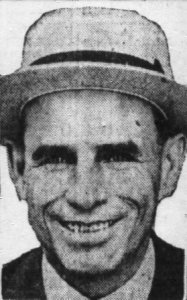
Ollie Pecord

26 Sep

Oliver T. Pecord had a brief minor league career during the last decade of the 19th century, but for a brief time was known around the world for his pivotal role in another sport.

Born April 5, 1869, in Troy, NY, Pecord began his career in 1890 with the Flint Flyers in the Michigan League.  Pecord is credited with a .371 career average, but the available statistics appear incomplete.   For example, several newspaper accounts put Pecord with the Columbus Reds of the Western League in 1892, but there are no surviving statistics for 1892 for Pecord with any ballclub.

pecord

Ollie Pecord

After playing in the Southern Association, Western League and Eastern Iowa League (where he is credited with a .660 average, 31 for 47 in 14 games with Rock Island in 1895) Pecord left professional baseball to focus on boxing.

Pecord was a popular fighter, and while mentioned often for bouts in and around his home in Toledo, he appears to have been a journeyman and unknown outside of Ohio.  In 1900, Pecord turned his attention to work as an umpire for local semi-pro baseball leagues, managing fighters, and serving as a boxing referee.

Pecord went from a local sports figure to being known nationally when, in 1919, he was named as referee of the July 4 fight in Toledo between challenger Jack Dempsey and champion Jess Willard.

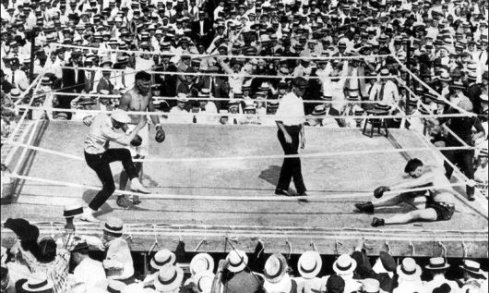
Pecord was at the center of the fight’s two controversies.  The ringside bell had malfunctioned and replaced by a whistle which Pecord, nor anyone else in the crowd, could hear.  Willard, knocked down for the seventh time in that round, was counted out by Pecord who raised Dempsey’s arm, and Dempsey left the ring.  But the round had actually ended at the count of seven; Pecord informed Dempsey’s manager Jack Kearns that the fight was not over and his fighter needed to return to the ring.

Pecord in the ring with Dempsey and Willard

Pecord in the ring with Dempsey and Willard

Willard was unable to answer the bell for the fourth round and Dempsey was declared the winner, but because Willard’s corner did not throw in the towel until after the fourth round had begun, it fell to Pecord to rule exactly when, and how the fight ended.  Two days later Pecord ruled the fight ended by a knockout in the third round.

This was not an insignificant decision because of the huge amount of money wagered on the bout—as an example, it was reported by the Associated Press that a man in Chicago who ran pari-mutual machines and a book on the fight, made $82,500 on the fight; $25,000 more than he would have made if Pecord ruled the fight over in the fourth round.

After the controversy around the fight died down, Pecord returned to relative obscurity nationally, but remained a popular figure in Toledo and served as a fight referee until the mid-thirties when illness forced his retirement.

Pecord died in Toledo on July 1, 1941.  The Toledo Blade called him “(T)he most prominent figure in sports Toledo has ever produced.”

What Would He Think of the Ones They Use Now?

25 Sep

One constant in baseball is that every generation thinks the game was better in the past.

Jake Morse was one of the most influential early baseball writers who contributed to game’s popularity.  He was with the Boston Herald from 1884-1907 and founded Baseball Magazine in 1908.

By 1907 Morse longed for the early days and was bothered by the lack of hitting during the first decade of the 20th century –he blamed it on the baseball mitt:

“There is no doubt that patrons of the national game are becoming heartily sick and tired of the kind of baseball they compelled to see today. ..Who is there who has not noticed game after game how the infielder can block the hottest of driven balls and throw out a man after it?”

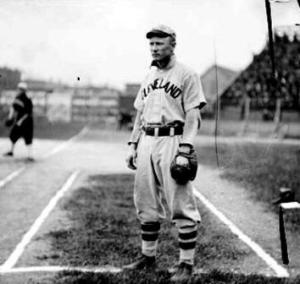
Morse went on to mention a play made by Cleveland Indians shortstop Terry Turner (who, incidentally made 39 errors in 1907):

Turner

Turner

“Turner blocked a ball that he could never have stopped but for the protection he wore on his hands.  Line ball after line ball is blocked and caught by the help of the mitt.”

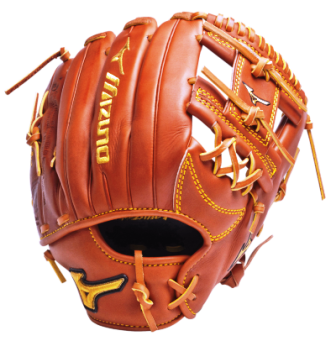
What would Morse make of this?

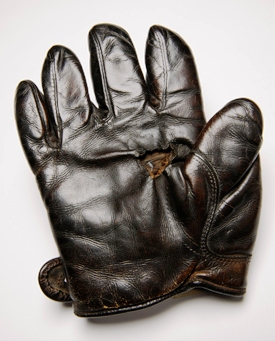
1905 Rube Waddell glove

11-Inning No-Hitter

24 Sep

Harry Wormwood played seven seasons in the New England League with Worcester, Fall River and Portland.  His statistics are incomplete but he was basically a .500 pitcher and weak hitting utility infielder with a fairly uneventful career until June 9, 1910.

Pitching for the Fall River Indians Wormwood pitched an 11-Inning no-hitter against his former team, the Worcester Busters.  Game summaries mention that Fall River did not commit any errors, but don’t say whether Wormwood walked any batters.

The Eastern press couldn’t ignore the fact that just one year earlier in the Bluegrass League Fred Toney of the Winchester Hustlers had thrown a 17-inning no-hitter against the Lexington Colts, so the papers referred to Wormwood’s feat as “The Eastern record for a no-hit game.”

Toney of course would become famous for another no-hitter in 1917 when he was with the Cincinnati Reds—he and Chicago Cubs pitcher Jim “Hippo” Vaughn hooked up in one of baseball’s greatest pitching duels, with neither allowing a hit through nine innings.  Vaughn would allow a hit in the 10th and lose the game 1-0.

But back in 1910 Toney was not well known and was referred to in the New York Times and other papers simply as “Pitcher Torrey (sic) of Winchester, KY,” in the coverage of Wormwood’s no-hitter.

The following season Wormwood nearly duplicated his feat.  He held the Lawrence Barristers hitless for 10 2/3 innings; Wormwood gave up three straight singles in the 11th, but retired the side without giving up a run.  He held Lawrence hitless for two more innings and the game ended in a 0-0 tie after 13 innings.  1911 was Wormwood’s best season, he posted a 20-15 record and hit .289.

Harry Wormwood, from a picture of his high school football team in Auburn, ME

Wormwood finished his career with the Portland Duffs in 1913—newspaper reports from 1914 and 1915 say he spent time with the Lewiston Cupids in the New England League and the Hartford Senators in the Colonial League, but there are no records to confirm this.

Wormwood passed away January 9, 1955 in Auburn, Maine.