Charlie Dexter, and the Other Charlie Dexter

14 Aug
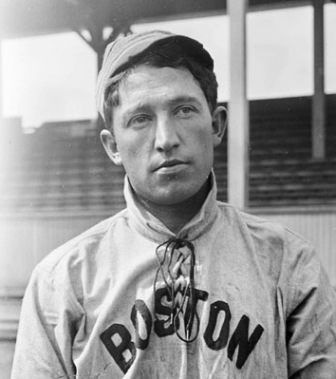
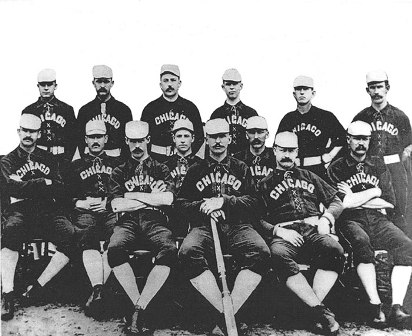
Last week I told you about Charlie Dexter, former major leaguer, and one of the heroes of Chicago’s Iroquois Theater fire.  Not to be confused with the other Charlie Dexter, a minor league outfielder and first baseman of the same era.  The two were often conflated in contemporary newspaper accounts.

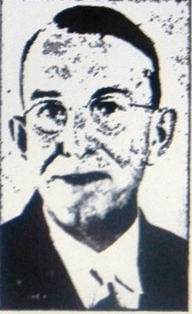
Charlie Dexter

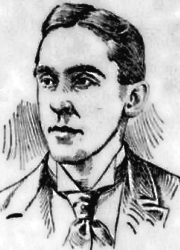
The other Charlie Dexter, the career minor leaguer (1904-09), was born Oscar Schoenbecker in Ohio and was killed in a hunting accident in November of 1909 in Mount Holly, Ohio.  According to his obituary, in The Cincinnati Commercial Tribune he changed his name “fearing the jests of the old people in case he failed,” as a player.

Reading contemporary accounts of the major league Charlie Dexter is a study in dichotomies.  A year and a half before his heroics at the Iroquois theater were recounted in papers across the country, numerous papers echoed the sentiments of the Pittsburgh Press that Dexter’s release by Chicago had more to do with his being a “trouble maker” than his .227 average.

Numerous stories over the years hinted, or outright said that Dexter, like many players of the era, had a serious drinking problem. He was released by Boston after the 1903 season and returned to the minor leagues for the first time since 1895.
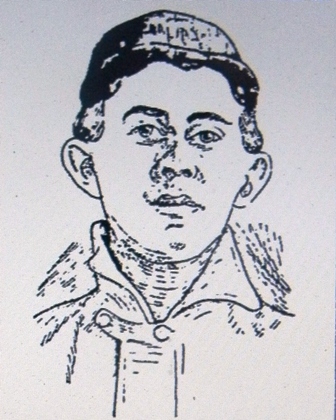
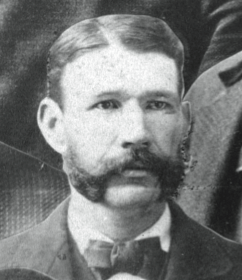
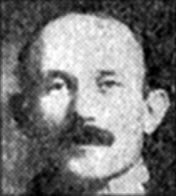
The end of line seemed to come in October of 1905 in Des Moines, when during what was described as a “Drinking binge” Dexter stabbed his friend, Milwaukee first baseman Henry “Quait” Bateman.  The earliest reports from Iowa papers and wire services said Bateman was either dead or near death and that “(Dexter) slashed Bateman across the breast, the blade cutting into the lung.”

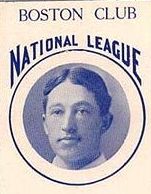
Quait Bateman

Dexter was immediately arrested.  But within days the wire services were reporting that Bateman was not seriously injured and had refused to file charges.  Dexter was released from custody.  Other players who were present (none were named is stories) “Dexter and Bateman are on the best of terms and that their little quarrel had done nothing to mar their friendship.”  Without Bateman’s cooperation, a grand jury elected not to indict Dexter.

He played two more seasons in Des Moines, taking over as manager from Mike Kelly 20 games into the 1907 season and managing the team through 1908.

Dexter stayed in Iowa and was occasionally mentioned in local papers over the next few years in connection with amateur and semi-pro leagues.  Dexter shot himself in 1934 in Cedar Rapids, Iowa.  Bateman Died in Milwaukee on January 18, 1937.

One more story about the aftermath of the Bateman stabbing next week.
“King of the Sandlots”

13 Aug

Not every baseball legend had a long professional career.

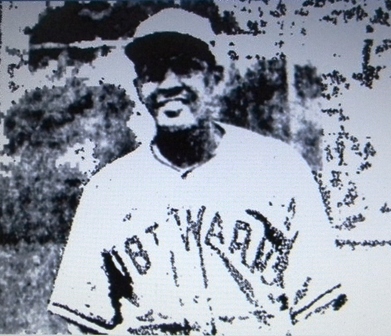
“King of the Sandlots” and “Pittsburgh’s Satchel Paige” is what they called Ralph “Felix” Mellix when the former Negro League and barnstorming pitcher announced his retirement from the Semi-pro 18th Ward Team in Pittsburgh’s South Hills League.  Mellix retired every year for a decade only to return again the next season until he was 60.

Ralph “Felix” Mellix

 Almost all of the statistics compiled by Mellix are lost to history, “officially” Mellix appeared in two professional games in his late 30s, one for the Newark Dodgers in 1934 and another the following season for the Homestead Grays, posting an undistinguished ERA of 12.54. Mellix was said to have spent short stints with the Chicago American Giants in 1915 and the Pittsburgh Crawfords in the early 30s, where he was said to be Paige’s roommate, but no records exist of his time with either team.  He pitched for the Crawfords a few times in the 40s in exhibition games, including one against the Chicago Brown Bombers in Milwaukee in 1944.

Like many African American players who began their careers during the first two decades of the twentieth century, Mellix barnstormed and played semi-pro ball for most of his career.  Mellix toured with Jesse Owens when the Olympic Heroes’ was barnstorming with his Toledo Crawfords in 1939.

Born in Atlantic City, New Jersey in 1896, Mellix began playing for his father’s Mellix A.C. Stars semi-pro team at 12 years old.  Mellix began his career as a pitcher in 1915 and spent the next 40 years pitching in an estimated 1500 games, winning more than 600 according to James A. Riley in his book The Biographical Encyclopedia of the Negro League Baseball Leagues.

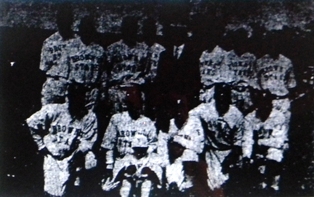
Mellix starred for the powerful Brown’s Colored Stars team in Youngstown Ohio during the mid-20s, sharing mound duties with George Brannigan and Admiral Walker, who also had short professional careers in Negro League baseball.

Brown’s Colored Stars 1924

At the close of his semi-pro career in Pittsburgh, Mellix continued to barnstorm, billing himself as “Baseball’s Oldest Pitcher,” including an appearance with Paige at Forbes Field in 1965 when Paige was traveling with the New York Stars.

Mellix will never haves a bust in Cooperstown, but the Hall of Fame does include his papers and mementos, including a 1946 contract offer from the Brooklyn Brown Dodgers, Joe Hall’s Hillsdale Club transplanted to Brooklyn at the behest of Branch Rickey.  Mellix, employed by the city of Pittsburgh, said he didn’t want to jeopardize his pension to play pro ball at 49 years of age.

Mellix remained a legend in Pittsburgh until his death on March 23, 1985.

The Quarter Million Dollar Wrist Injury

10 Aug

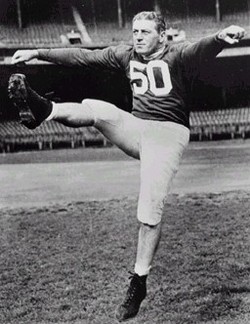
Ken Strong was a Hall of Fame running back and kicker for 12 seasons in the NFL, and the hero of the 1934 Championship game when he scored 17 points in the New York Giants 30-13 win over the Chicago Bears.  The aftermath of a wrist injury prevented him from starring in the major leagues as well.

Elmer Kenneth Strong Jr. was born March 21, 1906 (Baseball Reference incorrectly lists his birth as August 6, and his name as Kenneth Elmer).  A football and baseball star at New York University, Strong played the 1929 season at New Haven in the Eastern League before joining the NFL’s Staten Island Stapleton’s in September.

Ken Strong

In 104 games at New Haven Strong hit .283 with 21 home runs. After hitting .272 in 27 games at New Haven in 1930, he was sent to Hazleton in the New York Penn League.  Strong hit .373 with 41 home runs in 117 games at Hazelton.  Headlines that referred to Strong as the “New Babe” were greatly exaggerated given that 39 of his 41 home runs were hit at Hazleton’s Buhler Stadium, the smallest ballpark in organized ball in 1930.  Regardless, he was considered a top prospect and his contract was purchased by the Detroit Tigers who sent him to Toronto in the International League in 1931.

At Toronto he was batting .340 through 118 games when he broke his wrist.  Strong underwent a surgical procedure in Detroit which included the removal of part of his wrist bone and was limited to kicking during the 1931 NFL season.

Strong was given a good shot at making the Tigers opening day roster, but was slow to recover from the surgery.  When the Tigers sent Strong to New York for a second surgery it was discovered that the wrong bone had been removed during the first procedure, permanently damaging Strong’s wrist.

In 1933 Strong sued the doctor for $250,000, the equivalent of more than $4.4 million today.  Strong claimed the surgery robbed him of the opportunity to play major league ball and limited his ability in the NFL.

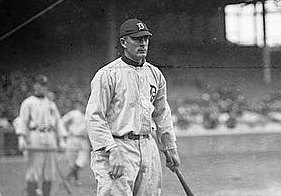
The trial featured former Tigers star Bobby Veach demonstrating to Federal Judge Ernest O’Brien “that good wrist action was essential in baseball.

Bobby Veach

Strong was awarded $75,000 and the verdict was upheld on a later appeal.

While Strong continued to play in the NFL through 1935, and again in 1939 and 1944-47, his baseball career was over. He attempted to come back in 1935, signing with the Brooklyn Dodgers, but was released before the season began.

Elected to the Pro Football Hall of Fame in 1967, Strong died in New York City on October 5, 1979.

Assumed Names

9 Aug

In the early days of baseball assumed names were common; either to avoid the stigma of being a professional baseball player—not the top of the social strata of 19th and early 20th century America–to avoid the law, or to jump a contract.  Or sometimes just because.

William McGill, listed as simply McGill on Baseball Reference, is one such case.  McGill, a  pitcher and outfielder with the 1901 Reading team in Pennsylvania State League was, as theReading Eagle reported “Born Sauers and Christened John Sauers.  Someone nicknamed him William McGill and he has gone by that name on the diamond.”

McGill was born in Reading in 1878 or ’79 and was a well known amateur and semi-pro player in the Reading area, hardly the candidate for an assumed name in his home town.

John Sauers/William McGill

Newspaper accounts seem to indicate that McGill is the same William McGill who played briefly in the Texas League the following season.

The trail of Sauers/McGill goes cold after 1902.

Filling in the Blanks-J Palatas

8 Aug

Baseball Reference lists J Palatas as an outfielder for the 1942 Washington Red Birds in the Pennsylvania State Association, hitting .278 in 107 games.

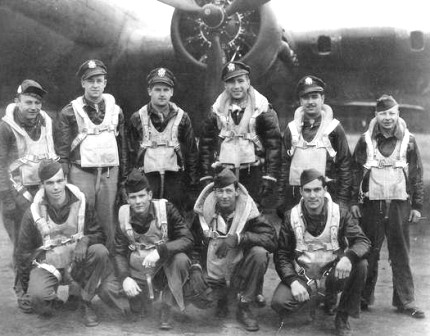
Joseph M. Palatas, a Cleveland native, born in 1921, entered the service in September of 1942 and served as a Flight Officer with the 325th Bomb Squadron.

Joseph Palatas, standing third from left

On April 11, 1944 Palatas was wounded when his plane was shot down over Germany.  He managed to bail out with the rest of his crew despite being badly injured.  Palatas was captured and died of his injuries the same day.

Heroes of the Iroquois Fire

7 Aug

The deadliest single-building fire in US history took place at the Iroquois Theater on Randolph Street in Chicago, December 30, 1903.  The  “absolutely fireproof” theater, as it was billed, caught fire just six weeks after opening.

At least 605 people died, although the actual number has never been confirmed.

Two heroes that day, credited with saving numerous lives, were former Chicago ballplayers.

Charlie Dexter, who played with Boston in 1902 and 03 after being released by the Orphans in July 1902, and John Franklin Houseman who had played for Chicago and St. Louis is the 1890s, were seated together in a box with their families when the fire broke out.

Charlie Dexter

The fire, ignited by a malfunctioning stage light, spread quickly and the estimated 2000 people in the audience panicked.

Contemporary newspaper accounts highlighted the heroics of three individuals in particular: Actor Eddie Foy, who stayed on the stage trying to calm the panicked crowd until finally escaping through a sewer, and the two ballplayers.

Several people had already jumped from the balconies as the fire spread, and Dexter and Houseman were credited with having forced open two doors on the north side of the theater and clearing away bodies to create a path to the exit.  When they were finally forced by the flames to leave their stations at the doors, where both stayed to usher people out, Houseman caught a woman jumping from a window in the theater’s gallery to the alley below.  According to reports, she was uninjured.

John Franklin Houseman

Both Dexter and Houseman downplayed their roles in the aftermath of the fire and credited Foy with “Saving hundreds of lives,” but their heroism likely saved as many lives and has, for the most part, been forgotten.

Houseman, born January 10, 1870, was the first Dutch-born major league ballplayer, he died November 4, 1922 in Chicago.

More on Charlie Dexter next week.

Before Pete Gray

6 Aug

Pitcher Hugh Daily in the 1890s and outfielder Pete Gray in the 1940s are the only two men to play major league baseball with one arm, but they are not the only two to play professionally.

Hugh Daily

Hugh Daily

Twenty-five years before Pete Gray made his debut with Trois-Rivers in the Canadian-American League another outfielder who lost an arm to a childhood accident played professional baseball.

William P. “Bill” White was born in 1891 in Grantville, Georgia, and lost his right arm to a gun accident at age 13.  White played baseball and football at Mercer University in Macon, Georgia.

After college, White played for the 1917 Anniston Moulders in the Georgia-Alabama League.  While Baseball-Reference does not note White’s time at Anniston, showing only 2 players on the roster (Guy Lacy and Johnny Morrison), White’s time with the team is detailed in contemporary newspapers.

William P. “Bill” White

There are no official statistics available for White’s performance.  Some newspaper accounts labeled him “A fair hitter,” while other, much later accounts said, “His batting average was well above the .300 mark.”

After his year at Anniston, White played semi-pro ball and umpired until being named head coach at the University of Georgia in 1921.  White managed the Bulldogs until 1933 compiling a 224-100-7 record and was named conference coach of the year in 1933.  White also managed the Columbus Foxes in the Southeastern League from 1928-1930.

White went to work for the Georgia Secretary of State and ran unsuccessfully for office in 1940, but maintained his interest in baseball.

In 1937 White put together a “One-armed baseball team” which played about 100 games with semi-pro teams around the south.  With the exception of the catcher, third baseman, and first baseman, White’s team was made up of players with one arm.  The pitcher, Orville Paul was said by Branch Rickey to be good enough to win in any Class A league.

White died in Rome, Georgia on January 22, 1947.

While neither played pro ball, two other players with one arm made headlines playing college baseball between 1910 and 1920.  Outfielders Dick Hooper of Texas and Eddie Ash of Wabash were both highly touted players, but neither made the jump to pro ball.

eddieash

Murdered by an Actor

3 Aug

In 1905 Arthur Brown was a promising first baseman from Wilkes-Barre PA.  He had been discovered by Walter Burnham who managed east coast minor league teams for more than 20 years.  After spending the ’05 season with his hometown team in the New York State League.

He played for Burnham with Newark in the Eastern League the following season, and despite a .235 average he was purchased by the Detroit Tigers and then sold to Montreal.  After a .239 season with Montreal in the Eastern League and a spring training Trial with the St. Louis Browns, Brown played for Milwaukee in the American Association in 1908, hitting .192.  In 1909 he played for Trenton in the Tri State League and moved on to Albany in the New York State League in 1910.

On June 15 of 1911 Brown was in his second season with Albany, hitting .187.  He was living in Albany with an actress named Mildred Barre; the problem was she was still married to an actor from New Orleans named John V. McStea.  McStea entered the house on Pearl Street  in Albany and after being hit by Brown pulled a revolver and shot the 1st baseman four times.  Brown died that night.

McStea was convicted the following year, his wife testified for the prosecution.

“The Greatest Play Ever Made”

2 Aug

Most fans know that the first confirmed major league unassisted triple play was turned by Neal Ball of the Cleveland Naps July 19, 1909, and that one credited to Paul Hines of the Providence Grays against the Boston Red Caps May 8, 1878 has been disputed.

What most don’t know is that the first confirmed unassisted triple play in professional baseball was turned on August 18, 1902 by Hal O’Hagan of Rochester in an Eastern League game in Jersey city, New Jersey.  The New York Times called it “The Greatest Play Ever Made in Baseball.”

Patrick Henry “Hal” O’Hagan had two brief stays in the major leagues.  He played in one game as a twenty-two-year-old rookie with Washington in 1892, and trials with Chicago and New York in the National League and Cleveland in the American League in 1902.

After being released by the Giants in mid-July, O’Hagan was signed by Rochester to manage and play first base.

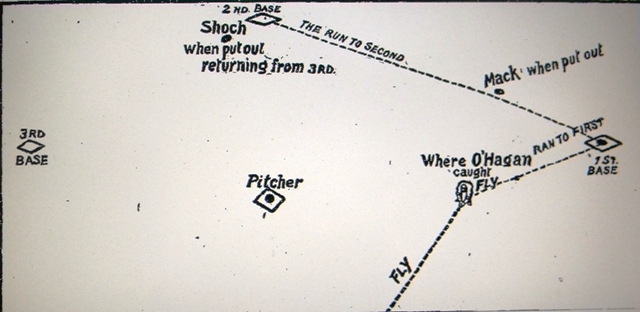
John Butler was batting for Jersey City with George Shoch on second and “Mack” on first (every contemporary newspaper account identified the runner on first this way, it was probably catcher/1st baseman Frank McManus).  Butler attempted a sacrifice bunt as The Times reported “O’Hagan ran in and caught the ball within a few inches of the ground, a seemingly impossible catch.”

According to the glowing account: “Having in his quick-thinking mind the possibility of a triple play, O’Hagan, with the coolness and agility which are part of a baseball player’s earning capacity, ran back and placed his foot on the initial bag thus completing a double play.”  O’Hagan then ran to second as Shoch returned from third, “It was a hot race, but O’Hagan, ball in hand, reached the bag first, thus dismissing the side.”

Diagram of the play published in The New York Times and several newspapers across the country

O’Hagan continued playing until 1908, finishing his career with Lynn in the New England League.  He passed away on January 14, 1913 in Newark, New Jersey at 43 years old.

Professional Baseball’s Last HBP Death

1 Aug
On June 2, 1951 at Peanut Stadium in Headland, Alabama, John Ottis Johnson an outfielder with the Dothan Browns of the Alabama-Florida League stepped to plate with 10 home runs and a .394 average in 155 at bats. The pitcher for the Headland Dixie Runners, Harry Repard “Jack” Clifton had just returned to professional baseball after an eight year layoff. Clifton had been a good hitting outfielder and occasional pitcher from 1940-43 playing in the Coastal Plaines, Bi-State and Piedmont Leagues.

Johnson was born April 5, 1923 (incorrectly listed as 1926 on Baseball Reference) in Alabama and was in his second season with Dothan, having hit .313 the previous year. His brother Edsel, who was attending the game that evening, had played for Brewton in the Alabama State League in 1948.

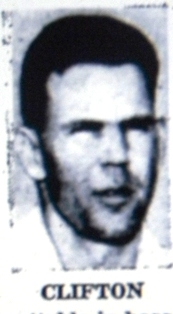
Clifton threw an inside fastball that froze Johnson and he was struck in the head, fracturing his skull. Johnson, who was a high school teacher in Midland City, Alabama, never fully regained consciousness and died eight days later. He left a wife and child. It was the last instance of a player being killed by a pitched ball in professional baseball.

Jack Clifton

The fallout from Johnson’s death nearly resulted in the folding of the Alabama-Florida League. Dothan owner Charles Smith forfeited two games against Headland in the following weeks when Clifton was slated to pitch. The franchises in Ozark, Panama City and Enterprise threatened to pull out of the league and form a four team league with Dothan if Headland did not release Clifton and suspend manager Bubba Ball. Johnson’s wife supported Clifton, telling reporters “We’re willing to forget the accident, the rest of the people ought to be broad minded enough to do the same.”

As negotiations continued to keep the league intact, Clifton continued pitching. As late as June 30 newspapers were reporting the league would fold, but on July 5 an agreement was finally reached that allowed Clifton to continue pitching and kept the league intact.